Question 15 Marks
Draw the graph of the equation $2x + y = 6.$ Shade the region bounded by the graph and the coordinate axes. Also, find the area of the shaded region.
Answer
View full question & answer→We have, $2x + y = 6$
$⇒ y = 6 - 2x ...(i)$
Putting $x = 3$ in $(i),$
we get $y = 6 - 2 × 3 = 0$
Putting $x = 0$ in $(i),$
we get $y = 6 - 2 × 0 = 6$
Thus, we obtain the following table giving coordinates of two points on the line represented by the equation $2x + y = 6.$
The graph of line $2x + y = 6:$ 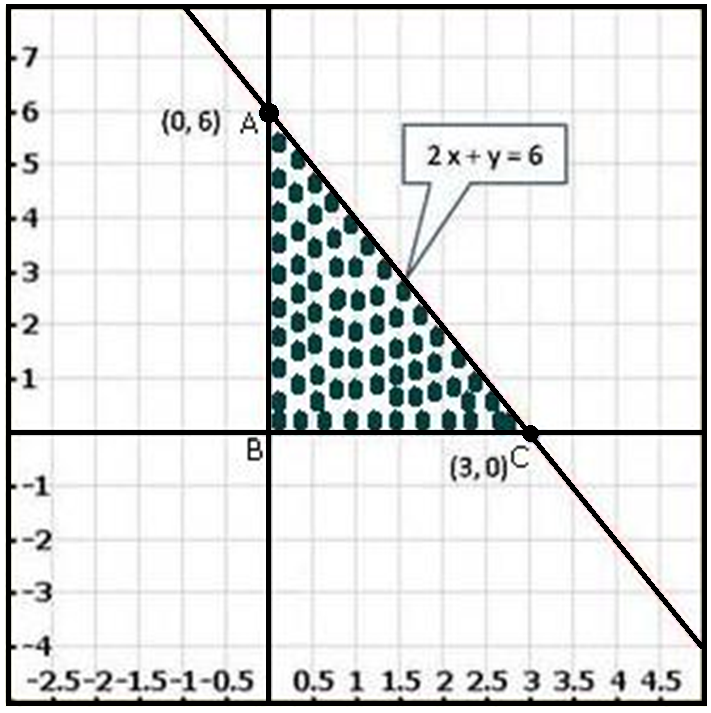 The area enclosed by the graph of line and the coordinate axes is shaded in the graph Now, Required area $=$ Area of the shaded region
$⇒$ Required area $=$ Area of $\triangle\text{ABC}$
$⇒$ Required area $=\frac{1}{2}(\text{Base}\times\text{Height})$
$⇒$ Required area $=\frac{1}{2}(3\times6)$ =9sq. units.
$⇒ y = 6 - 2x ...(i)$
Putting $x = 3$ in $(i),$
we get $y = 6 - 2 × 3 = 0$
Putting $x = 0$ in $(i),$
we get $y = 6 - 2 × 0 = 6$
Thus, we obtain the following table giving coordinates of two points on the line represented by the equation $2x + y = 6.$
|
$X$
|
$3$
|
$0$
|
|
$y$
|
$0$
|
$6$
|
The area enclosed by the graph of line and the coordinate axes is shaded in the graph Now, Required area $=$ Area of the shaded region$⇒$ Required area $=$ Area of $\triangle\text{ABC}$
$⇒$ Required area $=\frac{1}{2}(\text{Base}\times\text{Height})$
$⇒$ Required area $=\frac{1}{2}(3\times6)$ =9sq. units.