Questions

5 Marks Questions

Take a timed test

9 questions · self-marked practice — reveal the answer and mark yourself.

Question 15 Marks
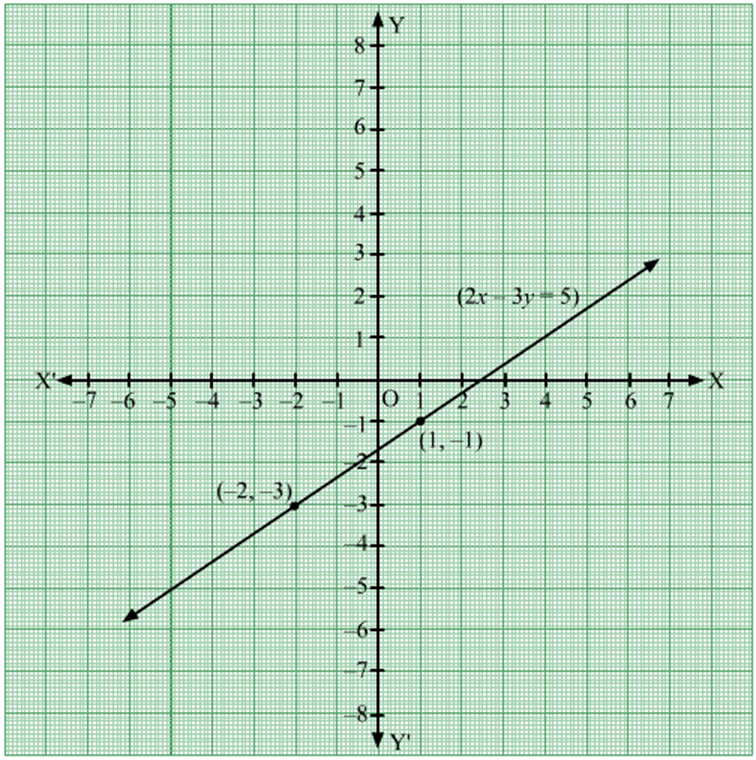
Draw the graph of the equation $2x - 3y - 3 = 5$.From your graph, Find:
$i.$ The value of $y$ when $x = 4$
$ii.$ The value of $x$ when $y = 3$.
Answer
Given equation:$2\text{x}-3\text{y}-3=5$
$\Rightarrow2\text{x}=3\text{y}+5$
$\Rightarrow\text{x}=\frac{3\text{y}+5}{2}$
When, $\text{y}=-1,$$\text{x}=\frac{-3+5}{2}$
$\Rightarrow\frac{2}{2}=1$
When, $\text{y}=-3$$\text{x}=\frac{-9+5}{2}$
$\Rightarrow\frac{-4}{2}=-2$
Thus, we have the following table:
$x$ $1$ $-2$
$y$ $-1$ $-3$
plot the points $(-2, -3), (1, -1)$ on the graph paper and extend the line both directions.
$i.$ When, $x = 4$:
$4=\frac{3\text{y}+5}{2}$
$\Rightarrow8=3\text{y}+5$
$\Rightarrow3\text{y}=8-5=3$
$\Rightarrow3\text{y}=3$
$\Rightarrow\text{y}=1$
$ii.$ When, $y = 3$:
$\text{x}=\frac{3\text{y}+5}{2}$
$\Rightarrow\frac{14}{2}=7$
View full question & answer
Question 25 Marks
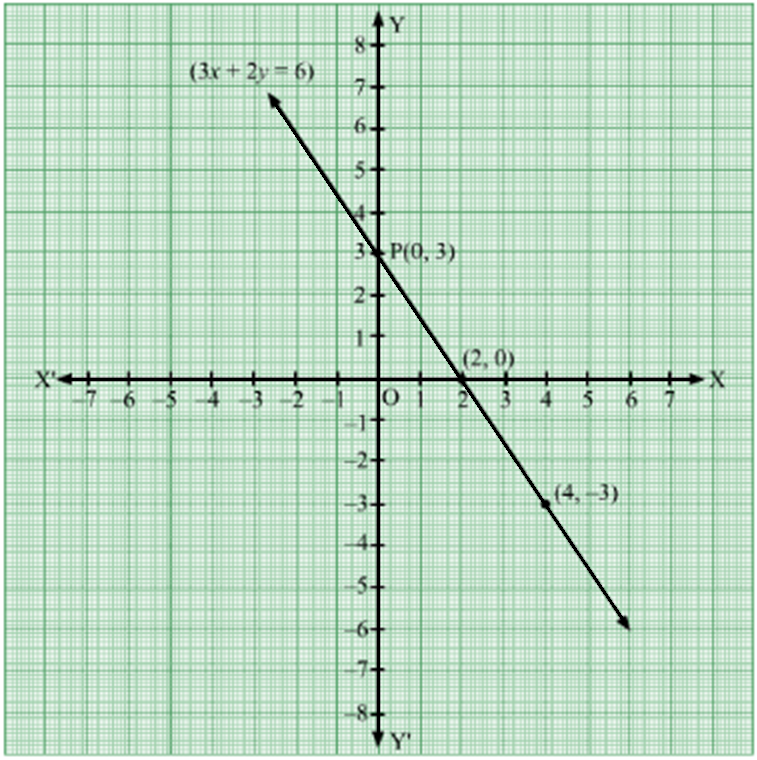
Draw the graph of the equation, $3x + 2y = 6$. Find the coordinates of the point where the graph cuts the $y$-axis.
Answer
Given equation:$3\text{x}+2\text{y}=6.$
Then,$2\text{y}=6-3\text{x}$
$\Rightarrow\text{y}=\frac{6-3\text{x}}{2}$
When, $\text{x}=2,\ \text{y}=\frac{6-6}{2}=0$ When, $\text{x}=4,\ \text{y}=\frac{6-12}{2}=-3$ Thus, we get the following table:
x
$2$
$4$
y
$0$
$-3$
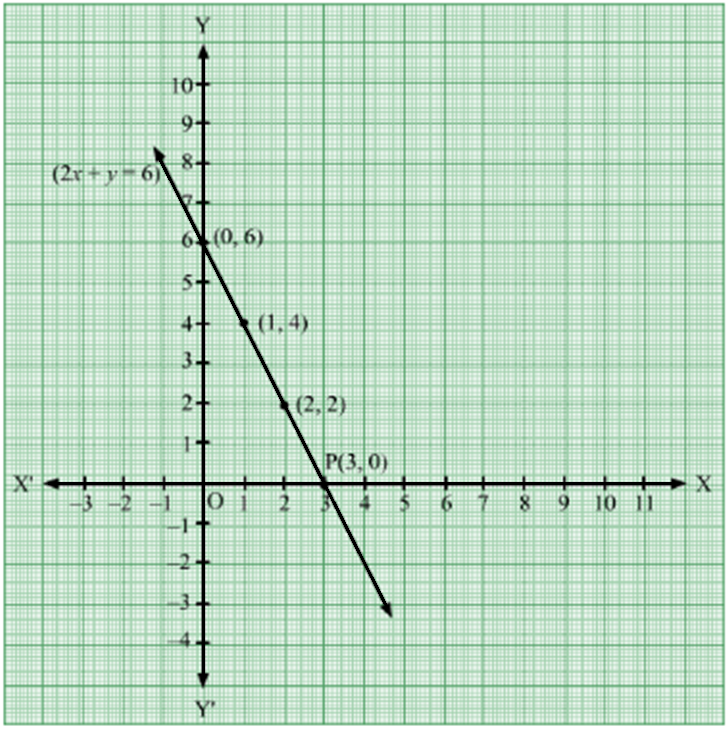
plot the points $(2, 0), (4, -3)$ on the graph paper. join the points and extend the graph in both the directions. Clearly, the graph cuts the $y$-axis at $p(0, 3)$.
View full question & answer
Question 35 Marks
Draw the graph of the equation, $2x + y = 6$. Find the coordinates of the point where the graph cuts the $x$-axis.
Answer
$2x + y = 6 \Rightarrow y = 6 - 2x$ When, $x = 0, y = 6 - 0 = 6$ When. $x = 1, y = 6 - 2 = 4$ When, $x = 2, y = 6 - 4 = 2.$
x
$0$
$1$
$2$
Y
$6$
$4$
$2$
plot the point $(0, 6), (1, 4)$ and $(2, 2)$ on the graph paper. Join these points and extend the line.
View full question & answer
Question 45 Marks
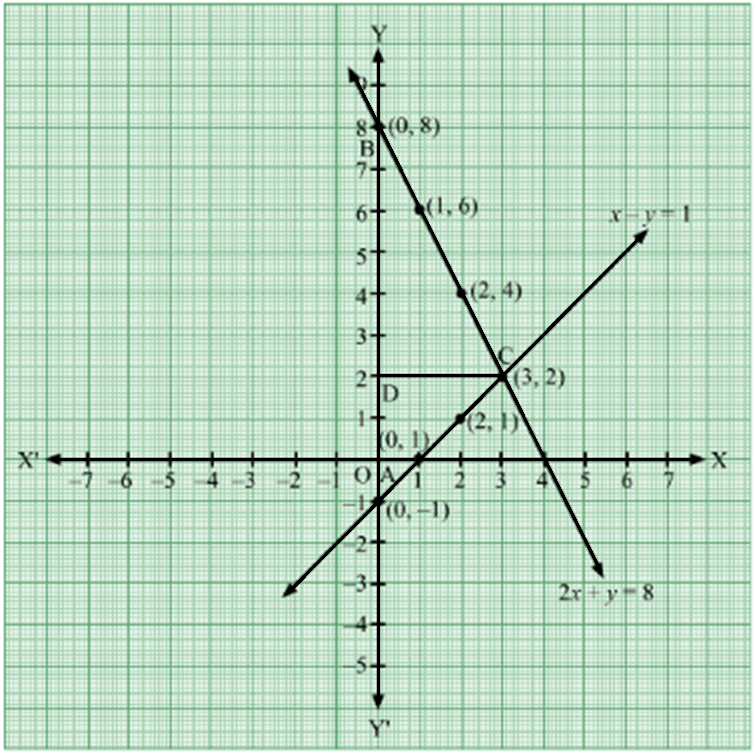
Draw the graphs of the lines $x - y = 1$ and $2x + y = 8$. Shade the area formed by these two and the $y$-axis. Also, find this area.
Answer
$x - y = 1\Rightarrow y = x - 1$
When $x = 0, y = 0 - 1 = -1$
When, $x = 1, y = 1 - 1 = 0$
When $x = 2, y = 2 - 1 = 1$
Thus, the points on the line $x - y = 1$ are as given in the following table:
x
$0$
$1$
$2$
y
$-1$
$0$
$1$
Plotting the points $(0, 1), (1, 0)$ and $(2, 1)$ and drawing a line passing through these points, we obtain the graph of the line $x - y = 1$.
$2x + y = 8$
$\Rightarrow y = -2x + 8$
When, $x = 1, y = -2 × 1 + 8 = -2 + 8 = 6$
When, $x = 2, y = -2 × 2 + 8 = -4 + 8 = 4$
When, $x = 3, y = -2 × 3 + 8 = -6 + 8 = 2$
Thus, the points on the line $2x + y = 8$ are as given in the following tabel:
x
$1$
$2$
$3$
y
$6$
$4$
$2$
Plotting the points $(1, 6), (2, 4)$ and $(3, 2)$ and drawing a line passing through these points, we obtain the graph of the line $2x + y = 8$.

The shaded region represents the area bounded by the lines $x - y = 1$, $2x + y = 8$ and the $y$-axis. This represents a triangle.
It can be seen that the lines intersect at the point $C(3, 2)$. Draw $CD$ perpendicular from $C$ on the $y$-axis.
Height = $CD = 3$ units
Base = $AB = 9$ units
$\therefore\ $Area of the shaded region = Area of $\triangle\text{ABC}=\frac{1}{2}\times\text{AB}\times\text{CD}=\frac{1}{2}\times9\times3=\frac{27}{2}$ square units.
View full question & answer
Question 55 Marks
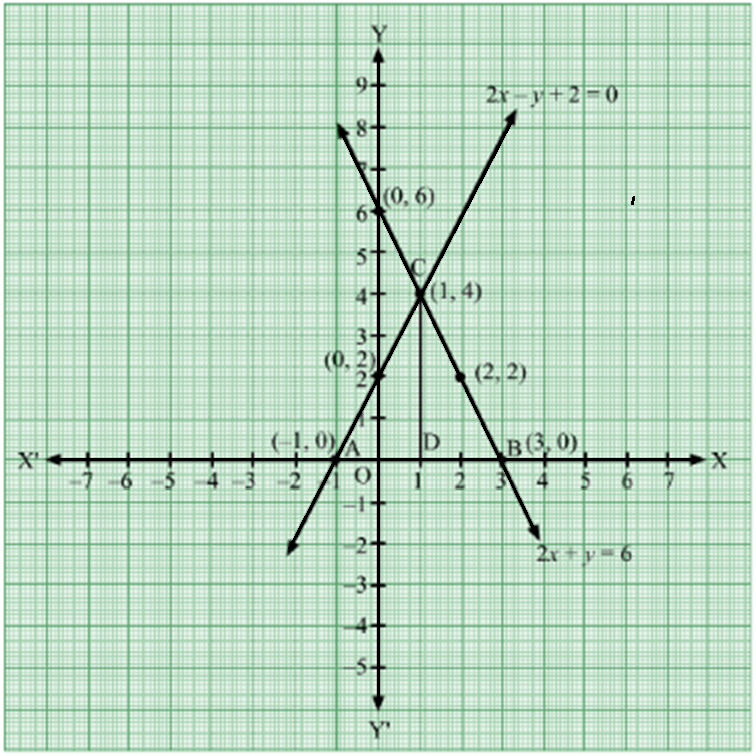
Draw the graph of the lines $2x + y = 6$ and $2x - y + 2 = 0$. Shade the region bounded by these lines and the $x$-axis. Find the area of the shaded region.
Answer
$2x + y = 6 $
$\Rightarrow y = -2x + 6$
When, $x = 0, y = -2 × 0 + 6 = 0 + 6 = 6$
When, $x = 1, y = -2 × 1 + 6 = -2 + 6 = 4$
When, $x = 2, y = -2 × 2 + 6 = -4 + 6 = 2$
Thus, the point on the line $2x + y = 6$ are as given in the following tabel:
x
$0$
$1$
$2$
y
$6$
$4$
$2$
Plotting the pints $(0, 6), (1, 4)$ and $(2, 2)$ and drawing a line passing through these points,
we obtain the graph of the line $2x + y = 6$. $2x - y + 2 = 0 \Rightarrow y = 2x + 2$
When, $x = 0, y = 2 \times 0 + 2 = 0 + 2 = 2$
When, $x = 1, y = 2 \times 1 + 2 = 2 + 2 = 4$
When, $x = -1, y = 2 \times (-1) + 2 = -2 + 2 = 0$
Thus, the points on the line $2x - y + 2 = 0$ are as given in the following tabel:
x
$0$
$1$
$-1$
y
$2$
$4$
$0$
Plotting the points $(0, 2), (1, 4)$ and $(-1, 0)$ and drawing a line passing through these points, we obain the graph of the line $2x - y + 2 = 0$. The shaded region represents the area bounded by the linces $2x + y = 6, 2x - y + 2 = 0$ and the $x$-axis.
This represents a triangle. It can be seen that the lines intersect at the point $c(1, 4)$.
Draw $CD$ perpendicular from $C$ on the $x$-axis.
Height $= CD = 4$ units Base $= AB = 4$ units
$\therefore\ $Area of the shaded region = Area of $\triangle\text{ABC}=\frac{1}{2}\times\text{AB}\times\text{CD}=\frac{1}{2}\times4\times4=8$ square units.
View full question & answer
Question 65 Marks
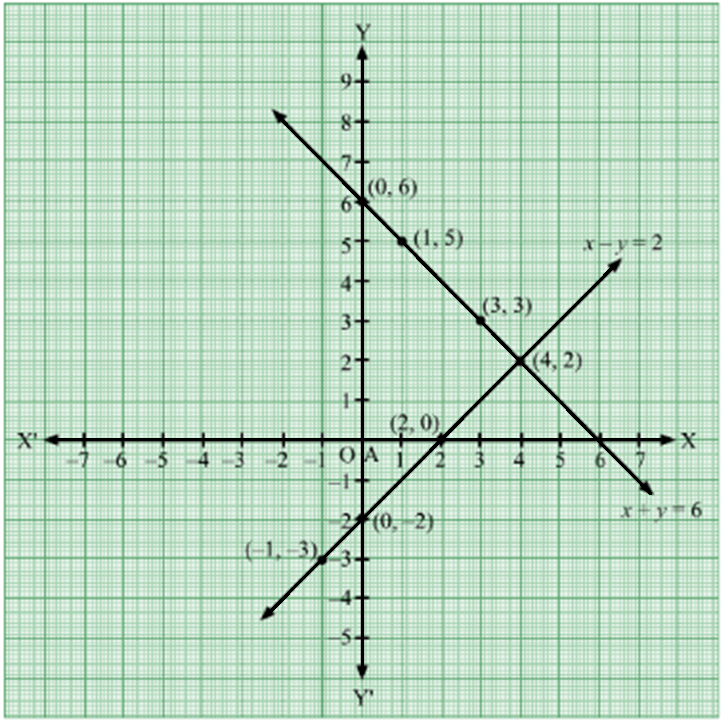
Draw the graph for each of the equations $x + y = 6$ and $x - y = 2$ on the same graph paper and find the coordinates of the point where the two straight lines intersect.
Answer
$x + y = 6$
$\Rightarrow y = -x + 6$
When $x = 0, y = -0 + 6 = 6$
When, $x = 1, y = -1 + 6 = 5$
When, $x = 3, y = -3 + 6 = 3$
Thus, the points on the line $x + y = 6$ are as given in the following table:
x
$0$
$1$
$3$
y
$6$
$5$
$3$
Plotting the points $(0, 6), (1, 5)$ and $(3, 3)$ and drawing a line passing through these points.
we obtain the graph of the line $x + y = 6. x - y = 2 \Rightarrow y = x - 2$
When $x = 0, y = 0 - 2 = -2$
When $x = 2, y = 2 - 2 = 0 $
When $x = -1, y = -1 - 2 = -3$ Thus, the points on the line $x + y = 6$ are as given in the following table
x
$0$
$2$
$-1$
y
$-2$
$0$
$-3$
Plotting the points $(0, -2), (2, 0)$ and $(-1, -3)$ and drawing a line passing through these points, we obtain the graph of the line$ x - y = 2$.
It can be seen that the lines $x + y = 6$ and $x - y = 2$ intersect at the point $(4, 2)$.
View full question & answer
Question 75 Marks
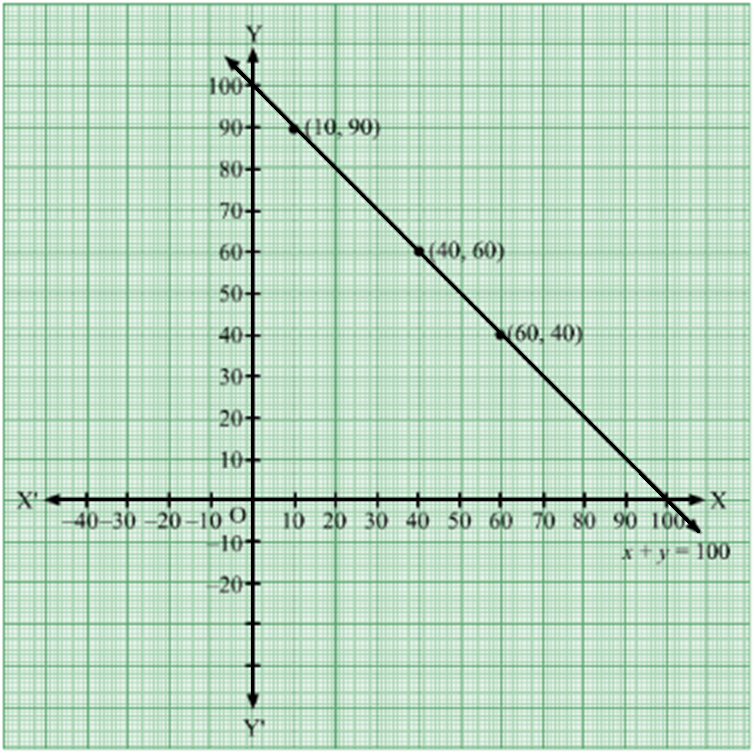
Two students $A$ and $B$ contributed $Rs.\ 100$ towards the prime Minister's Relief Fund to help the earthquake victims. Write a linear equation to satisfy the above data and draw its graph.
Answer
Let: The contribution of $A$ and $B$ be $Rs.\ x$ and $Rs.\ y$, respectively.
Total contribution of $A$ and $B = Rs.\ x + Rs.\ y = Rs.\ (x + y)$
It is given that the total contribution of $A$ and $B$ is $Rs.\ 100$.
$\therefore\ $$x + y = 100$
This is the linear equation satisfying the given data.
$x + y = 100 \Rightarrow y = 100 - x$
When, $x = 10, y = 100 - 10 = 90$
When, $x = 40, y = 100 - 40 = 60$
When, $x = 60, y = 100 - 60 = 40$
Thus, the points on the line $x + y = 100$ are as given in the following tabel:
x
$10$
$40$
$60$
y
$90$
$60$
$40$
Plotting the points $(10, 90), (40, 60)$ and $(60, 40)$ and drawing a line passing through these points, we obains the graph of the line $x + y = 100$.
View full question & answer
Question 85 Marks
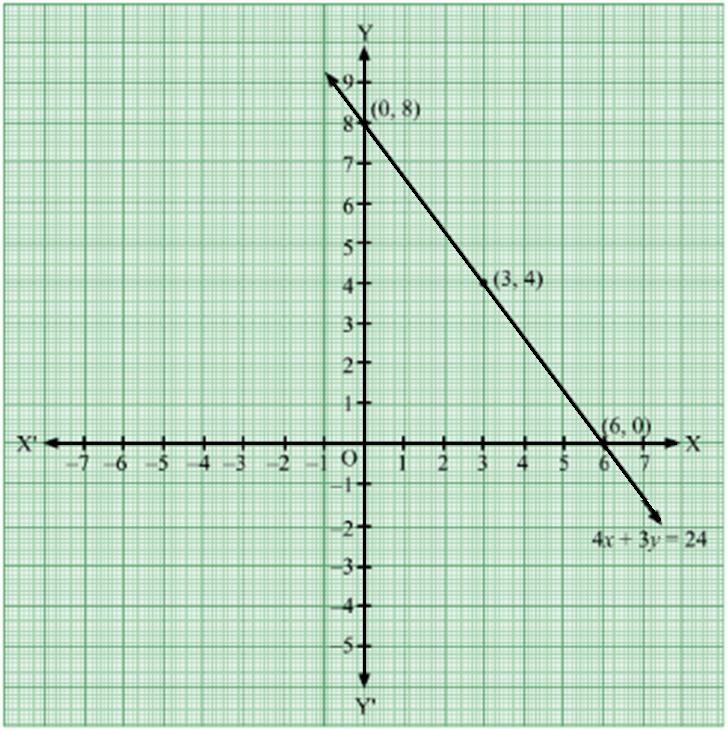
Draw the graph of the line $4x + 3y = 24$.
$i$. Write the coordinates of the point where this line interects the $x$-axis and the $y$-axis.
$ii.$ Use this graph to find the area of the triangle formed by the graph line and the coordinate axes.


Answer
$4\text{x}+3\text{y}=24$
$\Rightarrow3\text{y}=-4\text{x}+24$
$\Rightarrow\text{y}=\frac{-4\text{x}+24}{3}$
When, $\text{x}=0,\ \text{y}=\frac{-4\times0+24}{3}=\frac{0+24}{3}=\frac{24}{3}=8$
When, $\text{x}=3,\ \text{y}=\frac{-4\times3+24}{3}=\frac{-12+24}{3}=\frac{12}{3}=4$
When, $\text{x}=6,\ \text{y}=\frac{-4\times6+24}{3}=\frac{-24+24}{3}=\frac{0}{3}=0$
Thus, the points on the line $4x + 3y = 24$ are as given in the following table:
$x$ $0$ $3$ $6$
$y$ $8$ $4$ $0$
Plotting the points $(0, 8), (3, 4)$ and $(6, 0)$ and drawing a line passing through these points, we obtain the graph of line $4x + 3y = 24$.

$i.$ It can be seen that the line $4x + 3y = 24$ interesects the $x-$axis at $(6, 0)$ and $y-$axis at $(0, 8)$.
$ii.$ The triangle formed by the line and the coordinate axes is a right triangle right angled at get origine.
$\therefore\ $Area of the triangle $=\frac{1}{2}\times6\times8=24$ square units.
View full question & answer
Question 95 Marks
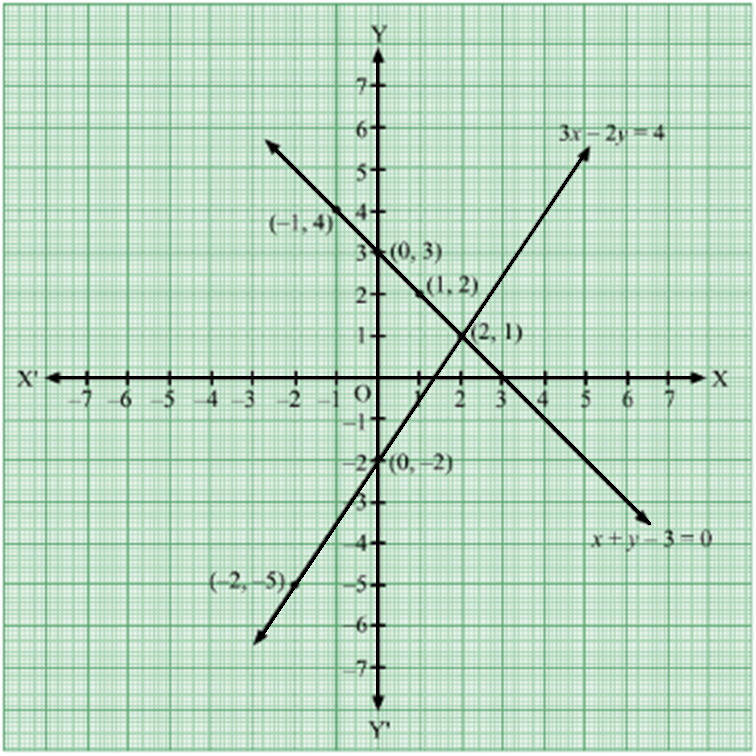
Draw the graph of the equation, $3x - 2y = 4$ and $x + y - 3 = 0$. On the same graph paper find the coordinates of the point where the two graph lines intersect.
Answer
$3\text{x}-2\text{y}=4$$\Rightarrow2\text{y}=3\text{x}-4$
$\Rightarrow\text{y}=\frac{3\text{x}-4}{2}$
When, $\text{x}=0,\ \text{y}=\frac{3\times0-4}{2}=\frac{0-4}{2}=\frac{-4}{2}=-2$
When, $\text{x}=2,\ \text{y}=\frac{3\times2-4}{2}=\frac{6-4}{2}=\frac{2}{2}=1$
When, $\text{x}=-2,\ \text{y}=\frac{3\times(-2)-4}{2}=\frac{-6-4}{2}=\frac{-10}{2}=-5$
Thus, the points on the line 3x - 2y = 4 are as given in the following table:
x
$0$
$2$
$-2$
y
$-2$
$1$
$-5$
Plotting the points $(2, -2), (-2, -5)$ and drawing a line passing through these points, we obtain the graph of the line $3x - 2y = 4.$
$x + y - 3 = 0$
$\Rightarrow y = -x + 3$
When, $x = 0, y = -0 + 3 = 3$
When, $x = 1, y = -1 + 3 = 2$
When, $x = -1, y = -(-1) + 3 = 1 + 3 = 4$
Thus, the points on the line $x + y - 3 = 0$ are as given in the following tabel
x
$0$
$1$
$-1$
y
$3$
$2$
$4$
Plotting the points $(0, 3), (1, 2)$ and $(-1, 4)$ and drawing a line passing through these points, we obtain the graph of the line $x + y = 0$.

It can be seen that the linces $3x - 2y = 4$ and $x + y - 3 = 0$ interesect at the point $(2, 1)$.
View full question & answer