Questions

3 Marks Question

Take a timed test

5 questions · self-marked practice — reveal the answer and mark yourself.

Question 13 Marks
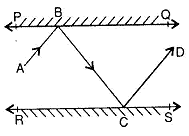
In figure, $PQ$ and $RS$ are two mirrors placed parallel to each other. An incident ray $AB$ strikes the mirror $PQ$ at $B$. The reflected ray moves along the path $BC$ and strikes the mirror $RS$ at $C$ and again reflects back along $CD$. Prove that $AB \| CD.$
Answer
Draw ray BL $\perp PQ$ and ray $CM \perp RS.$
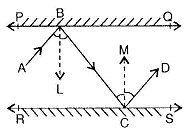
BL $\perp$ PQ, CM $\perp$ RS and PQ $\parallel$ $RS$
$BL \| CM$
$\angle LBC = \angle MCB . . . (1)$
$\angle ABL = \angle LBC . . . $[Angle of incident = Angle of reflection] $. . . .(2)$
$\angle MCB = \angle MCD . . . $[Angle of incident = Angle of reflection] $. . . . (3)$
$\angle ABL = \angle MCD . . . $[From $(1), (2)$ and $(3)]$
$\angle LBC + \angle ABL = \angle MCB + \angle MCD . . . $[Adding $(1)$ and $(4)]$
$\angle ABC = \angle BCD$ are alternate interior angles and are equal.
$\therefore AB \| CD$
View full question & answer
Question 23 Marks
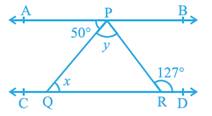
In the given figure, if $AB \| CD$,$\angle$ $APQ = 50°$ and $\angle PRD = 127°$, find $x$ and $y.$
Answer
We are given that $A B \| C D, \angle A P Q=50^{\circ}$ and $\angle PRD =127^{\circ}$
We need to find the value of $x$ and $y$ in the figure.
$\angle APQ = x = 50^\circ $ (Alternate interior angles)
$\angle PRD = \angle APR = 127^\circ $ (Alternate interior angles)
$\angle APR = \angle QPR + \angle APQ.$
$127^\circ = y + 50^\circ $
$\Rightarrow y = 77^\circ .$
Therefore, we can conclude that $x=55^{\circ}$ and $y=77^{\circ}$
Alternatively, $127^{\circ}=y+x$ (because exterior angle is equal to the sum of interior opposite angles).
so, ​​​​​​$127^\circ = y + 50^\circ $
which gives, $x=50^{\circ}$ and $y=77^{\circ}$
View full question & answer
Question 33 Marks
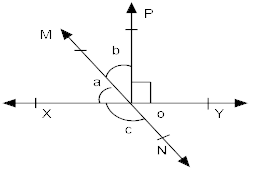
In fig lines $XY$ and $MN$ intersect at $O$ If $\angle POY = 90$^\circ and $a:b = 2:3$ find $\angle c.$
​​​​​​​
Answer
Lines $XY$ and $MN$ intersect at $O.$
$\therefore \angle C = \angle XON = \angle MOY$ [vertically opposite angle]
$= \angle b + \angle POY$
But,$ \angle POY = 90^\circ $
$ \therefore \angle C = \angle b + 90^\circ ...(i)$
Also,
$\angle POX = 180^\circ - \angle POY$
$= 180^\circ - 90^\circ $
$= 90^\circ $
$ \therefore a + b = 90^\circ $
But,
$a:b = 2:3$ [Given]
$a = \frac{2}{5} \times {90^0} $
$= 36^\circ ...(ii)$
Thus, From $(i)$ and $(ii)$ we get
$b = 90^\circ - 36^\circ = 54^\circ $
$ \angle C = 54^\circ + 90^\circ $ ( From$ (1) )$
$= 144^\circ $
View full question & answer
Question 43 Marks
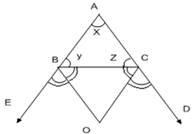
In fig the side $A B$ and $A C$ of $\triangle A B C$ are produced to point $E$ And $D$ respectively. If bisector $B O$ and $C O$ of $\angle C B E$ And $\angle B C D$ respectively meet at point $O$, then prove that $\angle B O C=90^{\circ}-\frac{1}{2} \angle B A C$
Answer
Ray $BO$ bisects $\angle CBE$
${\text{ }}\therefore {\text{ }}\angle {\text{CBO = }}\frac{1}{2}{\text{ }}\angle {\text{CBE}}$
${\text{ = }}\frac{1}{2}\left( {{{180}^ \circ } - y} \right)$
${\text{ }}\left( {\because {\text{ }}\angle {\text{CBE + y = 18}}{{\text{0}}^ \circ }}\therefore \angle CBE = 180^\circ - y \right)$
${\text{ = }}{90^ \circ } - {\text{ }}\frac{y}{2}{\text{ }}...(i)$
Similarly, ray $CO$ bisects $\angle BCD$
$\angle {\text{BCO = }}\frac{1}{2}\angle BCD$
${\text{ = }}\frac{1}{2}\left( {{{180}^ \circ } - z} \right)$
${\text{ = }}{90^ \circ } - \frac{Z}{2}...(ii)$
$In{\text{ }}\vartriangle {\text{ BOC }}$In $\triangle BOC$
$\angle {\text{BOC + }}\angle {\text{BCO + }}\angle {\text{CBO = 18}}{{\text{0}}^ \circ }$
$\angle {\text{BOC = }}\frac{1}{2}\left( {y + z} \right)$
But $x + y + z = 180^\circ $
$y + z = 180^\circ -x$
$\angle {\text{BOC = }}\frac{1}{2}\left( {{{180}^ \circ } - x} \right) = {90^ \circ } - \frac{x}{2}$
$\angle {\text{BOC = }}{90^ \circ } - \frac{1}{2}{\text{ }}\angle {\text{BAC}}$
View full question & answer
Question 53 Marks
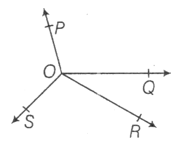
In the given figure, $OP, OQ, OR$ and $OS$ are four rays. Prove that
$ \angle POQ + \angle ROQ + \angle SOR + \angle POS = 360^\circ. $

Answer
Similarly, $OS$ is a ray on the line $MOQ$. Then, by linear pair axiom, we have
$\angle M O S+\angle S O Q=180^{\circ} \ldots \text {...(ii) }$
Also, $\angle SOR$ and $\angle ROQ$ are adjacent angles.
$\therefore \angle SOQ=\angle SOR+\angle ROQ \ldots \text {...(iii) }$
On putting the value of $\angle S O Q$ from Eq.$(iii)$ in Eq.$(ii)$, we get
$\angle M O S+\angle S O R+\angle R O Q=180^{\circ} \ldots \text {...(iv) }$
Now, on adding Eqs.$(i)$ and $(iv)$, we get
$\angle MOP+\angle POQ+\angle MOS+\angle SOR+\angle ROQ=180^{\circ}+180^{\circ}$
$\Rightarrow \angle MOP+\angle MOS+\angle POQ+\angle SOR+\angle ROQ=360^{\circ} \ldots \text { (iv) }$
$\text { But } \angle MOP+\angle MOS=\angle POS$
Then, from Eq.$(v)$, we get
$\angle POS+\angle POQ+\angle SOR+\angle ROQ=360^{\circ}$
Hence proved.
View full question & answer