Questions

4 Marks Questions

Take a timed test

8 questions · self-marked practice — reveal the answer and mark yourself.

Question 14 Marks
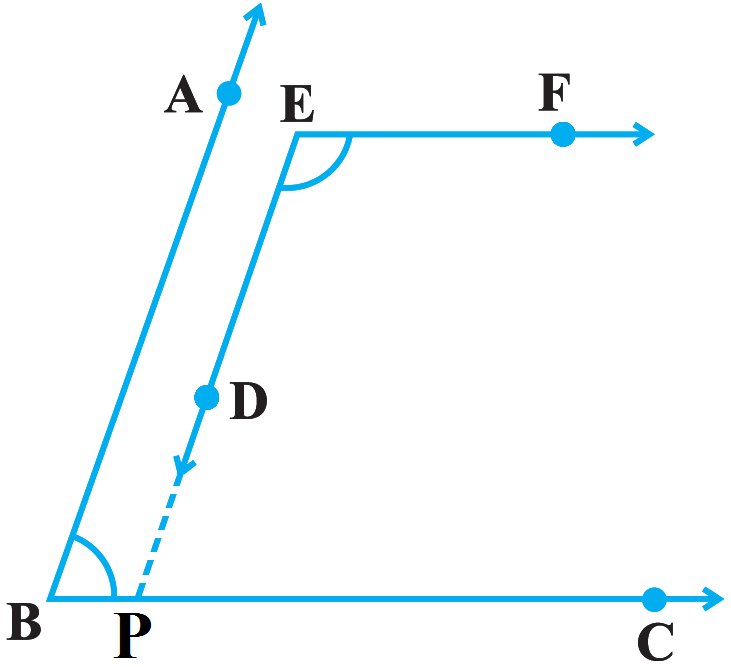
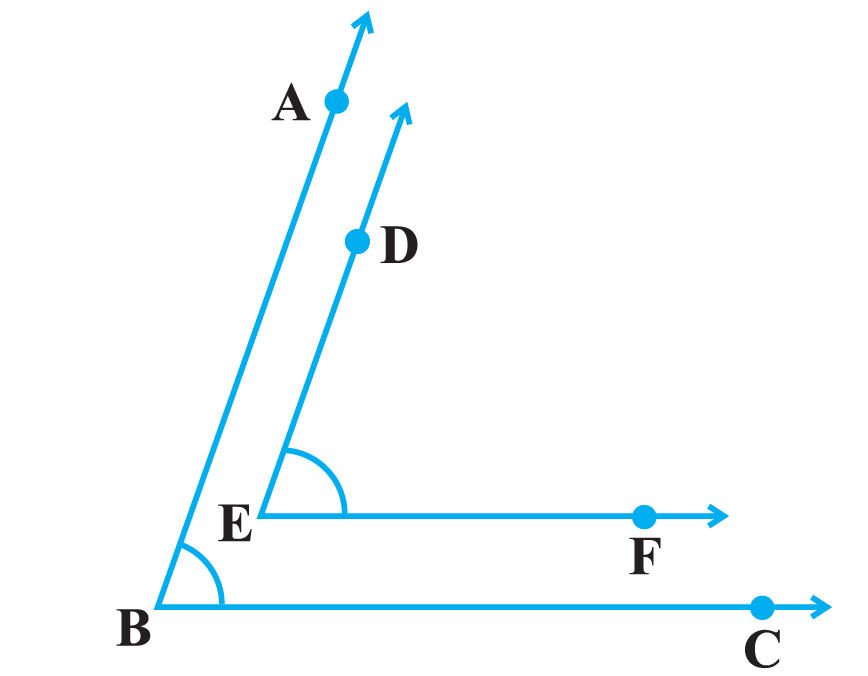
In Fig. $\text{BA}||\text{ED}$ and $\text{BC}||\text{EF}$ . Show that $\angle\text{ABC}=\angle\text{DEF}$
[Hint: Produce $DE$ to intersect $BC$ at $P$ (say)].
Answer
Produce $DE$ to intersect $BC$ at P(say). $\text{EF}||\text{BC}$ and $DP$ is the transversal,
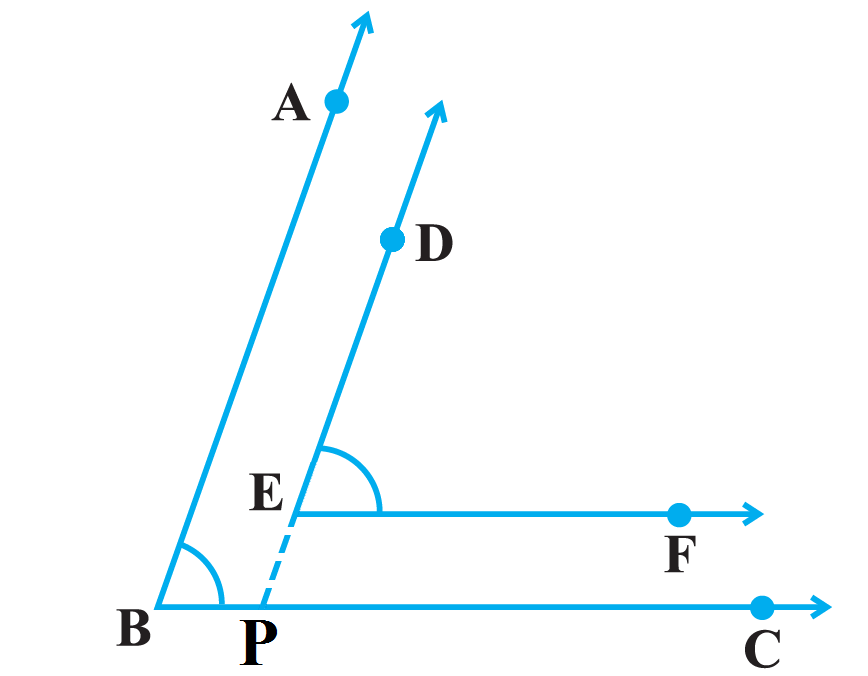
$\therefore\angle\text{DEF}=\angle\text{DPC}.....(1)$ $[\text{Corres}.\angle\text{S}]$
Now, $\text{AB}||\text{DP}$ and $BC$ is the transversal, $\therefore\angle\text{DPC}=\angle\text{ABC}..(2)$ $[\text{Corres}.\angle\text{S}]$ From $(1)$ and $(2),$ we get
$\angle\text{ABC}=\angle\text{DEF}$ Hence, Proved.
View full question & answer
Question 24 Marks
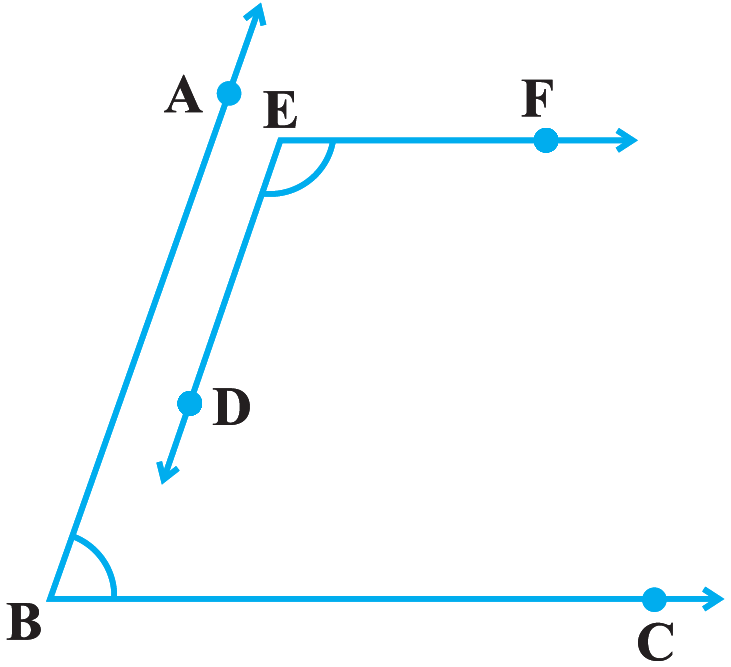
In Fig.$\text{BA}||\text{ED}$ and $\text{BC}||\text{EF}$ Show that $\angle\text{ABC}+\angle\text{DEF}=180^\circ$
Answer
Produce $ED$ to meet $BC$ at $P($say$)$

Now, $\text{EF}||\text{BC}$ and $EP$ is the transversal.
$\angle\text{DEF}+\angle\text{EPC}=180^\circ....(1)$
Again, $\text{EP}||\text{AB}$ and $BC$ is the transversal.
$\therefore\angle\text{EPC}=\angle\text{ABC}....(2)$ $[\text{corresponding}\angle\text{S}]$
From $(1)$ and $(2),$ we get $\angle\text{DEF}+\angle\text{ABC}=180^\circ$
$\Rightarrow\angle\text{ABC}+\angle\text{DEF}=180^\circ$ Hence, proved.
View full question & answer
Question 34 Marks
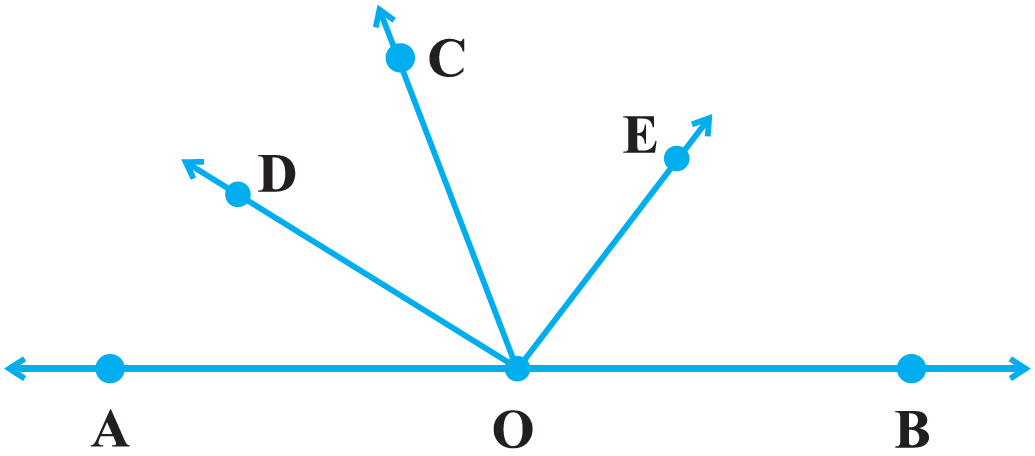
In Fig. $OD$ is the bisector of $\angle\text{AOC}, OE$ is the bisector of $\angle\text{BOC}$ and $\text{OD}\perp\text{OE}.$ Show that the points $A, O$ and $B$ are collinear.
Answer
Given: In figure, $\text{OD}\perp\text{OE}$
$(\text{i.e.}\angle\text{DOE}=90^\circ),$
$OD$ and $OE$ are the bisector of $\angle\text{AOC}$ and $\angle\text{BOC}.$
To prove: points $A, O$ and $B$ are collinear i.e., $AOB$ is a straight line.
Proof: Since, $OD$ and $OE$ bisect angles $\angle\text{AOC}$ and $\angle\text{BOC}$ respectively.
$\therefore\ \angle\text{AOC}=2\angle\text{DOC}...(1)$ And
$\angle\text{COB}=2\angle\text{COE}...(2)$
On adding euations $(1)$ and $(2),$
we get $\angle\text{AOC}+\angle\text{COB}=2\angle\text{DOC}+\angle\text{COE}$
$\Rightarrow\angle\text{AOC}+\angle\text{COB}=2\big(\angle\text{DOC}+\angle\text{COE}\big)$
$\Rightarrow\angle\text{AOC}+\angle\text{COB}=2\angle\text{DOE}$
$\Rightarrow\angle\text{AOC}+\angle\text{COB}=2\times90^\circ$
$\big[\because\text{OD}\perp\text{OE}\big]$
$\Rightarrow\angle\text{AOC}+\angle\text{COB}=180^\circ$
$\therefore\ \angle\text{AOB}=180^\circ$
So, $\angle\text{AOC}+\angle\text{COB}$ are forming linear pair or $AOB$ is a straight line.
Hence, points $A, O$ and $B$ are collinear.
View full question & answer
Question 44 Marks
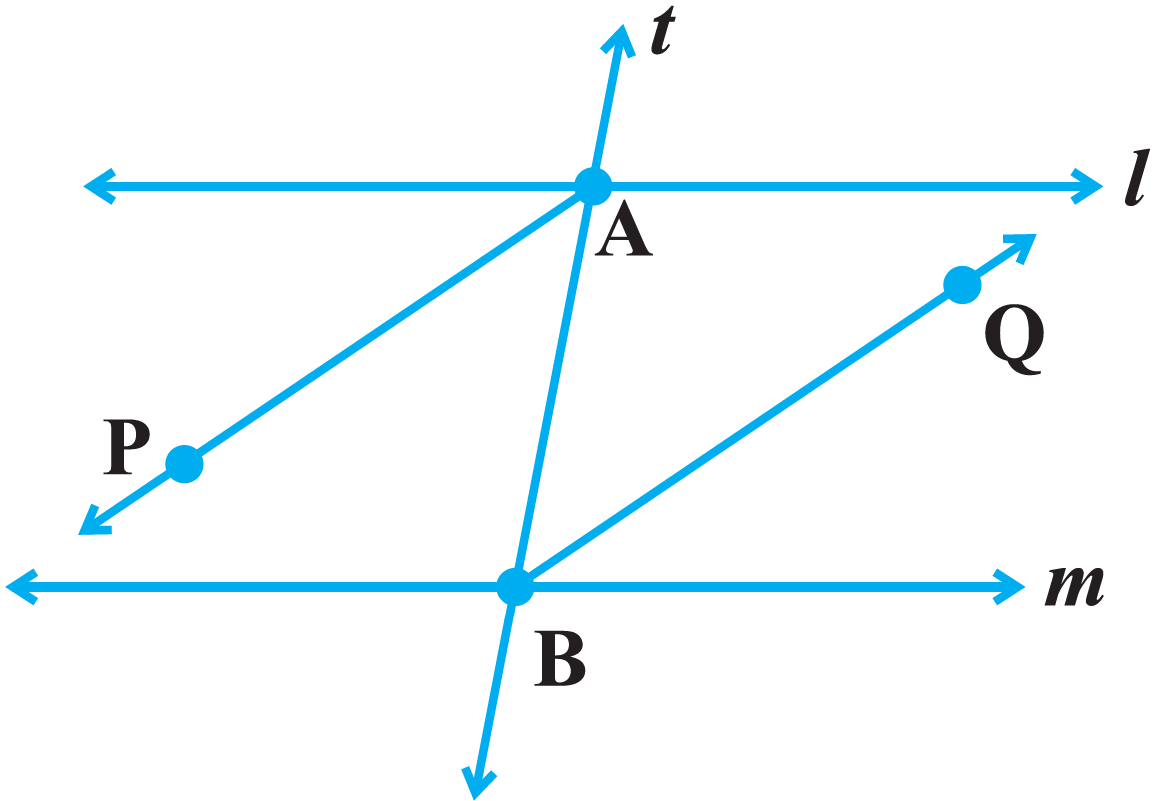
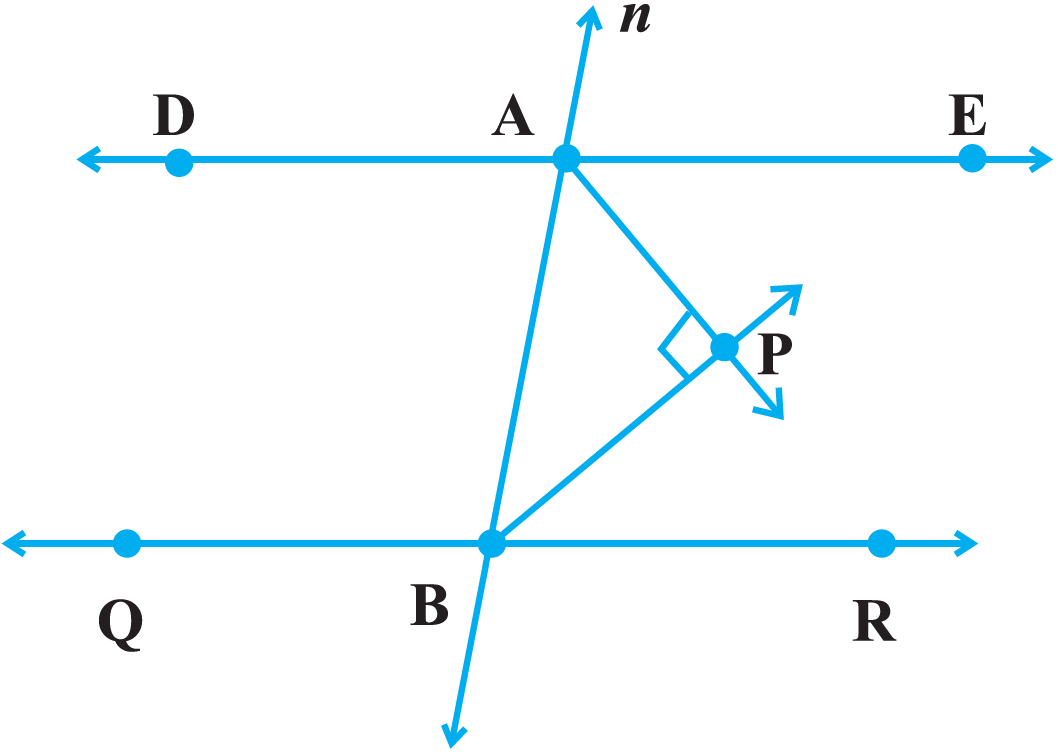
If in Fig. bisectors $AP$ and $BQ$ of the alternate interior angles are parallel, then show that $\text{l}||\text{m}.$
Answer
Given, In the figure $\text{AP}||\text{BQ},$
$AP$ and $BQ$ are the bisectors of alternate interior angles $\angle\text{CAB}$ and $\angle\text{ABF}.$
To show $\text{l}||\text{m}$ Proof Since,$\text{AP}||\text{BQ}$ and t is transversal,
therefore $\angle\text{PAB}=\angle\text{ABQ}$ [alternate interior angles]
$=>2\angle\text{PAB}=2\angle\text{ABQ} [$multiplying both sides by $2]$

So, alternate interior angles are equal.
We know that, if two alternate interior angles are equal, then lines are parallel Hence, $\text{l}||\text{m}.$
View full question & answer
Question 54 Marks
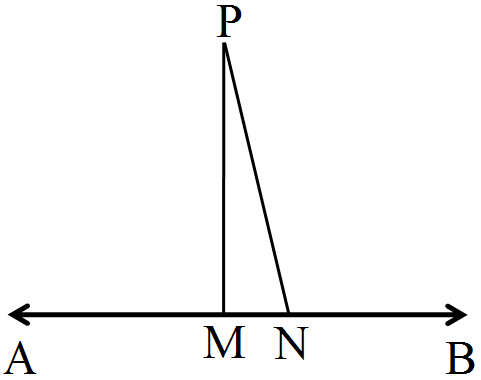
Prove that through a given point, we can draw only one perpendicular to a given line. [Hint: Use proof by contradiction].
Answer
From the point $P$, a perpendicular $PM$ is drawn to the given line $AB$. $\therefore\ \angle\text{PMB}=90^\circ$ Let if possible, we can draw another perpendicular $PN$ to the line $AB$. then, $\angle\text{PMB}=90^\circ$ $\angle\text{PMB}=\angle\text{PNB},$ which is possible only when $PM$ and $PN$ coincide with each other.

Hence, through a given point, we can draw only one perpendicular to a given line.
View full question & answer
Question 64 Marks
In Fig. $\text{DE}||\text{QR}$ and $AP$ and $BP$ are bisectors of $\angle\text{EAB}$ and respectively. Find $\angle\text{APB}$
Answer
Given, $\text{DE}||\text{QR}$ and $AP$ and $PB$ are the bisectors of $\angle\text{EAB}$ and $\angle\text{RBA},$ respectively. We know that, the interior angles on the same side of transversal are supplementary.
$\therefore\ \angle\text{EAB}+\angle\text{RBA}=180^\circ$
$\Rightarrow\frac{1}{2}\angle\text{EAB}+\frac{1}{2}\angle\text{RBA}=\frac{180^\circ}{2}$ [dividing both sides by $2$]
$\frac{1}{2}\angle\text{EAB}+\frac{1}{2}\angle\text{RBA}=90^\circ....(\text{i})$
Since, $AP$ and $BP$ are the bisector of $\angle\text{EAB}$ and $\angle\text{RBA},$ respectively.
$\therefore\ \angle\text{BAP}=\frac{1}{2}\angle\text{EAB}....(\text{ii})$
and $\angle\text{ABP}=\frac{1}{2}\angle\text{RBA}....(\text{iii})$
On adding Eqs. $(ii)$ and $(iii)$, we get
$\angle\text{BAP}+\angle\text{ABP}=\frac{1}{2}\angle\text{EAB}+\frac{1}{2}\angle\text{RBA}$
From Eq. $(i)$
$\Rightarrow\angle\text{BAP}+\angle\text{ABP}=90^\circ..(\text{iv})$
In $\Delta\text{APB},$ $\angle\text{BAP}+\angle\text{ABP}+\angle\text{APB}=180^\circ$ [sum of all angles of a triangle is $180^\circ $]
$\Rightarrow90^\circ+\angle\text{APB}=180^\circ$[from Eq.(iv)]
$\Rightarrow\angle\text{APB}=180^\circ-90^\circ=90^\circ$
View full question & answer
Question 74 Marks
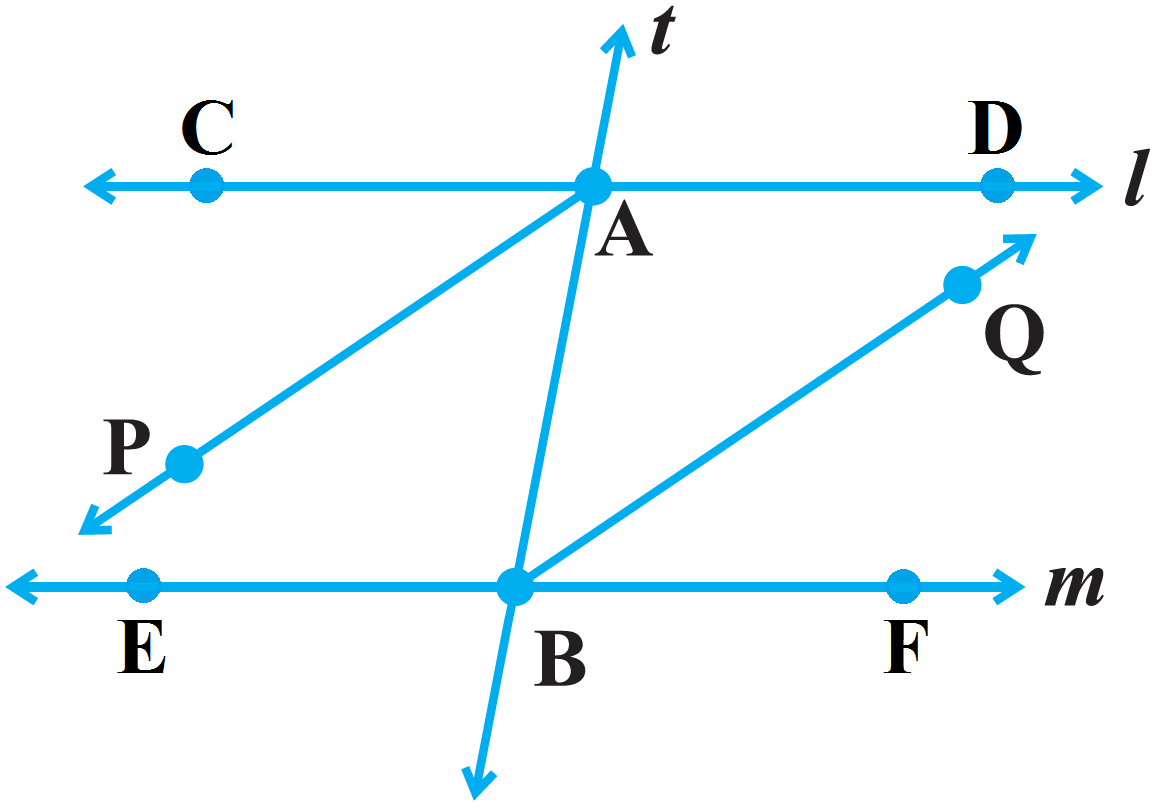
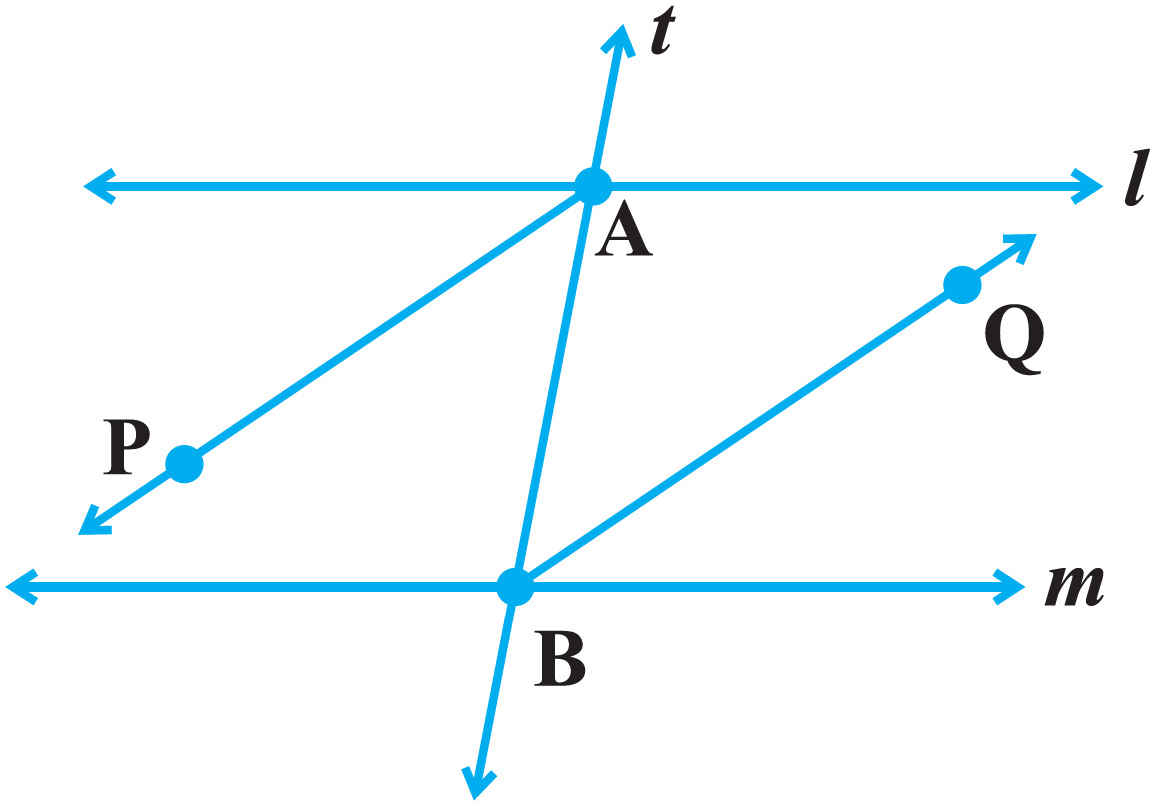
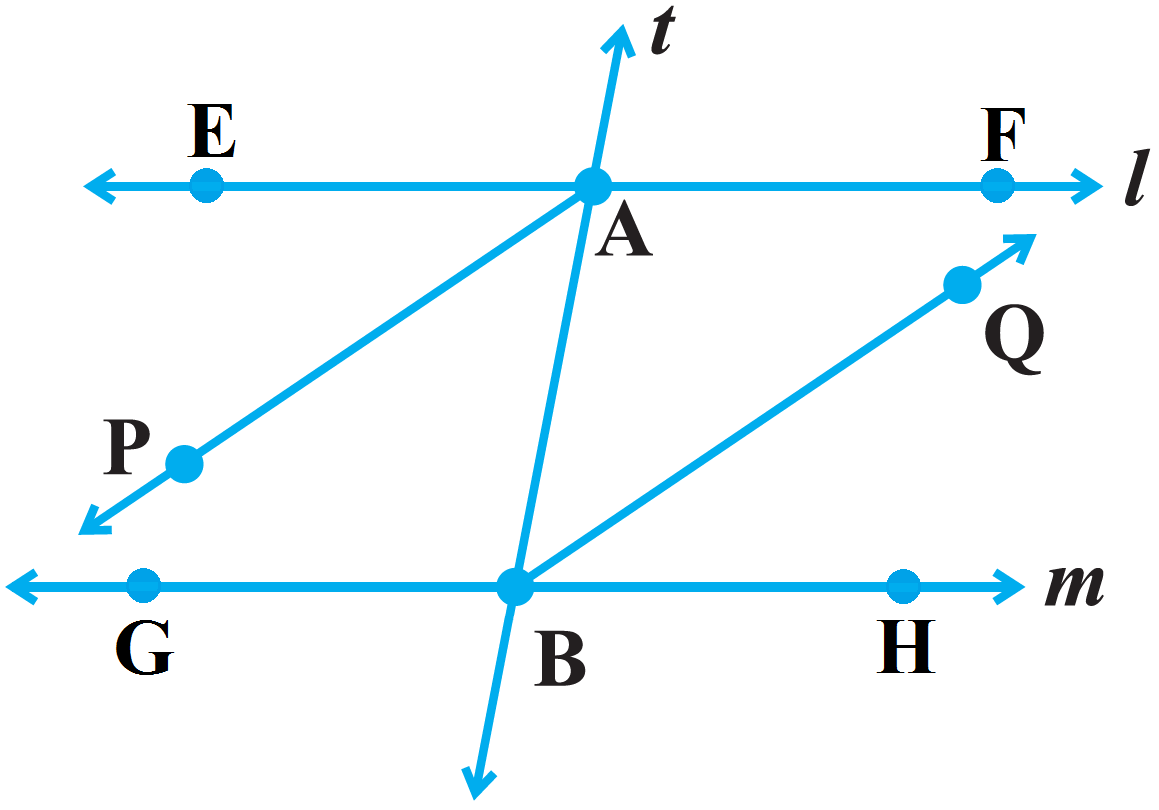
$AP$ and $BQ$ are the bisectors of the two alternate interior angles formed by the intersection of a transversal t with parallel lines l and m (Fig.). Show that $\text{AP}||\text{BQ}.$
Answer
Given In the figure $\text{l}||\text{m}, AP$ and $BQ$ are the bisectors of $\angle\text{EAB}$ and $\angle\text{ABH},$ respectively.
To prove $\text{AP}||\text{BQ}$ Proof
Since, $\text{l}||\text{m},$ and t is transversal.
Therefore, $\angle\text{EAB}=\angle\text{ABH}$ [alternate interior angles]

$\frac{1}{2}\angle\text{EAB}=\frac{1}{2}\text{ABH} [$dividing both sides by $2]$
$\angle\text{PAB}=\angle\text{ABQ}$ $\big[AP$ and $BQ$ are the bisectors of $\angle\text{EAB}$ and $\angle\text{ABH}\big]$ Since, $\angle\text{PAB}$ and $\angle\text{ABQ}$ are alternate interior angles with two lines $AP$ and $BQ$ and transvetrsal $AB.$
Hence, $\text{AP}||\text{BQ}.$
View full question & answer
Question 84 Marks
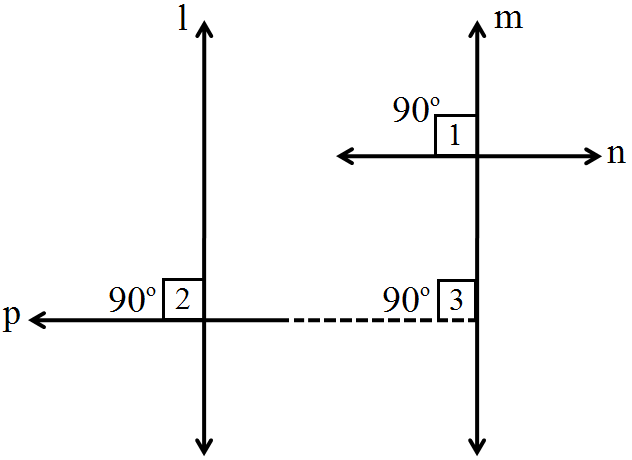
Two lines are respectively perpendicular to two parallel lines. Show that they are parallel to each other.
Answer


Two lines $p$ and $n$ are respectively perpendicular to two parallel line $l$ and $m$, i.e., $\text{p}\perp\text{l}$ and $\text{n}\perp\text{m}$
We have to show that $p$ is parallel to $n.$
As $\text{n}\perp\text{m},$ So $\angle1=90^\circ....(1)$
Again, $\text{p}\perp\text{l},$ So $\angle2=90^\circ.$
But, $l$ is parallel to $m,$ so
$\angle1=\angle3$ $[\text{corres}.\angle\text{s}]$
$\therefore\angle2=\angle90^\circ...(2)$ $[\because\angle2=90^\circ]$
From $(1)$ and $(2),$ we get
$\Rightarrow\angle1=\angle3$ $[\text{Each}=90^\circ]$
angles.
Hence, $p||n.$
But, these are corresponding.
View full question & answer