Questions

M.C.Q

Take a timed test

66 questions · 50 auto-graded MCQ + 16 self-marked written.

MCQ 11 Mark
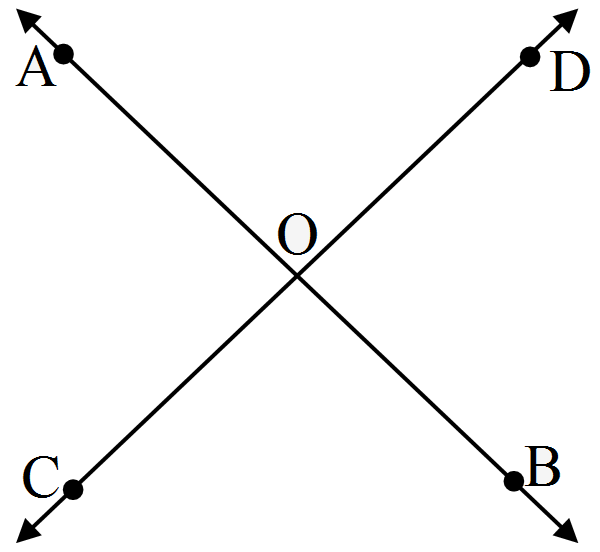
Two straight lines $AB$ and $CD$ cut each other at $O$. If $\angle\text{BOD}=63^\circ,$ then $\angle\text{BOC}=$
  • A
    $63^\circ$
  • $117^\circ$
  • C
    $17^\circ$
  • D
    $153^\circ$
Answer
Correct option: B.
$117^\circ$
$\angle\text{BOD}$ and $\angle\text{BOC}$ from a linear pair.
$\therefore\ \angle\text{BOD}+\angle\text{BOC}=180^\circ$
$\Rightarrow\ 63^\circ+\angle\text{BOC}=180^\circ$
$\Rightarrow\ \angle\text{BOC}=117^\circ$
View full question & answer
MCQ 21 Mark
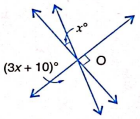
Given $\angle\text{POR}=3\text{x}$ and $\angle\text{QOR}=2\text{x}+10^\circ.$If $POQ$ is a straight line, then the value of $x$ is:
  • A
    $30^\circ$
  • $34^\circ$
  • C
    $36^\circ$
  • D
    None of these
Answer
Correct option: B.
$34^\circ$
$\angle\text{POR}=3\text{x}$ and $\angle\text{QOR}=2\text{x}+10^\circ$
From figure, we can see that $\angle\text{POR}$ and $\angle\text{QOR}$ are two adjacent angles and are supplement.
$\Rightarrow\ \angle\text{POR}+\angle\text{QOR}=180^\circ$
$\Rightarrow\ 3\text{x}+2\text{x}+10^\circ=180^\circ$
$\Rightarrow\ 5\text{x}=170^\circ$
$\Rightarrow\ \text{x}=34^\circ$
View full question & answer
MCQ 31 Mark
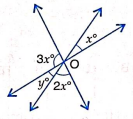
In figure, the value of $x$, is:
  • A
    $12$
  • B
    $15$
  • $20$
  • D
    $30$
Answer
Correct option: C.
$20$
From figure, we can see that
$\angle\text{BOD}+\angle\text{AOD}=180^\circ$
$\angle\text{BOD}=90^\circ$ [Given]
$\Rightarrow\ \angle\text{AOD}=180^\circ-90^\circ=90^\circ$
Now,
$\text{x}^\circ=\angle\text{COE}=\angle\text{FOD}$ [Opposite angles are equal]
Now,
$\angle\text{AOF}+\angle\text{FOD}=90^\circ=\angle\text{AOD}$
$\Rightarrow\ 3\text{x}^\circ+10^\circ+\text{x}^\circ=90^\circ$
$\Rightarrow\ 4\text{x}^\circ=80^\circ$
$\Rightarrow\ \text{x}^\circ=20^\circ$
View full question & answer
MCQ 41 Mark
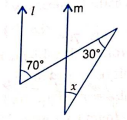
In figure, if lines $l$ and $m$ are parallel lines, then $x =$
  • A
    $70^\circ$
  • B
    $100^\circ $
  • $40^\circ$
  • D
    $30^\circ$
Answer
Correct option: C.
$40^\circ$
From figure,
$\angle\text{ABC}=\angle\text{DCE}\dots(1)$ [Corresponding angles]
$\angle\text{ECF}=180^\circ-\angle\text{DCE}$ [Supplementary]
$=180^\circ-\angle\text{ABC}$ [From (1)]
$=180^\circ-70^\circ$
$\Rightarrow\ \angle\text{ECF}=110^\circ$
Now, in $\triangle\text{CEF}$
$\angle\text{ECF}+\angle\text{CFE}+\angle\text{FEC}=180^\circ$
$\Rightarrow\ 110^\circ+\text{x}+30^\circ=180^\circ$
$\Rightarrow\ \text{x}=40^\circ$
View full question & answer
MCQ 51 Mark
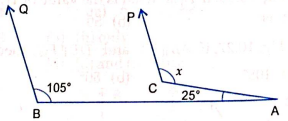
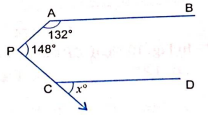
In figure, if $CP || BQ$, then the measure of $x$ is:
  • $130^\circ$
  • B
    $105^\circ$
  • C
    $175^\circ$
  • D
    $125^\circ$
Answer
Correct option: A.
$130^\circ$
From figure,
$\angle\text{QBA}=\angle\text{CEA}$ [Correspondence angles]
$\Rightarrow\ \angle\text{CEA}=105^\circ\dots(1)$
In $\triangle\text{ACE},$
$\angle\text{CEA}+\angle\text{EAC}+\angle\text{ACE}=180^\circ$
$\Rightarrow\ 105^\circ+25^\circ+\angle\text{ACE}=180^\circ$ [From $(1)$]
$\Rightarrow\ 130^\circ+\angle\text{ACE}=180^\circ$
$\Rightarrow\ \angle\text{ACE}=50^\circ$
Now,
$\text{x}=\angle\text{ACP}=180^\circ-\angle\text{ACE}$
$=180^\circ-50^\circ=130^\circ$
View full question & answer
MCQ 61 Mark
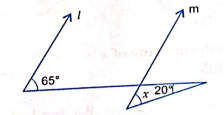
In figure, if lines $l$ and $m$ are parallel, then $x =$
  • A
    $20^\circ$
  • $45^\circ$
  • C
    $65^\circ$
  • D
    $85^\circ$
Answer
Correct option: B.
$45^\circ$
From figure,
$\angle\text{ABD}=\angle\text{CDF}$ [Correspondence angles]
$\Rightarrow\ \angle\text{CDF}=65^\circ$
Now,
$\angle\text{FDE}=180^\circ-\angle\text{CDF}=180^\circ-65^\circ$
$\Rightarrow\ \angle\text{FDE}=115^\circ$
In $\triangle\text{EDF},$
$\angle\text{FDE}+\angle\text{DEF}+\angle\text{EFD}=180^\circ$
$\Rightarrow\ 115^\circ+\text{x}+20^\circ=180^\circ$ [Sum of all interior angles of a $\triangle$ as $180^\circ$]
$\Rightarrow\ \text{x}=180^\circ-20^\circ-115^\circ=45^\circ$
View full question & answer
MCQ 71 Mark
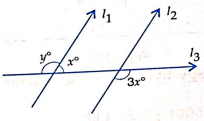
In figure, if $\mathrm{I}_1 \| \mathrm{I}_2$, what isb the value of $y$ ?
  • A
    $100$
  • B
    $120$
  • $135$
  • D
    $150$
Answer
Correct option: C.
$135$


Let angle supplement of $3 x^{\circ}$ be $Z^{\circ}$
$\Rightarrow z^{\circ}=180^{\circ}-3 x^{\circ}$
$\Rightarrow \angle \mathrm{AHF}+\angle \mathrm{FHB}=180^{\circ}$
$\Rightarrow z^{\circ}+3 x^{\circ}=180^{\circ}$
$\Rightarrow z^{\circ}=180^{\circ}-3 x^{\circ}$
Now,
$x^{\circ}+y^{\circ}=180^{\circ}$
Also,
$x^{\circ}=z^{\circ} \text { [Correspondence angles] }$
$\Rightarrow x^{\circ}=180^{\circ}-3 x^{\circ}$
$\Rightarrow 4 x^{\circ}=180^{\circ}$
$\Rightarrow x^{\circ}=45^{\circ}$
$x^{\circ}+y^{\circ}=180^{\circ}$
$\Rightarrow y^{\circ}=180^{\circ}-x^{\circ}=180^{\circ}-45^{\circ}=135^{\circ}$.

View full question & answer
MCQ 81 Mark
Two straight lines $AB$ and $CD$ intersect one another at the point $O$. If $\angle\text{AOC}+\angle\text{COB}+\angle\text{BOD}=274^\circ,$ then $\angle\text{AOD}=$
  • $86^\circ$
  • B
    $90^\circ$
  • C
    $94^\circ$
  • D
    $137^\circ$
Answer
Correct option: A.
$86^\circ$
$\angle\text{AOC}+\angle\text{COB}+\angle\text{BOD}+\angle\text{AOD}=360^\circ\dots(1)$
Now,
$\angle\text{AOC}+\angle\text{COB}+\angle\text{BOD}=274^\circ\dots(2)$ [Given]
From $(1)$ and $(2)$.
$274^\circ+\angle\text{AOD}=360^\circ$
$\Rightarrow\ \angle\text{AOD}=360^\circ-274^\circ$
$\Rightarrow\ \angle\text{AOD}=86^\circ$
View full question & answer
MCQ 91 Mark
If two interior angles on the same side of a transversal intersecting two parallel lines are in the ratio $2 : 3$, then the measure of the larger angle is:
  • A
    $54^\circ$
  • B
    $120^\circ$
  • $108^\circ$
  • D
    $136^\circ$
Answer
Correct option: C.
$108^\circ$
Let $AB$ and $CD$ are two parallel lines and $PQ$ is transverce to it.
According to question,
$\frac{\angle\text{BRS}}{\angle\text{DSR}}=\frac{2}{3}$
$\Rightarrow\ \angle\text{BRS}=\frac{2}{3}\angle\text{DSR}\dots(1)$
Now,
$\angle\text{CSR}=\angle\text{BRS}$ [Alternate angles]
$\Rightarrow\ \angle\text{CSR}+\angle\text{DSR}=180^\circ$
$\Rightarrow\ \angle\text{BRS}+\angle\text{DSR}=180^\circ$
$\Rightarrow\ \frac{2}{3}\angle\text{DSR}+\angle\text{DSR}=180^\circ$
$\Rightarrow\ \angle\text{DSR}=\frac{180\times3}{5}=108^\circ$
$\Rightarrow\ \angle\text{BRS}=\frac{2}{3}\times108^\circ=72^\circ$
Thus,
$\angle\text{DSR}=108^\circ$ and $\angle\text{BRS}=72^\circ$
$\Rightarrow $ Larger angle is $\angle\text{DSR}.$
View full question & answer
MCQ 101 Mark
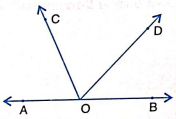
In figure, $AOB$ is a straight line. If $\angle\text{AOC}+\angle\text{BOD}=85^\circ,$ then $\angle\text{COD}=$
  • A
    $85^\circ$
  • B
    $90^\circ$
  • $95^\circ$
  • D
    $100^\circ$
Answer
Correct option: C.
$95^\circ$
From figure, we can see
$\angle\text{AOC}+\angle\text{COD}+\angle\text{BOD}=180^\circ$
But,
$\angle\text{AOC}+\angle\text{BOD}=85^\circ$ [Given]
$\Rightarrow\ 85^\circ+\angle\text{COD}=180^\circ$
$\Rightarrow\ \angle\text{COD}=95^\circ$
View full question & answer
MCQ 111 Mark
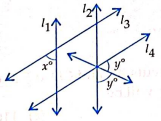
In figure, if $I_1 \| I_2$ and $I_3 \| I_4$ what is $y$ in terms of $x$ ?
  • A
    $90+\text{x}$
  • B
    $90+2\text{x}$
  • $90-\frac{\text{x}}{2}$
  • D
    $90-2\text{x}$
Answer
Correct option: C.
$90-\frac{\text{x}}{2}$


From figure,
$\angle\text{EPR}=\angle\text{PQS}$ [Correspondence angles are equal]
$\Rightarrow\ \angle\text{PQS}=\text{x}^\circ$
Also,
$\angle\text{PQS}=\angle\text{RSD}$ [Correspondence angles are equal]
$\Rightarrow\ \angle\text{RSD}=\text{x}^\circ$
Now,
$\angle\text{RSD}+\text{y}^\circ+\text{y}^\circ=180^\circ$
$\Rightarrow\ \text{x}^\circ+2\text{y}^\circ=180^\circ$
$\Rightarrow\ \text{y}^\circ=\frac{180^\circ-\text{x}^\circ}{2}$
$\Rightarrow\ \text{y}^\circ=90^\circ-\frac{\text{x}^\circ}{2}$

View full question & answer
MCQ 121 Mark
In figure, $AB || CD || EF$ and $GH || KL$. The measure of $\angle\text{HKL},$ is:
  • A
    $85^\circ$
  • B
    $135^\circ$
  • $145^\circ$
  • D
    $215^\circ$
Answer
Correct option: C.
$145^\circ$
$GH || KL$
$\Rightarrow\ \angle\text{GHK}=\angle\text{HKL}$ [Interior opposite angles]
Now,
$\angle\text{GHK}=\angle\text{GHD}+\angle\text{DHR}$
$=(180^\circ-\angle\text{GHC})+\angle\text{DHK}$
[$\angle\text{GHC}$ and $\angle\text{GHD}$ are supplementary]
$=180^\circ-60^\circ+25^\circ$
$\Rightarrow\ \angle\text{GHK}=145^\circ$
$\Rightarrow\ \angle\text{HKL}=\angle\text{GHK}=145^\circ$
View full question & answer
MCQ 131 Mark
Two complementary angles are such that two times the measure of one is equal to three times the measure of the other. The measure of the smaller angle is:
  • A
    $45^\circ$
  • B
    $30^\circ$
  • $36^\circ$
  • D
    None of these
Answer
Correct option: C.
$36^\circ$
Let one angle be $\theta$
Then, its complementary $=90-\theta$
According to question,
$2\theta=3(90-\theta)$
$=5\theta=270$
$\theta=54^\circ$
Then, $90-\theta^\circ=36^\circ$
Hence, the smaller angle is $36^\circ$.
View full question & answer
MCQ 141 Mark
Consider the following statement: When two straight lines intersect:
$i.$ Adjacent angles are complementary
$ii.$ Adjacent angles are supplementary
$iii.$ Opposite angles are equal
$iv.$ Opposite angles are supplementary
Of these statements
  • A
    $(i)$ and $(ii)$ are correct
     
  • $(ii)$ and $(iii)$ are correct
     
  • C
    $(i)$ and $(iv)$ are correct
     
  • D
    $(ii)$ and $(iv)$ are correct
Answer
Correct option: B.
$(ii)$ and $(iii)$ are correct
 
Let two lines $AB$ and $CD$ intersect each other at $O$.
Now,
We can see from fogure any two adjacent angles
$\angle\text{AOD}$ and $\angle\text{DOB},\angle\text{DOB}$ and $\angle\text{BOC}$ etc are supplementary because their sum is $180^\circ$.
$\angle\text{AOD}+\angle\text{DOB}=180^\circ$
$\angle\text{DOB}+\angle\text{BOC}=180^\circ$
So two adjacent angles are always supplementary.
Now,
Two opposite angle like $\angle\text{AOC}$ and $\angle\text{DOB},\angle\text{AOD}$ and $\angle\text{COB}$ are always equal to each other as they are vertically opposite angles
$\angle\text{AOC}=\angle\text{DOB}$
$\angle\text{AOD}=\angle\text{COB}$
Hence statement $(ii)$ and $(iii)$ are correct.
View full question & answer
MCQ 151 Mark
One angle is equal to three times its supplement. The measure of the angle is:
  • A
    $130^\circ $
  • $135^\circ $
  • C
    $90^\circ $
  • D
    $120^\circ $
Answer
Correct option: B.
$135^\circ $
Let the required angle be ${\theta}.$
Then, measure of its supplement $180^\circ-\theta$
According to question, we have
$\theta=3(180-\theta)$
$\Rightarrow\ \theta=540^\circ-3\theta$
$\Rightarrow\ 4\theta=540^\circ $
$\Rightarrow\ \theta=135^\circ$
View full question & answer
MCQ 161 Mark
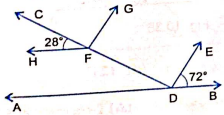
In figure, if $AB || HF$ and $DE || FG,$ then the measure of $\angle\text{FDE}$ is:
  • A
    $108^\circ$
  • $80^\circ$
  • C
    $100^\circ$
  • D
    $90^\circ$
Answer
Correct option: B.
$80^\circ$
$AB || HF$ and $\angle\text{CFH}=28^\circ$ [Given]
$\angle\text{CFH}=\angle\text{FDA}$ [Correspondence angels are equal]
$\angle\text{FDA}=28^\circ$
Now,
$\angle\text{FDA}+\angle\text{FDE}+\angle\text{EDB}=180^\circ$
$\Rightarrow\ 28^\circ+\angle\text{FDE}+72^\circ=180^\circ$
$\Rightarrow\ \angle\text{FDE}=80^\circ$
View full question & answer
MCQ 171 Mark
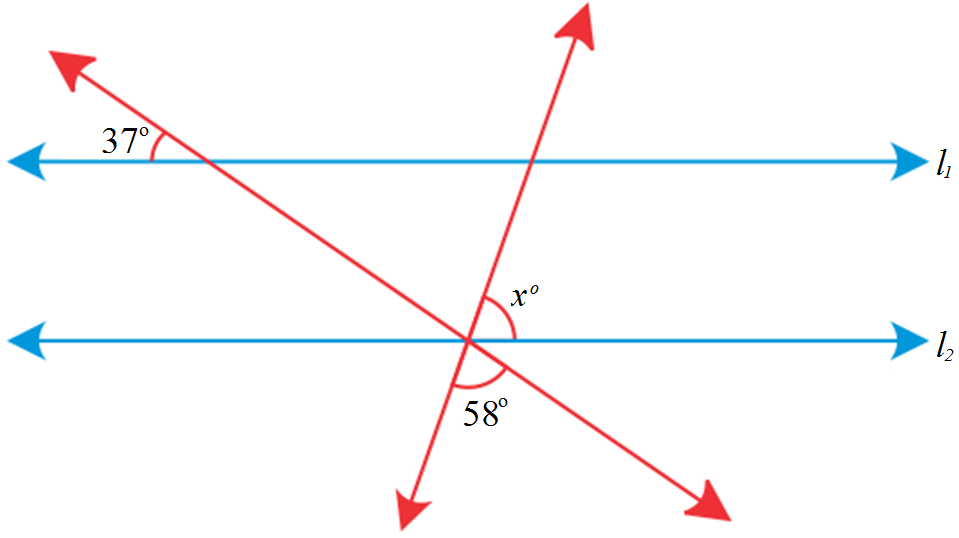
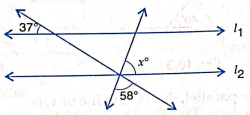
In figure, if $l_1$ || $l_ 2$, what is the value of $x$ ?
  • A
    $90^\circ$
  • $85^\circ$
  • C
    $75^\circ$
  • D
    $70^\circ$
Answer
Correct option: B.
$85^\circ$

From figure,
$\angle\text{ERC}=\angle\text{RPA}$ [Corresponding angles are equal]
$\Rightarrow \angle\text{ERC}=37^\circ=\angle\text{RPA}$
Also,
$\angle\text{RPA}=\angle\text{BPF}$ [Opposite angles]
$\Rightarrow\ \angle\text{RPA}=37^\circ=\angle\text{BPF}$
Now,
$\angle\text{QPB}+\angle\text{BPF}+\angle\text{FPG}=180^\circ$
$\Rightarrow\ \text{x}^\circ+37^\circ+58^\circ=180^\circ$
$\Rightarrow\ \text{x}^\circ=85^\circ$
View full question & answer
MCQ 181 Mark
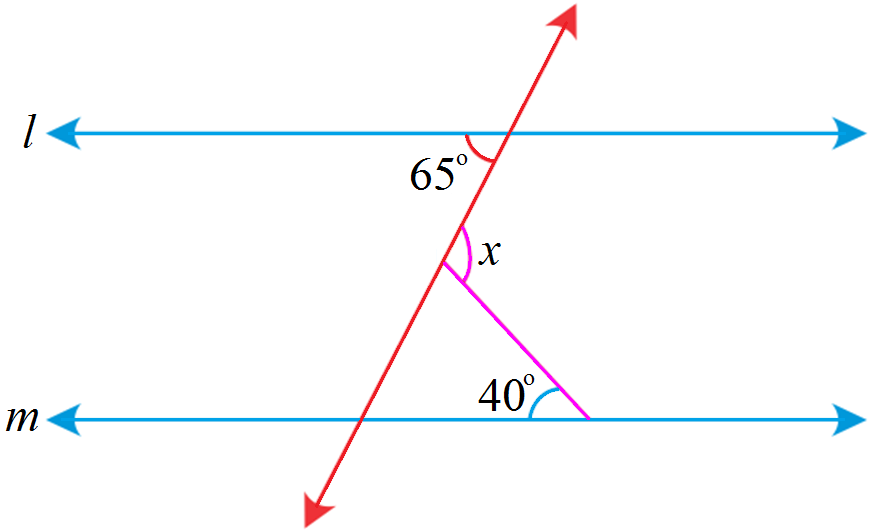
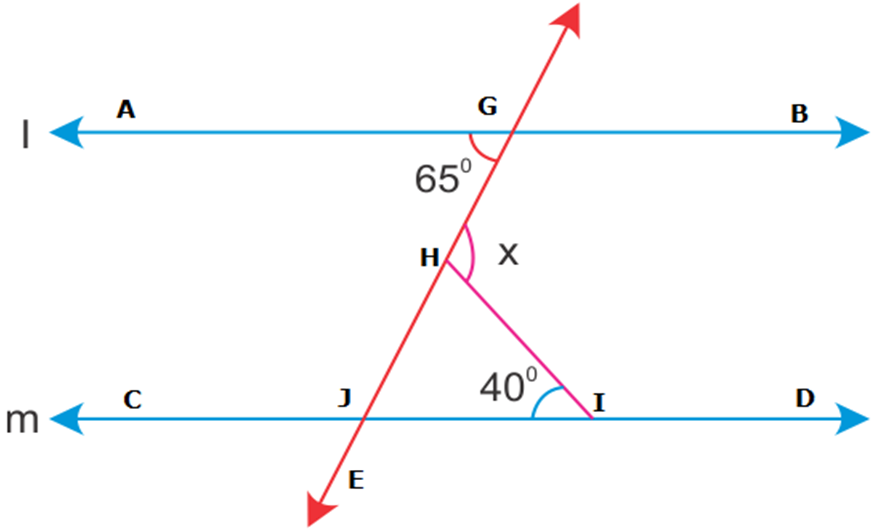
In figure, if $l || m$, then $x =$
  • $105^\circ$
  • B
    $65^\circ$
  • C
    $40^\circ$
  • D
    $25^\circ$
Answer
Correct option: A.
$105^\circ$

From figure,
$\angle\text{AGE}=\angle\text{FGB}$ [Opposite angles]
$\Rightarrow\ \angle\text{FGB}=65^\circ$
Also,
$\angle\text{FGB}=\angle\text{HJI}$ [Corresponding angle]
$\Rightarrow\ \angle\text{HJI}=65^\circ$
Now, in $\angle\text{HJI},$
$\angle\text{HJI}+\angle\text{JIH}+\angle\text{IHJ}=180^\circ$
$\Rightarrow\ 65^\circ+40^\circ+\angle\text{IHJ}=180^\circ$
$\Rightarrow\ \angle\text{IHJ}=180^\circ-65^\circ-40^\circ=75^\circ$
Now,
$\text{x}=180^\circ-\angle\text{IHJ}=180^\circ-75^\circ$
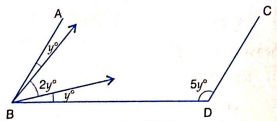
$=105^\circ$
View full question & answer
MCQ 191 Mark
Two lines $AB$ and $CD$ intersect at $O$. If $\angle\text{AOC}+\angle\text{COB}+\angle\text{BOD}=270^\circ,$then $\angle\text{AOC}=$
  • A
    $70^\circ$
  • B
    $80^\circ$
  • $90^\circ$
  • D
    $180^\circ$
Answer
Correct option: C.
$90^\circ$

$\angle\text{AOC}+\angle\text{COB}+\angle\text{BOD}=270^\circ$ [Given]
From figure,
$\angle\text{AOC}+\angle\text{COB}+\angle\text{BOD}+\angle\text{DOA}=360^\circ$
$\Rightarrow\ 270^\circ+\angle\text{DOA}=360^\circ$
$\Rightarrow\ \angle\text{DOA}=360^\circ-270^\circ=90^\circ$
Now,
$\angle\text{DOA}+\angle\text{AOC}=180^\circ$
$\Rightarrow\ \angle\text{AOC}=180^\circ-90^\circ=90^\circ$
View full question & answer
MCQ 201 Mark
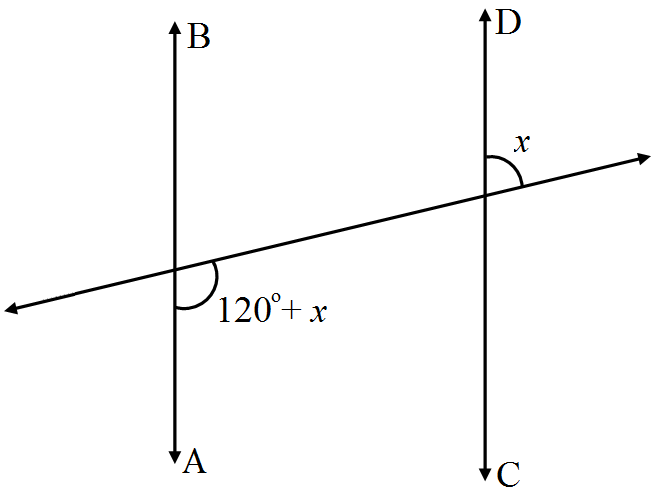
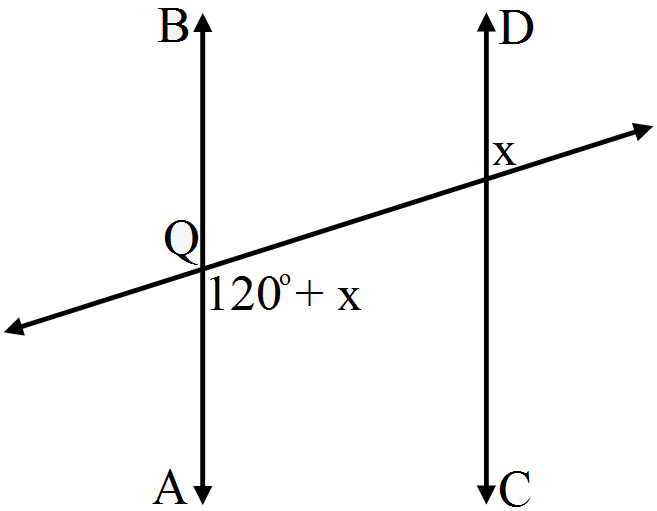
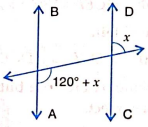
In figure, if $AB || CD$, then the value of $x$ is:
  • A
    $20^\circ$
  • $30^\circ $
  • C
    $45^\circ$
  • D
    $60^\circ$
Answer
Correct option: B.
$30^\circ $

From figure,
$\angle\text{DPQ}+\angle\text{x}^\circ=180^\circ\dots(1)$ [linear pair]
Also,
$\angle\text{DPQ}=\angle\text{AQP}$ [Interior opposite angles]
$\Rightarrow\ \angle\text{DPQ}=120^\circ+\text{x}$
From (1),
$120^\circ+\text{x}+\text{x}=180^\circ$
$\Rightarrow\ 2\text{x}=60^\circ$
$\Rightarrow\text{x}=30^\circ$
View full question & answer
MCQ 211 Mark
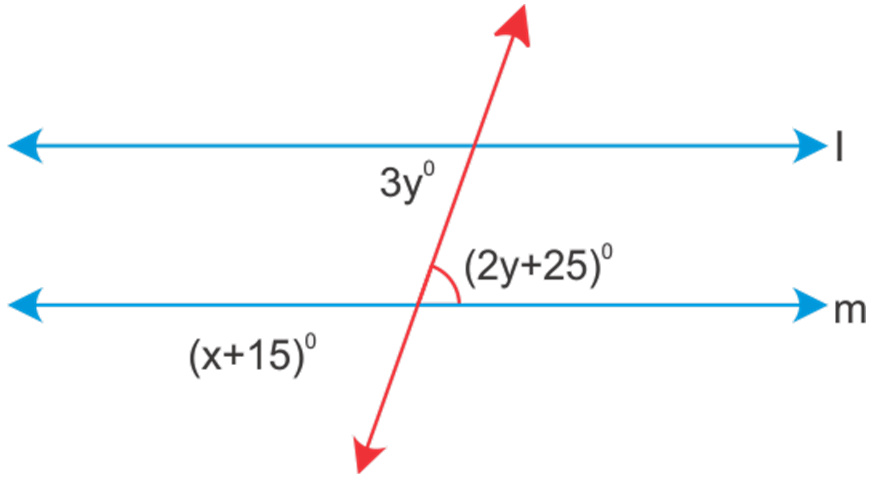
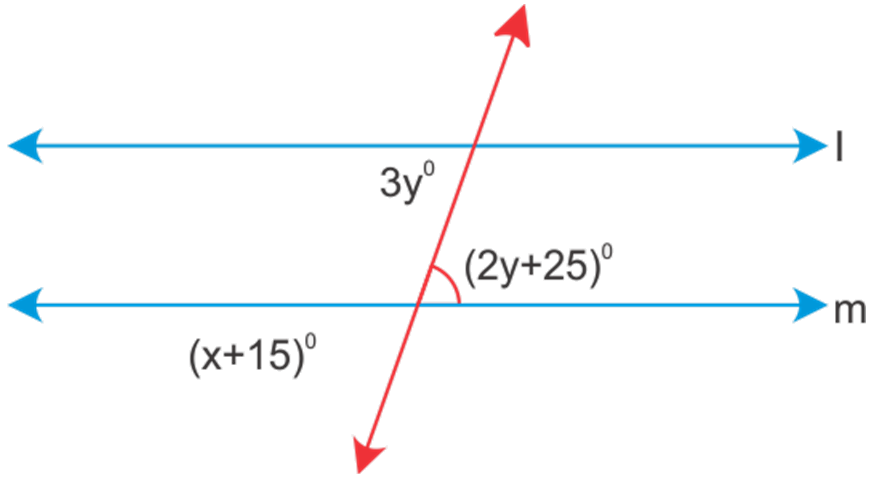
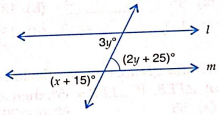
In figure, if $l || m$, what is the value of $x$?
  • $60$
  • B
    $50$
  • C
    $45$
  • D
    $30$
Answer
Correct option: A.
$60$

$3y^\circ = 2y^\circ + 25^\circ$ [Alternate angles]
$\Rightarrow y^\circ = 25^\circ $
Now,
$x^\circ + 15^\circ = 2y^\circ + 25^\circ $ [Opposite angles]
$\Rightarrow x = 2y^\circ + 25^\circ - 15^\circ $
$\Rightarrow x = 2y^\circ + 10^\circ $
$\Rightarrow x = 2 \times 25^\circ + 10^\circ $
$\Rightarrow x = 60^\circ $
View full question & answer
MCQ 221 Mark
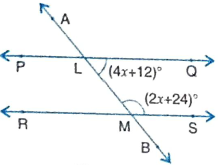
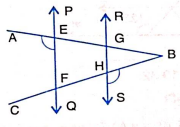
In Fig , if transversal $A B$ cuts parallel lines $P Q$ and $R S$ at $L$ and $M$ respectively. Then, then the value of $x$ is
Image
  • A
    $20^{\circ}$
  • B
    $24^{\circ}$
  • C
    $30^{\circ}$
  • D
    $34^{\circ}$
Answer
B. $24^{\circ}$
We find that $\angle Q L M$ and $\angle S M L$ are alternate interior angles.$
\therefore \quad 4 x+12+2 x+24=180^{\circ} \Rightarrow 6 x+36^{\circ}=180^{\circ} \Rightarrow 6 x=144^{\circ} \Rightarrow x=24^{\circ}
$
View full question & answer
MCQ 231 Mark
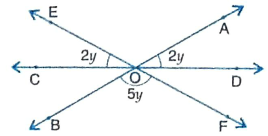
In Fig , if $A B, C D$ and $E F$ are three lines concurrent at $O$, then $y=$
Image
  • A
    $10^{\circ}$
  • B
    $30^{\circ}$
  • C
    $20^{\circ}$
  • D
    $15^{\circ}$
Answer
C. $20^{\circ}$
We find that $\angle A O E$ and $B O F$ are vertically opposite angles.$
\angle A O E=\angle B O F \Rightarrow \angle A O E=5 y .
$
Since $C O D$ is a straight line. Therefore,
$
\begin{array}{ll}
& \angle C O E+\angle E O A+\angle A O D=180^{\circ} \\
\Rightarrow \quad & 2 y+5 y+2 y=180^{\circ} \Rightarrow 9 y=180^{\circ} \Rightarrow y=20^{\circ}
\end{array}
$
View full question & answer
MCQ 241 Mark
  • A
    $85^{\circ}$
  • B
    $145^{\circ}$
  • C
    $135^{\circ}$
  • D
    $40^{\circ}$
Answer
A. $85^{\circ}$
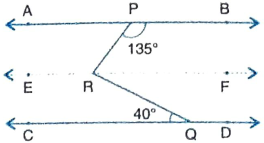
Through point $R$ draw $E F\|A B\| C D$.$
\begin{array}{lll}
& \angle A P R=\angle P R F & \text { [Alternate angles] } \\
\Rightarrow & \angle P R F=180^{\circ}-135^{\circ}=45^{\circ} & \\
\text { Also, } & \angle F R Q=\angle CQR & \text { [Alternate angles] } \\
\Rightarrow & \angle F R Q=40^{\circ} &
\end{array}
$
$
\text { Hence, } \angle P R Q=\angle P R F+\angle F R Q=45^{\circ}+40^{\circ}=85^{\circ}
$
View full question & answer
MCQ 251 Mark
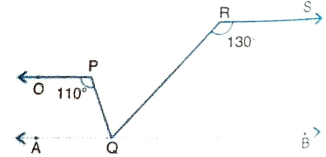
In Fig , if $O P \| R S, \angle O P Q=100^{\circ}$ and $\angle Q R S=130^{\circ}$, then $\angle P Q R$ is equal to
Image
  • A
    $40^{\circ}$
  • B
    $50^{\circ}$
  • C
    $60^{\circ}$
  • D
    $70^{\circ}$
Answer
C. $60^{\circ}$
Through $Q$, draw $A Q B\|O P\| R S$.
Now, $O P \| A B$ and transversal $P Q$ cuts them at $P$ and $Q$ respectively.
$\therefore$ $\angle O P Q+\angle A Q P=180^{\circ}$
$\Rightarrow$ $110^{\circ}+\angle A Q P=180^{\circ}$
$\Rightarrow$ $\angle A Q P=70^{\circ}$
$A B \| R S$ and transversal $Q R$ cuts them at $Q$ and $R$ respectively.
$\therefore$ $\angle B Q R+\angle Q R S=180^{\circ} \Rightarrow \angle B Q R+130^{\circ}=180^{\circ} \Rightarrow \angle B Q R=50^{\circ}$
Since, AQB is a straight line. Therefore,
$\angle A P Q+\angle B Q R+\angle P Q R=180^{\circ}$ $\Rightarrow 70^{\circ}+50^{\circ}+\angle P Q R=180^{\circ}$ $\Rightarrow \angle P Q R=60^{\circ}$
View full question & answer
MCQ 261 Mark
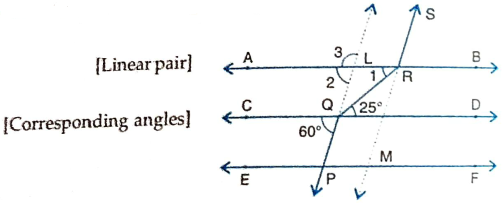
In Fig , if $A B\|C D\| E F, P Q \| R S, \angle R Q D=25^{\circ}$ and $\angle C Q P=60^{\circ}$, then $\angle Q R S$ is equal to
Image
  • A
    $85^{\circ}$
  • B
    $135^{\circ}$
  • C
    $145^{\circ}$
  • D
    $110^{\circ}$
Answer
C. $145^{\circ}$
Produce $P Q$ and $S R$ to intersect $A B$ and $E F$ respectively at $L$ and $M$.
Now, $A B \| C D$ and transversal $Q R$ cuts them at $R$ and $S$ respectively.
$
\therefore \quad \angle I=25^{\circ}
$
Again, $A B \| C D$ and transversal $Q L$ cuts them at $L$ and $Q$ respectively.$
\begin{array}{lr}
\therefore & \angle 2=60^{\circ} \\
\text { But, } & \angle 2+\angle 3=180^{\circ} \\
\therefore & \angle 3=120^{\circ}
\end{array}
$
But, $\angle A R S=\angle 3$

$
\therefore \quad \angle A R S=120^{\circ}
$
But, $\angle Q R S=\angle 1+\angle A R S$

$
\therefore \quad \angle Q R S=25^{\circ}+120^{\circ}=145^{\circ}
$

View full question & answer
MCQ 271 Mark
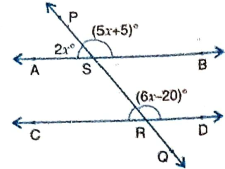
Answer
A. Yes, because measures of corresponding angles $\angle D R S$ and $\angle B S P$ are equal and their measure is $130^{\circ}$.
We find that $\angle B S P$ and $\angle A S P$ form a linear pair.$
\begin{array}{ll}
\therefore & \angle B S P+\angle A S P=180^{\circ} \Rightarrow 5 x+5+2 x=180 \Rightarrow 7 x=175 \Rightarrow x=25 \\
\therefore & \angle B S P=(5 \times 25+5)^{\circ}=130^{\circ} \text { and } \angle D R S=(6 \times 25-20)^{\circ}=130^{\circ} \\
\Rightarrow & \angle B S P=\angle D R S
\end{array}
$
Thus, lines $A B$ and $C D$ are intersected by transversal $P Q$ such that corresponding angles are equal. Hence, $A B \| C D$.
View full question & answer
MCQ 281 Mark
Answer
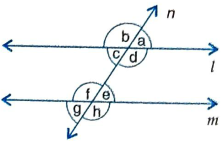
B. $d=h$ as $d$ and $h$ are corresponding angles.
We observe that $c=e$ as these are alternate angles. So, statement (a) is not correct. We find that $d$ and $h$ are corresponding angles. Therefore, $d=h$. So, statement (b) is correct.
Statement (c) is not correct as $b$ and $g$ are not corresponding angles.
Finally, we find that $a$ and $e$ are corresponding angles. Therefore $a=e$. So, statement (d) is not correct.
View full question & answer
MCQ 291 Mark
Answer
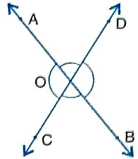
A. $\angle A O C$ and $\angle B O D$ are adjacent angles
From Fig. , we observe that $\angle A O D$ and $\angle C O B$ form a pair of vertically opposite angles. So, statement (d) is true. Since $A O B$ is a straight line. Therefore,$
\begin{aligned}
& \angle A O D+\angle D O B=180^{\circ} \\
\Rightarrow \quad & \angle A O D \text { and } \angle D O B \text { are supplementary angles. }
\end{aligned}
$
Therefore, option (c) is true.
Clearly, $\angle A O C$ and $\angle C O B$ form a linear pair. So, option (b) is also true.
$\angle A O C$ and $\angle B O D$ are vertically opposite angles. So, statement in option (a) is false
View full question & answer
MCQ 301 Mark
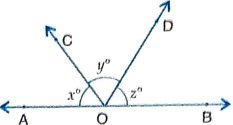
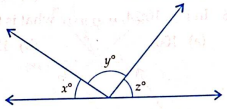
In Fig , $A O B$ is a straight line. If $x: y: z=4: 5: 6$, then $y=$
Image
  • A
    60
  • B
    80
  • C
    48
  • D
    72
Answer
A. 60
It is given that $x: y: z=4: 5: 6$.
So, let $x=4 k, y=5 k, z=6 k$. $A O B$ is a straight line.$
\begin{array}{ll}
\therefore & \angle A O C+\angle C O D+\angle D O B=180^{\circ} \\
\Rightarrow & x+y+z=180 \Rightarrow 4 k+5 k+6 k=180 \Rightarrow 15 k=180 \Rightarrow k=12 \\
\therefore & y=5 k=60
\end{array}
$
View full question & answer
MCQ 311 Mark
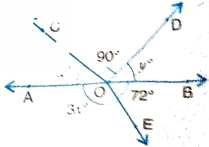
In Fig , the value of $y$ is
Image
  • A
    36
  • B
    54
  • C
    63
  • D
    72
Answer
B. 54
Since $A O B$ is a straight line.$
\begin{array}{ll}
\therefore & \angle A O C+\angle C O D+\angle D O B=180^{\circ} \text { and } \angle A O E+\angle E O B=180^{\circ} \\
\Rightarrow & x+90+y=180 \text { and } 3 x+72=180 \\
\Rightarrow & x+y=90 \text { and } x=36 \Rightarrow x=36 \text { and } y=54
\end{array}
$
View full question & answer
MCQ 321 Mark
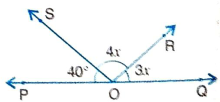
In Fig , POQ is a line. The value of $x$ is
Image
  • A
    $20^{\circ}$
  • B
    $25^{\circ}$
  • C
    $30^{\circ}$
  • D
    $35^{\circ}$
Answer
A. $20^{\circ}$
It is given that $P O Q$ is a straight line.
$
\begin{array}{ll}
\therefore & \angle P O S+\angle S O R+\angle R O Q=180^{\circ} \\
\Rightarrow & 40^{\circ}+4 x+3 x=180^{\circ} \Rightarrow 7 x=140^{\circ} \Rightarrow x=20^{\circ}
\end{array}
$
View full question & answer
MCQ 331 Mark
If supplement of an angle is three times its complement, then the measure of the angle is
  • A
    $45^{\circ}$
  • B
    $40^{\circ}$
  • C
    $90^{\circ}$
  • D
    $50^{\circ}$
Answer
A. $45^{\circ}$
 Let the degree measure of the required angle be $x$. Then, the measures of its supplement and complement are $180^{\circ}-x$ and $90^{\circ}-x$ respectively.
It is given that$
180^{\circ}-x=3\left(90^{\circ}-x\right) \Rightarrow 2 x=90^{\circ} \Rightarrow x=45^{\circ}
$
View full question & answer
MCQ 341 Mark
If the measures of two supplementary angles are $(3 x+15)^{\circ}$ and $(2 x+5)^{\circ}$, then $x=$
  • A
    32
  • B
    64
  • C
    14
  • D
    24
Answer
A. 32
we have,
$
3 x+15+2 x+5=180 \Rightarrow 5 x+20=180 \Rightarrow 5 x=160 \Rightarrow x=32
$
View full question & answer
MCQ 351 Mark
The measure of an angle which is twice its supplement is
  • A
    $60^{\circ}$
  • B
    $120^{\circ}$
  • C
    $110^{\circ}$
  • D
    $130^{\circ}$
Answer
B. $120^{\circ}$
Let the measure of the required angle be $x^{\circ}$. Then the measure of its supplement is $180^{\circ}-x^{\circ}$. It is given that
$
x=2(180-x) \Rightarrow 3 x=360 \Rightarrow x=120
$
View full question & answer
MCQ 361 Mark
The measure of an angle which excends its complement by $30^{\circ}$ is
  • A
    $150^{\circ}$
  • B
    $120^{\circ}$
  • C
    $60^{\circ}$
  • D
    $80^{\circ}$
Answer
C. $60^{\circ}$
 Let the measure of the required angle be $x^{\circ}$. Then, the measure of its complement is $90^{\circ}-x^{\circ}$. It is given that
$
x-(90-x)=30 \Rightarrow 2 x=120 \Rightarrow x=60
$
View full question & answer
MCQ 371 Mark
Two angles are supplementary. One of them is an acute angle. Which of the following could be the measure of the other angle?
  • A
    $60^{\circ}$
  • B
    $120^{\circ}$
  • C
    $200^{\circ}$
  • D
    $240^{\circ}$
Answer
B. $120^{\circ}$
Let $x$ and $y$ be the degree measures of two supplementary angles such that $x$ is an acute angle i.e. $x<90^{\circ}$. Then
 $x+y=180^{\circ}$ $\Rightarrow y=180^{\circ}-x$ $\Rightarrow$ $90^{\circ}$ < y < $180^{\circ}$ 
 Clearly, option (b) satisfies this relation.
View full question & answer
MCQ 381 Mark
In Fig. if CP ||BQ, then the measure of x is
Image
  • $130^{\circ}$
  • B
    $105^{\circ}$
  • C
    $175^{\circ}$
  • D
    $125^{\circ}$
Answer
Correct option: A.
$130^{\circ}$
a
View full question & answer
MCQ 391 Mark
In Fig. if line segment AB is parallel to the line segment CD, what is the value of y?
Image
  • A
    12
  • B
    15
  • C
    18
  • 20
Answer
Correct option: D.
20
d
View full question & answer
MCQ 401 Mark
AB and CD are two parallel lines. PQ cuts AB and CD at E and F respectively. EL is the bisector of $\angle F E B$. If $\angle L E B=35^{\circ}$, then $\angle C F Q$ will be
  • A
    $55^{\circ}$
  • B
    $70^{\circ}$
  • $110^{\circ}$
  • D
    $130^{\circ}$
Answer
Correct option: C.
$110^{\circ}$
c
View full question & answer
MCQ 411 Mark
In Fig. if $\frac{y}{x}=5$ and $\frac{z}{x}=4$, then the value of x is
Image
  • A
    $8^{\circ}$
  • $18^{\circ}$
  • C
    $12^{\circ}$
  • D
    $15^{\circ}$
Answer
Correct option: B.
$18^{\circ}$
b
View full question & answer
MCQ 421 Mark
Two complementary angles are such that two times the measure of one is equal to three times the measure of the other. The measure of the smaller angle, is
  • A
    $45^{\circ}$
  • B
    $30^{\circ}$
  • $36^{\circ}$
  • D
    none of these
Answer
Correct option: C.
$36^{\circ}$
c
View full question & answer
MCQ 431 Mark
In Fig. if lines 1 and m are parallel, then the value of x is
Image
  • $35^{\circ}$
  • B
    $55^{\circ}$
  • C
    $65^{\circ}$
  • D
    $75^{\circ}$
Answer
Correct option: A.
$35^{\circ}$
a
View full question & answer
MCQ 441 Mark
In Fig. if l ||m 1 then x =
Image
  • $105^{\circ}$
  • B
    $65^{\circ}$
  • C
    $40^{\circ}$
  • D
    $25^{\circ}$
Answer
Correct option: A.
$105^{\circ}$
a
View full question & answer
MCQ 451 Mark
In Fig. if lines I and m are parallel lines, then x =
Image
  • A
    $70^{\circ}$
  • B
    $100^{\circ}$
  • $40^{\circ}$
  • D
    $30^{\circ}$
Answer
Correct option: C.
$40^{\circ}$
c
View full question & answer
MCQ 461 Mark
In Fig. if AB ||CD, then x =
Image
  • $100^{\circ}$
  • B
    $105^{\circ}$
  • C
    $110^{\circ}$
  • D
    $115^{\circ}$
Answer
Correct option: A.
$100^{\circ}$
a
View full question & answer
MCQ 471 Mark
In Fig. if lines / and I are parallel, then x =
Image
  • A
    $20^{\circ}$
  • $45^{\circ}$
  • C
    $65^{\circ}$
  • D
    $85^{\circ}$
Answer
Correct option: B.
$45^{\circ}$
b
View full question & answer
MCQ 481 Mark
In Fig. if AB || HF and DE || FG, then the measure of $\angle F D E$ is
Image
  • A
    $108^{\circ}$
  • $80^{\circ}$
  • C
    $100^{\circ}$
  • D
    $90^{\circ}$
Answer
Correct option: B.
$80^{\circ}$
b
View full question & answer
MCQ 501 Mark
In Fig. if $l_1 \| l_2$ and $l_3 \| l_4$ what is y in terms of x?
Image
  • A
    90 + x
  • B
    90 + 2x
  • $90-\frac{x}{2}$
  • D
    90 - 2x
Answer
Correct option: C.
$90-\frac{x}{2}$
c
View full question & answer
MCQ 521 Mark
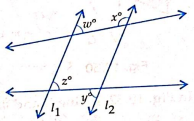
In Fig. if $l_1 \| l_2$, what is x + y in terms of w and z?
Image
  • 180 - w + z
  • B
    180 + w - z
  • C
    180 - w - z
  • D
    180 + w + z
Answer
Correct option: A.
180 - w + z
a
View full question & answer
MCQ 531 Mark
In Fig. if $l_1 \| l_2$, what is the value of x?
Image
  • A
    $90^{\circ}$
  • $85^{\circ}$
  • C
    $75^{\circ}$
  • D
    $70^{\circ}$
Answer
Correct option: B.
$85^{\circ}$
b
View full question & answer
MCQ 541 Mark
In Fig. PQ ||RS, $\angle A E F=95^{\circ}, \angle B H S=110^{\circ}$ and $\angle A B C=x^{\circ}$.Then the value of x is
Image
  • A
    $15^{\circ}$
  • $25^{\circ}$
  • C
    $70^{\circ}$
  • D
    $35^{\circ}$
Answer
Correct option: B.
$25^{\circ}$
b
View full question & answer
MCQ 551 Mark
Two lines AB and CD intersect at O. If $\angle A O C+\angle C O B+\angle B O D=270^{\circ}$, then $\angle A O C=$
  • A
    $70^{\circ}$
  • B
    $80^{\circ}$
  • $90^{\circ}$
  • D
    $180^{\circ}$
Answer
Correct option: C.
$90^{\circ}$
c
View full question & answer
MCQ 561 Mark
In Fig. if AB ||CD, then the value of x is
Image
  • A
    $20^{\circ}$
  • $30^{\circ}$
  • C
    $45^{\circ}$
  • D
    $60^{\circ}$
Answer
Correct option: B.
$30^{\circ}$
b
View full question & answer
MCQ 571 Mark
If two interior angles on the same side of a transversal intersecting two parallel lines are in the ratio 2/3 then the measure of the larger angle, is
  • A
    $54^{\circ}$
  • B
    $120^{\circ}$
  • $108^{\circ}$
  • D
    $136^{\circ}$
Answer
Correct option: C.
$108^{\circ}$
c
View full question & answer
MCQ 581 Mark
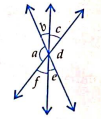
In Fig. which of the following statements must be true?
(i) a+b=d+c$\quad$(ii) $a+c+e=180^{\circ}$$\quad$(iii) b+f=c+e
Image
  • A
    (i) only
  • B
    (ii) only
  • C
    (iii) only
  • (ii) and (iii) only
Answer
Correct option: D.
(ii) and (iii) only
d
View full question & answer
MCQ 601 Mark
In Fig. the value of y, is
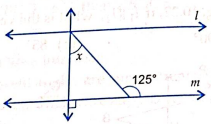
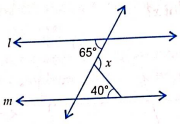
Image
  • A
    $20^{\circ}$
  • $30^{\circ}$
  • C
    $45^{\circ}$
  • D
    $60^{\circ}$
Answer
Correct option: B.
$30^{\circ}$
b
View full question & answer
MCQ 611 Mark
In Fig. AOB is a straight line. If $\angle A O C+\angle B O D=85^{\circ}$, then $\angle C O D=$
Image
  • A
    $85^{\circ}$
  • B
    $90^{\circ}$
  • $95^{\circ}$
  • D
    $100^{\circ}$
Answer
Correct option: C.
$95^{\circ}$
c
View full question & answer
MCQ 621 Mark
Given $\angle P O R=3 x$ and $\angle Q O R=2 x+10^{\circ}$. If POQ is a straight line, then the value of x is
  • A
    $30^{\circ}$
  • $34^{\circ}$
  • C
    $36^{\circ}$
  • D
    none of these
Answer
Correct option: B.
$34^{\circ}$
b
View full question & answer
MCQ 631 Mark
Consider the following statements: When two straight lines intersect:
(i) adjacent angles are complementary
(ii) adjacent angles are supplementary
(iii) opposite angles are equal
(iv) opposite angles are supplementary
Of these statements
  • A
    (i) and (iii) are correct
  • (ii) and (iii) are correct
  • C
    (i) and (iv) are correct
  • D
    (ii) and (iv) are correct
Answer
Correct option: B.
(ii) and (iii) are correct
b
View full question & answer
MCQ 641 Mark
Two straight lines AB and CD cut each other at O. If $\angle B O D=63^{\circ}$, then $\angle B O C=$
  • A
    $63^{\circ}$
  • $117^{\circ}$
  • C
    $17^{\circ}$
  • D
    $153^{\circ}$
Answer
Correct option: B.
$117^{\circ}$
b
View full question & answer
MCQ 651 Mark
Two straight lines AB and CD intersect one another at the point O. If $\angle A O C+\angle C O B+\angle B O D=274^{\circ}$, then $\angle A O D=$
  • $80^{\circ}$
  • B
    $90^{\circ}$
  • C
    $94^{\circ}$
  • D
    $137^{\circ}$
Answer
Correct option: A.
$80^{\circ}$
a
View full question & answer
MCQ 661 Mark
One angle is equal to three times its supplement. The measure of the angle is
  • A
    $130^{\circ}$
  • $135^{\circ}$
  • C
    $90^{\circ}$
  • D
    $120^{\circ}$
Answer
Correct option: B.
$135^{\circ}$
b
View full question & answer