Questions

2 Marks Questions

Take a timed test

19 questions · self-marked practice — reveal the answer and mark yourself.

Question 12 Marks
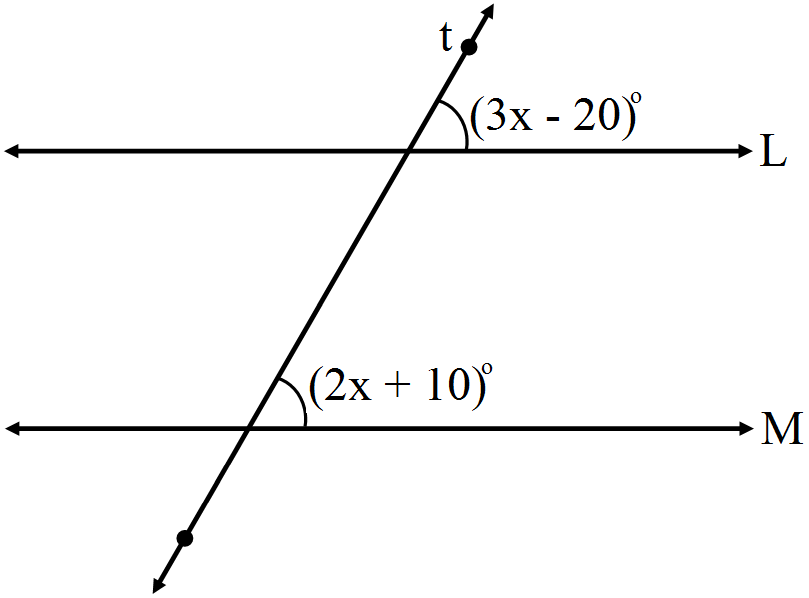
For what value of $x$ will the lines $l$ and $m$ be parallel to each other?
 
Answer
Lines l and m will be parallel if $3x - 20 = 2x + 10$ [Since, if corresponding angles are equal, lines are parallel]
$\Rightarrow 3x - 2x = 10 + 20$
$ \Rightarrow x = 30$
View full question & answer
Question 22 Marks
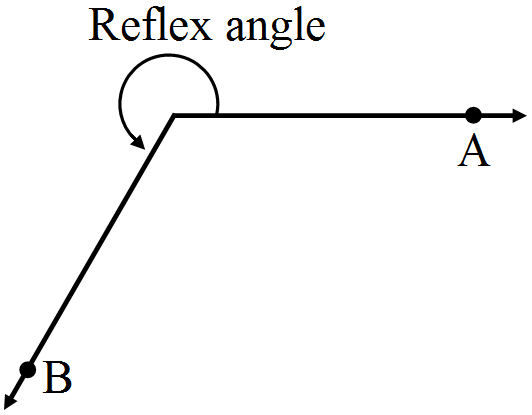
Define the following terms: Reflex angle.
Answer
An angle greater than $180^\circ $but less than $360^\circ $is called a reflex angle.
​​​​​​​
View full question & answer
Question 32 Marks
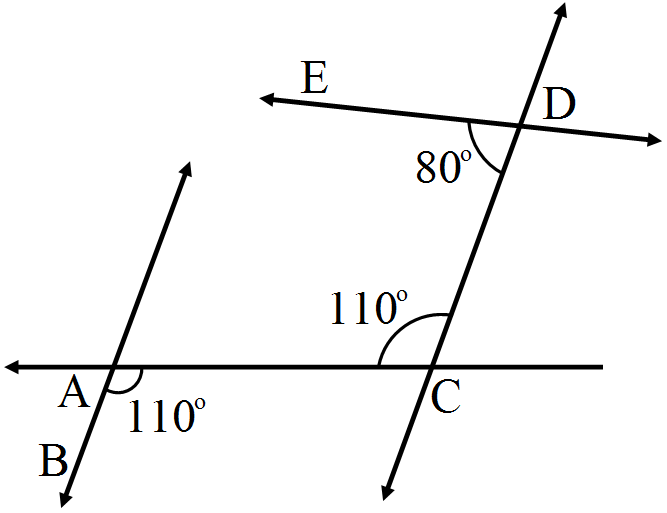
In the figure given below, state which lines are parallel and why?
Answer
In the given figure, $\angle\text{BAC}=\angle\text{ACD}=110^\circ$ But, these are alternate angles when transversal $AC$ cuts $AB$ and $CD$. Hence, $AB \| CD.$
View full question & answer
Question 42 Marks
Find the angle which is four times its complement.
Answer
Let the measure of the required angle be $x$.
Then, measure of its complement $= (90^\circ - x).$
Therefore, $x = (90^\circ - x)4$
$\Rightarrow x = 360^\circ - 4x$
$\Rightarrow 5x = 360^\circ $
$\Rightarrow x = 72^\circ $
Hence, the measure of the required angle is $72^\circ $.
View full question & answer
Question 52 Marks
Define the following terms: Supplementary angles.
Answer
Two angles are said to be supplementary if the sum of their measures is $180^\circ .$
View full question & answer
Question 62 Marks
Find theangle which is five times its supplement.
Answer
Let the measure of the required angle be $x$ .
Then, measure of its supplement $=\left(180^{\circ}- x \right)$.
Therefore, $x =\left(180^{\circ}- x \right) 5$
$\Rightarrow x=900^{\circ}-5 x $
$ \Rightarrow 6 x=900^{\circ} x=150^{\circ}$
Hence, the measure of the required angle is $150^{\circ}$.
View full question & answer
Question 72 Marks
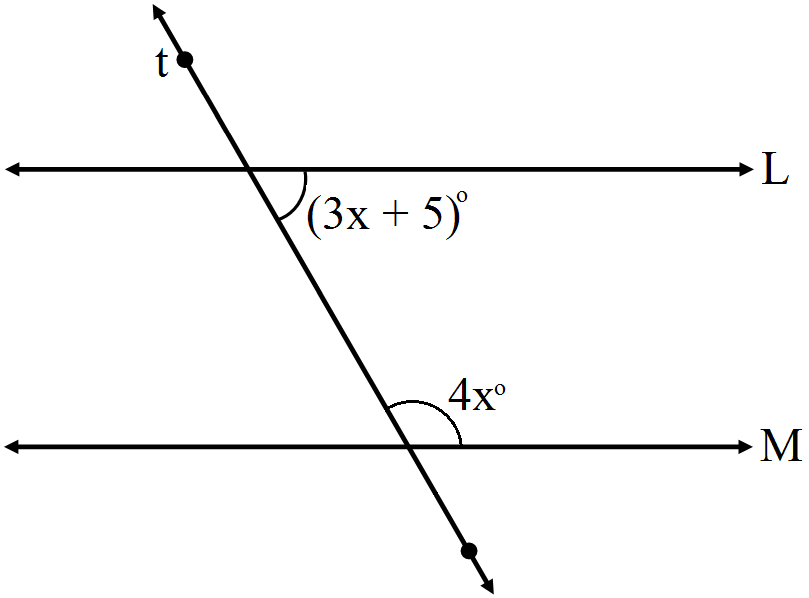
For what value of $x$ will the lines $l$ and $m$ be parallel to each other?
Answer
$⇔ 3x + 5 + 4x = 180$ [Consecutive Interior Angle] $⇔ 7x = 175 ⇔ x = 25$
View full question & answer
Question 82 Marks
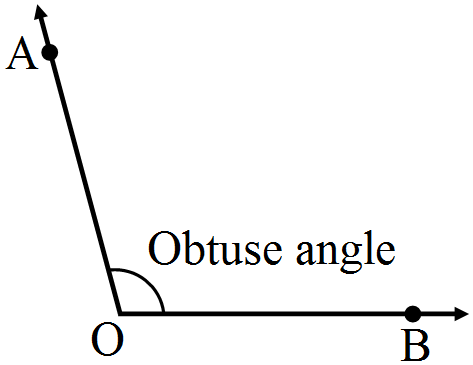
Define the following terms: Obtuse angle.
Answer
An angle greater than $90^\circ $ but less than $180^\circ $ is called an obtuse angle.
View full question & answer
Question 92 Marks
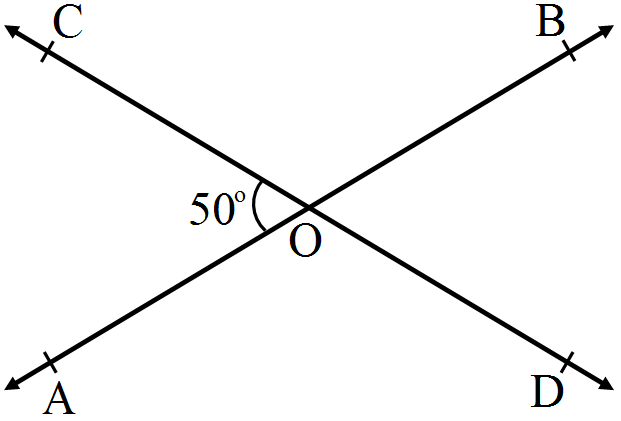
Two lines $AB$ and $CD$ intersect at $O$. If $\angle\text{AOC}=50^\circ,$ find $\angle\text{AOD},\angle\text{BOD}$ and $\angle\text{BOC}.$
 
Answer
We know that if two lines intersect then the vertically-opposite angle are equal.
Therefore, $\angle\text{AOC}=\angle\text{BOD}=50^\circ$
Let $\angle\text{AOD}=\angle\text{BOC}=\text{x}^\circ$
Also, we know that the sum of all angles around a point is $360^\circ $.
Therefore, $\angle\text{AOC}+\angle\text{AOD}+\angle\text{BOD}+\angle\text{BOC}=360^\circ$
$\Rightarrow 50 + x + 50 + x = 360^\circ$
$\Rightarrow 2x = 260^\circ$
$\Rightarrow x = 130^\circ$
Hence, $\angle\text{AOD}=\angle\text{BOC}=130^\circ$
​​​​​​​Therefore, $\angle\text{AOD}=130^\circ,\angle\text{BOD}=50^\circ$ and $\angle\text{BOC}=130^\circ.$
View full question & answer
Question 102 Marks
Find the measure of an angle which is: Equal to its supplement.
Answer
Let the measure of the rquired angle be $x^\circ $.
Then, in case of supplementary angle: $x + x = 180^\circ $
$\Rightarrow 2x = 180^\circ $
$\Rightarrow x = 90^\circ $
Hence, measure of the angle that is equal to its supplement is $90^\circ .$
View full question & answer
Question 112 Marks
Two adjacent angles on a straight line are in the ratio $5 : 4$. Find the measure of each of these angles.
Answer
Let the two adjacent angles be $5x$ and $4x$, respectively.
Then, $5x + 4x = 180^\circ $
$\Rightarrow 9x = 180^\circ $
$\Rightarrow x = 20^\circ $
Hence, the two angles are $5 \times 20^\circ = 100^\circ $ and $4 \times 20^\circ = 80^\circ .$
View full question & answer
Question 122 Marks
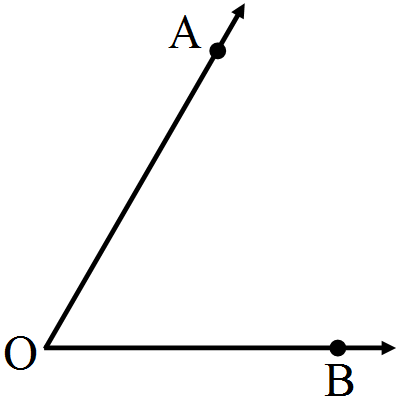
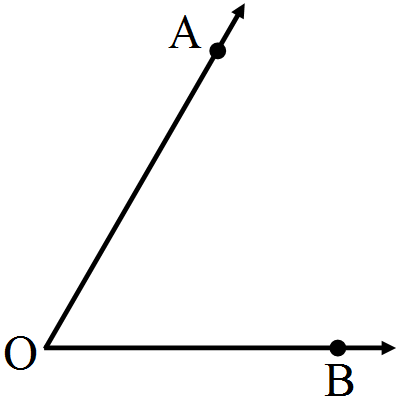
Define the following terms: Interior of an angle.
Answer
The interior of an angle is the set of all points in its plane, which lie on the same side of $OA$ as $B$ and also on the same side of as $A.$
View full question & answer
Question 132 Marks
Find the measure of an angle which is: Equal to its complement.
Answer
Let the measure of the required angle be $x^{\circ}$.
Then, in case of complementary angle: $x+x=90^{\circ} $
$\Rightarrow 2 x=90^{\circ} $
$\Rightarrow x=45^{\circ}$
Hence, measure of the angle that is equal to its complement is $45^{\circ}$.
View full question & answer
Question 142 Marks
Define the following terms: Angle.
Answer
rays $OA$ and $OB$, with a common end-point $O$, form an angle $AOB$ that is represented as $\angle\text{AOB}.$
View full question & answer
Question 152 Marks
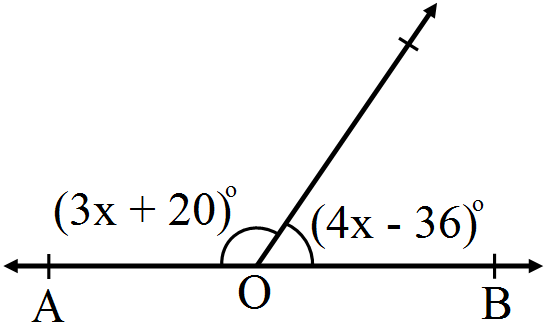
In the adjoining figure, what value of x will make $AOB$ a straight line?
Answer
AOB will be a straight line if $3 x+20+4 x-36=180^{\circ} $
$\Rightarrow 7 x=196^{\circ} $
$\Rightarrow x=28^{\circ}$
Hence, $x=28$ will make AOB a striaght line.
View full question & answer
Question 162 Marks
Two complementary angles are in the ratio $4 : 5$. Find the angles.
Answer
Let the angles be $4 x$ and $5 x$, respectively.
Then, $4 x+5 x=90 $
$\Rightarrow 9 x=90 $
$\Rightarrow x=10^{\circ}$
Hence, the two angles are $4 x=4 \times$
$10^{\circ}=40^{\circ}$ and $5 x=5 \times 10^{\circ}=50^{\circ}$.
View full question & answer
Question 172 Marks
Define the following terms: Complementary angles.
Answer
Two angles are said to be complementry if the sum of their measures is$ 90^\circ .$
View full question & answer
Question 182 Marks
Find the measure of an angle which is $36^\circ $ more than its complement.
Answer
Let the measure of the required angle be $x^\circ .$
then, measure of its complement $= (90 - x)^\circ .$
Therefore, $x - (90^\circ - x) = 36^\circ $
$\Rightarrow 2x = 126^\circ $
$\Rightarrow x = 63^\circ $
Hence, the measure of the required angle is $63^\circ .$
View full question & answer
Question 192 Marks
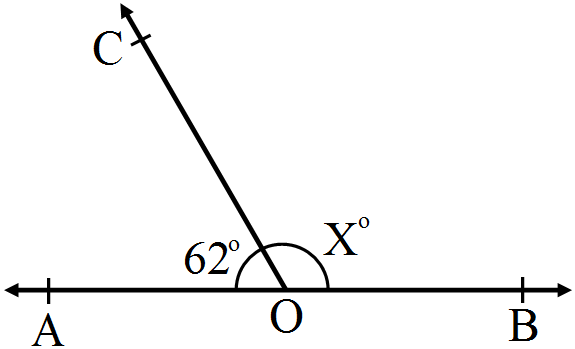
In the adjoining figure, $AOB$ is a straight line. Find the value of $x.$
 
Answer
We know that the sum of angles in a linear pair is $180^\circ .$
Therefore, $\angle\text{AOC}+\angle\text{BOC}=180^\circ$
$\Rightarrow 62^\circ + x^\circ = 180^\circ $
$\Rightarrow x^\circ = (180^\circ - 62^\circ ) $
$\Rightarrow x = 118^\circ $
Hence, the value of $x$ is $118^\circ .$
View full question & answer