Questions

3 Marks Question

Take a timed test

13 questions · self-marked practice — reveal the answer and mark yourself.

Question 13 Marks
A dome of a building is in the form of a hemisphere. From inside, it was white$-$washed at the cost of $Rs. 4989.60$. If the cost of white$-$washing is $Rs. 20$ per square metre. Find the
$i.$ inside surface area of the dome.
$ii.$ Volume of the air inside the dome.
Answer
Inside surface area of the dome $=\frac{4989.60}{20}=249.48\ m^2$
Let the radius of the hemisphere be $rm .$
Inside surface area $=249.48\ m^2$
$\Rightarrow 2 \pi r^2=249.48$
$\Rightarrow 2 \times \frac{22}{7} \times r^2=249.48$
$\Rightarrow r^2=\frac{249.48 \times 7}{2 \times 22}$
$\Rightarrow r^2=39.69$
$\Rightarrow r=\sqrt{39.69}$
$\Rightarrow r=6.3\ m$
$\therefore$ Volume of the air inside the dome $=\frac{2}{3} \pi r^3$
$=\frac{2}{3} \times \frac{22}{7} \times(6.3)^3=523.9\ m^3$
View full question & answer
Question 23 Marks
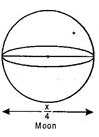
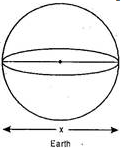
The diameter of the moon is approximately one-fourth the diameter of the earth. What fraction is the volume of the moon of the volume of the earth?
Answer
Let diameter of earth be $x$
$\therefore$ Radius of earth $\left( r \right)=\frac{x}{2}$
Now, Volume of earth = $\frac{4}{3}\pi {{r}^{3}}$ [$\because$ Earth is considered to be a sphere]
=$\frac{4}{3}\times \pi \times \frac{x}{2}\times \frac{x}{2}\times \frac{x}{2}$
=$\frac{1}{8}\times \frac{4}{3}\pi {{x}^{3}} ………..(i)$
According to question, Diameter of moon = $\frac{1}{4}\times$ Diameter of earth= $\frac{1}{4}\times x=\frac{x}{4}$
$\therefore$ Radius of moon $(R) =\frac{x}{8}$
Now, Volume of Moon$ = \frac{4}{3}\pi {{\text{R}}^{3}}$ [$\because$ Moon is considered to be a sphere]
=$\frac{4}{3}\times \pi \times \frac{x}{8}\times \frac{x}{8}\times \frac{x}{8}$
=$\frac{1}{512}\times \frac{4}{3}\pi {{x}^{3}}$
=$\frac{1}{64}\times \left[ \frac{1}{8}\times \frac{4}{3}\pi {{x}^{3}} \right]$
=$\frac{1}{64}\times$ Volume of Earth [From eq.$ (i)]$
$\therefore$ Volume of moon is $\frac{1}{64}th$ the volume of earth.
View full question & answer
Question 33 Marks
A heap of wheat is in the form of a cone whose diameter is 10.5 m and height is 3 m. Find its volume. The heap is to be covered by canvas to protect it from rain. Find the area of the canvas required.
Answer
For heap of wheat
$\text { Diameter }=10.5 \mathrm{~m}$
$\therefore \text { Radius }(\mathrm{r})=\frac{10.5}{2} \mathrm{~cm}=5.25 \mathrm{~m}$
$\text { Height }(\mathrm{h})=3 \mathrm{~m}$
$\therefore \text { Volume }=\frac{1}{3} \pi r^2 h$
$=\frac{1}{3} \times \frac{22}{7} \times(5.25)^2 \times 3$
$=86.625 \mathrm{~m}^3$
Slant height, $l=\sqrt{r^2+h^2}$
$=\sqrt{(5.25)^2+(3)^2}=\sqrt{27.5625+9}$
$=\sqrt{36.5625}=6.05 \mathrm{~m}$
$\therefore \text { Curved surface area }=\pi \mathrm{rl}$
$=\frac{22}{7} \times 5.25 \times 6.05=99.825 \mathrm{~m}^2$
$\therefore$ The area of the canvas required is $99.825 \mathrm{~m}^2$
View full question & answer
Question 43 Marks
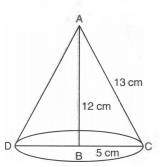
A right triangle $ABC$ with its sides $5 \ cm, 12 \ cm$, and $13 \ cm$ is revolved about the side $12 \ cm$. Find the volume of the solid so formed. If the triangle $ABC$ is revolved about side $5 \ cm$, then find the volume of the solid so obtained. Find also the ratio of the volumes of the two solids obtained.
Answer
Let $A B C$ be a right triangle with $A B=12 cm, B C=5 cm$ and $A C=13 cm$.
When this triangle is revolved about $A B$, it forms a right circular cone of radius $=B C=5 cm$ and height $A B=12 cm$.

$\therefore V _1=$ Volume of the solid formed $=$ Volume of the cone of radius 5 cm and height 12 cm
$=\frac{1}{3} \times \pi \times 5 \times 5 \times 12 cm^3=100 \pi cm^3$
When triangle $A B C$ is revolved about $B C$, it forms a right circular cone of radius $A B=12 cm$ and height $B C=5 cm$.
$\therefore V _2=$ Volume of the solid formed
$\Rightarrow V_2=$ Volume of the cone of radius 12 cm and height 5 cm
$\Rightarrow V _2=\frac{1}{3} \times \pi \times 12 \times 12 \times 5 cm^3=240 \pi cm^3$
$\therefore$ Required ratio $= V _1: V _2=100 \pi: 240 \pi=5: 12$
View full question & answer
Question 53 Marks
The diameter of the moon is approximately one fourth the diameter of the earth. Find the ratio of their surface areas.
Answer
Let diameter of Earth $= x$
$\therefore$ Radius of Earth $\left( r \right)=\frac{x}{2}$
$\therefore$ Surface area of Earth = $4\pi {{r}^{2}}$= $4\pi \times \frac{x}{2}\times \frac{x}{2}=\pi {{x}^{2}}$

Now, Diameter of Moon = $\frac{1}{4}th$ of diameter of Earth = $\frac{x}{4}$
$\therefore$ Radius of Moon $\left( r \right)$=$\frac{x}{8}$
Surface area of Moon = $4\pi {{r}^{2}}$= $4\pi \times \frac{x}{8}\times \frac{x}{8}=\frac{\pi {{x}^{2}}}{16}$
Now, Ratio = $\frac{\text{Surface area of Moon}}{\text{Surface area of Earth}}$=$\frac{\frac{\pi {{x}^{2}}}{16}}{\pi {{x}^{2}}}$=$\frac{\pi {{x}^{2}}}{16}\times \frac{1}{\pi {{x}^{2}}}$=$\frac{1}{16}$
$\therefore $ Required ratio $= 1: 16$
View full question & answer
Question 63 Marks
A bus stop is barricaded from the remaining part of the road, by using $50$ hollow cones made of recycled cardboard. Each cone has a base diameter of 40 cm and height $1 \ m$ . If the outer side of each of the cones is to be painted and the cost of painting is ₹ $12$ per $m ^2$, what will be the cost of painting all these cones? (Use $\pi=3.14$ and take $\sqrt{1.04}= 1.02)$
Answer
Diameter of cone $=40 cm$
$\Rightarrow$ Radius of cone $(r)=\frac{40}{2}$
$=20 cm$
$=\frac{20}{100} m$
$=0.2 m$
Height of cone $( h )=1 m$
Slant height of cone $(l)=\sqrt{r^2+h^2}$
$=\sqrt{(0.2)^2+(1)^2}$
$=\sqrt{1.04} m$
Curved surface area of cone $=\pi r l$
$=3.14 \times 0.2 \times \sqrt{1.04}$
$=0.64056 m^2$
$\because$ Cost of painting $1 m^2$ of a cone $= Rs. 12$
$\therefore$ Cost of painting $0.64056 m^2$ of a cone $=12 \times 0.64056= Rs. 7.68672$
$\therefore$ Cost of painting of $50$ such cones $=50 \times 7.68672= Rs. 384.34$ (approx.)
View full question & answer
Question 73 Marks
A Joker's cap is in the form of a right circular cone of base radius $7 \ cm$ and height $24 \ cm$. Find the area of the sheet required to make $10$ such caps.
Answer
Radius of cap $(r)=7 \mathrm{~cm}$, Height of cap $(h)=24 \mathrm{~cm}$
Slant height of the cone $(\mathrm{I})=\sqrt{r^2+h^2}=\sqrt{(7)^2+(24)^2}$
$=\sqrt{49+576}$
$=\sqrt{625}$
$=25 \mathrm{~cm}$
Area of sheet required to make a cap $=\operatorname{CSA}$ of cone $=\pi r l \pi \mathrm{rl}$
$=\frac{22}{7} \times 7 \times 25$
$=550 \mathrm{~cm}^2=550 \mathrm{~cm}^2$
$\therefore$ Area of sheet required to make $10$ caps $=10 \times 550=5500 \mathrm{~cm}^2$
View full question & answer
Question 83 Marks
A conical tent is $10 \ m$ high and the radius of its base is $24 \ m$. Find
$i.$ Slant height of the tent.
$ii.$ Cost of the canvas required to make the tent, if the cost of $1\ m^2$ canvas is $Rs. 70 .$
Answer
$i. h = 10\ m , r = 24\ m$
$l = { \sqrt{r^2+h^2}}={\sqrt{(24)^2+(10)^2}}$
$= {\sqrt{576+100}}={\sqrt{676}}$
$= 26 \ m$
$\therefore$ the slant height of the tent is $26 \ m$.
$ii.$ Curved surface area of the tent =$\pi rl$
$={22\over7}\times24\times26\ m^2$
$\therefore$ Cost of the canvas required to make the tent, if the cost of $1 \ m$ canvas is $Rs. 70$.
$={22\over7}\times24\times26\times70=Rs.137280$
$\therefore$ The cost of the canvas is $Rs. 137280.$
View full question & answer
Question 93 Marks
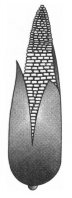
A corn cob (see Fig.), shaped somewhat like a cone, has the radius of its broadest end as $2.1 \ cm$ and length as $20 \ cm$ . If each 1 $cm ^2$ of the surface of the cob carries an average of four grains, find how many grains you would find on the entire cob?
Answer
Since the grains of corn are found on the curved surface of the corn cob.
So, Total number of grains on the corn cob = Curved surface area of the corn cob $\times$ Number of grains of corn on $1 cm^2$ Now, we will first find the curved surface area of the corn-cob.
We have, $r=2.1$ and $h=20$
Let I be the slant height of the conical corn cob. Then,
$l = \sqrt { r ^ { 2 } + h ^ { 2 } } = \sqrt { ( 2.1 ) ^ { 2 } + ( 20 ) ^ { 2 } } = \sqrt { 4.41 + 400 } = \sqrt { 404.41 }$ = 20.11
$\therefore$ Curved surface area of the corn cub $=\pi r l$
$=\frac{22}{7} \times 2.1 \times 20.11 cm^2$
$=132.726 cm^2=132.73 cm^2$
Hence, Total number of grains on the corn cob $=132.73 \times 4=530.92$ So, there would be approximately 531 grains of corn on the cob.
View full question & answer
Question 103 Marks
Monica has a piece of Canvas whose area is $551 \mathrm{~m}^2$. She uses it to have a conical tent made with a base radius of $7 \ m$ . Assuming that all the stitching margins and wastage incurred while cutting, amounts to approximately $1 \mathrm{~m}^2$. Find the volume of the tent that can be made with it.
Answer
Since the area of the canvas $=551 \mathrm{~m}^2$ and area of the canvas lost in wastage is $1 \mathrm{~m}^2$, therefore the area of canvas available for making the tent is $(551-1) \mathrm{m}^2=550 \mathrm{~m}^2$
Now, the surface area of the tent $=550 \mathrm{~m}^2$ and the required base radius of the conical tent $=7 \mathrm{~m}$
Therefore, curved surface area of tent $=550 \mathrm{~m}^2$
That is, $\pi r l=550$
or, $\frac{22}{7} \times 7 \times 1=550$
$l=\frac{550}{22} \mathrm{~m}=25 \mathrm{~m}$
Now, $l^2=r^2+h^2$
Therefore, $\mathrm{h}=\sqrt{l^2-r^2}=\sqrt{25^2-7^2} m=\sqrt{625-49 m}=\sqrt{576 m}$
$=24 \mathrm{~m}$
So, the volume of the conical tent $=\frac{1}{3} \pi \mathrm{r}^2 \mathrm{~h}=\frac{1}{3} \times \frac{22}{7} \times 7 \times 7 \times 24 \mathrm{~m}^3=1232 \mathrm{~m}^3$
View full question & answer
Question 113 Marks
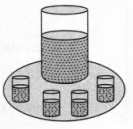
At a Ramzan Mela, a stall keeper in one of the food stalls has a large cylindrical vessel of the base radius $15 \ cm$ filled upto a height of $32 \ cm$ with the orange juice. The juice is filled in small cylindrical glasses (see figure) of radius $3 \ cm$ upto a height of 8 cm and sold for Rs. $15$ each. How much money does the stall keeper receive by selling the juice completely?
Answer
Given, radius of large cylindrical vessel $( r )=15 cm$ and height of orange juice in large vessel $( h )=32 cm$
$\therefore$ Volume of juice in the large vessel $=\pi r ^2 h=\pi \times 15 \times 15 \times 32 cm^3$
For small cylindrical glasses, radius $\left(r_1\right)=3 cm$ and height of juice $\left(h_1\right)=8 cm$
$\therefore$ Volume of juice in each glass $=\pi r_1^2 h_1=\pi \times 3 \times 3 \times 8 cm^3$
Since, small cylindrical glasses are filled with juice from large vessel.
So, Volume of juice in vessel $=$ Number of glasses $\times$ Volume of juice in each glass
$\therefore$ Number of glasses of juice = $\frac{\text { Volume of juice in vessel }}{\text { Volume of juice in each glass }}$
= $\frac{\pi \times 15 \times 15 \times 32}{\pi \times 3 \times 3 \times 8} = 100$
Now, cost of one glass juice = Rs. $15$
$\therefore$ Cost of 100 glass juice $=100 \times 15= Rs. 1500$
Hence, the stall keeper receive $Rs. 300$ by selling the juice completely.
View full question & answer
Question 123 Marks
A wall of length $10 \ m$ was to be built across open ground. The height of wall is $4 \ m$ and the thickness of the wall is $24 \ cm$. If this wall is to be built up with bricks whose dimensions are $24cm\times 12cm\times 8cm.$How many bricks would be required?
Answer
Length of wall $=10 \mathrm{~m}=1000 \mathrm{~cm}$
Thickness $=24 \mathrm{~cm}$
Height $=4 \mathrm{~m}=400 \mathrm{~cm}$
Volume of wall $=$ length $x$ thickness $x$ height $=1000 \times 24 \times 400 \mathrm{~cm}^3=9600000 \mathrm{~cm}^3$
Now each brick is a cuboid with length $=24 \mathrm{~cm}$
Breadth $=12 \mathrm{~cm}$ and height $=8 \mathrm{~cm}$
Volume of each brick $=l \times b \times h=2304 \mathrm{~cm}^3$
Number of bricks required $=\frac{\text { volume of the wall }}{\text { volume of each brick }}$
$=\frac{1000 \times 24 \times 400}{24 \times 12 \times 8}$
$=4166.6$
Therefore, the wall requires $4167$ bricks
View full question & answer
Question 133 Marks
A hemispherical dome of a building needs to be painted. If the circumference of the base of the dome is $17.6 \ m$ , find the cost of painting it, given the cost of painting is ₹ $5$ per $100 \mathrm{~cm}^2$.
Answer
Since only the rounded surface of the dome is to be painted, we would need to find the curved surface area of the hemisphere to know the extent of painting that needs to be done. Now, circumference of the dome $=17.6 \mathrm{~m}$. Therefore, $17.6=2 \pi r$
$2 \times \frac{22}{7} r=17.6 \mathrm{~m}$
So, the radius of the dome $=17.6 \times \frac{7}{2 \times 22} \mathrm{~m}=2.8 \mathrm{~m}$
The curved surface area of the dome $=2 \pi r^2$
$=2 \times \frac{22}{7} \times 2.8 \times 2.8 \mathrm{~m}^2$
$=49.28 \mathrm{~m}^2$
Now, the cost of painting $100 \mathrm{~cm}^2$ is $Rs. 5.$
So, the cost of painting $1 \mathrm{~m}^2=$ Rs. $500$
Therefore, the cost of painting the whole dome
$=\text { Rs. } 500 \times 49.28$
$=\text { Rs. } 24640$
View full question & answer