Questions

M.C.Q

Take a timed test

10 questions · auto-graded multiple-choice test.

MCQ 11 Mark
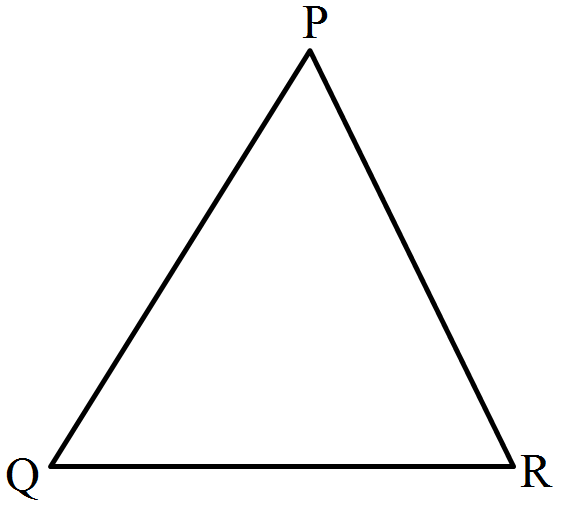
In the following, write the correct answer. In $\triangle\text{PQR}$ if $\angle\text{R}=\angle\text{P}$ and $QR = 4\ cm$ and $PR = 5\ cm$. Then, the length of PQ is:
  • $4\ cm$
  • B
    $5\ cm$
  • C
    $2\ cm$
  • D
    $2.5\ cm$
Answer
Correct option: A.
$4\ cm$
In $\triangle\text{PQR}$ if $\angle\text{R}=\angle\text{P}$
NOw, $QR = 4\ cm$, Therefore, $PQ = 4\ cm$.
View full question & answer
MCQ 21 Mark
In the following, write the correct answer. In $\triangle\text{ABC}$ and $\triangle\text{PQR},$ if $AB = AC$, $\angle\text{C}=\angle\text{P}$ and $\angle\text{B}=\angle\text{Q}$ then the two triangles are:
  • Isosceles but not congruent.
  • B
    Isosceles and congruent.
  • C
    Congruent abut not isosceles.
  • D
    Neither congruent nor isosceles.
Answer
Correct option: A.
Isosceles but not congruent.
In $\triangle\text{ABC},$
$AB = AC$
$\angle\text{C}=\angle\text{B}$
So, is an isosceles triangle.
But it is given that,
$\angle\text{B}=\angle\text{Q}$
$\angle\text{C}=\angle\text{P}$
$\angle\text{P}=\angle\text{Q}$
So, is also an isosceles triangle.Therefore both triangle are isosceles but not congruent.
View full question & answer
MCQ 31 Mark
In the following, write the correct answer. Which of the following is not a criterion for congruence of triangles?
  • A
    $SAS$
  • B
    $ASA$
  • $SSA$
  • D
    $SSS$
Answer
Correct option: C.
$SSA$
We know that, two triangles are congruent, if the sides and angles of one triangle are equal to the corresponding sides and angles of the other triangle.
Also, criterion for congruence of triangles are $SAS$ (Side-Angle-Side), $ASA$ (Angle-Side- Angle), $SSS$ (Side-Side-Side) and $RHS$ (right angle-hypotenuse-side).
So, $SSA$ is not a criterion for congruence of triangles.
View full question & answer
MCQ 41 Mark
In the following, write the correct answer.
In $\triangle\text{ABC}$ and $\triangle\text{DEF},$ if $AB = AC$, $\angle\text{A}=\angle\text{D}.$ The two triangles are:
  • A
    $BC = EF$
  • $AC = DE$
  • C
    $AC = EF$
  • D
    $BC = DE$
Answer
Correct option: B.
$AC = DE$
In $\triangle\text{ABC},$
$AB = DF$
$\angle\text{A}=\angle\text{D}$
We know that, two triangles will be congruent by $ASA$ rule, if two angles and the included side of one triangle are equal to the two angles and the included side of other triangle.
$AC = DE.$
View full question & answer
MCQ 51 Mark
In the following, write the correct answer.Two sides of a triangle are of lengths $5\ cm$ and $1.5\ cm$. The length of the third side of the triangle cannot be:
  • A
    $3.6\ cm$
  • B
    $4.1\ cm$
  • C
    $3.8\ cm$
  • $3.4\ cm$
Answer
Correct option: D.
$3.4\ cm$
Since sum of any two sides of triangle is always greater than thrid side, so that side of the triangle cannot be $3.4\ cm$ becouse then,
$1.5\ cm + 3.4\ cm = 4.9\ cm$.
View full question & answer
MCQ 61 Mark
In the following, write the correct answer. If $AB = QR, BC = PR$ and $CA = PQ$, then:
  • A
    $\triangle\text{ABC}\cong\triangle\text{QRP}$
  • $\triangle\text{CBA}\cong\triangle\text{PRQ}$
  • C
    $\triangle\text{BAC}\cong\triangle\text{RQP}$
  • D
    $\triangle\text{PQR}\cong\triangle\text{BCA}$
Answer
Correct option: B.
$\triangle\text{CBA}\cong\triangle\text{PRQ}$
We know that, if is congruent to, then sides of $\triangle\text{RST}$ fall on corresponding equal sides of angles of fall on corresponding equal angles.
Here, given $AB = QR, BC = PR$ and $CA = PQ$, which shows that $AB$ covers $QR, BC$ covers $PR$ and $CA$ covers $PQ$ i.e., $A$ correspond to $Q$, $B$ correspond to $R$ and $C$ correspond to $P$.
View full question & answer
MCQ 71 Mark
In the following, write the correct answer.It is given that $\triangle\text{ABC}=\triangle\text{FDE}$ and $AB = 5\ cm,$ $∠\text{B} = 40°$and $∠\text{A} = 80^\circ $then which of the following is true?
  • A
    $\text{DF}=5\text{CM}, \angle\text{F}=60^{\circ}$
  • $\text{DF}=5\text{CM}, \angle\text{E}=60^{\circ}$
  • C
    $\text{DE}=5\text{CM}, \angle\text{E}=60^{\circ}$
  • D
    $\text{DE}=5\text{CM}, \angle\text{D}=40^{\circ}$
Answer
Correct option: B.
$\text{DF}=5\text{CM}, \angle\text{E}=60^{\circ}$
Given $\triangle\text{ABC}=\triangle\text{FDE}$ and AB = 5cm, $∠\text{B} = 40^\circ ,\angle\text{A}=80^{\circ}$
Since, $\triangle\text{ABC}=\triangle\text{FDE}$
$DF = AB$
$DF = 5\ cm$
$\angle\text{E}=\angle\text{C}$
$\angle\text{E}=\angle\text{C}=180^{\circ}-(\angle\text{A}+\angle\text{B})$
$\angle\text{E}=180^{\circ}-(80^{\circ}+40^{\circ})$
$\angle\text{E}=60^{\circ}$
View full question & answer
MCQ 81 Mark
In the following, write the correct answer. In $\triangle\text{ABC}$ if $AB = AC$ and $\angle\text{B}=50^{\circ}$ then is equal to:
  • A
    $40^\circ$
  • $50^\circ$
  • C
    $80^\circ$
  • D
    $130^\circ$
Answer
Correct option: B.
$50^\circ$
Given $\triangle\text{ABC}$ such that $AB = AC$ and $\angle\text{B}=50^{\circ}$
View full question & answer
MCQ 91 Mark
In the following, write the correct answer.
In $\triangle\text{ABC}$ if $BC = AB$ and $\angle\text{B}=80^{\circ}$ then is equal to:
  • A
    $80^\circ$
  • B
    $40^\circ$
  • $50^\circ$
  • D
    $100^\circ$
Answer
Correct option: C.
$50^\circ$
In $\triangle\text{ABC}$ we have
$BC = AB$
 But $\angle\text{B}=80^{\circ}$
$\angle\text{A}+\angle\text{B}+\angle\text{C}=180^{\circ}$
$=\angle\text{A}+80^{\circ}\angle\text{A}=180^{\circ}$
$=2\angle\text{A}=100^{\circ}$
$=\angle\text{A}=100^{\circ}\div2=50^{\circ}$
View full question & answer
MCQ 101 Mark
In the following, write the correct answer. In $\triangle\text{PQR},$ if $\angle\text{R}>\angle\text{Q}$ then:
  • A
    $QR > PR$
  • $PQ > PR$
  • C
    $PQ < PR$
  • D
    $QR < PR$
Answer
Correct option: B.
$PQ > PR$
Given, $\angle\text{R}>\angle\text{Q}$

$PQ > PR$.
View full question & answer