Questions

3 Marks Question

Take a timed test

14 questions · self-marked practice — reveal the answer and mark yourself.

Question 13 Marks
Two angle of a triangle are equal and the third angle is greater than each one of them by $18^\circ.$ Find the angles.
Answer
Let the two equal angles, $\angle\text{A}$ and $\angle\text{B},$ of the triangle be $x^o$ each.
We know, $\angle\text{A}+\angle\text{B}+\angle\text{C}=180^\circ$
$\Rightarrow\text{x}^\circ+\text{x}^\circ+\angle\text{C}=180^\circ$
$\Rightarrow2\text{x}^\circ+\angle\text{C}=180^\circ\ ...(\text{i)}$
Also, it is given that, $\angle\text{C}=\text{x}^\circ+18^\circ\ ....(\text{ii)}$
Substituting $\angle\text{C}$ from $(ii)$ in $(i)$,
we get, $2\text{x}^\circ+\text{x}^\circ+18^\circ=180^\circ$
$\Rightarrow3\text{x}^\circ=180^\circ-18^\circ=162^\circ$
$\Rightarrow\text{x}=\frac{162}{3}=54$
Thus, the required angles of the triangle are
​​​​​​​$54^o, 54^o$ and $x^o + 18^o = 54^o + 18^o = 72^o.$
View full question & answer
Question 23 Marks
In a right-angled triangle, one of the acute angles measures $53º$. Find the measure of each angle of the triangle.
Answer
Let ABC be a right angled triangle and $\angle\text{C}=90^\circ$ Since, $\angle\text{A}+\angle\text{B}+\angle\text{C}=180^\circ$
$\Rightarrow\angle\text{A}+\angle\text{B}=180^\circ-\angle\text{C}=180^\circ-90^\circ=90^\circ$ Suppose $\angle\text{A}=53^\circ$ Then, $53^\circ+\angle\text{B}=90^\circ$
$\Rightarrow\angle\text{B}=90^\circ-53^\circ=37^\circ$
$\therefore$ The required angles are $53^o, 37^o$ and $90^o$.
View full question & answer
Question 33 Marks
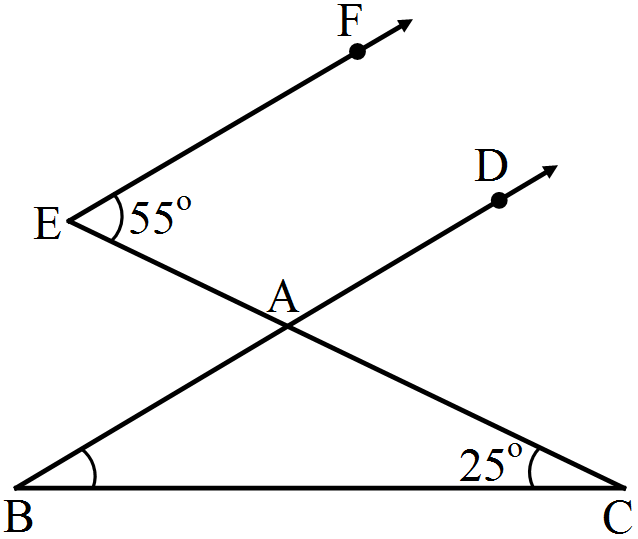
In the given figure, $BAD\ ||\ EF$, $\angle\text{AEF}=55^\circ$ and $\angle\text{ACB}=25^\circ,$ find $\angle\text{ABC}.$
Answer
$BAD\ ||\ EF$ and $EC$ is the transversal.
$\Rightarrow\angle\text{AEF}=\angle\text{CAD}$ (corresponding angles)
$\Rightarrow\angle\text{CAD}=55^\circ$ Now,
$\angle\text{CAD}+\angle\text{CAB}=180^\circ$ (linear pair)
$\Rightarrow55^\circ+\angle\text{CAB}=180^\circ$
$\Rightarrow\angle\text{CAB}=125^\circ$ In $\triangle\text{ABC},$
by angle sum property, $\angle\text{ABC}+\angle\text{CAB}+\angle\text{ACB}=180^\circ$
$\Rightarrow\angle\text{ABC}+125^\circ+25^\circ=180^\circ$
$ \Rightarrow\angle\text{ABC}=30^\circ$
View full question & answer
Question 43 Marks
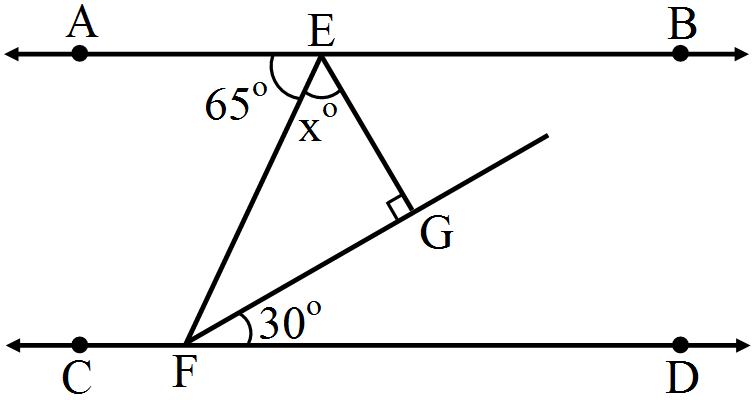
In the given figure, $AB\ ||\ CD$ and $EF$ is a transversal. If $\angle\text{AEF}=65^\circ,\angle\text{DFG}=30^\circ,\angle\text{EFG}=90^\circ$ and $\angle\text{GEF}=\text{x}^\circ,$ find the value of $x$.
Answer
$AB\ ||\ CD$ and $EF$ is the transversal.
$\Rightarrow\angle\text{AEF}=\angle\text{EFD}$ (alternate angles)
$\Rightarrow\angle\text{AEF}=\angle\text{EFG}+\angle\text{DFG}$
$\Rightarrow65^\circ=\angle\text{EFG}+30^\circ$
$\Rightarrow\angle\text{EFG}=35^\circ$ In $\triangle\text{GEF},$ by angle sum property,
$\angle\text{GEF}+\angle\text{EGF}+\angle\text{EFG}=180^\circ$
$\Rightarrow\text{x}+90^\circ+35^\circ=180^\circ$
$\Rightarrow\text{x}=55^\circ$
View full question & answer
Question 53 Marks
Of the three angles of a triangle, one is twice the smallest and another one is thrice the smallest. Find the angles.
Answer
Let $\angle\text{C}$ be the smallest angle of $\angle\text{ABC}.$
Then, $\angle\text{A}=2\angle\text{C}$ and $\angle\text{B}=3\angle\text{C}$
Also, $\angle\text{A}+\angle\text{B}+\angle\text{C}=180^\circ$
$\Rightarrow2\angle\text{C}+3\angle\text{C}+\angle\text{C}=180^\circ$
$\Rightarrow6\angle\text{C}=180^\circ$
$\Rightarrow\angle\text{C}=30^\circ$
So, $\angle\text{A}=2\angle\text{C}=2\times30^\circ=60^\circ$
$\angle\text{B}=3\angle\text{C}=3\times30^\circ=90^\circ$
$\therefore$ The required angles of the triangle are $60^\circ , 90^\circ , 30^\circ$ .
View full question & answer
Question 63 Marks
In $\triangle\text{ABC},$ if $\angle\text{A}+\angle\text{B}=108^\circ$ and $\angle\text{B}+\angle\text{C}=130^\circ,$ find $\angle\text{A},\angle\text{B}$ and $\angle\text{C}.$
Answer
$\angle\text{A}+\angle\text{B}=108^\circ$ [Given] But as $\angle\text{A},\angle\text{B}$ and $\angle\text{C}$ are the angles of a triangle,
$\angle\text{A}+\angle\text{B}+\angle\text{C}=180^\circ$
$\Rightarrow108^\circ+\angle\text{C}=180^\circ$
$\Rightarrow\angle\text{C}=180^\circ-108^\circ=72^\circ$
Also, $\angle\text{B}+\angle\text{C}=130^\circ$ [Given]
$\Rightarrow\angle\text{B}+72^\circ=130^\circ$
$\Rightarrow\angle\text{B}=130^\circ-72^\circ=58^\circ$
Now as, $\angle\text{A}+58^\circ=108^\circ$
$\Rightarrow\angle\text{A}+58^\circ=108^\circ$
$\Rightarrow\angle\text{A}=108^\circ-58^\circ=50^\circ$
$\therefore\angle\text{A}=50^\circ,\angle\text{B}=58^\circ$ and $\angle\text{C}=72^\circ$
View full question & answer
Question 73 Marks
The sum of two angles of a triangle is $116^\circ $ and their differance is $24^\circ $. Find the measure of each angle of the triangle.
Answer
Given that the sum of the angles $A$ and $B$ of a $\triangle\text{ABC}$ is $116^\circ$ , i. e., $\angle\text{A}+\angle\text{B}=116^\circ.$
Since, $\angle\text{A}+\angle\text{B}+\angle\text{C}=180^\circ$ So, $116^\circ+\angle\text{C}=180^\circ$
$\Rightarrow\angle\text{C}=180^\circ-116^\circ=64^\circ$ Also,
it is given that: $\angle\text{A}-\angle\text{B}=24^\circ$
$\Rightarrow\angle\text{A}=24^\circ+\angle\text{B}$ Putting,
$\angle\text{A}=24^\circ+\angle\text{B}$ in $\angle\text{A}+\angle\text{B}=116^\circ,$
we get, $24^\circ+\angle\text{B}+\angle\text{B}=116^\circ$
$\Rightarrow2\angle\text{B}+24^\circ=116^\circ$
$\Rightarrow2\angle\text{B}=116^\circ-24^\circ=92^\circ$
$\Rightarrow\angle\text{B}=\frac{92^\circ}{2}=46^\circ$
Therefore, $\angle\text{A}=24^\circ+46^\circ=70^\circ$
$\therefore\angle\text{A}=70^\circ,\angle\text{B}=46^\circ$ and $\angle\text{C}=64^\circ.$
View full question & answer
Question 83 Marks
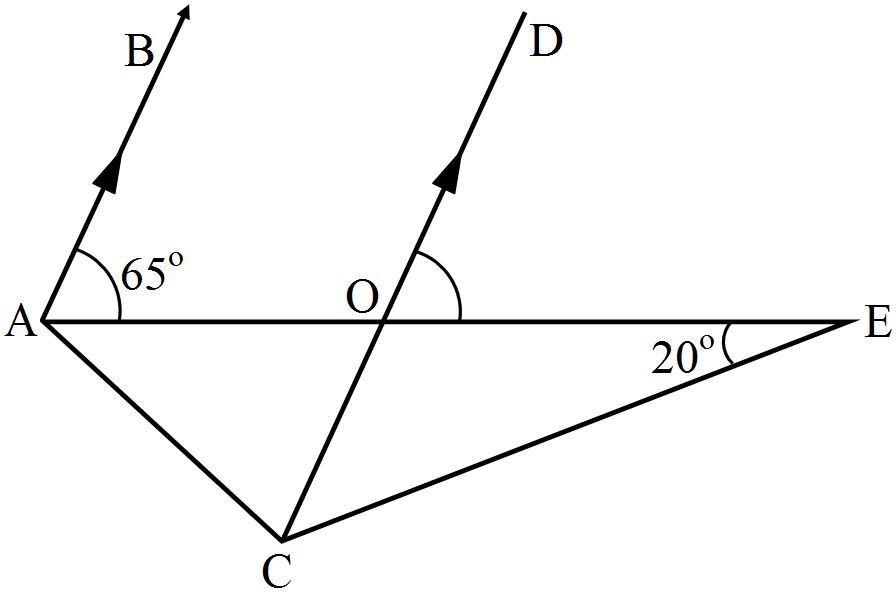
In the given figure, $AB\ ||\ CD$, $\angle\text{BAE}=65^\circ$ and $\angle\text{OEC}=20^\circ.$ Find $\angle\text{ECO}.$
Answer
$AB\ ||\ CD$ and $AE$ is the transversal.
$\Rightarrow\angle\text{BAE}=\angle\text{DOE}$ (corresponding angles)
$\angle\text{DOE}=65^\circ$ Now,
$\angle\text{DOE}+\angle\text{COE}=180^\circ$ (linear pair)
$\Rightarrow65^\circ+\angle\text{COE}=180^\circ$
$\Rightarrow\angle\text{COE}=115^\circ$ In
$\triangle\text{OCE},$ by angle sum property,
$\angle\text{OEC}+\angle\text{ECO}+\angle\text{COE}=180^\circ$
$\Rightarrow20^\circ+\angle\text{ECO}+115^\circ=180^\circ$
$\Rightarrow\angle\text{ECO}=45^\circ$
View full question & answer
Question 93 Marks
The angles of a triangles are in the ratio $2 : 3 : 4$ Find the angles.
Answer
Let the measures of the angles of a triangle are $(2 x)^{\circ},(3 x)^{\circ}$ and $(4 x)^{\circ}$.
Then, $2 x+3 x+4 x=180$ [sum of the angles of a triangle is $180^{\circ}$ ]
$\Rightarrow 9x = 180$
$\Rightarrow\text{x}=\frac{180}{9}=20$
$\therefore$ The measures of the required angles are: $2x = (2 \times 20)^o$
$= 40^o 3x$
$= (3 \times 20)^o $
$= 60^o 4x$
$​​​​​​​= (4 \times 20)^o = 80^o​​​​​​​$
View full question & answer
Question 103 Marks
If one angle of a triangle is equal to the sum of the other two, show that the triangle is right angled.
Answer
Let $ABC$ be a triangle.
Then,
$\angle\text{A}=\angle\text{B}+\angle\text{C}$
$\therefore\angle\text{A}+\angle\text{B}+\angle\text{C}=180^\circ$ [Sum of the angles of a triangle]
$\Rightarrow\angle\text {B}+\angle\text{C}+\angle\text{B}+\angle\text{C}=180^\circ$
$\Rightarrow2\angle\text{B}+\angle\text{C}=180^\circ$
$\Rightarrow\angle\text{B}+\angle\text{C}=90^\circ$
$\Rightarrow\angle\text{A}=90^\circ$ $[\because\angle\text{A}=\angle\text{B}+\angle\text{C}]$
This implies that the triangle is right-angled at $A$.
View full question & answer
Question 113 Marks
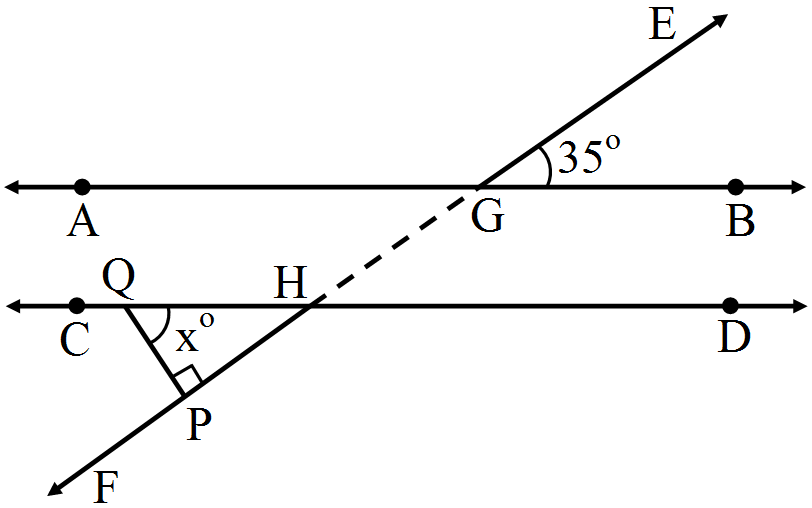
In the given figure, $AB\ ||\ CD$ and $EF$ is a transversal, cutting them at $G$ and $H$ respectively. If $\angle\text{EGB}=35^\circ$ and $\text{QP}\perp\text{EF},$ find the measure of $\angle\text{PQH}.$
Answer
$AB\ ||\ CD$ and $EF$ is the transversal.
$\Rightarrow\angle\text{EGB}=\angle\text{GHD}$ (corresponding angles)
$\angle\text{GHD}=35^\circ$ Now, $\angle\text{GHD}=\angle\text{QHP}$ (vertically opposite angles)
$\Rightarrow\angle\text{QHP}=35^\circ$ In $DQHP$,
by angle sum property, $\angle\text{PQH}+\angle\text{QHP}+\angle\text{QPH}=180^\circ$
$\Rightarrow\angle\text{PQH}+35^\circ+90^\circ=180^\circ$
$\Rightarrow\angle\text{PQH}=55^\circ$
View full question & answer
Question 123 Marks
In $\triangle\text{ABC},$ if $\angle\text{A}+\angle\text{B}=125^\circ$ and $\angle\text{A}+\angle\text{C}=113^\circ,$ find $\angle\text{A},\angle\text{B}$ and $\angle\text{C}.$
Answer
Since. $\angle\text{A},\angle\text{B}$ and $\angle\text{C}$ are the angles of a triangle . So, $\angle\text{A}+\angle\text{B}+\angle\text{C}=180^\circ$ Now, $\angle\text{A}+\angle\text{B}=125^\circ$ [Given] $\therefore125^\circ+\angle\text{C}=180^\circ$
$\Rightarrow\angle\text{C}=180^\circ=125^\circ=55^\circ$ Also, $\angle\text{A}+\angle\text{C}=113^\circ$ [Given] $\Rightarrow\angle\text{A}+55^\circ=113^\circ$
$\Rightarrow\angle\text{A}=113^\circ-55^\circ=58 ^\circ$ Now as $\angle\text{A}+\angle\text{B}=125^\circ$
$\Rightarrow58^\circ+\angle\text{B}=125^\circ$
$\Rightarrow\angle\text{B}=125^\circ-58^\circ=67^\circ$
$\therefore\angle\text{A}=58^\circ,\angle\text{B}=67^\circ$ and $\angle\text{C}=55^\circ.$
View full question & answer
Question 133 Marks
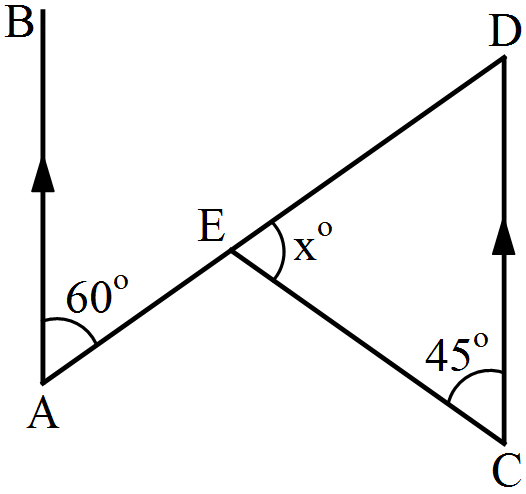
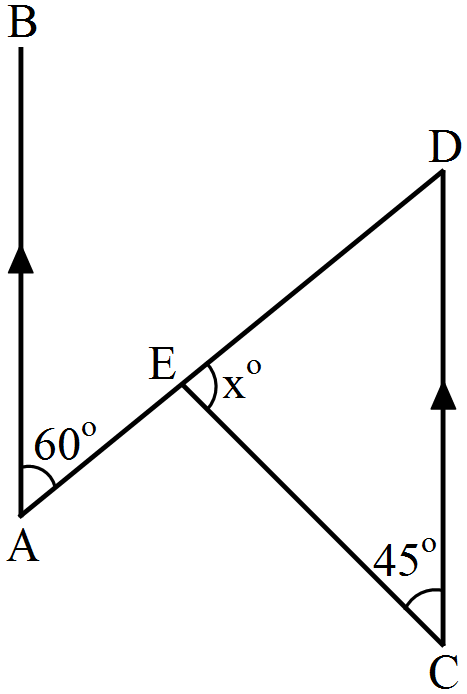
Calculate the value of $x$ in the following figures.
Answer

Since $AB || CD$ and $AD$ is a transversal. So, $\angle\text{BAD}=\angle\text{ADC}$
$\Rightarrow\angle\text{ADC}=60^\circ$ In $\triangle\text{ECD},$ we have, $\angle\text{E}+\angle\text{C}+\angle\text{D}=180^\circ$
$\Rightarrow\text{x}^\circ+45^\circ+60^\circ=180^\circ$
$\Rightarrow\text{x}^\circ+105^\circ=180^\circ$
$\Rightarrow\text{x}^\circ=180^\circ-105^\circ=75^\circ$
$\therefore\text{x}=75$
View full question & answer
Question 143 Marks
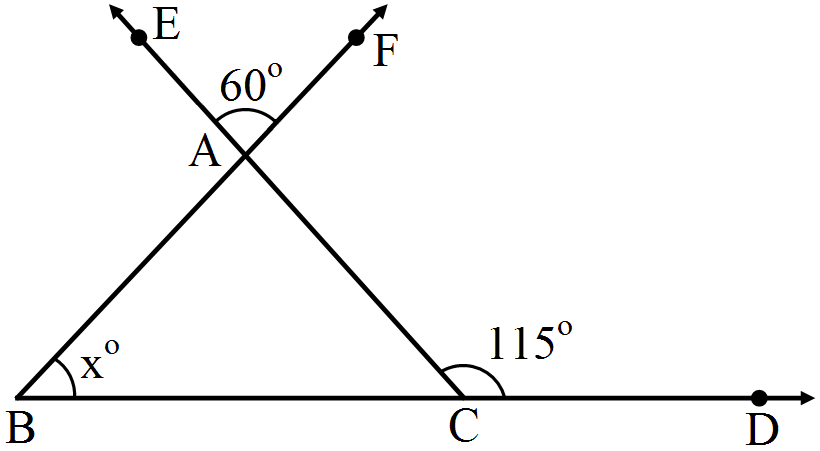
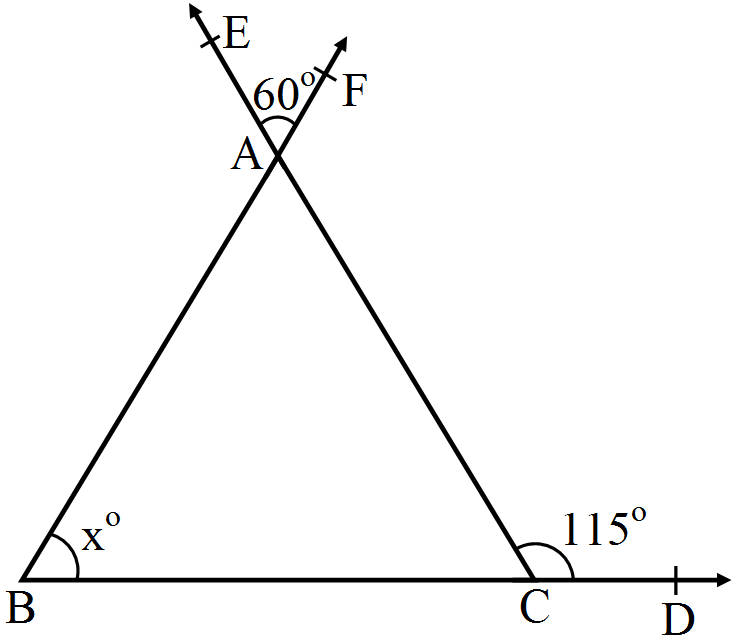
Calculate the value of $x$ in the following figures.
Answer

$\angle\text{EAF}=\angle\text{BAC}$ [Vertically opposite angles]
$\Rightarrow\angle\text{BAC}=60^\circ$ In $\triangle\text{ABC},$
exterior $\angle\text{ACD}$ is equal to the sum of two opposite interior angles.
​​​​​​​So, $\angle\text{ACD}=\angle\text{BAC}+\angle\text{ABC}$
$\Rightarrow115^\circ=60^\circ+\text{x}^\circ$
$\Rightarrow\text{x}^\circ=115^\circ-60^\circ=55^\circ$
$\therefore\text{x}=55$
View full question & answer