Question 14 Marks
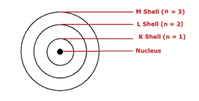
Neils Bohr got the Nobel Prize for his work on the structure of atom in $1922$. Among Professor Bohr’s numerous writings, three appearing as books are: $(i)$ The Theory of Spectra and Atomic Constitution, $(ii)$ Atomic Theory and, $(iii)$ The Description of Nature.
In order to overcome the objections raised against Rutherford’s model of the atom, Neil’s Bohr put forward the following postulates about the model of an atom:
- Only certain special orbits known as discrete orbits of electrons, are allowed inside the atom.
- While revolving in discrete orbits the electrons do not radiate energy. These orbits or shells are called energy levels. Energy levels in an atom are shown in Fig. A few energy levels in an atom These orbits or shells are represented by the letters $K,L,M,N,…$ or the numbers, $n=1,2,3,4,….$
$(a)$ Letters
$(b)$ Numbers
$(c)$ Both a & b
$(d)$ Special symbols
$(2)$ These orbits or shells are called
$(a)$ Energy levels
$(b)$ Discrete orbit
$(c)$ Atomic levels
$(d)$ None of the above
$(3)$ Which of the following book is written by Professor Bohr’s
$(a)$ The Theory of Spectra and Atomic Constitution
$(b)$ Atomic Theory
$(c)$ The Description of Nature
$(d)$ All of the above
$(4)$ Identify the correct statement
Statement $1 –$ The orbits or shells are represented by letters only.
Statement $2 –$ The orbits or shells are represented by numbers only.
Statement $3 –$ While revolving in discrete orbits the electrons do not radiate energy.
Statement $4 –$ Certain special orbits known as discrete orbits of electrons.
$(a)$ Both $1 \& 2$
$(b)$ Both $3 \& 4$
$(c)$ Only $3$
$(d)$ All of the above
$(5)$ Write the postulate of Neil’s Bohr model of an atom?
Answer
View full question & answer→$(1) c$
$(2) a$
$(3) d$
$(4) b$
$(5)$ Neil’s Bohr put forward the following postulates about the model of an atom:
$(2) a$
$(3) d$
$(4) b$
$(5)$ Neil’s Bohr put forward the following postulates about the model of an atom:
- Only certain special orbits known as discrete orbits of electrons, are allowed inside the atom.
- While revolving in discrete orbits the electrons do not radiate energy.