MCQ 11 Mark
The circumferences of two circles are in the ratio $3 : 4.$ The ratio of their areas is:
- A
$3 : 4$
- B
$4 : 3$
- ✓
$9 : 16$
- D
$16 : 9$
AnswerCorrect option: C. $9 : 16$
Let the the radii of the two circles be $r$ and $R,$
the circumferences of the circles be $c$ and $C$ and the areas of the two circles be a and $A.$
Now,
$\frac{\text{c}}{\text{C}}=\frac{3}{4}$
$\Rightarrow\frac{2\pi\text{r}}{2\pi\text{R}}=\frac{3}{4}$
$\Rightarrow\frac{\text{r}}{\text{R}}=\frac{3}{4}$
Now, the ratio between their areas is given by
$\frac{\text{a}}{\text{A}}=\frac{\pi\text{r}^2}{\pi\text{R}^2}$
$=\Big(\frac{\text{r}}{\text{R}}\Big)^2$
$=\Big(\frac{3}{4}\Big)^2$
$=\frac{9}{16}$
Hence, the correct answer is option $(c).$
View full question & answer→MCQ 21 Mark
The length of an arc of the sector of angle $\theta^\circ$ of a circle with radius $R$ is:
- A
$\frac{2\pi\text{R}\theta}{180}$
- ✓
$\frac{2\pi\text{R}\theta}{360}$
- C
$\frac{\pi\text{R}^2\theta}{180}$
- D
$\frac{\pi\text{R}^2\theta}{360}$
AnswerCorrect option: B. $\frac{2\pi\text{R}\theta}{360}$
$\frac{2\pi\text{R}\theta}{360}$
View full question & answer→MCQ 31 Mark
The length of the minute hand of a clock is $21\ cm$. The area swept by the mmute hand in $10$ minutes is:
- ✓
$231\ cm^2$
- B
$210\ cm^2$
- C
$126\ cm^2$
- D
$252\ cm^2$
AnswerCorrect option: A. $231\ cm^2$
Angle subtends by the minute hand in $1$ minute $= 6^\circ $
$\therefore$ Angle subtends by the minute hand in $10$ minutes $= 60^\circ $
Now,
Area of the sector $=\frac{\theta}{360}\pi\text{r}^2=\frac{60^\circ}{360^\circ}\times\frac{22}{7}(21)^2=231\text{cm}^2$
Hence, the correct answer is option $(a).$
View full question & answer→MCQ 41 Mark
If the sum of the areas of two circles with radii $R1$ and $R2$ is equal to the area of a circle of radius $R$, then:
- A
$\text{R}_1+\text{R}_2=\text{R}$
- B
$\text{R}_1+\text{R}_2<\text{R}$
- C
$\text{R}_1^2+\text{R}_2^2<\text{R}^2$
- ✓
$\text{R}_1^2+\text{R}_2^2=\text{R}^2$
AnswerCorrect option: D. $\text{R}_1^2+\text{R}_2^2=\text{R}^2$
Because the sum of the areas of two circles with radii $R_1$ and $R_2$ is equal to the area of a circle with
Radius $R$, we have:
$\pi\text{R}_1^2+\pi\text{R}_2^2=\pi\text{R}^2$
$\Rightarrow\pi\big(\text{R}_1^2+\text{R}_2^2\big)=\pi\text{R}^2$
$\Rightarrow\text{R}_1^2+\text{R}_2^2=\text{R}^2$
View full question & answer→MCQ 51 Mark
If the circumference of a circle and the perimeter of a square are equal, then:
- A
Area of the circle $=$ area of the square
- ✓
$($area of the circle$) > ($area of the square$)$
- C
$($area of the circle$) < ($area of the square$)$
- D
AnswerCorrect option: B. $($area of the circle$) > ($area of the square$)$
Let rbe the radius of the circle.
We know:
Circumference of the circle $=2\pi\text{r}$
Now,
Let a be the side of the square.
We know:
Perimeter of the square $= 4a$
Now,
$2\pi\text{r}=4\text{a}$
$\Rightarrow\text{r}=\frac{4\text{a}}{2\pi}$
$\therefore$ Area of the circle $=\pi\text{r}^2$
$=\pi\times\Big(\frac{4\text{a}}{2\pi}\Big)^2$
$=\pi\times\frac{16\text{a}^2}{4\pi^2}$
$=\frac{4\text{a}^2}{\pi}$
$=\frac{4\times7\text{a}^2}{22}$
$=\frac{14\text{a}^2}{11}$
Also,
Area of the square $= a^2$
Clearly, $\frac{14\text{a}^2}{11}>\text{a}^2$
$\therefore$ Area of the circlr $ > $ Area of the square
View full question & answer→MCQ 61 Mark
The diameter of a wheel is $84\ cm.$ How many revolutions Will it make to cover $792m?$
Answerlet $d \ cm$ be the diameter of the wheel.
We know:
Circumference of the wheel $=\pi\times\text{d}$
$=\Big(\frac{22}{7}\times84\Big)\text{cm}$
$=264\text{cm}$
Now,
Number of revolutions to cover $792m =\Big(\frac{792\times1000}{264}\Big)$
$=300$
View full question & answer→MCQ 71 Mark
The area of circle is equal to the sum of the areas of two circles of radii $24\ cm$ and $7\ cm.$ The diameter of
the new circle is:
- A
$25\ cm$
- B
$31\ cm$
- ✓
$50\ cm$
- D
$62\ cm$
AnswerCorrect option: C. $50\ cm$
Let rem be the radius of the new circle.
Now,
Area of the new circle $=$ Area of the circle with radius $24\ cm +$ Area of the circle with radius $7\ cm$
Thus. we have:
$\pi\text{r}\text{r}^2=\pi\text{r}_1^2+\pi\text{r}_2^2$
$\Rightarrow\pi\text{r}^2=\big[\pi\times(24)^2+\pi\times(7)^2\big]\text{cm}^2$
$\Rightarrow\pi\text{r}^2=\big[\pi\times576+\pi\times49\big]\text{cm}^2$
$\Rightarrow\pi\text{r}^2=\pi\times(576+49)\text{cm}^2$
$\Rightarrow\text{r}^2=625\pi\text{cm}^2$
$\Rightarrow\text{r}^2=625$
$\Rightarrow\text{r}=25$
$\therefore$ Diameter of the new circle $=(25\times2)\text{cm}$
$=50\text{cm}$
View full question & answer→MCQ 81 Mark
The radius of a wheel is $0.25m.$ How many revolutions will it make in covering $11\ km?$
- A
$2800$
- B
$4000$
- C
$5500$
- ✓
$7000$
AnswerCorrect option: D. $7000$
Distance covered in $1$ revolulion $=2\pi\text{r}$
$=\Big(2\times\frac{22}{7}\times0.25\Big)\text{m}$
$=\Big(2\times\frac{22}{7}\times\frac{25}{100}\Big)\text{m}$
$=\frac{11}{7}\text{m}$
Number of revolutions taken to cover $11\ km =\Big(11\times1000\times\frac{7}{11}\Big)$
$=7000$
View full question & answer→MCQ 91 Mark
The area of a circle is $38.5\ cm^2$. The circumference of the circle is:
- A
$6.2\ cm$
- B
$12.1\ cm$
- C
$11\ cm$
- ✓
$22\ cm$
AnswerCorrect option: D. $22\ cm$
Let the radius be $r \ cm.$
We know,
Area of a circle
$=\pi\text{r}^2\text{cm}^2$
Thus, we have:
$\pi\text{r}^2=38.5$
$\Rightarrow\frac{22}{7}\times\text{r}^2=38.5$
$\Rightarrow\text{r}^2=\Big(38.5\times\frac{7}{22}\Big)$
$\Rightarrow\text{r}^2=\Big(\frac{385}{10}\times\frac{7}{22}\Big)$
$\Rightarrow\text{r}^2=\frac{49}{4}$
$\Rightarrow\text{r}=\frac{7}{2}$
Now,
Circumference of the circle $=2\pi\text{r}$
$=2\times\frac{22}{7}\times\text{r}$
$=\Big(2\times\frac{22}{7}\times\frac{7}{2}\Big)$
$=22\text{cm}$
View full question & answer→MCQ 101 Mark
The radii of two concentric circles are $19\ cm$ and $16\ cm$ respectively. The area of the ring enclosed by these circles is:
- A
$320\ cm^2$
- ✓
$330\ cm^2$
- C
$332\ cm^2$
- D
$340\ cm^2$
AnswerCorrect option: B. $330\ cm^2$
$R = 19\ cm$ and $r = 16\ cm$
Thus. we have:
Area of the ring $=\pi\big(\text{R}^2-\text{r}^2\big)$
$=\pi(\text{R}+\text{r})(\text{R}-\text{r})$
$=\big|\frac{22}{7}\times(19+16)\times(19-16)\big|\text{cm}^2$
$=\Big(\frac{22}{7}\times35\times3\Big)\text{cm}^2$
$=330\text{cm}^2$
View full question & answer→MCQ 111 Mark
The circumference of a circle is equal to the sum of the circumference of two circles having diameters $36\ cm$ and $20\ cm$. The radius of the new circle is:
- A
$16\ cm$
- ✓
$28\ cm$
- C
$42\ cm$
- D
$56\ cm$
AnswerCorrect option: B. $28\ cm$
Let rem be the radius of the new circle.
We know:
Circumference of the new circle $=$ Circumference of the circle with diameter $36\ cm +$ Circumference of the circle with diameter $20\ cm$
Thus, we have:
$2\pi\text{r}=2\pi\text{r}_1+2\pi\text{r}_2$
$\Rightarrow2\pi\text{r}=(2\pi\times18)+(2\pi\times10)$
$\Rightarrow2\pi\text{r}=2\pi\times(18+10)$
$\Rightarrow2\pi\text{r}=(2\pi\times28)$
$\Rightarrow2\pi\text{r}=\Big(2\times\frac{22}{7}\times28\Big)$
$\Rightarrow2\pi\text{r}=176$
$\Rightarrow2\times\frac{22}{7}\times\text{r}=176$
$\Rightarrow\text{r}=\Big(176\times\frac{7}{44}\Big)$
$\Rightarrow\text{r}=28\text{cm}$
View full question & answer→MCQ 121 Mark
The perimeter of a circular field is $242\ m$. The area of the field is:
- A
$9317m^2$
- B
$18634m^2$
- ✓
$4658.5m^2$
- D
AnswerCorrect option: C. $4658.5m^2$
Let the radius be $r \ cm.$
We know,
Cirumference of the circle $=2\pi\text{r}$
Thus, we have:
$2\pi\text{r}^2=242$
$\Rightarrow2\times\frac{22}{7}\times\text{r}=242$
$\Rightarrow\frac{44}{7}\times\text{r}=242$
$\Rightarrow\text{r}=\Big(242\times\frac{7}{44}\Big)$
$\Rightarrow\text{r}=\frac{77}{2}$
$\therefore$ Area of the circle $=\pi\text{r}^2$
$=\Big(\frac{22}{7}\times\frac{77}{2}\times\frac{77}{2}\Big)\text{m}^2$
$=4658.5\text{m}^2$
View full question & answer→MCQ 131 Mark
The area of a square is the same as the area of a circle. Their perimeters are in the ratio:
- A
$1:1$
- B
$2:\pi$
- C
$\pi:2$
- ✓
$\sqrt{\pi}:2$
AnswerCorrect option: D. $\sqrt{\pi}:2$
$\sqrt{\pi}:2$
Let a be side of the square.
We know
Area of a square = $a^2$
Let r be the radius of the circle.
We know:
Area of a circle $=\pi\text{r}^2$
Because the area of the square is the same as the area of the circle, we have:
$\text{a}^32=\pi\text{r}^2$
$\Rightarrow\frac{\text{r}^2}{\text{a}^2}=\frac{1}{\pi}$
$\Rightarrow\frac{\text{r}}{\text{a}}=\frac{1}{\sqrt{\pi}}$
$\therefore$ Ratio of their perimeters
$=\frac{2\pi\text{r}}{4\text{a}}$ $\big[$because perimeter o the circle is $2\pi\text{r}$ and perimeter of the square. is 4a$\big]$
$=\frac{\pi\text{r}}{2\text{a}}$
$=\frac{\pi}{2}\times\frac{\text{r}}{\text{a}}$
$=\frac{\pi}{2}\times\frac{1}{\sqrt{\pi}}\Big[\text{Since}\frac{\text{r}}{\text{a}}=\frac{1}{\sqrt{\pi}}\Big]$
$=\frac{\sqrt{\pi}}{2}$
$=\sqrt{\pi}:2$
View full question & answer→MCQ 141 Mark
The difference between the circumference and radius of a circle is $37\ cm$. The area of the circle is:
- A
$111\ cm^2$
- B
$184\ cm^2$
- ✓
$154\ cm^2$
- D
$259\ cm^2$
AnswerCorrect option: C. $154\ cm^2$
Let the radius be $r \ cm.$
We know,
cirumference of the circle $=2\pi\text{r}$
Thus, we have:
$2\pi\text{r}^2-\text{r}=37$
$\Rightarrow\text{r}(2\pi-1)=37$
$\Rightarrow\text{r}\Big(2\times\frac{22}{7}-1\Big)=37$
$\Rightarrow\text{r}\Big(\frac{37}{7}\Big)=37$
$\Rightarrow\text{r}=\Big(37\times\frac{7}{37}\Big)$
$\Rightarrow\text{r}=7\text{cm}$
Now,
Circumference of the circle $=\pi\text{r}^2$
$=\Big(\frac{22}{7}\times7\times7\Big)\text{cm}^2$
$=154\text{cm}^2$
View full question & answer→MCQ 151 Mark
In a circle of radius $14\ cm$. an arc subtends an angle of $120^\circ $ at the centre. If $\sqrt{3}=1.73$ then the area of the segment of the circle is:
- ✓
$120.56\ cm^2$
- B
$124.63\ cm^2$
- C
$118.24\ cm^2$
- D
$130.57\ cm^2$
AnswerCorrect option: A. $120.56\ cm^2$
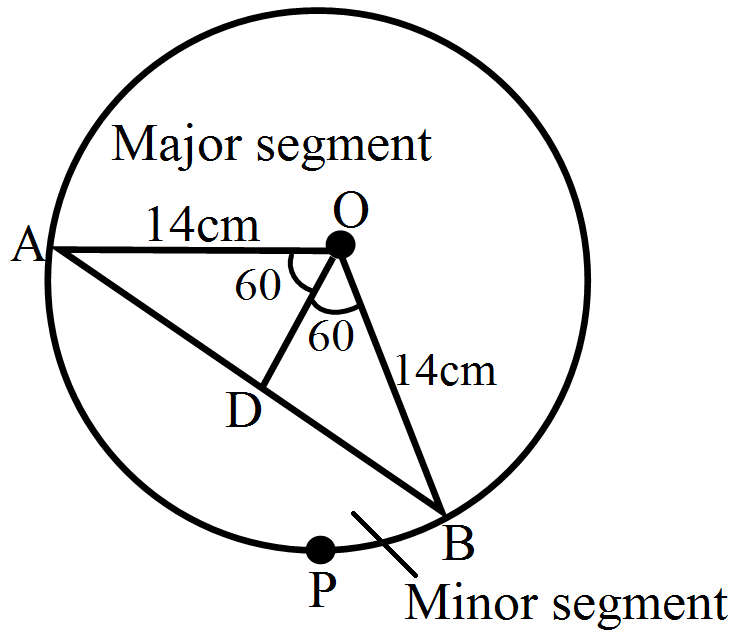
Radius of the circle, $r = 14\ cm$
Draw a perpendicular $OD$ to chord $AB$. It will bisect $AB.$
$\angle\text{A}=180^\circ-(90^\circ+60^\circ)=30^\circ$
$\cos30^\circ=\frac{\text{AD}}{\text{OA}}$
$\Rightarrow\frac{\sqrt{3}}{2}=\frac{\text{AD}}{14}$
$\Rightarrow\text{AD}=7\sqrt{3}$
$\Rightarrow\text{AB}=2\times\text{AD}=14\sqrt{3}\text{cm}$
$\sin30^\circ=\frac{\text{OD}}{14}$
$\Rightarrow\text{OD}=7\text{cm}$
Area of minor segment $=$ Area of sector $\text{OAPB} -$ Area of tringle $\text{AOB}$
$=\frac{\theta}{360^\circ}\pi(\text{OA})^2-\frac{1}{2}\times\text{OD}\times\text{AB}$
$=\frac{120^\circ}{360^\circ}\times\frac{22}{7}(14)^2-\frac{1}{2}\times7\times14\sqrt{3}$
$=205.33-84.77$
$=120.56\text{cm}^2$
Hence, the correct answer is option $(a).$ View full question & answer→MCQ 161 Mark
The area of the sector of angle $\theta^\circ$ of a circle with radius $R$ is:
- A
$\frac{2\pi\text{R}\theta}{180}$
- B
$\frac{\pi\text{R}^2\theta}{180}$
- C
$\frac{2\pi\text{R}\theta}{360}$
- ✓
$\frac{\pi\text{R}^2\theta}{360}$
AnswerCorrect option: D. $\frac{\pi\text{R}^2\theta}{360}$
$\frac{\pi\text{R}^2\theta}{360}$
View full question & answer→MCQ 171 Mark
The area of a circle is $49\pi\text{ cm}^2.$ Its circumference is:
- A
$7\pi\text{ cm}$
- ✓
$14\pi\text{ cm}$
- C
$21\pi\text{ cm}$
- D
$28\pi\text{ cm}$
AnswerCorrect option: B. $14\pi\text{ cm}$
Let the radius be $r \ cm$.
We know,
Area of a circle
$=\pi\text{r}^2$
Thus, we have:
$\pi\text{r}^2=49$
$\Rightarrow\text{r}^2=49$
$\Rightarrow\text{r}^2=\sqrt{49}$
$\Rightarrow\text{r}=7$
Now,
Circumference of the circle $=2\pi\text{r}$
$=\Big(2\times\frac{22}{7}\times\frac{7}{2}\Big)\text{cm}$
$=14\pi\text{cm}$
View full question & answer→MCQ 181 Mark
If the sum of the circumferences of two circles with radii $R_1$ and $R_2$ is equal to the circumference of a circle of radius $R$, then:
- ✓
$\text{R}_1+\text{R}_2=\text{R}$
- B
$\text{R}_1+\text{R}_2>\text{R}$
- C
$\text{R}_1+\text{R}_2<\text{R}$
- D
$\text{None of these}$
AnswerCorrect option: A. $\text{R}_1+\text{R}_2=\text{R}$
Because the sum of the circumferences of two circles with radii $R_1$ and $R_2$ is equal to the circumference of a circle with radius $R$. we have:
$2\pi\text{R}_1+2\pi\text{R}_2=2\pi\text{R}$
$\Rightarrow2\pi(\text{R}_1+\text{R}_2)=2\pi\text{R}$
$\Rightarrow\text{R}_1+\text{R}_2=\text{R}$
View full question & answer→MCQ 191 Mark
The diameter of a wheel is $40\ cm.$ How many revolutions will it make in covering $176m?$
AnswerDistance covered by the wheel in $1$ revolution $=\pi\text{d}$
$=\Big(\frac{22}{7}\times40\Big)\text{cm}$
$=\frac{880}{7}\text{cm}$
$=\frac{880}{7\times100}\text{m}$
Number of revolutions required to cover $176m =\bigg(\frac{176}{\frac{880}{7\times100}}\bigg)$
$=\Big(176\times100\times\frac{7}{880}\Big)$
$=140$
View full question & answer→MCQ 201 Mark
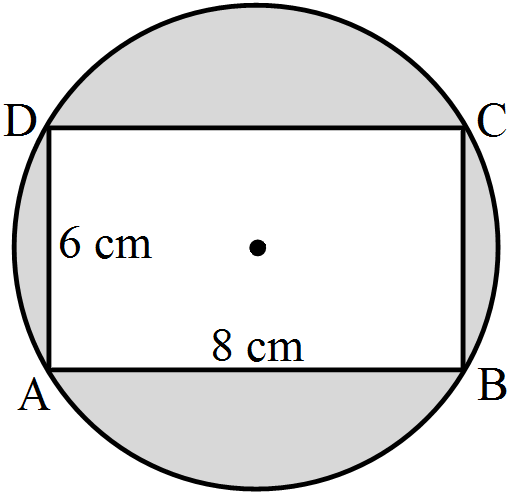
In the given figure, $\text{ABCD}$ is a rectangle inscribed in a circle having length $8\ cm$ and breadth $6\ cm$. If $\pi=3.14$ then the area of the shaded region is:
- A
$264\ cm^2$
- B
$266\ cm^2$
- C
$272\ cm^2$
- ✓
AnswerAll options are incorrect; the correct answer is $30.5\ cm.$
Join $AC.$
Now, $AC$ is the diameter of the circle.
We have:
$AC^2 = AB^2 + BC^2 [$By pythagoras' theorem$]$
$\Rightarrow\text{AC}^2=\big\{(8)^2+(6)^2\big\}\text{cm}^2$
$\Rightarrow\text{AC}^2=(64+36)\text{cm}^2$
$\Rightarrow\text{AC}^2=100\text{cm}^2$
$\Rightarrow\text{AC}=10\text{cm}$
$\therefore$ Radius of the circle $=\frac{10}{2}\text{cm}$
$=5\text{cm}$
Now,
Area of the shaded region $=$ Area of the circle with radius $5\ cm -$ Area of the rectangle $\text{ABCD}$
$=\big|(3.14\times5\times5)-(8\times6)\big|\text{cm}^2$
$=\Big|\Big(\frac{314}{100}\times25\Big)-48\Big|\text{cm}^2$
$=\Big(\frac{157}{2}-48\Big)\text{cm}^2$
$=\frac{61}{2}\text{cm}^2$
$=30.5\text{cm}^2$
View full question & answer→MCQ 211 Mark
The area of a sector of a circle with radius $r,$ making an angle of $x^\circ$ at the centre is:
- A
$\frac{\text{x}}{180}\times2\pi\text{r}$
- B
$\frac{\text{x}}{180}\times\pi\text{r}^2$
- C
$\frac{\text{x}}{360}\times2\pi\text{r}$
- ✓
$\frac{\text{x}}{360}\times\pi\text{r}^2$
AnswerCorrect option: D. $\frac{\text{x}}{360}\times\pi\text{r}^2$
$\frac{\text{x}}{360}\times\pi\text{r}^2$
View full question & answer→MCQ 221 Mark
In a circle of radius $21\ cm.$ an arc subtends an angle of $60^\circ$ at the centre. The length of the arc is:
- A
$21\ cm$
- ✓
$22\ cm$
- C
$18.16\ cm$
- D
$23.5\ cm$
AnswerCorrect option: B. $22\ cm$
We have, $\text{r}=21\text{cm}$ and $\theta=60^\circ$
Length of arc $=\frac{\theta}{360^\circ}\times2\pi\text{r}\frac{60^\circ}{360^\circ}\times2\times\frac{22}{7}\times21=22\text{cm}$
Hence, the correct answer is option $(b)$
View full question & answer→MCQ 231 Mark
On decreasing the radius of a circle by $30\%,$ its area is decreased by:
AnswerLet the original radius
Thus, we have;
Original area $=\pi\text{r}^2$
Also,
New radius $= 70\%$ of $r$
$=\Big(\frac{70}{100}\times\text{r}\Big)$
$=\frac{7\text{r}}{10}$
New area $=\pi\times\Big(\frac{7\text{r}}{10}\Big)^2$
$=\frac{49\pi\text{r}^2}{100}$
Decrease in the area $=\Big(\pi\text{r}^2-\frac{49\pi\text{r}^2}{100}\Big)$
$=\frac{59\pi\text{r}^2}{100}$
Thus, we have:
Decrease in the area $=\Big(\frac{59\pi\text{r}^2}{100}\times\frac{1}{\pi\text{r}^2}\times100\Big)\%$
$=51\%$
View full question & answer→MCQ 241 Mark
On increasing the diameter of a circle by $40\%$, its area will be increased by:
- A
$40\%$
- B
$80\%$
- ✓
$96\%$
- D
$82\%$
AnswerCorrect option: C. $96\%$
Let $d$ the original diameter.
Radius $=\frac{\text{d}}{2}$
Thus, we have:
Original area $=\pi\times\Big(\frac{\text{d}}{2}\Big)^2$
$=\frac{\pi\text{d}^2}{4}$
New diameter $=140\%$ of $d$
$=\Big(\frac{140}{100}\times\text{d}\Big)$
$=\frac{7\text{d}}{5}$
Now,
New radius $=\frac{7\text{d}}{5\times2}$
$=\frac{7\text{d}}{10}$
New area $=\pi\times\Big(\frac{7\text{d}}{10}\Big)^2$
$=\frac{49\pi\text{d}^2}{10}$
Increase in the area $=\Big(\frac{49\pi\text{d}^2}{10}-\frac{\pi\text{d}^2}{4}\Big)$
$=\frac{24\pi\text{a}^2}{100}$
$=\frac{6\pi\text{a}^2}{25}$
We have:
Increase in the area $=\Big(\frac{6\pi\text{a}^2}{25}\times\frac{4}{\pi\text{a}^2}\times100\Big)\%$
$=96\%$
View full question & answer→MCQ 251 Mark
In making $1000$ revolutions, a wheel covers $88\ km.$ The diameter of the wheel is:
AnswerDistance covered by the wheel in $1$ revolution $=\Big(\frac{88\times1000}{1000}\Big)\text{m}$
$=88\text{m}$
We have:
Circumference of the wheel $= 88m$
Now, let the diameter of the wheel be $d m.$
Thus. we have
$\pi\text{d}=88$
$\Rightarrow\frac{22}{7}\times\text{d}=88$
$\Rightarrow\text{d}=\Big(88\times\frac{7}{22}\Big)$
$\Rightarrow\text{d}=28\text{m}$
View full question & answer→MCQ 261 Mark
If the perimeter of a square is equal to the circumference of a circle then the ratio of their areas is:
- A
$4:\pi$
- ✓
$\pi:4$
- C
$\pi:7$
- D
$7:\pi$
AnswerCorrect option: B. $\pi:4$
Let the side of the square be a and the radius of the circle be $r.$
Now, Perimeter of circle $=$ Circumference of the circle
$\Rightarrow4\text{a}=2\pi\text{r}$
$\Rightarrow\frac{\text{a}}{\text{r}}=\frac{\pi}{2}$
Now,
$\frac{\text{Area of square}}{\text{Area of circle}}=\frac{\text{a}^2}{\pi\text{r}^2}$
$=\frac{1}{\pi}\times\Big(\frac{\text{a}}{\text{r}}\Big)^2$
$=\frac{1}{\pi}\times\frac{\pi^2}{4}$
$=\frac{\pi}{4}$
$=\pi:4$
Hence, the correct answer is option $(b).$
View full question & answer→MCQ 271 Mark
A chord of a circle of radius $10\ cm$ subtends a right angle at the centre. The area of the minor segments $(\text{given, }\pi=3.14)$ is:
- A
$32.5cm^2$
- B
$34.5cm^2$
- ✓
$28.5cm^2$
- D
$30.5cm^2$
AnswerCorrect option: C. $28.5cm^2$
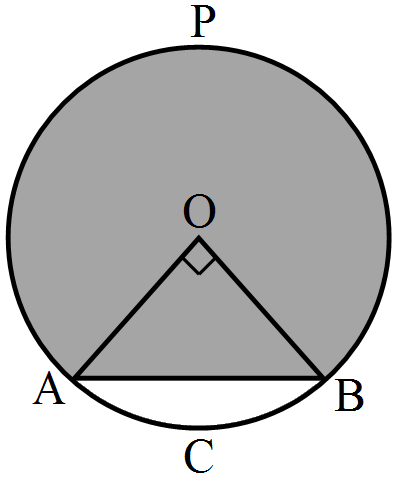
Area of minor segment $=$ Area of sector $\text{AOBC} -$ Area of right triangle $\text{AOB}$
$=\frac{90^\circ}{360^\circ}.\pi(\text{OA})^2-\frac{1}{2}\times\text{OA}\times\text{OB}$
$=\frac{1}{4}\times3.14\times(10)^2-\frac{1}{2}\times10\times10$
$=78.5-50$
$=28.5\text{cm}^2$
Hence, the correct answer is option $(c).$ View full question & answer→MCQ 281 Mark
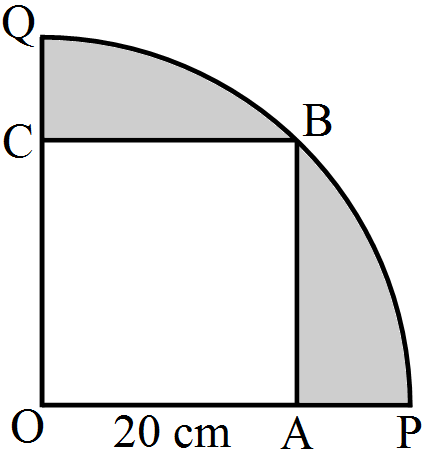
In the given figure, a square $\text{OABC}$ has been inscribed in the quadrant $\text{OPBQ.}$
If $OA = 20\ cm$, then the area of the shaded region is: $\big[\text{Take }\pi=3.14\big]$
- A
$214\ cm^2$
- ✓
$228\ cm^2$
- C
$242\ cm^2$
- D
$248\ cm^2$
AnswerCorrect option: B. $228\ cm^2$
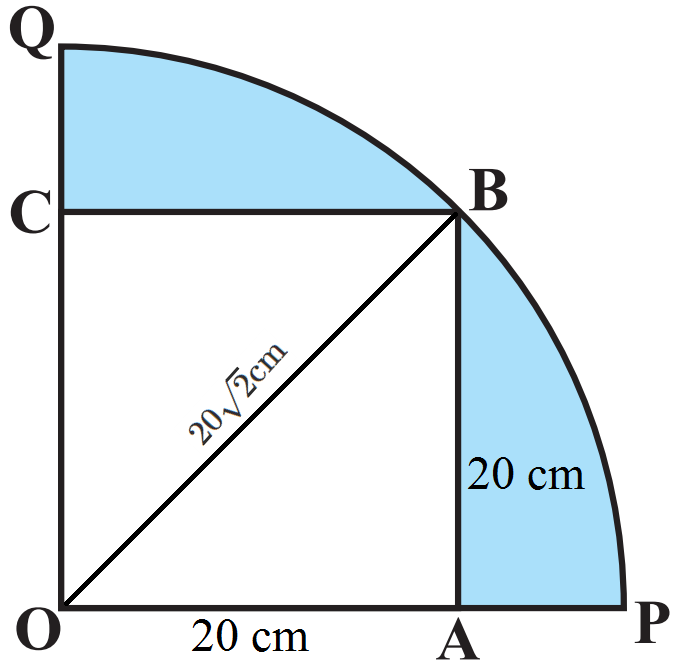
Join $OB.$
Now, $OB$ is the radius of the circle.
We have:
$OB^2 = OA^2 + AB^2$ [By] pythagoras' theorem]
$\Rightarrow\text{OB}^2=\big\{(20)^2+(20)^2\big\}\text{cm}^2$
$\Rightarrow\text{OB}^2=(400+400)\text{cm}^2$
$\Rightarrow\text{OB}^2=800\text{cm}^2$
$\Rightarrow\text{OB}=20\sqrt{2}\text{cm}$
Hence, the radius of the circle is $20\sqrt{2}\text{cm}.$
Now,
Area of the shaded region $=$ Area of the quadrant $-$ Area of the square $\text{OABC}$
$=\Big|\Big(\frac{1}{4}\times3.14\times20\sqrt{2}\times20\sqrt{2}\Big)-(20\times20)\Big|\text{cm}^2$
$=\Big|\Big(\frac{1}{4}\times\frac{314}{100}\times800\Big)-400\Big|\text{cm}^2$
$=(628-400)\text{cm}^2$
$=228\text{cm}^2$ View full question & answer→MCQ 291 Mark
The areas of two circles are in the ratio $9 : 4.$ The ratio of their circumferences is:
- ✓
$3 : 2$
- B
$4 : 9$
- C
$2 : 3$
- D
$81 : 16$
AnswerCorrect option: A. $3 : 2$
Let the the radii of the two circles be $r$ and $R,$
the circumferences of the circles be $c$ and $C$ and the areas of the two circles be $a$ and $A$.
Now,
$\frac{\text{a}}{\text{A}}=\frac{9}{4}$
$\Rightarrow\frac{\pi\text{r}^2}{\pi\text{R}^2}=\Big(\frac{3}{2}\Big)^2$
$\Rightarrow\frac{\text{r}}{\text{R}}=\frac{3}{2}$
Now, the ratio between their circumferences is given by
$\frac{\text{c}}{\text{C}}=\frac{2\pi\text{r}}{2\pi\text{R}}$
$=\frac{\text{r}}{\text{R}}$
$=\frac{3}{2}$
Hence, the correct answer is option $(a)$
View full question & answer→MCQ 301 Mark
The areas of two concentric circles are $1386\ cm^2$ and $962.5\ cm^2$. The width of the ring is:
- A
$2.8\ cm$
- ✓
$3.5\ cm$
- C
$4.2\ cm$
- D
$3.8\ cm$
AnswerCorrect option: B. $3.5\ cm$
Let $r \ cm$ and $R \ cm$ be the radii of two concentric circles.
Thus. we have:
$\pi\text{r}^2=1386$
$\Rightarrow\frac{22}{7}\times\text{R}^2=1386$
$\Rightarrow\text{R}^2=\Big(1386\times\frac{7}{22}\Big)\text{cm}^2$
$\Rightarrow\text{R}^2=441\text{cm}^2$
$\Rightarrow\text{R}=21\text{cm}$
Also,
$\pi\text{r}^2=962.2$
$\Rightarrow\frac{22}{7}\times\text{r}^2=962.2$
$\Rightarrow\text{r}^2=\Big(962.2\times\frac{7}{22}\Big)\text{cm}^2$
$\Rightarrow\text{r}^2=\Big(\frac{962.2}{10}\times\frac{7}{22}\Big)\text{cm}^2$
$\Rightarrow\text{r}^2=\frac{1225}{4}\text{cm}^2$
$\Rightarrow\text{r}=\frac{35}{2}\text{cm}$
$\therefore$ Width of the ring $=(\text{R}-\text{r})$
$=\Big(21-\frac{35}{2}\Big)\text{cm}$
$=\frac{7}{2}\text{cm}$
$=3.5\text{cm}$
View full question & answer→