Question 14 Marks
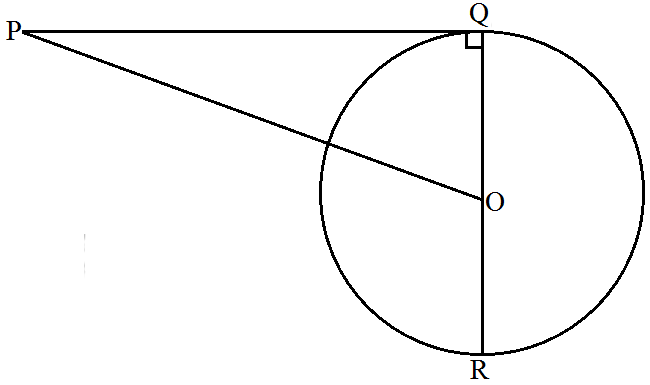
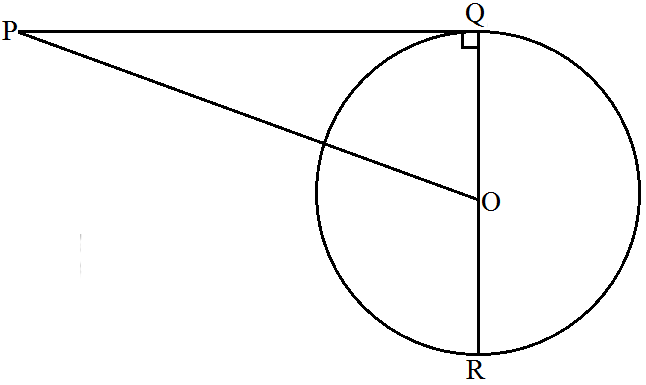
In the figure, PQ is a tangent from an external point P to a circle with centre O and OP cuts the circle at T and QOP is a diameter. If $\angle\text{POR}=130^{\circ}$ and S is a point
on the circle, find $\angle1+\angle2.$
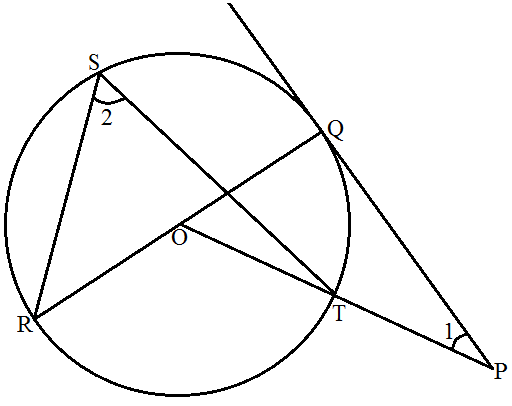
on the circle, find $\angle1+\angle2.$
Answer
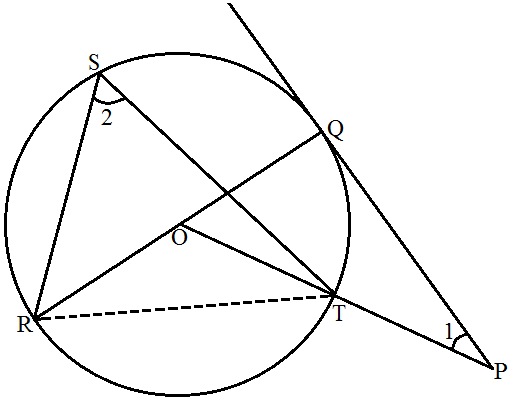
View full question & answer→Construction: Join RT.
Given,
$\angle\text{POQ}=180^{\circ}-(\angle\text{POR})=180^{\circ}-130^{\circ}=50^{\circ}$ Since, PQ is a tangent. $\angle\text{POQ}=90^{\circ}$ Now, In$\angle\text{POQ}+\angle\text{PQO}+\angle\text{QPO}=180^{\circ}$
$\Rightarrow50^{\circ}+90^{\circ}+\angle1=180^{\circ}$
$\Rightarrow\angle1=180^{\circ}-140^{\circ}$$\Rightarrow\angle1=40^{\circ}$
Now, In $\angle\text{RST}=\frac{1}{2}\angle\text{ROT}$ [Angle which is subtended by on arc at the centre of a circle is double the size of the angle subtended at any point on the circumference.] $\Rightarrow\angle2=\frac{1}{2}\times130^{\circ}=65^{\circ}$ Now$\angle1+\angle2=40^{\circ}+65^{\circ}=105^{\circ}$
$\angle\text{POQ}=180^{\circ}-(\angle\text{POR})=180^{\circ}-130^{\circ}=50^{\circ}$ Since, PQ is a tangent. $\angle\text{POQ}=90^{\circ}$ Now, In$\angle\text{POQ}+\angle\text{PQO}+\angle\text{QPO}=180^{\circ}$
$\Rightarrow50^{\circ}+90^{\circ}+\angle1=180^{\circ}$
$\Rightarrow\angle1=180^{\circ}-140^{\circ}$$\Rightarrow\angle1=40^{\circ}$
Now, In $\angle\text{RST}=\frac{1}{2}\angle\text{ROT}$ [Angle which is subtended by on arc at the centre of a circle is double the size of the angle subtended at any point on the circumference.] $\Rightarrow\angle2=\frac{1}{2}\times130^{\circ}=65^{\circ}$ Now$\angle1+\angle2=40^{\circ}+65^{\circ}=105^{\circ}$
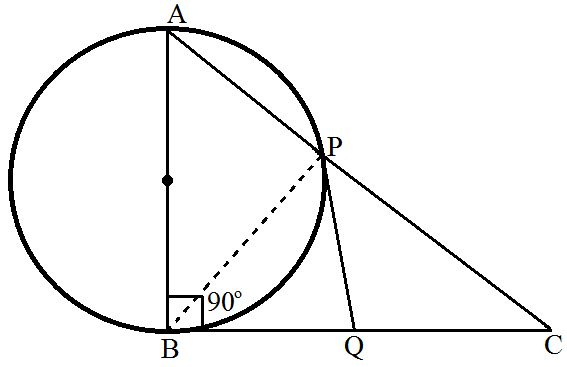
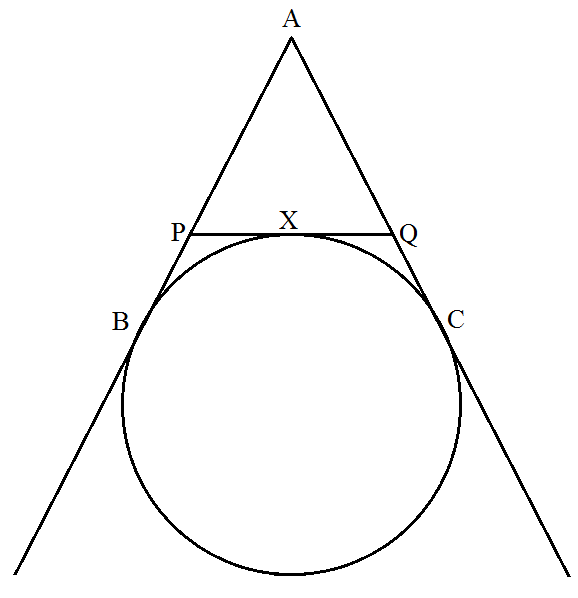
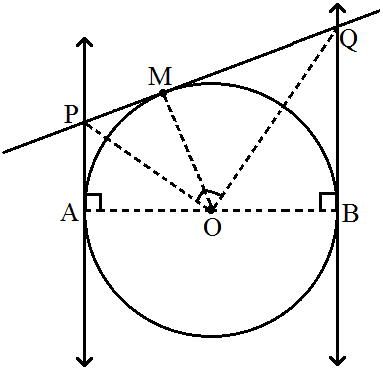 We have been asked to find the perimeter of the triangle APQ.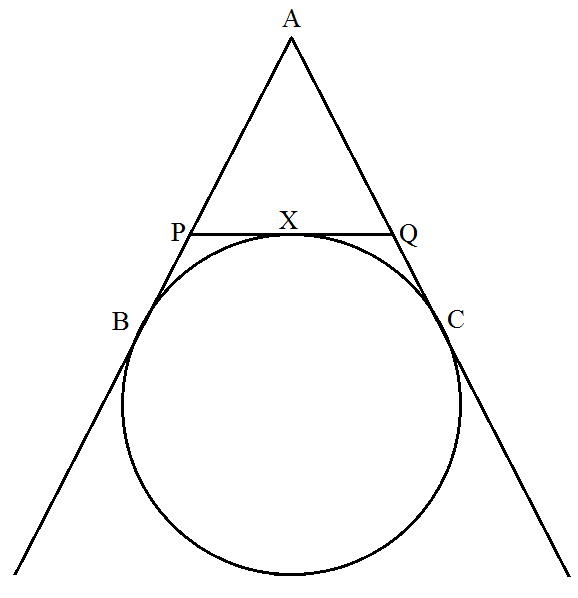
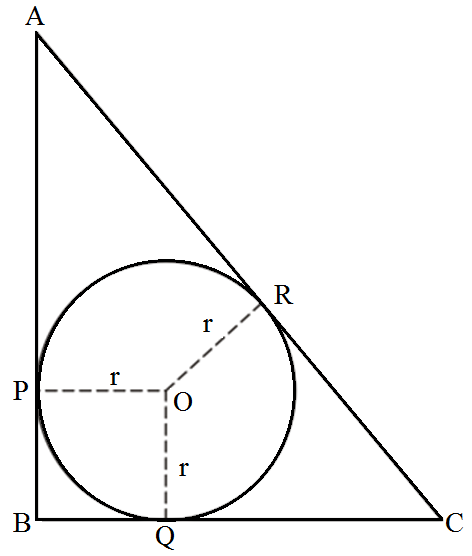
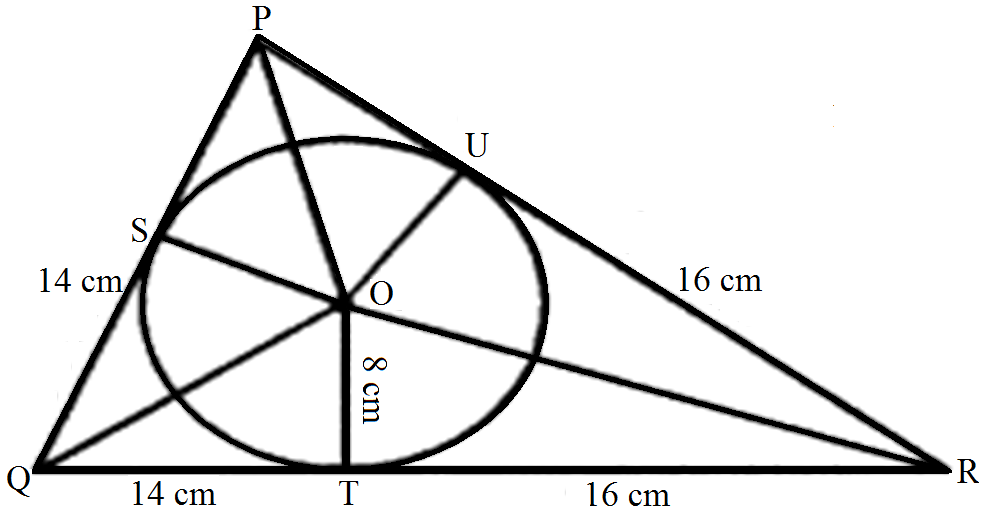
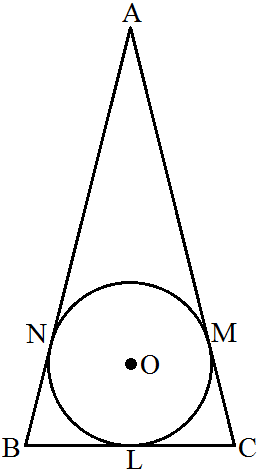
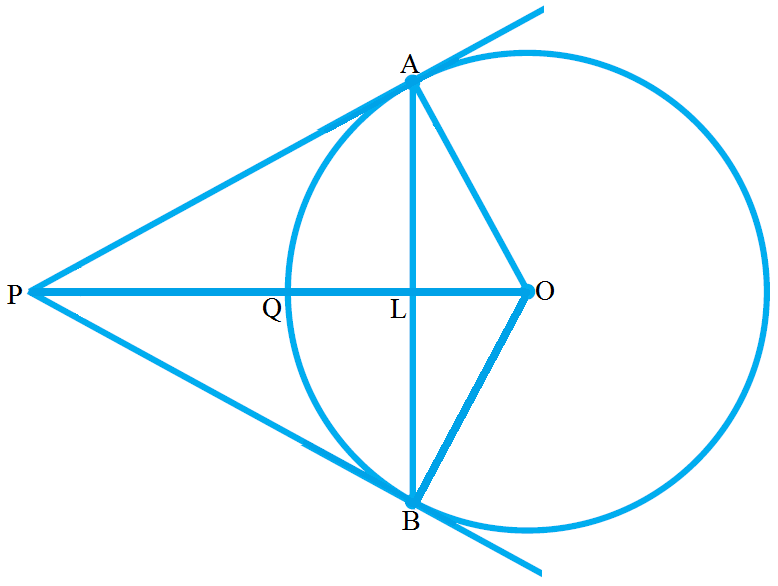
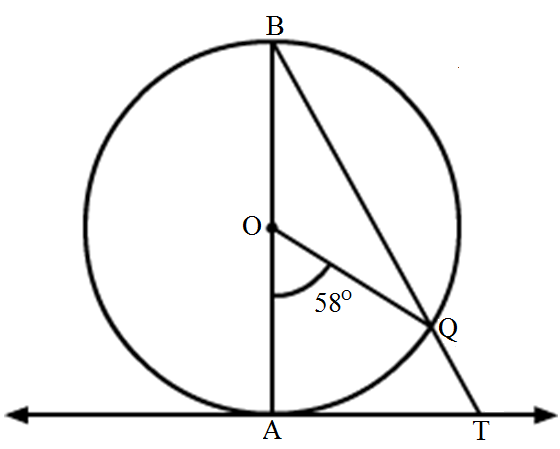
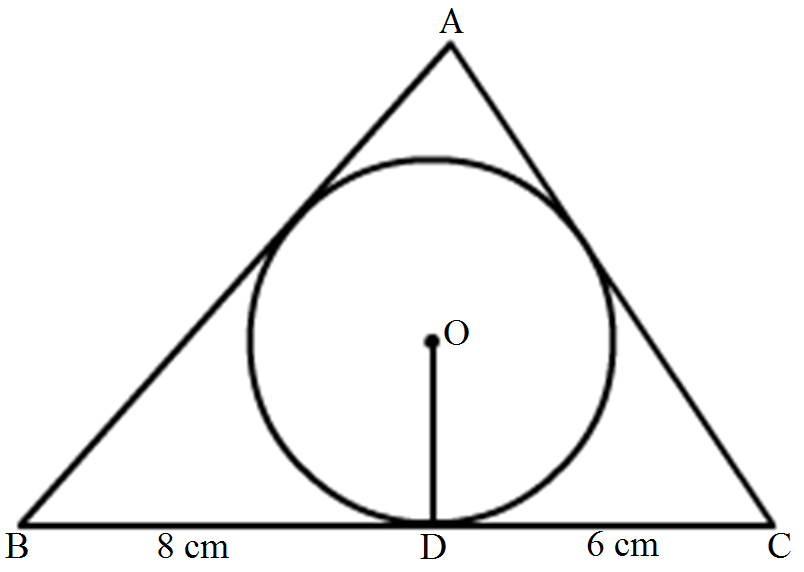
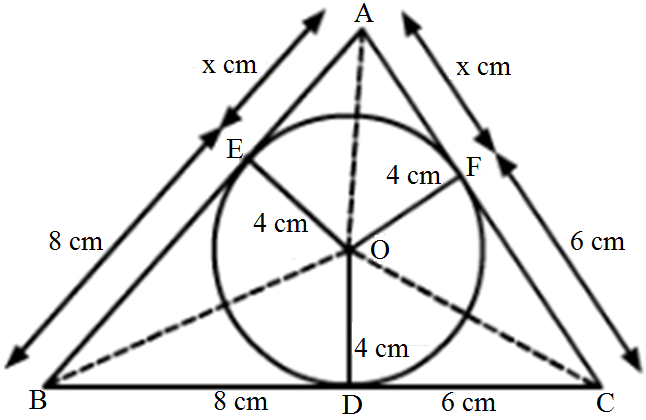
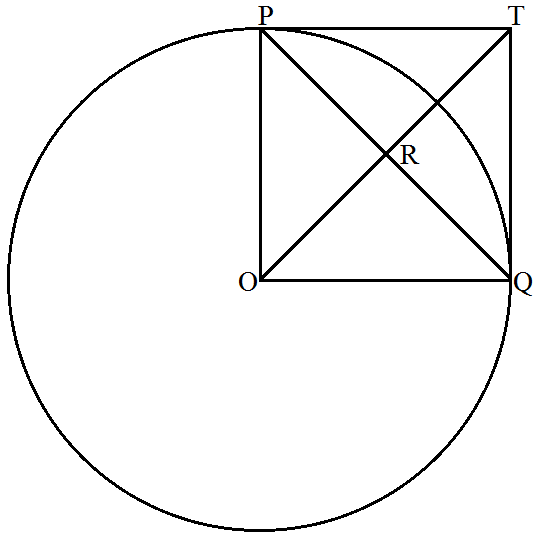
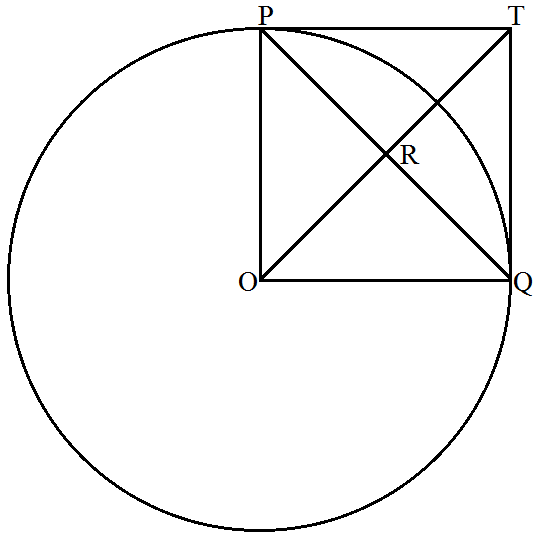
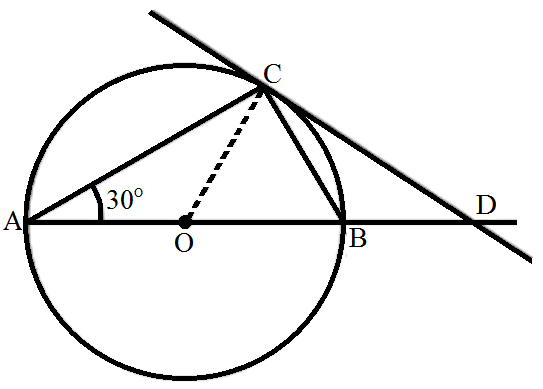
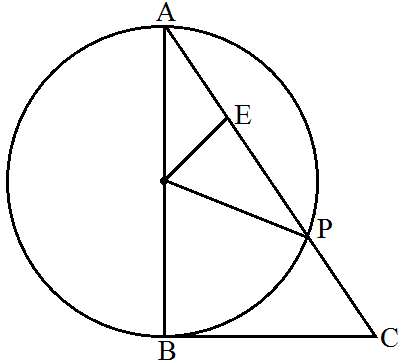
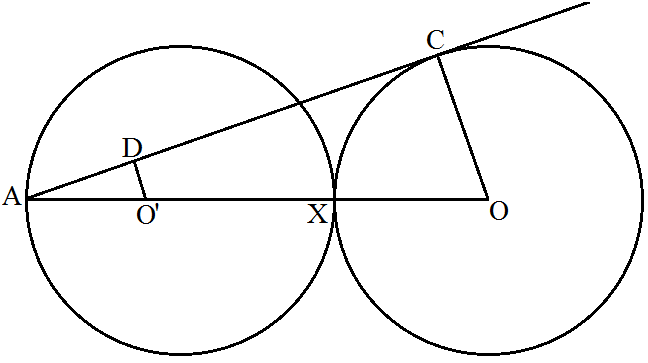
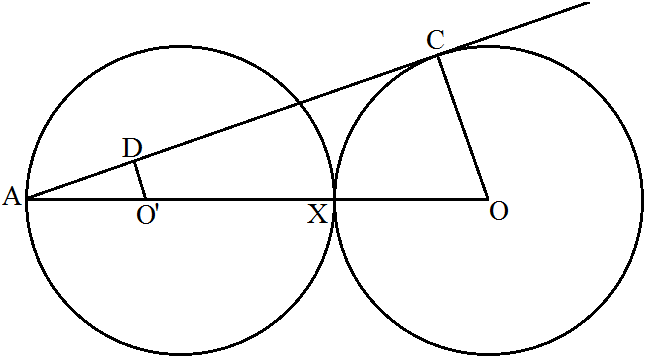
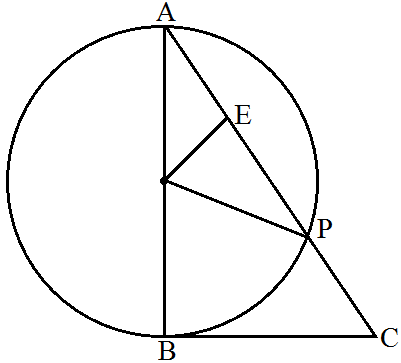 Let us first take up $\triangle\text{AOP}.$ We have, OA = OP (Since they are the radii of the same circle) Therefore,$\triangle\text{AOP}$ is an isosceles triangle. From the property of isosceles triangle, we know that, when a median drawn to the unequal side of the triangle will be perpendicular to the unequal side. Therefore, $\angle\text{OEA}=90^{\circ}$ Now let us take up$\triangle\text{AOE}\ \text{and}\ \triangle\text{ABC}.$ We know that the radius of the circle will always be perpendicular to the tangent at the point of contact. In this problem, OB is the radius and BC is the tangent and B is the point of contact. Therefore, $\angle\text{ABC}=90^{\circ}$ Also, from the property of isosceles triangle we have found that $\angle\text{OEA}=90^{\circ}$ Therefore, $\angle\text{A}$ is the common angle to both the triangles. Therefore, from AA postulate of similar triangles,$\triangle\text{AOE}\sim\triangle\text{ABC}$