Questions

2 Marks Questions

Take a timed test

24 questions · self-marked practice — reveal the answer and mark yourself.

Question 12 Marks
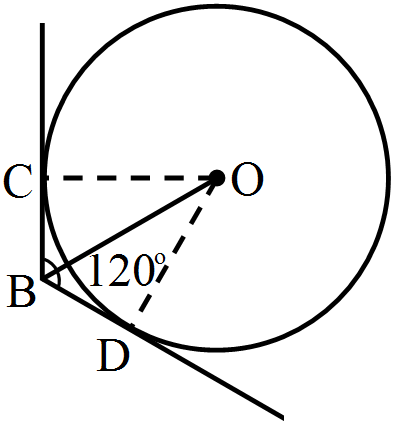
Two tangents BC and BD are drawn to a circle with centre O, such that $\angle\text{CBD} = 120^\circ.$ Prove that OB= 2BC.
Answer
In $\triangle\text{BCO}$ and $\triangle\text{BDO},$
$\angle\text{BCO}=\angle\text{BDO}=90^\circ$ ....(Since BC and BD are tangent to the circle)
$\text{OB}=\text{OB}$ ....(Common side)
$\text{OC}=\text{OD}$ ....(radii of the same circle)
$\Rightarrow\triangle\text{BCO}\cong\triangle\text{BDO}$ ....(RHS congruence criterion)
$\angle\text{OBC}=\angle\text{OBD}=60^\circ$ ....(cpct)
So, $\angle\text{COB}=30^\circ$
So, $\triangle\text{BCO}$ is a 30-60-90 triangle.
Side opposite $30^\circ=\frac{1}{2}\text{ hypotenus}$
$\Rightarrow\text{BC}=\frac{1}{2}\text{OB}$
$\Rightarrow\text{OB}=2\text{BC}$
Hence proved.
View full question & answer
Question 22 Marks
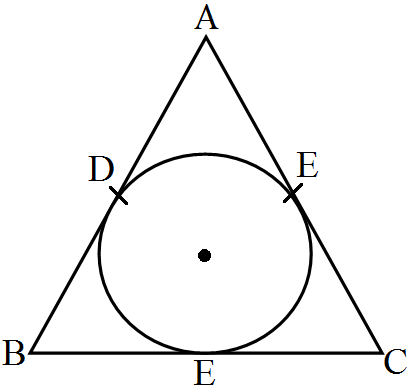
In the given figure, a circle inscribed in a triangle ABC, touches the sides AB, BC and AC at points D, E and F respectively. If AB = 12cm, BC = 8cm and AC = 10cm, find the lengths of AD, BE and CF.
Answer
We know that tangent segments to a circle from the same external point are congruent.
Now, we have
AD = AF, BD = BE and CE = CF
Now, AD + BD = 12cm ....(1)
AF + FC = 10cm
⇒ AD + FC = 10cm ....(2)
BE + EC = 8cm
⇒ BD + FC = 8cm ....(3)
Adding all these we get
AD + BD + AD + FC + BD + FC = 30
⇒ 2(AD + BD + FC) = 30
⇒ AD + BD + FC = 15cm ....(4)
Solving (1) and (4), we get
FC = 3cm
Solving (2) and (4), we get
BD = 5cm
Solving (3) and (4), we get
and AD = 7cm
$\therefore$ AD = AF = 7cm, BD = BE = 5cm and CE = CF = 3cm
View full question & answer
Question 32 Marks
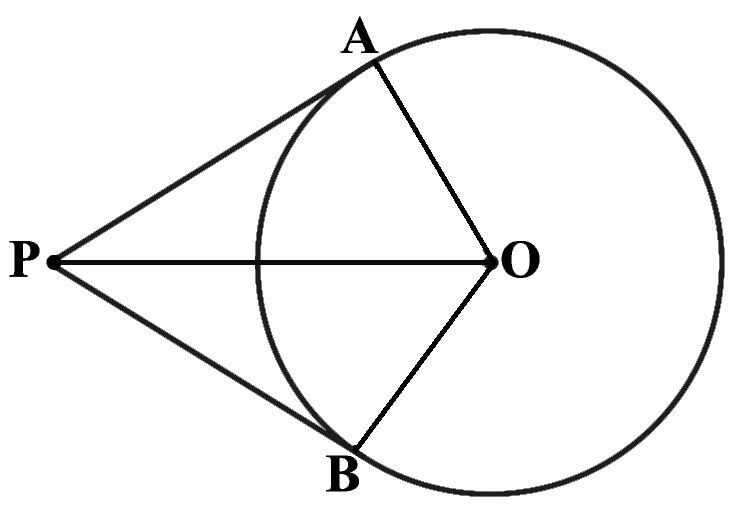
In the given figure, PA and PB are the tangents to a circle with centre O. Show that the points A, O, B, P are concyclic.
Answer
OA = OB ...(radii of the same circle)
Since PA and PB are tangent to the circle,
$\angle\text{OAP}=\angle\text{OBP}=90^\circ$
Consider,
$\angle\text{OAP}+\angle\text{OBP}$
$=90^\circ+90^\circ$
$=180^\circ$
In quad. AOBP,
$\angle\text{PAO}+\angle\text{PBO}+\angle\text{AOB}+\angle\text{APB}=360^\circ$
$\Rightarrow180^\circ+\angle\text{AOB}+\angle\text{APB}=360^\circ$
$\Rightarrow\angle\text{AOB}+\angle\text{APB}=180^\circ$
Since the sum of the opposite angles of quad. AOBP are supplementary, AOBP are concyclic.
That is, a circle passes through A, O, B and P.
Hence proved.
View full question & answer
Question 42 Marks
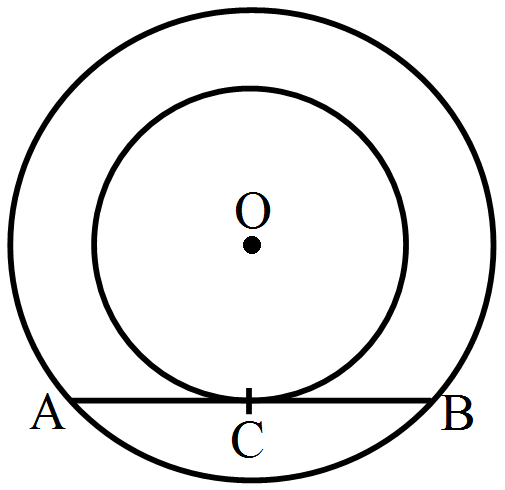
In the given figure, the chord AB of the larger of the two concentric circles, with centre O, touches the smaller circle at C. Prove that AC = CB.
Answer
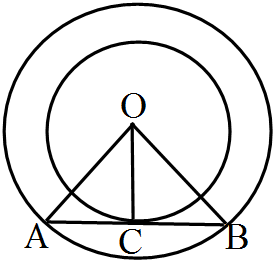
Construction: Join OA, OC and OB

We know that the radius and tangent are perpendicular at their point of contact
$\therefore\angle\text{OCA}=\angle\text{OCB}=90^\circ$
Now, In $\triangle\text{OCA}$ and $\triangle\text{OCB}$
$\angle\text{OCA}=\angle\text{OCB}=90^\circ$
$\text{OA}=\text{OB}$ (Radii of larger circle)
$\text{OC}=\text{OC}$ (Common)
By RHS congruency
$\triangle\text{OCA}\cong\triangle\text{OCB}$
$\therefore \text{CA}=\text{CB}$
View full question & answer
Question 52 Marks
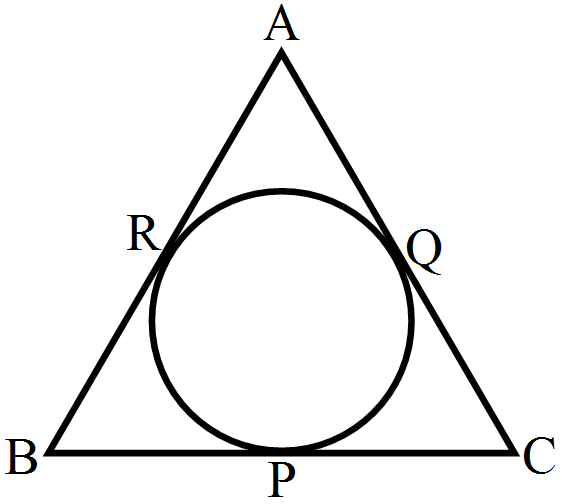
In the given figure, an isosceles triangle ABC, with AB = AC, circumscribes a circle. Prove that the point of contact P bisects the base BC.
Answer
We know that tangent segments to a circle from the same external point are congruent.
Now, we have
AR = AQ, BR = BP and CP = CQ
Now, AB = AC
⇒ AR + RB = AQ + QC
⇒ AR + RB = AR + QC
⇒ RB = QC
⇒ BP = CP
Hence, P bisects BC at P.
View full question & answer
Question 62 Marks
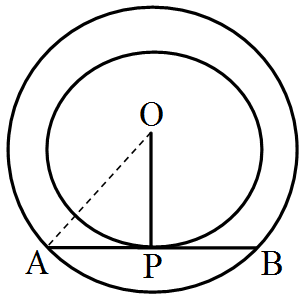
Two concentric circle are of radii $6.5\ cm$ and $2.5\ cm.$ Find the length of the chord of the larger circle which touches the smaller circle.
Answer

We know that the radius and tangent are perpendicular at their point of contact
In right triangle $AOP$
$AO^2 = OP^2+ PA^2$
$\Rightarrow (6.5)^2 =(2. 5)^2 + PA^2$
$\Rightarrow PA^2= 36$
$\Rightarrow PA = 6cm$
Since, the perpendicular drawn from the centre bisect the chord.
$\therefore PA = PB = 6cm$
Now, $AB = AP + PB = 6 + 6 = 12cm$
Hence, the length of the chord of the larger circle is $12cm$
View full question & answer
Question 72 Marks
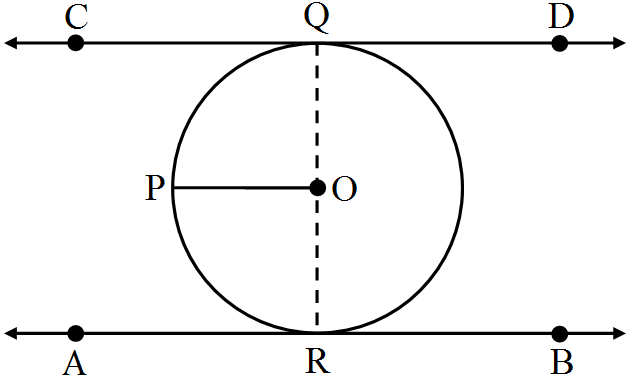
Prove that the line segment joining the points of contact of two parallel tangents of a circle, passes through its centre.
Answer

Suppose $CD$ and $AB$ are two parallel tangents of a circle with centre $O$
Construction: Draw a line parallel to $CD$ passing through $O$ i.e, $OP$
We know that the radius and tangent are perperpendular at their point of contact.
$\angle\text{OQC}=\angle\text{ORA}=90^\circ$
Now, $\angle\text{OQC}=\angle\text{POQ}=180^\circ$ (co-interior angles)
$\Rightarrow\angle\text{POQ}=180^\circ-90^\circ=90^\circ$
Similarly, Now, $\angle\text{ORA}+\angle\text{POR}=180^\circ$ (co-interior angles)
$\Rightarrow\angle\text{POR}=180^\circ-90^\circ=90^\circ$
Now, $\angle\text{POR}+\angle\text{POQ}=90^\circ+90^\circ=180^\circ$
Since, $\angle\text{POR}$ and $\angle\text{POQ}$ are linear pair angles whose sum is $180^∘$ 
Hence, $QR$ is a straight line passing through centre $O.$
View full question & answer
Question 82 Marks
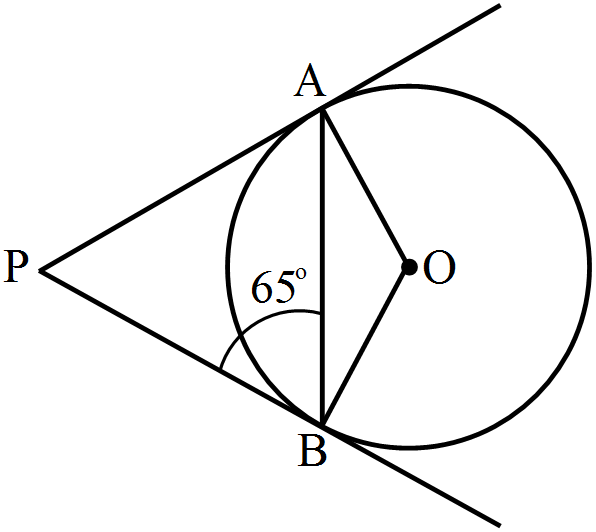
In the given figure, $PA$ and $PB$ are two tangents from an external point $P$ to a circle with centre $O$. If $\angle\text{PBA} = 65^\circ$ find $\angle\text{OAB}$ and $\angle\text{APB}.$
Answer
Since $PB$ is a tangent to the circle, $\angle\text{OBP}=90^\circ.$
Now,
$\angle\text{OBA}=\angle\text{OBP}-\angle\text{ABP}$
$=90^\circ-65^\circ$
$=25^\circ$
Since $ \text{OB} = \text{OA},\angle\text{OAB}=\angle\text{OBA}=25^\circ.$
In $\triangle\text{AOB},$
$\angle\text{AOB}+\angle\text{ABO}+\angle\text{OAB}=180^\circ$
$\Rightarrow\angle\text{AOB}+25^\circ+25^\circ=180^\circ$
$\Rightarrow\angle\text{AOB}=130^\circ$
In quad. $AOBP$
$\angle\text{PAO}+\angle\text{PBO}+\angle\text{AOB}+\angle\text{APB}=360^\circ$
$\Rightarrow90^\circ+90^\circ+130^\circ+\angle\text{APB}=360^\circ$
$\Rightarrow\angle\text{APB}=50^\circ$
Thus, $\angle\text{OAB}=25^\circ$ and $\angle\text{APB}=50^\circ.$
View full question & answer
Question 92 Marks
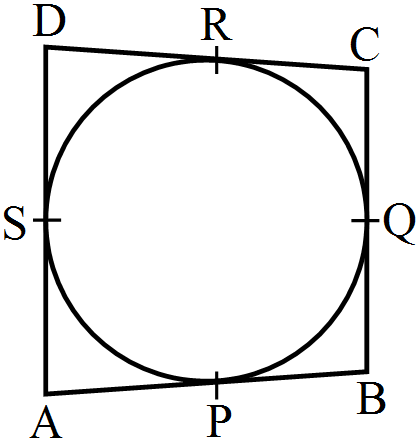
In the given figure, a quadrilateral ABCD is drawn to circumscribe a circle such that its side AB, BC, CD and AD touch the circle at P, Q, R and S respectively. If AB = x cm, BC = 7cm, CR = 3cm and AS = 5cm , find x.
Answer
We know that tangent is from an external point to the circle are equal.
AP = AS = 5cm
CQ = CR = 3cm
BQ = BP
Now,
BC = CQ + BQ
BQ = BC - CQ
= 7 - 3
= 4cm
So, BQ = PB = 4cm
Thus, AB = AP + PB = 5 + 4 = 9cm
View full question & answer
Question 102 Marks
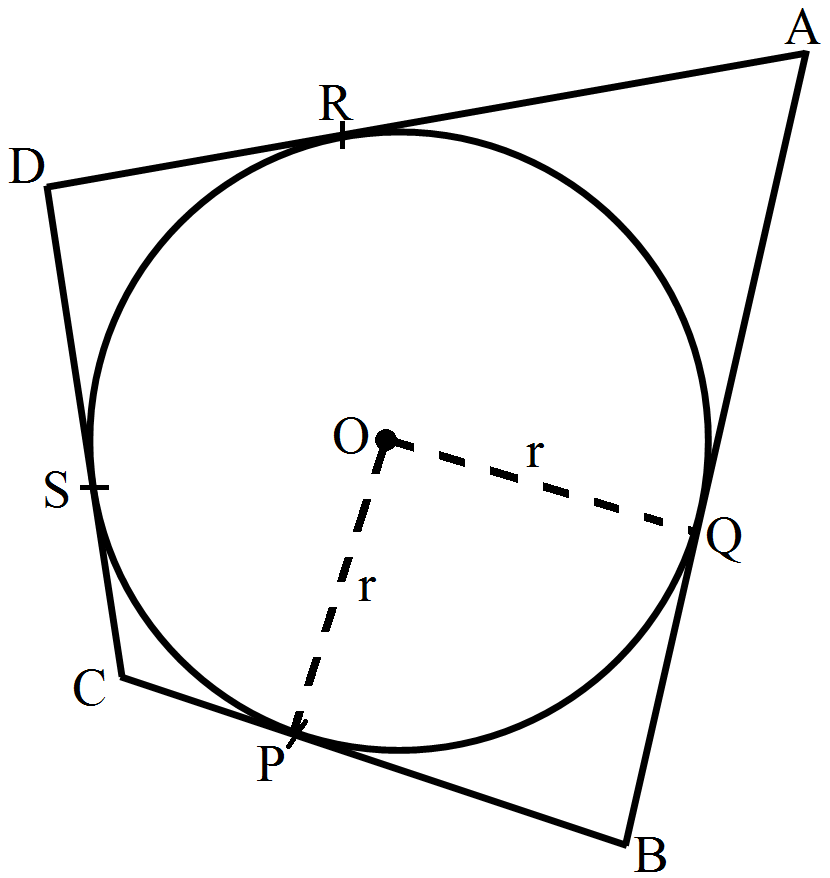
In the given figure, a circle with centre O, is inscribed in a quadrilateral ABCD such that it touches the side BC, AB, AD and CD at points P, Q, R and S respectively. If AB = 29cm, AD = 23cm, $\angle\text{B} = 90^\circ$and DS = 5cm then find the radius of the circle.
Answer
We know that tangent segments to a circle from the same external point are congruent.
Now, we have
DS = DR, AR = AQ
Now, AD = 23cm
⇒ AR + RD = 23
⇒ AR = 23 - RD
⇒ AR = 23 - 5 $[\therefore$ DS = DR = 5$]$
⇒ AR = 18cm
Again, AB = 29cm
⇒ AQ + QB = 29
⇒ QB = 29 - AQ
⇒ QB = 29 - 18 $[\therefore$ AR = AQ = 18$]$
⇒ QB = 11cm
Since all the angles are in a quadrilateral BQOP are right angles and OP = BQ.
Hence, BQOP is a square.
We know that all the sides of square are equal.
Therefore, BQ = PO = 11cm
Hence, the radius of the circle is 11cm.
View full question & answer
Question 112 Marks
In the given figure, PA and PB are the tangent segments to a circle with centre O. Show that the points A, O, B and P are concyclic.
Answer
Here, OA = OB
And $\text{OA}\perp\text{AP},\text{OA}\perp\text{BP}$ (Since tangent drawn from an external point are perpendicular to the radius at the point of contact)
$\therefore\angle\text{OAP}=90^\circ,\angle\text{OBP}=90^\circ$
$\therefore\angle\text{OAP}+\angle\text{OBP}=90^\circ+90^\circ=180^\circ$
$\therefore\angle\text{AOB}+\angle\text{APB}+\text{PB}=360^\circ)$
Sum of opposite angle of a quadrilateral is 180º.
Hence, A, O B and P are concyclic.
View full question & answer
Question 122 Marks
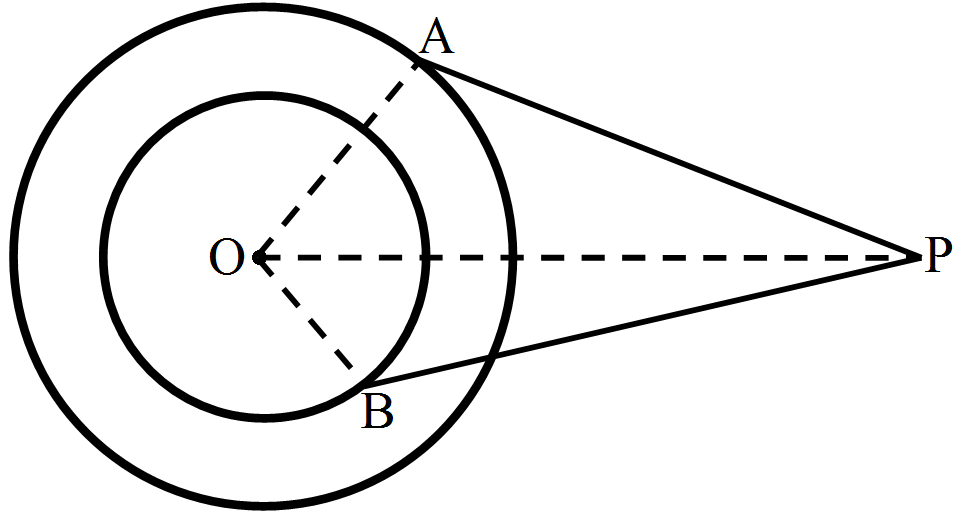
In the given figure, O is the center of two concentric circle of radii 4cm and 6cm respectively. PA and PB are tangle to the outer and inner circle respectively. If PA = 10cm, find the length of PB up to one place of decimal.
Answer
Given, O is the centre of two concentric circles of radii OA = 6 cm and OB = 4cm.PA and PB are the two tangents to the outer and inner circles respectively and PA = 10 cm.
Now, tangent drawn from an external point is perpendicular to the radiusat the point of contact.
$\therefore\angle\text{OAP}=\angle\text{OBP}=90^\circ$
$\therefore$ From right- angled $\triangle\text{OAP},\text{OP}^2=\text{OA}^2+\text{PA}^2$
$=>\text{OP}=\sqrt{\text{OA}^2+\text{PA}^2}$
$=>\text{OP}=\sqrt{\text{6}^2+\text{10}^2}$
$=>\text{OP}=\sqrt{136}\text{cm}.$
$\therefore$ From right- angled $\triangle\text{OAP},\text{OP}^2=\text{OB}^2+\text{PB}^2$
$=>\text{PB}=\sqrt{\text{OP}^2-\text{OB}^2}$
$=>\text{PB}=\sqrt{\text{366}-\text{16}}$
$=>\text{PB}=\sqrt{120}\text{cm}.$
$=>\text{OP}=10.9\text{cm}.$
$\therefore$ The length of PB is 10.9cm
View full question & answer
Question 132 Marks
Two tangents BC and BD are drawn to a circle with centre O, such that $\angle\text{CBD} = 120^\circ.$ Prove that OB= 2BC.
Answer
In $\triangle\text{BCO}$ and $\triangle\text{BDO},$
$\angle\text{BCO}=\angle\text{BDO}=90^\circ$ ....(Since BC and BD are tangent to the circle)
$\text{OB}=\text{OB}$ ....(Common side)
$\text{OC}=\text{OD}$ ....(radii of the same circle)
$\Rightarrow\triangle\text{BCO}\cong\triangle\text{BDO}$ ....(RHS congruence criterion)
$\angle\text{OBC}=\angle\text{OBD}=60^\circ$ ....(cpct)
So, $\angle\text{COB}=30^\circ$
So, $\triangle\text{BCO}$ is a 30-60-90 triangle.
Side opposite $30^\circ=\frac{1}{2}\text{ hypotenus}$
$\Rightarrow\text{BC}=\frac{1}{2}\text{OB}$
$\Rightarrow\text{OB}=2\text{BC}$
Hence proved.
View full question & answer
Question 142 Marks
In the given figure, a circle inscribed in a triangle ABC, touches the sides AB, BC and AC at points D, E and F respectively. If AB = 12cm, BC = 8cm and AC = 10cm, find the lengths of AD, BE and CF.
Answer
We know that tangent segments to a circle from the same external point are congruent.
Now, we have
AD = AF, BD = BE and CE = CF
Now, AD + BD = 12cm ....(1)
AF + FC = 10cm
⇒ AD + FC = 10cm ....(2)
BE + EC = 8cm
⇒ BD + FC = 8cm ....(3)
Adding all these we get
AD + BD + AD + FC + BD + FC = 30
⇒ 2(AD + BD + FC) = 30
⇒ AD + BD + FC = 15cm ....(4)
Solving (1) and (4), we get
FC = 3cm
Solving (2) and (4), we get
BD = 5cm
Solving (3) and (4), we get
and AD = 7cm
$\therefore$ AD = AF = 7cm, BD = BE = 5cm and CE = CF = 3cm
View full question & answer
Question 152 Marks
In the given figure, PA and PB are the tangents to a circle with centre O. Show that the points A, O, B, P are concyclic.
Answer
OA = OB ...(radii of the same circle)
Since PA and PB are tangent to the circle,
$\angle\text{OAP}=\angle\text{OBP}=90^\circ$
Consider,
$\angle\text{OAP}+\angle\text{OBP}$
$=90^\circ+90^\circ$
$=180^\circ$
In quad. AOBP,
$\angle\text{PAO}+\angle\text{PBO}+\angle\text{AOB}+\angle\text{APB}=360^\circ$
$\Rightarrow180^\circ+\angle\text{AOB}+\angle\text{APB}=360^\circ$
$\Rightarrow\angle\text{AOB}+\angle\text{APB}=180^\circ$
Since the sum of the opposite angles of quad. AOBP are supplementary, AOBP are concyclic.
That is, a circle passes through A, O, B and P.
Hence proved.
View full question & answer
Question 162 Marks
In the given figure, the chord AB of the larger of the two concentric circles, with centre O, touches the smaller circle at C. Prove that AC = CB.
Answer
Construction: Join OA, OC and OB

We know that the radius and tangent are perpendicular at their point of contact
$\therefore\angle\text{OCA}=\angle\text{OCB}=90^\circ$
Now, In $\triangle\text{OCA}$ and $\triangle\text{OCB}$
$\angle\text{OCA}=\angle\text{OCB}=90^\circ$
$\text{OA}=\text{OB}$ (Radii of larger circle)
$\text{OC}=\text{OC}$ (Common)
By RHS congruency
$\triangle\text{OCA}\cong\triangle\text{OCB}$
$\therefore \text{CA}=\text{CB}$
View full question & answer
Question 172 Marks
In the given figure, an isosceles triangle ABC, with AB = AC, circumscribes a circle. Prove that the point of contact P bisects the base BC.
Answer
We know that tangent segments to a circle from the same external point are congruent.
Now, we have
AR = AQ, BR = BP and CP = CQ
Now, AB = AC
⇒ AR + RB = AQ + QC
⇒ AR + RB = AR + QC
⇒ RB = QC
⇒ BP = CP
Hence, P bisects BC at P.
View full question & answer
Question 182 Marks
Two concentric circle are of radii $6.5\ cm$ and $2.5\ cm$. Find the length of the chord of the larger circle which touches the smaller circle.
Answer


We know that the radius and tangent are perpendicular at their point of contact
In right triangle AOP
$AO^2 = OP^2+ PA^2$
$\Rightarrow (6.5)^2 =(2. 5)^2 + PA^2$
$\Rightarrow PA^2= 36$
$\Rightarrow PA = 6cm$
Since, the perpendicular drawn from the centre bisect the chord.
$\therefore$ $PA = PB = 6\ cm$
Now, $AB = AP + PB = 6 + 6 = 12\ cm$
Hence, the length of the chord of the larger circle is $12\ cm$
View full question & answer
Question 192 Marks
Prove that the line segment joining the points of contact of two parallel tangents of a circle, passes through its centre.
Answer


Suppose CD and AB are two parallel tangents of a circle with centre O
Construction: Draw a line parallel to CD passing through O i.e, OP
We know that the radius and tangent are perperpendular at their point of contact.
$\angle\text{OQC}=\angle\text{ORA}=90^\circ$
Now, $\angle\text{OQC}=\angle\text{POQ}=180^\circ$ (co-interior angles)
$\Rightarrow\angle\text{POQ}=180^\circ-90^\circ=90^\circ$
Similarly, Now, $\angle\text{ORA}+\angle\text{POR}=180^\circ$ (co-interior angles)
$\Rightarrow\angle\text{POR}=180^\circ-90^\circ=90^\circ$
Now, $\angle\text{POR}+\angle\text{POQ}=90^\circ+90^\circ=180^\circ$
Since, $\angle\text{POR}$ and $\angle\text{POQ}$ are linear pair angles whose sum is $180^\circ$
Hence, QR is a straight line passing through centre O.
View full question & answer
Question 202 Marks
In the given figure, PA and PB are two tangents from an external point P to a circle with centre O.
If $\angle\text{PBA} = 65^\circ$ find $\angle\text{OAB}$ and $\angle\text{APB}.$

Answer
Since PB is a tangent to the circle, $\angle\text{OBP}=90^\circ.$
Now,
$\angle\text{OBA}=\angle\text{OBP}-\angle\text{ABP}$
$=90^\circ-65^\circ$
$=25^\circ$
Since $ \text{OB} = \text{OA},\angle\text{OAB}=\angle\text{OBA}=25^\circ.$
In $\triangle\text{AOB},$
$\angle\text{AOB}+\angle\text{ABO}+\angle\text{OAB}=180^\circ$
$\Rightarrow\angle\text{AOB}+25^\circ+25^\circ=180^\circ$
$\Rightarrow\angle\text{AOB}=130^\circ$
In quad. AOBP
$\angle\text{PAO}+\angle\text{PBO}+\angle\text{AOB}+\angle\text{APB}=360^\circ$
$\Rightarrow90^\circ+90^\circ+130^\circ+\angle\text{APB}=360^\circ$
$\Rightarrow\angle\text{APB}=50^\circ$
Thus, $\angle\text{OAB}=25^\circ$ and $\angle\text{APB}=50^\circ.$
View full question & answer
Question 212 Marks
In the given figure, a quadrilateral ABCD is drawn to circumscribe a circle such that its side AB, BC, CD and AD touch the circle at P, Q, R and S respectively. If AB = x cm, BC = 7cm, CR = 3cm and AS = 5cm , find x.
Answer
We know that tangent is from an external point to the circle are equal.
AP = AS = 5cm
CQ = CR = 3cm
BQ = BP
Now,
BC = CQ + BQ
BQ = BC - CQ
= 7 - 3
= 4cm
So, BQ = PB = 4cm
Thus, AB = AP + PB = 5 + 4 = 9cm
View full question & answer
Question 222 Marks
In the given figure, a circle with centre O, is inscribed in a quadrilateral ABCD such that it touches the side BC, AB, AD and CD at points P, Q, R and S respectively. If AB = 29cm, AD = 23cm, $\angle\text{B} = 90^\circ$and DS = 5cm then find the radius of the circle.
Answer
We know that tangent segments to a circle from the same external point are congruent.
Now, we have
DS = DR, AR = AQ
Now, AD = 23cm
⇒ AR + RD = 23
⇒ AR = 23 - RD
⇒ AR = 23 - 5 $[\therefore$ DS = DR = 5$]$
⇒ AR = 18cm
Again, AB = 29cm
⇒ AQ + QB = 29
⇒ QB = 29 - AQ
⇒ QB = 29 - 18 $[\therefore$ AR = AQ = 18$]$
⇒ QB = 11cm
Since all the angles are in a quadrilateral BQOP are right angles and OP = BQ.
Hence, BQOP is a square.
We know that all the sides of square are equal.
Therefore, BQ = PO = 11cm
Hence, the radius of the circle is 11cm.
View full question & answer
Question 232 Marks
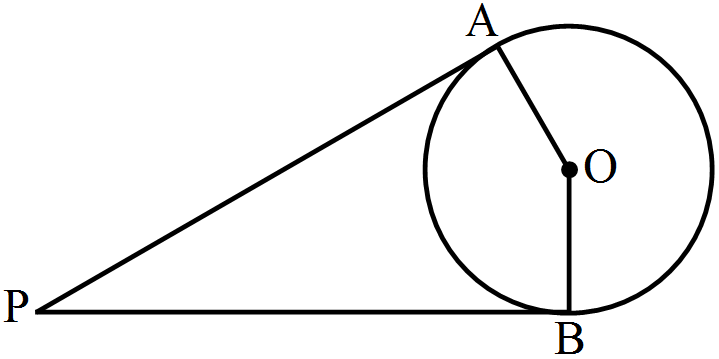
In the given figure, PA and PB are the tangent segments to a circle with centre O. Show that the points A, O, B and P are concyclic.
Answer
Here, OA = OB
And $\text{OA}\perp\text{AP},\text{OA}\perp\text{BP}$ (Since tangent drawn from an external point are perpendicular to the radius at the point of contact)
$\therefore\angle\text{OAP}=90^\circ,\angle\text{OBP}=90^\circ$
$\therefore\angle\text{OAP}+\angle\text{OBP}=90^\circ+90^\circ=180^\circ$
$\therefore\angle\text{AOB}+\angle\text{APB}+\text{PB}=360^\circ)$
Sum of opposite angle of a quadrilateral is 180º.
Hence, A, O B and P are concyclic.
View full question & answer
Question 242 Marks
In the given figure, O is the center of two concentric circle of radii 4cm and 6cm respectively. PA and PB are tangle to the outer and inner circle respectively. If PA = 10cm, find the length of PB up to one place of decimal.
Answer
Given, O is the centre of two concentric circles of radii OA = 6 cm and OB = 4cm.PA and PB are the two tangents to the outer and inner circles respectively and PA = 10 cm.
Now, tangent drawn from an external point is perpendicular to the radiusat the point of contact.
$\therefore\angle\text{OAP}=\angle\text{OBP}=90^\circ$
$\therefore$ From right- angled $\triangle\text{OAP},\text{OP}^2=\text{OA}^2+\text{PA}^2$
$=>\text{OP}=\sqrt{\text{OA}^2+\text{PA}^2}$
$=>\text{OP}=\sqrt{\text{6}^2+\text{10}^2}$
$=>\text{OP}=\sqrt{136}\text{cm}.$
$\therefore$ From right- angled $\triangle\text{OAP},\text{OP}^2=\text{OB}^2+\text{PB}^2$
$=>\text{PB}=\sqrt{\text{OP}^2-\text{OB}^2}$
$=>\text{PB}=\sqrt{\text{366}-\text{16}}$
$=>\text{PB}=\sqrt{120}\text{cm}.$
$=>\text{OP}=10.9\text{cm}.$
$\therefore$ The length of PB is 10.9cm
View full question & answer