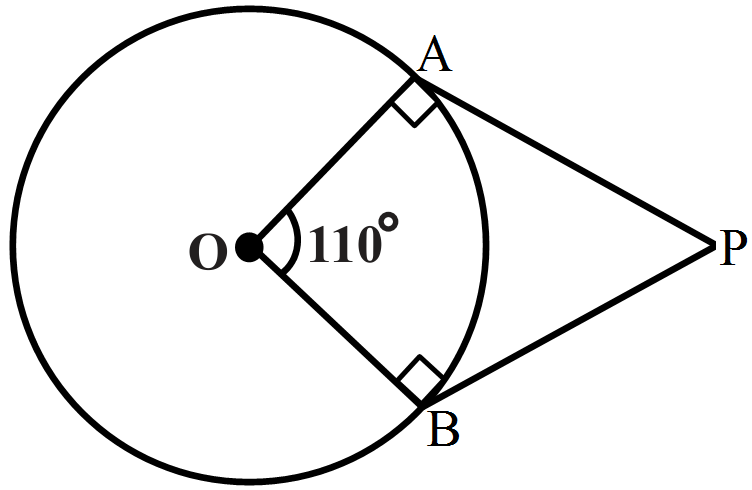
Questions

M.C.Q (1 Marks)

Take a timed test

59 questions · auto-graded multiple-choice test.

MCQ 11 Mark
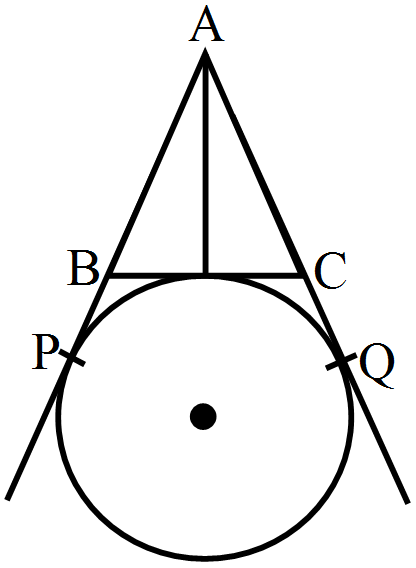
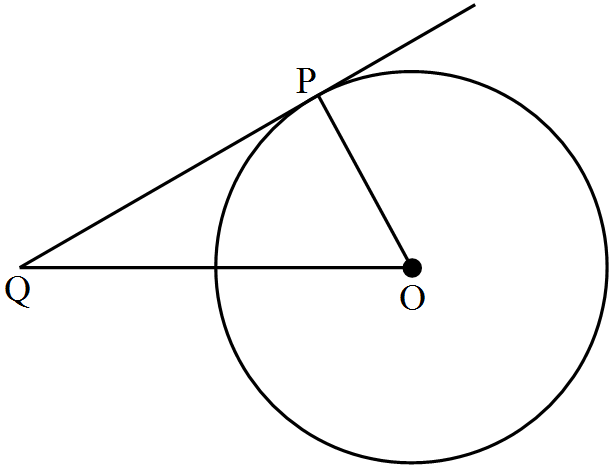
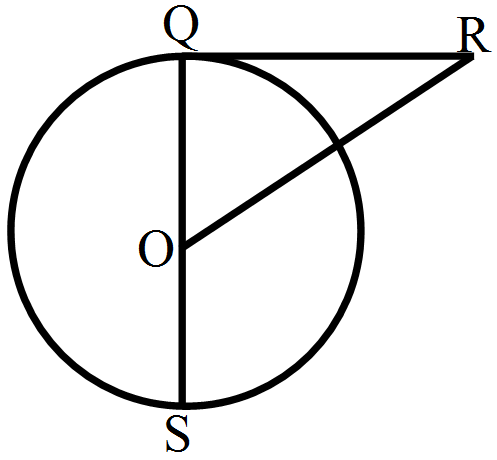
In the given figure, $RQ$ is a tangent to the circle with centre $O$. If $SQ = 6\ cm$ and $QR = 4\ cm$, then $OR$ is equal to:
  • A
    $2.5\ cm$
  • B
    $3\ cm$
  • $5\ cm$
  • D
    $8\ cm$
Answer
Correct option: C.
$5\ cm$
$SQ = 6\ cm \Rightarrow OQ = 3\ cm$
$QR = 4\ cm$
Since $RQ$ is a tangent to the circle at $Q.$
$\angle\text{RQO}=90^\circ ....($tangent is perpendicular to the radius of a circle$)$
In $\triangle\text{RQO},$
By using Pythagoras theorem,
$OR^2 = RQ^2 + OQ^2$
$= 4^2 + 3^2$
$= 16 + 9$
$= 25$
$\therefore OR^2 = 25$
$\Rightarrow OR = 5\ cm$
View full question & answer
MCQ 21 Mark
Each question consists of two statements, namely, Assertion $(A)$ and Reason $(R)$. for selecting the correct answer, use the following code:
Assertion $(A)$
Reason $(R)$
 
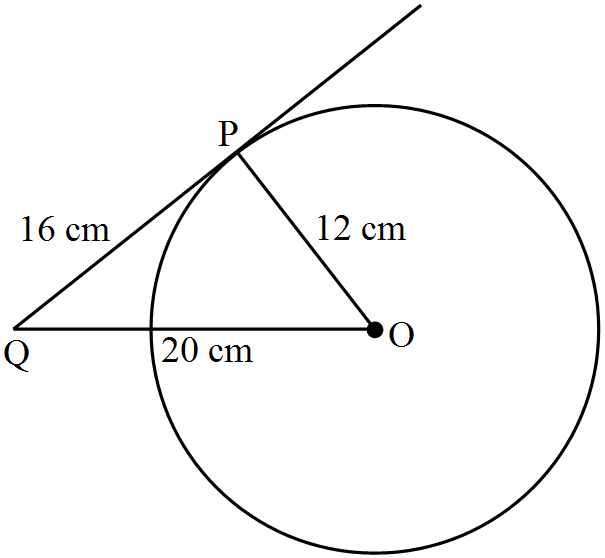
At a point $P$ of a circle with centre $O$ and radius $12cm$, a tangent $PQ$ of length $16\ cm$ is drawn. Then, the point of contact. $OQ = 20\ cm.$
The tangent at any point of a circle is perpendicular to the radius through the point of contact.
  • Both Assertion $(A)$ and Reason $(R)$ are true and Reason $(R)$ is a correct explanation of Assertion $(A).$
  • B
    Both Assertion $(A)$ and Reason $(R)$ are true but Reason $(R)$ is not a correct explanation of Assertion $(A).$
  • C
    Assertion $(A)$ is true and Reason $(R)$ is false.
  • D
    Assertion $(A)$ is false and Reason $(R)$ is true.
Answer
Correct option: A.
Both Assertion $(A)$ and Reason $(R)$ are true and Reason $(R)$ is a correct explanation of Assertion $(A).$

We know that the tangent is perpendicular to the radius of a circle.
In $\triangle\text{OPQ},$
By Pythagoras theorem,
$OQ^2= QP^2 + OP^2$
$\Rightarrow OP^2 = 16^2 + 12^2$
$\Rightarrow OP^2 = 256 + 144$
$\Rightarrow OP^2 = 400$
$\Rightarrow OP = 20\ cm$
So, the Assertion $(A)$ is true.
The Reason $(R)$ is true and is the correct explanation for the Assertion $(A).$
 
View full question & answer
MCQ 31 Mark
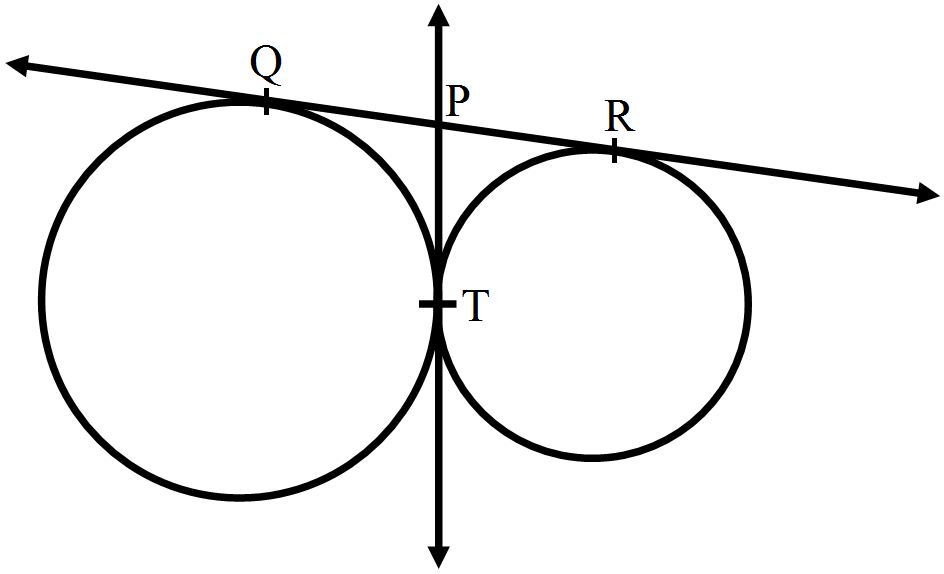
In the given figure, $QR$ is a common tangent to the given circle, touching externally at the point $T$. The tangent at $T$ meets $QR$ at $P$. If $PT = 3.8\ cm$ then the length of $QR$ is:
  • A
    $1.9\ cm$
  • B
    $3.8\ cm$
  • C
    $5.7\ cm$
  • $7.6\ cm$
Answer
Correct option: D.
$7.6\ cm$
We know that tangent from an external point to the circle are equal.
$\text{PQ = PT} = 3.8\ cm$
$\text{PR = PT} = 3.8\ cm$
$\text{QR = PQ + PR}$
$= 3.8 +3.8$
$=7.6\ cm$
View full question & answer
MCQ 41 Mark
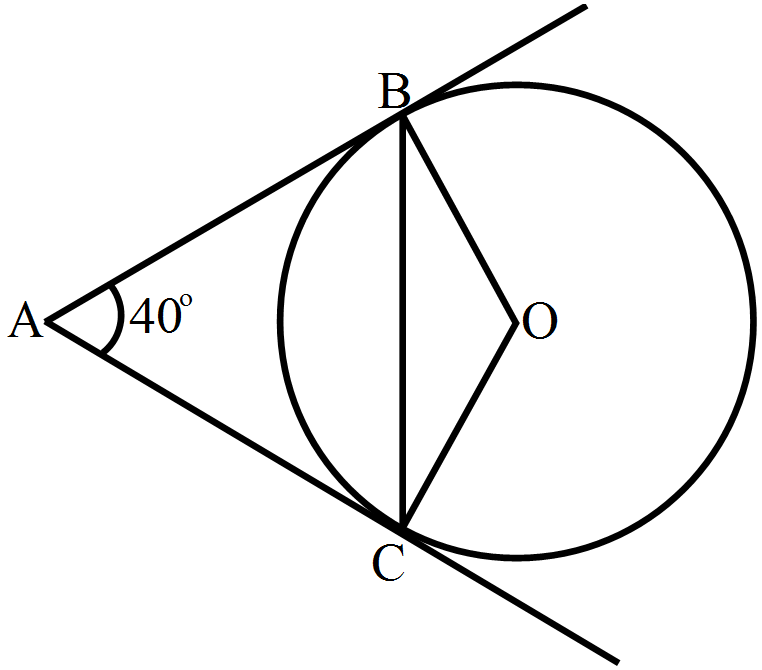
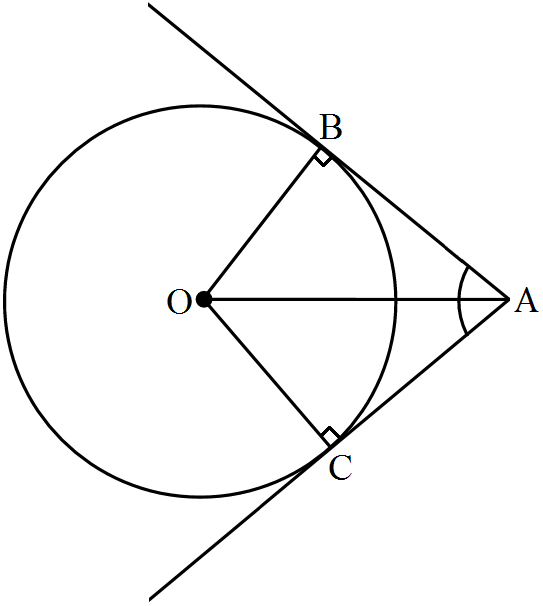
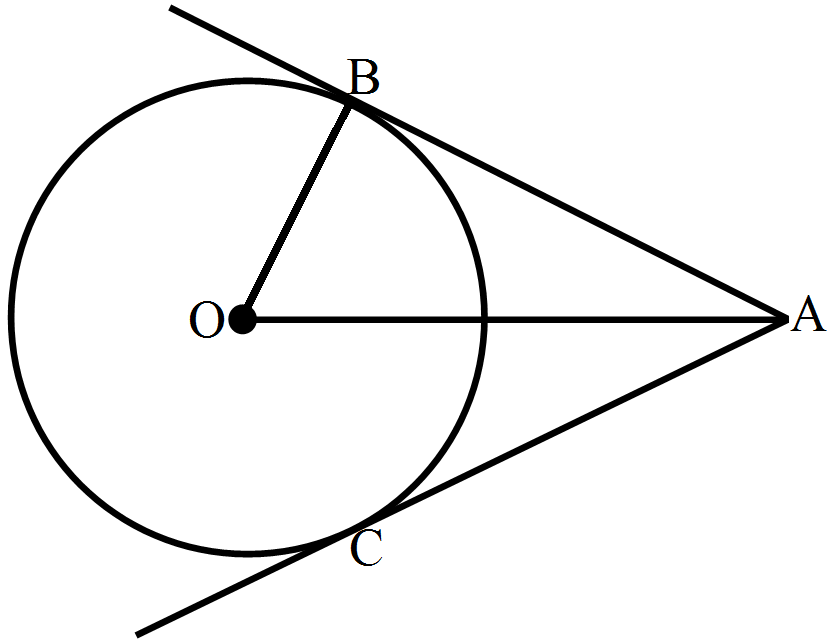
In the given figure, $AB$ and $AC$ are tangent to the circle with centre $O$ such that $\angle\text{BAC}=40^\circ.$ Then, $\angle\text{BOC}$ is equal to:
  • A
    $80^\circ$
  • B
    $100^\circ$
  • C
    $120^\circ$
  • $140^\circ$
Answer
Correct option: D.
$140^\circ$
Since $AB$ and $AC$ are the tangent to the circle.
$\angle\text{OBA}=\angle\text{BAC}=90^\circ....($tangent is perpendicular to the radius of a circle$)$
In $\text{ABOC}$
$\angle\text{OBA}+\angle\text{BAC}+\angle\text{OCA}+\angle\text{BOC}=360^\circ$
$\Rightarrow90^\circ+40^\circ+90^\circ+\angle\text{BOC}=360^\circ$
$\Rightarrow\angle\text{BOC}=140^\circ$
View full question & answer
MCQ 51 Mark
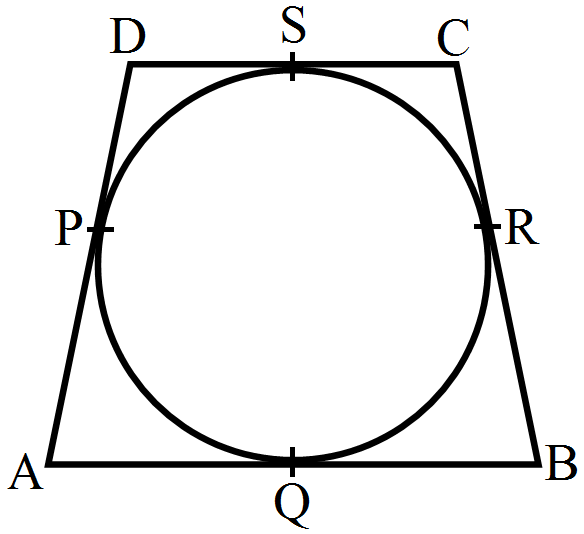
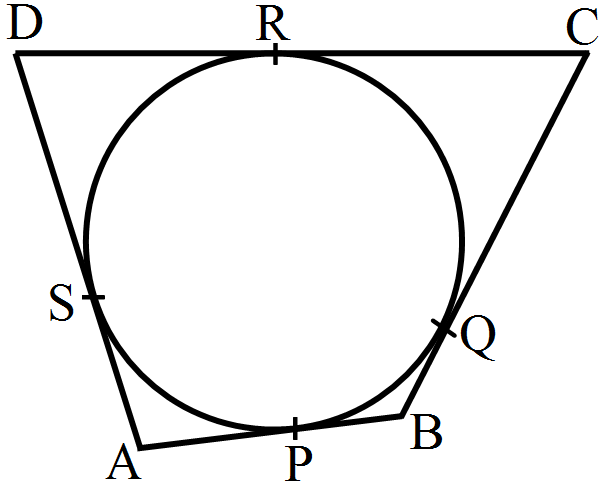
In the given figure, quadrilateral $\text{ABCD}$ is circumscribed, touching the circle at $P, Q, R$ and $S.$ If $AP = 5\ cm, BC = 7\ cm$ and $CS = 3\ cm, AB =?$
  • $9cm$
  • B
    $10cm$
  • C
    $12cm$
  • D
    $8cm$
Answer
Correct option: A.
$9cm$
We know that tangent from an external point to the circle are equal.
$\text{AP = AQ} = 5\ cm$
$\text{CS = CR} = 3\ cm$
$\text{RB = BC - CR}$
$= 7 +3$
$=4\ cm$
So, $\text{BQ = RB} = 4\ cm$
Thus, $\text{AB = AQ + RB}$
$= 5 + 4$
$= 9\ cm$
View full question & answer
MCQ 61 Mark
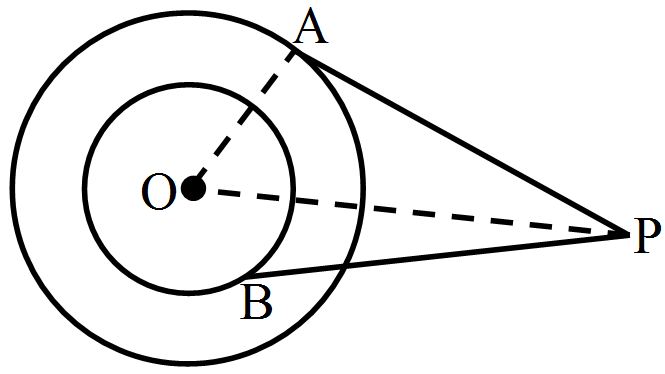
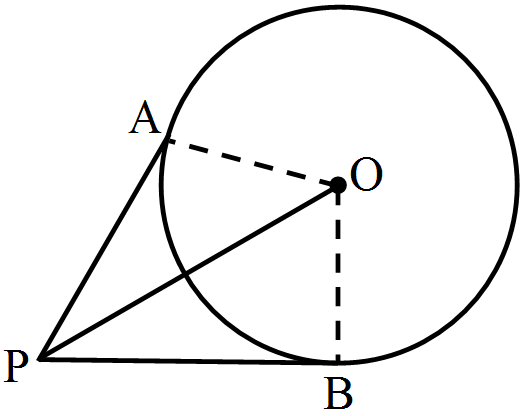
In the given figure, $O$ is the centre of two concentric circles of radii $5\ cm$ and $3\ cm$.
From an external point $P$ tangents $PA$ and $PB$ are drawn to these circles. If $PA = 12\ cm$ then $PB$ is equal to:

  • A
    $5\sqrt{2}\text{cm}$
  • B
    $3\sqrt{5}\text{cm}$
  • $4\sqrt{10}\text{cm}$
  • D
    $5\sqrt{10}\text{cm}$
Answer
Correct option: C.
$4\sqrt{10}\text{cm}$
Construction: Join $OB$.
We know that tangent is perpendicular to the radius of a circle.
In $\triangle\text{OPA},$
By Pythagoras theorem,
$OP^2 = OA^2 + AP^2$
$\Rightarrow OP^2 = 5^2 + 12^2$
$\Rightarrow OP^2 = 169$
$\Rightarrow OP = 13\ cm$
In $\triangle\text{OPB},$
By Pythagoras theorem,
$OP^2 = OB^2 + PB^2$
$\Rightarrow PB^2= OP^2- OB^2$
$\Rightarrow PB^2 = 13^2 - 3^2$
$\Rightarrow PB^2= 160$
$\Rightarrow \text{PB} =4\sqrt{10}\text{cm} $
View full question & answer
MCQ 71 Mark
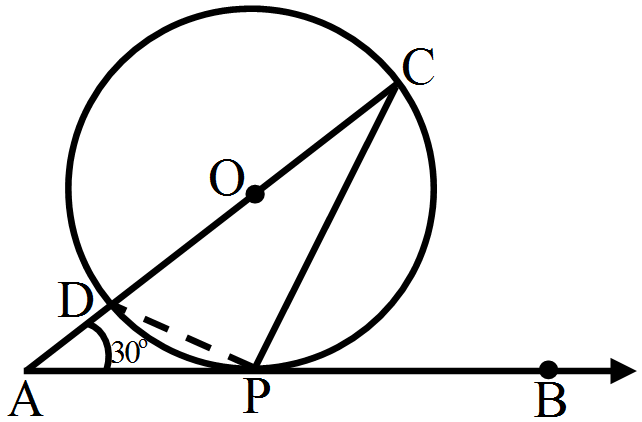
In the given figure, $O$ is the centre of the circle. $AB$ is the tangent to the circle at the point $P.$ If $\angle\text{PAO} = 30^\circ$ then $\angle\text{CPB} + \angle\text{ACP}$ is equal to:
  • A
    $60^\circ$
  • $90^\circ$
  • C
    $120^\circ$
  • D
    $150^\circ$
Answer
Correct option: B.
$90^\circ$
Since $\text{APB}$ is a straight line,
$\angle\text{APD}+\angle\text{DPC}+\angle\text{CPB}=180^\circ $
We know that angles that subtend the same arc are equal.
$\Rightarrow\angle\text{APD}=\angle\text{ACP}$
$\Rightarrow\angle\text{ACP}+90^\circ+\angle\text{CPB}=180^\circ....($Since $\angle\text{DPC}$ is inscribed in a semicircle$)$
$\Rightarrow\angle\text{CPB}+\angle\text{ACP}=90^\circ$
View full question & answer
MCQ 81 Mark
Each question consists of two statements, namely, Assertion $(A)$ and Reason $(R)$. for selecting the correct answer, use the following code:
Assertion $(A)$
Reason $(R)$
If two tangent are drawn to a circle from an external point then they subtend equal angles at the centre. A parallelogram circumscribing a circle is a rhombus.
  • A
    Both Assertion $(A)$ and Reason $(R)$ are true and Reason $(R)$ is a correct explanation of Assertion $(A).$
  • Both Assertion $(A)$ and Reason $(R)$ are true but Reason $(R)$ is not a correct explanation of Assertion $(A).$
  • C
    Assertion $(A)$ is true and Reason $(R)$ is false.
  • D
    Assertion $(A)$ is false and Reason $(R)$ is true.
Answer
Correct option: B.
Both Assertion $(A)$ and Reason $(R)$ are true but Reason $(R)$ is not a correct explanation of Assertion $(A).$

Consider tangent $AB$ and $AC$ drawn to the circle with centre $O.$
In $​​\triangle\text{OBA}$ and $​​\triangle\text{OCA},$
$\text{AO}=\text{AO} ....($common side$)$
$\text{OB}=\text{OC} .....($radii of the same circle$)$
$\angle\text{B}=\angle\text{C}=90^\circ$
$\Rightarrow\triangle\text{OBA}\cong\triangle\text{OCA} ....(\text{RHS}$ congruence criterion$)$
So, $\angle\text{OBA}=\angle\text{COA} ....(\text{cpct})$
Thus, the $(R)$ is also true and can be proved using the property, 'tangent from an external point to a circle are equal'
But, the Reason $(R)$ is not the correct explanation for the Assertion $(A).$
View full question & answer
MCQ 91 Mark
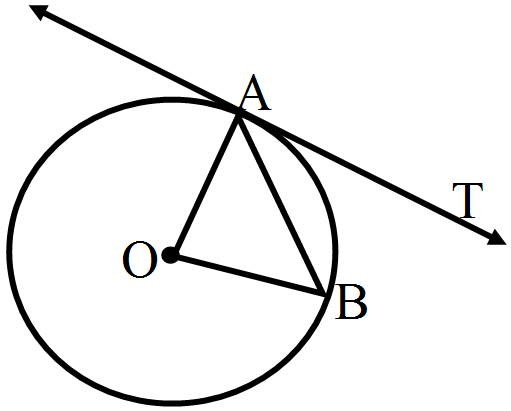
In the given figure, $O$ is the centre of the circle $AB$ is a chord and $AT$ is the tangent at $A.$ If $\angle\text{AOB} = 100^\circ$ then $\angle\text{BAT} $ is equal to:
  • A
    $40^\circ$
  • $50^\circ$
  • C
    $90^\circ$
  • D
    $100^\circ$
Answer
Correct option: B.
$50^\circ$
In $\triangle\text{OAB},$
$\text{OA}=\text{OB} ....($radii of the same circle$)$
$\Rightarrow\angle\text{OAB}=\angle\text{OAB} ....($angles opposite equal sides are equal$)$
$\angle\text{AOB}+\angle\text{OAB}+\angle\text{OBA}=180^\circ ($Angle Sum Property$)$
$\Rightarrow\angle\text{AOB}+\angle\text{OAB}+\angle\text{OAB}=180^\circ$
$\Rightarrow100^\circ+2\angle\text{OAB}=180^\circ$
$\Rightarrow2\angle\text{OAB}=80^\circ$
$\Rightarrow\angle\text{OAB}=40^\circ$
Since $\text{AT}$ is the tangent,
$\angle\text{OAT}=90^\circ$
$\Rightarrow\angle\text{OAB}+\angle\text{BAT}=90^\circ$
$\Rightarrow40^\circ+\angle\text{BAT}=90^\circ$
$\Rightarrow\angle\text{BAT}=50^\circ$
View full question & answer
MCQ 101 Mark
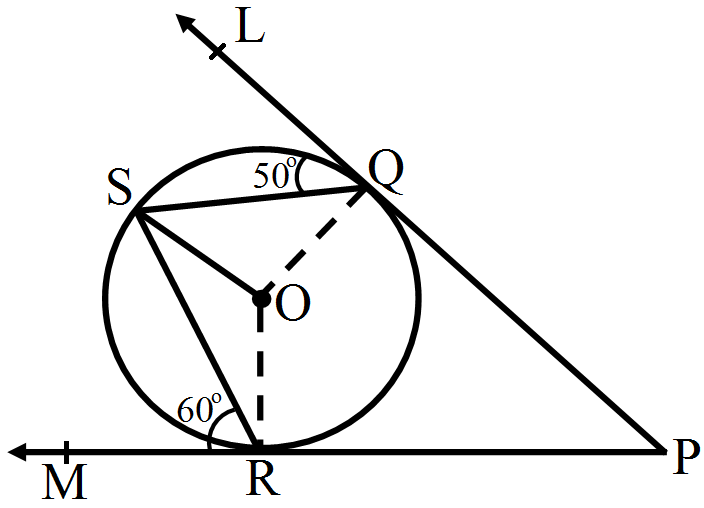
In the given figure, $O$ is the centre of a circle; $\text{PQL}$ and $\text{PRM}$ are the tangents at the points $Q$ and $R$ respectively, and $S$​​​​​​​ is a point on the circle, such that $\angle\text{SQL} = 50^\circ.$ and $\angle\text{SRM} = 60^\circ.$ Find $ \angle\text{QSR}=?$
  • A
    $40^\circ$
  • B
    $50^\circ$
  • C
    $60^\circ$
  • $70^\circ$
Answer
Correct option: D.
$70^\circ$
Since $\text{PL}$ and $\text{PM}$ are the tangent to the circle.
$\angle\text{OQL}=\angle\text{ORM}=90^\circ ($tangent is perpendicular to the radius of a circle$)$
So,
$\angle\text{OQL}+\angle\text{SQL}+\angle\text{OQS}$
$\Rightarrow90^\circ=50^\circ+\angle\text{OQS}$
$\Rightarrow\angle\text{OQC}=40^\circ$
Similarly, we can find $\angle\text{ORS}=30^\circ.$
In $\triangle\text{OQS},$
$\text{OQ}=\text{OS}$
$\angle\text{OQS}=\angle\text{OSQ}=40^\circ ...($angles opposite equal sides are equal$)$
In $\triangle\text{ORS},$
$\text{OR}=\text{OS}$
$\angle\text{ORS}=\angle\text{OSR}=30^\circ$
So, $\angle\text{QSR}=\angle\text{OSQ}+\angle\text{OSR}$
$=40^\circ+30^\circ$
$=70^\circ.$
View full question & answer
MCQ 111 Mark
In the given figure, $\text{AP, AQ}$ and $\text{BC}$ are tangents to the circle. If $AB = 5\ cm, AC = 6\ cm$ and $BC = 4\ cm$ then the length of $\text{AP}$ is:
  • A
    $15\ cm$
  • B
    $10\ cm$
  • C
    $9\ cm$
  • $7.5\ cm$
Answer
Correct option: D.
$7.5\ cm$
Let $\text{BC}$ intersect the circle at $D$.
We know that tangent from an external point to the circle are equal.
$\text{BP = BD}$
$\text{CD = CQ}$
$\text{AP = AQ}$
perimeter of $\triangle\text{ABC}$
$= \text{AB + BC + AC}$
$= \text{AB + (BD + CD) + AC}$
$= \text{AB + (BP + CQ) + AC}$
$= \text{(AB + BP) + (AC + CQ)}$
$= \text{AP + AQ}$
Since perimeter of $\triangle\text{ABC = AB + BC + AC} = 5 + 6 + 4 = 15\ cm$
$\Rightarrow \text{AP + AQ} = 15$
$\Rightarrow \text{2AP} = 15$
$\Rightarrow \text{AP} = 7.5\ cm$
View full question & answer
MCQ 121 Mark
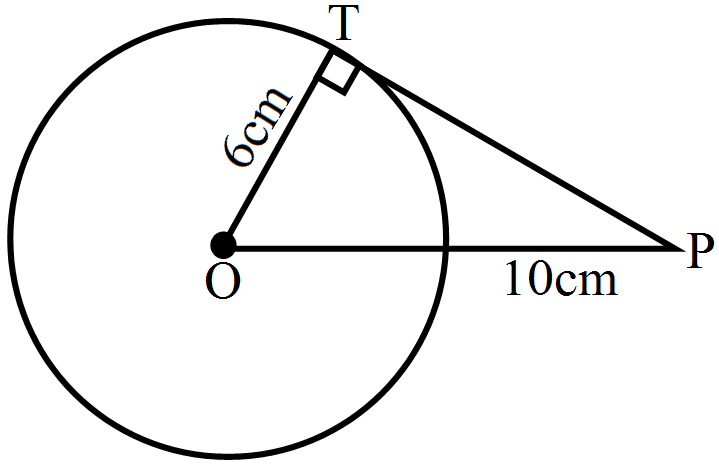
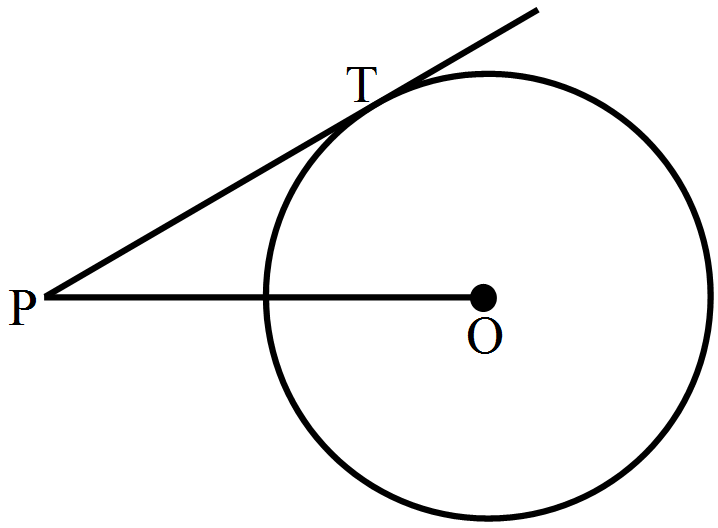
In the given figure, $PT$ is a tangent to a circle with centre $O$. If $OT = 6\ cm$ and $OP = 10\ cm$, then the length of tangent $PT$ is:
  • $8\ cm$
  • B
    $10\ cm$
  • C
    $12\ cm$
  • D
    $16\ cm$
Answer
Correct option: A.
$8\ cm$
$OT = 6\ cm$
$OP = 10\ cm$
Since $PT$ is a tangent to the circle at $T$.
$\angle\text{PTO}=90^\circ....($tangent is perpendicular to the radius of a circle$)$
In $\triangle\text{PTO},$
By Pythagoras theorem,
$OP2 = PT^2 + OT^2$
$\Rightarrow PT^2 = OP^2 - OT^2$
$\Rightarrow PT^2 = 10^2- 6^2$
$\Rightarrow PT^2 = 100 - 36$
$\Rightarrow PT = 8\ cm$
View full question & answer
MCQ 131 Mark
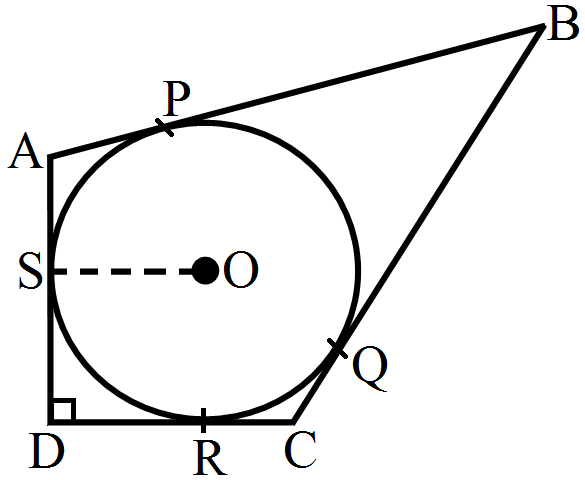
In the given figure, a circle is inscribed in a quadrilateral $\text{ABCD}$ touching its sides $\text{AB, BC, CD}$ and $\text{AD}$ at $\text{P, Q, R}$ and $S$ respectively. If the radius of the circle is $10\ cm, \text{BC} = 38\ cm, \text{PB} = 27\ cm$ and $\text{AD} \perp \text{CD}$ then the length of $\text{CD}$ is:
  • A
    $11\ cm$
  • B
    $15\ cm$
  • C
    $20\ cm$
  • $21\ cm$
Answer
Correct option: D.
$21\ cm$
We know that tangles from an external point to the circle are equal.
$\text{BQ = PB} = 27\ cm$
So, $\text{CQ = BC - BQ} = 38 - 27 = 11\ cm$
$\Rightarrow \text{CR = CQ} = 11\ cm$
In quad. $\text{SORD,}$
$\angle\text{SDR}=90^\circ....(\therefore\text{AD}\perp\text{CD})$
$\Rightarrow\angle\text{OSD}=\angle\text{ORD}=90^\circ$
Also, $\text{OS = OR}$ and $\text{SD = SR}$
So, quad. $\text{SORD}$ is a square.
Thus, $\text{DR = SO} = 10\ cm$
Hence, $\text{CD = DR + CR} = 10 + 11 = 21cm.$
View full question & answer
MCQ 141 Mark
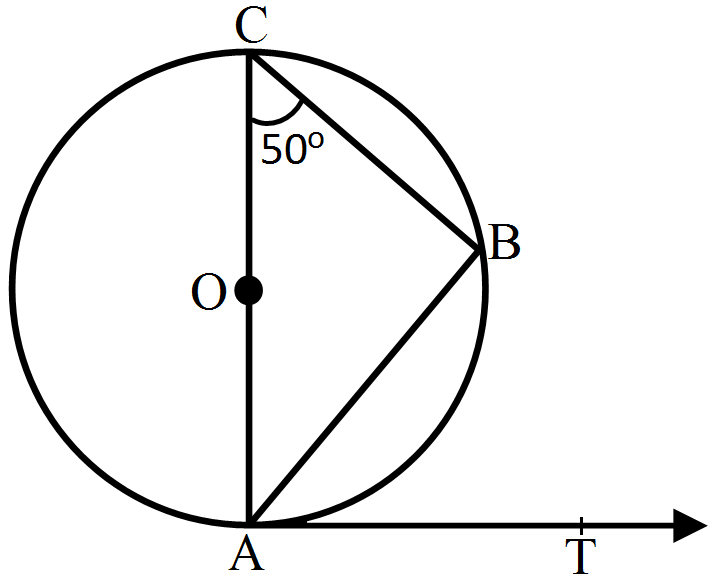
In the given figure, $O$ is the centre of a circle. $\text{AOC}$ is its diameter, such that $\angle\text{ACB} = 50^\circ.$ If $\text{AT}$ is the tangent to the circle at the point $A,$ then $\angle \text{BAT} = ?$
  • A
    $40^\circ$
  • $50^\circ$
  • C
    $60^\circ$
  • D
    $65^\circ$
Answer
Correct option: B.
$50^\circ$
Construction: Join $\text{OC.}$
Since $\text{AC}$ is a diameter of the circle.
$\angle\text{ABC}=90^\circ ....($angle in a semicircle is $90^\circ)$
In $\triangle\text{ABC},$
$\angle\text{ABC}+\angle\text{BCA}+\angle\text{BAC}=180^\circ ......($Angle Sum Property$)$
$\Rightarrow 90^\circ+50^\circ+\angle\text{BAC}=180^\circ$
$\Rightarrow\angle\text{BAC}=40^\circ$
Since $\text{AC}$ is a tangent to the inner circle.
$\Rightarrow\angle\text{OAT}=90^\circ .....($Tangent is perpendicular to the radius of a circle$)$
$\Rightarrow\angle\text{BAO}+\angle\text{BAT}=90^\circ$
$\Rightarrow40^\circ+\angle\text{BAT}=90^\circ$
$\Rightarrow\angle\text{BAT}=50^\circ$
View full question & answer
MCQ 151 Mark
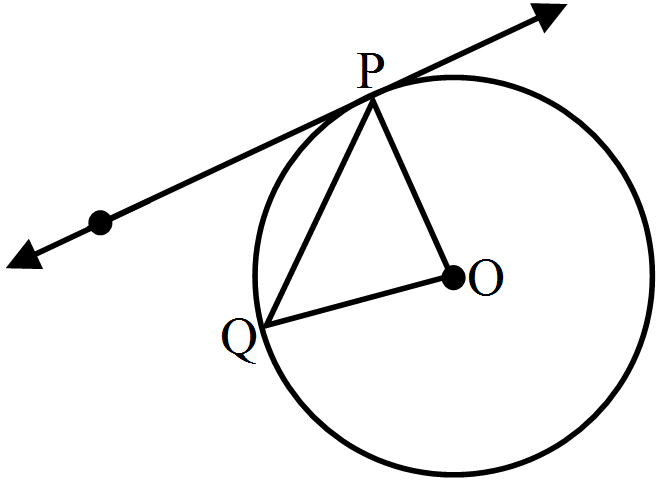
$PQ$ is a tangent to a circle with centre $O$ at the point $P.$ If $\triangle\text{OPQ}$ is an isosceles triangle, then $\angle\text{OQP}$ is equal to:
  • A
    $30^\circ$
  • $45^\circ$
  • C
    $60^\circ$
  • D
    $90^\circ$
Answer
Correct option: B.
$45^\circ$

Given that $\triangle\text{PQO}$ is an isosceles triangle.
Since $\text{PQ}$ is a tangent to the circle at $P.$
Sunce $\text{PQ}$ is a tangent to the circle at $P.$
$\angle\text{OPQ}=90^\circ .....($tangent is perpendicular to the radius of a circle$)$
In $\triangle\text{OPQ},$
$\text{OP = OQ}$
$\Rightarrow\angle\text{OQP}=\angle\text{POQ}$
Using Angle Sum Property,
$\angle\text{OQP}+\angle\text{POQ}+\angle\text{OPQ}=180^\circ$
$\Rightarrow\angle\text{OQP}+\angle\text{OQP}+90^\circ=180^\circ$
$\Rightarrow2\angle\text{OQP}=90^\circ$
$\Rightarrow\angle\text{OQP}=45^\circ$
View full question & answer
MCQ 161 Mark
Each question consists of two statements, namely, Assertion $(A)$ and Reason $(R)$. for selecting the correct answer, use the following code:
Assertion (A)
Reason (R)
In the given figure, a quad. $\text{ABCD}$ is drawn to circumscribe a given circle as shown. Then, $\text{AB + BC = AD + DC.}$ In two concentric circles, the chord of the larger circle, which to uches the smaller circle, is bisected at the point of contact.
  • A
    Both Assertion $(A)$ and Reason $(R)$ are true and Reason $(R)$ is a correct explanation of Assertion $(A).$
  • B
    Both Assertion $(A)$ and Reason $(R)$ are true but Reason $(R)$ is not a correct explanation of Assertion $(A).$
  • C
    Assertion $(A)$ is true and Reason $(R)$ is false.
  • Assertion $(A)$ is false and Reason $(R)$ is true.
Answer
Correct option: D.
Assertion $(A)$ is false and Reason $(R)$ is true.
The Assertion $(A)$ is false since sum of the opposite sides of a quadrilateral circumscribing a circle are equal, and not the adjacent sides.
The chord of the larger circle is the tangent to the smaller circle.
We know that the perpendicular drawn from the centre to the chord
So, the Reason $(R)$ is true.
But is not the correct explanation for the Assertion $(A).$
View full question & answer
MCQ 171 Mark
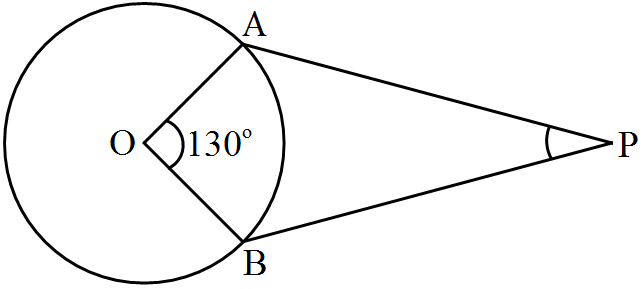
If the angle between two radii of a circle is $130^\circ$ , then the angle between the tangent at the ends of the radii is:
  • A
    $65^\circ$
  • B
    $40^\circ$
  • $50^\circ$
  • D
    $90^\circ$
Answer
Correct option: C.
$50^\circ$

In quad. $\text{AOBP}$
$\angle\text{PAO}+\angle\text{PBO}+\angle\text{AOB}+\angle\text{APB}=360^\circ....($Angle Sum Property$)$
$\Rightarrow90^\circ+90^\circ+130^\circ+\angle\text{APB}=360^\circ....($Since radius of a circle is perpendicular to the tangent$)$
$\Rightarrow\angle\text{APB}=50^\circ$
View full question & answer
MCQ 181 Mark
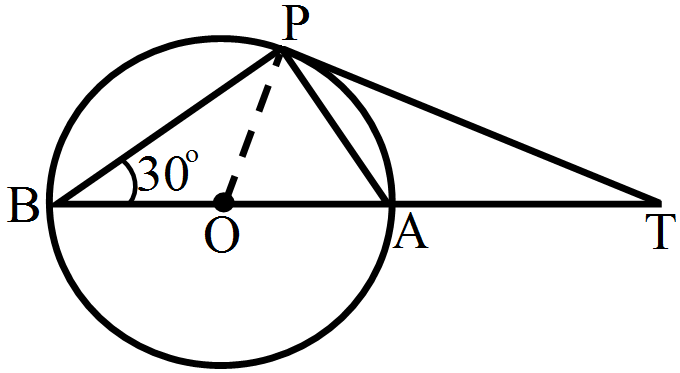
In the given figure, $O$ is the centre of a circle, $\text{BOA}$ is its diameter and the tangent at the point $P$ meets $BA$ extended at $T. \angle\text{PBO} = 30^\circ$ then $\angle\text{PTA} =?$
  • A
    $60^\circ$
  • $30^\circ$
  • C
    $15^\circ$
  • D
    $45^\circ$
Answer
Correct option: B.
$30^\circ$
In $\triangle\text{OBP},$
$\text{OB} = \text{OP} ....($radii of the circle$)$
$\Rightarrow\angle\text{OBP}=\angle\text{OPB}=30^\circ ....($angles opposite equal sides are equal$)$
Since $PT$ is a tangent,
$\angle\text{OPT}=90^\circ$
In $\triangle\text{BPT},$
$\angle\text{BPT}+\angle\text{PBT}+\angle\text{PTB}=180^\circ....($Angle Sum Property$)$
$\Rightarrow(30^\circ+90^\circ)+30^\circ+\angle\text{PTB}=180^\circ$
$\Rightarrow\angle\text{PTB}=30^\circ$
That is, $\angle\text{PTA}=30^\circ$
View full question & answer
MCQ 191 Mark
$O$ is the centre of a circle of radius $5\ cm$. At a distance of $13\ cm$ from $O$, a point $P$ is taken.
From this point, two tangents $PQ$ and $PR$ are drawn to the circle.
Then, the area of quadrilateral $\text{PQOR}$ is:
  • $60\ cm^2$
  • B
    $32.5\ cm^2$
  • C
    $65\ cm^2$
  • D
    $30\ cm^2$
Answer
Correct option: A.
$60\ cm^2$
In $\triangle\text{OPQ}$ and $\triangle\text{ORP},$
$\angle\text{OQP}=\angle\text{ORP}=90^\circ ....($Since $OP$ and $RP$ are tangent to the circle$)$
$\text{OP}=\text{OP} ....($common side$)$
$\text{OQ}=\text{OR} ....($radii of the same circle$)$
$\Rightarrow\triangle\text{OPQ}\cong\triangle\text{ORP} ....(\text{RHS}$ congruence criterion$)$
So, the areas of both the triangle will be the swame.
In $\triangle\text{OPQ},$
By Pythagoras theorem,
$\text{OP}^2=\text{OQ}^2+\text{PQ}^2$
$\Rightarrow\text{PQ}^2=\text{OP}^2-\text{OQ}^2$
$\Rightarrow\text{PQ}^2=\text{13}^2-\text{5}^2$
$\Rightarrow\text{PQ}^2=144$
$\Rightarrow\text{PQ}=12\text{cm}$
$\text{ar}(\triangle\text{OPQ})=\frac{1}{2}\times\text{PQ}\times\text{OQ}$
$=\frac{1}{2}\times\text{12}\times5$
$=30\text{cm}^2$
$\text{ar}(\text{quad PQOR})=\text{ar}(\triangle\text{OPQ})+\text{ar}(\triangle\text{ORP})$
$\Rightarrow\text{ar}(\text{quad PQOR})=30\text{cm}^2+30\text{cm}^2$
$\Rightarrow\text{ar}(\text{quad PQOR})=60\text{cm}^2$
View full question & answer
MCQ 201 Mark
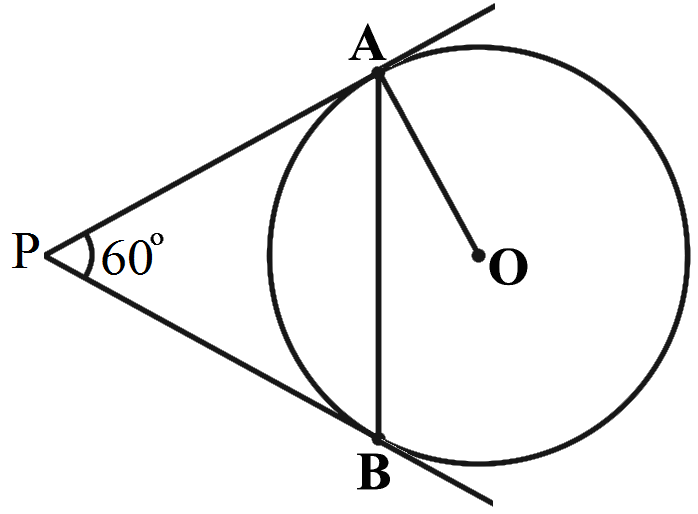
In the given figure, $\text{PA}$ and $\text{PB}$ are two tangents to the circle with centre $O$. If $\angle\text{APB}=60^\circ$ then $\angle\text{OAB}$ is:
  • A
    $15^\circ$
  • $30^\circ$
  • C
    $60^\circ$
  • D
    $90^\circ$
Answer
Correct option: B.
$30^\circ$
We know that tangent from an external point to a circle are equal.
So,
$\text{PA}=\text{PB}$
$\Rightarrow\angle\text{PAB}+\angle\text{PBA} ....($angles opposite equal sides are equal$)$
Now in $\triangle\text{PAB},$
$\angle\text{PAB}+\angle\text{PBA}+\angle\text{APB}=180^\circ ...($angles Sum Property$)$
$\Rightarrow\angle\text{PAB}+\angle\text{PAB}+60^\circ=180^\circ$
$\Rightarrow2\angle\text{PAB}+60^\circ=180^\circ$
$\Rightarrow2\angle\text{PAB}=120^\circ$
$\Rightarrow\angle\text{PAB}=60^\circ$
Since $\text{AP}$ is a tangent to the circle,
$\angle\text{OAP}=90^\circ$
$\Rightarrow\angle\text{OAB}+\angle\text{PAB}=90^\circ$
$\Rightarrow\angle\text{OAB}+60^\circ=90^\circ$
$\Rightarrow\angle\text{OAB}=30^\circ$
View full question & answer
MCQ 211 Mark
In the given figure, point $P$ is $26\ cm$ away from the centre $O$ of a circle and the length $PT$ of the tangent drawn from $P$ to the circle is $24\ cm$. Then the radius ofthe circle is:
  • $10\ cm$
  • B
    $12\ cm$
  • C
    $13\ cm$
  • D
    $15\ cm$
Answer
Correct option: A.
$10\ cm$
Construction: Join $OT.$
$PT = 24\ cm$
$OP = 26\ cm$
Sunce $PT$ is a tangent to the circle at $T.$
$\angle\text{PTO}=90^\circ .....($tangent is perpendicular to the radius of a circle$)$
In $\triangle\text{PTO},$
By Pythagoras theorem,
$OP^2 = PT^2 + OT^2$
$\Rightarrow OT^2 = OP^2 - PT^2$
$\Rightarrow OT^2 = 26^2 - 24^2$
$\Rightarrow OT^2 = 676 - 576$
$\Rightarrow OT^2 = 100$
$\Rightarrow OT^2 = 10\ cm$
View full question & answer
MCQ 221 Mark
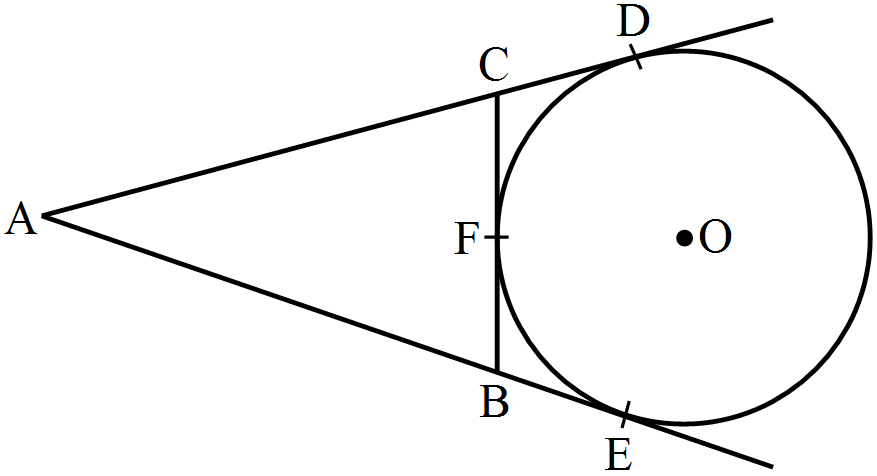
In the given figure, $AD$ and $AE$ are the tangents to a circle with centre $O$ and $BC$ touches the circle at $F$. If $AE = 5\ cm,$ then perimeter of $\triangle\text{ABC}$ is:
  • A
    $15\ cm$
  • $10\ cm$
  • C
    $22.5\ cm$
  • D
    $20\ cm$
Answer
Correct option: B.
$10\ cm$
We know that tangent from an external point to the circle equal.
So,
$\text{AE = AD} = 5\ cm$
$\text{BF = BE}$
$\text{CF = CD}$
Perimeter of $\triangle\text{ABC}$
$= \text{AB + BC + AC}$
$= \text{AB + (BE + DC) + AC}$
$= \text{(AB + BE) + (AC + DC)}$
$= \text{AE + AD}$
$= 5 + 5$
$= 10\ cm$
View full question & answer
MCQ 231 Mark
Which of the following statements is not true?
  • A
    A line which intersects a circle at two points, is called a secant of the circle.
  • B
    A line intersecting a circle at one point only, is called a tangent to the circle.
  • C
    The point at which a line touches the circle, is called the point of contact.
  • A tangent to the circle can be drawn from a point inside the circle.
Answer
Correct option: D.
A tangent to the circle can be drawn from a point inside the circle.
Options $(a), (b)$ and $(c)$ are all true.
However, Option $(d)$ is false since it is not possible to draw a tangent from a point inside a circle.
View full question & answer
MCQ 241 Mark
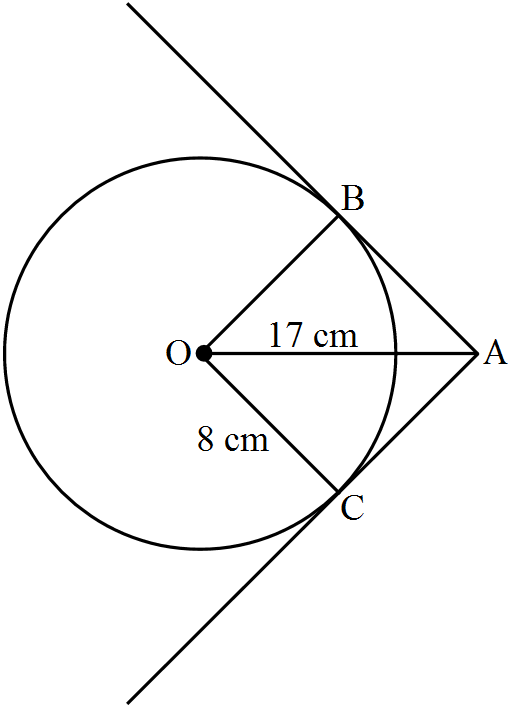
In the given figure, $AB$ and $AC$ are tangents to a circle with centre $O$ and radius $8\ cm$. If $OA = 17\ cm$, then the length of $AC ($ in $cm)$ is:
  • A
    $9$
  • $15$
  • C
    $\sqrt{353}$
  • D
    $25$
Answer
Correct option: B.
$15$

Construction: Join $OC.$
Since $AC$ is a tangent to the circle.
$\angle\text{OCA}=90^\circ ....($tangent is perpendicular to the radius of a circle$)$
In $\triangle\text{OCA},$
By Pythagoras theorem,
$OA^2 = OC^2 + AC^2$
$\Rightarrow 17^2 = 8^2 + AC^2$
$\Rightarrow AC^2 = 289 - 64$
$\Rightarrow AC^2 = 225$
$\Rightarrow AC = 15\ cm$
View full question & answer
MCQ 251 Mark
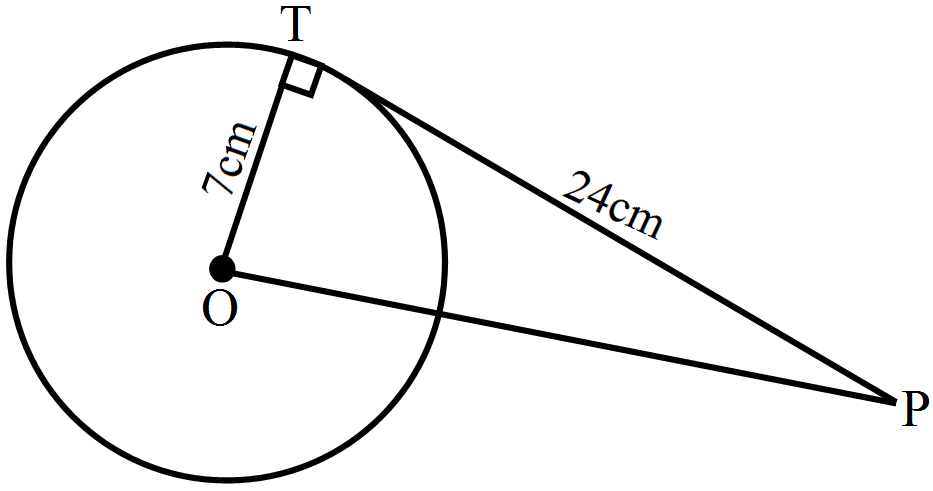
In a circle of radius $7\ cm$, tangent $PT$ is drawn from a point $P$, such that $PT = 24\ cm$. If $O$ is the centre of the circle, then $OP =?$
  • A
    $30\ cm$
  • B
    $28\ cm$
  • $25\ cm$
  • D
    $18\ cm$
Answer
Correct option: C.
$25\ cm$
$PT = 24\ cm, OT = 7\ cm$.
Since $PT$ is a tangent to the circle at $T.$
$\angle\text{PTO}=90^\circ ....($tangent is perpendicular to the radius of a circle$)$
In $\triangle\text{PTO},$
By using Pythagoras theorem,
$OP^2 = PT^2 + OT^2$
$\Rightarrow OP^2 = 24^2+ 7^2$
$\Rightarrow OP^2 = 576 + 49$
$\Rightarrow OP^2 =625$
$\Rightarrow OP = 25\ cm.$
View full question & answer
MCQ 261 Mark
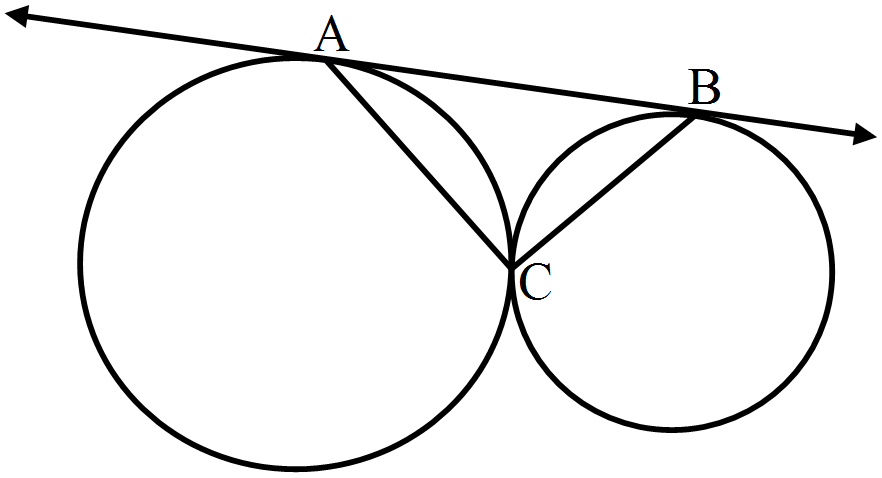
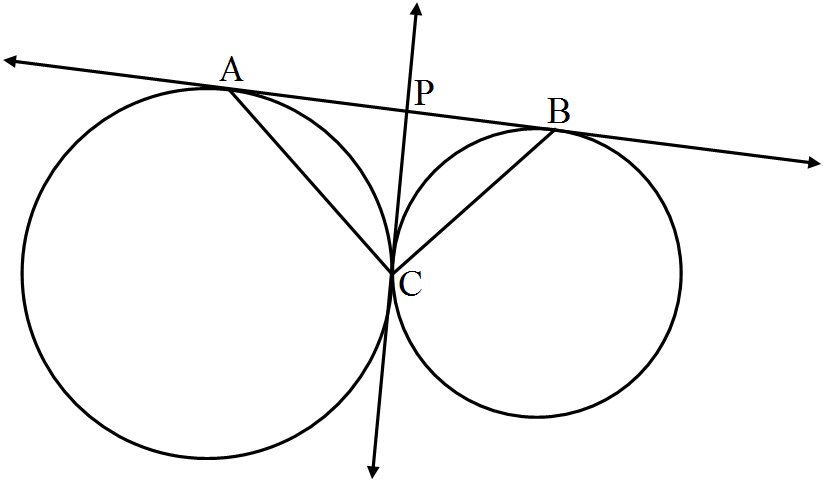
In the given figure, two circles touch each other at $C$ and $AB$ is a tangent to both the circles. The measure of $\angle\text{ACB}$ is:
  • A
    $45^\circ$
  • B
    $60^\circ$
  • $90^\circ$
  • D
    $120^\circ$
Answer
Correct option: C.
$90^\circ$

Draw a tangent to the circle at point $C$ meet $AB$ at $P.$
Then,
$\text{PA = PC}$
$\Rightarrow \angle\text{PAC}=\angle\text{PCA}$
And $\text{PB = PC}$
$\Rightarrow\angle\text{PBC}=\angle\text{PCB}$
$\therefore\angle\text{PAC}+\angle\text{PBC}=\angle\text{PCA}+\angle\text{PCB}=\angle\text{ACB}$
$\Rightarrow\angle\text{PAC}+\angle\text{PBC}+\angle\text{ACB}=2\angle\text{ACB}$
$\Rightarrow180^\circ=2\angle\text{ACB}$
$\Rightarrow\angle\text{ACB}=90^\circ$
View full question & answer
MCQ 271 Mark
In the given figure, $O$ is the centre of the circle, $PQ$ is a chord and $PT$ is the tangent at $P$. If $ \angle\text{POQ} = 70^\circ$then $\angle\text{TPQ} $ is equal to:
  • $35^\circ$
  • B
    $45^\circ$
  • C
    $55^\circ$
  • D
    $70^\circ$
Answer
Correct option: A.
$35^\circ$
In $\triangle\text{OPQ},$
$\text{OP}=\text{OQ} ....($radii of the same circle$)$
$\Rightarrow\angle\text{OQP}=\angle\text{OPQ} ....($angles opposite equal sides are equal$)$
$\triangle\text{OPQ},$
$\angle\text{OQP}+\angle\text{OPQ}+\angle\text{POQ}=180^\circ ......($Angle Sum Property$)$
$\Rightarrow\angle\text{OPQ}+\angle\text{OPQ}+70^\circ=180^\circ$
$\Rightarrow2\angle\text{OPQ}=110^\circ$
$\Rightarrow\angle\text{OPQ}=55^\circ$
Since PT is a tangent to the inner circle.
$\Rightarrow\angle\text{OPT}=90^\circ .....($Tangent is perpendicular to the radius of a circle$)$
$\Rightarrow\angle\text{OPQ}+\angle\text{TPQ}=90^\circ$
$\Rightarrow55^\circ+\angle\text{TPQ}=90^\circ$
$\Rightarrow\angle\text{TPQ}=35^\circ$
View full question & answer
MCQ 281 Mark
The number of tangents that can be drawn from an external point to a circle is:
  • A
    $1$
  • $2$
  • C
    $3$
  • D
    $4$
Answer
Correct option: B.
$2$

We can draw only two tangents from an external point to a circle.
View full question & answer
MCQ 291 Mark
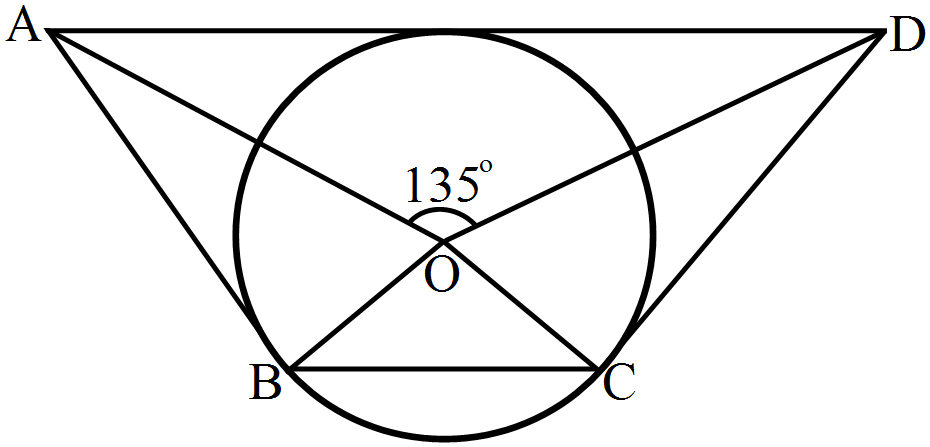
In the given figure, if $\angle\text{AOD}=135^\circ$ then $\angle\text{BOC}$ is equal to:
  • A
    $25^\circ$
  • $45^\circ$
  • C
    $52.5^\circ$
  • D
    $62.5^\circ$
Answer
Correct option: B.
$45^\circ$
We know that sum of the angles subtended by opposite sides of a quadrilateral having a circumscribed circle is $180^\circ .$
$\Rightarrow\angle\text{AOD}+\angle\text{BOC}=180^\circ$
$\Rightarrow135^\circ+\angle\text{BOC}=180^\circ$
$\Rightarrow\angle\text{BOC}=45^\circ$
View full question & answer
MCQ 301 Mark
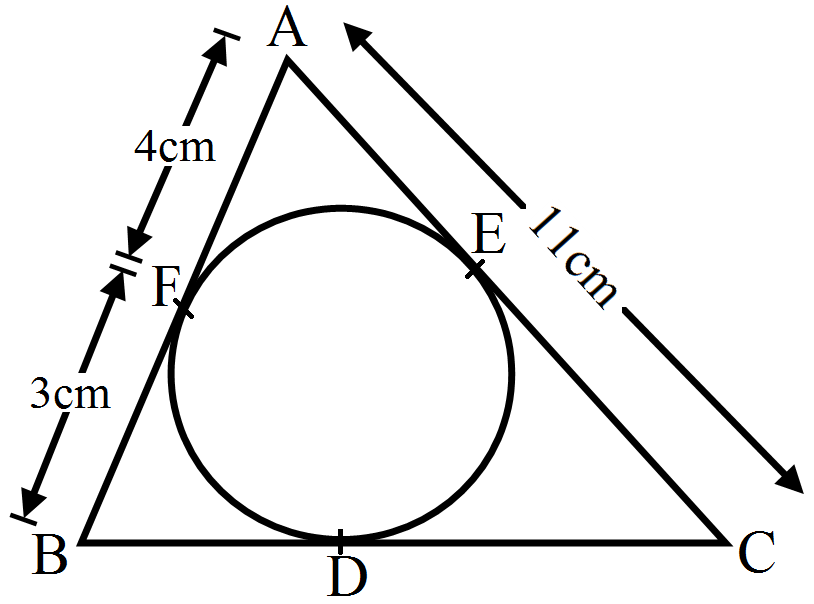
In the given figure, the length of $BC$ is:
  • A
    $7\ cm$
  • $10\ cm$
  • C
    $14\ cm$
  • D
    $15\ cm$
Answer
Correct option: B.
$10\ cm$
We know that tangent from an external point to a circle are equal.
So,
$\text{AF = AE} = 4\ cm$
$\Rightarrow \text{EC = AC - AE} = 11 - 4 = 7\ cm$
Now,
$\text{CD = CE} = 7\ cm$
and $\text{BF = BD} = 3\ cm$
$\text{BD = BD + CD}$
$\Rightarrow \text{BD} = 3 + 7$
$\Rightarrow \text{BD} = 10\ cm$
View full question & answer
MCQ 311 Mark
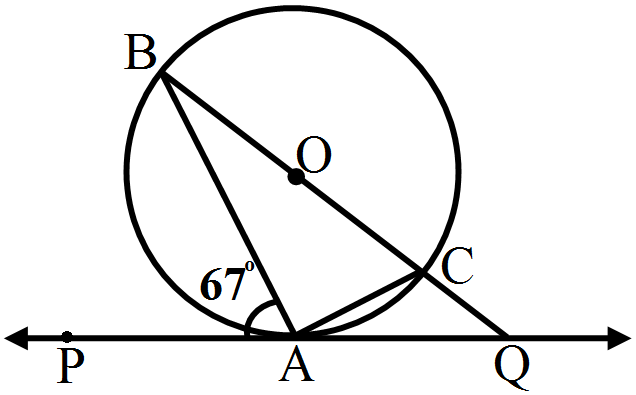
In the given figure, $PQ$ is a tangent to a circle with centre $O$. A is the point of contact. If $\angle\text{PAB} = 67^\circ$then the measure of $\angle\text{AQB} $ is:
  • A
    $73^\circ$
  • B
    $64^\circ$
  • C
    $53^\circ$
  • $44^\circ$
Answer
Correct option: D.
$44^\circ$
Since $\angle\text{BAC}$ is inscribed in a semicircle, $\angle\text{BAC}=90^\circ.$
Since $\text{PAQ}$ is a straight line,
$\angle\text{PAB}+\angle\text{BAC}+\angle\text{CAQ}=180^\circ $
$\Rightarrow67^\circ+90^\circ+\angle\text{CAQ}=180^\circ$
$\Rightarrow\angle\text{CAQ}=23^\circ$
We know that angles that subtend the same arc are equal.
$\Rightarrow\angle\text{CBA}=\angle\text{CAQ}=23^\circ$
In $\triangle\text{BAQ},$
$\angle\text{BAQ}+\angle\text{QBA}+\angle\text{AQB}=180^\circ ....($Angle Sum Property$)$
$\Rightarrow(90^\circ+23^\circ)+23^\circ+\angle\text{AQB}=180^\circ$
$\Rightarrow\angle\text{AQB}=44^\circ$
View full question & answer
MCQ 321 Mark
Which of the following statment is not true?
  • A
    If a point $P$ lies inside a circle, no tangent can be drawn to the circle passing through $P.$
  • B
    If a point $P$ lies on a circle, then one and only one tangent can be drawn to the circle at $P.$
  • C
    If a point $P$ lies outside a circle, then only two tangents can be drawn to the circle from $P.$
  • A circle can have more than two parallel tangents parallel to a given line.
Answer
Correct option: D.
A circle can have more than two parallel tangents parallel to a given line.
Options $(a), (b)$ and $(c)$ are all true.
However, Option $(d)$ is false since we can draw only parallel tamngent on either side of the diameter,
which would be parallel to a given line.
View full question & answer
MCQ 331 Mark
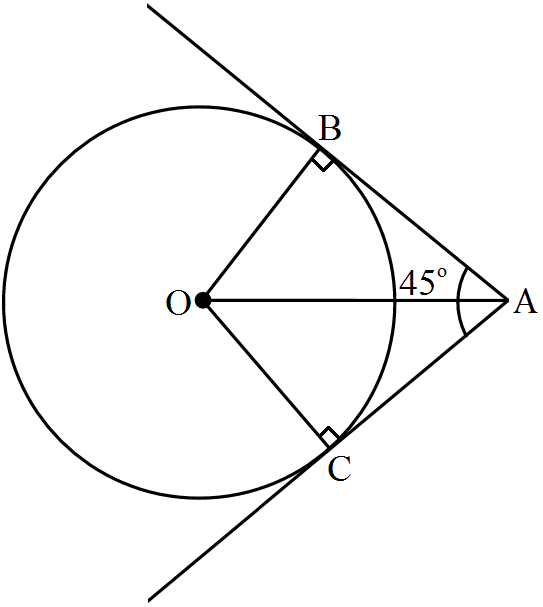
To draw a pair of tangents to a circle, which are inclined to each other at angle of $45^\circ$ , we have to draw the tangents at the end points of those two radii, the angle between which is:
  • A
    $105^\circ$
  • $135^\circ$
  • C
    $140^\circ$
  • D
    $145^\circ$
Answer
Correct option: B.
$135^\circ$

Since $AB$ and $AC$ are the tangent to the circle.
$\angle\text{OBA}=\angle\text{OCA}=90^\circ ($tangent is perpendicular to the radius of a circle$)$
In $\text{ACOB,}$
$\angle\text{OBA}+\angle\text{BAC}+\angle\text{OCA}+\angle\text{BOC}=360^\circ$
$\Rightarrow90^\circ+45^\circ+45^\circ+\angle\text{BOC}=360^\circ$
$\Rightarrow\angle\text{BOC}=135^\circ$
View full question & answer
MCQ 341 Mark
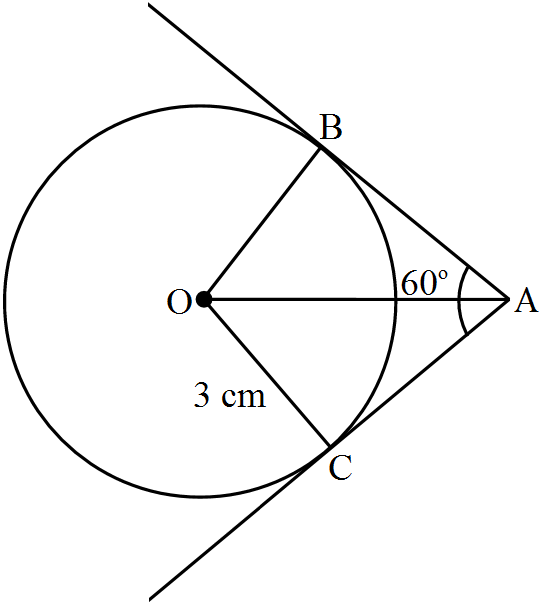
If two tangents inclined at an angle of $60^\circ$ are drawn to a circle of radius $3\ cm,$ then the length of each tangent is:
  • A
    $3\text{cm}$
  • B
    $\frac{3\sqrt{3}}{2}\text{cm}$
  • $3\sqrt{3}\text{cm}$
  • D
    $6\text{cm}$
Answer
Correct option: C.
$3\sqrt{3}\text{cm}$

In $\triangle\text{BAO}$ and $\triangle\text{CAO},$
$\angle\text{OBA}=\angle\text{OCA}=90^\circ ....($Since $\text{AB}$ and $\text{AC}$ are tangent to the circle$)$
$\text{OA}=\text{OA} ....($common side$)$
$\text{OB}=\text{OC} ....($radii of the same circle$)$
$\Rightarrow\triangle\text{BAO}\cong\triangle\text{CAO} ....(\text{RHS}$ congruence criterion$)$
$\angle\text{OAB}=\angle\text{OAC ....(cpct)}$
$\Rightarrow\angle\text{OAB}=\frac{1}{2}\angle\text{BAC}=30^\circ$
So, $\triangle\text{BAO}$ is a $30-60-90$ triangle.
side opposite $30^\circ=\frac{1}{2}$ hypotenuse
$\Rightarrow\text{OB}=\frac{1}{2}$ hypotenuse
$\Rightarrow$ hypotene $= 2\text{OB} = 2(3) = 6\ cm$
side opposite $60^\circ=\frac{\sqrt{3}}{2}$ hypotenuse
$\Rightarrow\text{AB}=\frac{\sqrt{3}}{2}(6)=3\sqrt{3}\text{cm}$
$\text{AB}=\text{AC}=3\sqrt{3}\text{cm} ....($Since tangents from an external point to the circle are equal$)$
Hence, the length of each tangent is $3\sqrt{3}\text{cm}.$
View full question & answer
MCQ 351 Mark
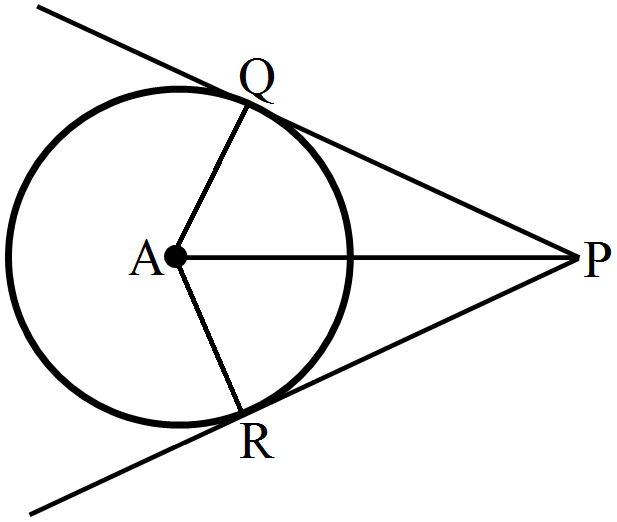
In the given figure, $\text{PQ}$ and $\text{PR}$ are tangents to a circle with centre $A.$ If $\angle\text{QPA}=27^\circ$ then $\angle\text{QAR}$ equals:
  • A
    $63^\circ$
  • B
    $117^\circ$
  • $126^\circ$
  • D
    $153^\circ$
Answer
Correct option: C.
$126^\circ$
In $\triangle\text{PAQ}$ and $\triangle\text{PAR},$
$\angle\text{PQA}=\angle\text{PRA} ....($Since $\text{PQ}$ and $\text{PR}$ are tangent to the circle$)$
$\text{AP}=\text{AP} ....($common side$)$
$\text{AQ}=\text{AR} ....($ radii of the same circle$)$
$\Rightarrow \triangle\text{PAQ}\cong\triangle\text{PAR} ....(\text{RHS}$ congruence criterion$)$
$\angle\text{OAP}=\angle\text{RAP ....(cpct)}$
In $\triangle\text{PAQ},$
$\angle\text{QAP}+\angle\text{PQA}+\angle\text{APQ}=180^\circ ....($Angle Sum property$)$
$\Rightarrow\angle\text{QAP}+90^\circ+27^\circ=180^\circ.....(\angle\text{PQA}=90^\circ,$ since radius is perpendicular to the tangent $)$
$\Rightarrow\angle\text{QAP}=63^\circ$
So, $\angle\text{QAR}=\angle\text{QAP}+\angle\text{RAP}$
$\Rightarrow\angle\text{QAR}=63^\circ+63^\circ$
$\Rightarrow\angle\text{QAR}=126^\circ$
View full question & answer
MCQ 361 Mark
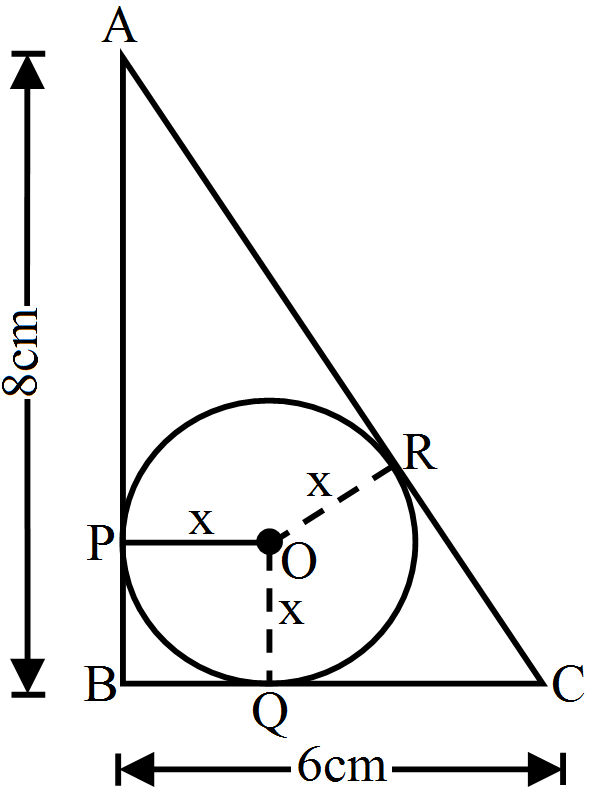
In the given figure,$ \triangle\text{ABC}$ is right$-$angled at $B,$ such that $BC = 6\ cm$ and $AB = 8\ cm$. A circle with centre $O$ has been inscribed in the triangle. $\text{OP} \perp \text{AB}, \text{OQ} \perp \text{BC} $ and $\text{OR} \perp \text{AC}.$ If $\text{OP = OQ = OR} = x \ cm,$ then $x =?$
  • $2\ cm$
  • B
    $2.5\ cm$
  • C
    $3\ cm$
  • D
    $3.5\ cm$
Answer
Correct option: A.
$2\ cm$
In right $\triangle\text{ABC},$
$\text{AC}^2=\text{AB}^2+\text{BC}^2 ....($By Pythagoras theorem$)$
$\Rightarrow\text{AC}^2=8^2+6^2$
$\Rightarrow\text{AC}^2=64+36$
$\Rightarrow\text{AC}=100$
$\Rightarrow\text{AC}=10\text{cm}$
We know that tangent from an external poit to the circle are equal.
$\Rightarrow\text{CR}=\text{CQ}=\text{BC}-\text{BQ}=(6-\text{x})\text{cm}$
$\Rightarrow\text{AR}=\text{AP}=\text{AB}-\text{BP}=(8-\text{x})\text{cm}$
$\text{AC}=(\text{AR}+\text{CR})=(8-\text{x})+(6-\text{x})=(14-2\text{x})\text{cm}$
$\Rightarrow14-2\text{x}=10$
$\Rightarrow2\text{x}=4$
$\Rightarrow\text{x}=2$
View full question & answer
MCQ 371 Mark
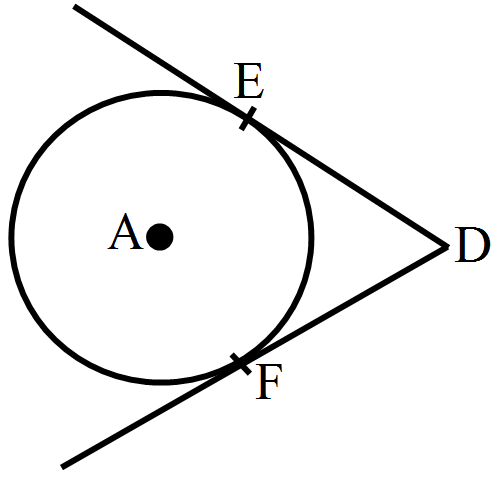
In the given figure, $DE$ and $DF$ are tangents from an external point $D$ to a circle with centre $A.$ If $DE = 5\ cm.$ and $\text{DE}\perp\text{DF}$ then the radius of the circle is:
  • A
    $3\ cm$
  • B
    $4\ cm$
  • $5\ cm$
  • D
    $6\ cm$
Answer
Correct option: C.
$5\ cm$
Construction: Join $\text{AE}$ and $\text{AF}.$
Since $\text{DE}$ and $DF$ are tangent to the circle,
$\angle\text{AED}=\angle\text{AFD}=\angle\text{EDF}=90^\circ$
Also, $\text{AE = AF} .....($ radii of the same circle$)$
and $\text{ED = EF} ....($Since tangent drawn from an external point to the circle are equal$)$
So, quadrilateral $\text{AEDF}$ is a square.
Thus, $\text{AE = DF} = 5\ cm$
Hence, the length of the radius is $5\ cm.$
View full question & answer
MCQ 381 Mark
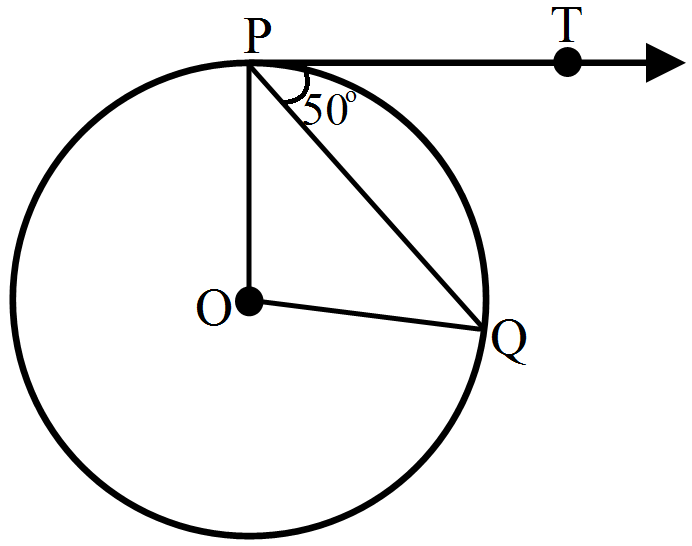
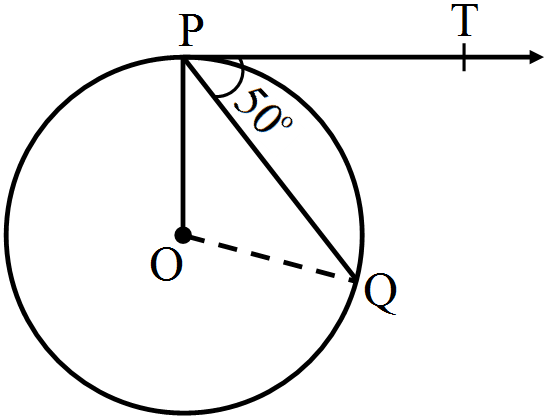
In the given figure, $O$ is the centre of a circle, $PQ$ is a chord and the tangent $PT$ at $P$ makes an angle of $50^\circ$ with $PQ.$ Then,$ \angle\text{POQ} = ?$
  • A
    $130^\circ$
  • $100^\circ$
  • C
    $90^\circ$
  • D
    $75^\circ$
Answer
Correct option: B.
$100^\circ$
Since $PT$ is the tangent to the circle.
$\angle\text{OPT}=90^\circ$
$\Rightarrow\angle\text{TPQ}+\angle\text{OPQ}=90^\circ$
$\Rightarrow50^\circ+\angle\text{OPQ}=90^\circ$
$\Rightarrow\angle\text{OPQ}=40^\circ$
In $\triangle\text{OPQ},$
$\text{OP}=\text{OQ} ....($radii of the same circle$)$
$\Rightarrow\angle\text{OPQ}=\angle\text{OQP}=40^\circ....($angles opposite equal sides are equal$)$
Now,
$\angle\text{OPQ}+\angle\text{OQP}+\angle\text{POQ}=180^\circ....($Angle Sum Property$)$
$\Rightarrow40^\circ+40^\circ+\angle\text{POQ}=180^\circ$
$\Rightarrow\angle\text{POQ}=100^\circ$
View full question & answer
MCQ 391 Mark
Which of the following pairs of lines in a circle cannot be parallel?
  • A
    Two chords
  • B
    A chord and a tangent
  • C
    Two tangents
  • Two diameters
Answer
Correct option: D.
Two diameters
Two diameter of the circle always passes through the centre. This means all the diameters of a given circle will intersect at the centre, and hence they cannot be parallel.
View full question & answer
MCQ 401 Mark
In the given figure, a triangle $\text{PQR}$ is drawn to circumscribe a circle of radius $6\ cm$ such that the segments $QT$ and $TR$ into which $QR$ is divided by the point of contact $T$ are of lengths $12\ cm$ and $9\ cm$ respectively. If the area of $\triangle\text{PQR} = 189 \text{cm}^2 $ then the length of side $PQ$ is:
  • A
    $17.5\ cm$
  • B
    $20\ cm$
  • $22.5\ cm$
  • D
    $25\ cm$
Answer
Correct option: C.
$22.5\ cm$
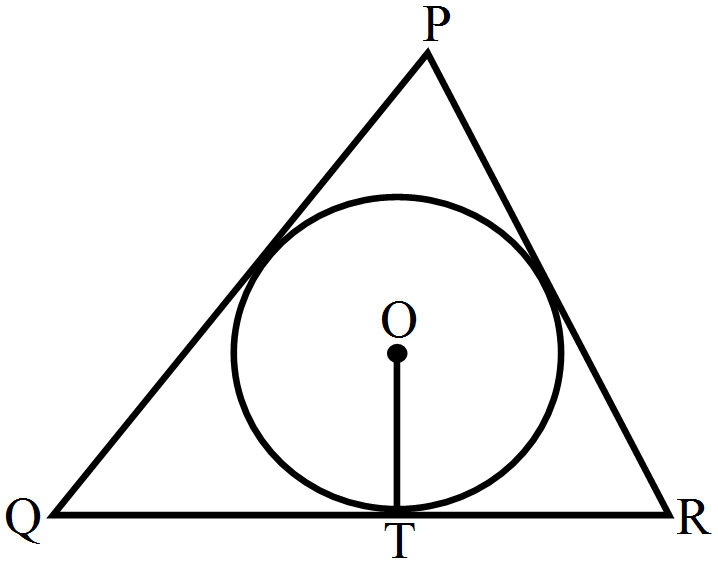
We know that tangent from an external point to the circle are equal.
So,
$\text{QT = QN} = 12\ cm$
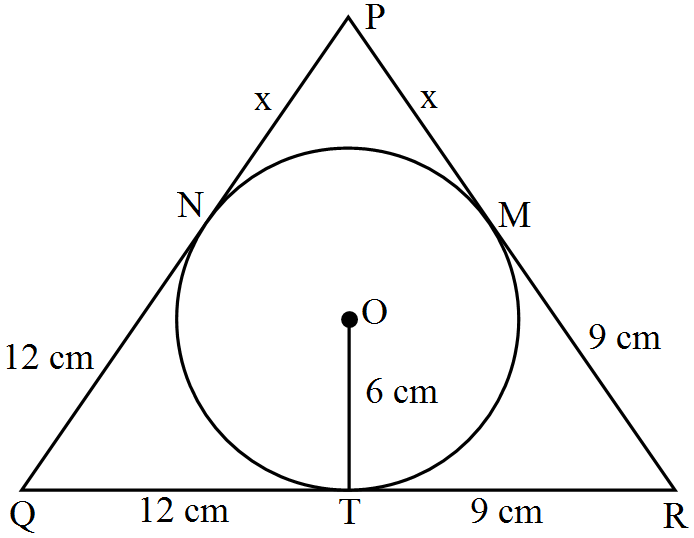
$\text{TR = RM} = 9\ cm$
Now,
$\text{ar}(\triangle\text{PQR})=\frac{1}{2}(\text{Perimeter of }\triangle\text{PQR})\times\text{r}$
$\Rightarrow\text{ar}(\triangle\text{PQR})=\frac{1}{2}(12+12+9+9+\text{x}+\text{x})\times\text{r}$
$\Rightarrow\text{ar}(\triangle\text{PQR})=\frac{1}{2}(42+2\text{x})\times6$
$\Rightarrow189=3(42+2\text{x})$
$\Rightarrow63=42+2\text{x}$
$\Rightarrow2\text{x}=21$
$\Rightarrow\text{x}=10.5$
So, $\text{PQ} = 12 + 10.5 = 22.5\ cm$
View full question & answer
MCQ 411 Mark
If tangents $\text{PA}$ and $\text{PB}$ from a point $P$ to a circle with centre $O$ are drawn, so that $\angle\text{APB} = 80^\circ, $ then $\angle\text{POA} = ?$
  • A
    $40^\circ$
  • $50^\circ$
  • C
    $80^\circ$
  • D
    $60^\circ$
Answer
Correct option: B.
$50^\circ$
In $\triangle\text{PAO}$ and $\triangle\text{PBO},$
$\angle\text{PAO}+\angle\text{PBO}=90^\circ....($Since $\text{PQ}$ and $\text{PR}$ are tangent to the circle$)$
$\text{OP}=\text{OP} ....($Common side$)$
$\text{AO}=\text{OB} ....($radii of the same circle$)$
$\Rightarrow\triangle\text{PAO}\cong\triangle\text{PBO} ....(\text{RHS}$ congruence criterion$)$
$\angle\text{POA}=\angle\text{BOP ....(cpct)}$
In quad. $\text{AOBP}$
$\angle\text{PAO}+\angle\text{PBO}+\angle\text{AOB}+\angle\text{APB}=360^\circ$
$\Rightarrow90^\circ+90^\circ+\angle\text{AOB}+80^\circ=360^\circ$
$\Rightarrow\angle\text{AOB}=100^\circ$
So, $\angle\text{POA}=50^\circ$
View full question & answer
MCQ 421 Mark
In the given figure, $\text{O}$ is the centre of a circle and $\text{PT}$ is the tangent to the circle. If $\text{PQ}$ is a chord such that $\angle\text{QPT}=50^\circ$ then $\angle\text{POQ}=?$
  • $100^\circ$
  • B
    $90^\circ$
  • C
    $80^\circ$
  • D
    $75^\circ$
Answer
Correct option: A.
$100^\circ$
Since $\text{PT}$ is the tangent to the circle,
$\angle\text{TPQ}=90^\circ$
$\Rightarrow\angle\text{TPQ}+\angle\text{OPQ}=90^\circ$
$\Rightarrow50^\circ+\angle\text{OPQ}=90^\circ$
$\Rightarrow\angle\text{OPQ}=40^\circ$
In $\triangle\text{OPQ},$
$\text{OP}=\text{OQ} ....($radii of the same circle$)$
$\Rightarrow\angle\text{OPQ}=\angle\text{OQP}=40^\circ ....($angles opposite equal sides are equal$)$
Now,
$\angle\text{OPQ}+\angle\text{OQP}+\angle\text{POQ}=180^\circ ....($Angle Sum Property$)$
$\Rightarrow40^\circ+40^\circ+\angle\text{POQ}=180^\circ$
$\Rightarrow\angle\text{POQ}=100^\circ$
View full question & answer
MCQ 431 Mark
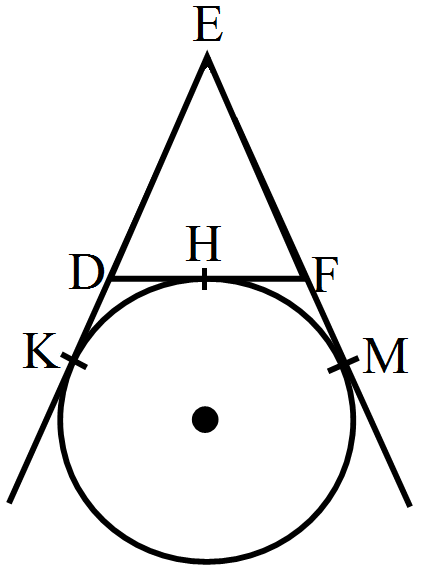
In the given figure, a circle touches the side $DF$ of $\triangle\text{EDF}$ at $H$ and touches $ED$ and $EF$ produced at $K$ and $M$ respectively. If $EK = 9\ cm$ then the perimeter of $\triangle\text{EDF}$ is:
  • A
    $9\ cm$
  • B
    $12\ cm$
  • C
    $13.5\ cm$
  • $18\ cm$
Answer
Correct option: D.
$18\ cm$
We know that tangents from an external point to the circle are equal.
So,
$\text{EK = EM} = 9\ cm$
$\text{DK = DH}$
$\text{FH = FM}$
perimeter of $\triangle\text{EDF}$
$= \text{ED + EF + DF}$
$= \text{ED + EF + DH + HF}$
$= \text{(ED + DH) + (EF + HF)}$
$= \text{(ED + DK) + (EF + FM)}$
$= \text{EK + EM}$
$= 9 + 9$
$= 18\ cm.$
View full question & answer
MCQ 441 Mark
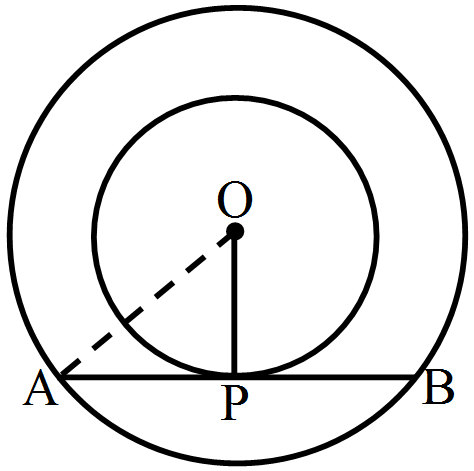
In the given figure, $O$ is the centre of two concentric circles of radii $6\ cm$ and $10\ cm. AB$ is a chord of outer circle which touches the inner circle. The length of $AB$ is:

  • A
    $8\ cm$
  • B
    $14\ cm$
  • $16\ cm$
  • D
    $\sqrt{136}\ cm$
Answer
Correct option: C.
$16\ cm$
Since $AB$ is a tangent to the circle.
$\angle\text{OPA}=90^\circ ....($tangent is perpendicular to the radius of a circle$)$
$AB$ is a chord of the outer circle
We know that of the perpendicular drawn from the centre to a chord of a circle of a circle, bisects the chord.
In $\triangle\text{OPA},$
$AO^2 = OP^2 + AP^2$
$\Rightarrow 10^2 = 6^2 + AP^2$
$\Rightarrow AP^2 = 10^2 - 6^2$
$\Rightarrow PA^2 = 64$
$\Rightarrow PA = 8\ cm$
$AB = 2AP = 2(8) = 16\ cm.$
View full question & answer
MCQ 451 Mark
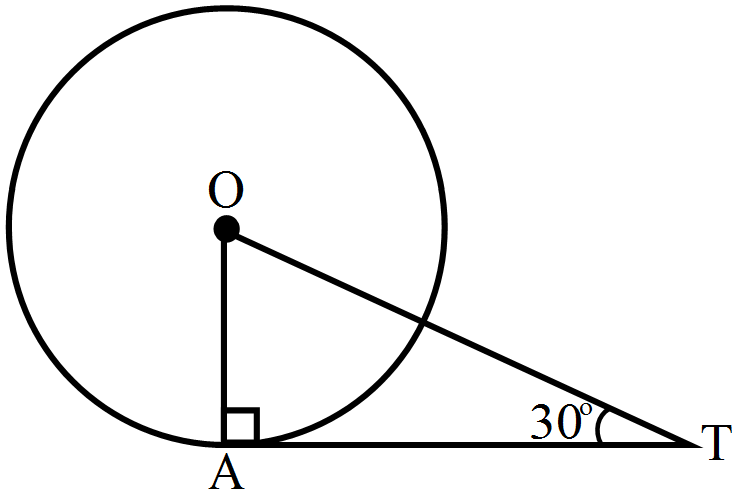
In the given figure, $\text{AT}$ is a tangent to the circle with centre $\text{O,}$ such that $\text{OT} = 4\ cm$ and $\angle\text{OTA} = 30^\circ. $Then, $\text{AT} =?$​​​​​​​
  • A
    $4\text{cm}$
  • B
    $2\text{cm}$
  • $2\sqrt{3}\text{cm}$
  • D
    $4\sqrt{3}\text{cm}$
Answer
Correct option: C.
$2\sqrt{3}\text{cm}$
Since $\angle\text{OAT}=90^\circ$ and $\angle\text{OTQ}=30^\circ$
Clearly, $\angle\text{AOT}=60^\circ$
So, $\triangle\text{AOT}$ is a $30^\circ - 60^\circ - 90^\circ$ triangle.
Side opposite $60^\circ=\frac{\sqrt{3}}{2}$ hypotenuse
$\Rightarrow\text{AT}=\frac{\sqrt{3}}{2}(\text{OT})$
$\Rightarrow\text{AT}=\frac{\sqrt{3}}{2}(4)$
$\Rightarrow\text{AT}=2\sqrt{3}\text{cm}$
View full question & answer
MCQ 461 Mark
Which of the following statements is not true?
  • A
    A tangent to a circle intersects the circle exactly at one point.
  • B
    The point common to a circle and its tangent is called the point of contact.
  • C
    The tangent at any point of a circle is perpendicular to the radius of the circle through the point of contact.
  • A straight line can meet a circle at one point only.
Answer
Correct option: D.
A straight line can meet a circle at one point only.
Options $(a), (b)$ and $(c)$ are all true.
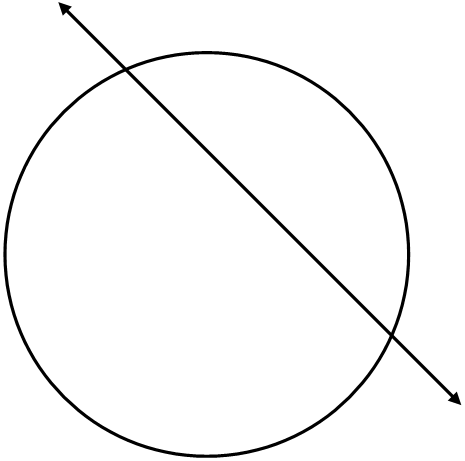
However, Option $(d)$ is false since a straight line can meet a circle at two points even as shown below.

View full question & answer
MCQ 471 Mark
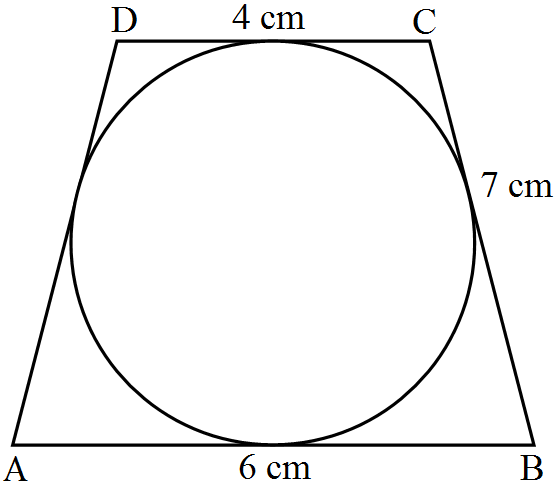
Quadrilateral $\text{ABCD}$ is circumscribed to a circle. If $\text{AB} = 6\ cm, \text{BC} = 7\ cm$ and $\text{CD} = 4\ cm$, then the length of $\text{AD}$ is:
  • $3\ cm$
  • B
    $4\ cm$
  • C
    $6\ cm$
  • D
    $7\ cm$
Answer
Correct option: A.
$3\ cm$

Using the property, tangent from an external point to the circle are equal.
We can say, $\text{AB + CD = AD + BC}$
$\Rightarrow \text{AD = AB + CD - BC}$
$\Rightarrow \text{AD} = 6 + 4 - 7$
$\Rightarrow \text{AD} = 3\ cm$
View full question & answer
MCQ 481 Mark
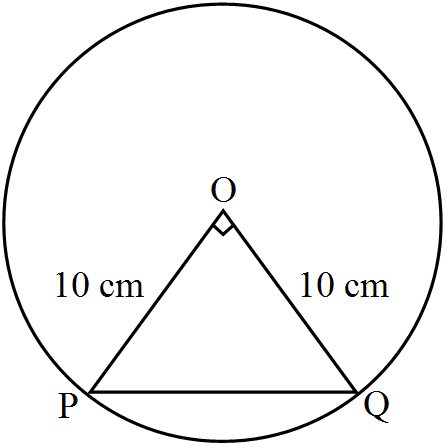
The chord of a circle of radius $10\ cm$ subtends a right angle at its centre. The length of the chord $($in $ cm)$ is:
  • A
    $\frac{5}{\sqrt{2}}\text{cm}$
  • B
    $5\sqrt{2}\text{cm}$
  • $10\sqrt{2}\text{cm}$
  • D
    $10\sqrt{3}\text{cm}$
Answer
Correct option: C.
$10\sqrt{2}\text{cm}$

In $\triangle\text{POQ},$
By using Pythagoras theorem,
$PQ^2 = PO^2 + OQ^2$
$\Rightarrow PQ^2= 10^2 + 10^2$
$\Rightarrow PQ^2= 100 + 100$
$\Rightarrow PQ^2= 200$
$\Rightarrow PQ^2 = 200$
$\Rightarrow\text{PQ}=10\sqrt{2}\text{cm}$
So, the length of the chord is $10\sqrt{2}\text{cm}$
View full question & answer
MCQ 491 Mark
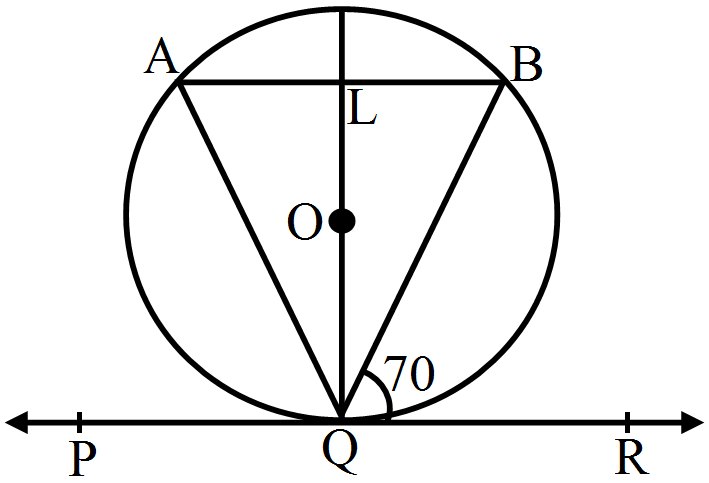
In the given figure, $\text{PQR}$ is a tangent to the circle at $\text{Q,}$ whose centre is $\text{O}$ and $\text{AB}$ is a chord parallel to $\text{PR,}$ such that$ \angle\text{BQR} = 70^\circ.$ Then, $\angle\text{AQB}=?$
  • A
    $20^\circ$
  • B
    $35^\circ$
  • $40^\circ$
  • D
    $45^\circ$
Answer
Correct option: C.
$40^\circ$
Since $\ce{AB \| PQ}$
$\angle\text{BQR}=\angle\text{ABQ}=70^\circ ....($alternate angles$)$
and $\angle\text{PQA}=\angle\text{BAQ}=70^\circ....($alternate angles$)$
In $\triangle\text{ABQ},$
$\angle\text{ABQ}+\angle\text{BAQ}+\angle\text{AQB}=180^\circ....($angle Sum Property$)$
$\Rightarrow70^\circ+70^\circ+\angle\text{AQB}=180^\circ$
$\Rightarrow\angle\text{AQB}=40^\circ$
View full question & answer
MCQ 501 Mark
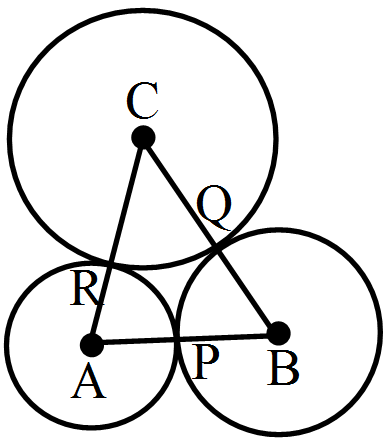
In the given figure, three circles with centres $\text{A, B, C,}$ respectively, touch each other externally. If $\text{AB} = 5\ cm, \text{BC} = 7\ cm$ and $\text{CA} = 6\ cm,$ the radius of the circle with centre $A$ is:
  • A
    $1.5\ cm$
  • $2\ cm$
  • C
    $2.5\ cm$
  • D
    $3\ cm$
Answer
Correct option: B.
$2\ cm$
Let the radii of the circle with centres $A, B$ and $C$ be $x, y,$ and $z$ respectively.
We know that radii of the same circle are equal.
$x + y = 5$
$y + z = 7$
$z + x = 6$
Adding the three equation, we get
$2(x + y + z) = 18$
$\Rightarrow x + y + z = 9$
$\Rightarrow x = 2$
So, the radius of the circle with centre $A$ is $2\ cm.$
View full question & answer
MCQ 511 Mark
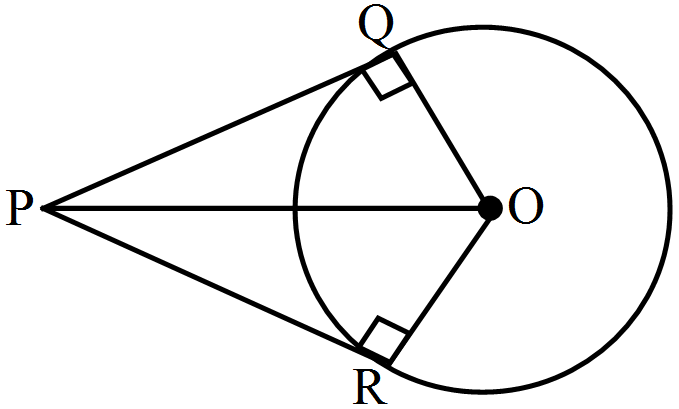
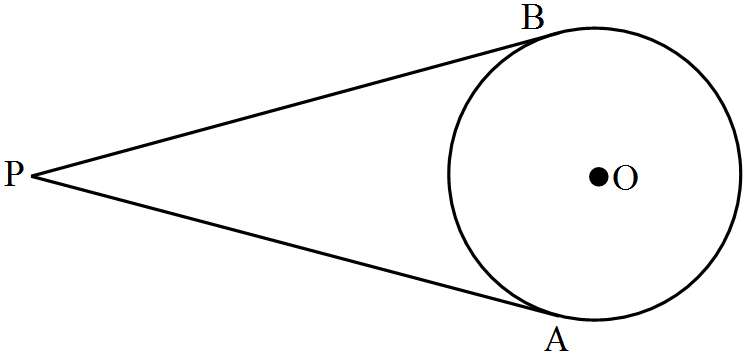
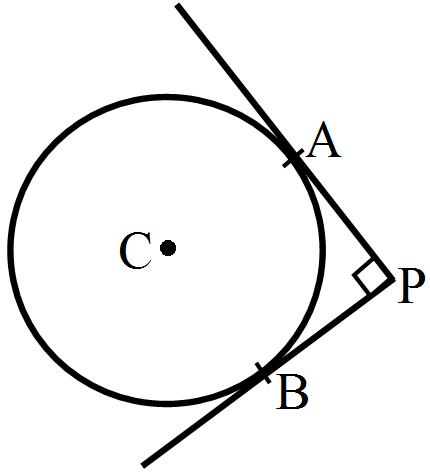
In the given figure, $\text{PA}$ and $\text{PB}$ are two tangents drawn from an external point $P$ to a circle with centre $C$ and radius $4\ cm$. If $\text{PA}\perp \text{PB}$ then the length of each tangent.
  • A
    $3\ cm$
  • $4\ cm$
  • C
    $5\ cm$
  • D
    $6\ cm$
Answer
Correct option: B.
$4\ cm$
Construction: Join $\text{CA}$ and $\text{CB.}$
Since $\text{AP}$ and $\text{PB}$ are tangent to the circle,
$\angle\text{CAP}=\angle\text{CBA}=90^\circ$
Given that $\angle\text{APB}=90^\circ$
We know that tangents drawn from an external point to the circle are equal.
$\Rightarrow\text{AP}=\text{PB}$
Also, $\text{CA}=\text{CB} ....($radii of the same circle$)$
So, quadrilateral $\text{APBC}$ is a square.
Thus, $\text{AP = PB = CA = CB} = 4\ cm.$
View full question & answer
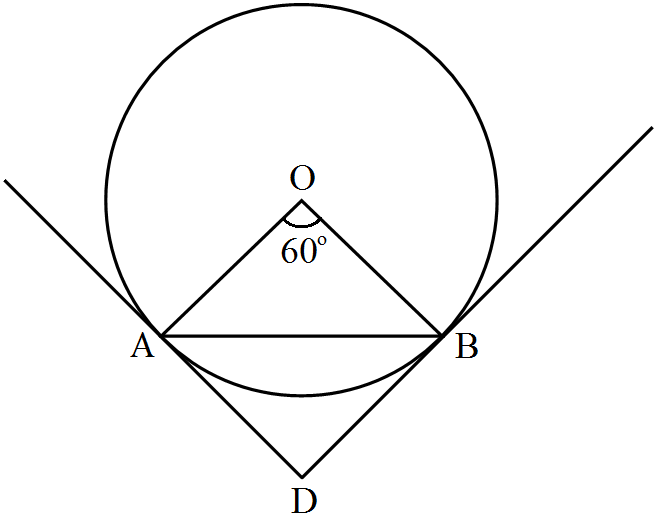
MCQ 521 Mark
If a chord $AB$ subtends an angle of $60^\circ $ at the centre of a circle, then the angle between the tangents to the circle drawn from $A$ and $B$ is:
  • A
    $30^\circ $
  • B
    $60^\circ $
  • C
    $90^\circ $
  • $120^\circ $
Answer
Correct option: D.
$120^\circ $

Since $AD$ and $DB$ are the tangent to the circle.
$\angle\text{OAD}=\angle\text{OBD}=90^\circ....($tangent is perpendicular to the radius of a circle$)$
In $\text{ABOD}$
$\angle\text{OAD}+\angle\text{ADB}+\angle\text{OBD}+\angle\text{AOB}=360^\circ$
$\Rightarrow90^\circ+\angle\text{ADB}+90^\circ+60^\circ=360^\circ$
$\Rightarrow\angle\text{ADB}=120^\circ$
View full question & answer
MCQ 531 Mark
In a right triangle $\text{ABC}$, right angled at $\text{B, BC} = 12\ cm$ and $\text{AB} = 5\ cm$. The radius of the circle inscribed in the triangle is:
  • A
    $1\ cm$
  • $2\ cm$
  • C
    $3\ cm$
  • D
    $4\ cm$
Answer
Correct option: B.
$2\ cm$
In right $\triangle\text{ABC},$
$\text{AC}^2=\text{AB}^2+\text{BC}^2 ....($By Pythagoras theorem$)$
$\Rightarrow\text{AC}^2=5^2+12^2$
$\Rightarrow\text{AC}^2=169$
$\Rightarrow\text{AC}=13\text{cm}$
We know that,
$\text{ar}(\triangle\text{ABC})=\frac{1}{2}\times(\text{perimeter of }\triangle\text{ABC})\times\text{r}$
$\Rightarrow\frac{1}{2}\times\text{base}\times\text{height}=\frac{1}{2}\times(\text{perimeter of }\triangle\text{ABC})\times\text{r}$
$\Rightarrow\frac{1}{2}\times12\times5=\frac{1}{2}\times(5+12)\times\text{r}$
$\Rightarrow\frac12\times5=30\times\text{r}$
$\Rightarrow\text{r}=2\text{cm}$
View full question & answer
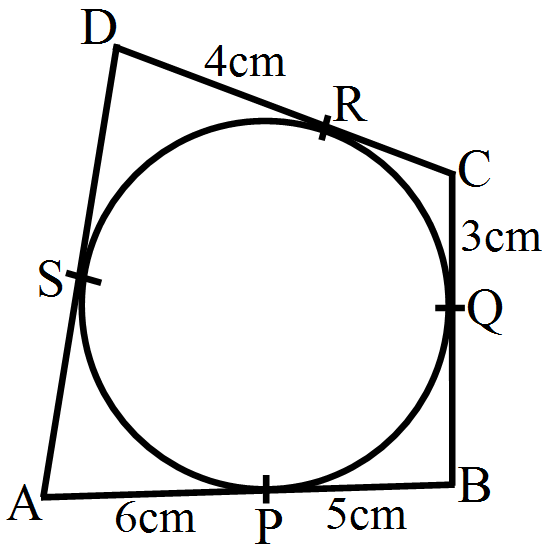
MCQ 541 Mark
In the given figure, quadrilateral $\text{ABCD}$ is circumscribed, touching the circle at $\text{P, Q, R}$ and $S$. If $\text{AP} = 6\ cm, \text{BP} = 5\ cm, \text{CQ} = 3\ cm$ and $\text{DR} = 4\ cm$, then the perimeter of quadrilateral $\text{ABCD}$ is:
  • A
    $18\ cm$
  • B
    $27\ cm$
  • $36\ cm$
  • D
    $32\ cm$
Answer
Correct option: C.
$36\ cm$
We know that tangent from an external point to the circle are equal.
$\text{RC = QC} = 3\ cm$
$\text{PB = BQ} = 5\ cm$
$\text{AP = AS} = 6\ cm$
$\text{SD = DR} = 4\ cm$
Perimeter of quad. $\text{ABCD}$
$= \text{AB + BC + CD + AD}$
$= \text{(AP + PB) + (BQ + CQ) + (CR + DR) + (AS + SD)}$
$= (6 + 5) + (5 + 3) + (3 + 4) + (6 + 4)$
$= 36\ cm$
View full question & answer
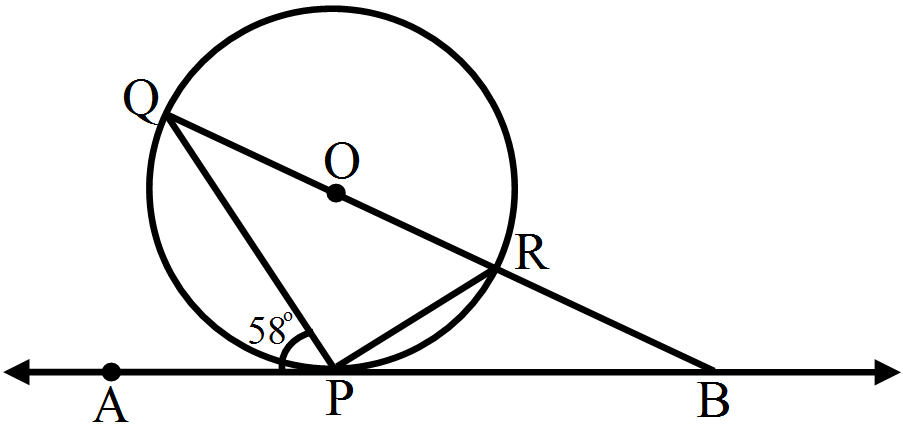
MCQ 551 Mark
In the given figure, $O$ is the centre of the circle. $\text{AB}$ is the tangent to the circle at the point $P$. If $\angle\text{APQ}=58^\circ$ then the measure of $\angle\text{PQB}$ is:
  • $32^\circ$
  • B
    $58^\circ$
  • C
    $122^\circ$
  • D
    $132^\circ$
Answer
Correct option: A.
$32^\circ$
$\angle\text{APQ}=58^\circ$
$\angle\text{QPR}=90^\circ ....($angle inscribed a semicircle$)$
Since $\text{APB}$ is a straight line,
$\angle\text{APQ}+\angle\text{QPR}+\angle\text{RPB}=180^\circ$
$\Rightarrow58^\circ+90^\circ+\angle\text{RPB}=180^\circ$
$\Rightarrow\angle\text{RPB}=32^\circ$
We know that angle that subtend the same arc are equal.
So, $\angle\text{RPB}=\angle\text{RPB}=32^\circ$
View full question & answer
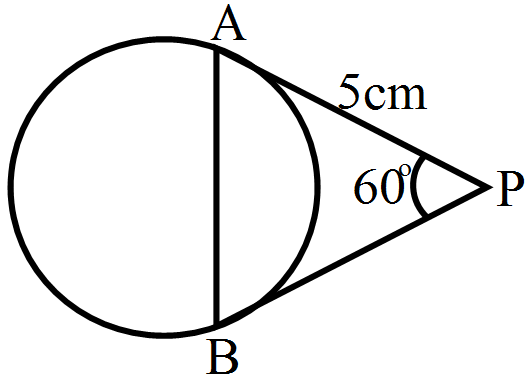
MCQ 561 Mark
In the given figure, $\text{PA}$ and $\text{PB}$ are tangents to the given circle, such that $\text{PA} = 5\ cm$ and $\angle\text{APB} = 60^\circ.$ The length of chord $\text{AB}$ is:
  • A
    $5\sqrt{2}\text{cm}$
  • $5\text{cm}$
  • C
    $5\sqrt{3}\text{cm}$
  • D
    $7.5\text{cm}$
Answer
Correct option: B.
$5\text{cm}$
We know that tangents from an external point to the circle are equal.
$\text{PA}=\text{PB}$
$\Rightarrow\angle\text{PBA}=\angle\text{PAB}=\text{x}^\circ$
In $\triangle\text{PAB},$
$\angle\text{PBA}+\angle\text{PAB}+\angle\text{APB}=180^\circ....($Angle Sum Property$)$
$\Rightarrow\angle\text{PAB}+\angle\text{PAB}+60^\circ=180^\circ$
$\Rightarrow2\angle\text{PAB}=120^\circ$
$\Rightarrow\angle\text{PAB}=60^\circ=\angle\text{PBA}$
So, $\triangle\text{PAB}$ is an equilateral triangle.
thus, $\text{AB = PA} = 5\ cm.$
View full question & answer
MCQ 571 Mark
If $\text{PA}$ and $\text{PB}$ are two tangents to a circle with centre $O$, such that $\angle\text{AOB} = 110^\circ,$ find $ \angle\text{APB}$ is equal to
  • A
    $55^\circ$
  • B
    $60^\circ$
  • $70^\circ$
  • D
    $90^\circ$
Answer
Correct option: C.
$70^\circ$
Since $\text{PA}$ and $\text{PB}$ are the tangent to the circle.
$\angle\text{OAP}=\angle\text{OBP}=90^\circ ...($tangent is perpendicular to the radius of a circle$)$
In $\text{AOBP,}$
$\angle\text{OAP}+\angle\text{APB}+\angle\text{OBP}+\angle\text{AOB}=360^\circ$
$\Rightarrow90^\circ+\angle\text{APB}+90^\circ+110^\circ=360^\circ$
$\Rightarrow\angle\text{APB}=70^\circ$
View full question & answer
MCQ 581 Mark
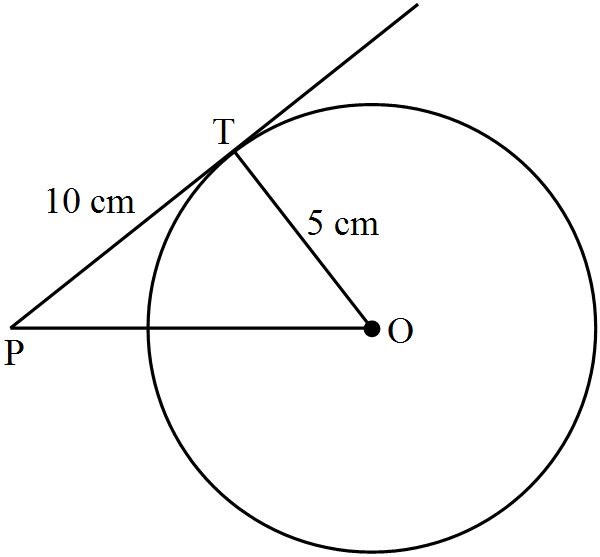
The length of the tangent from an external point $P$ to a circle of radius $5\ cm$ is $10\ cm.$ The distance of the point from the centre of the circle is:
  • A
    $8\text{cm}$
  • B
    $\sqrt{104}\text{cm}$
  • C
    $12\text{cm}$
  • $\sqrt{125}\text{cm}$
Answer
Correct option: D.
$\sqrt{125}\text{cm}$

In $\triangle\text{PTO}$
By Pythagoras theorem,
$\text{OP}^2=\text{PT}^2+\text{OT}^2$
$\Rightarrow\text{OP}^2=10^2+5^2$
$\Rightarrow\text{OP}^2=100+25$
$\Rightarrow\text{OP}=\sqrt{125}\text{cm}$
Hence, the distance of the point from the centre of the circle is $\sqrt{125}\text{cm}.$
View full question & answer
MCQ 591 Mark
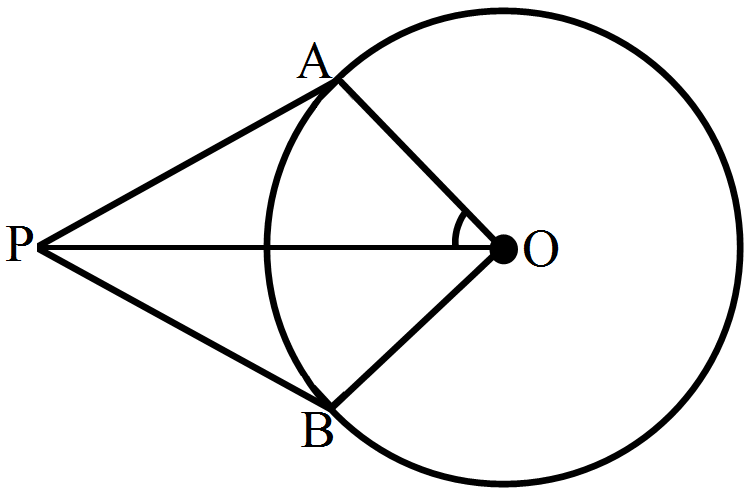
If $\text{PA}$ and $\text{PB}$ are two tangent to a circle with centre $O$ such that $\angle\text{APB}=80^\circ.$ Then, $\angle\text{AOP}=?$
  • A
    $40^\circ$
  • $50^\circ$
  • C
    $60^\circ$
  • D
    $70^\circ$
Answer
Correct option: B.
$50^\circ$
Construction: Join $\text{CA}$ and $\text{CB.}$
In $\triangle\text{PAO}$ and $\triangle\text{PBO},$
$\angle\text{OAP}=\angle\text{OBP}=90^\circ....($Since $\text{AP}$ and $\text{PB}$ are tangent to the circle$)$
$\text{OP}=\text{OP} ....($common side$)$
$\text{AO}=\text{BO} ....($radii of the same circle$)$
$\Rightarrow\triangle\text{PAO}\cong\triangle\text{PBO}....(\text{RHS}$ congruence criterion$)$
$\angle\text{OPA}=\angle\text{OPB ....(cpct)}$
$\Rightarrow\angle\text{OPA}=\frac{1}{2}\angle\text{APB}=40^\circ$
In $\triangle\text{PAO},$
$\angle\text{OPA}+\angle\text{PAO}+\angle\text{AOP}=180^\circ ....($Angle Sum Property$)$
$\Rightarrow40^\circ+90^\circ+\angle\text{AOP}=180^\circ$
$\Rightarrow\angle\text{AOP}=50^\circ$
View full question & answer