Question 12 Marks
What is the distance between the points A(c, 0) and B(0, -c)?
AnswerDistance between A(c, 0) and B(0, -c)
$=\sqrt{(\text{x}_2-\text{x}_1)^2+(\text{y}_2-\text{y}_1)^2}$
$=\sqrt{(0-\text{c})^2+(-\text{c}-0)^2}$
$=\sqrt{\text{c}^2+\text{c}^2}=\sqrt{2\text{c}^2}=\sqrt{2}\text{c}$
View full question & answer→Question 22 Marks
Find the value of a so that the point $(3, a)$ lies on the line represented by $2x - 3y + 5 = 0$
AnswerIf a point $(x_1, y_1)$ is said lie on a line represented by $ax + by + c= 0$, then the given equation of the line should hold true when the values of the co-ordinates of the points are substituted in it.
Here it is said that the point $(3, a)$ lies on the line represented by the equation $2x - 3y + 5 = 0.$
Substituting the co-ordinates of the values in the equation of the line we have,
$2x - 3y + 5$
$ = 0 2(3) - 3(a) + 5 $
$= 0 3a = 6 + 5 3a $
$= 11$
$\text{a}=\frac{11}{3}$Thus the value of $‘a’$ satisfying the given conditions is $\text{a}=\frac{11}{3}.$
View full question & answer→Question 32 Marks
On which axis do the following points lie?
S(0, 5).
AnswerGiven that:Point S(0, 5)
we have,
x = 0, y = 5
Here, x = 0, y = 5, then the points lies on the Y-axis.
View full question & answer→Question 42 Marks
Find the distance between the points $\Big(\frac{-8}{5},2\Big)$ and $\Big(\frac{2}{5},2\Big).$
AnswerDistance between the points $\Big(\frac{-8}{5},2\Big)$ and $\Big(\frac{2}{5},2\Big)$$=\sqrt{(\text{x}_2-\text{x}_1)^2+(\text{y}_2-\text{y}_1)^2}$
$=\sqrt{\Big[\frac{2}{5}-\frac{(-8)}{5}\Big]^2+(2-2)^2}$
$=\sqrt{\Big(\frac{2}{5}+\frac{8}{5}\Big)^2+(0)^2}=\sqrt{\Big(\frac{10}{5}\Big)^2+0}$
$=\sqrt{(2)^2}=2\text{ units}$
View full question & answer→Question 52 Marks
If P(2, 6) is the mid-point of the line segment joining A(6, 5) and B(4, y), find y.
AnswerP(2, 6) is the mid-point of the line segment A(6, 5) and B(4, y).
$\therefore\ 6=\frac{\text{y}_1+\text{y}_2}{2}=\frac{5+\text{y}}{2}$
⇒ 5 + y = 12
⇒ y = 12 - 5 = 7
View full question & answer→Question 62 Marks
Find the centroid of the triangle whose vertices are:
(-2, 3) (2, -1) (4, 0).
AnswerThe coordinates of the centroid of a triangle whose vertices are (-2, 3) (2, -1) (4, 0) are,
$=\Big(\frac{2-2+4}{3},\frac{3-1+0}{3}\Big)$
$=\Big(\frac{4}{3},\frac{2}{3}\Big)$
View full question & answer→Question 72 Marks
What is the distance between the points $(5\sin60^\circ,0)$ and $(0,5\sin30^\circ)?$
AnswerDistance between the given points, $=\sqrt{(\text{x}_2-\text{x}_1)^2+(\text{y}_2-\text{y}_1)^2}$ $=\sqrt{(0-5\sin60^\circ)^2+(5\sin30^\circ-0)^2}$ $=\sqrt{\Big(-5\times\frac{\sqrt{3}}{2}\Big)^2+\Big[5\Big(\frac{1}{2}\Big)\Big]^2}$ $\begin{Bmatrix}\because\ \sin60^\circ=\frac{\sqrt{3}}{2}\\\ \ \ \ \ \sin30^\circ=\frac{1}{2}\end{Bmatrix}$$=\sqrt{\frac{25\times3}{4}+\frac{25\times1}{4}}$
$=\sqrt{\frac{75}{4}+\frac{25}{4}}=\sqrt{\frac{100}{4}}$
$=\sqrt{25}=5\text{ units}$
View full question & answer→Question 82 Marks
Find the values of $x$ for which the distance between the point $P(2, -3)$, and $Q(x, 5)$ is $10$.
AnswerIt is given that distance between $P(2, -3)$ and $Q(x, 5)$ is $10$.
In general, the distance between $A(x_1, y_1)$ and $B(x_2, y_2)$ is given by,
$AB^2 = (x_2 - x_1)^2 + (y_2 - y_1)^2$
So,
$10^2 = (x - 2)^2 + (5 + 3)^2$
On further simplification,
$(x - 2)^2 = 36$
$\text{x}=2\pm6$
$= 8, -4$
View full question & answer→Question 92 Marks
A(4, 2), B(6, 5) and C(1, 4) are the vertices of ΔABC.
The median from A meets BC in D. Find the coordinates of the point D.
Answer
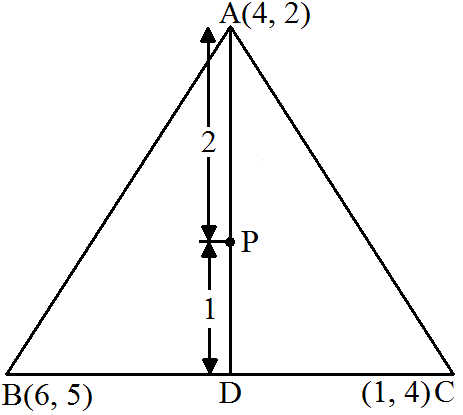 Median AD of the triangle will divide the side BC in two equals parts. So D is the midpoint of side BC.
Coordinates of $\text{D}=\Big(\frac{6+1}{2},\frac{5+4}{2}\Big)$
$=\Big(\frac{7}{2},\frac{9}{2}\Big)$ View full question & answer→Question 102 Marks
If the distance between points $(x, 0)$ and $(0, 3)$ is $5$, what are the values of $x$?
AnswerWe have to find the unknown x using the distance between $A(x, 0)$ and $B(0, 3)$ which is $5$.
In general, the distance between $A(x_1, y_1)$ and $B(x_2, y_2)$ is given by,
$\text{AB}=\sqrt{(\text{x}_2-\text{x}_1)^2+(\text{y}_2-\text{y}_1)^2}$
So, $5=\sqrt{(\text{x}-0)^2+(0-3)^2}$
Squaring both the sides we get,
$\text{x}^2-16=0$ So, $\text{x}=\pm4$
View full question & answer→Question 112 Marks
Write the ratio in which the line segment joining the points A(3, -6) and B(5, 3) is divided by x-axis.
AnswerThe point lies on x-axis. Its ordinate will be = 0 Let the point P(x, 0) divides the line segment joining the points A(3, -6) and B(5, 3) in the ratio m : n.$\therefore\ 0=\frac{\text{my}_2+\text{my}_1}{\text{m}+\text{n}}\Rightarrow\ 0=\frac{\text{m}\times3+\text{n}(-6)}{\text{m}+\text{n}}$
⇒ 3m - 6n = 0 ⇒ 3m = 6n$\Rightarrow\ \frac{\text{m}}{\text{n}}=\frac{6}{3}=\frac{2}{1}$
$\therefore$ Ratio = 2 : 1
View full question & answer→Question 122 Marks
The points $A \left( x _1, y _1\right), B \left( x _2, y _2\right)$ and $C \left( x _3, y _3\right)$ are the vertices of $\triangle A B C$.
What are the coordinates of the centroid of the triangle $A B C$ ?
AnswerThe points P, Q and R coincides and is the centroid of the triangle ABC.
So, coordinates of the centroid is $\Big(\frac{\text{x}_1+\text{x}_2+\text{x}_3}{3},\frac{\text{y}_1+\text{y}_2+\text{y}_3}{3}\Big).$
View full question & answer→Question 132 Marks
On which axis do the following points lie?
P(5, 0).
AnswerGiven that:Point P(5, 0)
we have
x = 5, y = 0
Here, y = 0, $\text{x}\neq0$ then the points lies on the X-axis.
View full question & answer→Question 142 Marks
The points $A\left(x_1, y_1\right), B\left(x_2, y_2\right)$ and $C\left(x_3, y_3\right)$ are the vertices of $\triangle A B C$.
The median from $A$ meets $B C$ at $D$. Find the coordinates of the point $D$.
AnswerMedian $A D$ of the triangle will divide the side $B C$ in two equal parts.
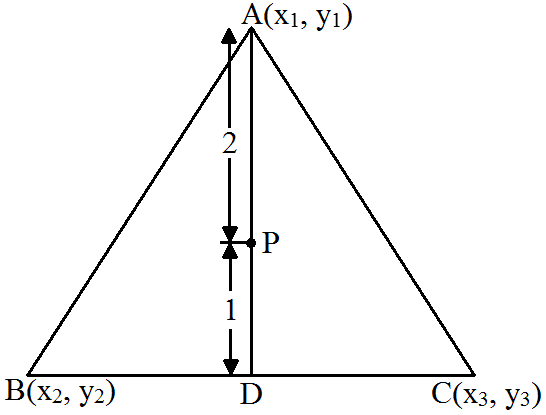
Therefore, $D$ is the midpoint of side $BC$ .
Coordinates of $D$ are,
$\left(\frac{ x _2+x_3}{2}, \frac{y_2+y_3}{2}\right)$ View full question & answer→Question 152 Marks
Write the condition of collinearity of points $\left(x_1, y_1\right),\left(x_2, y_2\right)$ and $\left(x_3, y_3\right)$.
AnswerThree points $\left(x_1, y_1\right),\left(x_2, y_2\right)$ and $\left(x_3, y_3\right)$. are said to be collinear if the area of the triangle formed by these point $=0$ i.e.,
$\frac{1}{2}\left[x_1\left(y_2-y_3\right)+x_2\left(y_3-y_1\right)+x_3\left(y_1-y_2\right)\right]=0 \\
\Rightarrow x_1\left(y_2-y_3\right)+x_2\left(y_3-y_1\right)+x_3\left(y_1-y_2\right)=0 $
View full question & answer→Question 162 Marks
Find the coordinates of the point which is equidistant from the three vertices $A(2x, 0), O(0, 0)$ and $B(0, 2y)$ of $\triangle AOB.$
AnswerLet the coordinate of the point which is equidistant from the three vertices $O(0, 0), A(0, 2y)$ and $B(2x, 0)$ is $P(h, k)$.
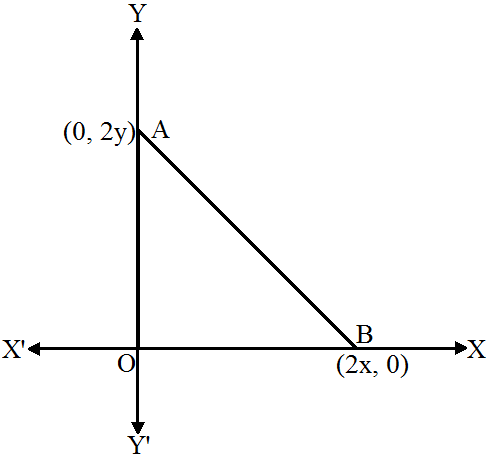
Then, $PO = PA = PB$
$\Rightarrow (PO)^2 = (PA)^2 = (PB)^2 ......(i)$
By distance formula,
$\big[\sqrt{(\text{h}-0)^2+(\text{k}-0)^2}\big]^2$
$=\big[\sqrt{(\text{h}-0)^2+(\text{k}-2\text{y})^2}\big]^2$
$=\big[\sqrt{(\text{h}-2\text{x})^2+(\text{k}-0)^2}\big]^2$
$\Rightarrow h^2 + k^2 = h^2 + (k - 2y)^2 = (h - 2x)^2 + k^2 ......(ii)$
Taking first two equations, we get
$\Rightarrow h^2 + k^2 = h^2 + (k - 2y)^2$
$\Rightarrow k^2 = k^2 + 4y^2 - 4yk$
$\Rightarrow 4y(y - k) = 0$
$\Rightarrow y = k$ $[\because\ \text{y}\neq0]$
Taking first and third equations, we get
$h^2 + k^2 = (h - 2x)^2 + k^2$
$\Rightarrow h^2= h^2 + 4x^2 - 4xh$
$\Rightarrow 4x(x - h) = 0$
$\Rightarrow x = h$ $[\because\ \text{x}\neq0]$
$\therefore$ Required points $= (h, k) = (x, y)$ View full question & answer→Question 172 Marks
Find the area of the triangle with vertices $(a, b + c), (b, c + a)$ and $(c, a + b)$.
AnswerThe area 'A' encompassed by three points $(x_1, y_1), (x_2, y_2)$ and $(x_3, y_3)$ is given by the formula,
$\text{A}=\frac{1}{2}|\text{x}_1(\text{y}_2-\text{y}_3)+\text{x}_2(\text{y}_3-\text{y}_1)+\text{x}_3(\text{y}_1-\text{y}_2)|$
Here, three points $(x_1, y_1), (x_2, y_2)$ and $(x_3, y_3)$ are $(a, b + c), (b, c + a)$ and $(c, a + b).$
Area is as follows: $(a, b + c), (b, c + a)$ and $(c, a + b)$
$\text{A}=\frac{1}{2}|\text{a}(\text{c}+\text{a}-\text{a}-\text{b})+\text{b}(\text{a}+\text{b}-\text{b}-\text{c})+\text{c(b}+\text{c}-\text{c}-\text{a})|$
$=\frac{1}{2}|\text{a(c}-\text{b})+\text{b(a}-\text{c})+\text{c(b}-\text{a})|$
$=\frac{1}{2}|\text{ac}-\text{ab}+\text{ba}-\text{bc}+\text{cb}-\text{ca}|$ $=0$
View full question & answer→Question 182 Marks
If $a \neq b \neq 0$, prove that the points $\left(a, a^2\right),\left(b, b^2\right),(0,0)$ will not be collinear.
AnswerLet $A \left( a , a ^2\right), B \left( b , b ^2\right)$ and $C (0,0)$ be the coordinates of the given points.
We know that the area of triangle having vertices $\left(x_1, y_1\right),\left(x_2, y_2\right)$ and $\left(x_3, y_3\right)$ is $\left|\frac{1}{2}\left[ x _1\left( y _2- y _3\right)+ x _2\left( y _3- y _1\right)+ x _3\left( y _1- y _2\right)\right]\right|$ square units.
So, Area of $\triangle ABC =\left|\frac{1}{2}\left[ a \left( b ^2-0\right)+ b \left(0- a ^2\right)+0\left( a ^2- b ^2\right)\right]\right|$ $=\left|\frac{1}{2}\left(a b^2-a^2 b\right)\right|$
$=\frac{1}{2}| ab ( b - a )|$
$\neq 0(\because a \neq b \neq 0)$
Since the area of the triangle formed by the points $\left(a, a^2\right),\left(b, b^2\right)$ and $(0,0)$ is not zero, so the given points are not collinear.
View full question & answer→Question 192 Marks
Write the coordinates of the point dividing line segment joining points (2, 3) and (3, 4) internally in the ratio 1 : 5.
AnswerLet the coordinates of the required point be (x, y), then
$\text{x}=\frac{\text{mx}_2+\text{mx}_1}{\text{m}+\text{n}}$ and $\text{y}=\frac{\text{my}_2+\text{my}_1}{\text{m}+\text{n}}$
Now, $\text{x}=\frac{1\times3+5\times2}{1+5}=\frac{3+10}{6}=\frac{13}{6}$
and $\text{y}=\frac{1\times4+5\times3}{1+5}=\frac{4+15}{6}=\frac{19}{6}$
Hence coordinates of the required point will be $\Big(\frac{13}{6},\frac{19}{6}\Big).$
View full question & answer→Question 202 Marks
Write the perimeter of the triangle formed by the points O(0, 0), A(a, 0), and B(0, b).
AnswerThe vertices of a ∆OAB, O(0, 0), A(a, 0), and B(0, b).
Now length of $\text{OA}=\sqrt{(\text{x}_2-\text{x}_1)^2+(\text{y}_2-\text{y}_1)^2}$
$=\sqrt{(\text{a}-0)^2+(0-0)^2}$
$=\sqrt{\text{a}^2+0^2}=\sqrt{\text{a}^2}=\text{a}$
$\text{OB}=\sqrt{(0-0)^2+(\text{b}-0)^2}$
$=\sqrt{0^2+\text{b}^2}=\sqrt{\text{b}^2}=\text{b}$
$\text{AB}=\sqrt{(0-\text{a})^2+(\text{b}-0)^2}$
$=\sqrt{\text{a}^2+\text{b}^2}$
$\therefore$ Now area of ∆ABC
$=\frac{1}{2}\times\text{OA}\times\text{OB}$
$=\frac{1}{2}\text{ab sq.units}$
View full question & answer→Question 212 Marks
Write the formula for the area of the triangle having its vertices at $\left(x_1, y_1\right),\left(x_2, y_2\right)$ and $\left(x_3, y_3\right)$.
AnswerArea of a triangle whose vertices are $\left( x _1, y _1\right),\left( x _2, y _2\right)$ and $\left( x _3, y _3\right)$.
$=\frac{1}{2}[\text{x}_1(\text{y}_2-\text{y}_3)+\text{x}_2(\text{y}_3-\text{y}_1)+\text{x}_3(\text{y}_1-\text{y}_2)]$
View full question & answer→Question 222 Marks
If P(x, 6) is the mid-point of the line segment joining A(6, 5) and B(4, y), find y.
AnswerP(x, 6) is the mid-point of the line segment joining the points A(6, 5), B(4, y)
$\therefore\ 6=\frac{5+\text{y}}{2}$
⇒ 5 + y = 12
⇒ y = 12 - 5 = 7
$\therefore$ y = 7
View full question & answer→Question 232 Marks
What is the area of the triangle formed by the points O(0, 0), A(6, 0) and B(0, 4)?
AnswerThe vertices of the triangle OAB are O(0, 0), A(6, 0) and B(0, 4)
$\therefore$ Area $=\frac{1}{2}[\text{x}_1(\text{y}_2-\text{y}_3)+\text{x}_2(\text{y}_3-\text{y}_1)+\text{x}_3(\text{y}_1-\text{y}_2)]$
$=\frac{1}{2}[0(0-4)+6(4-0)+(0-0)]$
$=\frac{1}{2}[0+24+0]$
$=\frac{1}{2}\times24=12\text{ sq.units}$
View full question & answer→Question 242 Marks
A(4, 2), B(6, 5) and C(1, 4) are the vertices of ΔABC.
What do you observe?
Answer
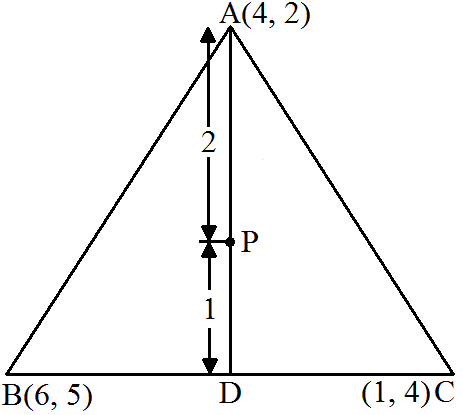
We see that co-ordinates of P, Q and R are same i.e., P, Q and R coincides eachother. Medians of the sides of a triangle pass through the same point which is called the centroid of the triangle.
View full question & answer→Question 252 Marks
On which axis do the following points lie?
Q(0, -2).
AnswerGiven that:Point Q(0, -2)
we have,
x = 0, y = -2
Here, x = 0, $\text{y}\neq0$ then the points lies on the Y-axis.
View full question & answer→Question 262 Marks
Write the coordinates the reflections of points (3, 5) in x and y-axes.
AnswerWe have to find the reflection of (3, 5) along x-axis and y-axis.
Reflection of any point P(a, b) along x-axis is (a, -b).
So reflection of (3, 5) along x-axis is (3, -5).
Similarly, reflection of any point P(a, b) along y-axis is (-a, b).
So, reflection of (3, 5) along y-axis is (-3, 5).
View full question & answer→Question 272 Marks
If (x, y) be on the line joining the two points (1, -3) and (-4, 2), prove that x + y + 2= 0.
AnswerSince the point (x, y) lie on the line joining the points (1, -3) and (-4, 2); the area of triangle formed by these points is 0.
That is,
$\triangle=\frac{1}{2}\{\text{x}(-3-2)+1(2-\text{y})-4(\text{y}+3)\}=0$
= -5x + 2 - y - 4y - 12 = 0
= -5x - 5y - 10 = 0
= x + y + 2 = 0
Thus, the result is proved.
View full question & answer→Question 282 Marks
Two vertices of a triangle have co-ordinates (-8, 7) and (9, 4). If the centroid of the triangle is at the origin, what are the co-ordinates of the third vertex?
AnswerTwo vertices of a triangle are (-8, 7) and (9, 4)
Let the third vertex be (x, y)
Centroid of the triangle is (0, 0)
$\therefore\ \frac{\text{x}_1+\text{x}_2+\text{x}_3}{3}=0\Rightarrow\ \frac{-8+9+\text{x}}{3}=0$
⇒ 1 + x = 0 ⇒ x = -1
and $\frac{\text{y}_1+\text{y}_2+\text{y}_3}{3}=0\Rightarrow\ \frac{7+4+\text{y}}{3}=0$
⇒ 11 + y = 0 ⇒ y = -11
$\therefore$ Third vertex will be (-1, -11).
View full question & answer→Question 292 Marks
On which axis do the following points lie?
R(-4, 0).
AnswerGiven that:Point R(-4, 0)
we have,
x = -4, y = 0
Here, $\text{x}\neq0,$ y = 0, then the points lies on the X-axis.
View full question & answer→Question 302 Marks
Find the centroid of the triangle whose vertices are:
$(1, 4) (-1, -1), (3, -2).$
AnswerWe know that the coordinates of the centroid of a triangle whose vertices are $(x_1, y_1), (x_2, y_2), (x_3, y_3)$ are,
$\Big(\frac{\text{x}_1+\text{x}_2+\text{x}_3}{3},\frac{\text{y}_1+\text{y}_2+\text{y}_3}{3}\Big)$
So, the coordinates of the centroid of a triangle whose vertices are $(1, 4), (-1, -1)$ and $(3, -2)$ are $\Big(\frac{1-1+3}{3},\frac{4-1-2}{3}\Big)$
$=\Big(1,\frac{1}{3}\Big)$
View full question & answer→Question 312 Marks
Name the type of triangle PQR formed by the points $\text{P}(\sqrt{2},\sqrt{2}),\ \text{Q}(-\sqrt{2},-\sqrt{2})$ and $\text{R}(-\sqrt{6},\sqrt{6}).$
AnswerUsing distance formula, $\text{PQ}=\sqrt{(\sqrt{2}+\sqrt{2})^2+(\sqrt{2}+\sqrt{2})^2}$ $=\sqrt{(2\sqrt{2})^2+(2\sqrt{2})^2}=\sqrt{16}=4$ $\text{PR}=\sqrt{(\sqrt{2}+\sqrt{6})^2+(\sqrt{2}-\sqrt{6})^2}$$=\sqrt{2+6+2\sqrt{12}+2+6-2\sqrt{12}}=\sqrt{16}=4$
$\text{RQ}=\sqrt{(-\sqrt{2}+\sqrt{6})^2+(-\sqrt{2}-\sqrt{6})^2}$
$=\sqrt{2+6-2\sqrt{12}+2+6+2\sqrt{12}}=\sqrt{16}=4$
Since, PQ = PR = RQ = 4, point P, Q, R form an equilateral triangle.
View full question & answer→Question 322 Marks
Find the distance between the following pair of points:
(a + b, b + c) and (a - b, c - b).
AnswerThe two given points are (a + b, b + c) and (a - b, c - b)
The distance between these two points is,
$\text{d}=\sqrt{(\text{a}+\text{b}-\text{a}+\text{b})^2+(\text{b}+\text{c}-\text{c}+\text{b})^2}$
$=\sqrt{(2\text{b})^2+(2\text{b})^2}$
$=\sqrt{4\text{b}^2+4\text{b}^2}$
$=\sqrt{8\text{b}^2}$
$\text{d}=2\text{b}\sqrt{2}$
Hence the distance is $2\text{b}\sqrt{2}\text{units}.$
View full question & answer→Question 332 Marks
If the centroid of the triangle formed by points $P ( a , b ), Q ( b , c )$ and $R ( c , a )$ is at the origin, what is the value of $a + b +$ c?
AnswerThe co-ordinates of the vertices are ( $a, b$ ); ( $b, c$ ) and ( $c, a$ ) The co-ordinate of the centroid is $(0,0)$
We know that the co-ordinates of the centroid of a triangle whose vertices are $\left( x _1, y _1\right),\left( x _2, y _2\right),\left( x _3, y _3\right)$ is, $\left(\frac{x_1+x_2+x_3}{3}, \frac{y_1+y_2+y_3}{3}\right)$
So, $(0,0)=\left(\frac{ a + b + c }{3}, \frac{b+ c + a }{3}\right)$
Compare individual terms on both the sides, $\frac{ a + b + c }{3}=0$ Therefore, $a+b+c=0$
View full question & answer→Question 342 Marks
If the centroid of the triangle formed by points P(a, b), Q(b, c) and R(c, a) is at the origin, what is the value of $\frac{\text{a}^2}{\text{bc}}+\frac{\text{b}^2}{\text{ca}}+\frac{\text{c}^2}{\text{ab}}?$
AnswerThe vertices of the triangle $PQR$ are $P(a, b), Q(b, c)$ and $R(c, a)$ and its centroid is $O(0, 0)$
$\therefore\ \frac{\text{x}_1+\text{x}_2+\text{x}_3}{3}=0\Rightarrow\ \frac{\text{a}+\text{b}+\text{c}}{3}=0$
$\Rightarrow\ \text{a}+\text{b}+\text{c}=0$ Now, $\frac{\text{a}^2}{\text{bc}}+\frac{\text{b}^2}{\text{ca}}+\frac{\text{c}^2}{\text{ab}}$
$=\frac{\text{a}^3+\text{b}^3+\text{c}^3}{\text{abc}}=\frac{3\text{abc}}{\text{abc}}$ {$\therefore$$a^3 + b^3 + c^3 = 3abc$ if $a + b + c = 0$}= $3$
View full question & answer→Question 352 Marks
Write the ratio in which the line segment joining points $(2, 3)$ and $(3, -2)$ is divided by $x$-axis.
AnswerLet $P(x, 0)$ be the point of intersection of $x$-axis with the line segment joining $A(2,3)$ and $B(3,-2)$ which divides the line segment $A B$ in the ratio $\lambda: 1$.
Now according to the section formula if point a point $P$ divides be the point of intersection of $x$-axis with the line segment joining $A(2,3)$ and $B(3,-2)$ which divides the line segment $A B$ in the ratio a line segment joining $A\left(x_1, y_1\right)$ and $B\left(x_2, y_2\right)$ in the ratio $m : n$ internally than, $P ( x , y )=\left(\frac{ mx _1+ mx _2}{m+ n }, \frac{ ny _1+ my _2}{m+ n }\right)$
Now we will use section formula as,
$(x, 0)=\left(\frac{3 \lambda+2}{\lambda+1}, \frac{3-2 \lambda}{\lambda+1}\right)$
Now equate the $y$ component on both the sides,
$\frac{3-2 \lambda}{\lambda+1}=0$
On further simplification,
$\lambda=\frac{3}{2} \text { So } x \text {-axis divides } A B \text { in the ratio } \frac{3}{2} .$
View full question & answer→Question 362 Marks
If P(2, p) is the mid-point of the line segment joining the points A(6, -5) and B(-2, 11), find the value of p.
AnswerP(2, p) is the mid-point of the line segment joining the points A(6, -5) and B(-2, 11)
$\therefore\ \text{P}=\frac{-5+11}{2}\Rightarrow\ \text{P}=\frac{6}{2}=3$
View full question & answer→Question 372 Marks
Write the distance between the points $\text{A}(10\cos\theta, 0)$ and $\text{B}(0,10\sin\theta).$
AnswerDistance between the points $\text{A}(10\cos\theta, 0)$ and $\text{B}(0,10\sin\theta).$
$=\sqrt{(\text{x}_2-\text{x}_1)^2+(\text{y}_2-\text{y}_1)^2}$
$=\sqrt{(0-10\cos\theta)^2+(10\sin\theta-0)^2}$
$=\sqrt{100\cos^2\theta+100\sin^2\theta}$
$=\sqrt{100(\sin^2\theta+\cos^2\theta)}$
$=\sqrt{100\times1}=\sqrt{100}$
$\{\because\ \sin^2\theta+\cos^2\theta=1\}$
$=10$
View full question & answer→Question 382 Marks
The points $A\left(x_1, y_1\right), B\left(x_2, y_2\right)$ and $C\left(x_3, y_3\right)$ are the vertices of $\triangle A B C$.
Find the coordinates of the point $P$ on $A D$ such that $A P: P D=2: 1$.
Answer
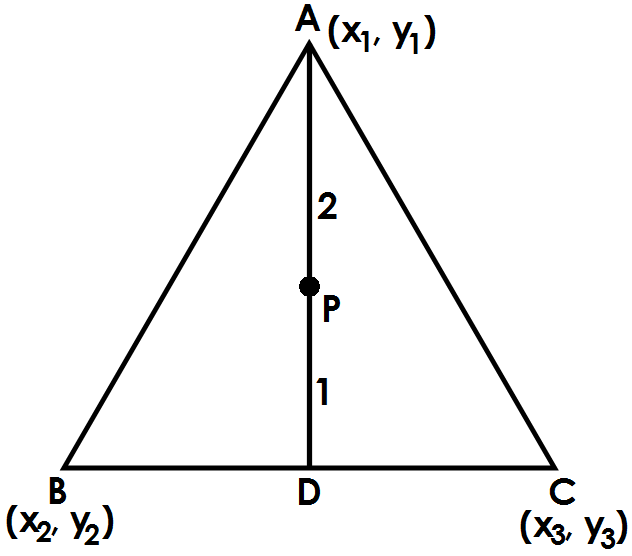
Let the co-ordinates of a point P be $(x, y).$
Given that, the point $P(x, y)$, divide the line joining A(x1, y3) and $\text{D}=\Big(\frac{\text{x}_2+\text{x}_3}{2},\frac{\text{y}_2+\text{y}_3}{2}\Big)$ in the ratio $2 : 1$, then the coordinates of $P$.
$=\begin{bmatrix}\frac{2\Big(\frac{\text{x}_2+\text{x}_3}{2}\Big)+1.\text{x}_1}{2+1}\frac{2\Big(\frac{\text{y}_2+\text{y}_3}{2}\Big)+1.\text{y}_1}{2+1} \end{bmatrix}$
$\bigg[\because$ internal section formula $=\Big(\frac{\text{m}_2+\text{x}_2+\text{m}_2\text{x}_1}{\text{m}_1+\text{m}_2},\frac{\text{m}_1\text{y}_2+\text{m}_2\text{m}_1}{\text{m}_1+\text{m}_2}\Big)\bigg]$
$=\Big(\frac{\text{x}_2+\text{x}_3+\text{x}_1}{3},\frac{\text{y}_2+\text{y}_3+\text{y}_1}{2}\Big)$
$\therefore$ So, required coordinates of point $\text{P}=\Big(\frac{\text{x}_1+\text{x}_2+\text{x}_3}{3},\frac{\text{y}_1+\text{y}_2+\text{y}_3}{3}\Big)$ View full question & answer→Question 392 Marks
If the distance between the points (4, k) and (1, 0) is 5, then what can be the possible values of k?
AnswerConsider the points A(4, k) and B(1, 0).It is given that the distance AB is 5 units.
By distance formula, distance AB is as follows:
$\text{AB}=\sqrt{(4-1)^2+(\text{k}-0)^2}$
$\Rightarrow\ 5=\sqrt{9+(\text{k})^2}$
$\Rightarrow\ 25=9+\text{k}^2$
$\Rightarrow\ 16=\text{k}^2$
$\Rightarrow\ \pm4=\text{k}$
Hence, value of k are $\pm4.$
View full question & answer→Question 402 Marks
Find the distance between the following pair of points:
$(a, 0)$ and $(0, b).$
AnswerWe have $P(a, 0)$ and $Q(0, b)$
Here,
$x_1 = a, y_1 = 0, x_2 = 0, y_2 = b,$
$\text{PQ}=\sqrt{(\text{x}_2-\text{x}_1)^2+(\text{y}_2-\text{y}_1)^2}$
$\text{PQ}=\sqrt{(0-\text{a})^2+(\text{b}-0)^2}$
$\text{PQ}=\sqrt{(-\text{a})^2+(\text{b})^2}$
$\text{PQ}=\sqrt{\text{a}^2+\text{b}^2}$
View full question & answer→Question 412 Marks
If the distance between the points $(3, 0)$ and $(0, y)$ is $5$ units and $y$ is positive. then what is the value of $y$?
AnswerIt is given that distance between $A (3,0)$ and $B (0, y )$ is 5 . In general, the distance between $A \left( x _1, y _1\right)$ and $B \left( x _2, y _2\right)$ is given by, $A B^2=\left(x_2-x_1\right)^2+\left(y_2-y_1\right)^2$
So,
$5^2=(0-3)^2+(y-0)^2$
On further simplification,
$y^2=16$
$y= \pm 4$
We will neglect the negative value. So,
$y=4$
View full question & answer→