MCQ 11 Mark
If $A(4, 2), B(6, 5)$ and $C(1, 4)$ be the verteces of $\triangle\text{ABC}$ and $AD$ is a median, then the coordinates of $D$ are:
- A
$\Big(\frac{5}{2},3\Big)$
- B
$\Big(5,\frac{7}{2}\Big)$
- ✓
$\Big(\frac{7}{2},\frac{9}{2}\Big)$
- D
$\text{none of these}$
AnswerCorrect option: C. $\Big(\frac{7}{2},\frac{9}{2}\Big)$
Since $D$ is the median on the side $\text{BC, D}$ is the mid point formula, we get
$\text{D}=\Big(\frac{6+1}{2},\frac{5+4}{2}\Big)$
$\text{D}=\Big(\frac{7}{2},\frac{9}{2}\Big)$
View full question & answer→MCQ 21 Mark
If the points $A(2, 3), B(5 , k)$ and $C(6, 7)$ are collinear then:
- A
$\text{k}=4$
- ✓
$\text{k}=6$
- C
$\text{k}=\frac{-3}{2}$
- D
$\text{k}=\frac{11}{4}$
AnswerCorrect option: B. $\text{k}=6$
The given points are $A (2, 3), B(5, k)$ and $C(6, 7)$ are collinear.
$\therefore(\text{x}_1=2,\text{y}_1=3),(\text{x}_2=5,\text{y}_2=\text{k)}$and $(\text{x}_3=6,\text{y}_3=7)$
The given points are collinear.
$\Rightarrow\text{x}_1(\text{y}_2-\text{y}_3)+\text{x}_2(\text{y}_3-\text{y}_1)+\text{x}_3(\text{y}_1-\text{y}_2)=0$
$\Rightarrow2(\text{k}-7)+5(7-3)+6(3-\text{k)}=0$
$\Rightarrow5\text{k}-14+20+18-6\text{k}=0$
$\Rightarrow4\text{k}=24$
$\Rightarrow\text{k}=6$
View full question & answer→MCQ 31 Mark
Two vertices of $\triangle\text{ABC}$ are $A(-1, 4)$ and $B(5, 2)$ and its centroid is $G(0, -3).$ Then, the coordinates of $C$ are:
- A
$(4, 3)$
- B
$(4, 15)$
- ✓
$(-4, -15)$
- D
$(-15, -4)$
AnswerCorrect option: C. $(-4, -15)$
Let the third vertex have coordinates $D (x,y).$
The centroid of a triangle is given by
$\text{C}(\text{x,y}) = \Big(\frac{\text{x}_1 + \text{x}_2 + \text{x}_3}{3},\frac{\text{y}_1 + \text{y}_2 + \text{y}_3}{3}\Big)$
$\Rightarrow \text{G}(0,-3) = \Big(\frac{-1 +5 \text{ x}}{3},\frac{4+2+\text{ y}}{3}\Big)$
$\Rightarrow \text{G}(0,-3) = \Big(\frac{4+\text{ x}}{3},\frac{4+2+\text{ y}}{3}\Big)$
$\Rightarrow \frac{4+\text{ x}}{3} = 0 $ and $\frac{6 + \text{ y}}{3} = -3$
$\Rightarrow 4+\text{x} - 0 $ and $ 6+\text{ y} = -9$
$\Rightarrow \text{x} = -4 $ and$\text{ y} = -15$
So, the coordinates of the third vertex are $(-4,-15)$
View full question & answer→MCQ 41 Mark
If $A(-1, 0), B(5, -2)$ and $C(8, 2)$ are the vertices of a $\triangle\text{ABC}$ then its centroid is:
- A
$(12, 0)$
- B
$(6, 0)$
- C
$(0, 6)$
- ✓
$(4, 0)$
AnswerCorrect option: D. $(4, 0)$
Let the centrcid have coordinates $C(x,y).$
The centroid of a triangle is given by
$\text{C}(\text{x,y}) = \Big(\frac{\text{x}_1+\text{x}_2+\text{x}_3}{3},\frac{\text{y}_1+\text{y}_2+\text{y}_3}{3}\Big)$
$\Rightarrow \text{C}\text{(x,y)} = \Big(\frac{-1+5+8}{3},\frac{0-2+2}{3}\Big)$
$\Rightarrow \text{C}(\text{x,y}) = (4,0)$
View full question & answer→MCQ 51 Mark
In the given figure $P(5, -3)$ and $Q(3, y)$ are the points of teisection of the line segment joining $A(7, -2)$ and $B(1, -5).$ Then y equals:
- A
$2$
- B
$4$
- ✓
$-4$
- D
$\frac{-5}{2}$
AnswerSince $P$ and $Q$ are the points of trisection.
This means $\text{AP = PQ = QB.}$
So, $Q$ divides $AB$ in the ratio $2 : 1$ and let the coordinates of $Q$ be $(x, y).$
We know that, the centre is the mid$-$point of the diameter.
Using the section formula, we get
$(3,\text{y})=\Big(\frac{2(1)+1(7)}{2+1},\frac{2(-5)+1(-2)}{2+1}\Big)$
$\Rightarrow\ \text{y}=\frac{2(-5)+1(-2)}{2+1}$
$\Rightarrow\ \text{y}=-4$
View full question & answer→MCQ 61 Mark
$\text{AOBC}$ is a rectangle whose three vertices are $A(0, 3), O(0, 0)$ and $B(5, 0).$ The length of each of its diagonals is:
- A
$5\text{ units}$
- B
$3\text{ units}$
- C
$4\text{ units}$
- ✓
$\sqrt{34}\text{ units}$
AnswerCorrect option: D. $\sqrt{34}\text{ units}$
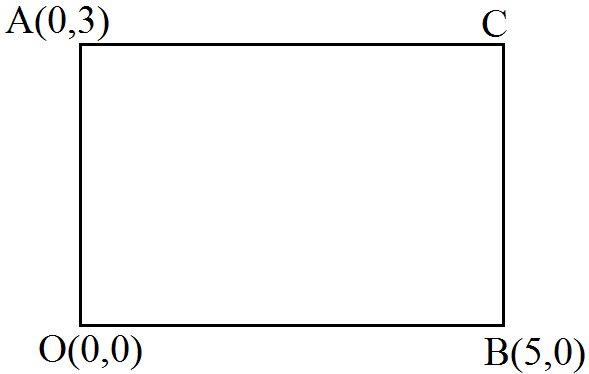
The diagonal $=\sqrt{(0-5)^2+(3-0)^2}$
$=\sqrt{5^2+3^2}$
$=\sqrt{25+9}$
$=\sqrt{34}\text{ units}$ View full question & answer→MCQ 71 Mark
If the coordinates of one end of a diameter of a circle are $(2, 3)$ and the coordinates of its centre are $(-2, 5),$ then the coordinates of the other end of the diameter are:
- ✓
$(-6, 7)$
- B
$(6, -7)$
- C
$(4, 2)$
- D
$(5, 3)$
AnswerCorrect option: A. $(-6, 7)$
Let the coordinates of the other end of the diameter be $(x, y).$
We know that, the centre is the mid$-$point of the diameter.
Using the mid$-$point formula, we get:
$(-2,5)=\Big(\frac{2+\text{x}}{2},\frac{3+\text{y}}{2}\Big)$
$\Rightarrow\ \frac{2+\text{x}}{2}=-2$ and $\frac{3+\text{y}}{2}=5$
$\Rightarrow 2 + x = -4$ and $3 + y = 10$
$\Rightarrow x = -6$ and $y = 7$
So, the coordinates of the oyter end are $(-6, 7).$
View full question & answer→MCQ 81 Mark
The points $P(0, 6), Q(-5, 3)$ and $R(3, 1)$ are the vertices of a triangle, which is:
AnswerCorrect option: D. Right$-$angled.
$\text{PQ}=\sqrt{(0+5^2+(6-3)^2}$
$=\sqrt{25+9}=\sqrt{34}\text{ units}$
$\text{QR}=\sqrt{(-5-3)^2+(3-1)^2}$
$=\sqrt{64+4)}=\sqrt{68}\text{ units}$
$\text{PR}=\sqrt{(0-3)^2+(6-1)^2}$
$=\sqrt{9+25}=\sqrt{34}\text{ units}$
Since $\text{PQ}=\text{PR}=\triangle\text{ABC}$ is an isosceles triangle.
Also, $\text{PQ}^2=34,+\text{ PR}^2=34$ and $\text{QR}^2=68$
Clearly, $\text{PQ}^2+\text{PR}^2=\text{QR}^2,$
and so, $\triangle\text{PQR}$ is a rights$-$angled triangle.
View full question & answer→MCQ 91 Mark
If the distance between the points $A(4, p)$ and $B(1, 0)$ is $5$ then:
AnswerCorrect option: C. $\text{p} = \pm4$
Using distance formula, we get
$\text{AB}=\sqrt{(4-1)^2+(\text{p}-0)^2}$
$\Rightarrow5=\sqrt{3^2+\text{p}^2}$
$\Rightarrow25=3^2+\text{p}^2$
$\Rightarrow25=9+\text{p}^2$
$\Rightarrow\text{p}^2=16$
$\Rightarrow\text{p}=\pm4$
View full question & answer→MCQ 101 Mark
Which point on $x-$axis is equidistant from the points $A(7, 6)$ and $B(-3, 4)$?
- A
$(0, 4)$
- B
$(-4, 0)$
- ✓
$(3, 0)$
- D
$(0, 3)$
AnswerCorrect option: C. $(3, 0)$
Let the coordinates of the point be $P(x, 0)$
Since the point lies on the $x-$axis. $P$ is equidistant from $A(7, 6)$ and $B(-3, 4)$
Using the distance from, we get
$AP^2 = BP^2$
$\Rightarrow (7 - x)^2 + (6 - 0)^2 = (-3 - x)^2 + (4 - 0)^2$
$\Rightarrow 49 - 14x + x^2 + 36 = 9 + 6x + x^2 + 16$
$\Rightarrow 85 - 14x = 6x + 25$
$\Rightarrow 20x = 60$
$\Rightarrow x = 3$
Thus, the point $(3, 0)$.
View full question & answer→MCQ 111 Mark
The point $P$ which divides the line segment joining the points $A(2, -5)$ and $B(5, 2)$ in the ratio $2 : 3$ lies in the quadrant.
Answer$P$ divides $AB$ in the ratio $2 : 3.$
Let the coordinates of $P$ be $(x, y).$
We know that, the centra is the mid$-$point of the diameter.
Using the section formula, we get:
$(\text{x},\text{y})=\Big(\frac{2(5)+3(2)}{2+3},\frac{2(2)+3(-5)}{2+3}\Big)$
$\Rightarrow\ (\text{x},\text{y})=\Big(\frac{16}{5},\frac{-11}{5}\Big)$
We know that, points of the from $(a, -b)$ lie in quadrant $IV.$
View full question & answer→MCQ 121 Mark
If the points $A(x, 2), B(-3, -4)$ and $C(7, -5)$ are collinear then the value of $x$ is:
AnswerThe given points are $\text{A} (\text{x},2) \text{B} (-3,-4) $ and $ \text{C} (7,-5)$ are cdlinear.
$\therefore (\text{x}_1=\text{x},\text{ y}_1 =2) (\text{x}_2=-3,\text{ y}_2=-4), \text{ y}=-5)$ and $(\text{x}_2 =7,\text{y}_2=5)$
The given points are collinear.
$\Rightarrow \text{x}_1 (\text{y}_2 -\text{y}_2) + \text{x}_2 (\text{y}_2 -\text{y}_1) +\text{x}_2 (\text{y}_1 -\text{y}_2) =0$
$\Rightarrow \text{x}(-4+5)-3(-5-2)+7(2+4)=0$
$\Rightarrow \text{x} + 21 + 42 = 0$
$\Rightarrow \text{x} = - 63$
View full question & answer→MCQ 131 Mark
If $R(5, 6)$ is the mid$-$point of the line segment $AB$ joining the points $A(6, 5)$ and $B(4, 4)$, the y equals.
AnswerGiven that $R$ is the mid$-$point of the line segment $AB.$
The $y-$coordinate of $\text{R}=\frac{5+\text{y}}{2}$
$\Rightarrow6=\frac{5+\text{y}}{2}$
$\Rightarrow 12 = 5 +\text{y}$
$\Rightarrow \text{y}=7$
View full question & answer→MCQ 141 Mark
If $\text{P}\Big(\frac{a}{2},4\Big)$ is the mid$-$point of the line segment joining the points $A(-6, 5)$ and $B(-2, 3)$ then the value of a is:
AnswerGiven that $P \Big(\frac{\text{a}}{2},4\Big) $is the mid$-$point of the line segment joining
the points $A (-6, 5)$ and $B (-2, 3).$
so, $\frac{a}{2}=\frac{-6-2}{2}$
$\Rightarrow\text{a}=-8$
View full question & answer→MCQ 151 Mark
In what ratio does the $x-$axis divide the join of $A(2, -3)$ and $B(5, 6)?$
- A
$2 : 3$
- B
$3 : 5$
- ✓
$1 : 2$
- D
$2 : 1$
AnswerCorrect option: C. $1 : 2$
Let the $x-$axis cut $AB$ at the point $P(x, 0)$ in the ratio $k : 1.$
Then, using section formula, we get
$\frac{6\text{k}-3}{\text{k}+1}=0$
$\Rightarrow\ 6\text{k}-3=0$
$\Rightarrow\ \text{k}=\frac{1}{2}$
So, the required ratio is $\frac{1}{2}:1,$ that is $1 : 2.$
View full question & answer→MCQ 161 Mark
The point on $x-$axis which is equidistant from points $A(-1, 0)$ and $B(5, 0)$ is:
- A
$(0, 2)$
- ✓
$(2, 0)$
- C
$(3, 0)$
- D
$(0, 3)$
AnswerCorrect option: B. $(2, 0)$
Since the point lies on the $x-$axis, let the point be $P$
and its coordinates be $(x, 0).$
Given that the point is equidistant from the points $A$ and $B.$
$\Rightarrow\text{PA}=\text{PB}$
$\Rightarrow\sqrt{\text{(x}+1)^2}=\sqrt{\text{(x}-5)^2}$
$\Rightarrow(\text{x}+1)^2=(\text{x}-5)^2$
$\Rightarrow\text{x}^2+2\text{x}+1=\text{x}^2-10\text{x}+25$
$\Rightarrow2\text{x}+1=-10\text{x}+25$
$\Rightarrow12\text{x}=24$
$\Rightarrow\text{x}=2$
Hence, the point is $(2,0).$
View full question & answer→MCQ 171 Mark
The points $A(-4, 0), B(4, 0)$ and $C(0, 3)$ are the vertices of a triangle, which is:
Answer$\text{AC} = \sqrt{(4-4)^2 + (0-0)^2}$
$ = \sqrt{64} = 8 \text{ units}$
$\text{BC} = \sqrt{(4-0)^2 + (0-3)^2} $
$= \sqrt{16+9} = \sqrt{25} = 5 \text{ units}$
$\text{AC} = \sqrt{(-4-0)^2+)(0-3)^2} $
$= \sqrt{16+9} = \sqrt{25} = 5\text{ units}$
Since $\text{BC} = \text{AC}, \triangle\text{ABC}$ is an isosceles triangle.
View full question & answer→MCQ 181 Mark
The coordinates of the point $P$ dividing the line segment joining the points $A(1, 3)$ and $B(4, 6)$ in the ratio $2 : 1$ is:
- A
$(2, 4)$
- ✓
$(3, 5)$
- C
$(4, 2)$
- D
$(5, 3)$
AnswerCorrect option: B. $(3, 5)$
Let the coordinates of $P$ be $(x, y)$.
Using the section formula, we get:
$\text{P(x,y)}=\Big(\frac{2(4)+1(1)}{2+1},\frac{2(6)+1(3)}{2+1}\Big)$
$=\Big(\frac{9}{3},\frac{15}{3}\Big)$
$=(3,5)$
So, the coordinates of $P$ are $(3, 5).$
View full question & answer→MCQ 191 Mark
The area of $\triangle\text{ABC}$ with vertice $A(a, 0), O(0, 0)$ and $B(0, b)$ in square units is:
AnswerCorrect option: B. $\frac{1}{2}\text{ab}$
The given points are $A (a,0), 0(0, 0)$ and $B (0, b).$
$\therefore (x_1= a, y_1 = 0), (x_2 = 0, y_2 = 0)$ and $(x_2 = 0, y_2 = b)$
The area of the tringle
$= \frac{1}{2}|\text{x}_1 (\text{y}_2-\text{y}_3) + \text{x}_2 (\text{y}_3-\text{y}_1) + \text{x}_3 (\text{y}_1 -\text{y}_2)|$
$=\frac{1}{2}|\text{a}(0-\text{b})+0(\text{b}-0)+0(0-0)$
$=\frac{1}{2}|-\text{ab}|$
$=\frac{1}{2}\text{ab}\text{ sq.units}$
View full question & answer→MCQ 201 Mark
The line $2x + y - 4 = 0$ divides the line segment joining $A(2, -2)$ and $B(3, 7)$ in the ratio:
- A
$2 : 5$
- ✓
$2 : 9$
- C
$2 : 7$
- D
$2 : 3$
AnswerCorrect option: B. $2 : 9$
Let the required ration be $k : 1,$ and let $P$ be the point of division.
Using section formula, we get:
The point od division to be P$\Big(\frac{3\text{k}+2}{\text{k}+1},\frac{7\text{k}-2}{\text{k}+1}\Big).$
Since the point lies on the line $2x + y - 4 = 0,$ The point satisfies the equation of given line.
$\Rightarrow\ 2\Big(\frac{3\text{k}+2}{\text{k}+1}\Big)+\frac{7\text{k}-2}{\text{k}+1}-4=0$
$\Rightarrow 2(3k + 2) + 7k - 2 -4(k + 1) = 0$
$\Rightarrow 6k + 4 + 7k - 2 - 4k - 4 = 0$
$\Rightarrow 9k = 2$
$\Rightarrow\ \text{k}=\frac{2}{9}$
So, the ratio is $2 : 9.$
View full question & answer→MCQ 211 Mark
The distance of the point $P(-6, 8)$ from the origin is:
- A
$8$
- B
$2\sqrt{7}$
- C
$6$
- ✓
$10$
AnswerThe distance of the point $P(-6, 8)$ from the orgin $(0, 0)$
$=\sqrt{(-6)^2+8^2}$
$=\sqrt{36+36}$
$=\sqrt{100}$
$=10\text{ units}$
View full question & answer→MCQ 221 Mark
The area of $\triangle\text{ABC}$ with vertices $A(3, 0), B(7, 0)$ and $C(8, 4)$ is:
- A
$14$ sq.units
- B
$28$ sq.units
- ✓
$8$ sq.units
- D
$6$ sq.units
AnswerCorrect option: C. $8$ sq.units
The given points are $A (3, 0), B (7, 0)$ and $C (8, 4).$
$\therefore(\text{x}_1=3,\text{y}_1=0),(\text{x}_2=7,\text{y}_2=0)$and $(\text{x}_1=8,\text{y}_3=4)$
Area of $\triangle\text{ABC}$
$=\frac{1}{2}\mid\text{x}_1(\text{y}_2-\text{y}_3)+\text{x}_2(\text{y}_3-\text{y}_1)+\text{x}_3(\text{y}_1-\text{y}_2)\mid$
$=\frac{1}{2}\mid3(0-4)-7(4-0)+8(0-0)\mid$
$=\frac{1}{2}\mid-12+28\mid$
$=\frac{1}{2}\mid16\mid$
$=8\text{ sq}.\text{units}$
View full question & answer→MCQ 231 Mark
If the point $C(k, 4)$ divides the join of the points $A(2, 6)$ and $B(5, 1)$ in the ratio $2 : 3$ then the value of $k$ is:
- A
$16$
- B
$\frac{28}{5}$
- ✓
$\frac{16}{5}$
- D
$\frac{8}{5}$
AnswerCorrect option: C. $\frac{16}{5}$
By Section Formula,
The $x-$coordinate of $\text{C}=\frac{2(5)+3(2)}{2+3}$
$\Rightarrow\text{k}=\frac{16}{5}$
View full question & answer→MCQ 241 Mark
If the points $A(1, 2), O(0, 0)$ and $C(a, b)$ are collinear then:
- A
$a = b$
- B
$a = mb$
- ✓
$2a = b$
- D
$a + b = 0$
AnswerCorrect option: C. $2a = b$
The given points are $A (1,2) O(0,0)$ and $C(a, b)$ are collinear.
$\therefore(\text{x}_1=1,\text{y}_1=2),(\text{x}_2=0,\text{y}_2=0)$ and $(\text{x}_1=\text{a},\text{y}_1=\text{b})$
The given points are collinear.
$\Rightarrow\text{x}_1(\text{y}_2-\text{y}_3)+\text{x}_2(\text{y}_3-\text{y}_1)+\text{x}_3(\text{y}_1-\text{y}_2)=0$
$\Rightarrow1(0-\text{b})+0+\text{a}(2-0)=0$
$\Rightarrow-\text{b}+2\text{a}=0$
$\Rightarrow2\text{a}=\text{b}$
View full question & answer→MCQ 251 Mark
The area of a triangle with vertices $A(5, 0), B (8, 0)$ and $C(8, 4)$ in square units is:
AnswerThe given points are $ A (5,0), B (8, 0)$ and $C (8, 4)$.
$\therefore (x_1=5, y_1 = 0),+ (x_2 = 8, y_2 = 0)$ and $(x_2 =8, y_2 = 4)$
The area of the triangle
$=\frac{1}{2}|\text{x}_1(\text{y}_2 -\text{y}_3) +\text{x}_2(\text{y}_3 -\text{y}_1) + \text{x}_3 (\text{y}_1 -\text{y}_2)|$
$=\frac{1}{2}|5(0-4)+8(4-0)+8(0)|$
$=\frac{1}{2}|-20+32+0$
$=\frac{1}{2}\times12$
$= 6 \text{sq. units}$
View full question & answer→MCQ 261 Mark
If $A(-6, 7)$ and $B(-1, -5)$ are two given points then the distance $2AB$ is:
Answer$A(-6, 7)$ and $B(-1, -5)$ are two given points.
Using the distance formula, we get
$2\text{AB}=\sqrt{(6-1)^2+(-7-5)^2}$
$=2\sqrt{(5)^2+(-12)^2}$
$=2\sqrt{25+144}$
$=2\sqrt{169}$
$=2\times13$
$=26$
View full question & answer→MCQ 271 Mark
The distance of the point $(-3, 4)$ from $x-$axis is:
AnswerThe distance of the point $P(-3, 4)$ from the $x-$axis
$= Y-$coordinate of the point
$= 4$ units
View full question & answer→MCQ 281 Mark
If $A(1, 3), B(-1, 2), C(2, 5)$ and $D(x, 4)$ are the vertices of $\ce{a || gm ABCD}$ then the value of $x$ is:
- A
$3$
- ✓
$4$
- C
$0$
- D
$\frac{3}{2}$
Answer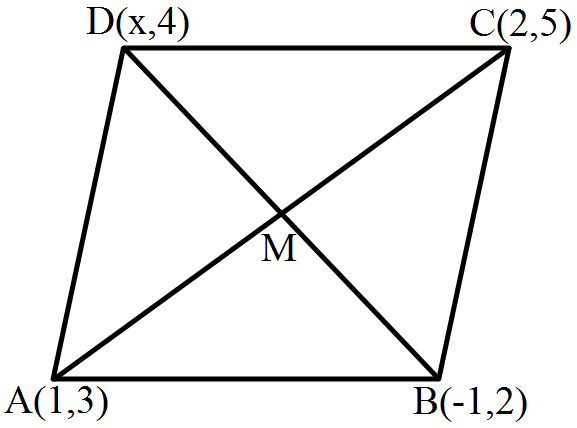
Since $\text{ABCD}$ is $\ce{a \|gm,}$ the diagonals bisect eachother.
So, Mis the mid$-$point of $BD$ as well as $AC.$
$\frac{1+2}{2}=\frac{\text{x}-1}{2}$
$\Rightarrow 1+2 = \text{x}-1$
$\Rightarrow \text{x}=4$ View full question & answer→MCQ 291 Mark
The mid$-$point of segment $AB$ is $P(0, 4).$ If the coordinates of $B$ are $(-2, 3),$ then the coordinates of $A$ are:
- ✓
$(2, 5)$
- B
$(-2, -5)$
- C
$(2, 9)$
- D
$(-2, 11)$
AnswerCorrect option: A. $(2, 5)$
Let the mid$-$point of $A$ be $(x, y).$
$P(0, 4)$ is given to be mid$-$point $AB.$
Using the mid$-$point formula, we get
$(0,4)=\Big(\frac{-2+\text{x}}{2},\frac{3+\text{y}}{2}\Big)$
$\Rightarrow\ 0=\frac{-2+\text{x}}{2}$ and $4=\frac{3+\text{y}}{2}$
$\Rightarrow -2 + x = 0$ and $3 + y = 8$
$\Rightarrow x = 2$ and $y = 5$
So, the coordinates of $A$ are $(2, 5).$
View full question & answer→MCQ 301 Mark
In what ratio does the $y-$axis divide the join of $P(-4, 2)$ and $Q(8, 3)?$
- A
$3 : 1$
- B
$1 : 3$
- C
$2 : 1$
- ✓
$1 : 2$
AnswerCorrect option: D. $1 : 2$
Let the $y-$axis cut $AB$ at the point $P(0, y)$ in the ratio $k : 1.$
Then, using section formula, we get
$\frac{8\text{k}-4}{\text{k}+1}=0$
$\Rightarrow\ 8\text{k}-4=0$
$\Rightarrow\ \text{k}=\frac{1}{2}$
So, the required ratio is $\frac{1}{2}:1,$ that is $1 : 2.$
View full question & answer→MCQ 311 Mark
The perimeter of the triangle with vertices $(0, 4), (0, 0)$ and $(3, 0)$ is:
- A
$(7+\sqrt{5})$
- B
$5$
- C
$10$
- ✓
$12$
Answer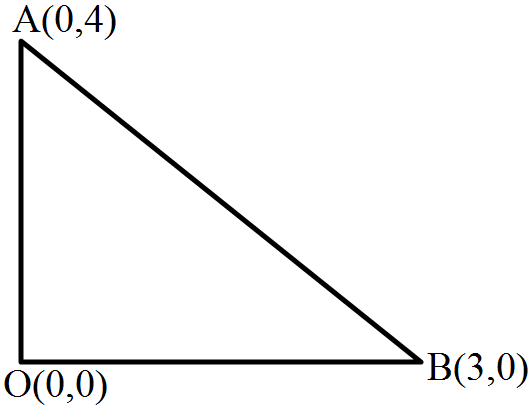
$AO = 4$ units
$BO = 3$ units
Using Distance formula, we get:
$\text{AB}=\sqrt{3^2+4^2}$
$=\sqrt{9+16}$
$=\sqrt{25}$
$=5\text{ units}$
So, the perimeter of the tringle
$= \text{AB + AO + BO}$
$= 5 + 4 + 3$
$= 12$ units View full question & answer→MCQ 321 Mark
The distance of $P(3, 4)$ from the $x-$axis is:
- A
$3$ units
- ✓
$4$ units
- C
$5$ units
- D
$1$ units
AnswerCorrect option: B. $4$ units
The distance of the point $P(3, 4)$ is given by the $y-$coordinate of the points $P.$
So, the distance $= 4$ units.
View full question & answer→MCQ 331 Mark
If $P(-1, 1)$ is the mid$-$point of the line segment joining $A(-3, b)$ and $B(1, b + 4)$ then $b = ?$
AnswerGiven that $P$ is the mid$-$point of $AB.$
Using mid$-$point formula, we get
$\text{P(-1,1)}=\Big(\frac{-3+1}{2},\frac{\text{b}+\text{b}+4}{2}\Big)$
$\Rightarrow\ \frac{\text{b}+\text{b}+4}{2}=1$
$\Rightarrow 2\text{b} + 4 = 2$
$\Rightarrow 2\text{b} = -2$
$\Rightarrow\text{ b} = -1$
View full question & answer→MCQ 341 Mark
$\text{ABCD}$ is a rectangle whose three vertices are $B(4, 0), C(4, 3)$ and $D(0, 3)$. The length of one of its diagonal is:
Answer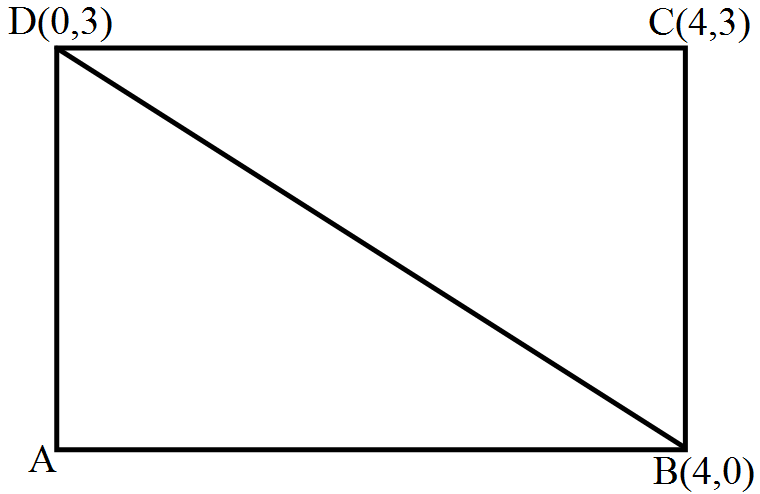
The length of the diagonal $BD =\sqrt{(4-0)^2+(0-3)^2}$
$=\sqrt{16+9}$
$=5\text{ units}$ View full question & answer→