Questions

2 Marks Questions

Take a timed test

28 questions · self-marked practice — reveal the answer and mark yourself.

Question 12 Marks
Solve the system of equations: x - 2y = 0, 3x + 4y = 20
Answer
The given equations are as follows:
x - 2y = 0 ....(i)
3x + 4y = 20 ...(ii)
On multiplying (i) by 2, we get
2x - 4y = 0 ...(iii)
On adding (ii) and (iii), we get
4 - 2y = 0
⇒ 4 = 2y
⇒ y = 2
Hence, the required solution is x = 4 and y = 2.
View full question & answer
Question 22 Marks
Very-Short and Short-Answer Questions:
If $\frac{2}{\text{x}}+\frac{3}{\text{y}}=\frac{9}{\text{xy}}$ and $\frac{4}{\text{x}}+\frac{9}{ \text{y}}=\frac{21}{\text{xy}},$ find the values of x and y.
Answer
The given pair of equation is:
$\frac{2}{\text{x}}+\frac{3}{\text{y}}=\frac{9}{\text{xy}}\ ...(\text{i})$
$\frac{4}{\text{x}}+\frac{9}{\text{y}}=\frac{21}{\text{xy}}\ ...(\text{ii})$
Multiplying (i) and (ii) by xy, we have
3x + 2y = 9 ....(iii)
9x + 4y = 21 ...(iv)
Now, multiplying (iii) by 2 and subtracting from (iv), we get
$9\text{x}-6\text{x}=21-18$
$\Rightarrow\text{x}=\frac{3}{3}=1$
Putting x = 1 in (iii), we have
$3\times1+2\text{y}=9$
$\Rightarrow\text{y}=\frac{9-3}{2}=3 $
Hence, x = 1 and y = 3.
View full question & answer
Question 32 Marks
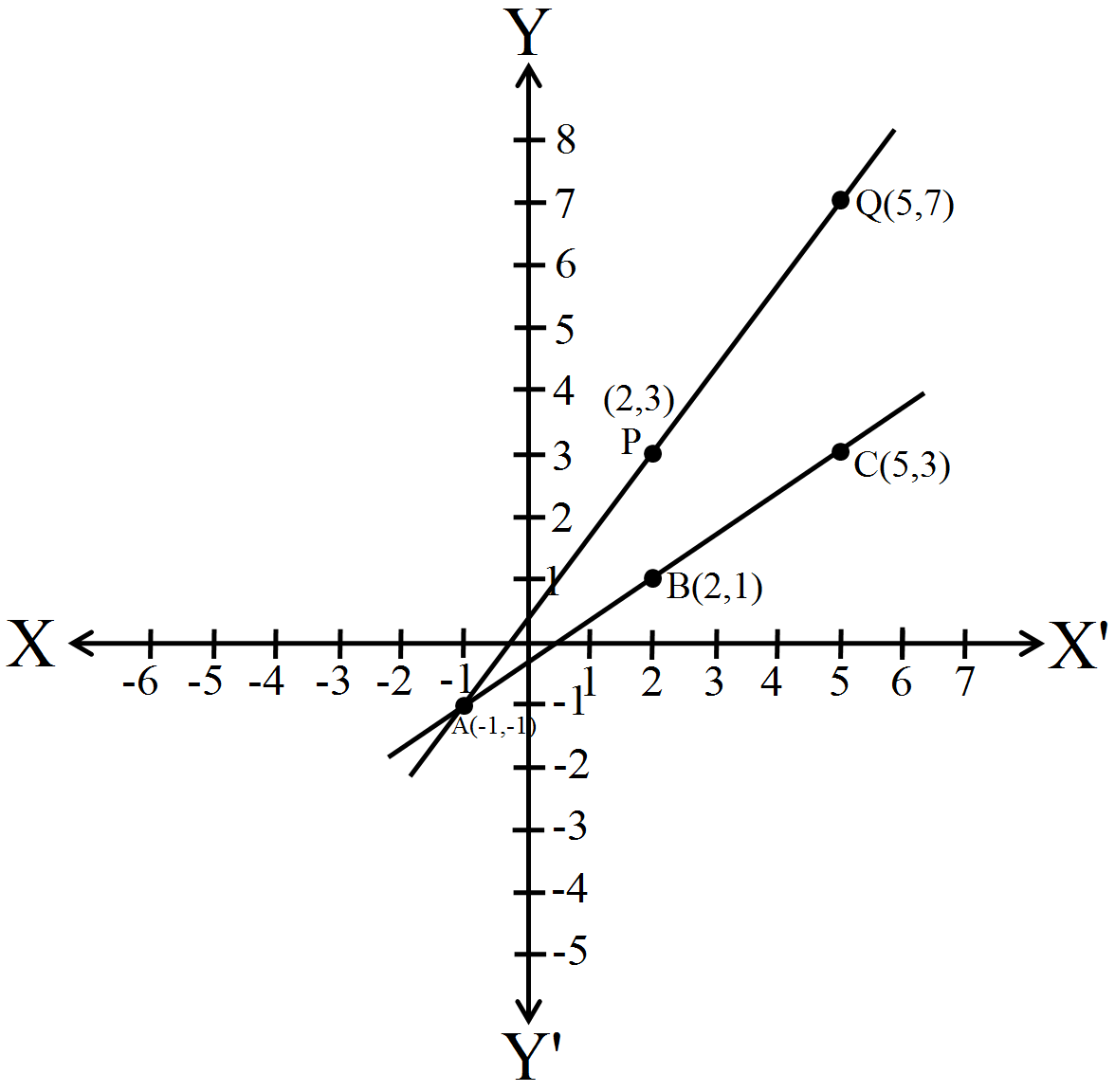
Solve the following system of equations graphically:
2x - 3y = 1, 4x - 3y + 1 = 0
Answer
On the graph paper, draw a horizontal line X'OX and a vertical line YOY' as the x-axis and y-axis, respectively.Graph of 2x - 3y = 1:
2x - 3y = 1 ⇒ 3y = (2x - 1) $\therefore\text{y}=\frac{2\text{x}-1}{3}\ ...(\text{i})$ Putting x = -1, we get: ⇒ y = -1 Putting x = 2, we get: ⇒ y = 1 Putting x = 5, we get: ⇒ y = 3 Thus, we have the following table for the equation 2x - 3y = 1.
x:
-1
2
5
y:
-1
1
3
Now, plot the points A(-1, -1), B(2, 1) and C(5, 3) on the graph paper. Join AB and BC to get the graph line AC. Extend it on both the sides. Thus, the line AC is the graph of 2x - 3y = 1.Graph of 4x - 3y + 1 = 0:
4x - 3y + 1 = 0 ⇒ 3y = (4x + 1) $\therefore\text{y}=\frac{4\text{x}-1}{3}\ ...(\text{ii})$ Putting x = -1, we get: ⇒ y = -1 Putting x = 2, we get: ⇒ y = 3 Putting x = 5, we get: ⇒ y = 7 Thus, we have the following table for the equation 4x - 3y + 1 = 0.
x:
-1
2
5
y:
-1
3 7
Now, plots the points P(2, 3) and Q(5, 7). The point A(-1, -1) has already been plotted. Join PA and QP to get the graph line AQ. Extend it on both the sides. Thus, the line AQ is the graph of the equation 4x - 3y + 1 = 0.
The two lines intersect at A(-1, -1). Thus, x = -1 and y = -1 is the solution of the given system of equations.
View full question & answer
Question 42 Marks
Solve for x and y:
0.4x + 0.3y = 1.7,
0.7x - 0.2y = 0.8
Answer
The given equations are: 0.4x + 0.3y = 1.7 ...(i) 0.7x - 0.2y = 0.8 ...(ii)Multiply (i) by 0.2 and (ii) by 0.3 add them
⇒ 0.8x + 2.1x = 3.4 + 2.4
⇒ 2.9x = 5.8
⇒ x = 2
Substitute x = 2 in (i), we get
⇒ 0.4(2) + 0.3y = 1.7
⇒ y = 3
So, x = 2 and y = 3
View full question & answer
Question 52 Marks
Show that the equations $9x - 10y = 21$, $\frac{\text{3x}}{2}-\frac{\text{5y}}{3}=\frac{7}{2}$ have infinitely many solutions.
Answer
The given system of equations can be written as follows:
$9\text{x}-10\text{y}-21=0$ and $\frac{3\text{x}}{2}-\frac{5\text{y}}{3}-\frac{7}{2}=0$
The given equations are of the following form:
$a_1x + b_1y + c_1 = 0 and a_2x + b_2y + c_2 = 0$
Here, $a_1 = 9, b_1 = -10, c_1 = -21$ and $\text{a}_1=\frac{3}{2},\ \text{b}_2=-\frac{-5}{3}$ and $\text{c}_2=\frac{-7}{2}$
$\therefore\frac{\text{a}_1}{\text{a}_2}=\frac{9}{\frac{3}{2}}=6,\ \frac{\text{b}_1}{\text{b}_2}=\frac{-10}{\big(\frac{-5}{3}\big)}=6$ and $\frac{\text{c}_1}{\text{c}_2}=-21\times\frac{2}{-7}=6$
$\therefore\frac{\text{a}_1}{\text{a}_2}=\frac{\text{b}_1}{\text{b}_2}=\frac{\text{c}_1}{\text{c}_2}$
This shows that the given system has an infinite number of solutions.
View full question & answer
Question 62 Marks
Show that the system of equations $-x + 2y + 2 = 0$ and $\frac{1}{2}\text{x}-\frac{1}{4}\text{y}-1=0$ has a unique solution.
Answer
The given system of equations:
$-\text{x}+2\text{y}+2=0$ and $\frac{1}{2}\text{x}-\frac{1}{4}\text{y}-1=0$
The given equations are of the following form:
$a_1x + b_1y + c_1 = 0$ and $a_2x + b_2y + c_2 = 0$
Here, $a_1 = -1, b_1 = 2, c_1 = 2$ and $\text{a}_1=\frac{1}{4},\ \text{b}_2=-\frac{1}{4}$ and $c_3 = -1$
$\therefore\frac{\text{a}_1}{\text{a}_2}=\frac{-1}{\big(\frac{1}{2}\big)}=-2,\ \frac{\text{b}_1}{\text{b}_2}=\frac{2}{\big(\frac{-1}{4}\big)}=-8$ and $\frac{\text{c}_1}{\text{c}_2}=\frac{2}{-1}=-2$
$\therefore\frac{\text{a}_1}{\text{a}_2}\neq\frac{\text{b}_1}{\text{b}_2}$
The given system has a unique has a unique solution.
Hence, the lines intersect at one point.
View full question & answer
Question 72 Marks
The difference between two numbers is 26 and one number is three times the other. Find the numbers.
Answer
Let the larger number be x and the smaller number be y.
Then, we have:
x - y = 26 ....(i)
x = 3y ...(ii)
On substituting x = 3y in (i), we get:
3y - y = 26
⇒ 2y = 26
⇒ y = 13
On Substituting y = 13 in (i), we get:
x - 13 = 26
⇒ x = 26 + 13 = 39
Hence, the required number are 39 and 13.
View full question & answer
Question 82 Marks
Very-Short and Short-Answer Questions:
Find k for which the system$ x + 2y = 3$ and $5x + ky + 7 = 0$ is inconsistent.
Answer
The given system is
$x + 2y - 3 = 0$ ...(i)
$5x + ky + 7 = 0$ ...(ii)
Here, $a_1 = 1, b_1 = 2, c_1 = -3, a_2 = 5, b_2 = k$ and $c_2 = 7$
For the system to be inconsistent, we must have
$\frac{\text{a}_1}{\text{a}_2}=\frac{\text{b}_1}{\text{b}_2}\neq\frac{\text{c}_1}{\text{c}_2}$
$\Rightarrow\frac{1}{5}=\frac{2}{\text{k}}\neq\frac{-3}{7}$
$\Rightarrow\frac{1}{5}=\frac{2}{\text{k}}$
$\Rightarrow\text{k}=10$
Hence, $k = 10.$
View full question & answer
Question 92 Marks
Very-Short and Short-Answer Questions:
If $\frac{\text{x}}{4}+\frac{\text{y}}{\text{3}}=\frac{5}{\text{12}}$ and $\frac{\text{x}}{\text{2}}+\text{y}=1$ then find the value of (x + y).
Answer
The given pair of equation is
$\frac{\text{x}}{4}+\frac{\text{y}}{3}=\frac{58}{12}\ ...(\text{i})$
$\frac{\text{x}}{2}+\text{y}=1\ ...(\text{ii})$
Multiplying (i) by 12 and (ii) by 4, we get
3x + 4y = 5 ....(iii)
2x + 4y = 4 ...(iv)
Now, subtracting (iv) from (iii), we get
⇒ x = 1
Putting x = 1 in (iv), we have
2 + 4y = 4
⇒ 4y = 2
$\Rightarrow\text{y}=\frac{1}{2}$
$\therefore\text{x}+\text{y}=1+\frac{1}{2}=\frac{3}{2}$
Hence, the value of x + y is $\frac{3}{2}.$
View full question & answer
Question 102 Marks
Very-Short and Short-Answer Questions:
Show that the system $2x + 3y - 1 = 0$, $4x + 6y - 4 = 0$ has no solution.
Answer
The given system is:
$2x + 3y - 1 = 0 ...(i)$
$4x + 6y - 4 = 0 ...(ii)$
Here, $a_1 = 2, b_1 = 3, c_1 = -1, a_2 = 4, b_2 = 6$ and $c_2 = -4$
Now,
$\frac{\text{a}_1}{\text{a}_2}=\frac{2}{4}=\frac{1}{2}$
$\frac{\text{b}_1}{\text{b}_2}=\frac{3}{6}=\frac{1}{2}$
$\frac{\text{c}_1}{\text{c}_2}=\frac{-1}{-4}=\frac{1}{4}$
Thus, $\frac{\text{a}_1}{\text{a}_2}=\frac{\text{b}_1}{\text{b}_2}\neq\frac{\text{c}_1}{\text{c}_2}$ and therefore the given system has no solution.
View full question & answer
Question 112 Marks
Very-Short and Short-Answer Questions:
The sum of two numbers is 80. The larger number exceeds four times the smaller one by 5. Find the numbers.
Answer
Let the larger number be x and the smaller number be y.
Then as per the question
x + y = 80 ....(i)
x = 4y + 5
x - 4y = 5 ...(ii)
Subtracting (ii) from (i), we get
5y = 75
⇒ y = 15
Now, putting y = 15 in (i), we have
x + 15 = 80
⇒ x = 65
Hence, the numbers are 65 and 15.
View full question & answer
Question 122 Marks
Very-Short and Short-Answer Questions:
Find k for which the system $2x + 3y - 5 = 0$ and $4x + ky - 10 = 0$ has an infinite number of solutions.
Answer
The given system is
$2x + 3y - 5 = 0 ...(i)$
$4x + ky - 10 = 0 ...(ii)$
Here, $a_1 = 2, b_1 = 3, c_1 = -5, a_2 = 4, b_2 = k$ and $c_2 = -10$
For the system, to have an infinite number of solutions, we must have
$\frac{\text{a}_1}{\text{a}_2}=\frac{\text{b}_1}{\text{b}_2}=\frac{\text{c}_1}{\text{c}_2}$
$\Rightarrow\frac{2}{4}=\frac{3}{\text{k}}=\frac{-5}{-10}$
$\Rightarrow\frac{1}{2}=\frac{3}{\text{k}}=\frac{1}{2}$
$\Rightarrow\text{k}=6$
Hence, $\text{k}=6.$
View full question & answer
Question 132 Marks
Very-Short and Short-Answer Questions:
Find the value of k for which the system 3x + 5y = 0 and kx + 10y = 0 has a nonzero solution.
Answer
The given system is
3x + 5y = 0 ...(i)
kx + 10y = 0 ...(ii)
This is a homogeneous system of linear differential equation, so it always has a zero solution i.e., x = y = 0.
But to have a nonzero solution, it must have infinitely many solutions
For this, we have
$\frac{\text{a}_1}{\text{a}_2}=\frac{\text{b}_1}{\text{b}_2}$
$\Rightarrow\frac{3}{\text{k}}=\frac{5}{10}=\frac{1}{2}$
$\Rightarrow\text{k}=6$
Hence, k = 6.
View full question & answer
Question 142 Marks
Solve: 6x + 3y = 7xy and 3x + 9y =11xy
Answer
The given equations are as follow:
6x + 3y = 7xy ...(i)
3x + 9y = 11 ....(ii)
For equation (i), we have:
$\frac{6\text{x}+3\text{y}}{\text{xy}}=7$
$\frac{6\text{x}}{\text{xy}}+\frac{3\text{y}}{\text{xy}}=7$
$\frac{6\text{}}{\text{y}}+\frac{3\text{}}{\text{x}}=7...(\text{iii})$
For equation (ii), we have:
$\frac{3\text{x}+9\text{y}}{\text{xy}}=11$
$\frac{3\text{x}}{\text{xy}}+\frac{9\text{y}}{\text{xy}}=11$
$\frac{3\text{}}{\text{y}}+\frac{9\text{}}{\text{x}}=11...(\text{iv})$
On Substituting $\frac{1}{\text{y}}=\text{v}$ and $\frac{1}{\text{x}}=\text{u}$ in (iii) and (iv), we get:
6v + 3u = 7 ...(v)
3v + 9u = 11 ....(vi)
On multipiying (v) by 3, We get:
18v + 9u = 21 ....(vii)
On subtracting (vi) from (vii), we get:
15v = 10
$\Rightarrow\text{v}=\frac{10}{15}=\frac{2}{3}$
$\Rightarrow\frac{1}{\text{y}}=\frac{2}{3}$
$\Rightarrow\text{y}=\frac{3}{2}$
On subtracting $\text{y}=\frac{3}{2}$ in (iii), we get:
$\frac{6}{\frac{3}{2}}+\frac{3}{\text{x}}=7$
$\Rightarrow4+\frac{3}{\text{x}}=7$
$\Rightarrow\frac{3}{\text{x}}=3$
$\Rightarrow3\text{x}=3$
$\Rightarrow\text{x}=1$
Hence, the required solution is x = 1 and $\text{y}=\frac{3}{2}$
View full question & answer
Question 152 Marks
Very-Short and Short-Answer Questions:
Find $k$ for which the system $kx - y = 2$ and $6x - 2y = 3$ has a unique solution.
Answer
The given system is
$kx - y - 2 = 0 ...(i)$
$6x - 2y - 3 = 0 ...(ii)$
Here, $a_1 = k, b_1 = -1, c_1 = -2. a_2 = 6, b_2 = -2$ and $c_2 = -3$
For the system, to have a unique solution, we must have
$\frac{\text{a}_1}{\text{a}_2}\neq\frac{\text{b}_1}{\text{b}_2}$
$\Rightarrow\frac{\text{k}}{6}\neq\frac{-1}{-2}=\frac{1}{2}$
$\Rightarrow\text{k}\neq3$
Hence, $\text{k}\neq3.$
View full question & answer
Question 162 Marks
In $\triangle\text{ABC},\ \angle\text{C}=3\angle\text{B}=2(\angle\text{A}+\angle\text{B}).$ find the measure of each one of $\angle\text{A},\ \angle\text{B}$ and $\angle\text{C}.$
Answer
Let $\angle\text{A}=\text{x}^\circ$ and $\angle\text{B}=\text{y}^\circ$
Then, $\angle\text{C}=3\angle\text{B}=(3\text{y})^\circ$
Now, we have:
$\angle\text{A}+\angle\text{B}+\angle\text{C}=180^\circ$
⇒ x + y + 3y = 180
⇒ x + 4y = 180 ...(i)
Also, $\angle\text{C}=2(\angle\text{A}+\angle\text{B})$
⇒ 3y = 2(x + y)
⇒ 2x - y = 0 ...(ii)
On multiplying (ii) by 4, we get:
8x - 4y = 0 ...(iii)
On adding (i) and (ii), we get:
9x = 180
⇒ x = 20
On Substituting x = 20 in (i), we get:
20 + 4y = 180
⇒ 4y = (180 - 20) = 160
⇒ y = 40
$\therefore$ x = 20 and y = 40
$\therefore\angle\text{A}=20^\circ,\ \angle\text{B}=40^\circ,$ $\angle\text{C}=(3\times40^\circ)=120^\circ$
View full question & answer
Question 172 Marks
Very-Short and Short-Answer Questions:
For what value of k will the following pair of linear equations have no solution?:
$2x + 3y = 9, 6x + (k - 2)y = (3k - 2)$
Answer
The given pair of linear equation are:
$2x + 3y - 9 = 0 ...(i)$
$6x + (k - 2)y - (3k - 2) = 0 ...(ii)$
Which is of the form $a_1x + b_1y + c_1 = 0$ and $a_2x + b_2y + c_2 = 0,$
where $a_1 = 2, b_1 = 3, c_1 = -9, a_2 = 6, b_2 = k - 2$ and $c_2 = -(3k - 2)$
For the given pair of linear equations to have no solution, we must have
$\frac{\text{a}_1}{\text{a}_2}=\frac{\text{b}_1}{\text{b}_2}\neq\frac{\text{c}_1}{\text{c}_2}$
$\Rightarrow\frac{2}{6}=\frac{3}{\text{k}-2}\neq\frac{-9}{-(3\text{k}-2)}$
$\Rightarrow\frac{2}{6}=\frac{3}{\text{k}-2},\ \frac{3}{\text{k}-2}\neq\frac{-9}{-(3\text{k}-2)}$
$\Rightarrow\text{k}=11,\ \frac{3}{\text{k}-2}\neq\frac{9}{(3\text{k}-2)}$
$\Rightarrow\text{k}=11,\ 3(3\text{k}-2)\neq9(\text{k}-2)$
$\Rightarrow\text{k}=11,\ 1\neq3$ (true)
Hence, $k = 11.$
View full question & answer
Question 182 Marks
For what values of $k$ is the system of equations $kx + 3y = k - 2, 12x + ky = k$ inconsistent?
Answer
The given system of equations can be written as follows:
$kx + 3y - (k - 2) = 0$ and $12x + ky - k = 0$
The given equations are of the following form:
$a_1x + b_1y + c_1 = 0$ and $a_2x + b_2y + c_2 = 0$
Here, a_$_1 = k, b_1 = 3, c_1 = -(k - 2)$ and $a_2 = 12, b_2 = k$ and $c_2 = -k$
$\therefore\frac{\text{a}_1}{\text{a}_2}=\frac{\text{k}}{12},\ \frac{\text{b}_1}{\text{b}_2}=\frac{3}{\text{k}}$ and $\frac{\text{c}_1}{\text{c}_2}=\frac{-(\text{k}-2)}{-\text{k}}=\frac{(\text{k}-2)}{\text{k}}$
For inconsistency, we must have:
$\frac{\text{a}_1}{\text{a}_2}=\frac{\text{b}_1}{\text{b}_2}\neq\frac{\text{c}_1}{\text{c}_2}$
$\Rightarrow\frac{\text{k}}{12}=\frac{3}{\text{k}}\neq\frac{(\text{k}-2)}{\text{k}}$
$\Rightarrow\text{k}^2=(3\times12)=36$
$\Rightarrow\text{k}=\sqrt{36}=\pm6$
Hence, the pair of equations is inconsistency if $\text{k}=\pm6.$
View full question & answer
Question 192 Marks
Very-Short and Short-Answer Questions:
The cost of 5 pens and 8 pencils is ₹ 120, while the cost of 8 pens and 5 pencils is ₹ 153. Find the cost of 1 pen and that of 1 pencil.
Answer
Let the cost of 1 pen and 1 pencil are Rs. x and Rs. y respectively.
Then as per the question
5x + 8y = 120 ...(i)
8x + 5y = 153 ...(ii)
Adding (i) and (ii), we get
3x - 3y = 3
⇒ x - y = 11 ...(iv)
Now, adding (iii) and (iv), we get
2x = 32
⇒ x = 16
Substituting x = 16 in (iii), we have
16 + y = 21
⇒ y = 5
Hence, the cost of 1 pen and 1 pencil are respectively ₹ 16 and ₹ 5.
View full question & answer
Question 202 Marks
Very-Short and Short-Answer Questions:
If 12x + 17y = 53 and 17x + 12y =63, then find the value of (x + y).
Answer
The given pair of equation is
12x + 17y = 53 ...(i)
17x + 12y = 63 ...(ii)
Adding (i) and (ii), we get
29x + 29y = 116
⇒ x + y = 4 (Dividing by 4)
Hence, the value of x + y is 4.
View full question & answer
Question 212 Marks
Find the value of k for which the system of equations $3x + y = 1$ and $kx + 2y = 5$ has:
  1. A unique solution,
  2. No solution.
Answer
The given system of equation:
$3x + y = 1$
$3x + y - 1 = 0 ...(i)$
$kx + 2y = 5$
$kx + 2y - 5 = 0 ...(ii)$
These equations are of the following form:
$a_1x + b1y + c_1 = 0, a_2x + b_2y + c_2 = 0$
Here, $a_1 = 3, b_1 = 1, c_1 = -1$ and $a_2 = k, b_2 = 2, c_2 = -5$
i.For a unique solution, we must have:
$\frac{\text{a}_1}{\text{a}_2}\neq\frac{\text{b}_1}{\text{b}_2}\text{ i.e }\frac{3}{\text{k}}\neq\frac{1}{2}$
$\Rightarrow\text{k}\neq6$
ii.In order that the given equations have no solution, we must have: $\frac{\text{a}_1}{\text{a}_2}=\frac{\text{b}_1}{\text{b}_2}\neq\frac{\text{c}_1}{\text{c}_2}$
$\frac{\text{3}}{\text{k}}=\frac{\text{1}}{\text{2}}\neq\frac{\text{-1}}{\text{-5}}$
$\Rightarrow\frac{3}{\text{k}}=\frac{1}{2}$ and $\frac{3}{\text{k}}\neq\frac{-1}{-5}$
$\Rightarrow\text{k}=6,\ \text{k}\neq15$
Thus, for $k = 6$, the given system of equations will have no solution.
View full question & answer
Question 222 Marks
Show that the paths represented by the equations $x - 3y = 2$ and $-2x + 6y = 5$ are parallel.
Answer
The given system of equations can be written as follows:
$x - 3y - 2 = 0$ and $-2x + 6y - 5 = 0$
The given equations are of the following form:
$a_1x + b_1y + c_1 = 0$ and $a_2x + b_2y + c_2 = 0$
Here, $a_1 = 1, b_1 = -3, c_1 = -2$ and $a_2 = -2, b_2 = 6$ and $c_2 = -5$
$\therefore\frac{\text{a}_1}{\text{a}_2}=\frac{1}{-2}=\frac{-1}{2},\ \frac{\text{b}_1}{\text{b}_2}=\frac{-3}{6}=\frac{-1}{2}$ and $\frac{\text{c}_1}{\text{c}_2}=\frac{-2}{-5}=\frac{2}{5}$
For inconsistency, we must have:
$\frac{\text{a}_1}{\text{a}_2}=\frac{\text{b}_1}{\text{b}_2}\neq\frac{\text{c}_1}{\text{c}_2}$
Hence, the paths represented by the equations are parallel.
View full question & answer
Question 232 Marks
Very-Short and Short-Answer Questions:
A man purchased 47 stamps of 20p and 25p for ₹ 10. Find the number of each type of stamps.
Answer
Let the number of stamps of 20p and 25p be x and y respectively.
As per the question
x + y = 47 ....(i)
0.20x + 0.25y = 10
4x + 5y = 200 ...(ii)
From (i), we get
y = 47 - x
Now, substituting y = 47 - x in (ii), we have
4x + 5(45 - x) = 200
⇒ 4x - 5x + 235 = 200
⇒ x = 235 - 200 = 35
Putting x = 35 in (i), we get
35 + y = 47
⇒ y = 47 - 35 = 12
Hence, the number of 20p stamps amd 25p stamps are 35 and 12 respectively.
View full question & answer
Question 242 Marks
Very-Short and Short-Answer Questions:
A number consists of two digits whose sum is 10. If 18 is subtracted from the number, its digits are reversed. Find the number.
Answer
Let the ones digit and tens digit be x and y respectively.
Then as per the question
x + y = 10 ....(i)
(10y + x) - 18 = 10x + y
x - y = -2 ...(ii)
Adding (i) and (ii), we get
2x = 8
⇒ x = 4
Now, putting x = 4 in (i), we have
4 + y = 10
⇒ y = 6
Hence, the numbers is 64.
View full question & answer
Question 252 Marks
Solve: 23x + 29y = 98, 29x + 23y =110
Answer
The given equations are as follow:
23x + 29y = 98 ...(i)
29x + 23y = 110 ....(ii)
On adding (i) and (ii), we get,
52x + 52y = 208
⇒ x + y = 4 ....(iii)
On subtracting (i) from (ii), we get:
6x - 6y = 12
⇒ x - y = 2 ....(iv)
On additing (iii) and (iv), we get:
2x = 6
⇒ x = 3
On subtracting x = 3 in (iii), we get:
3 + y = 4
⇒ y = 4 - 3 = 1
Hence, the required solution is x = 3 and y = 1.
View full question & answer
Question 262 Marks
5 pencils and 7 pens together cost ₹ 195 while 7 pencils and 5 pens together cost ₹ 153. Find the cost of each one of the pencil and the pen.
Answer
Let the cost of each pencil be ₹ x and that of each pen be ₹ y.
Then, we have:
5x + 7y = 195 ...(i)
7x + 5y = 153 ...(ii)
Adding (i) and (ii), we get:
12x + 12y = 348
⇒ 12(x + y) = 348
⇒ x + y = 29 ...(iii)
Subtracting (i) from (ii), we get:
2x - 2y = -42
⇒ 2(x - y) = -42
⇒ x - y = -21 ...(iv)
On adding (iii) and (iv), we get:
2x = 8
⇒ x = 4
On Substituting x = 4 in (iii), we get:
4 + y = 29
⇒ y = (29 - 4) = 25
Hence, the cost of each pencil is ₹ 4 and the cost of each pen is ₹ 25.
View full question & answer
Question 272 Marks
Very-Short and Short-Answer Questions:
The difference between two numbers is $5$ and the difference between their squares is $65$. Find the numbers.
Answer
Let the number be $x$ and $y$, where $x > y.$
Then as per the question
$x - y = 5 ...(i)$
$x^2 - y^2 = 65 ...(ii)$
Dividing (ii) by (i), we get
$\frac{\text{x}^2-\text{y}^2}{\text{x}-\text{y}}=\frac{65}{5}$
$\Rightarrow\frac{(\text{x+y})(\text{x+y})}{\text{x}-\text{y}}=13$
$\text{x}+\text{y}=13\ ...(\text{iii})$
Now, adding (i) and (ii), we have
$2x = 18$
$\Rightarrow x = 9$
Substituting $x = 9$ in (iii), we have
$9 + y = 13$
$\Rightarrow y = 4$
$$Hence, the number are $9$ and $4.$
View full question & answer
Question 282 Marks
Very-Short and Short-Answer Questions:
A man has some hens and cows. If the number of heads be 48 and the number of feet be 140, how many cows are there?
Answer
Let the number of hens and cow be x and y respectively.
As per the question
x + y = 48 ....(i)
2x + 4y = 140
x + 2y = 70 ...(ii)
Subtracting (i) from (ii), we have
y = 22
Hence, the number of cow is 22.
View full question & answer