Question 14 Marks
Solve for x and y:
$x + y = a + b,$
$ax - by = a^2 - b^2$
Answer$x + y = a + b ...(i)$
$ax - by = a^2 - b^2...(ii)$
Multiplying (i) by b adding it to (ii), we get
$\Rightarrow bx + ax = ab + b^2 + a^2- b^2$
$\Rightarrow x(a + b) = a(a + b)$
$\Rightarrow x = a$
Substitute $x = a$ in (i), we get $y = b$.
So, $x = a$ and $y = b$
View full question & answer→Question 24 Marks
Solve the following systems of equations by using the method of cross multiplication:
$x + 2y + 1 = 0$
$2x - 3y - 12 = 0$
AnswerThe given equations are:
$x + 2y + 1 = 0 ...(i)$
$2x - 3y - 12 = 0 ...(ii)$
Here, $a_1 = 1, b_1 = 2, c_1 = 1, a_2 = 2, b_2 = -3$ and $c_2 = -12$
By cross multiplication, we have
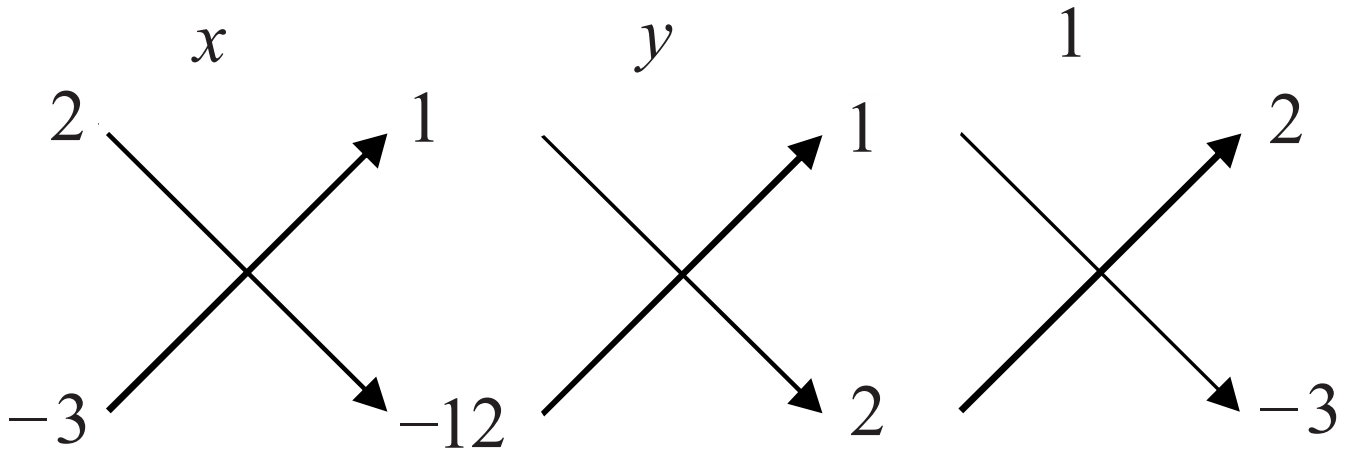
$\therefore\frac{\text{x}}{[2\times(-12)-1\times(-3)]}=\frac{{\text{y}}}{[1\times2-1\times(-12)]}=\frac{1}{[1\times(-3)-2\times2]}$
$\Rightarrow\frac{\text{x}}{(-24+3)}=\frac{\text{y}}{(2+12)}=\frac{1}{(-3-4)}$
$\Rightarrow\frac{\text{x}}{(-21)}=\frac{\text{y}}{(14)}=\frac{1}{(-7)}$
$\Rightarrow\text{x}=\frac{-21}{-7}=3,\ \text{y}=\frac{14}{-7}=-2$
Hence, $x = 3$ and $y = -2$ is the required solution. View full question & answer→Question 34 Marks
Solve for x and y:
7(y + 3) - 2(x + 2) = 14,
4(y - 2) + 3(x - 3) = 2
AnswerThe given equations are: 7(y + 3) - 2(x + 2) = 14 4(y - 2) + 3(x - 3) = 2 7(y + 3) - 2(x + 2) = 14⇒ 7y + 21 - 2x - 4 = 14
⇒ 7y - 2x = 14 + 4 - 21
⇒ -2x + 7y = -3 ...(1)
4(y - 2) + 3(x - 3) = 2⇒ 4y - 8 + 3x - 9 = 2
⇒ 4y + 3x = 2 + 8 + 9
⇒ 3x + 4y = 19 ...(2)
Multiply (1) by 4 and (2) by 7, we get
-8x + 28y = -12 ...(3)
21x + 28y = 133 ...(4)
Subtracting (3) and (4), we get
29x = 145
x = 5
Substituting x = 5 in (1), we get
-2 × 5 + 7y = -3
⇒ 7y = -3 + 10
⇒ 7y = 7
⇒ y = 1
$\therefore$ Solution is x = 5 and y = 1
View full question & answer→Question 44 Marks
Solve for x and y:
3(2x + y) = 7xy,
3(x + 3y) = 11xy $(\text{x}\neq0\ \text{and}\ \text{y}\neq0)$
Answer3(2x + y) = 7xy and 3(x + 3y) = 11xy
Divide each equation by xy.
$\Rightarrow\frac{3}{\text{x}}+\frac{6}{\text{y}}=7\ \dots(\text{i})$ and $\frac{9}{\text{x}}+\frac{3}{\text{y}}=11\ \dots({\text{ii}})$
Multiply (i) by 3 and subtract from (ii).
$\frac{18}{\text{y}}-\frac{3}{\text{y}}=10$
$\Rightarrow\text{y}=\frac{15}{10}=\frac{3}{2}$
Substituting $\text{y}=\frac{3}{2}$ in (i), we have
$\frac{3}{\text{x}}+\frac{6}{\frac{3}{2}}=7$
$\Rightarrow\frac{3}{\text{x}}+4=7$
$\Rightarrow\frac{3}{\text{x}}=3$
$\Rightarrow\text{x}=1$
So, x = 1 and $\text{y}=\frac{3}{2}$
View full question & answer→Question 54 Marks
Solve the following systems of equations by using the method of cross multiplication:
$3x - 2y + 3 = 0$
$4x + 3y - 47 = 0$
AnswerThe given equations are: $3x - 2y + 3 = 0 ...(i) 4x + 3y - 47 = 0 ...(ii)$
Here, $a_1 = 3, b_1 = -2, c_1 = 3, a_2 = 4, b_2 = 3$ and $c_2 = -47$ By cross multiplication, we have:
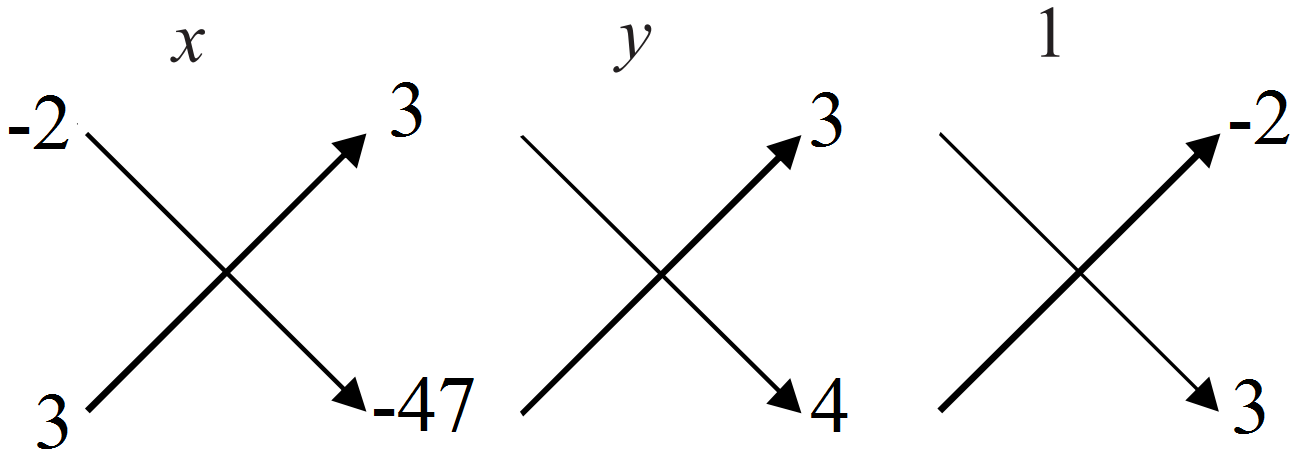
$\therefore\frac{\text{x}}{[(-2)\times(-47)-3\times3]}=\frac{{\text{y}}}{[3\times4-(-47)\times3]}=\frac{1}{[3\times3-(-2)\times4]}$
$\Rightarrow\frac{\text{x}}{(94-9)}=\frac{\text{y}}{(12+141)}=\frac{1}{(9+8)}$
$\Rightarrow\frac{\text{x}}{85}=\frac{\text{y}}{153}=\frac{1}{17}$
$\Rightarrow\text{x}=\frac{85}{17}=5,\ \text{y}=\frac{153}{17}=9$
Hence, $x = 5$ and $y = 9$ is the required solution. View full question & answer→Question 64 Marks
Solve for x and y:
$\frac{1}{(3\text{x}+\text{y)}}+\frac{1}{(3\text{x}-\text{y)}}=\frac{3}{4},$
$\frac{1}{2(3\text{x}+\text{y)}}-\frac{1}{2(3\text{x}-\text{y)}}=\frac{-1}{8}$
Answer$\frac{1}{(3\text{x}+\text{y)}}+\frac{1}{(3\text{x}-\text{y)}}=\frac{3}{4},$
$\frac{1}{2(3\text{x}+\text{y)}}-\frac{1}{2(3\text{x}-\text{y)}}=\frac{-1}{8}$
$\Rightarrow\frac{1}{(3\text{x}+\text{y)}}-\frac{1}{(3\text{x}-\text{y)}}=\frac{-1}{4}$
Put $\frac{1}{\text{3x}+\text{y}}=\text{u}$ and $\frac{1}{\text{3x}-\text{y}}=\text{v}$
So, we get
$\text{u}+\text{v}=\frac{3}{4}\ \dots(\text{i})$ and $\text{u}-\text{v}=\frac{-1}{4}\ \dots(\text{ii})$
Adding (i) and (ii), we get
$\Rightarrow\text{2u}=\frac{1}{2}$
$\Rightarrow\text{u}=\frac{1}{4}$
Substituting $\text{u}=\frac{1}{4}$ in (i), we get $\text{v}=\frac{1}{2}$
$\Rightarrow\frac{1}{\text{3x}+\text{y}}=\frac{1}{4}$ and $\frac{1}{\text{3x}-\text{y}}=\frac{1}{2}$
3x + y = 4 ...(iii) and 3x - y = 2 ...(iv)
Adding (iii) and (iv), we get
6x = 6
x = 1
Substituting x = 1 in (iii), we get y = 1
Hence, x = 1 and y = 1
View full question & answer→Question 74 Marks
The sum of the numerator and denominator of a fraction is 4 more than twice the numerator. If the numerator and denominator are increased by 3, they are in the ratio 2 : 3. Determine the fraction.
AnswerLet the fraction be $\frac{\text{x}}{\text{y}}$
According to the first condition,
x + y - 2x + 4
⇒ x - y = -4 ...(i)
According to the second condition,
$\frac{\text{x}+3}{\text{y}+3}=\frac{2}{3}$
⇒ 3x + 9 = 2y + 6
⇒ 3x - 2y = -3 ...(ii)
Multiply (i) by -2 and adding it to (ii).
-2x + 2y - 8 and 3x - 2y = -3
⇒ x = 5
Substituting x = 5 in (i), we get
y = 9
So, the fraction is $\frac{5}{9}$
View full question & answer→Question 84 Marks
A two-digit number is 3 more than 4 times the sum of its digits. If 18 is added to the number, the digits are reversed. Find the number.
AnswerLet the ten's and unit's of required number be x and y respectively.
Then required number = 10x + y
According to the given question:
10x + y = 4(x + y) + 3
⇒ 10x + y = 4x + 4y +3
⇒ 6x - 3y = 3
⇒ 2x - y = 1 ...(1)
And
⇒ 10x + y + 18 = 10y + x
⇒ 9x - 9y = -18
⇒ 9(x - y) = -18
$\Rightarrow(\text{x}-\text{y})=\frac{-18}{9}$
⇒ x - y = -2 ...(2)
Subtracting (2) from (1), we get
$\therefore$ x = 3
Putting x = 3 in (1), we get
2 × 3 - y = 1
y = 6 - 1 = 5
$\therefore$ x = 3, y = 5
Required number = 10x + y
= 10 × 3 + 5
= 30 + 5
= 35
Hence, required number is 35.
View full question & answer→Question 94 Marks
Solve for x and y:
$\frac{\text{x}}{\text{a}}+\frac{\text{y}}{\text{b}}=2,$
$\text{ax}-\text{by}=\text{a}^2-\text{b}^2$
Answer$\frac{\text{x}}{\text{a}}+\frac{\text{y}}{\text{b}}=2$
$\frac{\text{bx}+\text{ay}}{\text{ab}}=2$
$bx + ay = 2ab ...(1)$
$ax - by = (a^2- b^2) ...(2)$
Multiplying $(1) $ by $b$ and $(2)$ by a
$\Rightarrow b^2x + bay = 2ab^2 ...(3)$
$\Rightarrow a^2x - bay = a(a^2 - b^2) ...(4)$
Adding $(3)$ and $(4),$
we get $b^2x + a^2x = 2ab^2 + a(a^2 - b^2) $
$x(b^2+ a^2) = 2ab^2 + a^3 - ab^2 $
$x(b^2 + a^2) = ab^2 + a^3 $
$x(b^2 + a^2) = a(b^2 + a^2)$
$\text{x}=\frac{\text{a}\big(\text{b}^2+\text{a}^2\big)}{\big(\text{b}^2+\text{a}^2\big)}=\text{a}$
Putting $x = a$ in $(1),$ we get $b \times a + ay= 2ab$
$ ay = 2ab - ab $
$ay = ab or y = b$
$\therefore$ Solution is $ x = a, y = b$
View full question & answer→Question 104 Marks
Solve the following systems of equations by using the method of cross multiplication:
$2x + y = 35,$
$3x + 4y = 65$
AnswerThe given equations may be written as: $2x + y - 35 = 0 ...(i) 3x + 4y - 65 = 0 ...(ii)$
Here, $a_1 = 2, b_1 = 1, c_1 = -35, a_2 = 3, b_2 = 4$ and $c_2 = -65$
By cross multiplication, we have:
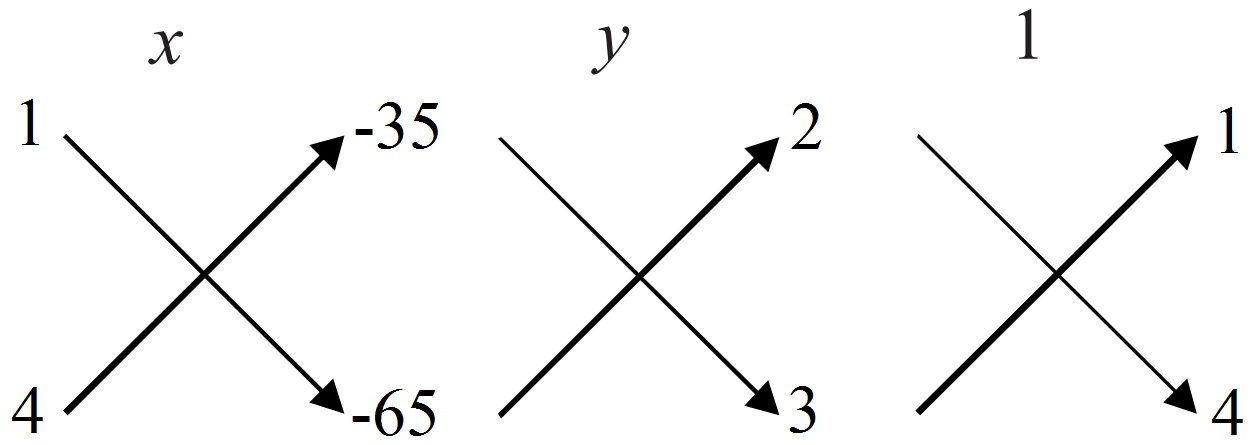
$\therefore\frac{\text{x}}{[1\times(-65)-4\times(-35)]}=\frac{{\text{y}}}{[(-35)\times3-(-65)\times2]}=\frac{1}{[2\times4-3\times1]}$
$\Rightarrow\frac{\text{x}}{(-65+140)}=\frac{\text{y}}{(-105+130)}=\frac{1}{(8-3)}$
$\Rightarrow\frac{\text{x}}{75}=\frac{\text{y}}{25}=\frac{1}{5}$
$\Rightarrow\text{x}=\frac{75}{5}=15,\ \text{y}=\frac{25}{5}=5$
Hence, $x = 15$ and $y = 5$ is the required solution. View full question & answer→Question 114 Marks
Solve the following systems of equations by using the method of cross multiplication:
$\frac{1}{\text{x}}+\frac{1}{\text{y}}=7,$
$\frac{2}{\text{x}}-\frac{3}{\text{y}}=17 $ $(\text{x}\neq0,\ \text{y}\neq0).$
AnswerTaking $\frac{1}{\text{x}}=\text{u}$ and $\frac{1}{\text{y}}=\text{v},$
the given equations become: $u + v = 7 2u + 3v = 17$
The given equations may be written as:
$u + v - 7 = 0 ...(i) $
$2u + 3v - 17 = 0 ...(ii)$
Here, $a_1 = 1, b_1 = 1, c_1 = -7,$
$ a_2 = 2, b_2 = 3$ and $c_2 = -17$
By cross multiplication, we have:
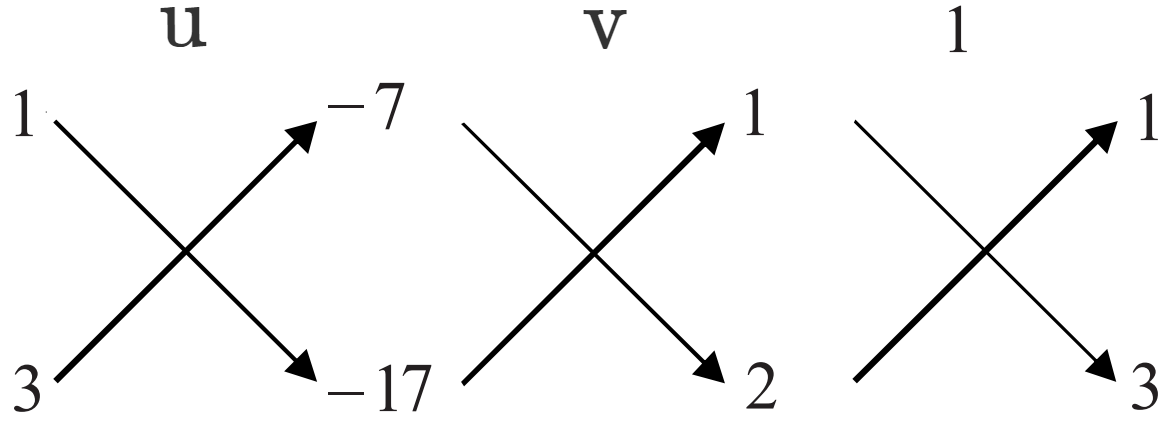
$\therefore\frac{\text{u}}{[1\times(-17)-3\times(-7)]}=\frac{\text{v}}{[(-7)\times2-1\times(-17)]}=\frac{1}{[3-2]}$
$\Rightarrow\frac{\text{u}}{-17+21}=\frac{\text{v}}{-14+17}=\frac{1}{1}$
$\Rightarrow\frac{\text{u}}{4}=\frac{\text{v}}3{}=\frac{1}{1}$
$\Rightarrow\text{u}=\frac{4}{1}=4,\ \text{v}=\frac{3}1{}=3$
$\Rightarrow\frac{1}{\text{x}}=4,\ \frac{1}{\text{y}}=3$
$\Rightarrow\text{x}=\frac{1}4{},\ \text{y}=\frac{1}3{}$
Hence, $\text{x}=\frac{1}4{}$ and $\text{y}=\frac{1}{3}$ is the required solution. View full question & answer→Question 124 Marks
A railway half ticket costs half the full fare and the reservation charge is the same on half ticket as on full ticket. One reserved first class ticket from Mumbai to Delhi costs ₹4,150 while one full and one half reserved first class
tickets cost ₹6,255. What is the basic first class full fare and what is the reservation charge?
AnswerLet the full fare be Rs. x and the reservation charge be Rs. y.
Since one full ticket cost ₹ 4150,
x + y = 4150 ...(i)
Since one full and one half reserved ticket cost ₹ 6255,
$(\text{x}+\text{y})+\Big(\frac{1}{2}\text{x}+\text{y}\Big)=6255$
$\Rightarrow\frac{3}{2}\text{x}+\text{2y}=6255$
$\Rightarrow\text{3x}+\text{4y}=12510\ \dots(\text{ii})$
Multiplying (i) by 3 and subtracting the resultant from (ii), we get
3x + 3y - 12450
and 3x + 4y - 12510
⇒ y = 60
Substituting y = 60 in (i), we get
⇒ x = 4090
Hence, the full fare is ₹ 4090 and the reservation charge is ₹ 60.
View full question & answer→Question 134 Marks
The sum of the numerator and denominator of a fraction is 8. If 3 is added to both of the numerator and the denominator, the fraction becomes $\frac{3}{4}.$ Find the fraction.
AnswerLet the numerator and denominator of fraction be x and y respectively.
According to the question:
x + y = 8 ...(1)
And
$\therefore\frac{\text{x}+3}{\text{y}+3}=\frac{3}{4}$
⇒ 4x + 12 - 3y + 9
⇒ 4x - 3y = -3 ...(2)
Multiplying (1) be 3 and (2) by 1
3x + 3y = 24 ...(3)
4x - 3y = -3 ...(4)
Add (3) and (4), we get
7x = 21
$\Rightarrow\text{x}=\frac{21}{7}=3$
Putting x = 3 in (1), we get
3 + y = 8
⇒ y = 8 - 3
⇒ y = 5
$\therefore$ x = 3, y = 5
Hence, the fraction is $\frac{\text{x}}{\text{y}}=\frac{3}{5}$
View full question & answer→Question 144 Marks
The sum of a two-digit number and the number obtained by reversing the order of its digits is 121, and the two digits differ by 3. Find the number.
AnswerLet the two-digit number be xy.
The given number = 10x + y
The number obtained by interchanging the digits is yx.
According to the first condition,
⇒ 10x + y + 10y + x = 121
⇒ 11x + 11y - 121
⇒ x + y = 11 ...(i)
According to the second condition,
x - y = 3 ...(ii)
Adding (i) and (ii), we get
2x - 14
⇒ x - 7
Substituting x = 7 in (i), we get
y = 4
So, the given number is xy - 74 or 47.
View full question & answer→Question 154 Marks
If 2 is added to the numerator of a fraction, it reduces to $\Big(\frac{1}{2}\Big)$ and if 1 is subtracted from the denominator, it reduces to $\Big(\frac{1}{3}\Big).$ Find the fraction.
AnswerLet the numerator and denominator be x and y respectively.
Then the fraction is $\frac{\text{x}}{\text{y}}.$
$\therefore\frac{\text{x}+2}{\text{y}}=\frac{1}{2}$
⇒ 2x + 4 = y
⇒ 2x - y = -4 ...(1)
and $\frac{\text{x}}{\text{y}-1}=\frac{1}{3}$
⇒ 3x = y - 1
⇒ 3x - y = -1 ...(2)
Subtracting (1) from (2), we get
x = 3
Putting x = 3 in (1), we get
2 × 3 - 4
⇒ y = -4 - 6
⇒ y = 10
$\therefore$ x = 3 and y = 10
Hence the fraction is $\frac{3}{10}$
View full question & answer→Question 164 Marks
Solve for x and y:
$\frac{10}{\text{x}+\text{y}}+\frac{2}{\text{x}-\text{y}}=4,$
$\frac{15}{\text{x}+\text{y}}-\frac{9}{\text{x}-\text{y}}=-2$
Answer$\frac{10}{\text{x}+\text{y}}+\frac{2}{\text{x}-\text{y}}=4,$
$\frac{15}{\text{x}+\text{y}}-\frac{9}{\text{x}-\text{y}}=-2$
Put $\frac{1}{\text{x}+\text{y}}=\text{u}$ and $\frac{1}{\text{x}-\text{y}}=\text{v}$ in the equation, we get
10u + 2v = 4 ...(i)
15u - 9v = -2 ...(ii)
Multiply (i) by 9 and (ii) by 2, we get
⇒ 90u + 18v = 36 and 30u - 18v = -4
⇒ 120u = 32
$\Rightarrow\text{u}=\frac{4}{15}$
Substituting $\text{u}=\frac{4}{15},$ in (i), we get $\text{v}=\frac{2}{3}$
$\Rightarrow\frac{1}{\text{x}+\text{y}}=\frac{4}{15}$
and $\frac{1}{\text{x}-\text{y}}=\frac{2}{3}$
$\Rightarrow\text{x}+\text{y}=\frac{15}{4}\ \dots(\text{iii})$
and $\text{x}-\text{y}=\frac{3}{2}\ \dots(\text{iv})$
Adding (iii) and (iv), we get
$\text{2x}=\frac{21}{4}$
$\Rightarrow\text{x}= \frac{21}{8}$
Substituing $\text{x}=\frac{21}{2}$ in (iii), we get $\text{y}=\frac{9}{8}$
So, $\text{x}=\frac{21}{2}$ and $\text{v}=\frac{9}{8}$
View full question & answer→Question 174 Marks
Solve for x and y:
71x + 37y = 253,
37x + 71y = 287
AnswerThe given equations are: 71x + 37y = 253 ...(1) 37x + 71y = 287 ...(2) Adding (1) and (2) 108x + 108y = 540 108(x + y) = 540 $\therefore\text{x}+\text{y}=\frac{540}{108}=5\ \dots(3)$ Subtracting (2) from (1) 34x - 34y = 253 - 287 = -34 34(x - y) = -34$\therefore\text{x}-\text{y}=- \frac{34}{34}=-1\ \dots(4)$
Adding (3) and (4) 2x = 5 - 1 = 4 ⇒ x = 2 Subtracting (4) from (3) 2y = 5 + 1 = 6 ⇒ y = 3 $\therefore$ The solution is x = 2, y = 3
View full question & answer→Question 184 Marks
Solve for x and y:
6x + 5y = 7x + 3y + 1 = 2(x + 6y - 1)
AnswerThe given equations are: 6x + 5y = 7x + 3y + 1 = 2(x + 6y - 1) Therefore, we have 6x + 5y = 2(x + 6y - 1)⇒ 6x + 5y = 2x + 12y - 2
⇒ 6x - 2x + 5y - 12y = -2
4x - 7y = -2 ...(1) 7x + 3y + 1 = 2(x + 6y - 1)⇒ 7x + 3y + 1 = 2x + 12y - 2
⇒ 7x - 2x + 13y - 12y = -2 - 1
5x - 9y = -3 ...(2)Multiply (1) by 9 and (2) by 7, we get
36x - 63y = -18 ...(3)
35x - 63y = -21 ...(4)
Subtracting (4) from (3), we get
x = 3
Substituting x = 3 in (1), we get
4 × 3 - 7y = -2
⇒ -7y = -2 - 12
⇒ -7y = -14
⇒ y = 2
$\therefore$ Solution is x = 3 and y = 2
View full question & answer→Question 194 Marks
Find a fraction which becomes $\Big(\frac{1}{2}\Big)$ when 1 is subtracted from the numerator and 2 is added to the denominator, and the fraction becomes $\Big(\frac{1}{3}\Big)$ when 7 is subtracted from the numerator and 2 is subtracted from the denominator.
AnswerLet the numerator and denominator be x and y respectively.
Then the fraction is $\frac{\text{x}}{\text{y}}.$
$\therefore\frac{\text{x}-1}{\text{y}+2}=\frac{1}{2}$
⇒ 2x - 2 = y + 2
⇒ 2x - y =4 ...(1)
and $\therefore\frac{\text{x}-7}{\text{y}-2}=\frac{1}{3}$
⇒ 3x - 21 = y - 2
⇒ 3x - y = 19 ...(2)
Subtracting (1) from (2), we get
x = 15
Putting x = 15 in (1), we get
2 × 15 - y = 4
⇒ 30 - y = 4
⇒ y = 26
$\therefore$ x = 15 and y = 26
Hence the given fraction is $\frac{15}{26}$
View full question & answer→Question 204 Marks
The denominator of a fraction is greater than its numerator by 11. If 8 is added to both its numerator and denominator, it becomes $\frac{3}{4}.$ Find the fraction.
AnswerLet the numerator and denominator be x and y respectively.
Then the fraction is $\frac{\text{x}}{\text{y}}.$
y = x + 11
y - x = 11 ...(1)
and
$\frac{\text{x}+8}{\text{y}+8}=\frac{3}{4}$
⇒ 4x + 32 = 3y + 24
⇒ 4x - 3y = -8
⇒ -3y + 4x = -8 ...(2)
Multiplying (1) by 4 and (2) by 1
4y - 4x = 44 ...(3)
-3y + 4x = -8 ...(4)
Adding (3) and (4), we get
y = 36
Putting y = 36 in (1), we get
y - x = 11
⇒ 36 - x = 11
⇒ x = 25
$\therefore$ x = 25, y = 36
Hence the fraction is $\frac{25}{36}$
View full question & answer→Question 214 Marks
A number consists of two digits.
When it is divided by the sum of its digits, the quotient is $6$ with no remainder.
When the number is diminished by $9$, the digits are reversed. Find the number.
AnswerLet the ten's and unit's digits of the required number be x and y respectively.
Then, $xy = 35$
Required number $= 10x + y$
Also,
$(10x + y) + 18 = 10y + x$
$\Rightarrow 9x - 9y = -18$
$\Rightarrow 9(y - x) = 18 ...(1)$
$\Rightarrow y - x = 2$
Now,
$(y + x)^2- (y - x)^2 = 4xy$
$\Rightarrow\text{y}+\text{x}=\sqrt{(\text{y}-\text{x})^2+\text{4xy}}$
$=\sqrt{4+4\times35}$
$=\sqrt{144}$
$=12$
$y + x = 12 ...(2)$
Adding (1) and (2),
$2y = 12 + 2 = 14$
$\Rightarrow y = 7$
Putting $y = 7$ in (1),
$7 - x = 2$
$\Rightarrow x = 5$
Hence, the required number $= 5 x 10 + 7 = 57$
View full question & answer→Question 224 Marks
Solve the following systems of equations by using the method of cross multiplication:
$2x + 5y = 1,$
$2x + 3y = 3$
AnswerThe given equations are: $2x + 5y = 1 ...(i) 2x + 3y = 3 ...(ii)$
Here, $a_1 = 2, b_1 = 5, c_1 = -1, a_2 = 2, b_2 = 3$ and $c_2 = -3$
By cross multiplication, we have:
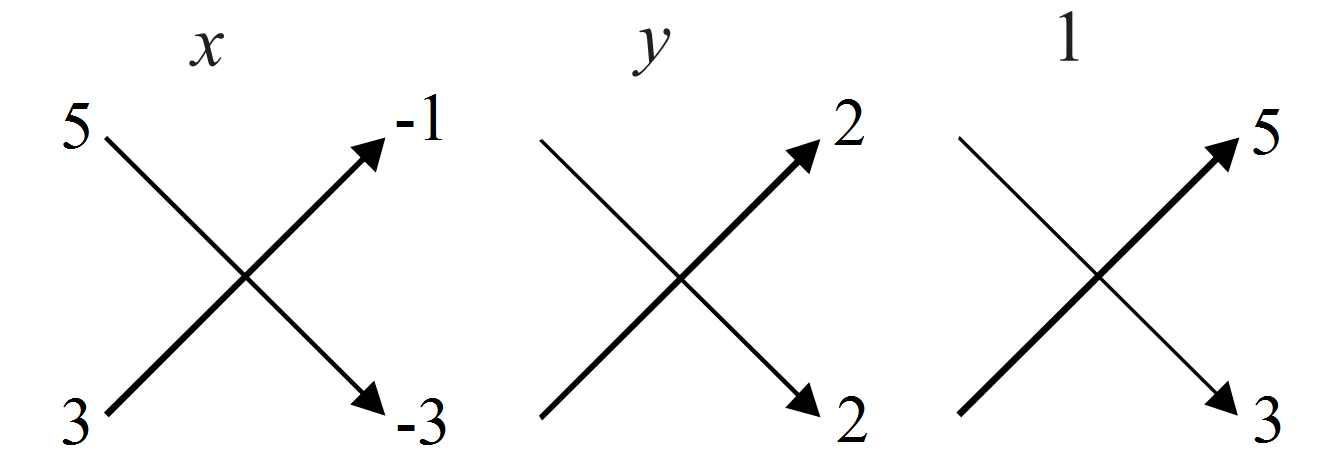
$\therefore\frac{\text{x}}{[5\times(-3)-3\times(-1)]}=\frac{{\text{y}}}{[(-1)\times2-(-3)\times2]}=\frac{1}{[2\times3-2\times5]}$
$\Rightarrow\frac{\text{x}}{(-15+3)}=\frac{\text{y}}{(-2+6)}=\frac{1}{(6-10)}$
$\Rightarrow\frac{\text{x}}{-12}=\frac{\text{y}}{4}=\frac{1}{-4}$
$\Rightarrow\text{x}=\frac{-12}{-4}=3,\ \text{y}=\frac{4}{-4}=-1$
Hence, $x = 3$ and $y = -1$ is the required solution. View full question & answer→Question 234 Marks
A number consists of two digits. When it is divided by the sum of its digits, the quotient is 6 with no remainder. When the number is diminished by 9, the digits are reversed. Find the number.
AnswerLet the ten's digit and unit's digit of required number be x and y respectively.
We know,
Dividend = (divisor × quotient) + remainder
According to the given question:
10x + y = 6 x (x + y) +0
⇒ 10x - 6x + y-by = 0
⇒ 4x - 5y = 0 ...(1)
Number obtained by reversing the digits is 10y + x
10x + y - 9 = 10y + x
⇒ 9x - 94 = 9
⇒ 9(x - y) = 9
⇒ (x - y) = 1 ...(2)
Multiplying (1) by 1 and (2) by 5, we get
4x - 5y = 0 ...(3)
5x - 5y = 5 ...(4)
Subtracting (3) from (4), we get
$\therefore$ x = 5
Putting x = 5 in (1), we get
4 × 5 - 5y = 0
⇒ -5y = -20
$\Rightarrow\text{y}=\frac{-20}{-5}=4$
$\therefore$ x = 5 and y = 4
Hence, required number is 54
View full question & answer→Question 244 Marks
Solve for x and y:
$\frac{\text{2x}+\text{5y}}{\text{xy}}=6,$
$\frac{\text{4x}-\text{5y}}{\text{xy}}=-3$
AnswerThe given equations are: $\frac{\text{2x}+\text{5y}}{\text{xy}}=6$ $\Rightarrow\frac{2}{\text{y}}+\frac{5}{\text{x}}=6\ \dots(\text{i})$ $\frac{\text{4x}-\text{5y}}{\text{xy}}=-3$ $\Rightarrow\frac{4}{\text{y}}-\frac{5}{\text{x}}=-3\ \dots(\text{ii})$ Adding (i) and (ii), we get $\frac{6}{\text{y}}=3$ $\Rightarrow\text{y}=2$ Substituting y = 2 in (i), we get x = 1Hence, x = 1 and y = 2
View full question & answer→Question 254 Marks
Solve for $x$ and $y$:
$6(ax + by) = 3a + 2b,$
$6(bx - ay) = 3b - 2a$
Answer$6(ax + by) = 3a + 2b$
$6ax + 6bx = 3a + 2b ...(1)$
$6(bx - ay) = 3b - 2a$
$6bx - 6ay = 3b - 2a ...(2)$
$6ax + 6bx = 3a + 2b ...(1)$
$6bx - 6ay = 3b - 2a ...(2)$
Multiplying (1) by by a and (2) by b
$6a^2x + 6b^2x = 3a^2 + 2ab ...(3)$
$6a^2x - 6b^2x = 3b^2- 2ab ...(4)$
Adding (3) and (4), we get
$6a^2x + 6b^2x = 3a^2 + 3b^2$
$6(a^2 + b^2)x = 3(a^2 + b^2)$
$\text{x}=\frac{3\big(\text{a}^2+\text{b}^2\big)}{6\big(\text{a}^2+\text{b}^2\big)}=\frac{3}{6}=\frac{1}{2}$
Substituting $\text{x}=\frac{1}{2}$ in (1), we get
$\text{6a}\times\frac{1}{2}+\text{6by}=\text{3a}+\text{2b}$
$\text{3a}+\text{6by}=\text{3a}+\text{2b}$
$\text{6by}=\text{3a}+\text{2b}-\text{3a}$
$\text{6by}=\text{2b}$
$\text{y}=\frac{\text{2b}}{\text{6b}}=\frac{1}{3}$
Hence, the solution is $\text{x}=\frac{1}{2},\ \text{y}=\frac{1}{3}$
View full question & answer→Question 264 Marks
Solve for x and y:
$\frac{5}{\text{x}}+\text{6y}=13,$
$\frac{3}{\text{x}}+\text{4y}=7\ (\text{x}\neq0).$
AnswerPutting $\frac{1}{\text{x}}=\text{u}$ the given equations become 5u + 6y = 13 ...(1) 3u + 4y = 7 ...(2)Multiplying (1) by 4 and (2) by 6, we get
20u + 24y = 52 ...(3)
18u + 24y = 42 ...(4)
Subtracting (4) from (3), we get
2u = 10
⇒ x = 5
Substituting u = 5 in (1), we get
5 × 5 + 6y = 13
⇒ 6y = 13 - 25
⇒ 6y = -12
⇒ y = -2
u = 5
$\Rightarrow\frac{1}{\text{x}}=5$ $\Rightarrow\text{5x}=1$ $\Rightarrow\text{x}=\frac{1}{5}$$\therefore$ The solution is $\text{x}=\frac{1}{5}$ and y = -2
View full question & answer→Question 274 Marks
The sum of the digits of a two-digit number is 15. The number obtained by interchanging the digits exceeds the given number by 9. Find the number.
AnswerLet the ten's digit and unit's digits of required number be x and y respectively.
x + y = 15 ...(1)
Required number = 10x + y
Number obtained by interchanging the digits = 10y + x
$\therefore$ 10y + x - (10x + y) = 9
10y + x - 10x - y = 9
9y - 9x = 9
9(y - x) = 9
$\Rightarrow\text{y}-\text{x}=\frac{9}{9}$
⇒ y - x = 1
-x + y = 1 ...(2)
Add (1) and (2), we get
$\text{2y}=16$
$\Rightarrow\text{y}=\frac{16}{2}=8$
Putting y = 8 in (1), we get
x + 8 = 15
x = 15 - 8 = 7
Required number = 10x + y
= 10 x 7 + 8
= 70 + 8
= 78
Hence the required number is 78.
View full question & answer→Question 284 Marks
Solve for x and y:$\frac{\text{bx}}{\text{a}}+\frac{\text{ay}}{\text{b}}=\text{a}^2+\text{b}^2,$
$\text{x}+\text{y}=\text{2ab}$
Answer$\frac{\text{bx}}{\text{a}}-\frac{\text{ax}}{\text{b}}+\text{a}^2+\text{b}^2$
By taking L.C.M., we get
$\frac{\text{b}^2\text{x}+\text{a}^2\text{y}}{\text{ab}}=\text{a}^2+\text{b}^2$
$b^2x + a^2y = ab(a^2 + b^2) ...(1)$
$x + y = 2ab ...(2)$
Multiplying $(1)$ by $1$ and $(2)$ by $a^2$
$b^2x + a^2y = a^3b + ab^3 ...(3)$
$a^2x + a^2y = 2a^3b ...(4)$
Subtracting $(4)$ from $(3)$, we get
$b^2x - a^2x = a^3b + ab^3 - 2a^3b$
$x(b^2- a^2) = ab^3- a^3b$
$x(b^2 - a^2) = ab(b^2 - a^2)$
$\therefore\ \text{x}=\frac{\text{ab}(\text{b}^2-\text{a}^2)}{(\text{b}^2-\text{a}^2)}=\text{ab}$
Substituting $x = ab$, in $(3)$, we get
$b^2(ab) + a^2y = a^3b + ab^3$
$b^3a + a^2y = a^3b + ab^3$
$a^2y = a^3b + ab^3 - b^3a$
$a^2y = a^3b$
$\Rightarrow\text{y}=\frac{\text{a}^3\text{b}}{\text{a}^3}=\text{ab}$
$\therefore$ solution is$ x = ab, y = ab$
View full question & answer→Question 294 Marks
Solve for $x$ and $y$:
$\frac{\text{x}}{\text{a}}+\frac{\text{y}}{\text{b}}=\frac{\text{a}+\text{b}}{\text{b}}$
$\frac{\text{x}}{\text{a}^2}+\frac{\text{y}}{\text{b}^2}=2$
Answer$\frac{\text{x}}{\text{a}}+\frac{\text{y}}{\text{b}}=\frac{\text{a}+\text{b}}{\text{b}}\dots(\text{i})$
$\frac{\text{x}}{\text{a}^2}+\frac{\text{y}}{\text{b}^2}=2\ \dots(\text{ii})$
Multiplying (i) by $b$ and (ii) by $b^2$ and subtract, we get
$\Rightarrow\frac{\text{bx}}{\text{a}}-\frac{\text{b}^2\text{x}}{\text{a}^2}=\text{ab}+\text{b}^2-\text{2b}^2$
$\Rightarrow\text{x}=\frac{\big(\text{a}\text{b}-\text{b}^2\big)\text{a}^2}{\big(\text{ab}-\text{b}^2\big)}$
$\Rightarrow\text{x}=\text{a}^2$
Substituting $x = a^2$ in (i), we get
$\text{a}+\frac{\text{y}}{\text{b}}=\frac{\text{a}+\text{b}}{\text{b}}$
$\Rightarrow\frac{\text{y}}{\text{b}}=\frac{\text{a}+\text{b}}{\text{b}}-\text{a}$
$\Rightarrow\text{y}=\text{b}^2$
So, $x = a^2$ and $y = b^2$
View full question & answer→Question 304 Marks
A two-digit number is such that the product of its digit is 18. When 63 is subtracted from the number, the digits interchange their places. Find the number.
AnswerLet the ten's and unit's digits of the required number be x and y respectively.
Then,$ xy = 18$
Required number $= 10x + y$
Number obtained on reversing its digits $= 10y + x$
$\therefore$ $(10x + y) - 63 = (10y + x)$
$\Rightarrow 9x - 9y = 63$
$\Rightarrow x - y = 7 ...(1)$
Now,
$\Rightarrow (x + y)^2 - (x - y)^2 = 4xy$
$\Rightarrow(\text{x}+\text{y})=\sqrt{(\text{x}-\text{y})^2+\text{4xy}}$
$\Rightarrow\text{x}+\text{y}=\sqrt{(7)^2+4\times18}$
$=\sqrt{49+72}$
$=\sqrt{121}$
$x + y = 11 ...(2)$
Adding (1) and (2), we get
$\text{2x}=18$
$\Rightarrow\text{x}=\frac{18}{2}=9$
Putting $x = 9$ in (1), we get
$9 - y = 7$
$\Rightarrow y = 9 - 7$
$\Rightarrow y = 2$
$\therefore$ $x = 9, y = 2$
Hence, the required number $= 9 x 10 + 2$
$= 92.$
View full question & answer→Question 314 Marks
Solve for x and y:
$\frac{3}{\text{x}+\text{y}}+\frac{2}{\text{x}-\text{y}}=2,$
$\frac{9}{\text{x}+\text{y}}-\frac{4}{\text{x}-\text{y}}=1$
AnswerPutting $\frac{1}{\text{x}+\text{y}}=\text{u}$ and $\frac{1}{\text{x}-\text{y}}=\text{v}$
3u + 2v = 2 ...(1)
9u - 4v = 1 ...(2)
Multiply (1) by 2 and (2) by 1, we get
6u + 4v = 4 ...(3)
9u - 4v = 1 ...(4)
Adding (3) and (4), we get
$\text{15u}=5,$
$\text{u}=\frac{5}{15}=\frac{1}{3}$
Putting $\text{u}=\frac{1}{3}$ in (i), we get
$3\times\frac{1}{3}+\text{2v}=2$
$\Rightarrow1+\text{2v}=2$
$\Rightarrow\text{2v}=1$
$\text{v}=\frac{1}{2}$
Now, $\text{u}=\frac{1}{3}$
$\Rightarrow\frac{1}{\text{x}+\text{y}}=\frac{1}{3}$
$\Rightarrow\text{x}+\text{y}=3\ \dots(5)$
and $\text{v}=\frac{1}{2}$
$\Rightarrow\frac{1}{\text{x}-\text{y}}=\frac{1}{2}$
$\Rightarrow\text{x}-\text{y}=2\ \dots(6)$
Adding (5) and (6), we get
$\text{2x}=5$
$\Rightarrow\text{x}= \frac{5}{2}$
Putting $\text{x}=\frac{5}{2}$ in (5), we get
$\frac{5}{2}+\text{y}=3$
$\Rightarrow\text{y}=3-\frac{5}{2}=\frac{6-5}{2}=\frac{1}{2}$
$\therefore$ the solution is $\text{x}=\frac{5}{2}$ and $\text{y}=\frac{1}2{}$
View full question & answer→Question 324 Marks
Solve for x and y:
$a^2x + b^2y = c^2,$
$b^2x + a^2y = d^2$
Answer$a^2x + b^2y = c^2...(i)$
$b^2x + a^2y = d^2...(ii)$
Multiplying (i) by $a^2$ and (ii) by $b^2$ and subtracting, we get
$\Rightarrow\text{a}^4\text{x} - \text{b}^4\text{x} = \text{a}^2\text{b}^2 - \text{b}^2\text{d}^2$
$\Rightarrow\text{x}=\frac{\text{a}^2\text{c}^2-\text{b}^2\text{d}^2}{\text{a}^4-\text{b}^4}$
Multiplying (i) by $b^2$ and (ii) by $a^2$ and subtracting, we get
$\Rightarrow\text{b}^4\text{y} - \text{a}^4\text{y} = \text{b}^2\text{c}^2 - \text{a}^2\text{d}^2$
$\Rightarrow\text{y}=\frac{\text{b}^2\text{c}^2-\text{a}^2\text{d}^2}{\text{b}^4-\text{a}^4}$
So, $\text{x}=\frac{\text{a}^2\text{c}^2-\text{b}^2\text{d}^2}{\text{a}^4-\text{b}^4}$ and $\text{y}=\frac{\text{b}^2\text{c}^2-\text{a}^2\text{d}^2}{\text{b}^4-\text{a}^4}$
View full question & answer→Question 334 Marks
Solve for x and y:
$x + y = a + b,$
$ax - by = a^2 - b^2$
Answer$x + y = a + b ...(i)$
$ax - by = a^2 - b^2 ...(ii)$
Multiplying (i) by b adding it to (ii), we get
$\Rightarrow bx + ax = ab + b^2 + a^2 - b^2$
$\Rightarrow x(a + b) = a(a + b)$
$\Rightarrow x = a$
Substitute $x = a$ in (i), we get $y = b.$
So, $x = a$ and $y = b$.
View full question & answer→