Questions

M.C.Q (1 Marks)

🎯

Test yourself on this topic

21 questions · timed · auto-graded

MCQ 11 Mark
If the system of equations has infinitely many solutions, then:
$2x + 3y = 7$
$(a + b)x + (2a - b)y = 21$
  • A
    $a = 1, b = 5$
  • $a = 5, b = 1$
  • C
    $a = -1, b = 5$
  • D
    $a = 5, b = -1$
Answer
Correct option: B.
$a = 5, b = 1$
The given systems of equations are
$2 x+3 y=7$
$(a+b) x+(2 a-b) y=21$
For the equations to have infinite number of solutions, $\frac{a_1}{a_2}=\frac{b_1}{b_2}=\frac{c_1}{c_2}$
Here, $a_1=2, a_2=(a+b), b_1=3, b_2=(2 a-b), c_1=7, c_2=21$
$\frac{2}{a+b}=\frac{3}{2 a-b}=\frac{7}{21}$
Let us take $\frac{a_1}{a_2}=\frac{b_1}{b_2}$
$\frac{2}{a+b}=\frac{3}{2 a-b}$
By cross multiplication we get,
$2(2 a-b)=3(a+b)$
$4 a-2 b=3 a+3 b$
$4 a-3 a=3 b+2 b$
$a=5 b \ldots . . .(i)$
Now take $\frac{ b _1}{b_2}=\frac{ c _1}{ c _2}$
$\frac{3}{2 a-b}=\frac{7}{21}$
$\frac{3}{2 a-b}=\frac{1}{3}$
By cross multiplication we get,
$3 \times 3=1 \times 2 a-b$
$9=2 a-b \ldots . . .(\text { iii) }$
Substitute $a=5 b$ in the above equation
$9=2 \times 5 b-b$
$9=10 b-b$
$9=9 b$
$\frac{9}{9}=b$
$1=b$
Substitute $b=1$ in equation $(i)$ we get $a=5 b$
$a=5 \times 1$
$a=5$
Therefore $a =5$ and $b =1$
Hence, the correct choice is $b.$
View full question & answer
MCQ 21 Mark
The value of $k$ for which the system of equations $x + 2y - 3 = 0$ and $5x + ky + 7 = 0$ has no solution, is:
  • $10.$
  • B
    $6.$
  • C
    $3.$
  • D
    $1.$
Answer
Correct option: A.
$10.$
The given system of equations are
$x + 2y - 3 = 0$
$5x + ky + 7 = 0$
For the equations to have no solutions,
$\frac{\text{a}_1}{\text{a}_2}=\frac{\text{b}_1}{\text{b}_2}\neq\frac{\text{c}_1}{\text{c}_2}$
$\frac{1}{5}=\frac{2}{\text{k}}\neq\frac{-3}{7}$
If we take
$\frac{\text{a}_1}{\text{a}_2}=\frac{\text{b}_1}{\text{b}_2}$
$\frac{1}{5}=\frac{2}{\text{k}}$
$\text{k}=10$
Therefore the value of $k$ is $10.$
Hence, correct choice is $a.$
View full question & answer
MCQ 31 Mark
The sum of the digits of a two digit number is $9.$ if $27$ is added to it, the digits of the number get reversed. The number is:
  • A
    $25.$
  • B
    $72.$
  • C
    $63.$
  • $36.$
Answer
Correct option: D.
$36.$
Since the sum of the digits of a two$-$digit number is $9,$ therefore
$x + y = 9 .....(i)$
It says if the digits are reversed, the new number is $27$ less than the original.
Since we are looking at the number like $xy,$ to separate them, it is actually $10x + y$ for $x$ is a tens digit.
$10y+ x = 10x + y + 27$
Simplify it, we get $9y = 9x + 27$
$y = x + 3 ....(ii)$
Substitute $(ii)$ into $(i),$ we will have
$x + (x + 3) = 9$
$\Rightarrow 2x + 3 = 9$
$\Rightarrow 2x = 6$
$\Rightarrow x = 3$
Put back into equation $(i),$
$\Rightarrow 3 + y = 9$
$\Rightarrow y = 6$
The original number is $36.$
View full question & answer
MCQ 41 Mark
If $am ≠ bl$, then the system of equations $ax + by = clx + my = nax + by = clx + my = n.$
  • Has a unique solution.
  • B
    Has no solution.
  • C
    Has infinitely many solutions.
  • D
    May or may not have a solution.
Answer
Correct option: A.
Has a unique solution.
Solution:
Has a unique solution.
Given $\text{am}\neq\text{bl},$ the system of equations has
$ax + by = c$
$lx + my = n$
We know that intersecting lines have unique solution $\frac{\text{a}_1}{\text{a}_2}\neq\frac{\text{b}_1}{\text{b}_2}$
$\text{a}_1\times\text{b}_2\neq\text{a}_2\times\text{b}_1$
Here $a_1 = a, a_2 = l, b_1 = b, b_2 = m$
$\frac{\text{a}}{\text{l}}\neq\frac{\text{b}}{\text{m}}$
$\text{a}\times\text{m}\neq\text{l}\times\text{b}$
Therefore intersecting lines, have unique solution. Hence, the correct choice is a.
View full question & answer
MCQ 51 Mark
If $2x - 3y = 7$ and $(a + b)x - (a + b - 3)y = 4a + b$ represent coincident lines, then $a$ and $b$ satisfy the equation:
  • A
    $a + 5b = 0$
  • B
    $5a + b = 0$
  • $a - 5b = 0$
  • D
    $5a - b = 0$
Answer
Correct option: C.
$a - 5b = 0$
The given equation are
$2a - 3y = 7 ......(i)$
$(a + b)x - (a + b - 3)y = 4a + b .....(ii)$
For coincident lines,
$\frac{\text{a}_1}{\text{a}_2}=\frac{\text{b}_1}{\text{b}_2}=\frac{\text{c}_1}{\text{c}_2}$
$\Rightarrow\frac{2}{(\text{a}+\text{b})}=\frac{-3}{-(\text{a}+\text{b}-3)}=\frac{-7}{-(4\text{a}+\text{b})}$
$\Rightarrow\frac{2}{(\text{a}+\text{b})}=\frac{3}{(\text{a}+\text{b}-3)}$
$\Rightarrow 2(a + b - .3) = 3(a + b)$
$\Rightarrow 2a + 2b - 6 = 3a + 3b$
$\Rightarrow a + b + 6 = 0 ......(iii)$
$\Rightarrow\frac{2}{(\text{a}+\text{b})}=\frac{7}{(4\text{a}+\text{b})}$
$\Rightarrow 2(4a + b) = 7(a + b)$
$\Rightarrow 8a + 2b = 7a + 7b$
$\Rightarrow a - 5b = 0$
$\Rightarrow a = 5b .....(iv)$
Putting $a = 5b$ in $(iii)$ we get
$\Rightarrow 5b + b + 6 = 0$
$\Rightarrow 6b + 6 = 0$
$\Rightarrow\text{b}=\frac{-6}{6}$
$\Rightarrow b = -1$
Putting $b = -1$ in $(iv)$ we get
$\Rightarrow a = 5(-1)$
$\Rightarrow a = -5$
Thus, $a - 5b = 0$
View full question & answer
MCQ 61 Mark
The value of $k$ for which the system of equations $3x + 5y = 0$ and $kx + 10y = 0$ has non$-$zero solution, is:
  • A
    $0.$
  • B
    $2.$
  • $6.$
  • D
    $8.$
Answer
Correct option: C.
$6.$
The given equations are
$3x + 5y = 0 .....(i)$
$kx + 10y = 0 ......(ii)$
For non$-$zero solution,
$\frac{\text{a}_1}{\text{a}_2}=\frac{\text{b}_1}{\text{b}_2}$
$\Rightarrow\frac{3}{\text{k}}=\frac{5}{10}$
$\Rightarrow\frac{3}{\text{k}}=\frac{1}{2}$
$\Rightarrow\text{k}=6$
View full question & answer
MCQ 71 Mark
Aruna has only $₹ 1$ and $₹ 2$ coins with her. If the total number of coins that she has is $50$ and the amount of money with her is $₹ 75,$ then the number of $₹ 1$ and $₹ 2$ coins are, respectively:
  • A
    $35$ and $15.$
  • B
    $35$ and $20.$
  • C
    $15$ and $35.$
  • $25$ and $25.$
Answer
Correct option: D.
$25$ and $25.$
Let number of $₹ 1$ coins $= x$
and number of $₹ 2$ coins $= y$
Now, by given condition $x + y = 50 ..…(i)$
Also, $x \times 1 + y \times 2 = 75$
$\Rightarrow x + 2y = 75 …...(ii)$
On subtracting eq. $(i)$ from eq. $(ii),$ we get
$(x + 2y) - (x + y) = 75 - 50$
$\Rightarrow y = 25$
When $y = 25,$ then $x = 25$
View full question & answer
MCQ 81 Mark
The value of $k$ for which the system of equations has a unique solution, is: $kx - y = 2 , 6x - 2y = 3$
  • A
    $= 3$
     
  • $≠ 3$
     
  • C
    $≠ 0$
     
  • D
    $= 0$
Answer
Correct option: B.
$≠ 3$
 
The given system of equation are
$kx - y = 2$
$6x - 2y = 3$
$\frac{\text{a}_1}{\text{a}_2}\neq\frac{\text{b}_1}{\text{b}_2}$ for unique solution
Here $a_1 = k, a_2= 6, b_1= -1, b_2= -2$
$\frac{\text{k}}{6}\neq\frac{-1}{-2}$
By cross multiply we get
$2\text{k}\neq6$
$\text{k}\neq\frac{6}{2}$
$\text{k}\neq3$
Hence, the correct choice is $b.$ 
View full question & answer
MCQ 91 Mark
The value of k for which the system, of equations has infinite number of solutions, is:
$2x + 3y = 5$
$4x + ky = 10$
  • A
    $1.$
  • B
    $3.$
  • $6.$
  • D
    $0.$
Answer
Correct option: C.
$6.$
The given equation are
$2x + 3y = 5 ....(i)$
$4x + ky = 10 ......(ii)$
For infinite solution,
$\frac{\text{a}_1}{\text{a}_2}=\frac{\text{b}_1}{\text{b}_2}=\frac{\text{c}_1}{\text{c}_2}$
$\Rightarrow\frac{2}{4}=\frac{3}{\text{k}}=\frac{5}{10}$
$\Rightarrow\frac{2}{4}=\frac{3}{\text{k}}$
$\Rightarrow\frac{1}{2}=\frac{3}{\text{k}}$
$\Rightarrow\text{k}=6$
Thus, $k = 6$
View full question & answer
MCQ 101 Mark
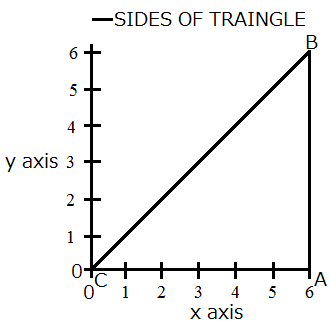
The area of the triangle formed by the lines $y = x, x = 6$ and $y = 0$ is:
  • A
    $36$ sq. units
  • $18$ sq. units
  • C
    $9$ sq. units
  • D
    $27$ sq. units
Answer
Correct option: B.
$18$ sq. units
Given $x = 6, y = 0$ and $x = y$
We have poltting points as $(6, 0) (0, 0) (6, 6)$ when $x = y$

Therefore, area of $\triangle\text{ABC}=\frac{1}{2}\times\text{base}\times\text{height}$
$=\frac{1}{2}(\text{CA}\times\text{AB})$
$=\frac{1}{2}(6\times6)$
$=\frac{1}{2}\times36=18$
Area of triangle $\text{ABC}$ is $18$ square units.
Hence the correct choice is $b.$
View full question & answer
MCQ 111 Mark
For what value $k$, do the equations $3x - y + 8 = 0$ and $6x - ky + 16 = 0$ represent:
  • A
    $\frac{1}{2}$
  • B
    $-\frac{1}{2}$
  • $2$
  • D
    $-2$
Answer
Correct option: C.
$2$
Let $3x - y + 8 = 0 ...…(i)$
and $6x - (-ky) + 16 = 0 .....(ii)$
Here, $a_1 = 3, b_1 = -1, c_1 = 8$
and $a_2 = 6, b_2 = -k, c_2 = 16$
The given lines are coincident
$\therefore\frac{\text{a}_1}{\text{a}_2}=\frac{\text{b}_1}{\text{b}_2}=\frac{\text{c}_1}{\text{c}_2}$
$\therefore\frac{3}{6}=\frac{-1}{-\text{k}}=\frac{8}{16}$
$\therefore\frac{3}{6}=\frac{-1}{-\text{k}}$
$\therefore-\text{k}=-1\times\frac{6}{3}$
$\Rightarrow\text{k}=2$
View full question & answer
MCQ 121 Mark
If the system of equations is inconsistent, then $k = 3x + y = 1(2k - 1)x + (k - 1)y = 2k + 13x + y = 12k - 1x + k - 1 = 2k + 1.$
  • A
    $0.$
  • B
    $1.$
  • C
    $-1.$
  • $2.$
Answer
Correct option: D.
$2.$
The given equation are,
$3x + y = 1 .....(i)$
$(2k - 1)x + (k - 1)y = 2k + 1 ....(ii)$
For inconsistencey,
$\frac{\text{a}_1}{\text{a}_2}=\frac{\text{b}_1}{\text{b}_2}\neq\frac{\text{c}_1}{\text{c}_2}$
$\Rightarrow\frac{3}{2\text{k}-1}=\frac{1}{\text{k}-1}\neq\frac{-1}{-2(\text{k}+1)}$
$\Rightarrow\frac{3}{2\text{k}-1}=\frac{1}{\text{k}-1}$
$\Rightarrow 3(k - 1) = 2k - 1$
$\Rightarrow 3k - 3 = 2k - 1$
$\Rightarrow 3k - 2k = 3 - 1$
$\Rightarrow k = 2$
View full question & answer
MCQ 131 Mark
If a pair of linear equations in two variables is consistent, then the lines represented by two equations are:
  • A
    Intersecting.
  • B
    Parallel.
  • C
    Always coincident.
  • Intersecting or coincident.
Answer
Correct option: D.
Intersecting or coincident.
If a pair of linear equations in two variables is consistent, then its solution exists.
$\therefore$ The lines represented by the equations are either intersecting or coincident.
Hence, correct choice is $d.$
View full question & answer
MCQ 141 Mark
The area of the triangle formed by the line $\frac{\text{x}}{\text{a}}+\frac{\text{y}}{\text{b}}=1$ with the coordinate axes is:
  • A
    $\text{ab}$
  • B
    $2\text{ab}$
  • $\frac{1}{2}\text{ab}$
  • D
    $\frac{1}{4}\text{ab}$
Answer
Correct option: C.
$\frac{1}{2}\text{ab}$
Given
$\frac{\text{x}}{\text{a}}+\frac{\text{y}}{\text{b}}=1\ .....(\text{i})$
Eq. $(i)$ cut $x-$axis and $y-$axis at $a$ and $b$ respectively.
Area of $\triangle=\frac{1}{2}\times\text{base}\times\text{height}$
$=\frac{1}{2}\times\text{a}\times\text{b}$
$=\frac{1}{2}\text{ab}$
View full question & answer
MCQ 151 Mark
If the system of equations $kx - 5y = 2, 6x + 2y = 7$ has no solution, then $k =$
  • A
    $-10.$
  • B
    $-5.$
  • C
    $-6.$
  • $-15.$
Answer
Correct option: D.
$-15.$
The given equation are,
$kx - 5y = 2$
$6x + 2y = 7$
If $\frac{\text{a}_1}{\text{a}_2}=\frac{\text{b}_1}{\text{b}_2}\neq\frac{\text{c}_1}{\text{c}_2}$
Here $a_1 = k, a_2 = 6, b_1 = -5, b_2 = 2$
$\frac{\text{k}}{6}=\frac{-5}{2}$
$2\text{k}=-30$
$\text{k}=-15$
Hence, the correct choice is $d.$
View full question & answer
MCQ 161 Mark
If the system of equations $2x + 3y = 5, 4x + ky = 10$ has infinitely many solutions, then $k =$
  • A
    $1.$
  • B
    $\frac{1}{2}.$
  • C
    $3.$
  • $6.$
Answer
Correct option: D.
$6.$
The given equation are,
$2x + 3y = 5 .....(i)$
$4x + ky = 10 ......(ii)$
For nfinitely many solution,
$\frac{\text{a}_1}{\text{a}_2}=\frac{\text{b}_1}{\text{b}_2}=\frac{\text{c}_1}{\text{c}_2}$
$\Rightarrow\frac{2}{4}=\frac{3}{\text{k}}=\frac{-5}{-10}$
$\Rightarrow\frac{2}{4}=\frac{3}{\text{k}}$
$\Rightarrow\text{k}=\frac{3\times4}{2}$
$\Rightarrow\text{k}=6$
Thus, $k = 6$
View full question & answer
MCQ 171 Mark
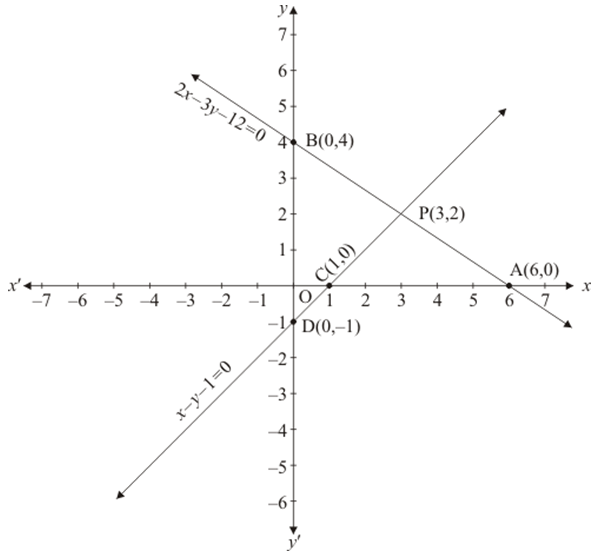
The area of the triangle formed by the lines $2x + 3y = 12, x - y - 1 = 0$ and $x = 0.$
  • A
    $7$ sq. units
  • $7.5$ sq units
  • C
    $6.5$ sq units
  • D
    $6$ sq. units
Answer
Correct option: B.
$7.5$ sq units
Given $2x + 3y = 12, x - y - 1 = 0$ and $x = 0$
If $x = 0$ we have plotting points as $D(0, -1), B(0, 4), P(3, 2)$

Therefore, area os $\text{BPD}=\frac{1}{2}(\text{Base}\times\text{Height})$
$=\frac{1}{2}(\text{BP}\times\text{PM})$
$=\frac{1}{2}(5\times3)$
$=\frac{1}{2}(15)$
$=7.5$
Area of triangle $\text{ABC}$ is $7.5$ square units.
Hence, the correct choice is $b.$
View full question & answer
MCQ 181 Mark
The area of the triangle formed by the lines $x = 3, y = 4$ and $x = y$ is:
  • $\frac{1}{2}$ sq. unit
  • B
    $1$ sq. unit
  • C
    $2$ sq. unit
  • D
    None of these
Answer
Correct option: A.
$\frac{1}{2}$ sq. unit
Given $x = 3, y = 4$ and $x = y$
Thus, when $x = 1,$ then $y = 1$
So, area of $\triangle=\frac{1}{2}\times\text{base}\times\text{height}$
$=\frac{1}{2}\times1\times1$
$=\frac{1}{2}$ sq. unit
View full question & answer
MCQ 191 Mark
If $x = a, y = b$ is the solution of the systems of equations $x - y = 2$ and $x + y = 4,$ then the values of $a$ and $b$ are, respectively.
  • $3$ and $1$
  • B
    $3$ and $5$
  • C
    $5$ and $3$
  • D
    $-1$ and $-3$
Answer
Correct option: A.
$3$ and $1$
Since, $x = a$ and $y = b$ is the solution of the equations $x - y = 2$ and $x + y = 4,$ then these values will satisfy that equations
$a - b = 2 .....(i)$
and $a + b = 4 .....(ii)$
By adding $(i)$ and $(ii)$ we get
$2a = 6$
Therefore, $a = 3$
By putting $a = 3$ in $(i),$ we get
$3 - b = 2$ Therefore, $b = 1$
Thus, $a = 3, b = 1$
View full question & answer
MCQ 201 Mark
The value of $k$ for which the system of equations has no solution is:
$x + 2y = 5$
$3x + ky + 15 = 0$
  • $6$
  • B
    $-6$
  • C
    $\frac{3}{2}$
  • D
    None of these
Answer
Correct option: A.
$6$
The given system of equation is
$x + 2y = 5$
$3x + ky + 15 = 0$
If $\frac{\text{a}_1}{\text{a}_2}=\frac{\text{b}_1}{\text{b}_2}=\frac{\text{c}_1}{\text{c}_2}$ then the equation have no solution
$\frac{1}{3}=\frac{2}{\text{k}}=\frac{-5}{-15}$
By cross multiply we get
$k \times 1 = 3 \times 2$
$k = 6$
Hence, the correct choice is $a.$
View full question & answer
MCQ 211 Mark
If the system of equations has infinitely many solutions, then:
$2x + 3y = 7$
$2ax + (a + b)y = 28$
  • A
    $a = 2b$
  • $b = 2a$
  • C
    $a + 2b = 0$
  • D
    $2a + b = 0$
Answer
Correct option: B.
$b = 2a$
The given equation are,
$2x + 3y = 7 .....(i)$
$2ax + (a + b)y = 28 .....(ii)$
For infinite many solutions,
$\frac{\text{a}_1}{\text{a}_2}=\frac{\text{b}_1}{\text{b}_2}=\frac{\text{c}_1}{\text{c}_2}$
$\Rightarrow\frac{2}{2\text{a}}=\frac{3}{(\text{a}+\text{b})}=\frac{-7}{-28}$
$\Rightarrow\frac{2}{2\text{a}}=\frac{-7}{-28}$
$\Rightarrow\frac{1}{\text{a}}=\frac{1}{4}$
$\Rightarrow\text{a}=4$
and, $\frac{3}{(\text{a}+\text{b})}=\frac{1}{4}$
$\Rightarrow\text{a}+\text{b}=12$
$\Rightarrow4+\text{b}=12$
$\Rightarrow\text{b}=8$
Thus, $b = 2a$
View full question & answer
M.C.Q (1 Marks) - Maths STD 10 Questions - Vidyadip