Questions

4 Marks Questions

Take a timed test

26 questions · self-marked practice — reveal the answer and mark yourself.

Question 14 Marks
There are six cards in a box, each bearing a number from 0 to 5. Find the probability of each of the following events, that a card drawn shows,
(1) a natural number.
(2) a number less than 1.
(3) a whole number.
(4) a number is greater than 5.
Answer
Probability that card drawn shows natural number,
$p ( N )=\frac{\text { Number of natural numbers }}{\text { Total number of numbers }}$
$\therefore p ( N )=\frac{5}{6}$
(2) Probability that card drawn shows a number less than 1,
$p(L)=\frac{\text { Number of numbers less than } 0}{\text { Total number of numbers }}$
$\therefore p(L)=\frac{1}{6}$
(3) Probability that card drawn shows a whole number,
$p(W)=\frac{\text { Number of whole numbers }}{\text { Total number of numbers }}$
$\therefore p(W)=\frac{6}{6}=1$
(4) Probability that card drawn shows a number is greater than 5 ,
$p(W)=\frac{\text { Number of numbers greater than } 5}{\text { Total number of numbers }}$
$\therefore p(W)=\frac{0}{6}=0$
View full question & answer
Question 24 Marks
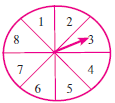
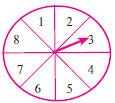
In a game of chance, a spinning arrow comes to rest at one of the numbers 1, 2, 3, 4, 5, 6, 7, 8.
All these are equally likely outcomes.
Find the probability that it will rest at
(1) 8.
(2) an odd number.
(3) a number greater than 2.
(4) a number less than 9.
Answer
Probability that it will rest at $8=\frac{1}{8}$
(2) Probability that it will rest at an odd number, $p(O)=\frac{\text { Number of odd numbers }}{\text { Total number of numbers }}$
$\therefore p ( O )=\frac{4}{8}=\frac{1}{2}$
(3) Probability that it will rest at a number greater than $2, p(E)=\frac{\text { Number of numbers greater than } 2}{\text { Total number of numbers }}$
$\therefore p ( E )=\frac{6}{8}=\frac{3}{4}$
(4) Probability that it will rest at a number less than $9, p(E)=\frac{\text { Number of numbers less than } 9}{\text { Total number of numbers }}$
$\therefore p ( E )=\frac{8}{8}=1$
View full question & answer
Question 34 Marks
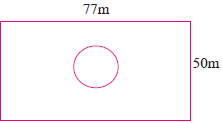
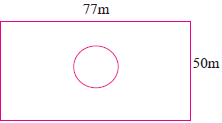
Length and breadth of a rectangular garden are 77 m and 50 m. There is a circular lake in the garden having diameter 14 m. Due to wind, a towel from a terrace on a nearby building fell into the garden. Then find the probability of the event that it fell in the lake.
Answer
Probability of the event that towel fell in the lake,$p(E)=\frac{\text { Area of lake }}{\text { Total area of garden }}$
Area of lake $=\pi r ^2$
$\Rightarrow=\frac{22}{7} \times \frac{14}{2} \times \frac{14}{2}$
$\Rightarrow=154 m^2$
Area of garden = length $\times$ breadth
$\Rightarrow=77 \times 50$
$\Rightarrow=3850 m^2$
$\therefore p ( E )=\frac{154}{3850}$
$=\frac{1}{25}$
View full question & answer
Question 44 Marks
Two dice are rolled, write the sample space ‘S’ and number of sample points
n(S). Also write events and number of sample points in the event according to the
given condition.
(i) Sum of the digits on upper face is a prime number.
(ii) Sum of the digits on the upper face is multiple of 5.
(iii) Sum of the digits on the upper face is 25.
(iv) Digit on the upper face of the first die is less than the digit on the second die.
View full question & answer
Question 54 Marks
A sanitation committee of 2 members is to be formed from 3 boys and
2 girls. Write sample space ‘S’ and number of sample points n(S). Also write
the following events in set form and number of sample points in the event.
(i) Condition for event A : at least one girl must be a member of the committee.
(ii) Condition for event B : Committee must be of one boy and one girl.
(iii) Condition for event C : Committee must be of boys only.
(iv) Condition for event D : At the most one girl should be a member of the committee.
View full question & answer
Question 64 Marks
Two coins are tossed simultaneously. Write the sample space (S) and number
of sample points n(S). Also write the following events in the set form and write
the number of sample points in each event.
(i) Condition for event A : to get at least one tail.
(ii) Condition for event B : to get only one head.
(iii) Condition for event C : to get at most one tail.
(iv) Condition for event D : to get no head.
Answer
If two coins are tossed simultaneously,
S = {HH, HT, TH, TT} n(S) = 4
(i) Condition for event A : at least one head.
A = {HH, HT, TH} n(A) = 3
(ii) Condition for event B : only one head.
B = { HT, TH} n(B) = 2
(iii) Condition for event C : at most one tail.
C = {HH, HT, TH} n(C) = 3
(iv) Condition for event D : No head.
D = {TT} n(D) = 1
View full question & answer
Question 74 Marks
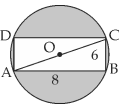
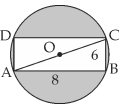
In the adjoining figure, a dart thrown lands in the interior of the circle. What is the probability that the dart will land in the shaded region.
Image
View full question & answer
Question 84 Marks
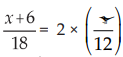
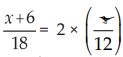
A box contains 12 balls, out of which x are black, (i) If one ball is drawn at random, what is the probability that it will be a black ball? (ii) If 6 more black balls are put in the bag, the probability of drawing a black ball will double than that in (i), find x.
View full question & answer
Question 94 Marks
Each coefficient in equation $a x^2+b x+c=0$ is obtained by throwing an ordinary die. Find the probability that the equation has real roots.
Answer
$a x^2+b x+c=0$
a, b and c can be selected from 1, 2, 3, 4, 5, 6 in $6^3$ ways.
$\therefore  n(S)=216$
For the equation to have real roots,
$b^2-4 a c>0$
$b^2 \geq 4 a c$
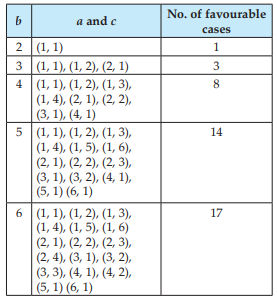
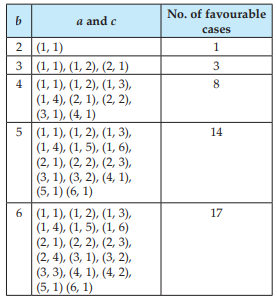
The values of a, b and c satisfying the above condition can be tabulated:
Image
There are 43 favourable caseds.
Let A be the event that the value of a, b, c selected in such a way that the roots of equation are real.
$\therefore n(A)=43$
$P ( A )=\frac{n(A)}{n(S)}=\frac{43}{216}$
$\therefore P(A)=\frac{43}{216}$
View full question & answer
Question 104 Marks
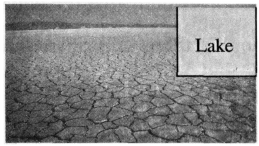
A missing helicopter is reported to have crashed somewhere in the rectangular region as shown in figure. What is the probability that it crashed inside the lake shown in the figure?
Image
Answer
For rectangular region:
Length = 9 km, Breadth = 4.5 km
Area of rectangular region = Length × Breadth
= 9 × 4.5
= 40.5 sq. km
For rectangular Lake:
length = 9 – 6 = 3 km
breadth = 4.5 – 2 = 2.5 km
Area of rectangular lake = length × breadth
= 3 × 2.5
= 7.5 sq. km
Let A be the event that the helicopter crashed inside the lake.
$P ( A )=\frac{\text { Area of lack }}{\text { Area of rectangular region }}$
$=\frac{7.5}{40.5}$
$=\frac{70}{405}$
$P(A)=\frac{5}{27}$
View full question & answer
Question 114 Marks
What is the probability that a leap year has 53 Sundays ?
Answer
A leap year has 366 days, which is equivalent to
52 weeks and 2 days.
52 weeks will have 52 Sundays.
The sample space for remaining two days can be
as follows:
$\therefore$ S= {Sunday-Monday, Monday-Tuesday, Tuesday -Wednesday, Wednesday-Thursday, Thursday-Friday, Friday-Saturday}
$\therefore n(S)=7$
Let A be the event of getting $53^{ rd }$ Sunday in remaining 2 days.
A = {Saturday-Sunday, Sunday-Monday}
$\therefore n(A)=2$
$P ( A )=\frac{n(A)}{n(S)}=\frac{2}{7}$
$\therefore$ The probability that a leap year has 53 Sundays is $\frac{2}{7}$.
View full question & answer
Question 124 Marks
What is the probability than an ordinary year has 53 Sundays?
View full question & answer
Question 134 Marks
Two customers Sumit and Amit are visiting a particular shop in the same week (Tuesday to Saturday). Each is equally likely to visit the shop on any day as on another day. What is the probability that both will visit the shop on: (i) the same day (ii) different days (iii) Consecutive days.
View full question & answer
Question 144 Marks
Answer
Probability of the event that towel fell in the lake, $p(E)=\frac{\text { Area of lake }}{\text { Total area of garden }}$
Area of lake $=\pi r^2$
$\begin{array}{l}
\Rightarrow=\frac{22}{7} \times \frac{14}{2} \times \frac{14}{2} \\
\Rightarrow=154 m ^2
\end{array}\\
Area of garden =\ length$ $\times$$breadth$
$\begin{array}{l}
\Rightarrow=77 \times 50 \\
\Rightarrow=3850 m ^2 \\
\therefore p(E)=\frac{154}{3850} \\
=\frac{1}{25}
\end{array}$
View full question & answer
Question 154 Marks
There are six cards in a box, each bearing a number from 0 to 5. Find the probability of each of the following events, that a card drawn shows,
(1) a natural number.
(2) a number less than 1.
(3) a whole number.
(4) a number is greater than 5.

Answer
Probability that card drawn shows natural number,
$\begin{array}{l}
p(N)=\frac{\text { Number of natural numbers }}{\text { Total number of numbers }} \\
\therefore p ( N )=\frac{5}{6}
\end{array}$
(2) Probability that card drawn shows a number less than 1 ,
$\begin{array}{l}
p(L)=\frac{\text { Number of numbers less than } 0}{\text { Total number of numbers }} \\
\therefore p(L)=\frac{1}{6}
\end{array}$
(3) Probability that card drawn shows a whole number,
$\begin{array}{l}
p(W)=\frac{\text { Number of whole numbers }}{\text { Total number of numbers }} \\
\therefore p(W)=\frac{6}{6}=1
\end{array}$
(4) Probability that card drawn shows a number is greater than 5 ,
$\begin{array}{l}
p(W)=\frac{\text { Number of numbers greater than } 5}{\text { Total number of numbers }} \\
\therefore p(W)=\frac{0}{6}=0
\end{array}$
View full question & answer
Question 164 Marks
Answer
Probability that it will rest at $8=\frac{1}{8}$
(2) Probability that it will rest at an odd number,
$p(O)=\frac{\text { Number of odd numbers }}{\text { Total number of numbers }}$
$\therefore p ( O )=\frac{4}{8}=\frac{1}{2}$
(3) Probability that it will rest at a number greater than
$2, p(E)=\frac{\text { Number of numbers greater than } 2}{\text { Total number of numbers }}$
$\therefore p ( E )=\frac{6}{8}=\frac{3}{4}$
(4) Probability that it will rest at a number less than
$9, p(E)=\frac{\text { Number of numbers less than 9}}{\text { Total number of numbers }}$
$\therefore p(E)=\frac{8}{8}=1$
View full question & answer
Question 174 Marks
Two dice are rolled, write the sample space ‘S’ and number of sample points
n(S). Also write events and number of sample points in the event according to the
given condition.
(i) Sum of the digits on upper face is a prime number.
(ii) Sum of the digits on the upper face is multiple of 5.
(iii) Sum of the digits on the upper face is 25.
(iv) Digit on the upper face of the first die is less than the digit on the second die.
Answer
Sample space,
S={(1,1),(1,2),(1,3),(1,4),(1,5),(1,6),
(2,1),(2,2),(2,3),(2,4),(2,5),(2,6),
(3,1),(3,2),(3,3),(3,4),(3,5),(3,6),
(4,1),(4,2),(4,3),(4,4),(4,5),(4,6),
(5,1),(5,2),(5,3),(5,4),(5,5),(5,6),
(6,1),(6,2),(6,3),(6,4),(6,5),(6,6)} n(S)=36
(i) Event (E) : The sum of the digits on the upper face is a prime number.
E = {(1,1),(1,2),(1,4),(1,6),(2,1),(2,3),(2,5),(3,2),(3,4),
(4,1),(4,3),(5,2),(5,6),(6,1),(6,5)}
(\therefore) n ( E )=15
(ii) Event (F) : The sum of the digits on the upper face is a multiple of 5.
(F ={(1,4),(2,3),(3,2),(4,1),(4,6),(5,5),(6,4)}
(\therefore) n ( F )=7)
(iii) Event (G) : The sum of the digits on the upper face is 25 .
G ={}=(\phi)
(\therefore) n ( G )=0
(iv) Event (H) : The number on upper face of first die is less than the digit on second die.
H ={(1,2)(1,3)(1,4)(1,5)(1,6)(2,3)(2,4)(2,5)(2,6)
(3,4)(3,5)(3,6)(4,5)(4,6)(5,6)}
(\therefore) n ( H )=15
View full question & answer
Question 184 Marks
A sanitation committee of 2 members is to be formed from 3 boys and
2 girls. Write sample space ‘S’ and number of sample points n(S). Also write
the following events in set form and number of sample points in the event.
(i) Condition for event A : at least one girl must be a member of the committee.
(ii) Condition for event B : Committee must be of one boy and one girl.
(iii) Condition for event C : Committee must be of boys only.
(iv) Condition for event D : At the most one girl should be a member of the committee.
Answer
Suppose $B_1, B_2, B_3$ are three boys and $G_1, G_2$ are two girls
Out of these boys and girls, a sanitation committee of two members is to be formed.
$\therefore S =\left\{ B _1 B _2, B _1 B _3, B _2 B _3, B _1 G _1, B _1 G _2, B _2 G _1, B _2 G _2, B _3 G _1, B _3 G _2, G _1 G _2\right\} \quad \therefore n ( S )=10$
(i) Condition for event $A$ is that at least one girl should be in the committee.
$A=\left\{B_1 G_1, B_1 G_2, B_2 G_1, B_2 G_2, B_3 G_1, B_3 G_2, G_1 G_2\right\} \quad \therefore n(A)=7$
(ii) Condition for event $B$ is that one boy and one girl should be there in the committee.
$B=\left\{B_1 G_1, B_1 G_2, B_2 G_1, B_2 G_2, B_3 G_1, B_3 G_2\right\} \quad \therefore n(B)=6$
(iii) Condition for event $C$ is that there should be only boys in the committee.
$C =\left\{ B _1 B _2, B _1 B _3, B _2 B _3\right\} \quad n ( C )=3$
(iv) Condition for event $D$ is that there can be at most one girl in the committee.
$D =\left\{ B _1 B _2, B _1 B _3, B _2 B _3, B _1 G _1, B _1 G _2, B _2 G _1, B _2 G _2, B _3 G _1, B _3 G _2\right\} \quad \therefore \quad n ( D )=9$
View full question & answer
Question 194 Marks
Two coins are tossed simultaneously. Write the sample space (S) and number
of sample points n(S). Also write the following events in the set form and write
the number of sample points in each event.
(i) Condition for event A : to get at least one tail.
(ii) Condition for event B : to get only one head.
(iii) Condition for event C : to get at most one tail.
(iv) Condition for event D : to get no head.
Answer
If two coins are tossed simultaneously,
S = {HH, HT, TH, TT} n(S) = 4
(i) Condition for event A : at least one head.
A = {HH, HT, TH} n(A) = 3
(ii) Condition for event B : only one head.
B = { HT, TH} n(B) = 2
(iii) Condition for event C : at most one tail.
C = {HH, HT, TH} n(C) = 3
(iv) Condition for event D : No head.
D = {TT} n(D) = 1
View full question & answer
Question 204 Marks
What is the probability that a leap year has 53 Sundays ?
Answer
A leap year has 366 days, which is equivalent to
52 weeks and 2 days.
52 weeks will have 52 Sundays.
The sample space for remaining two days can be
as follows:
$\therefore$ S= {Sunday-Monday, Monday-Tuesday, Tuesday -Wednesday, Wednesday-Thursday, Thursday-Friday, Friday-Saturday}
$\therefore n(S)=7$
Let A be the event of getting $53^{ rd }$ Sunday in remaining 2 days.
A = {Saturday-Sunday, Sunday-Monday}
$\therefore n(A)=2$
$P ( A )=\frac{n(A)}{n(S)}=\frac{2}{7}$
$\therefore$ The probability that a leap year has 53 Sundays is $\frac{2}{7}$.
View full question & answer
Question 214 Marks
What is the probability than an ordinary year has 53 Sundays?
View full question & answer
Question 224 Marks
Two customers Sumit and Amit are visiting a particular shop in the same week (Tuesday to Saturday). Each is equally likely to visit the shop on any day as on another day. What is the probability that both will visit the shop on: (i) the same day (ii) different days (iii) Consecutive days.
View full question & answer
Question 234 Marks
In the adjoining figure, a dart thrown lands in the interior of the circle. What is the probability that the dart will land in the shaded region.
Image
View full question & answer
Question 244 Marks
Each coefficient in equation $a x^2+b x+c=0$ is obtained by throwing an ordinary die. Find the probability that the equation has real roots.
Answer
$a x^2+b x+c=0$
a, b and c can be selected from 1, 2, 3, 4, 5, 6 in $6^3$ ways.
$\therefore  n(S)=216$
For the equation to have real roots,
$b^2-4 a c>0$
$b^2 \geq 4 a c$
The values of a, b and c satisfying the above condition can be tabulated:
Image
There are 43 favourable caseds.
Let A be the event that the value of a, b, c selected in such a way that the roots of equation are real.
$\therefore n(A)=43$
$P ( A )=\frac{n(A)}{n(S)}=\frac{43}{216}$
$\therefore P(A)=\frac{43}{216}$
View full question & answer
Question 254 Marks
A missing helicopter is reported to have crashed somewhere in the rectangular region as shown in figure. What is the probability that it crashed inside the lake shown in the figure?
Image
Answer
For rectangular region:
Length = 9 km, Breadth = 4.5 km
Area of rectangular region = Length × Breadth
= 9 × 4.5
= 40.5 sq. km
For rectangular Lake:
length = 9 – 6 = 3 km
breadth = 4.5 – 2 = 2.5 km
Area of rectangular lake = length × breadth
= 3 × 2.5
= 7.5 sq. km
Let A be the event that the helicopter crashed inside the lake.
$P ( A )=\frac{\text { Area of lack }}{\text { Area of rectangular region }}$
$=\frac{7.5}{40.5}$
$=\frac{70}{405}$
$P(A)=\frac{5}{27}$
View full question & answer
Question 264 Marks
A box contains 12 balls, out of which x are black, (i) If one ball is drawn at random, what is the probability that it will be a black ball? (ii) If 6 more black balls are put in the bag, the probability of drawing a black ball will double than that in (i), find x.
View full question & answer