Questions

1 Marks Question

Take a timed test

36 questions · self-marked practice — reveal the answer and mark yourself.

Question 11 Mark
Two circles of radii 5.5 cm and 4.2 cm touch each other externally. Find the distance between their centres.

Answer
Given: Two circles are touching each other externally


We know that if the circles touch each other externally, distance between their centres is equal to the sum of their radii.


⇒distance between their centres = 5.5 cm + 4.2 cm = 9.7 cm


View full question & answer
Question 21 Mark
Two circles having radii 3.5 cm and 4.8 cm touch each other internally. Find the distance between their centres.

Answer
Given: Two circles are touching each other internally.


∵The distance between the centres of the circles touching internally is equal to the difference of their radii.


⇒distance between their centres = 4.8 cm – 3.5 cm = 1.3 cm


View full question & answer
Question 31 Mark
What is the distance between two parallel tangents of a circle having radius4.5 cm ? Justify your answer.
Answer
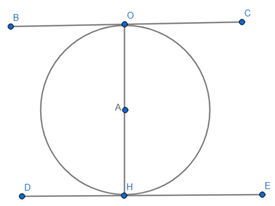
Let BC and DE be the parallel tangents to a circle centered at A with point of contact O and H respectively. On joining OH, we find OH is the diameter of the circle.∠ BOA = 90° = ∠ DHA {Using tangent-radius theorem which states that a tangent at any point of a circle is perpendicular to the radius at the point of contact.}
Distance between BC and DE = OH
∵ OH is perpendicular to BC and DE.
OH = 2 × 4.5 cm = 9 cm
View full question & answer
Question 41 Mark
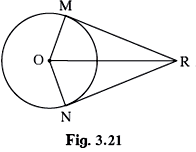
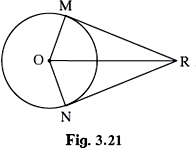
Seg RM and seg RN are tangent segments of a circle with centre O. Prove that seg OR bisects ∠MRN as well as ∠MON.
Answer
In triangle MOR and triangle NOR,
MR = NR {∵Tangents from same external point are congruent to each other.}
OR = OR {Common}
OM = ON {Radius of the circle}
⇒ ΔMOR ≅ ΔNOR {By SSS}
⇒ ∠ROM = ∠RON
And ∠MRO = ∠NRO {C.P.C.T.}
Hence proved that seg OR bisects ∠MRNas well as ∠MON.
View full question & answer
Question 51 Mark
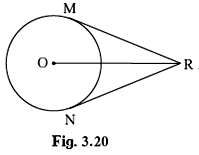
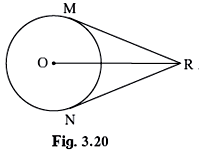
In the adjoining figure, O is the centre of the circle. From point R, seg RM and seg RN are tangent segments touching the circle at M and N. If (OR) = 10 cm and radius of the circle = 5 cm, then
What is the measure of ∠MRN?
Answer
Similarly, ∠NRO = 30°
⇒∠MRN = ∠ MRO + ∠NRO = 30° + 30° = 60°
View full question & answer
Question 61 Mark
In the adjoining figure, O is the centre of the circle. From point R, seg RM and seg RN are tangent segments touching the circle at M and N. If (OR) = 10 cm and radius of the circle = 5 cm, then
What is the measure of ∠MRO?
Answer
$\tan R=\frac{O M}{M R}=\frac{5}{5 \sqrt{3}} $
$ \Rightarrow \tan R=\frac{1}{\sqrt{3}}=\tan 30^{\circ}$
⇒∠MRO = 30°
View full question & answer
Question 71 Mark
In the adjoining figure, $O$ is the centre of the circle. From point $R$, seg $RM$ and seg $RN$ are tangent segments touching the circle at $M$ and $N$.
$If (OR) = 10\ cm$ and radius of the circle = $5\ cm,$ then
What is the length of each tangent segment?
Answer
Here $O M$ is the radius of the circle and $M$ and $N$ are the points of contact of $M R$ and $N R$ respectively. $\Rightarrow \angle RMO =90^{\circ}$ Using tangent-radius theorem which states that a tangent at any point of a circle is perpendicular to the radius at the point of contact.
In triangle $O R M$ right-angled at $M$,
Given that $O R=10 cm$ and $O M=5 cm$ {Radius of the circle}
$O R^2=O M^2+R M^2$ {Using Pythagoras theorem }
$\Rightarrow M R^2=10^2-5^2$
$\Rightarrow M R^2=100-25$
$\Rightarrow M R=\sqrt{ } 75$
$\Rightarrow M R=5 \sqrt{ } 3 cm$
Also, $RN =5 \sqrt{ } 3 cm\{\because$ Tangents from the same external point are congruent to each other.}
View full question & answer
Question 81 Mark
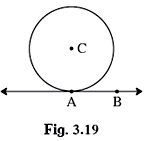
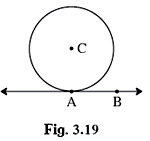
In the adjoining figure the radius of a circle with centre C is 6 cm, line AB is a tangent at A. Answer the following questions.
What is the measure of ∠ABC ? Why?
Answer
In triangle ABC right-angled at A,
AB = CA = 6 cm
⇒∠ABC = ∠ACB {Angles opposite to equal sides are equal}
⇒∠ABC + ∠ACB + ∠ BAC = 180° {Angle sum property of the triangle}
⇒ 2∠ABC = 90° {∵ ∠ BAC = 90°}
⇒ ∠ABC = 45°
View full question & answer
Question 91 Mark
In the adjoining figure the radius of a circle with centre $C$ is $6\ cm$ , line $A B$ is a tangent at $A$. Answer the following questions.
$d(A, B)=6 cm \text {, find } d(B, C)$
Answer
In triangle $A B C$ right-angled at $A$,
Given $A B=6 cm$ and $C A=6 cm$
$BC ^2= AB ^2+C A^2$ {Using Pythagoras theorem }
$\Rightarrow B C^2=6^2+6^2$
$\Rightarrow B C^2=36+36$
$\Rightarrow B C=\sqrt{ } 72$
$\Rightarrow B C=6 \sqrt{ } 2 cm$
View full question & answer
Question 101 Mark
In the adjoining figure the radius of a circle with centre C is 6 cm, line AB is a tangent at A. Answer the following questions.
What is the distance of point C from line AB? Why?
Answer
CA is the radius of the circle which is perpendicular to the tangent AB.


So, the perpendicular distance of line AB from C = CA = 6 cm

View full question & answer
Question 111 Mark
In the adjoining figure the radius of a circle with centre C is 6 cm, line AB is a tangent at A. Answer the following questions.
What is the measure of ∠CAB ? Why?
Answer
ere CA is the radius of the circle and A is the point of contact of the tangent AB.


⇒ ∠CAB = 90° Using tangent-radius theorem which states that a tangent at any point of a circle is perpendicular to the radius at the point of contact.

View full question & answer
Question 121 Mark
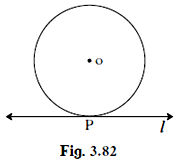
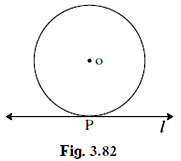
Line l touches a circle with centre Oat point P. If radius of the circle is 9 cm,answer the following.
(1) What is d(O, P) = ? Why ?
(2) If d(O, Q) = 8 cm, where does thepoint Q lie?
(3) If d(PQ) = 15 cm, How manylocations of point R are line online l ? At what distance will eachof them be from point P?
Answer
The perpendicular distance of O from P = radius of the circle = 9 cm.
(2)Q lies in the interior of the circle because P lieing on the circumference of the circle is at a distance of 9 cm.
(3)Position of R is not specified.
View full question & answer
Question 131 Mark
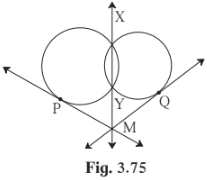
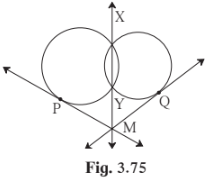
In figure 3.75, two circles intersect each other in points X and Y.Tangents drawn from a point M on line XY touch the circles at P and Q. Prove that, seg PM ≅ seg QM.
Image
Answer
self
View full question & answer
Question 141 Mark
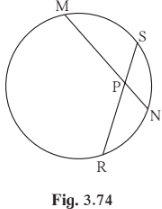
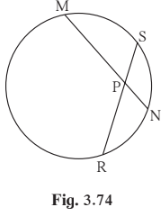
In figure 3.74, chord MN and chord RS intersect each other at point P.
If PR = 6, PS = 4, MN = 11 find PN.
Image
Answer
By theorem on interesecting chords,
PN ×PM=PR ×PS... (I)
let PN = x. ∴PM = 11 - x
substituting the values in (I),
x (11 - x) = 6 × 4
∴ 11x - x²- 24 = 0
∴ x² - 11x + 24 = 0
∴ (x - 3) (x - 8) = 0
∴ x - 3 = 0 or x - 8 = 0
∴ x = 3 or x = 8
∴ PN = 3 or PN = 8
View full question & answer
Question 151 Mark
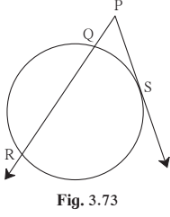
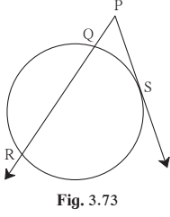
In figure 3.73, seg PS is a tangent segment. Line PR is a secant.
If PQ = 3.6,
QR = 6.4, find PS.
Image
Answer
PS²= PQ × PR .... tangent secant segments
theorem
= PQ × (PQ + QR)
= 3.6 × [3.6 + 6.4]
= 3.6 × 10
= 36
∴PS = 6
View full question & answer
Question 191 Mark
Two circles of radii 5.5 cm and 4.2 cm touch each other externally. Find the distance between their centres.
Answer
Given: Two circles are touching each other externally
We know that if the circles touch each other externally, distance between their centres is equal to the sum of their radii.
⇒distance between their centres = 5.5 cm + 4.2 cm = 9.7 cm
View full question & answer
Question 201 Mark
Two circles having radii 3.5 cm and 4.8 cm touch each other internally. Find the distance between their centres.
Answer
Given: Two circles are touching each other internally.
∵The distance between the centres of the circles touching internally is equal to the difference of their radii.
⇒distance between their centres = 4.8 cm – 3.5 cm = 1.3 cm
View full question & answer
Question 211 Mark
What is the distance between two parallel tangents of a circle having radius4.5 cm ? Justify your answer.
Answer
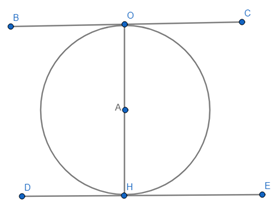
Let BC and DE be the parallel tangents to a circle centered at A with point of contact O and H respectively. On joining OH, we find OH is the diameter of the circle.∠ BOA = 90° = ∠ DHA {Using tangent-radius theorem which states that a tangent at any point of a circle is perpendicular to the radius at the point of contact.}
Distance between BC and DE = OH
∵ OH is perpendicular to BC and DE.
OH = 2 × 4.5 cm = 9 cm
Image
View full question & answer
Question 241 Mark
In the adjoining figure, O is the centre of the circle. From point R, seg RM and seg RN are tangent segments touching the circle at M and N. If (OR) = 10 cm and radius of the circle = 5 cm, then
What is the measure of ∠MRO?
Answer
$\begin{array}{l}\tan R=\frac{ OM }{ MR }=\frac{5}{5 \sqrt{3}} \\ \Rightarrow \tan R=\frac{1}{\sqrt{3}}=\tan 30^{\circ} \\ \Rightarrow \angle M R O=30^{\circ}\end{array}$
View full question & answer
Question 251 Mark
In the adjoining figure, O is the centre of the circle. From point R, seg RM and seg RN are tangent segments touching the circle at M and N. If (OR) = 10 cm and radius of the circle = 5 cm, then
What is the length of each tangent segment?
Answer
Here OM is the radius of the circle and M and N are the points of contact of MR and NR respectively.
⇒ ∠RMO = 90° Using tangent-radius theorem which states that a tangent at any point of a circle is perpendicular to the radius at the point of contact.
In triangle ORM right-angled at M,
Given that OR = 10 cm and OM = 5 cm {Radius of the circle}
OR2 = OM2 + RM2 {Using Pythagoras theorem}
⇒MR2 = 102 -52
⇒MR2 = 100 - 25
⇒ MR = √75
⇒ MR = 5√3 cm
Also, RN = 5√3 cm {∵ Tangents from the same external point are congruent to each other.}
View full question & answer
Question 271 Mark
In the adjoining figure the radius of a circle with centre C is 6 cm, line AB is a tangent at A. Answer the following questions.
d(A,B) = 6 cm, find d(B,C).
Answer
In triangle ABC right-angled at A,

Given AB = 6 cm and CA = 6 cm
BC2 = AB2 + CA2 {Using Pythagoras theorem}
⇒ BC2 = 62 + 62
⇒ BC2 = 36 + 36
⇒ BC = √72
⇒ BC = 6√2 cm
View full question & answer
Question 281 Mark
In the adjoining figure the radius of a circle with centre C is 6 cm, line AB is a tangent at A. Answer the following questions.
What is the distance of point C from line AB? Why?
Answer
CA is the radius of the circle which is perpendicular to the tangent AB.
So, the perpendicular distance of line AB from C = CA = 6 cm
View full question & answer
Question 291 Mark
In the adjoining figure the radius of a circle with centre C is 6 cm, line AB is a tangent at A. Answer the following questions.
What is the measure of ∠CAB ? Why?
Answer
ere CA is the radius of the circle and A is the point of contact of the tangent AB.
⇒ ∠CAB = 90° Using tangent-radius theorem which states that a tangent at any point of a circle is perpendicular to the radius at the point of contact.
View full question & answer
Question 301 Mark
Answer
The perpendicular distance of O from P = radius of the circle = 9 cm.
(2)Q lies in the interior of the circle because P lieing on the circumference of the circle is at a distance of 9 cm.
(3)Position of R is not specified.
View full question & answer
Question 311 Mark
In figure 3.75, two circles intersect each other in points X and Y.Tangents drawn from a point M on line XY touch the circles at P and Q. Prove that, seg PM ≅ seg QM.
Image
Answer
Given: Two circles intersect at points X and Y. A point M lies on line XY. Tangents drawn from M touch the circles at P and Q respectively.
Join MP and MQ.
The radius drawn to the point of contact is perpendicular to the tangent.
So,
∠MPY = 90° and ∠MQY = 90°
In right △MPY and right △MQY,
MY is common side,
∠MPY = ∠MQY = 90°
Also, YP = YQ (since Y is the point of intersection of the two circles and lies on both circles at equal distance from their centers).
Therefore, by RHS congruence,
△MPY ≅ △MQY
So,
PM = QM
Hence proved.
View full question & answer
Question 321 Mark
In figure 3.74, chord MN and chord RS intersect each other at point P.
If PR = 6, PS = 4, MN = 11 find PN.
Image
Answer
By theorem on interesecting chords,
PN ×PM=PR ×PS... (I)
let PN = x. ∴PM = 11 - x
substituting the values in (I),
x (11 - x) = 6  × 4
∴ 11x - x²- 24 = 0
∴ x² - 11x + 24 = 0
∴ (x - 3) (x - 8) = 0
∴ x - 3 = 0 or x - 8 = 0
∴ x = 3 or x = 8
∴ PN = 3 or PN = 8
View full question & answer
Question 331 Mark
In figure 3.73, seg PS is a tangent segment. Line PR is a secant.
If PQ = 3.6,
QR = 6.4, find PS.
Image
Answer
PS²= PQ  × PR .... tangent secant segments
theorem
= PQ  × (PQ + QR)
= 3.6  × [3.6 + 6.4]
= 3.6  × 10
= 36
∴PS = 6
View full question & answer