Questions

2 Marks Questions

Take a timed test

27 questions · self-marked practice — reveal the answer and mark yourself.

Question 12 Marks
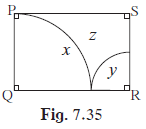
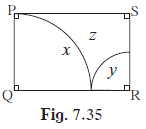
>In figure 7.35, □PQRS is a rectangle. If PQ = 14 cm, QR = 21 cm, find the areas of the parts x, y and z.
Answer
Since part x is a sector of a circle with radius, $\mathrm{r}=14 \mathrm{~cm}$ and the central angle is $90^{\circ}$, so the area of x will be equal to one-fourth of the area of circle with PQ as radius.
Area of circle with $P Q$ as radius $=\pi(P Q)^2$
$\Rightarrow x=\frac{1}{4} \times \pi \times P Q^2$
$\Rightarrow x=\frac{1}{4} \times \frac{22}{7} \times 14^2$
$\Rightarrow \mathrm{x}=154 \mathrm{sq} . \mathrm{cm}$
Similarly, area $y$ is also equal to one-fourth od area of circle with radius, $r=Q R-P Q$
$\Rightarrow r=21-14=7 \mathrm{~cm}$
Area of circle with $r$ as radius $=\pi(r)^2$
$\Rightarrow y=\frac{1}{4} \times \pi \times r^2$
$\Rightarrow y=\frac{1}{4} \times \frac{22}{7} \times 7^2$
$\Rightarrow \mathrm{y}=38.5 \mathrm{sq} . \mathrm{cm}$
Also,
$z=\text { Area of rectangle(PQRS) }-x-y$
Area of rectangle $=P Q \times Q R$
$\Rightarrow \text { Area of rectangle }=14 \times 21=294 \text { sq. } \mathrm{cm}$
$\Rightarrow z=294-154-38.5$
$\Rightarrow z=101.5 \mathrm{sq} . \mathrm{cm}$
$\therefore$ the area of $x, y$ and $z$ are 154 sq.cm, 38.5 sq.cm and $101.5 \mathrm{sq} . \mathrm{cm}$ respectively
View full question & answer
Question 22 Marks
>The area of a minor sector of a circle is $3.85 \mathrm{~cm}^2$ and the measure of its central angle is 36°. Find the radius of the circle.
Answer
As we know that,
Area of sector, $A=\frac{\theta}{360} \times \pi r^2$
Given area of sector, $A=3.85 sq . cm$
Radius of circle $=r$
Central angle, $\theta=36^{\circ}$
$\Rightarrow r=\sqrt{\frac{A \times 360}{\pi \times \theta}}$
On substituting the values, we get,
⇒ r = 3.5 cm
∴ Radius of circle is 3.5 cm
View full question & answer
Question 32 Marks
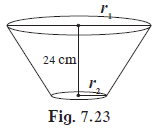
The circumferences of circular faces of a frustum are 132 cm and 88 cm and its height is 24 cm. To find the curved surface area of the frustum complete the following activity.$\left(\pi=\frac{22}{7}\right)$

Circumference $_1=2 \pi r_1=132$
$r_1=\frac{132}{2 \pi}=\square$
Circumference $_2=2 \pi \mathrm{r}_2=88$
$r_2=\frac{88}{2 \pi}=\square$
Slant height of frustum, $l=\sqrt{h^2+\left(r_1-r_2\right)^2}$
$=\sqrt{\square \square^2+\square^2}$
$=\square c m$
Curved Surface area of frustum $=\pi\left(r_1+r_2\right)$ l
$=\pi \times \square \times \square$
$=\square \text { sq. } \mathrm{cm}$
Answer
Circumference $_1=2 \pi r_1=132$
$\Rightarrow r_1=\frac{132}{2 \pi}=21$
Circumference $_2=2 \pi r r_2=88$
$\Rightarrow r_2=\frac{88}{2 \pi}=14$
Slant height of frustum, $l=\sqrt{h^2+\left(r_1-r_2\right)^2}$
$l=\sqrt{24^2+(21-14)^2}$
$l=\sqrt{24^2+7^2}$
$l=\sqrt{576+49}$
$l=25 \mathrm{~cm}$
Curved Surface area of frustum $=\pi\left(r_1+r_2\right) l$
$\Rightarrow$ Curved Surface Area of frustum $=\pi \times(21+14) \times 25$
$\Rightarrow$ Curved surface area $=\pi \times 35 \times 25=2750$ sq. $\cdot \mathrm{cm}$
View full question & answer
Question 42 Marks
The radii of two circular ends of frustum shape bucket are 14 cm and 7 cm. Height of the bucket is 30 cm. How many liters of water it can hold? (1 litre = $1000 \mathrm{~cm}^3$)
Answer
The two radii of frustum are, $r_1=14 \mathrm{~cm}$ and $r_2=7 \mathrm{~cm}$ Height of bucket, $\mathrm{H}=30 \mathrm{~cm}$
As we know that,
Volume of frustum, $V=\frac{1}{3} \pi H\left(r_1^2+r_2^2+r_1 r_2\right)$
$\Rightarrow V=\frac{1}{3} \times \frac{22}{7} \times 30 \times\left(14^2+7^2+14 \times 7\right)$
$\Rightarrow V=10780 \mathrm{~cm}^3$
Now, as 1 litre $=1000 \mathrm{~cm}^3$
$\Rightarrow V=10.780 \text { litre }$
$\therefore$ Bucket can hold 10.780 litres of water
View full question & answer
Question 52 Marks
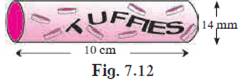
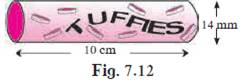
In the figure 7.12, a cylindrical wrapper of flat tablets is shown. The radius of a tablet is 7 mm and its thickness is 5 mm. How many such tablets are wrapped in the wrapper?
Answer
Since there are only flat tablets which are stacked onto each other inside the cylindrical wrapper, so the radius of the wrapper does not matter.
Height of wrapper, H = 10cm = 100mm
Thickness of the tablet, h = 5mm
Number of tablets $=\frac{\text { Height of wrapper }}{\text { Thickness of the tablet }}$
⇒ Number of the tablets = 20
∴ There are 20 tablets inside the cylindrical wrapper.
View full question & answer
Question 62 Marks
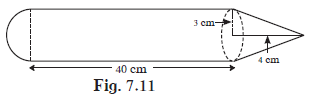
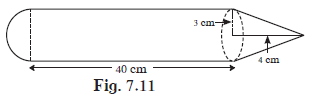
In figure 7.11, a toy made from a hemisphere, a cylinder and a cone is shown. Find the total area of the toy.
Answer
Radius of circular region, $\mathrm{r}=3 \mathrm{~cm}$
Height of Cylinder, $H=40 \mathrm{~cm}$
Height of cone, $\mathrm{h}=4 \mathrm{~cm}$
As we know,
Surface area of hemisphere, $A_H=2 \pi r^2$
Surface area of cylinder, $A_{c y}=2 \pi \mathrm{rH}$
Surface area of cone is,
$A_{C O}=\pi r \sqrt{r^2+h^2}$
$\Rightarrow A_{C O}=\pi r \sqrt{3^2+4^2}$
$\mathrm{A}_{\mathrm{CO}}=5 \pi \mathrm{r}$
Total area $=A_H+A_{C Y}+A_{C O}$
On substituting the values, we get,
$\Rightarrow$ Total area $=\pi r(2 r+2 H+5)$
$\Rightarrow$ Total area $=\pi \times 3 \times(6+80+5)$
$\Rightarrow$ Total area $=273 \pi$
$\therefore$ total area of the figure is $273 \pi \mathrm{sq} . \mathrm{cm}$
View full question & answer
Question 72 Marks
Find the surface area of a sphere of radius 7 cm.
Answer
Radius of sphere, $r=7 cm$
As we know, the surface area of sphere, $A=4 \pi r^2$
On substituting the values, we get,
$A = 4 \times \frac{22}{7} \times 7^2$
$\Rightarrow A =616 sq . cm$
$\therefore$ Surface area of sphere is 616 sq. cm
View full question & answer
Question 82 Marks
Find the total surface area of a cylinder if the radius of its base is 5 cm and height is 40 cm.

Answer
Radius of base of cylinder, r = 5 cm

Height of cylinder, H = 40 cm


As we know,


Total surface area of cylinder, A = 2πr (r + h)


On substituting the values, we get,


A = 2× (3.14)× 5× (5 + 40)


⇒ A = 1413 sq.cm


∴ Total surface area of square is 1413 sq. cm


View full question & answer
Question 92 Marks
Find the volume of a sphere of diameter 6 cm.
Answer
Diameter of the sphere, $d=6 cm$
$\Rightarrow$ Radius of sphere, $r=3 cm$
As we know, the volume of sphere, $V=\frac{4}{3} \pi r^3$
$\Rightarrow V=\frac{4}{3} \times \frac{22}{7} \times(3)^3$
$\Rightarrow V=113.04 cm^3$
$\therefore$ Volume of sphere is $113.04 cm^3$
View full question & answer
Question 102 Marks
A metal parallelopiped of measures $16 cm \times 11 cm \times 10 cm$ was melted to make coins. How many coins were made if the thickness and diameter of each coin was 2 mm and 2 cm respectively? $\left(\pi=\frac{22}{7}\right)$
Answer
Volume of parallelepiped, $V_P=$ Product of its three dimensions
$\Rightarrow V_p=16 \times 11 \times 10$
$\Rightarrow V_p=1760 cm^3$
Thickness of coin, $t =2 mm=0.2 cm$
Diameter of coin $=2 cm$
$\Rightarrow$ Radius of Coin, $r =1 cm$
Volume of one coin, $V _{ C }=\pi r ^2 t$
$\Rightarrow V_C=\frac{22}{7} \times 1^2 \times \frac{2}{10}$
$\Rightarrow V_C=0.6285 \text { cubic } cm$
Let the number of coins made be ' $n$ '
$\Rightarrow V _{ P }= n \times V _{ C }$
$\Rightarrow n=\frac{1760}{0.6285}$
$\Rightarrow n =2800$
$\therefore 2800$ coins are made.
View full question & answer
Question 112 Marks
In the figure $7.40,\angle AOB = 30^\circ, OA = 12\ cm .$ Find the area of the segment. $(\pi = 3.14)$
Answer
$\mathrm{A}(\text { segment } \mathrm{AXB})=\mathrm{r}^2\left[\begin{array}{c}\pi \theta \\ 360\end{array}-\frac{\sin \theta}{2}\right] $
$ =12^2\left[\frac{3.14 \times 30}{360}-\frac{\sin 30}{2}\right] $
$ =144\left[\frac{3.14}{12}-\frac{1}{2 \times 2}\right] $
$ =\frac{144}{4}\left[\frac{3.14}{3}-1\right]$
$=36\left[\frac{3.14-3}{3}\right] $
$=\frac{36}{3} \times 0.14$
$=12 \times 0.14 $
$=1.68 \mathrm{~cm}^2 \text {. } $
View full question & answer
Question 122 Marks
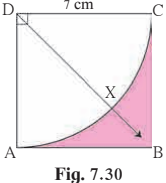
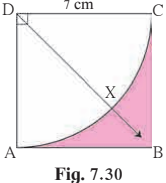
In figure 7.30, side of square ABCD is 7 cm. With centre D and radius DA,sector D - AXC is drawn. Fill in the following boxes properly and find out the area of the shaded region.
Image
Answer
Area of square $A B C D=$ side $^2$
$=7^2$
$=49 \mathrm{~cm}^2$
Sector D-AXC $=\frac{\theta}{360} \times \pi r^2$
$=\frac{90}{360} \times \frac{22}{7} \times 7^2$
$=\frac{1}{4} \times \frac{22}{7} \times 7 \times 7$
$=\frac{154}{4}$
$=38.5 \mathrm{~cm}^2$
$\therefore$ Area of shaded portion $=49-38.5$
$=10.5 \mathrm{~cm}^2$
View full question & answer
Question 132 Marks
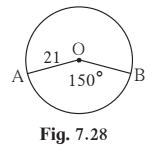
The measure of a central angle of a circle is 150 ° and radius of the circle is 21 cm. Find the length of the arc and area of the sector associated with the central angle.
Answer
$r=21 \mathrm{~cm}, \theta=150, \pi=\frac{22}{7}$
Area of the sector,
$A  =\frac{\theta}{360} \times \pi \mathrm{r}^2$
$ =\frac{150}{360} \times \frac{22}{7} \times 21 \times 21$
$=\frac{1155}{2}=577.5 \mathrm{~cm}^2$
Length of the arc, $l=\frac{\theta}{360} \times 2 \pi \mathrm{r}$
$ =\frac{150}{360} \times 2 \times \frac{22}{7} \times 21$
$=55 \mathrm{~cm} $
Image
View full question & answer
Question 142 Marks
Two cubes each with 12 cm edge, are joined end to end. Find the surface area of the resulting cuboid.
Answer
1440 sq cm
View full question & answer
Question 162 Marks
The area of a minor sector of a circle is 3.85 cm2 and the measure of its central angle is 36°. Find the radius of the circle.

View full question & answer
Question 172 Marks
The radii of two circular ends of frustum shape bucket are 14 cm and 7 cm. Height of the bucket is 30 cm. How many liters of water it can hold? (1 litre = 1000cm3)
View full question & answer
Question 232 Marks
A metal parallelopiped of measures 16 cm × 11cm × 10 cm was melted to make coins. How many coins were made if the thickness and diameter of each coin was 2 mm and 2 cm respectively?$\left(\pi=\frac{22}{7}\right)$
View full question & answer
Question 252 Marks
In figure 7.30, side of square ABCD is 7 cm. With centre D and radius DA,sector D - AXC is drawn. Fill in the following boxes properly and find out the area of the shaded region.
Image
View full question & answer
Question 262 Marks
The measure of a central angle of a circle is 150 ° and radius of the circle is 21 cm. Find the length of the arc and area of the sector associated with the central angle.
View full question & answer