Questions

4 Marks Questions

Take a timed test

40 questions · self-marked practice — reveal the answer and mark yourself.

Question 14 Marks
A chord PQ of a circle with radius 15 cm subtends an angle of 60° with the centre of the circle. Find the area of the minor as well as the major segment. (π = 3.14)
Answer
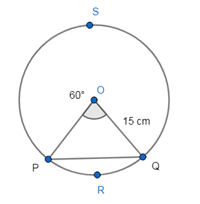
Radius of circle, $r=15 cm$
Central angle, $\theta=60^{\circ}$
Since the angle subtended at centre is $60^{\circ}$
And by the property, if two sides of a triangle are equal then their corresponding angles are also equal.
$\Rightarrow \angle OQP =\angle OPQ$
As the sum of all internal angles of a triangle is equal to $180^{\circ}$
$\Rightarrow \angle OQP =\angle OPQ =60^{\circ}$
$\Rightarrow \triangle O P Q$ is an equilateral triangle.
Area of equilateral triangle $\triangle OPQ , A _{ T }=\frac{\sqrt{3}}{4}( OP )^2$
$\Rightarrow A_T=\frac{\sqrt{3}}{4} \times 15^2$
$A_T=97.32 sq . cm$
Area of minor segment, $A_R($ PRQ $)=\frac{\theta}{360} \times \pi r^2-A_T$
$\Rightarrow A_R=\left(\frac{60}{360} \times 3.14 \times 15^2\right)-97.32$
$\Rightarrow A_R=117.75-97.32$
$\Rightarrow A_R=20.43 sq . cm$
Now,
Area of major segment, $A_S(P S Q)=\pi r^2-A_R$
$\Rightarrow A_S=\left(3.14 \times 15^2\right)-20.43$
$\Rightarrow A_S=706.5-20.43 \\
$\Rightarrow A_S=686.07 sq . cm
$\therefore$ The area of minor segment and major segment is 20.43 sq.cm and 686.07 sq.cm respectively
View full question & answer
Question 24 Marks
Radius of a circle is 10 cm. Area of a sector of the sector is $100 cm^2$. Find the area of its corresponding major sector. (π = 3.14)
Answer
Radius of circle, r = 10 cm

Area of sector (minor sector) $=100 sq . cm$
Area of circle, $A_C=\pi r^2$
$\Rightarrow A_C=3.14 \times 10^2$
$\Rightarrow A_C=314 sq . cm$
Area of major sector, $A_M=$ area of circle - area of minor sector
$\Rightarrow A_M=A_C-100$
$\Rightarrow A_M=314-100=214 \text { sq. } cm$
$\therefore$ area of major sector is $214 sq . cm$
View full question & answer
Question 34 Marks
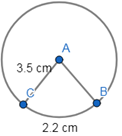
Radius of a sector of a circle is 3.5 cm and length of its arc is 2.2 cm. Find the area of the sector.
Answer

Radius of circle, r = 3.5 cm
Length of arc, l = 2.2 cm
As we know,
Length of arc $=\frac{\theta}{360} \times 2 \pi r$
$\Rightarrow 2.2=\frac{\theta}{360} \times 2 \times 3.14 \times 3.5$
$\Rightarrow \theta=36.03$
Also,
Area of sector $=\frac{\theta}{360} \times \pi r^2$
$\Rightarrow \text { Area }=\frac{36.03}{360} \times 3.14 \times(3.5)^2$
⇒ Area of sector = 3.85 sq. cm
View full question & answer
Question 44 Marks
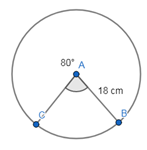
Measure of an arc of a circle is 80 cm and its radius is 18 cm. Find the length of the arc. (π = 3.14)
Answer
Measure of an arc of circle, θ = 80°
Radius of circle, r = 18 cm

Length of arc $=\frac{\theta}{360} \times 2 \pi r$
$\Rightarrow \text { Length of arc }=\frac{80}{360} \times 2 \times 3.14 \times 18$
⇒ Area of sector = 25.12 cm
View full question & answer
Question 54 Marks
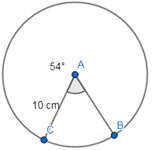
Radius of a circle is 10 cm. Measure of an arc of the circle is 54°. Find the area of the sector associated with the arc. (π = 3.14)
Answer
Radius of circle, r = 10 cm

Angle made between the arc ,θ = 54°
Area of sector $=\frac{\theta}{360} \times \pi r^2$
$\Rightarrow \text { Area of sector }=\frac{54}{360} \times 3.14 \times 10^2$
⇒ Area of sector = 47.1 sq. cm
View full question & answer
Question 64 Marks
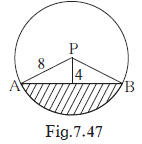
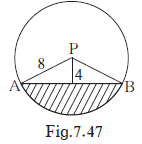
In the figure 7.47, seg AB is a chord of a circle with centre P. If PA = 8 cm and distance of chord AB from the centre P is 4 cm, find the area of the shaded portion.
Answer
Let $\angle A P B=\theta$
Therefore, $\cos \left(\frac{\theta}{2}\right)=\frac{\text { base }}{\text { hypotenuse }}$
$\cos \left(\frac{\theta}{2}\right)=\frac{\text { Distance of chord from centre }}{\text { AP }}$
$\Rightarrow \cos \left(\frac{\theta}{2}\right)=\frac{4}{8}$
$\Rightarrow \cos \left(\frac{\theta}{2}\right)=\frac{1}{2}$
$\Rightarrow \theta=120^{\circ}$
Area of $\triangle A P B, A_T=\frac{1}{2} \times(A P)^2 \times \sin (\theta)$
Area of $\triangle A P B, A_T=\frac{1}{2} \times(8)^2 \times \sin (120)$
Area of $\triangle A P B, A_T=\frac{1}{2} \times 64 \times \frac{\sqrt{3}}{2}$
$\Rightarrow A_T=27.68 sq . cm$
Also,
Area of sector, $A_S=\frac{\theta}{360} \times \pi r^2$
$\Rightarrow A_S=\frac{120}{360} \times 3.14 \times 8^2$
⇒ $A_S = 66.96 sq.cm$
Area of shaded region, $A_R=A_S-A_T$
$\Rightarrow A_R=66.96-27.68$
$\Rightarrow A_R=39.28 sq . cm$
View full question & answer
Question 74 Marks
A cylindrical bucket of diameter 28 cm and height 20 cm was full of sand. When the sand in the bucket was poured on the ground, the sand got converted into a shape of a cone. If the height of the cone was 14 cm, what was the base area of the cone?
Answer
Diameter of cylinder = 28 cm
⇒ Radius of cylinder, R = 14 cm
Height of cylinder, H = 20 cm
Volume of cylinder, $V_C=\pi R^2 H$
$V _{ C }=\frac{22}{7} \times 14^2 \times 20$
Height of cone, h = 14 cm
Radius of cone = r
Volume of cone, $v=\frac{1}{3} h \times \pi r ^2$
Now, as the sand in cylinder forms the cone,
⇒ V = v
$\Rightarrow \pi R^2 H=\frac{1}{3} \pi r^2 h$
$\Rightarrow r=\sqrt{\frac{3 \times R^2 \times H}{h}}$
$\Rightarrow r=\sqrt{\frac{3 \times 14^2 \times 20}{14}}$
⇒ r = 28.98 cm
Base area = $πr^2$
$\Rightarrow \text { Base area }=\frac{22}{7} \times(28.98)^2$
⇒ Base area = 2640 sq. cm
∴ The base area of the cone formed is 2640 sq. cm
View full question & answer
Question 84 Marks
The diameter and thickness of a hollow metals sphere are 12 cm and 0.01 m respectively. The density of the metal is 8.88 gm per $cm^3$. Find the outer surface area and mass of the sphere.
Answer
Thickness of sphere, $t =0.01 m=1 cm$
Diameter of sphere $=12 cm$
$\Rightarrow$ Outer Radius of sphere, $R _{ O }=6 cm$
$\Rightarrow$ Inner Radius of sphere, $R_I=R_O-t=6-1=5 cm$
Outer Surface area of sphere, $A=4 \pi R_0^2$
$\Rightarrow A=4 \times 3.14 \times 6^2$
$\Rightarrow A=452.16 sq . cm$
Volume of hollow sphere, $V =\frac{4}{3} \times \pi \times\left( R _{ O }^3- R _{ I }^3\right)$
Volume of hollow sphere, $V=\frac{4}{3} \times 3.14 \times\left(6^3-5^3\right)$
Volume of hollow sphere, $V=\frac{4}{3} \times 3.14 \times(216-125)$
$\Rightarrow V=381.33 cm^3$
As Mass $=$ Density $\times$ Volume
$\Rightarrow \text { Mass }=8.88 \times 381.33$
$\Rightarrow \text { Mass }=3385.94 gm$

∴ Outer surface area and mass of the sphere is 452.16 sq.cm and 3385.94 gm
View full question & answer
Question 94 Marks
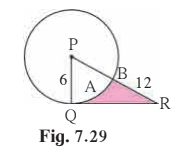
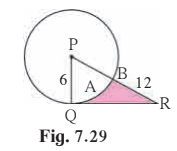
In figure 7.29, P is the centre of the circle of radius 6 cm. Seg QR is a tangent at Q. If PR = 12 find the area of the shaded region. ( √ 3= 1.73)
Image
Answer
Radius joining point of contact of the tangent is perpendicular to the tangent.
$\therefore \text { in } \triangle \mathrm{PQR}, \angle \mathrm{PQR}=90^{\circ}, \quad \mathrm{PQ}=6 \mathrm{~cm}, \mathrm{PR}=12 \mathrm{~cm} \quad \therefore \mathrm{PQ}=\frac{\mathrm{PR}}{2}$
If one side of a right anglesd triangle is half the hypoteneus then angle opposite to, that side is of $30^{\circ}$ measure
$ \therefore \angle \mathrm{R}=30^{\circ} \text { and } \angle \mathrm{P}=60^{\circ}$
$\therefore \text { by } 30^{\circ}-60^{\circ}-90^{\circ} \text { theorem, } \mathrm{QR}=\frac{\sqrt{3}}{2} \times \mathrm{PR}=\frac{\sqrt{3}}{2} \times 12=6 \sqrt{3}$
$\therefore \mathrm{QR}=6 \sqrt{3} \mathrm{~cm}$
$ \therefore \mathrm{A}(\Delta \mathrm{PQR})  =\frac{1}{2} \mathrm{QR} \times \mathrm{PQ}$
$ =\frac{1}{2} \times 6 \sqrt{3} \times 6$
$ =18 \sqrt{3}=18 \times 1.73$
$ =31.14 \mathrm{~cm}^2 $
$ \text { Area of a sector }=\frac{\theta}{360} \times \pi \mathrm{r}^2$
$\mathrm{A}(\mathrm{P}-\mathrm{QAB})  =\frac{60}{360} \times 3.14 \times 6^2$
$ =\frac{1}{6} \times 3.14 \times 6 \times 6=3.14 \times 6$
$ =18.84 \mathrm{~cm}^2 $
$\text { Area of shaded region }  =\mathrm{A}(\mathrm{PQR})-\mathrm{A}(\mathrm{P}-\mathrm{QAB})$
$ =31.14-18.84$
$ =12.30 \mathrm{~cm}^2 $
Area of the shaded region $=12.30 \mathrm{~cm}^2$
View full question & answer
Question 104 Marks
Radii of the top and the base of a frustum are $14 \mathrm{~cm}, 8 \mathrm{~cm}$ respectively. Its height is $8 \mathrm{~cm}$. Find its
i) curved surface area
ii) total surface area
iii) volume.
Answer
$\mathrm{r}_1=14 \mathrm{~cm}, \mathrm{r}_2=8 \mathrm{~cm}, \quad h=8 \mathrm{~cm}$
$
\begin{aligned}
\text { Slant height of the frustum }=1 & =\sqrt{h^2+\left(r_1-r_2\right)^2} \\
& =\sqrt{8^2+(14-8)^2} \\
& =\sqrt{64+36}=10 \mathrm{~cm}
\end{aligned}
$
$
\begin{aligned}
\text { Curved surface area of the frustum } & =\pi\left(\mathrm{r}_1+\mathrm{r}_2\right) l \\
& =3.14 \times(14+8) \times 10 \\
& =690.8 \mathrm{~cm}^2
\end{aligned}
$
$
\begin{aligned}
\text { Total surface area of frustum } & =\pi l\left(\mathrm{r}_1+\mathrm{r}_2\right)+\pi \mathrm{r}_1{ }^2+\pi \mathrm{r}_2{ }^2 \\
& =3.14 \times 10(14+8)+3.14 \times 14^2+3.14 \times 8^2 \\
& =690.8+615.44+200.96 \\
& =690.8+816.4 \\
& =1507.2 \mathrm{~cm}^2
\end{aligned}
$
$
\begin{aligned}
\text { Volume of the frustum } & =\frac{1}{3} \pi \mathrm{h}\left(\mathrm{r}_1^2+\mathrm{r}_2^2+\mathrm{r}_1 \times \mathrm{r}_2\right) \\
& =\frac{1}{3} \times 3.14 \times 8\left(14^2+8^2+14 \times 8\right) \\
& =3114.88 \mathrm{~cm}^3
\end{aligned}
$
View full question & answer
Question 114 Marks
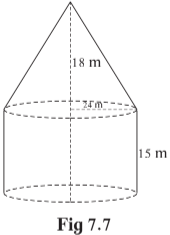
A tent of a circus is such that its lower part is cylindrical and upper part is conical. The diameter of the base of the tent is $48 \mathrm{~m}$ and the height of the cylindrical part is $15 \mathrm{~m}$. Total height of the tent is $33 \mathrm{~m}$. Find area of canvas required to make the tent. Also find volume of air in the tent.
Answer
Total height of the tent $=33 \mathrm{~m}$.
Let height of the cylindrical part be $\mathrm{H}$
$\therefore \mathrm{H}=15 \mathrm{~m} \text {. }$
Let the height of the conical part be $\mathrm{h}$
$\therefore \mathrm{h}=(33-15)=18 \mathrm{~m} \text {. }$
Slant height of cone, $l=\sqrt{r^2+(h)^2}$
$ =\sqrt{24^2+18^2}$
$=\sqrt{576+324}$
$=\sqrt{900}$
$=30 \mathrm{~m} . $
Canvas required for tent $=$ Curved surface area of the cylindrical part +
Curved surface area of conical part
$ =2 \pi \mathrm{rH}+\pi \mathrm{r} l$
$=\pi \mathrm{r}(2 \mathrm{H}+l)$
$=\frac{22}{7} \times 24(2 \times 15+30)$
$=\frac{22}{7} \times 24 \times 60$
$=4525.71 \mathrm{~m}^2 $
Volume of air in the tent $=$ volume of cylinder + volume of cone
$ =\pi r^2 \mathrm{H}+\frac{1}{3} \pi \mathrm{r}^2 \mathrm{~h}$
$=\pi \mathrm{r}^2\left(\mathrm{H}+\frac{1}{3} h\right)$
$=\frac{22}{7} \times 24^2\left(15+\frac{1}{3} \times 18\right)$
$=\frac{22}{7} \times 576 \times 21$
$=38,016 \mathrm{~m}^3 $
$\therefore$ canvas required for the tent $=4525.71 \mathrm{~m}^2$
$\therefore$ volume of air in the tent $=38,016 \mathrm{~m}^3$.
Image
View full question & answer
Question 124 Marks
Image
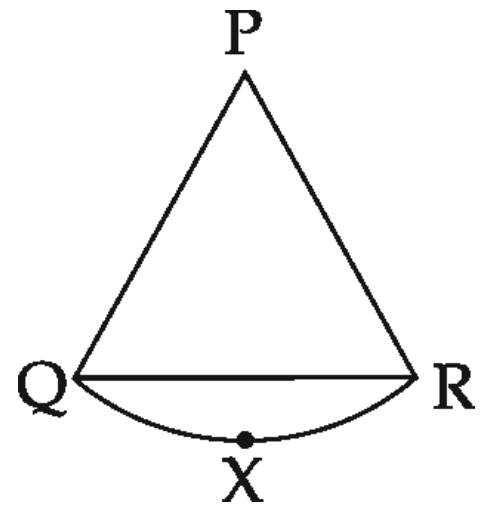
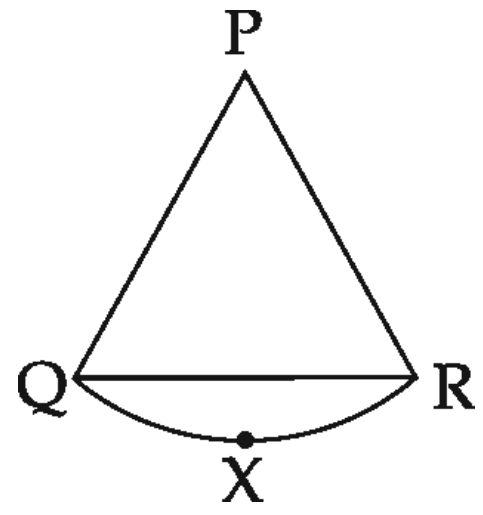
In the adjoining figure, $P$ is the centre of the circle with radius $18 \ cm$. If the area of the $\Delta{PQR}$ is $100 \ cm^2$. Find the central angle $QPR$.
Answer
$40^\circ $
View full question & answer
Question 134 Marks
Image
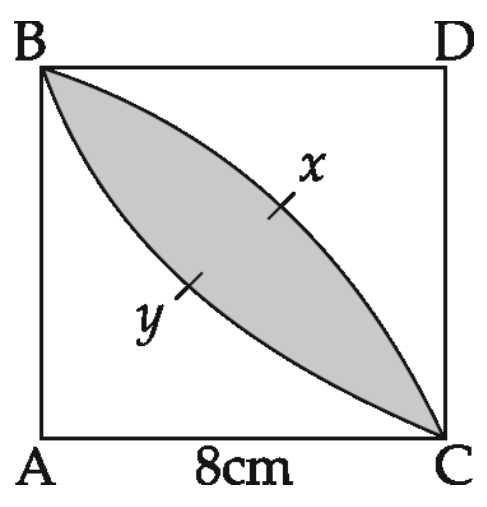
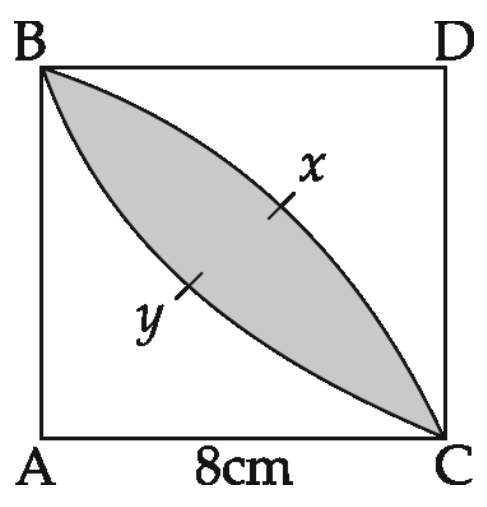
In the adjoining figures, arc AXC and arc AYC are drawn with radius 8 cm and centres as point B and point D respectively. Find the area of shaded region if $\square$ABCD is a square with side 8 cm.
Answer
$36.48 cm^2$
View full question & answer
Question 144 Marks
The curved surface area of the frustum of a cone is 180 sq cm and the circumfernce of its circular bases are 18 cm and 6 cm respectively. Find the slant height of the frustum of a cone.
Answer
15 cm
View full question & answer
Question 154 Marks
The radii of the circular ends of a frustum of a cone are 14 cm and 8 cm. If the height of the frustum is 8 cm. Find (i) Curved surface area of the frustum (ii) Total surface area of the frustum (iii) Volume of the frustum.
Answer
(i) $690.8 cm^2$ (ii) $157.2 cm^2$ (iii) $3114.88 cm^3$
View full question & answer
Question 164 Marks
The slant height of the frustum of the cone is 6.3 cm and the perimeters of its circular bases are 18 cm and 6 cm respectively. Find the curved surface area of the frustum.
Answer
$75.6 cm^2$
View full question & answer
Question 174 Marks
If the radii of the conical frustum bucket are 14 cm and 7 cm. If its height is 30 cm, then find (i) Its total surface area (ii) capacity of the bucket.
Answer
(i) $(770+66 \sqrt{449}) sq\ cm$ (ii) $10,780\ cm^3$
View full question & answer
Question 184 Marks
The dimensions of a metallic cuboid are 44 cm x 42 cm x 21 cm. It is molten and recast into a sphere. Find the surface area of the sphere.
Answer
$5544 cm^2$
View full question & answer
Question 194 Marks
If the radius of a sphere is doubled, what will be the ratio of its surface area and volume as to that of the first?
Answer
$4: 1,8: 1$
View full question & answer
Question 204 Marks
A fish tank is in the form of a cuboid, external measures of that cuboid are 80 cm x 40 cm × 30 cm. The base, side faces and back face are to be covered with a coloured paper. Find the area of the paper needed.
Answer
$8000 cm^3$
View full question & answer
Question 214 Marks
A chord PQ of a circle with radius 15 cm subtends an angle of 60° with the centre of the circle. Find the area of the minor as well as the major segment. (π = 3.14)
View full question & answer
Question 224 Marks
Radius of a circle is 10 cm. Area of a sector of the sector is 100 cm2. Find the area of its corresponding major sector. (π = 3.14)
View full question & answer
Question 234 Marks
Radius of a sector of a circle is 3.5 cm and length of its arc is 2.2 cm. Find the area of the sector.
View full question & answer
Question 244 Marks
Measure of an arc of a circle is 80 cm and its radius is 18 cm. Find the length of the arc. (π = 3.14)
View full question & answer
Question 254 Marks
Radius of a circle is 10 cm. Measure of an arc of the circle is 54°. Find the area of the sector associated with the arc. (π = 3.14)
View full question & answer
Question 274 Marks
A cylindrical bucket of diameter 28 cm and height 20 cm was full of sand. When the sand in the bucket was poured on the ground, the sand got converted into a shape of a cone. If the height of the cone was 14 cm, what was the base area of the cone?
View full question & answer
Question 284 Marks
The diameter and thickness of a hollow metals sphere are 12 cm and 0.01 m respectively. The density of the metal is 8.88 gm per cm3. Find the outer surface area and mass of the sphere.
View full question & answer
Question 294 Marks
In figure 7.29, P is the centre of the circle of radius 6 cm. Seg QR is a tangent at Q. If PR = 12 find the area of the shaded region. ( √ 3= 1.73)

Image

View full question & answer
Question 304 Marks
Radii of the top and the base of a frustum are $14 \mathrm{~cm}, 8 \mathrm{~cm}$ respectively. Its height is $8 \mathrm{~cm}$. Find its
i) curved surface area 
ii) total surface area 
iii) volume.
View full question & answer
Question 314 Marks
A tent of a circus is such that its lower part is cylindrical and upper part is conical. The diameter of the base of the tent is $48 \mathrm{~m}$ and the height of the cylindrical part is $15 \mathrm{~m}$. Total height of the tent is $33 \mathrm{~m}$. Find area of canvas required to make the tent. Also find volume of air in the tent.
View full question & answer
Question 324 Marks
The slant height of the frustum of the cone is 6.3 cm and the perimeters of its circular bases are 18 cm and 6 cm respectively. Find the curved surface area of the frustum.
View full question & answer
Question 334 Marks
The radii of the circular ends of a frustum of a cone are 14 cm and 8 cm. If the height of the frustum is 8 cm. Find (i) Curved surface area of the frustum (ii) Total surface area of the frustum (iii) Volume of the frustum.
View full question & answer
Question 344 Marks
The dimensions of a metallic cuboid are 44 cm x 42 cm x 21 cm. It is molten and recast into a sphere. Find the surface area of the sphere.
View full question & answer
Question 354 Marks
The curved surface area of the frustum of a cone is 180 sq cm and the circumfernce of its circular bases are 18 cm and 6 cm respectively. Find the slant height of the frustum of a cone.
View full question & answer
Question 364 Marks
If the radius of a sphere is doubled, what will be the ratio of its surface area and volume as to that of the first?
View full question & answer
Question 374 Marks
If the radii of the conical frustum bucket are 14 cm and 7 cm. If its height is 30 cm, then find (i) Its total surface area (ii) capacity of the bucket.
View full question & answer
Question 384 Marks
Image
In the adjoining figure, P is the centre of the circle with radius 18 cm. If the area of the $\Delta$PQR is 100 cm2. Find the central angle QPR.
View full question & answer
Question 394 Marks
Image
In the adjoining figures, arc AXC and arc AYC are drawn with radius 8 cm and centres as point B and point D respectively. Find the area of shaded region if $\square$ABCD is a square with side 8 cm.
View full question & answer
Question 404 Marks
A fish tank is in the form of a cuboid, external measures of that cuboid are 80 cm x 40 cm × 30 cm. The base, side faces and back face are to be covered with a coloured paper. Find the area of the paper needed.
View full question & answer