Questions

4 Marks Questions

Take a timed test

25 questions · self-marked practice — reveal the answer and mark yourself.

Question 14 Marks
Solve the following examples.
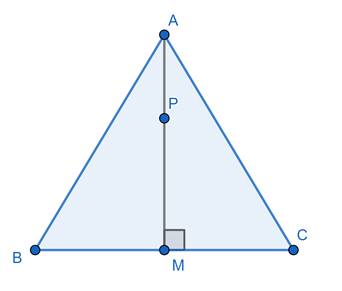
Find the height of an equilateral triangle having side 2a.
Answer
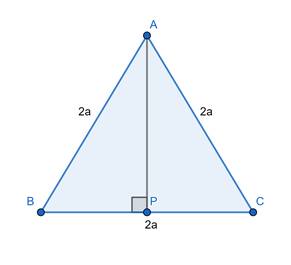
Let ABC be an equilateral triangle,
Let AP be a perpendicular on side BC from A.
To find : Height of triangle = AP
As, ABC is an equilateral triangle we have
AB = BC = CA = 2a
Also, we know that Perpendicular from a vertex to corresponding side in an equilateral triangle bisects the side
$\Rightarrow BP = CP =\frac{1}{2} = 'a'$
Now, In ΔABP, By Pythagoras theorem
$\text { (Hypotenuse }^2=(\text { base })^2+(\text { Perpendicular })^2$
$\Rightarrow A B^2=B P^2+A P^2$
$\Rightarrow(2 a)^2=a^2+A P^2$
$\Rightarrow A P^2=4 a^2-a^2$
$\Rightarrow A P^2=3 a^2$
$\Rightarrow A P=a \sqrt{3}$
View full question & answer
Question 24 Marks
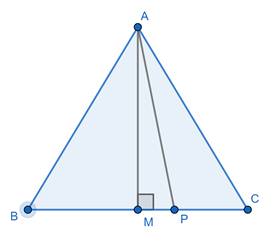
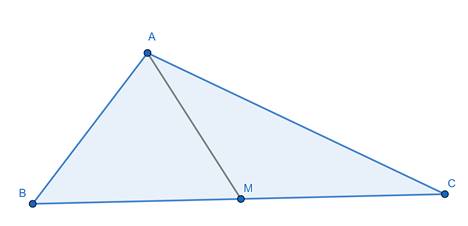
Seg AM is a median of ∆ ABC. If AB = 22, AC = 34, BC = 24, find AM
Answer

We know, By Apollonius theorem
In $\triangle A B C$, if $M$ is the midpoint of side $B C$, then $A B^2+A C^2=2 A M^2+2 B M^2$
Given that,
$A B=22, A C=34, B C=24$
$A P$ is median i.e. $P$ is the mid-point of $B C$
$\Rightarrow B P=C P=\frac{1}{2} B C=12$
Putting values in equation
$\Rightarrow 22^2+34^2=2 A M^2+2(12)^2$
$\Rightarrow 484+1156=2 M^2+288$
$\Rightarrow 1352=2 AM^2$
$\Rightarrow A M^2=676$
$\Rightarrow A M=26$
 
View full question & answer
Question 34 Marks
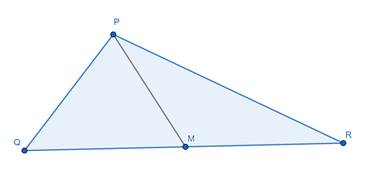
Seg PM is a median of ∆ PQR. If PQ = 40, PR = 42 and PM = 29, find QR.
Answer

We know, By Apollonius theorem
In $\triangle P Q R$, if $M$ is the midpoint of side $Q R$, then $P Q^2+P R^2=2 P M^2+2 Q M^2$
Given that, $P M$ is median i.e. $M$ is the mid-point of $Q R$
$Q M=M R=\frac{1}{2} Q R$
And $P Q=40, P R=42, P M=29$
Putting values,
$\Rightarrow(40)^2+(42)^2=2(29)^2+2(\mathrm{QM})^2$
$\Rightarrow 1600+1764=1682+2 \mathrm{QM}^2$
$\Rightarrow \mathrm{QM_2}=1682$
$\Rightarrow \mathrm{QM}=29$
$\Rightarrow \mathrm{QR}=2(29)=58$
 
View full question & answer
Question 44 Marks
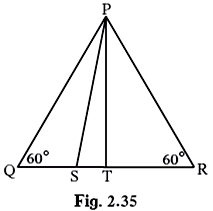
In the figure $2.35, \triangle P 20 QR$ is an equilatral triangle. Point S is on seg QR such that $Q S=\frac{1}{3} Q R$
Prove that : $9 PS ^2=7 PQ ^2$
Answer
As, PQR is an equilateral triangle,
Point S is on base QR, such that
$QS =\frac{1}{3} QR$
PT is perpendicular on side QR from P.
As, PQR is an equilateral triangle we have
PQ = QR = PR [1]
Also, we know that Perpendicular from a vertex to corresponding side in an equilateral triangle bisects the side
$\Rightarrow QT = TR =\frac{1}{2} QR =\frac{1}{2} PQ$
Now, In ΔPTQ, By Pythagoras theorem
$(\text { Hypotenuse })^2=(\text { base })^2+(\text { Perpendicular })^2$
$\Rightarrow \mathrm{PQ}^2=\mathrm{PT}^2+\mathrm{QT}^2$
$\Rightarrow PQ ^2= PT ^2+\left(\frac{1}{2} PQ \right)^2$
$\Rightarrow PQ ^2= PT ^2+\frac{1}{4} PQ ^2$
$\Rightarrow PT ^2=\frac{3}{4} PQ ^2$
As,
$QS =\frac{1}{3} QR$
$QT =\frac{1}{2} QR$
We have,
QT - QS = ST
$\Rightarrow ST =\frac{1}{2} QR -\frac{1}{3} QR$
$\Rightarrow ST =\frac{1}{6} QR =\frac{1}{6} PQ$
Now, In right angled triangle PST, By Pythagoras theorem
$(\mathrm{PS})^2=(\mathrm{ST})^2+(\mathrm{PT})^2$
$\Rightarrow PS ^2=\left(\frac{1}{6} PQ \right)^2+\frac{3}{4} PQ _{[\text {[From 2] }}$
$\Rightarrow PS ^2=\frac{ PQ ^2}{36}+\frac{3}{4} PQ ^2$
$\Rightarrow PS ^2=\frac{ PQ ^2+27 PQ ^2}{36}$
$\Rightarrow 36 \mathrm{PS}^2=28 \mathrm{PQ}^2$
$\Rightarrow 9 \mathrm{PS}^2=7 \mathrm{PQ}^2$
Hence Proved.
View full question & answer
Question 54 Marks
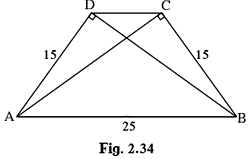
In a trapezium $A B C D$, seg $A B \| \operatorname{seg} D C$ seg $B D \perp \operatorname{seg} A D$, seg $A C \perp \operatorname{seg} B C$, If $A D=15, B C=15$ and $A B=25$. Find $A (\square ABCD )$
Answer

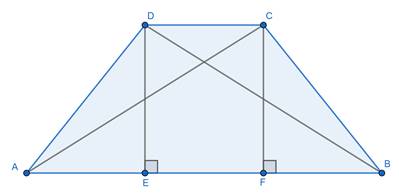
Construct $\mathrm{DE} \perp \mathrm{AB}$ and $\mathrm{CF} \perp \mathrm{AB}$
In $\triangle A D B$, as $B D \perp A D$, By Pythagoras theorem i.e.
$(\text { Hypotenuse })^2=(\text { base })^2+(\text { Perpendicular })^2$
$(A B)^2=(A D)^2+(B D)^2$
$\Rightarrow 25^2=15^2+B D^2$
$\Rightarrow B D^2=625-225=400$
$\Rightarrow B D=20 \mathrm{~cm}$
Similarly,
$A C=20 \mathrm{~cm}$
Now, In $\triangle A E D$ and $\triangle A B D$
$\angle \mathrm{AED}=\angle \mathrm{ADB}\left[\right.$ Both $\left.90^{\circ}\right]$
$\angle \mathrm{DAE}=\angle \mathrm{DAE}$ [Common]
$\triangle A E D \sim \triangle A B D$ [By Angle-Angle Criteria]
$\left.\Rightarrow \frac{D E}{B D}=\frac{A D}{A B}=\frac{A E}{A D} \text { [Property of similar triangles }\right] $
$A s=15 cm, B D=20 cm \text { and } A B=25 cm $
$\Rightarrow \frac{D E}{20}=\frac{15}{25} $
$\Rightarrow D E=12 cm$
Also,
$\frac{D E}{B D}=\frac{A E}{A D} $
$\Rightarrow \frac{12}{20}=\frac{A E}{15} $
$\Rightarrow A E=9 cm$
Similarly, $B F=9 cm$
Now,
$D C=E F[B y \text { construction }] $
$D C=A B-D E-A E $
$D C=25-9-9=7 cm$
Also, we know
$\text { Area of trapezium }=\frac{1}{2} \times(\text { Sum of Parallel Sides }) \times \text { Height } $
$=\frac{1}{2} \times( DC + AB ) \times DE $
$=\frac{1}{2} \times(7+25) \times 12 $
$=192 cm^2$
View full question & answer
Question 64 Marks
In an isosceles triangle, length of the congruent sides is 13 cm and its base is 10 cm. Find the distance between the vertex opposite the base and the centroid.
Answer

Let ABC be an isosceles triangle, In which AB = AC = 13 cm
And BC = 10 cm
Let AM be median on BC such that
$BM = CM = \frac{1}{2}Bc = 5\ cm$
Let P be centroid on median BC
To Find : AP [Distance between vertex opposite the base and centroid]
We know, By Apollonius theorem
In $\triangle A B C$, if $M$ is the midpoint of side $B C$, then $A B^2+A C^2=2 A M^2+2 B M^2$
Putting values, we get
$(13)^2+(13)^2=2 \mathrm{AM}^2+2(5)^2$
$\Rightarrow 169+169=2 \mathrm{AM}^2+50$
$\Rightarrow 2 \mathrm{AM}^2=288$
$\Rightarrow \mathrm{AM}^2=144$
$\Rightarrow \mathrm{AM}=12 \mathrm{~cm}$
Let P be the centroid
As, Centroid divides median in a ratio 2 : 1
⇒ AP : PM = 2 : 1
⇒ AP = 2PM
Now, AM = AP + PM
$\Rightarrow A M=A P+\frac{A P}{2}=\frac{3}{2} A P$
$ \Rightarrow A P=\frac{2}{3} A M=\frac{2}{3}(12)=8 cm$
View full question & answer
Question 74 Marks
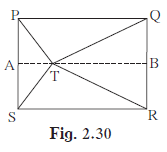
In figure 2.30, point $T$ is in theinterior of rectangle PQRS, Prove that, $T S^2+T Q^2=T P^2+T R^2$ (As shown in the figure, drawseg $A B ~\|$ side $S R$ and $A-T-B)$
Answer
From figure,
$\text { In } \triangle \mathrm{PAT}, \angle \mathrm{PAT}=90^{\circ}$
$\mathrm{TP}^2=\mathrm{AT}^2+\mathrm{PA}^2 \ldots 1$
$\text { In } \triangle \mathrm{AST}, \angle \mathrm{SAT}=90^{\circ}$
$\mathrm{TS}^2=\mathrm{AT}^2+\mathrm{SA}^2 \ldots 2$
$\text { In } \triangle \mathrm{QBT}, \angle \mathrm{QBT}=90^{\circ}$
$\mathrm{TQ} \mathrm{Q}^2=\mathrm{BT}^2+\mathrm{QB}^2 \ldots 3$
$\text { In } \triangle B T R, \angle R B T=90^{\circ}$
$T R^2=B T^2+B R^2 \ldots 4$
$\mathrm{TS}^2+\mathrm{TQ}^2=\mathrm{AT}^2+\mathrm{SA}^2+\mathrm{BT}^2+\mathrm{QB}^2 \text { [Adding } 2 \text { and 3] }$
$\Rightarrow \mathrm{TS}^2+\mathrm{TQ}^2=A T^2+P A^2+B T^2+B R^2[S A=B R, \mathrm{QB}=\mathrm{AP}]$
$\Rightarrow T S^2+T Q^2=T P^2+T R^2[\text { From } 1 \text { and } 4]$
PROVED.
View full question & answer
Question 84 Marks
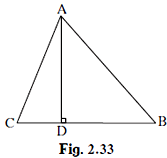
In ∆ ABC, seg AD $\perp$ seg BC DB = 3CD. Prove that : $2 A B^2=2 A C^2+B C^2$
Answer
Given,
$D B=3 C D$
Also,
$B C=C D+D B=C D+3 C D$
$\Rightarrow B C=4 C D[1]$
As, $A D \perp B C$, By Pythagoras theorem i.e.
$(\text { Hypotenuse })^2=(\text { base })^2+(\text { Perpendicular })^2$
In $\triangle A C D$
$A C^2=A D^2+C D^2[2]$
In $\triangle A B D$
$A B^2=A D^2+D B^2$
$\Rightarrow A B^2=A D^2+(3 C D)^2$
$\Rightarrow A B^2=A D^2+9 C D^2[3]$
Subtracting [2] from [3]
$\Rightarrow A B^2-A C^2=9 C D^2-C D^2$
$\Rightarrow A B^2=A C^2+8 C D^2$
$\Rightarrow 2 A B^2=2 A C^2+16 C D^2$
$\Rightarrow 2 A B^2=2 A C^2+(4 C D)^2$
$\Rightarrow 2 A B^2=2 A C^2+B C^2[\text { From 1] }$
Hence Proved.
View full question & answer
Question 94 Marks
Sum of the squares of adjacent sides of a parallelogram is 130 sq.cm and length of one of its diagonals is14 cm. Find the length of the other diagonal.
Answer
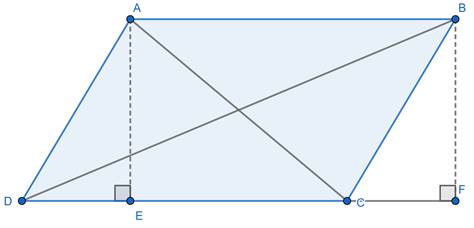
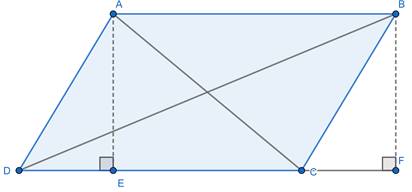
Let ABCD be a parallelogram, with AB = CD ; AB || CD and BC = AD ; BC || AD.
Construct AE ⊥ CD and extend CD to F such that, BF ⊥ CF.

Given: sum of squares of adjacent side $=130$
$\Rightarrow C D^2+B C^2=130 \text { and }$
Length of one diagonal $=14 \mathrm{~cm}$ [let it be $A C$ ]
To Find: length of the other diagonal, BD
In $\triangle A E D$ and $\triangle B C F$
$\mathrm{AE}=\mathrm{BF}$ [Distance between two parallel lines i.e. AB and $C D]$
$A D=B C$ [opposite sides of a parallelogram are equal]
$\angle \mathrm{AED}=\angle \mathrm{BFC}\left[\right.$ Both $\left.90^{\circ}\right]$
$\triangle A E D \cong \triangle B C F[$ By Right Angle - Hypotenuse - Side Criteria]
$\Rightarrow \mathrm{DE}=\mathrm{CF}$ [Corresponding sides of congruent triangles are equal] [1]
In $\triangle B F D$, By Pythagoras theorem i.e.
$(\text { Hypotenuse })^2=(\text { base })^2+(\text { Perpendicular })^2$
$\mathrm{BD}^2=\mathrm{DF}^2+B F^2$
$\Rightarrow \mathrm{BD}^2=(\mathrm{CD}+\mathrm{CF})^2+\mathrm{BF}^2[2]$
In $\triangle A E C$, By Pythagoras theorem
$A C^2=A E^2+C E^2$
$\Rightarrow A C^2=A E^2+(C D-A E)^2$
$\Rightarrow A C^2=B F^2+(C D-C F)^2[A s, A E=B F \text { and } C F=A E][2]$
In $\triangle B C F$, By Pythagoras theorem,
$B C^2=B F^2+C F^2$
$B F^2=B C^2-C F^2[3]$
Adding [2] and [3]
$B D^2+A C^2=2 B F^2+(C D+C F)^2+(C D-C F)^2$
$\Rightarrow B D^2+A C^2=2 B C^2-2 C F^2+C D^2+C F^2+2 C D \cdot C F+C D^2+C F^2-2 C D \cdot C F$
$\Rightarrow B D^2+A C^2=2 B C^2+2 C D^2$
$\Rightarrow B D^2+14^2=2(130)$
$\Rightarrow B D^2+196=260[\text { Using given data }]$
$\Rightarrow B D^2=64$
$\Rightarrow B D=8 \mathrm{~cm}$
Hence, length of other diagonal is 8 cm .
View full question & answer
Question 104 Marks
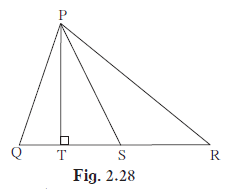
In the figure 2.28 seg PS is the median of ΔPQR and PT ⊥ QR. Prove that,
(1) $PR ^2= PS ^2+ QR \times ST +\left(\frac{ QR }{2}\right)^2$
(2) $PQ ^2= PS ^2- QR \times ST +\left(\frac{ QR }{2}\right)^2$
Answer
In $\triangle$ PTR, PT $\perp T R$, By Pythagoras Theorem we have
Perpendicular ${ }^2+$ Base $^2=$ Hypotenuse $^2$
$\Rightarrow \mathrm{PT}^2+\mathrm{TR}^2=\mathrm{PR}^2[1]$
Similarly, In $\triangle \mathrm{PTS}$
$\mathrm{PT}^2+\mathrm{TS}^2=\mathrm{PS}^2$
$\Rightarrow \mathrm{PT}^2=\mathrm{PS}^2-\mathrm{ST}^2[2]$
Using [2] in [1], we have
$\Rightarrow P S^2-S T^2+(S T+S R)^2=P R^2$
$\Rightarrow P S^2-S T^2+S T^2+S R^2+(2 \times S T \times S R)=P R^2$
Now, Since PS is a median we can write
$QS = SR =\frac{1}{2} QR $
$\Rightarrow PS ^2+\left(\frac{ QR }{2}\right)^2+\left(2 \times ST \times \frac{ QR }{2}\right)= PR ^2 $
$\Rightarrow PR ^2= PS ^2+ QR \times ST +\left(\frac{ QR }{2}\right)^2$
(ii)
$\text { In } \triangle P Q T \text {, By Pythagoras we have } $
$PQ ^2= PT ^2+ QT ^2 $
$\Rightarrow PQ ^2= PS ^2- ST ^2+( QS - ST )^2 \text { [From 2] } $
$\Rightarrow PQ ^2= PS ^2- ST ^2+ QS ^2+ ST ^2-(2 \times QS \times ST ) $
$\Rightarrow PQ ^2= PS ^2+\left(\frac{ QR }{2}\right)^2-\left(2 \times \frac{ QR }{2} \times ST \right) \quad\left[\because QS =\frac{ QR }{2}\right] $
$\Rightarrow PQ ^2= PS ^2- QR \times ST +\left(\frac{ QR }{2}\right)^2$
View full question & answer
Question 114 Marks
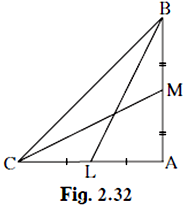
In $\triangle ABC , \angle BAC =90^{\circ}$, seg $B L$ and seg $C M$ are medians of $\triangle A B C$. Then prove that: $4\left( BL ^2+C M^2\right)=5 B C^2$
Answer
We know, By Apollonius theorem
In ΔABC, if L is the midpoint of side AC, then $A B^2+B C^2=2 B L^2+2 A L^2$
Given that, BL is median i.e. L is the mid-point of CA
$C L=A L=\frac{1}{2} A C $
$\Rightarrow A B^2+B C^2=2 B L^2+2 A L^2 $
$\Rightarrow A B^2+B C^2=2 B L^2+2\left(\frac{A C}{2}\right)^2 $
$\Rightarrow A B^2+B C^2=2 B L^2+\frac{A C^2}{2}$
Also, if $M$ is the midpoint of side $A B$, then $A C^2+B C^2=2 C M^2+2 B M^2$
Given that, $C M$ is median i.e. $M$ is the mid-point of $B A$
$AM = BM =\frac{1}{2} AB $
$\Rightarrow AC ^2+ BC ^2=2 CM ^2+2 BM ^2 $
$\Rightarrow AC ^2+ BC ^2=2 CM ^2+2\left(\frac{ AB }{2}\right)^2 $
$\Rightarrow AC ^2+ BC ^2=2 CM ^2+\frac{ AB ^2}{2}$
Also, In $\triangle A B C$, By Pythagoras theorem i.e.
$(\text { Hypotenuse })^2=(\text { base })^2+(\text { Perpendicular })^2 $
$\Rightarrow B C^2=A C^2+A B^2[3]$
Adding [1] and [2]
$\Rightarrow A B^2+B C^2+A C^2+B C^2=2 BL ^2+\frac{A C^2}{2}+2 CM ^2+\frac{A B^2}{2} $
$\Rightarrow \frac{A B^2}{2}+\frac{A C^2}{2}+2 B C^2=2 BL ^2+2 CM ^2 $
$\Rightarrow AB ^2+ AC ^2+4 BC ^2=4\left( BL ^2+C M^2\right) $
$\Rightarrow BC ^2+4 BC ^2=4\left( BL ^2+ CM ^2\right)[\text { From } 3] $
$\Rightarrow 5 BC ^2=4\left( BL ^2+ CM ^2\right)$
View full question & answer
Question 124 Marks
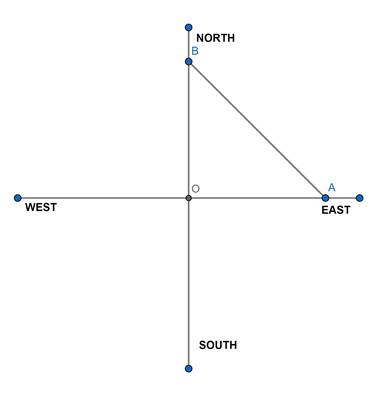
Pranali and Prasad started walking to the East and to the North respectively, from the same point and at the same speed. After 2 hours distance between them was 15$\sqrt 2$ km. Find their speed per hour.
Answer

Let their speed be 'x' km/h
We know, distance = speed × time
In two hours,
Distance travelled by both = '2x' km
Let their starting point be 'O', and Pranali and Prasad reach the point A in the East and point B in the north direction respectively.
Clearly, AOB is a right-angled triangle, So By Pythagoras theorem
$(\text { Hypotenuse })^2=(\text { base })^2+(\text { Perpendicular })^2$
$(A B)^2=(O A)^2+(O B)^2$
As, $A B=$ distance between them $=15 \sqrt{ } 2 \mathrm{~km}$
And $\mathrm{OA}=\mathrm{OB}=$ distance travelled by each $=2 \mathrm{x}$
$\Rightarrow(15 \sqrt{ } 2)^2=(2 x)^2+(2 x)^2$
$\Rightarrow 450=8 x^2$
$\Rightarrow x^2=56.25$
$\Rightarrow x=7.5 \mathrm{~km} / \mathrm{h}$
View full question & answer
Question 134 Marks
Prove that the sum of the squares of the diagonals of a parallelogram is equal to the sum of the squares of its sides.
Answer
Let ABCD be a parallelogram, with AB = CD ; AB || CD and BC = AD ; BC || AD.
Construct AE ⊥ CD and extend CD to F such that, BF ⊥ CF.

In $\triangle A E D$ and $\triangle B C F$
$\mathrm{AE}=\mathrm{BF}$ [Distance between two parallel lines i.e. $A B$ and $C D]$
$A D=B C$ [opposite sides of a parallelogram are equal]
$\angle \mathrm{AED}=\angle \mathrm{BFC}\left[\right.$ Both $\left.90^{\circ}\right]$
$\triangle A E D \cong \triangle B C F$ [By Right Angle - Hypotenuse - Side Criteria]
$\Rightarrow \mathrm{DE}=\mathrm{CF}$ [Corresponding sides of congruent triangles are equal] [1]
In $\triangle B F D$, By Pythagoras theorem i.e.
$(\text { Hypotenuse })^2=(\text { base })^2+(\text { Perpendicular })^2$
$\mathrm{BD}^2=\mathrm{DF}^2+\mathrm{BF}^2$
$\Rightarrow \mathrm{BD}^2=(\mathrm{CD}+\mathrm{CF})^2+\mathrm{BF}^2[2]$
In $\triangle A E C$, By Pythagoras theorem
$A C^2=A E^2+C E^2$
$\Rightarrow A C^2=A E^2+(C D-A E)^2$
$\Rightarrow A C^2=B F^2+(C D-C F)^2[A \mathrm{~s}, \mathrm{AE}=B F \text { and } C F=A E][2]$
In $\triangle B C F$, By Pythagoras theorem,
$B C^2=\mathrm{BF}^2+C F^2$
$\mathrm{BF}^2=\mathrm{BC}^2-\mathrm{CF}^2 [3]$
Adding [2] and [3]
$B D^2+A C^2=2 B F^2+(C D+C F)^2+(C D-C F)^2$
$\Rightarrow B D^2+A C^2=2 B C^2-2 C F^2+C D^2+C F^2+2 C D \cdot C F+C D^2+C F^2-2 C D \cdot C F$
$\Rightarrow B D^2+A C^2=2 B C^2+2 C D^2$
$\Rightarrow B D^2+A C^2=B C^2+B C^2+C D^2+C D^2$
$\Rightarrow B D^2+A C^2=A B^2+B C^2+C D^2+A D^2[\text { since } B C=A D \text { and } A B=C D]$
Hence, the sum of the squares of the diagonals of a parallelogram is equal to the sum of the squares of its sides.
View full question & answer
Question 144 Marks
∆ ABC is an equilateral triangle. Point P is on base BC such that  $PC = \frac{1}{3}BC$, if AB = 6 cm find AP.
Answer

ABC be an equilateral triangle,
Point P is on base BC, such that
$PC = \frac{1}{3}BC$
Let us construct AM perpendicular on side BC from A.
As, ABC is an equilateral triangle we have
AB = BC = CA = 6 cm
Also, we know that Perpendicular from a vertex to corresponding side in an equilateral triangle bisects the side
$\Rightarrow BM = CM = \frac{1}{2} BC = 3\  cm$
Now, In ΔACM, By Pythagoras theorem
$\text { (Hypotenuse }^2=(\text { base })^2+\text { (Perpendicular }^2$
$\Rightarrow \mathrm{CA}^2=\mathrm{CM}^2+\mathrm{AM}^2$
$\Rightarrow(6)^2=(3)^2+\mathrm{AM}^2$
$\Rightarrow 36=9+\mathrm{AM}^2$
$\Rightarrow \mathrm{AM}^2=27[1]$
As,
$PC = \frac{1}{3}BC$
$CM = \frac{1}{2}BC$
We have,
CM - PC = PM
$\Rightarrow PM =\frac{1}{2} BC -\frac{1}{3} BC $
$ \Rightarrow PM =\frac{1}{6} BC =\frac{1}{6}(6)$
⇒ PM = 1 cm
Now, In right angled triangle AMP, By Pythagoras theorem
$(\mathrm{AP})^2=(\mathrm{AM})^2+(\mathrm{PM})^2$
$\Rightarrow(\mathrm{AP})^2=27+1^2$
$\Rightarrow \mathrm{AP}^2=28$
$\Rightarrow \mathrm{AP}=2 \sqrt{7} \mathrm{~cm}$
View full question & answer
Question 154 Marks
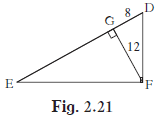
In figure 2.21, ∠DFE = 90°, FG ⊥ ED, If GD = 8, FG = 12,find (1) EG (2) FD and (3) EF
Answer
$\ln \triangle D G F, \angle D G F=90^0$
$\mathrm{FD}^2=D G^2+\mathrm{GF}^2$
$\Rightarrow \mathrm{FD}^2=64+144$
$\Rightarrow \mathrm{FD}^2=208$
$\mathrm{FD}=4 \sqrt{13}$
$\ln \triangle D E F, \angle D F E=90^0$
$E D^2=\mathrm{DF}^2+E F^2$
$\Rightarrow(E G+8)^2=208+\mathrm{EF}^2 \ldots(1)$
$\ln \triangle E G F, \angle F G E 90^0$
$E^2=E G^2+G F^2$
$\Rightarrow(E G+8)^2-208=\mathrm{EG}^2+144$
$\Rightarrow E G^2+2 \cdot E G \cdot 8+64-208=E G^2+144\left(\text { As we know }(a+b)^2=a^2+b^2+2 a b\right.$
$E G=18$
$\text { From }(1)$
$\Rightarrow(E G+8)^2=208+E F^2$
$E F=6 \sqrt{13}$
 
View full question & answer
Question 164 Marks
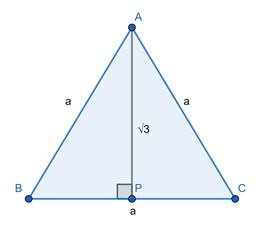
Find the length of the side and perimeter of an equilateral triangle whose height is $\sqrt3$ cm.
Answer

Let ABC be an equilateral triangle,
Let AP be a perpendicular on side BC from A.
To find : Height of triangle = AP
As, ABC is an equilateral triangle we have
AB = BC = CA = 'a'
Also, we know that Perpendicular from a vertex to corresponding side in an equilateral triangle bisects the side
$\Rightarrow BP = CP =\frac{1}{2} BC =\frac{1}{2} a$
Now, In ΔABP, By Pythagoras theorem
$(\text { Hypotenuse })^2=(\text { base })^2+(\text { Perpendicular })^2$
$\Rightarrow A B^2=\mathrm{BP}^2+A P^2$
$\Rightarrow a ^2=\left(\frac{1}{2} a \right)^2+ AP ^2$
$\Rightarrow A P^2= a ^2-\frac{1}{4} a ^2=\frac{3}{4} a ^2$
$\Rightarrow AP =\frac{\sqrt{3}}{2} a$
Given,
Height $=\sqrt3$
$\Rightarrow \frac{\sqrt{3}}{2} a=\sqrt{3}$
⇒ a = 2 cm
Also, Perimeter of equilateral triangle = 3a
Where 'a' depicts side of equilateral triangle.
∴ Perimeter = 3(2) = 6 cm
View full question & answer
Question 174 Marks
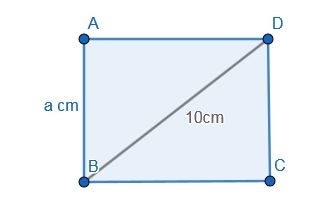
Find the side and perimeter of a square whose diagonal is 10 cm.
Answer
In a square of side say a cm, any diagonal divide the square into two right triangles of equal dimensions.


Thus $a^2+a^2=10^2$
$\Rightarrow 2 a^2=100$
$\Rightarrow a^2=50$
$a=5 \sqrt{2} \mathrm{~cm}$
a = 5$\sqrt 2$ cm
perimeter = 4a
= 4×5$\sqrt 2$
= 20$\sqrt 2$
Perimeter of square = 20$\sqrt 2$cm
View full question & answer
Question 184 Marks
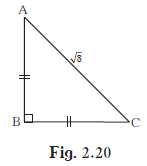
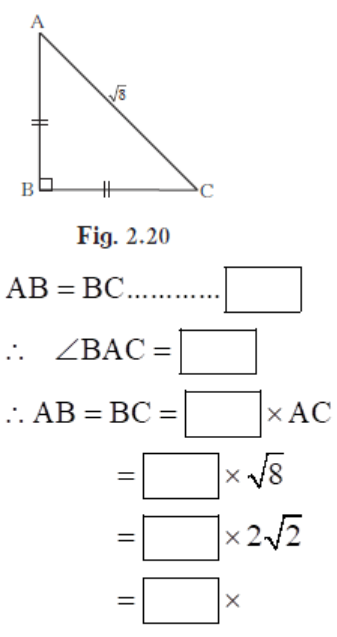
For finding AB and BC with the help of information given in figure 2.20, complete following activity.

$AB = BC \ldots \ldots \ldots \ldots$
$\therefore \quad \angle BAC =\square$
$\therefore AB = BC =\square \times AC$
$=\square \times \sqrt{8}$
$=\square \times 2 \sqrt{2}$
$=\square \times$
Answer
In $\triangle A B C, \angle A B C=90^0$
So $A B^2+B C^2=A C^2$
$\Rightarrow 2 A B^2=5$
$\Rightarrow A B^2=\frac{5}{2}$
$\Rightarrow A B=\sqrt{ }\left(\frac{5}{2}\right)=X(\text { Say })$
$A B=B C=\sqrt{ }\left(\frac{5}{2}\right)$
$\angle B A C=45^0 \text { Since } A B=B C$
NOW $\sqrt{ }\left(\frac{5}{2}\right)=X \sqrt{5}$
$X=\frac{1}{\sqrt{2}}$
Similarly, X2 $\sqrt{ } 2=\sqrt{ }\left(\frac{5}{2}\right)$
$X=\frac{1}{\sqrt{2}}$
Similarly, $X \sqrt{ } 8=\sqrt{ }\left(\frac{5}{2}\right)$
$X=\frac{1}{\sqrt{2}}$
View full question & answer
Question 194 Marks
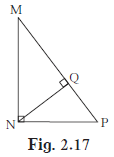
In figure 2.17, ∠MNP = 90°, seg NQ ⊥ seg MP, MQ = 9,QP = 4, find NQ.
Answer
In $\triangle M N P, \angle M N P=90^{\circ}$, By Pythagoras theorem,
$M N^2+N P^2=M P^2$
$\Rightarrow M N^2+N P^2=(M Q+Q P)^2$
$\Rightarrow M N^2+N P^2=(13)^2$
$\Rightarrow M N^2+N P^2=169 \ldots \text { (1) }$
In $\triangle M Q N, \angle M Q N=90^{\circ}$,
$\mathrm{QN}^2+\mathrm{MQ}^2=\mathrm{MN}^2$
$\Rightarrow \mathrm{QN}^2+9^2=\mathrm{MN}^2$
$\Rightarrow \mathrm{QN}^2+81=\mathrm{MN}^2 \ldots \text { (2) }$
$\text { In } \triangle \mathrm{PQN}, \angle \mathrm{PQN}=90^{\circ}$
$\mathrm{QN}^2+\mathrm{PQ}^2=\mathrm{PN}^2$
$\Rightarrow \mathrm{QN}^2+4^2=\mathrm{PN}^2$
$\Rightarrow \mathrm{QN}^2+16=\mathrm{PN}^2 \ldots \text { (3) }$
Now (2) + (3)
$\Rightarrow \mathrm{QN}^2+81+\mathrm{QN}^2+16=\mathrm{MN}^2+\mathrm{PN}^2$
$\Rightarrow 2 \mathrm{QN}^2+97=169[\text { from(1)] }$
$\Rightarrow 2 \mathrm{QN}^2=72$
$\Rightarrow \mathrm{QN}^2=36$
Thus $N Q=6$.
View full question & answer
Question 204 Marks
Prove that, the sum of the squares of the diagonals of a rhombus is equal to the sum of the squares of the sides.
View full question & answer
Question 234 Marks
prove the theorem : In a right angled triangle, the square of the hypotenuse is equal to the sum of the squares of remaining two sides.
View full question & answer
Question 244 Marks
prove the theorem : In a right angled triangle, if the altitude is drawn to the hypotenuse, then the two triangles formed are similar to the original triangle and to each other.
View full question & answer