Questions

4 Marks Questions

🎯

Test yourself on this topic

26 questions · timed · auto-graded

Question 14 Marks
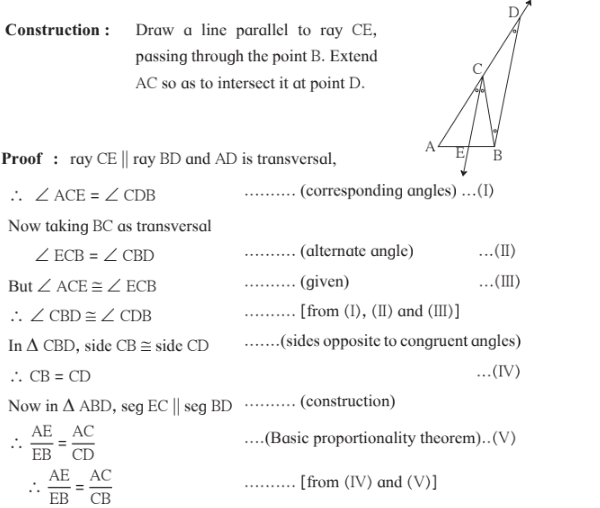
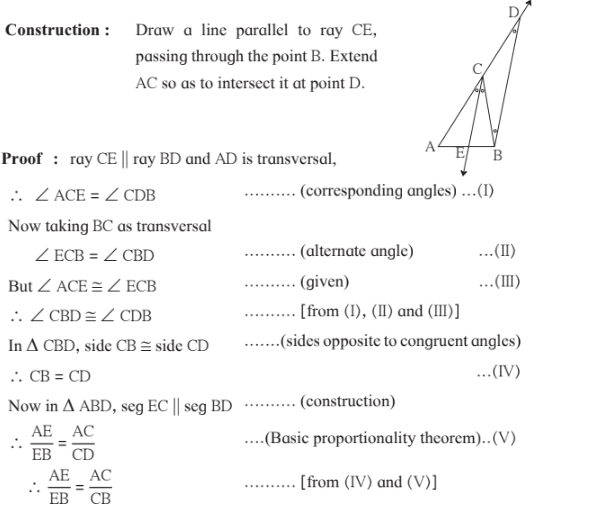
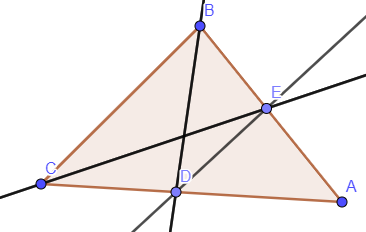
Prove The Theorem : The bisector of an angle of a triangle divides the side opposite to the angle in the ratio of the remaining sides.
Answer
Given : In $\triangle \mathrm{ABC}$, bisector of $\angle \mathrm{C}$ interesects seg $A B$ in the point $E$.To prove : $\frac{\mathrm{AE}}{\mathrm{EB}}=\frac{\mathrm{CA}}{\mathrm{CB}}$
Image

View full question & answer
Question 24 Marks
Prove The Theorem : When two triangles are similar, the ratio of areas of those triangles is equal to the ratio of the squares of their corresponding sides.
View full question & answer
Question 34 Marks
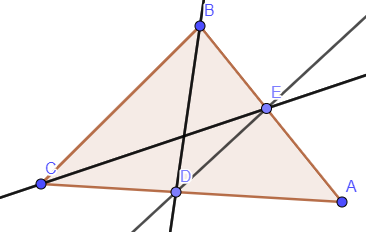
In ΔABC, ray BD bisects ∠ABC and ray CE bisects ∠ACB. If seg AB ≅ seg AC then prove that ED || BC.
Answer
PROOF:

Theorem: The bisector of an angle of a triangle divides the side opposite to the angle in the ratio of the remaining sides.
$\Rightarrow \frac{A D}{D C}=\frac{A B}{C B} \ldots . .(1) $
$\text { and } \frac{A E}{E B}=\frac{A C}{C B} \ldots . .(2)(\because, B D \text { and } C E \text { are angle bisectors of } \angle B \text { and } \angle C \text { respectively.) } $
$\text { Now, } \because \operatorname{seg} A B \cong \operatorname{seg} A C$
$\Rightarrow A B=A C$
$\Rightarrow \frac{A B}{C B}=\frac{A C}{C B} $
$\Rightarrow R \cdot H . S \text { of }(1) \&(2) \text { are equal. } $
$\Rightarrow L \cdot H \cdot S \text { of }(1) \&(2) \text { will be equal. } $
$\therefore \text { Equating } L . H \cdot S \text { of }(1) \&(2), \text { we get- }$
$\Rightarrow \frac{A D}{D C}=\frac{A E}{E B} $
$\Rightarrow E D \| B C(B y \text { converse basic proportionality theorem) }$
View full question & answer
Question 44 Marks
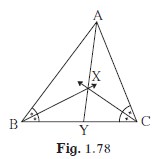
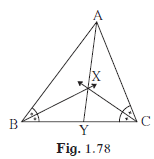
In fig 1.78, bisectors of ∠B and ∠C of ΔABC intersect each other in point X. Line AX intersects side BC in point Y. AB = 5, AC = 4, BC = 6 then find $\frac{AX}{XY}.$
Answer
By Bisector Theorem $\Rightarrow \frac{ AX }{ XY }=\frac{ AB }{ BY }$
$\Rightarrow$ And $\frac{ AX }{ XY }=\frac{ AC }{ CY }$
Equating (1) & (2), we get-
$\Rightarrow \frac{A B}{B Y}=\frac{A C}{C Y} $
$\Rightarrow \frac{A B}{A C}=\frac{B Y}{C Y} $
$\Rightarrow \frac{A B+A C}{A C}=\frac{B Y+C Y}{C Y} $
$= \frac{B C}{C Y} $
$\Rightarrow \frac{5+4}{4}=\frac{6}{C Y} $
$\Rightarrow C Y=\frac{24}{9} $
$\Rightarrow C Y=\frac{8}{3} $
Now  $\frac{A X}{X Y}=\frac{A C}{C Y} $
$\Rightarrow \frac{A X}{X Y}=\frac{4}{8} $
$\Rightarrow \frac{A X}{X Y}=\frac{3}{2} $
 
View full question & answer
Question 54 Marks
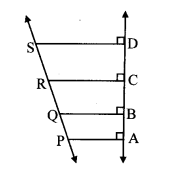
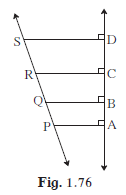
In the figure 1.76, seg PA, seg QB, seg RC and seg SD are perpendicular to line AD.
AB = 60, BC = 70, CD = 80, PS = 280 then find PQ, QR and RS.
Answer
coming soon
View full question & answer
Question 64 Marks
Given : In $\triangle \mathrm{ABC}$, bisector of $\angle \mathrm{C}$ interesects seg $A B$ in the point $E$.To prove : $\frac{\mathrm{AE}}{\mathrm{EB}}=\frac{\mathrm{CA}}{\mathrm{CB}}$
View full question & answer
Question 74 Marks
When two triangles are similar, the ratio of areas of those triangles is equal to the ratio of the squares of their corresponding sides.
View full question & answer
Question 84 Marks
Diagonals of a quadrilateral $\mathrm{ABCD}$ intersect in point $\mathrm{Q}$. If $2 \mathrm{QA}=\mathrm{QC}$, $2 \mathrm{QB}=\mathrm{QD}$, then prove that $\mathrm{DC}=2 \mathrm{AB}$.
Given :
$ 2 Q A=Q C$
$2 Q B=Q D $
To prove : $\mathrm{CD}=2 \mathrm{AB}$
View full question & answer
Question 94 Marks
In $\Delta$ABC, seg DE || side BC. If 2A ($\Delta$ADE) = A($\square$DBCE). Show that BC = $\sqrt{3} \times$ DE
Answer
self
View full question & answer
Question 104 Marks
In $\triangle ABC , \angle ABC =90^{\circ} . \triangle PAB , \triangle QAC$ and $\triangle RBC$ are the equilateral triangles constructed on sides $A B, A C$ and $B C$ respectively. Prove that : $A (\triangle P A B)+ A (\triangle R B C)= A (\triangle Q A C)$.
Answer
self
View full question & answer
Question 114 Marks
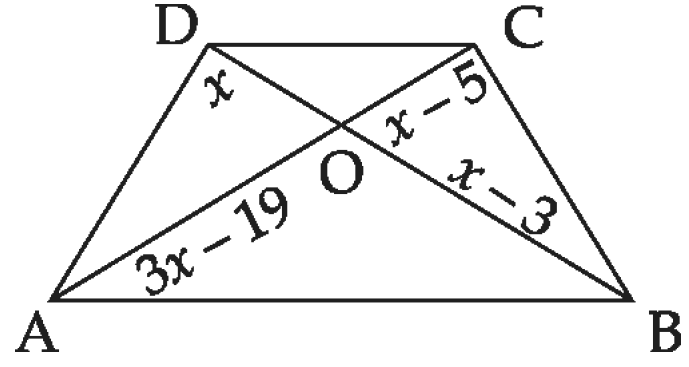
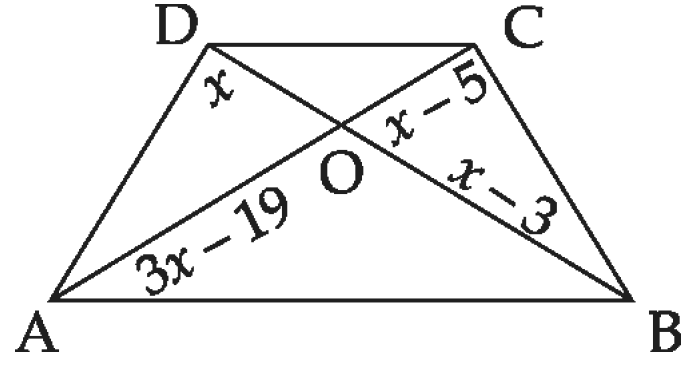
In the adjoining figure, seg AB || side DC, $OD =x OB =x-3, OC$ $=x-5, OA =3 x-19$ Find the value of $x$.
Image
Answer
$x=8, x=9$
View full question & answer
Question 124 Marks
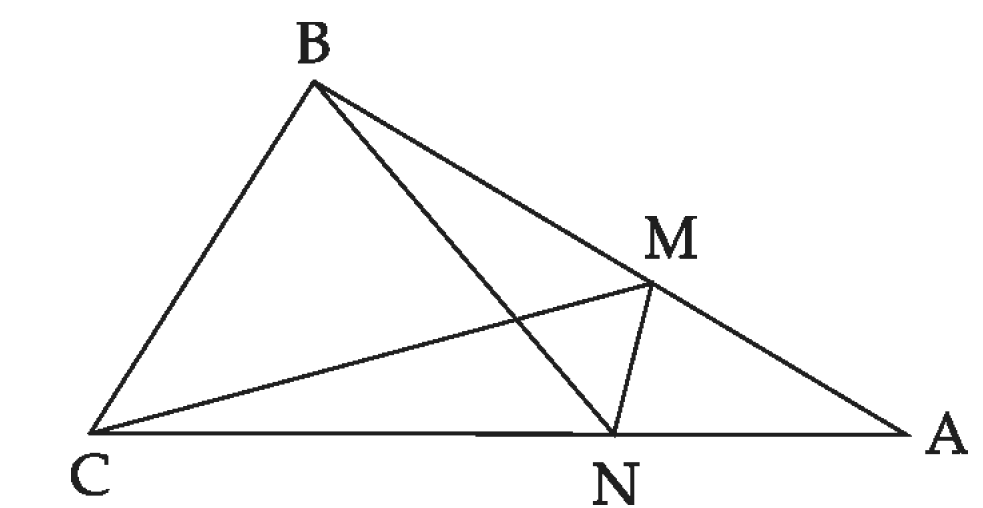
In the adjoining figure, if $\Delta$ABN = $\Delta$ACM, show that $\Delta$AMN $\sim$ $\Delta$ABC.
Image
Answer
self
View full question & answer
Question 134 Marks
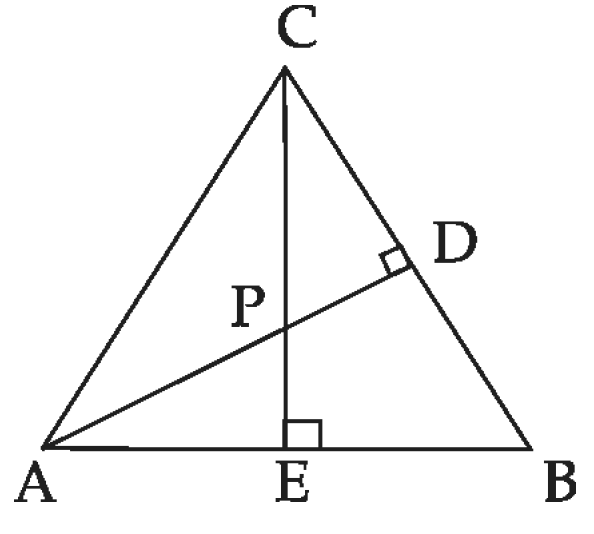
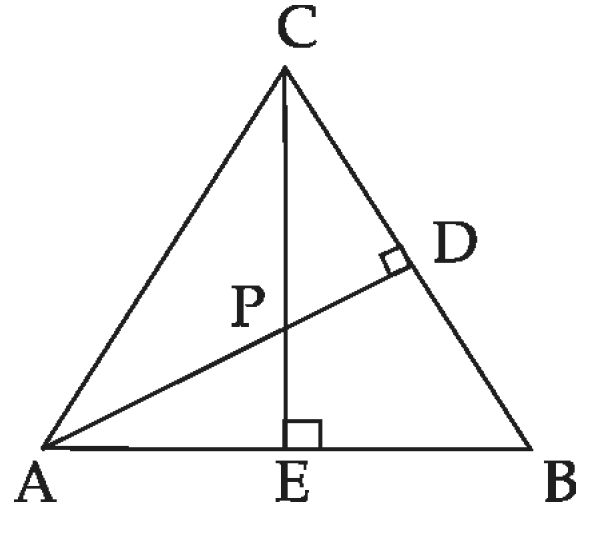
In the adjoining figure, seg CE $\perp$ side AB, seg AD $\perp$ side BC. Prove that (i) AEP ~ CDP (ii) AEP ~ ADB
Image
Answer
self
View full question & answer
Question 144 Marks
Prove The Theorem : The bisector of an angle of a triangle divides the side opposite to the angle in the ratio of the remaining sides.
Answer
Given : In $\triangle \mathrm{ABC}$, bisector of $\angle \mathrm{C}$ interesects seg $A B$ in the point $E$.To prove : $\frac{\mathrm{AE}}{\mathrm{EB}}=\frac{\mathrm{CA}}{\mathrm{CB}}$
Image

View full question & answer
Question 154 Marks
Prove The Theorem : When two triangles are similar, the ratio of areas of those triangles is equal to the ratio of the squares of their corresponding sides.
View full question & answer
Question 164 Marks
In ΔABC, ray BD bisects ∠ABC and ray CE bisects ∠ACB. If seg AB ≅ seg AC then prove that ED || BC.
View full question & answer
Question 174 Marks
View full question & answer
Question 184 Marks
View full question & answer
Question 194 Marks
Given : In $\triangle \mathrm{ABC}$, bisector of $\angle \mathrm{C}$ interesects seg $A B$ in the point $E$.To prove : $\frac{\mathrm{AE}}{\mathrm{EB}}=\frac{\mathrm{CA}}{\mathrm{CB}}$
View full question & answer
Question 204 Marks
When two triangles are similar, the ratio of areas of those triangles is equal to the ratio of the squares of their corresponding sides.
View full question & answer
Question 214 Marks
Diagonals of a quadrilateral $\mathrm{ABCD}$ intersect in point $\mathrm{Q}$. If $2 \mathrm{QA}=\mathrm{QC}$, $2 \mathrm{QB}=\mathrm{QD}$, then prove that $\mathrm{DC}=2 \mathrm{AB}$.
Given :
$
\begin{array}{l}
2 Q A=Q C \\
2 Q B=Q D
\end{array}
$
To prove : $\mathrm{CD}=2 \mathrm{AB}$
View full question & answer
Question 224 Marks
In $\triangle ABC , \angle ABC =90^{\circ} . \triangle PAB , \triangle QAC$ and $\triangle RBC$ are the equilateral triangles constructed on sides $A B, A C$ and $B C$ respectively. Prove that : $A (\triangle P A B)+ A (\triangle R B C)= A (\triangle Q A C)$.
Answer
Given: In △ABC, ∠ABC = 90°. Equilateral triangles △PAB, △QAC and △RBC are constructed on sides AB, AC and BC respectively.
To prove: A(△PAB) + A(△RBC) = A(△QAC)
Since △PAB is equilateral,
A(△PAB) = $ \frac{\sqrt{3}}{4} AB^{2} $
Since △RBC is equilateral,
A(△RBC) = $ \frac{\sqrt{3}}{4} BC^{2} $
Since △QAC is equilateral,
A(△QAC) = $ \frac{\sqrt{3}}{4} AC^{2} $
In right angled △ABC at B,
$ AB^{2} + BC^{2} = AC^{2} $ (by Pythagoras theorem)
Multiplying both sides by $ \frac{\sqrt{3}}{4} $,
$ \frac{\sqrt{3}}{4} AB^{2} + \frac{\sqrt{3}}{4} BC^{2} = \frac{\sqrt{3}}{4} AC^{2} $
So,
A(△PAB) + A(△RBC) = A(△QAC).
Hence proved.

View full question & answer
Question 234 Marks
In the adjoining figure, seg CE $\perp$ side AB, seg AD $\perp$ side BC. Prove that (i) AEP ~ CDP (ii) AEP ~ ADB
Image
Answer
Given: In triangle ABC, CE ⟂ AB and AD ⟂ BC.
(i) To prove: △AEP ~ △CDP
∠AEP = 90° (since CE ⟂ AB)
∠CDP = 90° (since AD ⟂ BC)
∠APE = ∠CPD (vertically opposite angles)
Therefore, by AA similarity criterion,
△AEP ~ △CDP.
(ii) To prove: △AEP ~ △ADB
∠AEP = 90° (since CE ⟂ AB)
∠ADB = 90° (since AD ⟂ BC)
∠APE = ∠ABD (common angle at A)
Therefore, by AA similarity criterion,
△AEP ~ △ADB.
View full question & answer
Question 244 Marks
In the adjoining figure, seg AB || side DC, $OD =x OB =x-3, OC$ $=x-5, OA =3 x-19$ Find the value of $x$.
Image
Answer
$x=8, x=9$
View full question & answer
Question 254 Marks
In the adjoining figure, if $\Delta$ABN = $\Delta$ACM, show that $\Delta$AMN $\sim$ $\Delta$ABC.
Image
View full question & answer
Question 264 Marks
In $\Delta$ABC, seg DE || side BC. If 2A ($\Delta$ADE) = A($\square$DBCE). Show that BC = $\sqrt{3} \times$ DE
Answer
Since segment $D E \| B C$ , triangle $\triangle A D E$ and triangle$\triangle A B C$. are similar.
Let
$A(\triangle A D E)=x$
Given, $2 A(\triangle A D E)=A(\square D B C E)$
$\Rightarrow A(\square D B C E)=2 x$
Now, $A(\triangle A B C)=A(\triangle A D E)+A(\square D B C E)$
$A(\triangle A B C)=x+2 x=3 x$
For similar triangles, the ratio of areas is equal to the square of the ratio of corresponding sides.
Hence,
$\frac{A(\triangle A D E)}{A(\triangle A B C)}=\left(\frac{D E}{B C}\right)^2$
Substituting the values,
$\frac{x}{3 x}=\left(\frac{D E}{B C}\right)^2$
$\frac{1}{3}=\left(\frac{D E}{B C}\right)^2$
Taking square root on both sides,
$\frac{D E}{B C}=\frac{1}{\sqrt{3}}$
Therefore,$B C=\sqrt{3} D E$
The given statement is proved.
View full question & answer
4 Marks Questions - Maths STD 10 Questions - Vidyadip