MCQ 11 Mark
The material of a cone is converted into the shape of a cylinder of equal radius. If height of the cylinder is $5\ cm,$ then height of the cone is:
- A
$10\ cm$
- ✓
$15\ cm$
- C
$18\ cm$
- D
$24\ cm$
AnswerCorrect option: B. $15\ cm$
Let height of cone $= h$
and let $r$ be its radius
$\therefore$ Volume $=\Big(\frac{1}{3}\Big)\pi\text{r}^3\text{h}$
Now radius of cylinder so formed $= r$
and height $= 5\ cm$
$\therefore$ Volume $=\pi\text{r}^2\times5=5\pi\text{r}^2$
$\therefore\frac{1}{3}\pi\text{r}^2\text{h}=5\pi\text{r}^2$
$\Rightarrow\frac{1}{3}\text{h}=5$
$\text{h}=5\times3=15\text{cm}$
View full question & answer→MCQ 21 Mark
If two solid$-$hemispheres of same base radius $r$ are joined together along their bases, then curved surface area of this new solid is:
- ✓
$4\pi\text{r}^2$
- B
$6\pi\text{r}^2$
- C
$3\pi\text{r}^2$
- D
$8\pi\text{r}^2$
AnswerCorrect option: A. $4\pi\text{r}^2$
Because curved surface area of a hemisphere is $2\pi\text{r}^2$ and here,
we join two solid hemispheres along their bases of radius $r,$
from which we get a solid sphere.
Hence, the curved surface area of new solid $=2\pi\text{r}^2+2\pi\text{r}^2=4\pi\text{r}^2$.
View full question & answer→MCQ 31 Mark
The diameters of two circular ends of the bucket are $44\ cm$ and $24\ cm.$ The height of the bucket is $35\ cm.$ The capacity of the bucket is:
- ✓
$32.7$ litres
- B
$33.7$ litres
- C
$34.7$ litres
- D
$31.7$ litres
AnswerCorrect option: A. $32.7$ litres
Given, diameter of one end of the bucket, $2R = 44$
$\Rightarrow R = 22\ cm [\therefore$ diameter, $r = 2 x$ radius$]$
and diameter of the other end, $2r = 24$
$\Rightarrow r = 12\ cm [\because$ diameter, $r = 2 x$ radius$]$
Height of the bucket, $h = 35\ cm$
Since, the shape of bucket is look like as frustum of a cone.
$\therefore$ Capacity of the bucket $=$ Volume of the frustum of the cone.
$=\frac{1}{3}\pi\text{h} \ [\text{R}^2+\text{r}^2+\text{Rr}]$
$=\frac{1}{3}\times\pi\times35[(22)^2+(12)^2+22\times12]$
$=\frac{35\pi}{3}[484+144+264]$
$=\frac{35\pi\times892}{3}$
$=\frac{35\times22\times892}{3\times7}$
$=32706.6\text{cm}^3=32.7\ \text{L}$
$[\because1000\text{cm}^3=1\text{L}]$
View full question & answer→MCQ 41 Mark
The maximum volume of a cone that can be carved out of a solid hemisphere of radius $r$ is:
AnswerCorrect option: B. $\frac{\pi\text{r}^3}{3}$
Radius of cone $= r$
and height $= r$
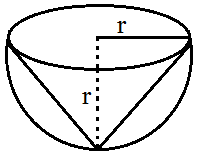
$\therefore\text{volume}=\frac{1}{3}\pi\text{r}^2\text{h}$
$=\frac{1}{3}\pi\text{r}^2\times\text{r}$
$=\frac{1}{3}\pi\text{r}^3$ View full question & answer→MCQ 51 Mark
A reservoir is in the shape of a frustum of a right circular cone. It is $8m$ across at the top and $4m$ across at the bottom. If it is $6m$ deep, then its capacity is:
- ✓
$176m^3$
- B
$196m^3$
- C
$200m^3$
- D
$110m^3$
AnswerCorrect option: A. $176m^3$
A reservoir is a frustum in shape which Upper diameter $= 8m$
and lower diameter $= 4m$
Upper radius $\Big(\frac{8}{2}\Big)=4\text{m}$
and lower radius $\Big(\frac{4}{2}\Big)=2\text{m}$
Height $(h) = 6m$
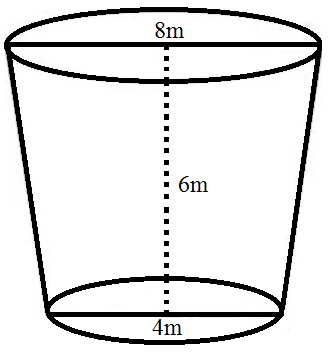
$\therefore$ Volume $=\frac{\pi}{3}[\text{r}_1^2+\text{r}_1\text{r}_2+\text{r}_2^2]\times\text{h}$
$=\frac{\pi}{3}[(4)^2+4\times2+(2)^2]\times6\text{m}^3$
$=\frac{22}{7\times3}[16+8+4]\times6\text{m}^3$
$=\frac{22}{21}(28\times6)\text{m}^3=176\text{m}^3$ View full question & answer→MCQ 61 Mark
A cylindrical vessel $32\ cm$ high and $18\ cm$ as the radius of the base, is filled with sand. This bucket is emptied on the ground and a conical heap of sand is formed. If the height of the conical heap is $24\ cm$, the radius of its base is:
- A
$12\ cm$
- B
$24\ cm$
- ✓
$36\ cm$
- D
$48\ cm$
AnswerCorrect option: C. $36\ cm$
Radius of a cylindrical vessel $(r_1) = 18\ cm$
and height $(h_1 ) = 32\ cm$
$\therefore$ Volume of sand filled in it $=\pi\text{r}^2_1\text{h}_1$
$=\pi(18)^2\times32=\pi\times324\times32\text{cm}^3$
$=10368\pi\ \text{cm}^3$
Now height of the conical heap $(h_2) = 24\ cm$
Let $r_2$ be its redius, then
$\frac{1}{3}\pi\text{r}_2^2\text{h}_2=10368\pi$
$\Rightarrow\frac{1}{3}\pi\text{r}_2^2\times24=10368\pi$
$\Rightarrow8\pi\text{r}_2^2=10368\pi$
$\text{r}_2^2=\frac{10368\pi}{8\pi}=1296$
$\therefore\text{r}_2=\sqrt{1296}=36$
Hence radius of the base of the heap $= 36\ cm$
View full question & answer→MCQ 71 Mark
A solid metallic spherical ball of diameter $6\ cm$ is melted and recast into a cone with diameter of the base as $12\ cm.$ The height of the cone is:
- A
$2\ cm$
- ✓
$3\ cm$
- C
$4\ cm$
- D
$6\ cm$
AnswerCorrect option: B. $3\ cm$
Clearly,
The volume of recasted cone $=$ volume of sphere
$\frac{1}{3}\pi\Big(\frac{12}{2}\Big)^2\times\text{h}=\frac{4}{3}\pi\Big(\frac{6}{2}\Big)^3$
$\frac{1}{3}\times36\times\text{h}=\frac{4}{3}\times27$
$\text{h}=\frac{4\times27\times3}{36}$
$\text{h}=3\text{cm}$
View full question & answer→MCQ 81 Mark
A solid piece of iron of dimensions $49 \times 33 \times 24\ cm$ is moulded into a sphere. The radius of the sphere is:
- ✓
$21\ cm$
- B
$28\ cm$
- C
$35\ cm$
- D
AnswerCorrect option: A. $21\ cm$
The volume of iron piece $= 49 \times 33 \times 24\ cm^3$
Let, $r$ is the radius sphere.
Clearly,
The volume of sphere $=$ volume of iron piece
$\frac{4}{3}\pi\text{r}^3=49\times33\times24$
$\frac{4}{3}\times\frac{22}{7}\times\text{r}^3=49\times33\times24$
$\text{r}^3=\frac{49\times33\times24\times3\times7}{4\times22}$
$\text{r}^3=49\times3\times3\times3\times7$
$\text{r}=7\times3$
$\text{r}=21\ \text{cm}$
View full question & answer→MCQ 91 Mark
A right circular cylinder of radius $r$ and height $h (h = 2r)$ just encloses a sphere of diameter:
AnswerRadius of right cylinder $= r$
Height $= h$ or $2r(\because h = 2r)$
Diameter of sphere encloses by the cylinder $= 2r$
View full question & answer→MCQ 101 Mark
The number of solid spheres, each of diameter 6cm that could be moulded to form a solid metal cylinder of height $45\ cm$ and diameter $4\ cm$, is:
AnswerDiameter of each sphere $= 6\ cm$
$\therefore$ Radius $(r_1)$ $=\frac{6}{2}=3\text{cm}$
Volume $=\frac{4}{3}\pi\text{r}_1^3=\frac{4}{3}\pi\times(3)^3\text{cm}^3$
$=36\pi\text{cm}^3$
Diameter of cylinder $= 4\ cm$
$\therefore$ Radius $(r_2)$ $=\frac{4}{2}=2\text{cm}$
and height $(h) = 45\ cm$
$\therefore$ Volume $=\pi\text{r}^2\text{h}=\pi\times(2)^2\times45\text{cm}^3$
$=\pi\times4\times45=180\pi\text{cm}^3$
$\therefore$ Number of sphere required $=\frac{180\pi}{36\pi}=5$
View full question & answer→MCQ 111 Mark
A solid frustum is of height $8\ cm$. If the radii of its lower and upper ends are $3\ cm$ and $9\ cm$ respectively, then its slant height is
- A
$15\ cm$
- B
$12\ cm$
- ✓
$10\ cm$
- D
$17\ cm$
AnswerCorrect option: C. $10\ cm$
In the frustum,
Upper radius $(r_1) = 9\ cm$
and lower radius $(r_2) = 3\ cm$
and height $(h) = 8\ cm$
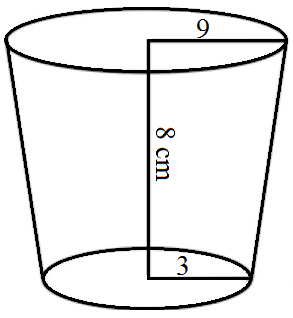
$\therefore$ Slant height $(l)=\sqrt{\text{h}^2+(\text{r}_1-\text{r}_2)^2}$
$=\sqrt{(8)^2+(9-3)^2}$
$=\sqrt{64+36}$
$=\sqrt{100}$
$=10\ \text{cm}$ View full question & answer→MCQ 121 Mark
Volumes of two spheres are in the ratio $64 : 27$. The ratio of their surface areas is:
- A
$3 : 4$
- B
$4 : 3$
- C
$9 : 16$
- ✓
$16 : 9$
AnswerCorrect option: D. $16 : 9$
$16 : 9$
Let the radii of the two sphere are $r_1$ and $r_2$ respectively
$\therefore$ Volume of the sphere of radius, $r_1 = v_1$
$=\frac{4}{3}\pi\text{r}_1^3...(1)$
$[ \because$ Volume of sphere $=\frac{4}{3}\pi(\text{radius})^3]$
and volume of the sohere of radius,
$\text{r}_2=\text{v}_2=\frac{4}{3}\pi\text{r}_2^3...(2)$
Given, ratio of volume $= V_1 : V_2$
$=64:27\Rightarrow\frac{\frac{4}{3}\pi\text{r}_1^3}{\frac{4}{3}\pi\text{r}_2^3}=\frac{64}{27}$
$[$using eqs. $(1)$ and $(2)]$
$\Rightarrow\frac{\text{r}_1^3}{\text{r}_2^3}=\frac{64}{27}\Rightarrow\frac{\text{r}_1}{\text{r}_2}=\frac{4}{3}...(3)$
Now, ratio of surface area $=\frac{4\pi\text{r}_1^2}{4\pi\text{r}_2^2}$
[$\because$ surface area of a sphere $=4\pi$ (radius)$^2$]
$=\frac{\text{r}_1^2}{\text{r}_2^2}$
$=\Big(\frac{\text{r}^1}{\text{r}^2}\Big)^2=\Big(\frac{4}{3}\Big)^2 [$using eq. $(3)]$
$= 16 : 9$
Hence, the required ratio of their surface area is $16 : 9$.
View full question & answer→MCQ 131 Mark
A rectangular sheet of paper $40\ cm \times 22\ cm,$ is rolled to form a hollow cylinder of height $40\ cm.$ The radius of the cylinder $($in $cm)$ is:
- ✓
$3.5$
- B
$7$
- C
$\frac{80}{7}$
- D
$5$
AnswerLength of rectangular sheet $(l) = 40\ cm$
and width $(b) = 22\ cm$
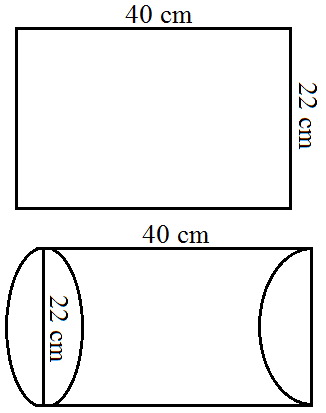
By rolling it is cylinder is formed
$\therefore$ circumference of cylinder $= b = 22\ cm$
Let $r$ be the radius
$\therefore22=2\times\frac{22}{7}\text{r}$
$\Rightarrow\text{r}=\frac{22\times7}{2\times22}=\frac{7}{2}$
$\therefore\text{Radius}=\frac{7}{2}=3.5\text{cm}$ View full question & answer→MCQ 141 Mark
A solid consists of a circular cylinder surmounted by a right circular cone. The height of the cone is $h.$ If the total height of the solid is $3$ times the volume of the cone, then the height of the cylinder is:
- A
$2\text{h}$
- B
$\frac{3\text{h}}{2}$
- C
$\frac{\text{h}}{2}$
- ✓
$\frac{2\text{h}}{2}$
AnswerCorrect option: D. $\frac{2\text{h}}{2}$
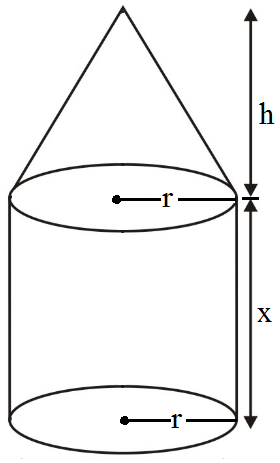
Disclaimer: In the the question, the statement given is incorrect.
Instead of total height of solid being equal to $3$ times the volume of cone, the volume of the total solid should be equal to $3$ times the volume of the cone.
Let $x$ be the height of cylinder.
Since, volume of the total solid should be equal to $3$ times the volume of the cone,
So,
$\frac{1}{3}\pi\text{r}^2\text{h}+\pi\text{r}^2\text{x}=3\Big(\frac{1}{3}\pi\text{r}^2\text{h}\Big)$
$\Rightarrow\frac{1}{3}\pi\text{r}^2\text{h}-\pi\text{r}^2\text{h}+\pi\text{r}^2\text{x}=0$
$\Rightarrow\pi\text{r}^2\text{x}=\frac{2}{3}\pi\text{r}^2\text{h}$
$\Rightarrow\text{x}=\frac{2}{3}\text{h}$ View full question & answer→MCQ 151 Mark
If the radii of the circular ends of a bucket of height $40\ cm$ are of lengths $35\ cm$ and $14\ cm$, then the volume of the bucket in cubic centimeters, is:
- A
$60060$
- ✓
$80080$
- C
$70040$
- D
$80160$
AnswerCorrect option: B. $80080$
Height of the bucket $(h) = 40\ cm$
Upper radius $(r_{1)}= 35\ cm$
and lower radius $(r_2) = 14\ cm$
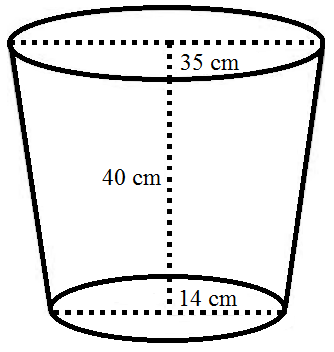
$\therefore$ Volume of the bucket
$=\frac{\pi}{3}[\text{r}_1^2+\text{r}_1\text{r}_2+\text{r}_2^2]\times\text{h}$
$=\frac{22}{21} [(35)^2 + 35 \times 14 + (14)^2] \times 40\ cm^3$
$=\frac{22}{21} \times 1911 \times 40\ cm^3$
$=\frac{22\times40\times1911}{21}\text{cm}^3=80080\text{cm}^3$ View full question & answer→MCQ 161 Mark
Water flows at the rate of $10$ metre per minute from a cylindrical pipe $5\ mm$ in diameter. How long will it take to fill up a conical vessel whose diameter at the base is $40\ cm$ and depth $24\ cm?$
- A
$48$ minutes $15 \sec$
- ✓
$51$ minutes $12 \sec$
- C
$52$ minutes $1 \sec$
- D
$55$ minutes
AnswerCorrect option: B. $51$ minutes $12 \sec$
The radius of cylindrical pipe
$\text{r}=\frac{5}{2}\text{mm}=0.25\text{cm}$
The volume per minute of water flow from the pipe
$=\pi\times(0.25)^2\times1000$
$=652\pi\text{cm}^3$ minutes
The radius of cone
$=\frac{40}{2}$
$= 20\ cm$
Depth of cone $= 24\ cm$
The volume of cone
$=\frac{1}{3}\pi(20)^2\times24$
$=3200\pi\text{cm}^3$
The time it will take to fill up a conical vessel
$\frac{3200\pi}{62.5\pi}$
$=51\frac{125}{625}\text{min}$
$=51\text{min}+\frac{125}{625}\times60\text{sec}$
$= 51\text{min} + 12 \sec$
View full question & answer→MCQ 171 Mark
The diameters of the top and the bottom portions of a bucket are $42\ cm$ and $28\ cm$ respectively. If the height of the bucket is $24\ cm$, then the cost of painting its outer surface at the rate of $50\ paise/ cm^2$ is:
- A
$Rs. 1582.50$
- B
$Rs. 1724.50$
- ✓
$Rs. 1683$
- D
$Rs. 1642$
AnswerCorrect option: C. $Rs. 1683$
Diameter of upper and lower portions of a bucket are $42\ cm$ and $28\ cm$
and height $(h) = 24\ cm$
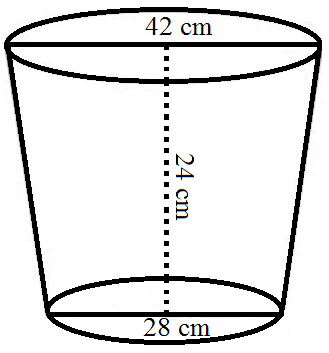
$\therefore\text{r}_1=\frac{42}{2}=21\text{cm}$
$\text{r}_2=\frac{28}{2}=21\text{cm}$
$\text{h}=24\text{cm}$
$\therefore$ slant height $(l)$
$=\sqrt{\text{h}^2+(\text{r}_1-\text{r}_2)^2}$
$=\sqrt{(24)^2+(7)^2}=\sqrt{576+49}$
$=\sqrt{625}=25\text{cm}$
Now area of outer surface
$\pi(\text{r}_1+\text{r}_2)\text{l}+\pi\text{r}_2^2$
$=\frac{22}{7}(21+14)\times25+\frac{22}{7}\times(14)^2\text{cm}^2$
$=\frac{22}{7}\times35\times25+\frac{22}{7}\times14\times14\text{cm}^2$
Rate of polishing $= 50\ p. per\ cm^2$
$\therefore$ Total cost $=3366\times\frac{50}{100}=\text{Rs}.\ 1683$ View full question & answer→MCQ 181 Mark
A cylindrical vessel of radius $4\ cm$ contains water. A solid sphere of radius $3\ cm$ is lowered into the water until it is completely immersed. The water level in the vessel will rise by:
- A
$\frac{2}{9}\text{cm}$
- B
$\frac{4}{9}\text{cm}$
- ✓
$\frac{9}{4}\text{cm}$
- D
$\frac{9}{2}\text{cm}$
AnswerCorrect option: C. $\frac{9}{4}\text{cm}$
The radius of sphere, $r = 3\ cm$
The volume of sphere
$=\frac{4}{3}\pi\text{r}^3$
$=\frac{4}{3}\pi(3)^3$
$=36\pi\ \text{cm}^3$
Since,
The sphere fully immersed into the vessel, the level of water be raised by $x \ cm.$
Then,
The volume of raised water $=$ volume of sphere
$\pi(4)^2\times\text{x}=36\pi$
$\text{x}=\frac{36}{16}$
$\text{x}=\frac{9}{4}\text{cm}$
View full question & answer→MCQ 191 Mark
The height of a cone is $30\ cm$. A small cone is cut off at the top by a plane parallel to the base. If its volume be of the volume of the given cone, then the height above the base at which the section has been made, is:
- A
$10\ cm$
- B
$15\ cm$
- ✓
$20\ cm$
- D
$25\ cm$
AnswerCorrect option: C. $20\ cm$
Height of given cone $(h_1) = 30\ cm$
Let $r_1$ be its radius
Then volume of the larger cone $\Big(\frac{1}{3}\Big)\pi\text{r}_1^2\text{h}_1$
A cone is cut off from the top of the larger cone, such that volume of smaller cone
$\frac{1}{27}$ of that of larger cone
$\therefore\frac{\text{volume of smaller cone}}{\text{Volume of bigger cone}}=\frac{1}{27}$
$=\frac{\frac{1}{3}\pi\text{r}_2^2\text{h}_2}{\frac{1}{3}\pi\text{r}_1^2\text{h}_1}=\frac{1}{27}\Rightarrow\frac{\text{r}_2^2\text{h}_2}{\text{r}_1^2\text{h}_1}=\frac{1}{27}=\Big(\frac{1}{3}\Big)^3$
$ \Rightarrow\frac{\text{h}_2}{\text{h}_1}=\frac{1}{3}\frac{\text{h}_2}{30}=\frac{1}{3}\Rightarrow\text{h}_2=\frac{30}{3}=10$
Height of smaller cone $= 10\ cm$
Height from the base of bigger cone will be
$= 30 - 10 = 20\ cm$
View full question & answer→MCQ 201 Mark
A metallic sphere of radius $10.5\ cm$ is melted and then recast into small cones, each of radius $3.5\ cm$ and height $3\ cm.$ The number of such cones is:
AnswerRadius of metallic sphere $= 10.5\ cm$
Therefore,
Volume of the sphere
$=\frac{4}{3}\pi\text{r}^3$
$=\frac{4}{3}\times\pi\times10.5\times10.5\times10.5$
$=\frac{4630.5\pi}{3}$
Now,
Radius of the cone $= 3.5\ cm$
and Height of the cone $= 3\ cm$
Therefore,
Volume of the cone
$=\frac{1}{3}\pi\text{r}^2\text{h}$
$=\frac{1}{3}\times\pi\times3.5\times3.5\times3.5$
$=\frac{36.75\pi}{3}$
Number of cone $=\frac{\text{Volume of sphere}}{\text{Volume of cone}}$
Dividing eq. $(i)$ and $(ii)$ we get
$=\frac{\frac{4630.5\pi}{3}}{\frac{36.75\pi}{3}}$
$=126$
Number of cone
Number of cone $= 126$
View full question & answer→MCQ 211 Mark
The number of solid spheres, each of diameter $6\ cm$ that can be made by melting a solid metal cylinder of height $45\ cm$ and diameter $4\ cm$ is :
AnswerLet the number of solid spheres be $n.$
Now, Volume of $n$ solid sphere $=$ Volume of cylinder
$\Rightarrow\text{n}\times\frac{4}{3}\times\frac{22}{7}\times\Big(\frac{6}{2}\Big)^3=\frac{22}{7}\times\Big(\frac{4}{2}\Big)^2\times45$
$\Rightarrow\text{n}\times\frac{4}{3}\times27=4\times45$
$\Rightarrow\text{n}=5$
View full question & answer→MCQ 221 Mark
The surface area of a sphere is same as the curved surface area of a right circular cylinder whose height and diameter are $12\ cm$ each. The radius of the sphere is:
- A
$3\ cm$
- B
$4\ cm$
- ✓
$6\ cm$
- D
$12\ cm$
AnswerCorrect option: C. $6\ cm$
Let $r$ be the radius of sphere
But,
Surface area of sphere $= \text{C.S.A.}$ of cylinder
$4\pi\text{r}^2=2\pi\text{rh}$
$4\text{r}^2=2\times6\times12$
$\text{r}^2=\frac{2\times6\times12}{4}$
$\text{r}=6\text{cm}$
View full question & answer→MCQ 231 Mark
A cylinder with base radius of $8 \ cm$ and height of $2\ cm$ is melted to form a cone of height $6\ cm$. The radius of the cone is:
- A
$4\ cm$
- B
$5\ cm$
- C
$6\ cm$
- ✓
$8\ cm$
AnswerCorrect option: D. $8\ cm$
Radius of cylinder $(r_1) = 8cm$
and height $(h_1) = 2cm$
$\therefore$ Volume $=\pi\text{r}_1^2=\pi\times(8)^2\times2\text{cm}^3$
$=128\pi\text{cm}^3$
Now Volume of cone $128\pi\ \text{cm}^3$
Height of cone $( h_2) = 6cm$
Let $r_2$ be its radius, then
$\frac{1}{3}\pi\text{r}_2^2\text{h}_2=128\pi\Rightarrow\frac{1}{3}\pi\text{r}_2^2\times6=128\pi$
$\Rightarrow\text{r}_2^2=\frac{128\pi\times3}{\pi\times6}=64=(8)^2$
$\Rightarrow\text{r}_1=8$
$\therefore$ Radius of cone $= 8\ cm$
View full question & answer→MCQ 241 Mark
The curved surface area of a cylinder is $264m^2$ and its volume is $924m^3$. The ratio of its diameter to its height is:
- A
$3 : 7$
- ✓
$7 : 3$
- C
$6 : 7$
- D
$7 : 6$
AnswerCorrect option: B. $7 : 3$
The $\text{C.S.A.}$ of cylinder
$S = 264m^2$
The volume of cylinder
$V = 924m^3$
$2\pi\text{rh}=264$
$2\text{rh}=\frac{264\times7}{22}$
$2\text{rh}=84$
$\text{rh}=42$
$\pi\text{r}^2\text{h}=924$
$\text{r}(\text{rh})=\frac{924\times7}{22}$
From $eq. (i)$ and $(ii),$
We get $r = 7$
Putting the value in $(i)$
$h = 6$
$\frac{\text{d}}{\text{h}}=\frac{14}{6}=\frac{7}{3}$
$\text{d}:\text{h}=7:3$
View full question & answer→MCQ 251 Mark
$12$ spheres of the same size are made from melting a solid cylinder of $16\ cm$ diameter and $2\ cm$ height. The diameter of each sphere is:
- A
$\sqrt{3}\text{cm}$
- B
$2\ cm$
- C
$3\ cm$
- ✓
$4\ cm$
AnswerCorrect option: D. $4\ cm$
Diameter of solid cylinder $= 16\ cm$
$\therefore$ Radius $(r_1)$ $=\frac{16}{2}=8\text{cm}$
Height $(h_1) = 2\ cm$
$\therefore$ Volume $=\pi\text{r}^2\text{h}=\pi\times8\times8\times2\text{cm}^3$
$=128\pi\ \text{cm}^3$
Now Volume $12$ sphere $=128\pi\ \text{cm}^3$
$\therefore$ volume of $1$ sphere $=\frac{128\pi}{12}=\frac{32}{3}\pi\ \text{cm}$
Let $r_2$ be its radius, then
$\frac{4}{3}\pi\text{r}_2^3=\frac{32}{3}\pi\Rightarrow\text{r}_2^3=\frac{32\pi}{3}\times\frac{3}{4\pi}$
$\Rightarrow r^3 = 8 = (2)^3\Rightarrow r = 2$
$\therefore$ Radius of each sphere $= 2\ cm$
$\therefore$ Diameter $= 2r_2 = 2 \times 2 = 4\ cm.$
View full question & answer→MCQ 261 Mark
A spherical ball of radius $r$ is melted to make $8$ new identical balls each of radius $r_1$. Then $r : r_1 =$
- ✓
$2 : 1$
- B
$1 : 2$
- C
$4 : 1$
- D
$1 : 4$
AnswerCorrect option: A. $2 : 1$
Radius of the bigger sphere $= r\ cm$
Radius of the smallerer sphere $= r_1\ cm$
$\frac{\text{Volume of bigger sphere}}{\text{Volume of smaller sphere}}=\frac{\frac{4}{3}\pi\text{r}^3}{\frac{4}{3}\pi\text{r}_1^3}=\frac{\text{r}^3}{\text{r}_1^3}=8$
$\Rightarrow\Big(\frac{\text{r}}{\text{r}_1}\Big)^3=\Big(\frac{2}{1}\Big)^3$
$\Rightarrow\Big(\frac{\text{r}}{\text{r}_1}\Big)=\Big(\frac{2}{1}\Big)$
Hence, $r : r_1 = 2 : 1$
View full question & answer→MCQ 271 Mark
A circus tent is cylindrical to a height of $4\ m$ and conical above it. If its diameter is $105\ m$ and its slant height is $40\ m$, the total area of the canvas required in $m^2$ is:
- A
$1760$
- B
$2640$
- C
$3960$
- ✓
$7920$
AnswerCorrect option: D. $7920$
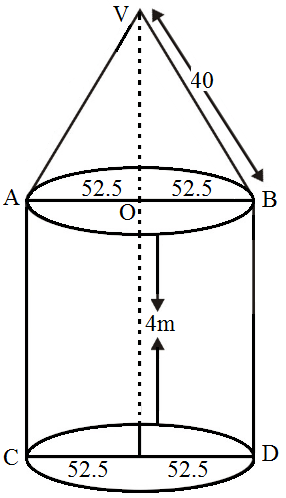
For conical portion
$r = 52.5$ and $l = 40\ m$
Curved surface area of the conical portion
$=\pi\text{rl}$
$=\pi\times52.5\times40$
$=2100\pi\ \text{m}^2$
For cylindrical portion we have
$r = 52.5\ m$ and $h = 4\ m$
Then,
Curved surface area of cylindrical portion
$=2\pi\text{rh}$
$=2\times\pi\times52.5\times4$
$=420\pi\ \text{m}^2$
Area of canvas used for making the tent. View full question & answer→MCQ 281 Mark
If the radius of the base of a right circular cylinder is halved, keeping the height the same, then the ratio of the volume of the cylinder thus obtained to the volume of orginal cylinder is:
- A
$1 : 2$
- B
$2 : 1$
- C
$1 : 4$
- ✓
$4 : 1$
AnswerCorrect option: D. $4 : 1$
Let $h$ be height in each case of the cylinder
Let $r$ be radius in first case, then
Volume $=\pi\text{r}^2\text{h}$
and if radius is halved
i.e. radius $=\frac{\text{r}}{2}$then
Volume $=\pi\frac{\text{r}_2\text{h}}{4}$
$\therefore$ ratio $\pi\text{r}^2\text{h}:\pi\frac{\text{r}_2\text{h}}{4}$
$=1:\frac{1}{4}$
$=4:1$
View full question & answer→MCQ 291 Mark
A solid consists of a circular cylinder with an exact fitting right circular cone placed at the top. The height of the cone is $h.$ If the total volume of the solid is $3$ times the volume of the cone, then the height of the circular is:
- A
$2\text{h}$
- ✓
$\frac{2\text{h}}{3}$
- C
$\frac{3\text{h}}{2}$
- D
$4\text{h}$
AnswerCorrect option: B. $\frac{2\text{h}}{3}$
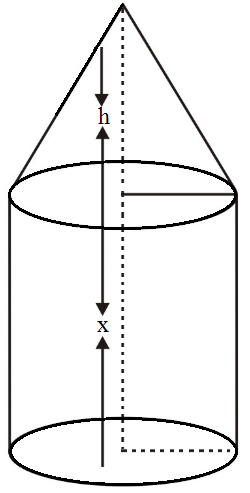
Let $r$ be the radius of the base of solid.
Clearly,
The volume of solid $= 3 \times$ volume of cone
Vol. of cone $+$ Vol. of cylinder $= 3$ Volume of cone
Vol. of cylinder $= 2$ Vol. of cone
$\pi\text{r}^2\text{x}=2\times\frac{1}{3}\pi\text{r}^2\text{h}$
$\text{x}=\frac{2}{3}\text{h}$
Thus,
The height of cylinder $=\frac{2}{3}\text{h}$ View full question & answer→MCQ 301 Mark
The radii of the ends of a bucket $16\ cm$ height are $20\ cm$ and $8\ cm$. The curved surface area of the bucket is:
- ✓
$1760\ cm^2$
- B
$2240\ cm^2$
- C
$880\ cm^2$
- D
$3120\ cm^2$
AnswerCorrect option: A. $1760\ cm^2$
Radius of top of bucket $r_1 = 20\ cm$
Radius of bottom of bucket $r_2 = 8\ cm$
Height of bucket $= 16\ cm$
The curved surface area of bucket $=\pi(\text{r}_1+\text{r}_2)\text{l}$
$\text{l}=\sqrt{\text{h}^2+(\text{r}_1-\text{r}_2)^2}$
$=\sqrt{16^2+(20-8)^2}$
$=\sqrt{256+144}$
$\text{l}=\sqrt{400}$
$\text{l}=20\ \text{cm}$
$\text{C.S.A.}$ of bucket
$=\pi(20+8)\times20$
$=\frac{22}{7}\times28\times20$
$=22\times80$
$=1760\ \text{cm}$
View full question & answer→MCQ 311 Mark
In a right circular cone, the cross$-$section made by a plane parallel to the base is a:
AnswerWhen a plane parallel to the base of a cone cuts it,
then a frustum and a smaller cone is formed.
The cross$-$section thus formed will be a circle.
View full question & answer→MCQ 321 Mark
The ratio of lateral surface area to the total surface area of a cylinder with base diameter $1.6m$ and height $20\ cm$ is:
- A
$1 : 7$
- ✓
$1 : 5$
- C
$7 : 1$
- D
$8 : 1$
AnswerCorrect option: B. $1 : 5$
Ratio in lateral surface area and total surface area
Base diameter $= 1.6m = 160\ cm$
Height $(h) = 20\ cm$
$\therefore$ Radius $= 80\ cm$
Now, lateral surface $=2\pi\text{rh}=2\pi\times80\times20=3200\pi$
and $2\pi\text{rh}+2\pi\text{r}^2=3200\pi+2\pi(80)^2$
$=3200\pi+2\pi\times6400$
$=(3200+12800)\pi$
$=16000\pi$
Ratio $=3200\pi:16000\pi=1:5$
View full question & answer→MCQ 331 Mark
A right circular cylinder of radius $r$ and height $h (h > 2r)$ just encloses a sphere of diameter:
AnswerBecause the sphere enclose in the cylinder,
therefore the diameter of sphere is equal to diameter of cylinder which is $2r.$
View full question & answer→MCQ 341 Mark
A solid is hemispherical at the bottom and conical above. If the surface areas of the two parts are equal, then the ratio of its radius and the height of its conical part is:
- A
$1 : 3$
- ✓
$1:\sqrt{3}$
- C
$1 : 1$
- D
$\sqrt{3}:1$
AnswerCorrect option: B. $1:\sqrt{3}$
Surface area of hemispherical part $=$ surface area of conical part
$\Rightarrow2\pi\text{r}^2=\pi\text{rl}$
$\Rightarrow2\text{r}\text{l}$
$\Rightarrow2\text{r}=\sqrt{\text{r}^2+\text{h}^2}$
$\Rightarrow4\text{r}^2=\text{r}^2+\text{h}^2$
$\Rightarrow3\text{r}^2=\text{h}^2$
$\Rightarrow\frac{\text{r}^2}{\text{h}^2}=\frac{1}{3}$
$\Rightarrow\frac{\text{r}}{\text{h}}=\frac{1}{\sqrt{3}}$
$\therefore\text{Roots}=1:\sqrt{3}$
View full question & answer→MCQ 351 Mark
The radii of two cylinders are in the ratio $3 : 5$. If their heights are in the ratio $2 : 3$, then the ratio of their curved surface areas is:
- ✓
$2 : 5$
- B
$5 : 2$
- C
$2 : 3$
- D
$3 : 5$
AnswerCorrect option: A. $2 : 5$
Given that
$r_1 : r_2 = 3 : 5$ and $h_1 : h_2 = 2 : 3$
Then, The ratio of $\text{C.S.A.}$ of cylinders
$\frac{\text{S}_1}{\text{S}_2}=\frac{2\pi\text{r}_1\text{h}_1}{2\pi\text{r}_2\text{h}_2}$
$\frac{\text{S}_1}{\text{S}_2}=\Big(\frac{\text{r}_1}{\text{r}_2}\Big)\times\Big(\frac{\text{h}_1}{\text{h}_2}\Big)$
$=\frac{3}{5}\times\frac{2}{3}$
$\frac{\text{s}_1}{\text{s}_2}=\frac{2}{3}$
$\text{S}_1:\text{S}_2=2:5$
View full question & answer→MCQ 361 Mark
The radii of the circular ends of a frustum are $6\ cm$ and $14\ cm$. If its slant height is $10\ cm$, then its vertical height is:
- ✓
$6\ cm$
- B
$8\ cm$
- C
$4\ cm$
- D
$7\ cm$
AnswerCorrect option: A. $6\ cm$
$r_1 = 14\ cm, r_2 = 6\ cm$
Slant height
$l = 10\ cm, h = ?$
$\text{l}=\sqrt{\text{h}^2+(\text{r}_1-\text{r}_2)^2}$
$\text{l}^2=\sqrt{\text{h}^2+(\text{r}_1-\text{r}_2)^2}$
$\{$squaring on both sides$\}$
$h^2 = l^2 - (r_1 - r_2)^2$
$h^2 = (10)^2 - (14 - 6)^2$
$h^2 = 100 - 64$
$h^2 = 36$
$h = 6\ cm$
View full question & answer→MCQ 371 Mark
A sphere of radius $6\ cm$ is dropped into a cylindrical vessel partly filled with water. The radius of the vessel is $8\ cm$. If the sphere is submerged completely, then the surface of the water rises by:
- ✓
$4.5\ cm$
- B
$3\ cm$
- C
$4\ cm$
- D
$2\ cm$
AnswerCorrect option: A. $4.5\ cm$
Radius of the sphere $= 6\ cm.$
Volume of the sphere
$=\frac{4}{3}\pi\text{r}^3$
$=\frac{4}{3}\pi\times6\times6\times6$
and
Radius of the cylinder $= 8\ cm$
Volume of the cylinder
$=\pi\text{r}^2\text{h}$
$=\pi\times8\times8\times\text{h}$
Therefore,
Volume of the sphere $=$ volume of the cylinder
$\frac{4}{3}\pi(6)^3=\pi(8)^2\text{h}$
or
$\text{h}=\frac{4\times72}{64}$
$=4.5\text{cm}$
View full question & answer→MCQ 381 Mark
A metalic solid cone is melted to form a solid cylinder of equal radius. If the height of the cylinder is $6\ cm,$ then the height of the cone was:
- A
$10\ cm$
- B
$12\ cm$
- ✓
$18\ cm$
- D
$24\ cm$
AnswerCorrect option: C. $18\ cm$
Let the height of the cone be $h.$
Volume of cylinder $=$ Volume of cone
$\Rightarrow\pi\text{r}^2(6)=\frac{1}{3}\pi\text{r}^2\text{h}$
$\Rightarrow\text{h}=18\text{cm}$
View full question & answer→MCQ 391 Mark
The volumes of two spheres are in the ratio $64 : 27$. The ratio of their surface areas is:
- A
$1 : 2$
- B
$2 : 3$
- C
$9 : 16$
- ✓
$16 : 9$
AnswerCorrect option: D. $16 : 9$
$I^{st}$ sphere
$\text{V}_1=\frac{4}{3}\pi\text{r}_1^3...(1)$
$II^{nd}$ sphere
$\text{V}_2=\frac{4}{3}\pi\text{r}_2^3...(2)$
Divide $(2)$ by $(2)$ we get,
$\frac{\text{v}_1}{\text{v}_2}=\frac{\frac{4}{3}\pi\text{r}_1^3}{\frac{4}{3}\pi\text{r}_2^3}$
$\frac{64}{27}=\Big(\frac{\text{r}_1}{\text{r}_2}\Big)^3$
$\frac{\text{r}_1}{\text{r}_2}=\sqrt{\frac{64}{27}}$
$\frac{\text{r}_1}{\text{r}_2}=\frac{4}{3}$
Now, the ratio of their $\text{C.S.A}$
$\frac{\text{S}_1}{\text{S}_2}=\frac{4\pi\text{r}_1^2}{4\pi\text{r}_2^2}=\Big(\frac{\text{r}_1}{\text{r}_2}\Big)^2$
$\frac{\text{S}_1}{\text{S}_2}=\Big(\frac{4}{3}\Big)^2=\frac{16}{9}$
Hence, $\text{S}_1:\text{S}_2=16:9$
View full question & answer→MCQ 401 Mark
If four times the sum of the areas of two circular faces of a cylinder of height $8\ cm$ is equal to twice the curve surface area, then diameter of the cylinder is:
- A
$4\ cm$
- ✓
$8\ cm$
- C
$2\ cm$
- D
$6\ cm$
AnswerCorrect option: B. $8\ cm$
Let $r$ be the radius of cylinder.
Area of circular base of cylinder $=\pi\text{r}^2$
The height of cylinder $h = 8\ cm$
The $\text{C.S.A}$. of cylinder $=2\pi\text{r}\times8=16\pi\text{r}$
Clearly,
$4\times(\pi\text{r}^2+\pi\text{r}^2)=2\times(\pi\text{r})$
$8\pi\text{r}^2=32\pi\text{r}$
$8\text{r}^2=32\text{r}$
$\text{r}=4\text{cm}$
The diameter of cylinder
$d = 4 \times 2 = 8\ cm$
View full question & answer→MCQ 411 Mark
If a cone is cut into two parts by a horizontal plane passing through the mid$-$point of its axis, the ratio of the volumes of the upper part and the cone is:
- ✓
$1 : 2$
- B
$1 : 4$
- C
$1 : 6$
- D
$1 : 8$
AnswerCorrect option: A. $1 : 2$
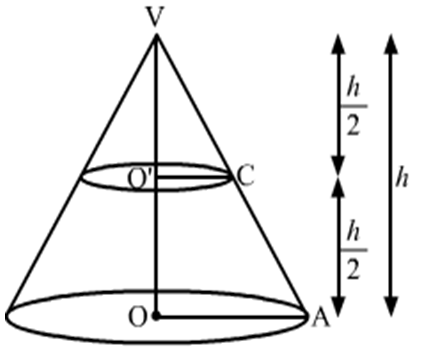
Since,
$\triangle\text{VOA}\sim\triangle\text{VO'C}$
Therefore,
$\text{In}\ \triangle\text{VOA}\ \text{and}\sim\triangle\text{VO'C}$
$\frac{\text{O'V}}{\text{OV}}=\frac{\text{O'C}}{\text{OA}}$
$\triangle\text{VOA}\sim\triangle\text{VO'C}$
$\frac{\frac{\text{h}}{2}}{\text{h}}=\frac{\text{O'C}}{\text{OA}}$
$\frac{1}{2}=\frac{\text{O'C}}{\text{OA}}$
$\frac{\text{O'C}}{\text{OA}}=\frac{1}{2}$
The ratio of the volume of upper part and the cone, View full question & answer→MCQ 421 Mark
The volume of the greatest sphere that can be cut off from a cylindrical $\log$ of wood of base radius $1\ cm$ and height $5\ cm$ is:
- ✓
$\frac{4}{3}\pi$
- B
$\frac{10}{3}\pi$
- C
$5\pi$
- D
$\frac{20}{3}\pi$
AnswerCorrect option: A. $\frac{4}{3}\pi$
Radius of cylindrical $\log (r) = 1\ cm$
and height $(h) = 5\ cm$
The radius of the greatest sphere cut off from the cylindrical $\log$ will be $=$ radius of
the $\log = 1\ cm$
$\therefore$ Volume $=\frac{4}{3}\pi\text{r}^3=\frac{4}{3}\pi(1)^3=\frac{4}{3}\pi\text{cm}^3$
View full question & answer→MCQ 431 Mark
The diameters of the ends of a frustum of a cone are $32\ cm$ and $20\ cm.$ If its slant height is $10\ cm,$ then its lateral surface area is:
- A
$321\pi\ \text{cm}^2$
- B
$300\pi\ \text{cm}^2$
- ✓
$260\pi\ \text{cm}^2$
- D
$250\pi\ \text{cm}^2$
AnswerCorrect option: C. $260\pi\ \text{cm}^2$
$\text{r}_1=\frac{32}{2}$
$=16\text{cm}$
$\text{r}_2=\frac{20}{2}$
$=10\text{cm}$
Slant height $= 10\ cm$
Total lateral surface area
$=\pi(\text{r}_1+\text{r}_2)\text{l}$
$=\pi(16+10)10$
$=260\pi\ \text{cm}^2$
View full question & answer→MCQ 441 Mark
If three metallic spheres of radii $6\ cm, 8\ cm$ and $10\ cm$ are melted to form a single sphere, the diameter of the sphere is:
- A
$12\ cm$
- ✓
$24\ cm$
- C
$30\ cm$
- D
$36\ cm$
AnswerCorrect option: B. $24\ cm$
Let radii of $3$ metallic spheres are $r_1= 6\ cm$
$r_2 = 8\ cm$
$r_3= 10\ cm$
Volume of first sphere $=\frac{4}{3}\pi\text{r}_1^3=\frac{4}{3}\pi(6)^3$
$=\frac{4}{3}\times216\pi\text{cm}^3$
$=\frac{864}{3}\pi\text{cm}^3$
Volume of secound sphere
$=\frac{4}{3}\pi\text{r}_2^3=\frac{4}{3}\pi\times(8)^3\text{cm}^3$
$=\frac{4}{3}\times512\pi=\frac{2048}{3}\pi\text{cm}^3$
Volume of third sphere
$=\frac{4}{3}\pi\text{r}_3^3=\frac{4}{3}\pi(10)^3\text{cm}^3$
$=\frac{4}{3}\pi\times1000=\frac{4000}{3}\pi\text{cm}^3$
$\therefore$ Sum of volume of the 3 sphere
$=\frac{864}{3}\pi+\frac{2048}{3}\pi+\frac{4000}{3}\pi$
$=\frac{864+2048+4000}{3}\pi=\frac{6912}{3}\pi\ \text{cm}^3$
Let $R$ be its radius, then
$\frac{4}{3}\pi\text{R}^3=\frac{6912\pi}{3}$
$\text{R}^3=\frac{6912\pi}{3}\times\frac{3}{4\pi}=1728=(12)^3$
$\therefore$ $R = 12\ cm$
$\therefore$ Diameter of the new sphere $= 2R = 2 \times 12 = 24\ cm$
View full question & answer→MCQ 451 Mark
The diameter of a sphere is $6\ cm.$ It is melted and drawn in to a wire of diameter $2\ mm$. The length of the wire is:
AnswerDiameter of sphere $= 6\ cm$
$\therefore$ Radius $(r) =\frac{6}{2}=3\text{cm}$
Volume $=\frac{4}{3}\pi\text{r}^3=\frac{4}{3}\pi\times(3)^3\text{cm}^3$
$=\frac{4}{3}\pi\times3\times3\times3=36\pi\text{cm}^3$
Diameter of wire $= 2\ \text{mm}$
$\therefore$ Radius $(r) =\frac{2}{2}=1\text{mm}=\frac{1}{10}\text{cm}$
let $h$ be its length, then
$\pi\text{r}_2^2\text{h}=36\pi$
$\Rightarrow\pi\times\Big(\frac{1}{10}\Big)^2\text{h}=36\pi$
$\Rightarrow\frac{\pi}{100}\text{h}=36\pi$
$\Rightarrow\text{h}=\frac{36\pi\times100}{\pi}=3600\text{cm}$
$\therefore$ height or lenght of wire $= 3600\ cm$
$=\frac{3600}{100}$
$=36\text{m}$
View full question & answer→MCQ 461 Mark
A hollow sphere of internal and external diameters $4\ cm$ and $8\ cm$ respectively is melted into a cone of base diameter $8\ cm$. The height of the cone is:
- A
$12\ cm$
- ✓
$14\ cm$
- C
$15\ cm$
- D
$18\ cm$
AnswerCorrect option: B. $14\ cm$
Internal diameter of a hollow sphere $= 4\ cm$
and external diameter $= 8\ cm$
$\therefore$ Internal radius $(r)$ $=\Big(\frac{4}{2}\Big)=2\text{cm}$
and external radius $(R) =\Big(\frac{8}{2}\Big)=4\text{cm}$
$\therefore$ Volume of metal used $=\Big(\frac{4}{3}\Big)\pi(\text{R}^3-\text{r}^3)$
$=\frac{4}{3}\pi(4^3-2^3)=\frac{4}{3}\pi(64-8)\text{cm}^3$
$=56\times\frac{4}{3}\pi=\frac{224}{3}\pi\ \text{cm}^3$
$\therefore$ Volume of cone $=\frac{224}{3}\pi\ \text{cm}^3$
Diameter of cone $= 8\ cm$
$\therefore$ Radius $(r_1)$ $=\frac{8}{2}=4\text{cm}$
$\therefore\frac{1}{3}\pi\text{r}_1^2\text{h}_1=\frac{224}{3}\pi$
$\Rightarrow\frac{1}{3}\pi(4)^2\text{h}_1=\frac{224}{3}\pi$
$\Rightarrow\frac{16}{3}\pi\text{h}_1=\frac{224}{3}\pi$
$\Rightarrow\text{h}_1=\frac{224\pi}{3}\times\frac{3}{16}\pi=14$
$\therefore$ Height of cone $= 14\ cm$
View full question & answer→MCQ 471 Mark
A solid sphere of radius $r $ is melted and cast into the shape of a solid cone of height $r,$ the radius of the base of the cone is:
AnswerVolume of sphere $=$ volume of the cone
$\frac{4}{3}\pi\text{r}^3=\frac{1}{3}\pi\text{R}^2\times\text{r}$
$R^2 = 4r^2$
$R = 2r$
View full question & answer→MCQ 481 Mark
A right triangle with sides $3\ cm, 4\ cm$ and $5\ cm$ is rotated about the side of $3\ cm$ to form a cone. The volume of the cone so formed is:
- A
$12\pi\text{cm}^3$
- B
$15\pi\text{cm}^3$
- ✓
$16\pi\text{cm}^3$
- D
$20\pi\text{cm}^3$
AnswerCorrect option: C. $16\pi\text{cm}^3$
A cone is formed be rotating the right angled triangle above the side $3\ cm$
Height of cone $(h) = 3\ cm$
and radius $(r) = 4\ cm$
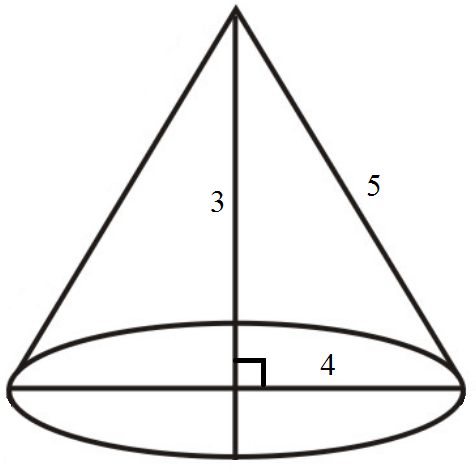
$\therefore \frac{1}{3}\pi\text{r}^2\text{h}$
$=\frac{1}{3}\pi\times(4)^2\times3\text{cm}^3$
$=\frac{1}{3}\pi\times16\times3$
$=16\pi\text{cm}^3$ View full question & answer→MCQ 491 Mark
The curved surface area of a right circular cone of height $15\ cm$ and base diameter 1$6\ cm$ is:
- A
$60\pi\text{cm}^2$
- B
$68\pi\text{cm}^2$
- C
$120\pi\text{cm}^2$
- ✓
$136\pi\text{cm}^2$
AnswerCorrect option: D. $136\pi\text{cm}^2$
Height,
$h = 15\ cm$
$\text{r}=\frac{16}{2}= 8\ cm$
$\text{l}=\sqrt{\text{r}^2+\text{h}^2}$
$=\sqrt{8^2+15^2}$
$=\sqrt{64+225}$
$=\sqrt{289}$
$l = 17\ cm$
The $\text{C.S.A.}$ of cone
$=\pi\text{rl}$
$=\pi\times8\times17$
$=136\pi\text{cm}^3$
View full question & answer→MCQ 501 Mark
The height and radius of the cone of which the frustum is a part are $h_1$, and $r_1$ respectively. If $h_2$ and $r_2$ are the heights and radius of the smaller base of the frustum respectively and $h_2 : h_1 = 1 : 2$, then $r_2 : r_1$ is equal to:
- A
$1 : 3$
- ✓
$1 : 2$
- C
$2 : 1$
- D
$3 : 1$
AnswerCorrect option: B. $1 : 2$
Height of cone $= h_1$
and radius $= r_1$
Height of frustum $= h_2$
and radius $= r_2$
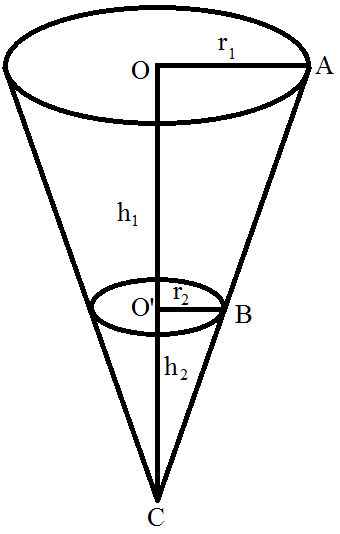
In $\triangle\text{AOC}\ \text{and}\ \triangle\text{O'BC}$
$\angle\text{OCA}=\angle\text{O'CA}$
$\angle\text{OCA}=\angle\text{CO'B}$
$\therefore\triangle\text{OAC}\sim\angle\text{O'BC}$
$\therefore\frac{\text{O'C}}{\text{OC}}=\frac{\text{O'B}}{\text{OA}}$
$\Rightarrow\frac{\text{h}_2}{\text{h}_1}=\frac{\text{r}_2}{\text{r}_1}=\frac{1}{2}$$(\because\text{h}_2:\text{h}_2=1:2)$
$\therefore\frac{\text{r}_2}{\text{r}_1}=\frac{1}{2}$
$\therefore\text{r}_2:\text{r}_1=1:2$ View full question & answer→