Question 15 Marks
A tent is made in the form of a frustum of a cone surmounted by another cone. The diameters of the base and the top of the frustum are 20m and 6m, respectively, and the height is 24m. If the height of the tent is 28m and the radius of the conical part is equal to the radius of the top of the frustum, find the quantity of canvas required. $\Big[\text{Take }\pi=\frac{22}{7}.\Big]$
AnswerFor the lower portion of the tent Diameter of the base = 20m Radius, R of the base = 10m Diameter of the top end of the frustum = 6m Radius of the top end of the frustum = r = 3m Height of the frustum = h = 24m Slant height = l$=\sqrt{\text{h}^2+(\text{R}-\text{r})^2}$
$=\sqrt{24^2+(10-3)^2}$
$=\sqrt{576+49}$
$=\sqrt{625}=25\text{m}$
For the conical part Radius of the cone's base = r= 3m Height of the cone = Total height - Height of the frustum = 28 - 24 = 4m Slant height, L,of the cone $=\sqrt{3^2+4^2}=\sqrt{9+16}=\sqrt{25}=5\text{m}$ Total quantity of canvas = Curved surface area of the frustum + curved surface area of the conical top.$=(\pi\text{l}(\text{R}+\text{r})+\pi\text{L}\text{r})$
$=\pi(\text{l}(\text{R}+\text{r})+\text{L}\text{r})$
$=\frac{22}{7}(25\times13+5\times3)$
$=\frac{22}{7}(325+15)=1068.57\text{m}^2$
View full question & answer→Question 25 Marks
A bucket of height 24cm is in the form of frustum of a cone whose circular ends are of diameter 28cm and 42cm. Find the cost of milk at the rate of ₹ 30 per litre, which the bucket can hold.
AnswerWe have,
Height of the frustum, h = 24cm,
Radius of the open end, $\text{R}=\frac{42}{2}=21\text{cm}$ and
Radius of the dose end, $\text{r}=\frac{28}{2}=14\text{cm}$
Now,
Volume of the bucket $=\frac{1}{3}\pi\text{h}\big(\text{R}^2+\text{r}^2+\text{Rr}\big)$
$=\frac{1}{3}\times\frac{22}{7}\times24\times(21^2+14^2+21\times14)$
$=\frac{176}{7}\times(441+196+294)$
$=\frac{176}{7}\times931$
$=23408\text{cm}^3$
$=23.408\text{L}(\text{As},1000\text{cm}^3=1\text{L})$
$\therefore$ The cost of the milk = 30 × 23. 408 = ₹ 702.24
So, the cost of the milk which the bucket can hold is ₹ 702.24.
View full question & answer→Question 35 Marks
A right triangle whose sides are 15cm and 20cm (other than hypotenuse), is made to revolve about its hypotenuse. Find the volume and surface area of the double cone so formed. (Choose value of $\pi$ as found appropriate)
Answer
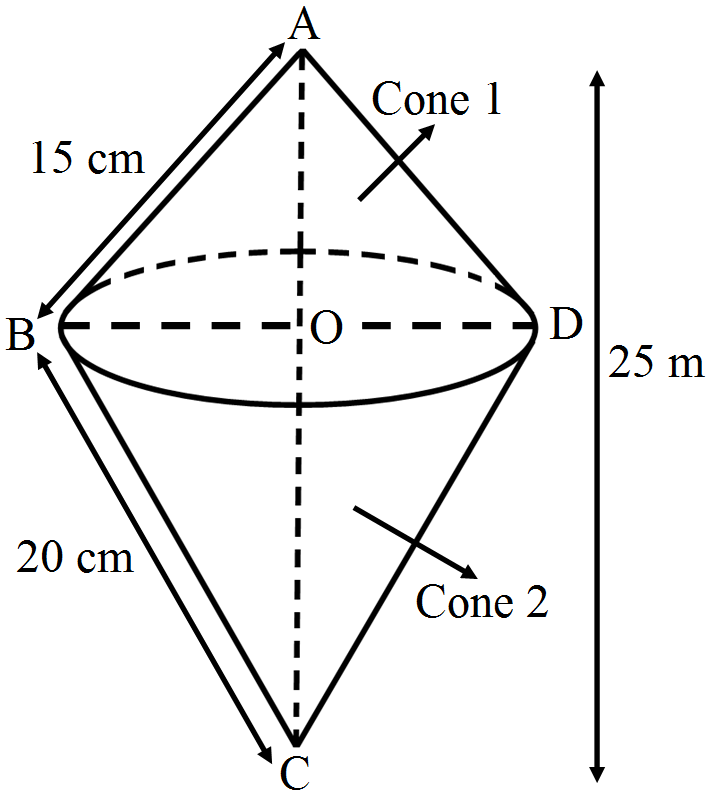 We have,
In $\Delta\text{ABC},\ \angle\text{B}=90^\circ,\ \text{AB}=\text{l}_1=15\text{cm}$ and $\text{BC}=\text{l}_2=20\text{cm}$
Let $\text{OD}=\text{OB}=\text{r},\ \text{AO}=\text{h}_1$ and $\text{CO}=\text{h}_2$
Using Pythagoras theorem,
$\text{AC}=\sqrt{\text{AB}^2+\text{BC}^2}$
$=\sqrt{15^2+20^2}$
$=\sqrt{225+400}$
$=\sqrt{625}$
$\Rightarrow\text{h}=25\text{cm}$
As, ar $(\Delta\text{ABC})=\frac{1}{2}\times\text{AC}\times\text{BO}=\frac{1}{2}\times\text{AB}\times\text{BC}$
$\Rightarrow\text{AC}\times\text{BO}=\text{AB}\times\text{BC}$
$\Rightarrow25\text{r}=15\times20$
$\Rightarrow\text{r}=\frac{15\times20}{25}$
$\Rightarrow\text{r}=12\text{cm}$
Now,
Volume of the double cone so formed = Volume of cone 1 + Volume of cone 2
$=\frac{1}{3}\pi\text{r}^2\text{h}_1+\frac{1}{3}\pi\text{r}^2\text{h}_2$
$=\frac{1}{3}\pi\text{r}^2(\text{h}_1+\text{h}_2)$
$=\frac{1}{3}\pi\text{r}^2\text{h}$
$=\frac{1}{3}\times\times3.14\times12\times12\times25$
$=3768\text{cm}^3$
Also,
Surace area of the solid so formed = CAS of cone 1 + CSA of cone 2
$=\pi\text{rl}_1+\pi\text{rl}_2$
$=\pi\text{r}(\text{l}_1+\text{l}_2)$
$=\frac{22}{7}\times12\times(15+20)$
$=\frac{22}{7}\times12\times35$
$=1320\text{cm}^2$ View full question & answer→Question 45 Marks
A medicine capsule is in the shape of a cylinder with two hemipheres stuck to each of its ends. The length of the entire capsule is 14mm and the diameter of the capsule is 5mm. Fin its surface area.
Answer
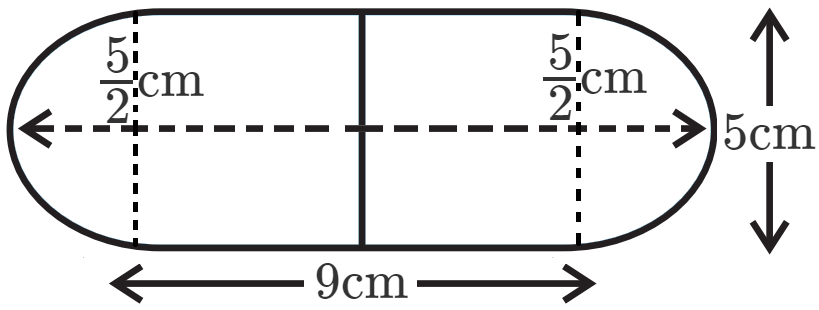 From the given figure,
Radius (r) of cylindrical part = Radius (r) of hemispherical part
⇒ Radius (r) of cylindrical part $=\frac{5}{2}$
⇒ 2r = 5
Length of the cylindrical part (h) = Length of the entire capsule - 2r
= 14 - 5
= 9mm
Surface area of capsule = 2 × curved surface area of hemispherical + curved surface area of cylindrical part
$=2\times2\pi\text{r}^2+2\pi\text{r}\text{h}$
$=4\pi\Big(\frac{5}{2}\Big)^2+2\pi\Big(\frac{5}{2}\Big)\times9$
$=25\pi+45\pi$
$=70\pi$
$=70\times\frac{22}{7}$
$=220\text{mm}^2$ View full question & answer→Question 55 Marks
The perimeters of the two circular ends of a frustum of a cone are 48cm and 36cm. If the height of the frustum is 11cm, then find its volume and curved surface area.
AnswerWe have, Perimeter of upper end, C = 48 cm, Perimeter of lower end, c = 36cm and Height, h = 11cm Let the radius of upper end be R and the radius of lower end be r. As, C = 48cm$\Rightarrow2\pi\text{R}=48$
$\Rightarrow\text{R}=\frac{48}{2\pi}$
$\Rightarrow\text{R}=\frac{24}{\pi}\text{cm}$
Similarly, c = 36cm$\Rightarrow\text{r}=\frac{26}{2\pi}$
$\Rightarrow\text{r}=\frac{18}{\pi}\text{cm}$
And, $\text{l}=\sqrt{(\text{R}-\text{r})^2+\text{h}^2}$ $=\sqrt{\Big(\frac{24}{\pi}-\frac{18}{\pi}\Big)^2+11^2}$ $=\sqrt{\Big(\frac{6}{\pi}\Big)^2+11^2}$ $=\sqrt{\Big(\frac{6\times7}{22}\Big)^2+11^2}$ $=\sqrt{\Big(\frac{21}{11}\Big)^2+11^2}$ $=\sqrt{\frac{441+121\times121}{121}}$ $=\sqrt{\frac{441+14641}{121}}$ $=\sqrt{\frac{15082}{11}}\text{cm}$ Now, Volume of the frustum $=\frac{1}{3}\pi\text{h}\big(\text{R}^2+\text{r}^2+\text{Rr}\big)$ $=\frac{1}{3}\times\pi\times11\times\bigg[\Big(\frac{24}{\pi}\Big)^2+\Big(\frac{18}{\pi}\Big)^2+\Big(\frac{24}{\pi}\Big)\times\Big(\frac{18}{\pi}\Big)\bigg]$ $=\frac{11\pi}{3}\times\Big[\frac{576}{\pi^2}+\frac{324}{\pi^2}+\frac{432}{\pi^2}\Big]$ $=\frac{11\pi}{3}\times\frac{1332}{\pi^2}$ $=\frac{11}3{}\times\frac{1332}{\pi}$ $=\frac{11}{3}\times\frac{1332\times7}{22}$ $=1554\text{cm}^3$ Also, Curved surface area of the frustum $=\pi(\text{R}+\text{r})\text{l}$ $=\frac{22}{7}\times\Big(\frac{24}{\pi}+\frac{18}{\pi}\Big)\times\frac{\sqrt{15082}}{11}$ $=\frac{22}{7}\times\frac{42}{\pi}\times\frac{\sqrt{15082}}{11}$ $=\frac{22}7{}\times\frac{42\times7}{22}\times\frac{\sqrt{15082}}{11}$ $\approx42\times11.164436$ $\approx468.91\text{cm}^2$
View full question & answer→Question 65 Marks
A wooden toy is in the shape of a cone mounted on a cylinder, as shown in the figure. The total height of the toy is 26cm, while the height of the conical part is 6cm. The diameter of the base of the conical part is 5cm and that of the cyliridrical part is 4cm. The conical part and the cylindrical part are respectively painted red and white. Find the area to be painted by each of these colours. $\big[$Take $\pi=\frac{22}{7}\big]$
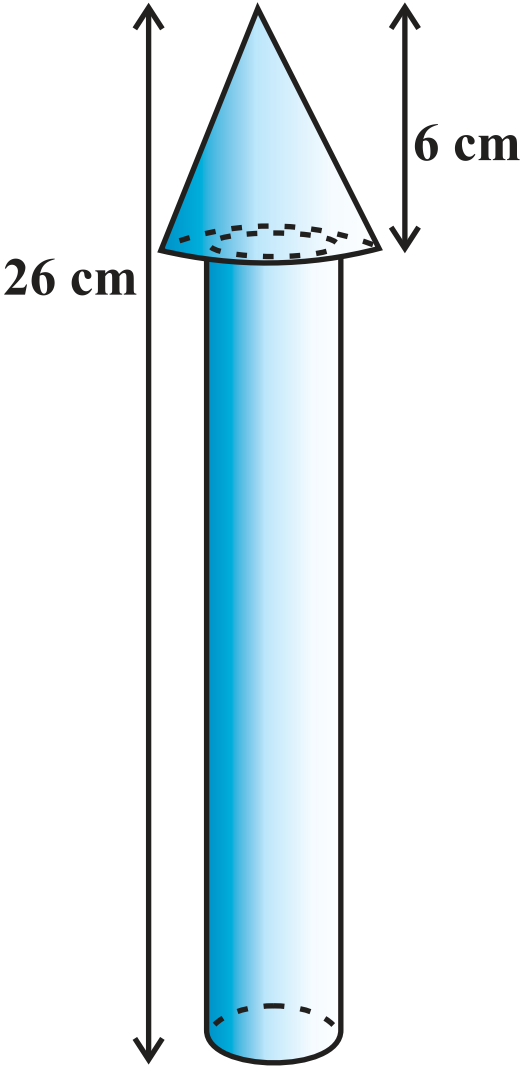
AnswerGivenDiameter of the cone = 5cm
⇒ Radius of cone (r) = 2.5cm,
Height of the cone (h) = 6cm,
Diameter of the cylinder = 4cm
⇒ Radius of cylinder (R) = 2cm,
Height of the Cylinder (H) = 26 = 6 = 20cm
Now,
Slant height (l) of cone $=\sqrt{\text{h}^2+\text{r}^2}$
$\Rightarrow\text{l}=\sqrt{\text{h}^2+\text{r}^2}$
$\Rightarrow\text{l}=\sqrt{(6)^2+(2.5)^2}$
$\Rightarrow\text{l}=\sqrt{36+6.25}$
$\Rightarrow\text{l}=\sqrt{42.25}$
$\Rightarrow\text{l}=6.5\text{cm}$
Here, the conical portion has its circular base resting on the base of the cylinder, but the base of the cone is larger is larger than the base of the cylinder, so a part of the base of the cone is to be painted.
Area of the top of the cylinder $=\pi\text{r}^2$
$=\frac{22}{7}\times2^2$
$=\frac{88}{7}\text{cm}^2$
Area of the base of the cone $=\pi\text{r}^2$
$=\frac{22}{7}\times2.5^2$
$=\frac{137.5}{7}\text{cm}^2$
Area of the painted region on the cone
= Area of the base of the cone - area of the top of the cylinder
$=\frac{137.5}{7}\text{cm}^2-\frac{88}{7}\text{cm}^2$
$=\frac{49.5}{7}\text{cm}^2$
Curved surface of the cone $=\pi\text{r}\text{l}$
$=\frac{22}{7}\times2.5\times6.5$
$=51.07\text{cm}^2$
Curved surface of the cylinder $=2\pi\text{r}\text{h}$
$=2\times\frac{22}{7}\times2.5\times20$
$=\frac{2200}{7}\text{cm}^2$
So, the painted red $=51.07\text{cm}^2+\frac{49.5}{7}\text{cm}^2$
$=58.143\text{cm}^2$
So, the area painted white $51.07\text{cm}^2+\frac{49.5}{7}\text{cm}^2$
$=58.143\text{cm}^2$
View full question & answer→Question 75 Marks
A copper wire of diameter 6mm is evenly wrapped on a cylinder of length 18cm and diameter 49cm to cover its whole surface. Find the length and the volume of the wire. If the density of the copper be 8.8g per cu-cm, then find the weight of the wire.
AnswerWe have,
Diameter of the coppe wire, d = 6mm = 0. 6cm,
Radius of the copper wire, $\text{r}=\frac{0.6}{2}=0.3\text{cm},$
Length of the cylinder, H = 18cm,
Radius of the cylinder, $\text{R}=\frac{49}{2}\text{cm}$
The number of rotations of the wire on the cylinder $=\frac{\text{length of the cylinder, H}}{\text{Diameter of the copper wire, d}}$
$=\frac{18}{0.6}$
$=30$
The circumference of the base of the cylinder $=2\pi\text{R}=2\times\frac{22}{7}\times\frac{49}{2}=154\text{cm}$
So, the length of the wire, h = 30 × 154 = 4620cm = 46. 2m
Now, the volume of the wire $=\pi\text{r}^2\text{h}$
$=\frac{22}{7}\times0.3\times0.3\times4620$
$=1306.84\text{cm}^3$
Also, the weight of the wire = Volume of the wire × Density of the wire
$=1306.8\times8.8$
$=11499.84\text{g}$
$=11.5\text{kg}$
View full question & answer→Question 85 Marks
If the radii of the circular ends of a bucket 28cm high, are 28cm and 7cm, then find its capacity and total surface area.
AnswerWe have,Height, h = 28cm,
Radius of the upper end, R = 28cm and
Radius of the lower end, r = 7cm
Also,
The slant height, $\text{l}=\sqrt{(\text{R}-\text{r})^2+\text{h}^2}$
$=\sqrt{(28-7)^2+28^2}$
$=\sqrt{21^2+28^2}$
$=\sqrt{441+784}$
$=\sqrt{1225}$
$=35\text{cm}$
Now,
Capacity of the bucket $=\frac{1}{3}\pi\text{h}(\text{R}^2+\text{r}^2+\text{Rr})$
$=\frac{1}{3}\times\frac{22}{7}\times28\times(28^2+7^2+28\times7)$
$=\frac{88}{3}\times(784+49+196)$
$=\frac{88}{3}\times1029$
$=30184\text{cm}^3$
Also,
Total surface area of the bucket $=\pi\text{l}(\text{R}+\text{r})+\pi\text{r}^2$
$=\frac{22}{7}\times35\times(28+7)+\frac{22}{7}\times7\times7$
$=110\times(35)+154$
$=3850+154$
$=4004\text{cm}^2$
Disclaimer: The answer of the totel surface area given in the textbook is incorrect The same has been corrected above.
View full question & answer→Question 95 Marks
A solid right circular cone of height $60\ cm$ and radius $30\ cm$ is dropped in a right circular cylinder full of water, of height $180\ cm$ and radius 60cm. Find the volume of water left in the cylinder, in cubic metres.
AnswerWe have,
Height of cone, $h = 60\ cm,$
The base radius of cone, $r = 30\ cm,$
The height of cylinder, $H = 180\ cm$ and
The base radius of the cylinder, $R = 60\ cm$
Now,
Volume of water left in the cylinder = Volume of cylinder - Volume of cone
$=\pi\text{R}^2\text{H}=\frac{1}{3}\pi\text{r}^2\text{h}$
$=\frac{22}{7}\times60\times60\times180=\frac{1}{3}\times\frac{22}{7}\times30\times30\times60$
$=\frac{22}{7}\times30\times30\times60(2\times2\times3-\frac{1}{3})$
$=\frac{22}{7}\times54000(12-\frac{1}{3})$
$=\frac{22}{7}\times54000\times\frac{35}{3}$
$=1980000\text{cm}^3$
$=\frac{1980000}{1000000}\text{m}^3$
$=1.98\text{m}^3$
So, the volume of water left in the cylinder is $1.98 m^3.$
View full question & answer→Question 105 Marks
An open metal bucket is in the shape of a frustum of a cone, mounted on a hollow cylindrical base made of the same metallic sheet. The diameters of the two circular ends of the bucket are $45\ cm$ and $25\ cm$, the total vertical height of the bucket is 40cm and that of the cylindrical base is 6cm. Find the area of the metallic sheet used to make the bucket. Also, find the volume of water the bucket can hold, in litres.
Answer
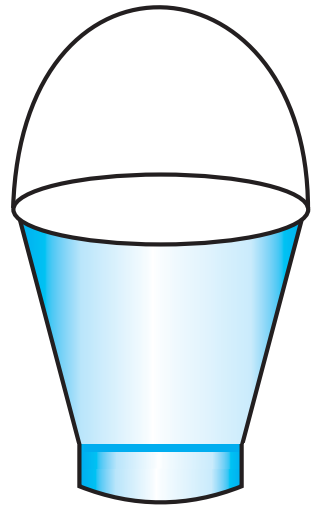
We have,
Radius of the upper end of the frustum, $\text{R}=\frac{45}{2}\text{cm},$
Radius of the lower end of the frustum = Radius of the cylinder $=\text{r}=\frac{25}{2}\text{cm,}$
Height of the cylinder, $h = 6\ cm$ and
Total height of the bucket $= 40\ cm$
And, the height of the frustum, $H = 40 - 6 = 34\ cm$
Also, the slant height of frustum, $\text{l}-\sqrt{(\text{R}-\text{r})^2+\text{H}^2}$
$=\sqrt{\Big(\frac{45}{2}-\frac{25}{2}\Big)^2+34^2}$
$=\sqrt{10^2+34^2}$
$=\sqrt{100+1156}$
$=\sqrt{1256}$
$\approx35.44\text{cm}$
Now,
The area of the metallic sheet used to make the bucket $= CSA$ of the frustum $+ CSA$ of the cylinder + Area of the base
$=\pi(\text{R}+\text{r})\text{l}+2\pi\text{rh}+\pi\text{r}^2$
$=\frac{22}{7}\times\Big(\frac{45}{2}+\frac{25}{2}\Big)\times35.44+2\times\frac{22}{7}\times\frac{25}{2}\times\frac{25}{2}$
$=\frac{22}{7}\times35\times35.44+\frac{22}{7}\times150+\frac{22}{7}\times\frac{625}{4}$
$=\frac{22}{7}\times(1240.4+150+156.25)$
$=\frac{22}{7}\times1546.65$
$=4860.9\text{cm}^2$
Also,
The volume of the water that the bucket can hold = Volume of the frustum
$=\frac{1}{3}\pi\text{H}(\text{R}^2+\text{r}^2+\text{Rr})$
$=\frac{1}{3}\times\frac{22}{7}\times34\times\Big[\Big(\frac{45}{2}\Big)^2+\Big(\frac{25}{2}\Big)^2+\Big(\frac{45}{2}\Big)\Big(\frac{25}{2}\Big)\Big]$
$=\frac{748}{21}\times\Big(\frac{2025}{4}+\frac{625}{4}+\frac{1125}{4}\Big)$
$=\frac{748}{21}\times\frac{3775}{4}$
$=33615.48\text{cm}^3$
$=33.61548\text{L} ($As, $1000\ cm^3 = 1\ L)$
$\approx33.61\text{ L}$ View full question & answer→Question 115 Marks
A hollow sphere of external and internal diameters 8cm and 4cm, respectively is melted into a solid cone of base diameter 8cm. Find the height of the cone.
AnswerWe have,
External radius of the hollow sphere, $\text{R}_1=\frac{8}{2}=4\text{cm},$
Internal radius of the hollow sphere, $\text{R}_2=\frac{4}{2}=2\text{cm}$ and
Base radius of the cone, $\text{r}=\frac{8}{2}=4\text{cm}$
Let the height of the cone be h.
Now,
Volume of the cone = Volume of the hollow sphere
$\Rightarrow\frac{1}{3}\pi\text{r}^2\text{h}=\frac{4}{3}\pi\text{R}_1^3=\frac{4}{3}\pi\text{R}_2^3$
$\Rightarrow\frac{1}{3}\pi\text{r}^2\text{h}=\frac{4}{3}\pi\Big(\text{R}_1^3-\text{R}_2^3\Big)$
$\Rightarrow\text{h}=\frac{4}{\text{r}^2}\big(\text{R}_1^3-\text{R}_2^3\big)$
$\Rightarrow\text{h}=\frac{4}{4\times4}\Big(4^3-2^3\Big)$
$\Rightarrow\text{h}=\frac{1}{4}(64-8)$
$\Rightarrow\text{h}=\frac{1}{4}\times56$
$\therefore\text{h}=14\text{cm}$
So, the height of the cone is 14cm.
View full question & answer→Question 125 Marks
A milk container is made of metal sheet in the shape of frustum of a cone whose volume is $10459\frac{3}{7}\text{cm}^3.$ The radii of its lower and upper circular ends are $8\ cm$ and $20\ cm,$ respectively. Find the cost of metal sheet used in making the container at the rate of $₹\ 1.40\ per\ cm^2.$
AnswerWe have,
Radius of the upper end, $R = 20\ cm$ and
Radius of the lower end, $r = 8\ cm$
Let the height of the container be $h.$
As,
Volume of the container $=10459\frac{3}{7}\text{cm}^3$
$\Rightarrow\frac{1}{3}\pi\text{h}(\text{R}^2+\text{r}^2+\text{R}\text{r})=\frac{73216}{7}$
$\Rightarrow\frac{1}{3}\times\frac{22}{7}\times\text{h}\times(20^2+8^2+20\times8)=\frac{73216}{7}$
$\Rightarrow\frac{22\text{h}}{21}\times(400+64+160)=\frac{73216}{7}$
$\Rightarrow\frac{22\text{h}}{21}\times624=\frac{73216}{7}$
$\Rightarrow\text{h}=\frac{73216\times21}{7\times22\times624}$
$\Rightarrow\text{h}=16\text{cm}$
Also,
The slant height of the container, $\text{l}=\sqrt{(\text{R}-\text{r})^2+\text{h} ^2}$
$=\sqrt{(20-8)^2+16^2}$
$=\sqrt{12^2+16^2}$
$=\sqrt{144+256}$
$=\sqrt{400}$
$=20\text{cm}$
Now,
Total surface area of the container $=\pi\text{l}(\text{R}+\text{r})+\pi\text{r}^2$
$=\frac{22}{7}\times20\times(20+8)+\frac{22}{7}\times8\times8$
$=\frac{22}{7}\times20\times28+\frac{22}{7}\times64$
$=\frac{22}{7}\times(560+64)$
$=\frac{22}{7}\times624$
$=\frac{13728}{7}\text{cm}^2$
So, the cost of metal sheet $=1.4\times\frac{13728}{7}=₹\ 2745.60$
Hence, the cost of the metal sheet used for making the rnlk container rs $₹\ 27 45.60.$
Disclaimer The answer given in the textbook is incooect. The same nas been corrected above
View full question & answer→Question 135 Marks
A tent consists of a frustum of a cone, surmounted by a cone. If the diameter of the upper and lower circular ends of the frustum be 14m and 26m, respectively, the height of the frustum be 8m and the slant height of the surmounted conical portion be 12m, find the area of the canvas required to make the tent. (Assume that the radii of the upper circular end of the frustum and the base of the surmounted conical portion are equal.)
AnswerFor the frustum: Upper diameter = 14m Upper Radius, r = 7m Lower diameter = 26m Lower Radius, R = 13m Height of the frustum = h = 8m Slant height l =$\sqrt{\text{h}^2+(\text{R}-\text{r})^2}$
$=\sqrt{8^2+(13-7)^2}$
$=\sqrt{64+36}$
$\sqrt{100}=10\text{m}$
For the conical part: Radius of the base = r = 7m Slant height = L = 12m Total surface area of the tent = Curved area of frustum + Curved area of the cone$=\pi\text{l}(\text{R}+\text{r})+\pi\text{r}\text{L}$
$=\frac{22}{7}\times10(13+7)+\frac{22}{7}\times7\times12$
$=\frac{22}{7}(200+84)=892.57\text{m}^2$
View full question & answer→Question 145 Marks
In a hospital, used water is collected in a cylindrical tank of diameter 2m and height 5m, After recycling this water is used to irrigate a park of hospital whose length is 25m and breadth is 20m. If the tank is filled completely then what will be the height of standing water used for irrigating the park? Write your views on recycling of water.
AnswerVolume of water in cylindrical tank = Volume of water in park
$\frac{22}{7}\times1\times1\times5=25\times20\times\text{h}$
where, h is the height of standing water
$\text{h}=\frac{11}{350}\text{m}$
$=\frac{22}{7}\text{m}$
Detailed Answer :
Diameter of cylinder (d) = 2m
Radius of cylinder (r) = 1m
Height of cylinder (H) = 5m
Volume of cylindrical tank $=\pi\text{r}^2\text{H}$
$=\pi\times(1)^2\times5$
$=5\pi\text{m}$
Length of tha park $(\text{l})=25\text{m}$
Breadth of park $(\text{b)}=20\text{m}$
Height of standing in the park = h
Volume of water in the park $=\text{lbh}=25\times20\text{h}$
Now, waret from the tank in used to irrigate the
park. so,
Volume of cylindrical tank
= Volume of water in the park
$\Rightarrow5\pi=25\times20\times\text{h}$
$\Rightarrow\frac{5\pi}{25\times20}=\text{h}$
$\Rightarrow=\text{h}\frac{\pi}{100}\text{m}$
$\Rightarrow\text{h}=0.0314\text{m}$
View full question & answer→Question 155 Marks
Water is flowing through a cylindrical pipe of internal diameter $2\ cm,$ into a cylindrical tank of base radius $40\ cm,$ at the rate of $0.4\ m$ per second. Determine the rise in level of water in the tank in half an hour.
AnswerDiameter of circular end of pipe $= 2cm$
$\therefore$ Radius$(r_1)$ of circular end of pipe $=\frac{2}{100}\text{m}=0.01\text{m}$
Area of cross-section $=\pi\times\text{r}^2_1-\pi\times(0.01)^2-0.0001\pi\text{m}^2$
Speed of water $= 0.4 m/s = 0.4 \times 60 = 24$ metre/min
Volume of water that flows in $1$ minute from pipe $=24\times0.0001\pi\text{m}^3-0.0024\pi\text{m}^3$
Volume of water that flows in $30$ minutes from pipe $=30\times0.0024\pi\text{m}^3=0.072\pi\text{m}^3$
Radius $(r_2)$ of base of cylindrical tank $= 40cm = 0.4m$
Let the cylindrical tank be filled up to h m in $30$ minutes.
Volume of water filled in tank in $30$ minutes is equal to the volume of water flowed out in $30$ minutes from the pipe.
$\therefore\pi\times(\text{r}_2^2)\times\text{h}=0.072\pi$
$\Rightarrow(0.4)^2\times\text{h}=0.072$
$\Rightarrow0.16\text{h}=0.072$
$\Rightarrow\text{h}=\frac{0.072}{0.16}$
$\Rightarrow\text{h}=0.45\text{m}=45\text{cm}$
Therefore, the rise in level of water in the tank in half an hour is $45cm.$
View full question & answer→Question 165 Marks
A toy is in the form of a cone of radius 3.5 cm mounted on a hemisphere of same radius. The total height of the toy is 15.5 cm. Find the total surface area of the toy.
Question 175 Marks
A wooden article was made by scooping out a hemisphere from each end of a cylinder, as shown in the figure. If the height of the cylinder is 20cm and its base is of diameter 7cm, find the total surface area of the article when it is ready.
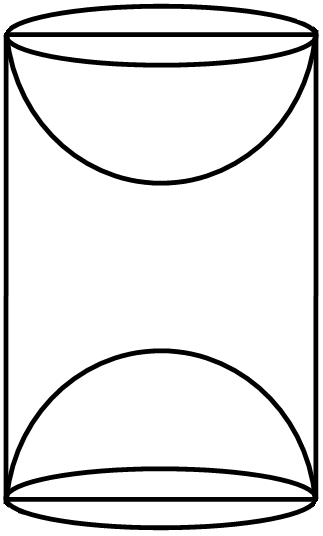
AnswerHeight of cylinder = 20cm
And diameter = 7cm and then radius = 3.5cm
Total surface area of article
= (lateral surface of cylinder with r = 3.5cm and h = 20cm)
$=\Big[2\pi\text{rh}+2\times\big(2\pi\text{r}^2\big)\Big]\text{sq. units}$
$=\Big[\Big(2\times\frac{22}{7}\times\frac{7}{2}\times20\Big)+\Big(4\times\frac{22}{7}\times\frac{7}{2}\times\frac{7}{2}\Big)\Big]\text{cm}^2$
$=(440+154)\text{cm}^2=594\text{cm}^2$
View full question & answer→Question 185 Marks
Three cubes of a metal whose edges are in the ratio 3 : 4 : 5 are melted and converted into a single cube whose diagonal is $12\sqrt{3}\text{cm}$ Find the edges of the three cubes.
AnswerLet the edge of the metal cubes be 3x, 4x and 5x.
Let the edge of the single cube be a.
As,
Diagonal of the single cube $12\sqrt{3}\text{cm}$
$\Rightarrow\text{a}\sqrt{3}=12\sqrt{3}$
$\Rightarrow\text{a}=12\text{cm}$
Now,
Volume of the single cube = Sum of the volumes of the metallic cubes
$\Rightarrow\text{a}^3=(3\text{x})^3+(4\text{x})^3+(5\text{x})^3$
$\Rightarrow12^3=27\text{x}^3+64\text{x}^3+125\text{x}^3$
$\Rightarrow1728=216\text{x}^3$
$\Rightarrow\text{x}^3=\frac{1728}{216}$
$\Rightarrow\text{x}^3=8$
$\Rightarrow\text{x}=\sqrt[3]{8}$
$\Rightarrow\text{x}=2$
So, the egdes of the cubes are 3 × 2 = 6cm, 4 × 2 = 8cm and 5 × 2 = 10cm.
Hence, the edges of the given three metallic cubes are 6cm, 8cm and 10cm.
View full question & answer→Question 195 Marks
The inner diameter of a glass is $7\ cm$ and it has a raised portion in the bottom in the shape of a hemisphere, as shown in the figure. If the height of the glass is $16\ cm$, find the apparent capacity and the actual capacity of the glass.
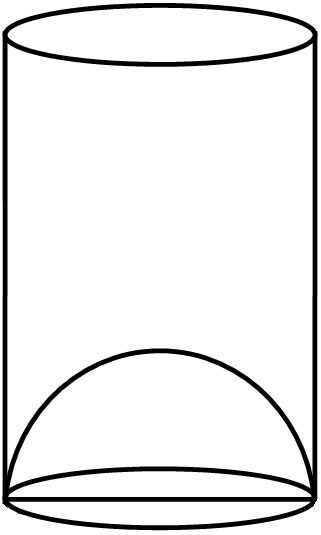
AnswerGiven Diameter of the cylinder $= 7cm$
$\Rightarrow $ Radius of the cylinder $= 3.5cm$
Height of the cylinder $= 16cm$
Apparent volume of the glass $=\pi\text{r}^2\text{h}$
$=\frac{22}{7}\times(3.5)^2\times16$
$=\frac{4312}{7}$
$=616\text{cm}^3$
$\Rightarrow $ Apparent capacity of the glass $= 616\ cm^3$
Actual volume of the glass $=\pi\text{r}^2\text{h}-\frac{2}{3}\pi\text{r}^3$
$=616-\frac{2}{3}\times\frac{22}{7}\times(3.5)^3$
$=616-\frac{1886.5}{3}$
$=616-89.833$
$=526.167\text{cm}^3$
$\Rightarrow$ Actual capacity of the glass $=526.17\text{cm}^3$
View full question & answer→Question 205 Marks
A right circular cone is divived into three parts by trisecting its height by two planes drawn parallel to the base. show that the volumes of the three portions starting from top are in ratio 1 : 7 : 19.
AnswerThe height of a Cone, 3h is trisected by 2 planes to the base of the cone at equal distances.
So, the cone is divided into a smaller cone & 2 frustums of the cone. The height of each piece is 'h' unit.
Since, right triangle ABG ~ tri ACF ~ tri ADE ( by AAA similarity criterion. So corresponding sides are to be proportional.
So, $\frac{\text{AB}}{\text{AC}}=\frac{\text{h}}{2\text{h}}=\frac{1}{2}=\frac{\text{BG}}{\text{CF}}=\frac{\text{r}}{2\text{r}}$
$\frac{\text{AB}}{\text{AD}}=\frac{\text{h}}{3\text{h}}=\frac{1}{3}=\frac{\text{BG}}{\text{DF}}=\frac{\text{r}}{3\text{r}}$
Now, we find the volume of each piece.. a smaller cone & 2 frustums
Volume of Cone $\text{ABG}=\frac{1}{3}\text{pl }\text{r}^2\text{ h}\ ....(1)$
Volume of middle frustum =
$\frac{1}{3}\text{ pl}\text{ (r}^2+4\text{r}^2+2\text{r}^2)\text{h}$
$=\frac{1}{3}\text{pl }7\text{r}^2\text{ h}\ ....(2)$
Volume of next frustum =
$=\frac{1}{3}\text{ pl}\ (4\text{r}^2+9\text{r}^2+6\text{r}^2)\text{h}$
$=\frac{1}{3}\text{ pl }19\text{r}^2\text{h}\ ....(3)$
Now, by finding the ratio of (1),(2)&(3)
we get, $\Big(\frac{1}{3}\text{ pl }\text{r}^2\text{h}\Big):\Big(\frac{1}{3}\text{ pl }7\text{r}^2\text{h}\Big):\Big(\frac{1}{3}\text{ pl }19\text{r}^2\text{h}\Big)$
= 1 : 7 : 19
View full question & answer→Question 215 Marks
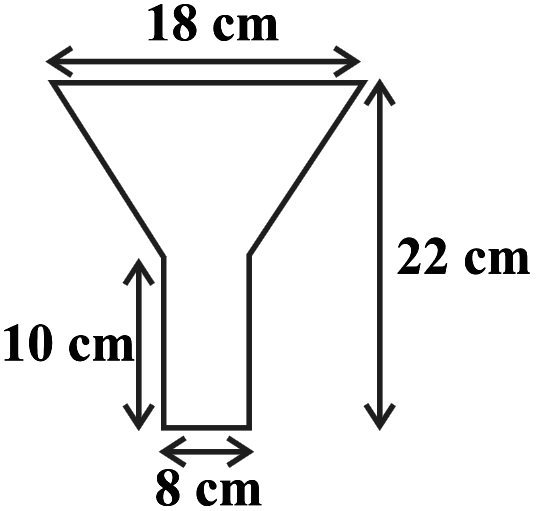
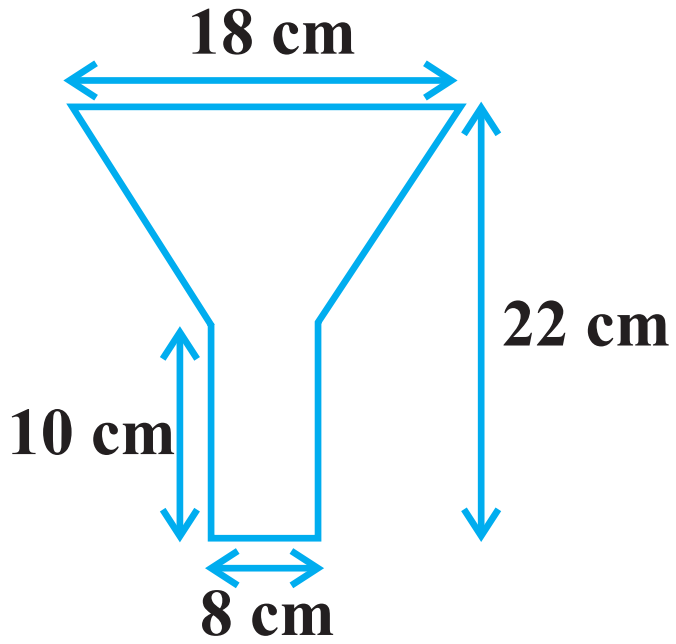
An oil funnel made of tin sheet consists of a $10\ cm$ long cylindrical portion attached to a frustum of a cone. If the total height is $22\ cm,$ diameter of the cylindrical portion is $8\ cm$ and the diameter of the top of the funnel is $18\ cm$, then find the area of the tin sheet required to make the funnel.
Answer
 We have,
Height of the cylindrical portion, $h=10cm,$
Height of the frustum of cone portion, $H = 22 - 10=12cm,$
Radius of the cylindical portion=Radius of smaller end of frustum portion, $r = 82 = 4cm$ and
Radius of larger end of frustum portion, $R = 182 = 9cm$
Also, the slant height of the frustum, $\text{l}=\sqrt{(\text{R}-\text{r})^2+\text{H}^2}$
$=\sqrt{(9-4)^2+12^2}$
$=\sqrt{5^2+12^2}$
$=\sqrt{25+144}$
$=\sqrt{169}$
$=13\text{cm}$
Now,
The area of the tin sheet required = CSA of frustum of cone + CSA of cylinder
$=\pi(\text{R}+\text{r})\text{l}+2\pi\text{rh}$
$=\frac{22}{7}\times(9-4)\times13+2\times\frac{22}{7}\times4\times10$
$=\frac{22}{7}\times13\times13+\frac{22}{7}\times80$
$=\frac{22}{7}\times(169+80)$
$=\frac{22}{7}\times249$
$\approx782.57\text{cm}^2$
So, the area of the tin sheet required to make the funnel is $782.57\ cm^2.$ View full question & answer→Question 225 Marks
From a solid cylinder whose height is $15\ cm$ and diameter $16\ cm$, a conical cavity of the same height and same diameter is hollowed out. Find the total surface area of the remaining solid. $[$Use $\pi= 3.14]$
Answer
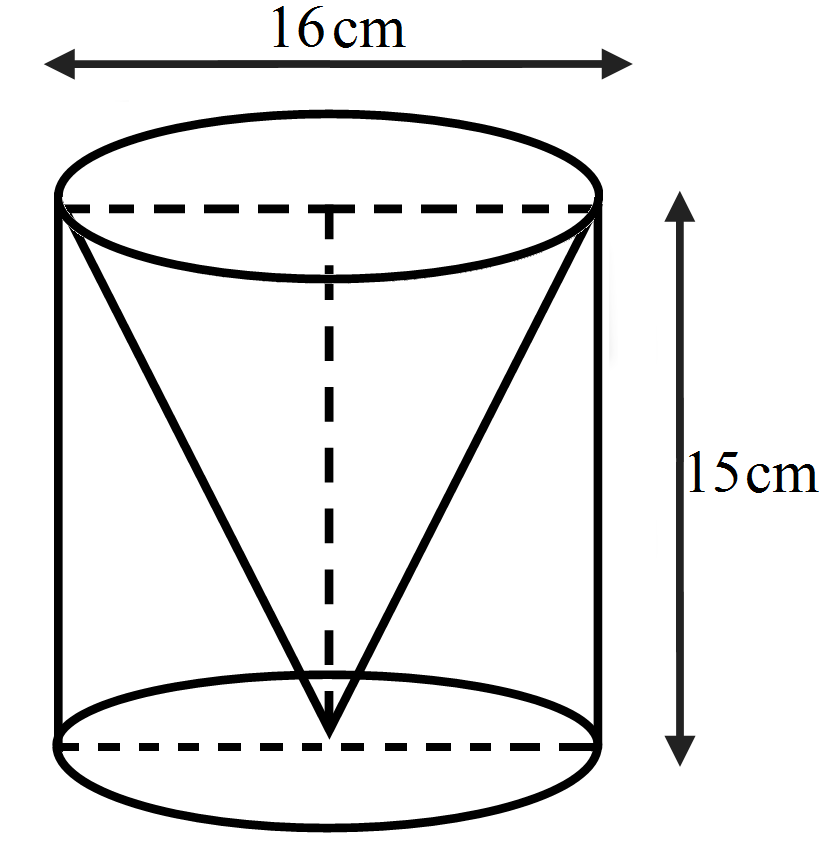
We have,
Height of the cylinder $=$ Height of the cone $= h = 15\ cm$ and
Radius of the cylinder $=$ Radius of the cone $\text{r}=\frac{16}{2}=8\text{cm}$
Also, the slant height of the cone, $\text{l}=\sqrt{\text{h}^2+\text{r}^2}$
$=\sqrt{15^2+8^2}$
$=\sqrt{225+64}$
$=\sqrt{289}$
$=17\text{cm}$
Now,
The total surface area of the remaining solid $= CSA $of the cone $+ CSA$ of the cylinder $+$ Are of the base
$=\pi\text{r}\text{l}+2\pi\text{rh}+\pi\text{r}^2$
$=\pi\text{r}(\text{l}+2\text{h}+\text{r})$
$=3.14\times8\times(17+2\times15+8)$
$=3.14\times8\times55$
$=1381.6\text{cm}^2$
So, the total surface area of the remaining solid is $1381.6\ cm^2.$
Disclaimer: The answer given in the textbook is incorrect. The same has been corrected above. View full question & answer→Question 235 Marks
A bucket is in the form of a frustum of a cone with a capacity of $12308.8\ cm^3 $ of water. The radii of the top and bottom circular ends are $20\ cm$ and $12\ cm$, respectively. Find the height of the bucket. $[$Use $\pi = 3.14]$
AnswerWe have,
Radius of the upper end, $R = 20\ cm $ and
Radius of the lower end, $r = 12 \ cm$
Let the height of the bucket be $h.$
As,
Volume of the bucket $= 12308.8\ cm^3$
$\Rightarrow\frac{1}{3}\pi\text{h}(\text{R}^2+\text{r}^2+\text{R}\text{r})=12308.8$
$\Rightarrow\frac{1}{3}\times3.14\times\text{h}\times(20^2+12^2+20\times12)=12308.8$
$\Rightarrow\frac{3.14\text{h}}{3}\times(400+144+240)=12308.8$
$\Rightarrow\frac{3.14\text{h}}{3}\times784=12308.8$
$\Rightarrow\text{h}=\frac{12308.8\times3}{3.14\times784}$
$\therefore\text{h}=15\text{cm}$
So. the heigh! of the bucket is $15\ cm$
View full question & answer→Question 245 Marks
A hemispherical tank, full of water, is emptied by a pipe at the rate of $\frac{25}{7}$ litres per second. How much time will it take to empty half the tank if the diameter of the base of the tank is 3m?
AnswerWe have,
The radius of the hemispherical tank, $\text{r}=\frac{3}{2}\text{m}$
Volume of the hemispherical tank $=\frac{2}{3}\pi\text{r}^3$
$=\frac{2}{3}\times\frac{22}{7}\times\frac{3}{2}\times\frac{3}{2}\times\frac{3}{2}$
$=\frac{99}{14}\text{m}^3$
Now,
Volume of half tank $=\frac{1}{2}\times\frac{99}{14}$
$=\frac{99}{28}\text{m}^3$
$=\frac{99}{28}\text{kL}$
$=\frac{99000}{28}\text{L}$
As, the rate of water emptied by the pipe $=\frac{25}{7}\text{L/s}$
So, the time taken to empty half the tank $=\frac{\Big(\frac{99000}{28}\Big)}{\Big(\frac{25}{7}\Big)}$
$=\frac{99000}{25\times4}$
$=990\text{s}$
$=\frac{990}{60}\text{min}$
$=16.5\text{min}$
$=16\text{min}\ 30\text{s}$
So, the time taken to empty half the tank is 16 minutes and 30 seconds.
View full question & answer→Question 255 Marks
A farmer connects a pipe of internal diameter 20cm from a canal into a cylindrical tank which is 10m in diameter and 2m deep. If the water flows through the pipe at the rate of 4km/hr, then in how much time will the tank be filled completely?
AnswerWe have,
Internal radius of the pipe, $\text{r}=\frac{20}{2}=10\text{cm}=0.1\text{m},$
Radius of the cylindrical tank, $\text{R}=\frac{10}{2}=5\text{m}$ and
Height of the cylindrical tank, H = 2m
Also, the speed of the water flow in the pipe, $\text{h}=4\text{km/hr}=\frac{4\times1000\text{m}}{1\text{hr}}=4000\text{m/hr}$
Now,
The volume of the water flowing out of the pipe in a hour $=\pi\text{r}^2\text{h}$
$=\frac{22}{7}\times5\times5\times2$
$=\frac{1100}{7}\text{m}^3$
So,
The time taken to fill the tank $=\frac{\text{Volume of the cylindrical tank}}{\text{Volume of water flowing out of pips in a hour}}$
$=\frac{\Big(\frac{1100}{7}\Big)}{\Big(\frac{880}{7}\Big)}$
$=\frac{1100}{880}$
$=\frac{5}{4}\text{hr}$
$=1\frac{1}{4}\text{hr}$
$=1\text{hr}\text{ and }\frac{1}{4}\times60\text{min}$
$=1\text{hr }15\text{min}$
So, the tank will be completely filled in 1 hour 15 minutes.
View full question & answer→Question 265 Marks
A solid rectangular block of dimensions 4.4m, 2.6m and 1m is cast into a hollow cylindrical pipe of internal radius 30cm and thickness 5cm. Find the length of the pipe.
AnswerWe have,
Length of the rectangular block, l = 4. 4m,
Breadth of the rectangular block, b = 2. 6m,
Height of the rectangular block, h = 1m,
Internal radius of the cylindrical pipe, r = 30cm = 0. 3m and
Thickness of the pipe = 5cm = 0. 05m
Also, the external radius of the pipe = 0. 3 + 0. 05 = 0. 35m
Let the length of the pipe be H.
Now,
Volume of the pipe = Volume of the block
$\Rightarrow\pi\text{R}^2\text{H}=\pi\text{r}^2\text{H}=\text{lbh}$
$\Rightarrow\pi(\text{R}^2-\text{r}^2)\text{H}=\text{lbh}$
$\Rightarrow\frac{22}{7}\times(0.35^2-0.3^2)\text{H}=4.4\times2.6\times1$
$\Rightarrow\frac{22}{7}\times(0.1225-0.09)\text{H}=4.4\times2.6$
$\Rightarrow\frac{22}{7}\times0.0325\times\text{H}=4.4\times2.6$
$=\text{H}=\frac{4.4\times2.6\times7}{22\times0.0325}$
$\therefore\text{H}=112\text{m}$
So, the length of the pipe is 112m.
View full question & answer→Question 275 Marks
The interior of a building is in the form of a right circular cylinder of diameter $4.2\ m$ and height $4\ m$ surmounted by a cone of same diameter. The height of the cone is $2.8\ m$. Find the outer surface area of the building.
Answer
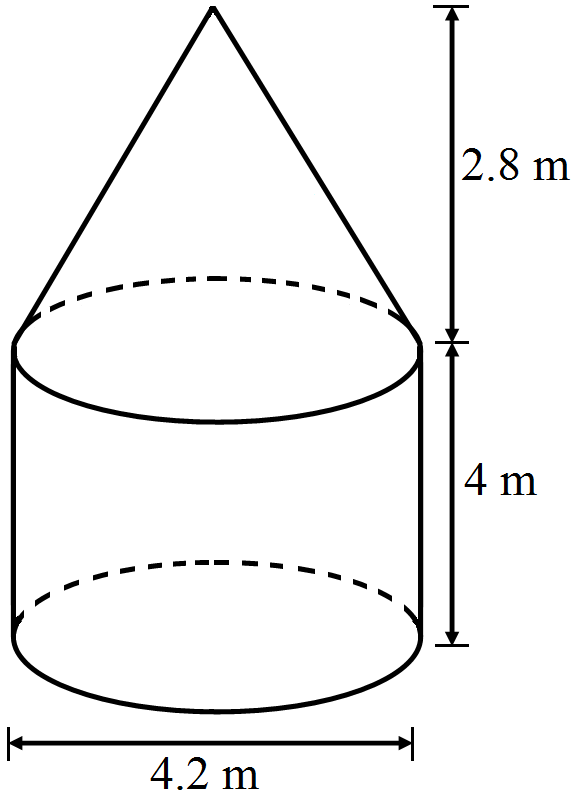
We have,
Radius of the cylinder = Radius of the cone $=\text{r}=\frac{4.2}{2}=2.1=\text{m},$
Height of the cylinder, $H = 4\ m$ and
Height of the cone, $h = 2.8\ m$
Also,
The slant height of the cone, $=\text{l}=\sqrt{=\text{r}^2+\text{h}^2}$
$=\sqrt{2.1^2+2.8^2}$
$=\sqrt{4.41+7.84}$
$=\sqrt{12.25}$
$=3.5$
Now,
The outer surface area of the building $=$ CSA of the cylinder $+$ CSA of the cone
$=2\pi\text{r}\text{H}+\pi\text{r}\text{l}$
$=\pi\text{r}(2\text{H}+\text{l})$
$=\frac{22}{7}\times2.1\times(2\times4+3.5)$
$=6.6\times11.5$
$=75.9\text{m}^2$
So, the outer surface area of the building rs $75.9\ m^2.$ View full question & answer→Question 285 Marks
A solid metallic right circular cone 20cm high and whose vertical angle is 60°, is cut into two parts at the middle of its height by a plane parallel to its base. If the frustum so obtained be drawn into a wire of diameter $\frac{1}{12}\text{cm},$ then find the length of the wire.
Answer
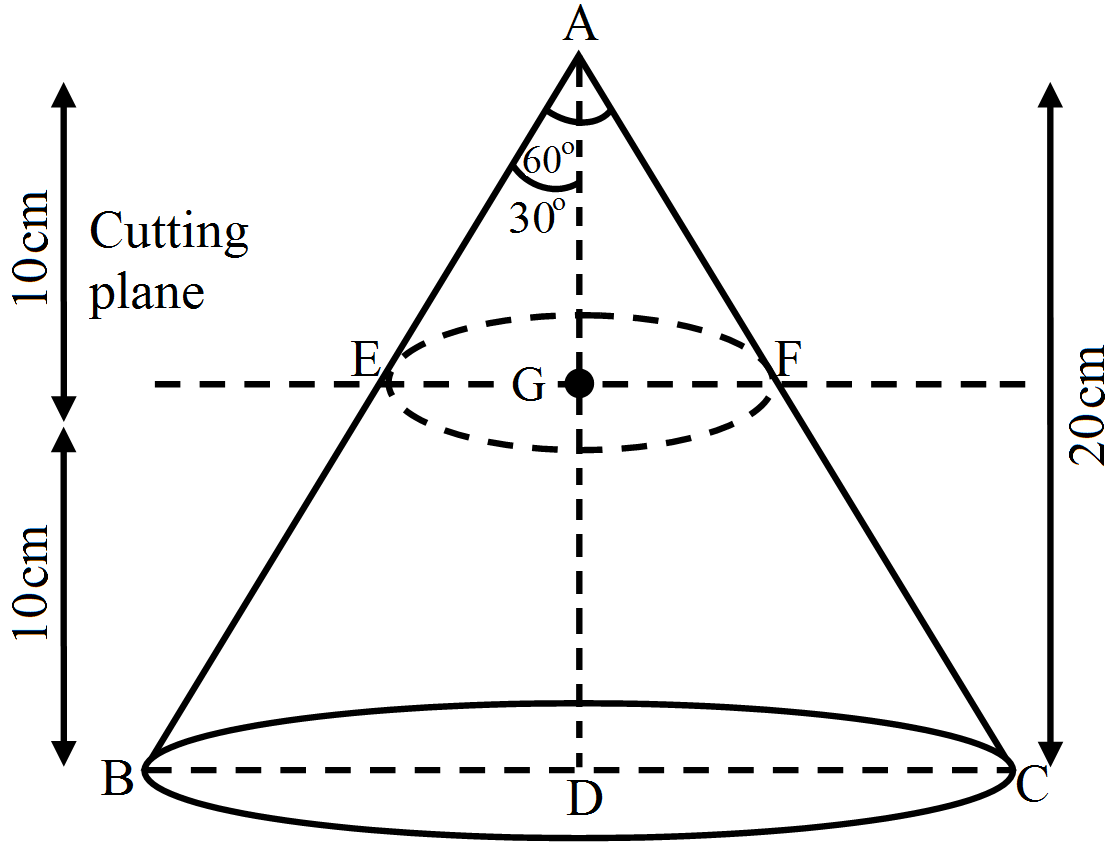 We have,
Height of the solid metallic cone, H = 20cm,
Height of the frustom, $\text{h}=\frac{20}{2}=10\text{cm}$ and
Radius of the wire $=\frac{1}{24}\text{cm}$
Let the length of the wire be l, BG = r and BO = R.
In $\triangle\text{AEG},$
$\tan30^\circ=\frac{\text{EG}}{\text{AG}}$
$\Rightarrow\frac{1}{\sqrt3}=\frac{\text{r}}{\text{H}-\text{h}}$
$\Rightarrow\frac{1}{\sqrt3}=\frac{\text{r}}{\text{20}-\text{10}}$
$\Rightarrow\text{r}=\frac{10}{\sqrt3}\text{cm}$
Also, in $\triangle\text{ABD},$
$\tan30^\circ=\frac{\text{BD}}{\text{AD}}$
$\Rightarrow\frac{1}{\sqrt3}=\frac{\text{R}}{\text{H}}$
$\Rightarrow\frac{1}{\sqrt3}=\frac{\text{R}}{\text{20}}$
$\Rightarrow\text{R}=\frac{20}{\sqrt3}\text{cm}$
Now,
Volume of the wire = Volume of the frustum
$\Rightarrow\pi\Big(\frac{1}{24}\Big)^2\text{l}=\frac{1}{3}\pi\text{h}\big(\text{R}^2+\text{r}^2+\text{Rr}\big)$
$\Rightarrow\frac{\text{l}}{576}=\frac{1}{3}\times10\times\bigg[\Big(\frac{20}{\sqrt3}\Big)^2+\Big(\frac{10}{\sqrt3}\Big)^2+\Big(\frac{20}{\sqrt3}\Big)\Big(\frac{10}{\sqrt3}\Big)\bigg]$
$\Rightarrow\text{l}=\frac{576}{3}\times10\times\Big[\frac{400}{3}+\frac{100}{3}+\frac{200}{3}\Big]$
$\Rightarrow\text{l}=\frac{576}{3}\times10\times\frac{700}{3}$
$\Rightarrow\text{l}=448000\text{cm}$
$\therefore\text{l}=4480\text{m}$
So, the length or the wire Is 4460m. View full question & answer→