MCQ 11 Mark
The ratio between the radius of the base and the height of a cylinder is $2 : 3$. If its volume is $1617\ cm^3$, the total surface area of the cylinder is:
- A
$308\ cm^2$
- B
$462\ cm^2$
- C
$540\ cm^2$
- ✓
$770\ cm^2$
AnswerCorrect option: D. $770\ cm^2$
$770\ cm^2$
View full question & answer→MCQ 21 Mark
A metallic cylinder of radius $8 \ cm$ and height $2\ cm$ is melted and converted into a right circular cone of height $6\ cm. $The radius of the base of this cone is:
- A
$4\ cm$
- B
$5\ cm$
- C
$6\ cm$
- ✓
$8\ cm$
AnswerCorrect option: D. $8\ cm$
$8\ cm$
View full question & answer→MCQ 31 Mark
A mason constructs a wall of dimensions $(270\ cm \times 300\ cm \times 350\ cm)$ with bricks, each of size $(22.5\ cm \times 11.25\ cm \times 8.75\ cm)$ and it is assumed that $1818$ space is covered by the mortar. Number of bricks used to construct the wall is:
- A
$11000$
- B
$11100$
- ✓
$11200$
- D
$11300$
AnswerCorrect option: C. $11200$
$11200$
View full question & answer→MCQ 41 Mark
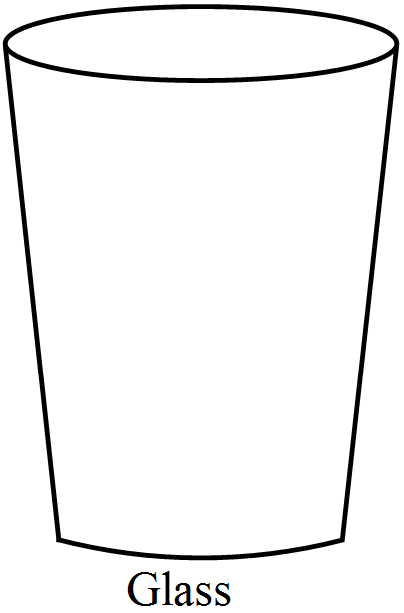
The shape of a glass $($tumbler$)$ is usually in the form of:
View full question & answer→MCQ 51 Mark
How many bricks, each measuring $(25\ cm \times 11.25\ cm \times 6\ cm),$ will be required to construct a wall $(8m \times 6m \times 22.5\ cm)?$
- A
$8000$
- ✓
$6400$
- C
$4800$
- D
$7200$
AnswerCorrect option: B. $6400$
$6400$
View full question & answer→MCQ 61 Mark
The volumes of two spheres are in the ratio $64 : 27$. The ratio of their surface areas is:
- A
$9 : 16$
- ✓
$16 : 9$
- C
$3 : 4$
- D
$4 : 3$
AnswerCorrect option: B. $16 : 9$
$16:9$
View full question & answer→MCQ 71 Mark
Assertion and Reason Type
Each question consists of two statements, namely, Assertion $(A)$ and Reason $(R)$. For selecting the correct answer, use the following code:
|
Assertion $(A)$
|
Reason $(R)$
|
|
The curved surface area of a cone of base radius $3\ cm$ and height $4\ cm$ is $15\pi\text{cm}^2$
|
Volume of a cone $\pi\text{r}^2\text{h}$
|
- A
Both Assertion $(A)$ and Reason $(R)$ are true and Reason $(R)$ is a correct explanation of Assertion $(A).$
- B
Both Assertion $(A)$ and Reason $(R)$ are true but Reason $(R)$ is not a correct explanation of Assertion $(A).$
- ✓
Assertion $(A)$ is true and Reason $(R)$ is false.
- D
Assertion $(A)$ is false and Reason $(R)$ is true.
AnswerCorrect option: C. Assertion $(A)$ is true and Reason $(R)$ is false.
Assertion $(A)$ is true and Reason $(R)$ is false.
View full question & answer→MCQ 81 Mark
A circus tent is cylindrical to a height of $4\ m$ and conical above it. If its diameter is $105\ m$ and its slant height is $40\ m$, the total area of canvas required is:
- A
$1760\ m^2$
- B
$2640\ m^2$
- C
$3960\ m^2$
- ✓
$7920\ m^2$
AnswerCorrect option: D. $7920\ m^2$
$7920\ m^2$
View full question & answer→MCQ 91 Mark
A solid piece of iron in the fo of a cuboid of dimensions $(49\ cm \times 33\ cm \times 24\ cm)$ is moulded to orm a solid sphere. The $r$ dius of the sphere is:
- A
$19\ cm$
- ✓
$21\ cm$
- C
$23\ cm$
- D
$25\ cm$
AnswerCorrect option: B. $21\ cm$
$21\ cm$
View full question & answer→Question 101 Mark
Match the following columns:
|
|
Column I
|
|
Column II
|
|
a.
|
A solid metallic sphere of radius 8cm is melted and the material is used to make solid right cones with height 4cm and base radius of 8cm. How many cones are formed?
|
p.
|
18
|
|
b.
|
A 20-m-deep well with diameter 14m is dug up and the earth from digging is evenly spread out to form a platform 44m by 14m. The height of the platform is ........ m.
|
q.
|
8
|
|
c.
|
A sphere of radius 6 cm is melted and recast in the shape of a cylinder of radius 4cm. Then, the height of the cylinder is ......... cm.
|
r.
|
16 : 9
|
|
d.
|
The volumes of two spheres are in the ratio 64 : 27. The ratio of their surface areas is ....... .
|
s.
|
5
|
MCQ 111 Mark
If the areas of three adjacent faces of a cuboid are $x, y$ and $z$, respectively, the volume of the cuboid is:
- A
$\text{xyz}$
- B
$2\text{xyz}$
- ✓
$\sqrt{\text{xyz}}$
- D
$\sqrt[3]{\text{xyz}}$
AnswerCorrect option: C. $\sqrt{\text{xyz}}$
$\sqrt{\text{xyz}}$
View full question & answer→MCQ 121 Mark
The total surface area of a hemisphere of radius $7\ cm$ is:
- A
$(588\pi)\text{cm}^2$
- B
$(392\pi)\text{cm}^2$
- ✓
$(147\pi)\text{cm}^2$
- D
$(98\pi)\text{cm}^2$
AnswerCorrect option: C. $(147\pi)\text{cm}^2$
$(147\pi)\text{cm}^2$
View full question & answer→MCQ 131 Mark
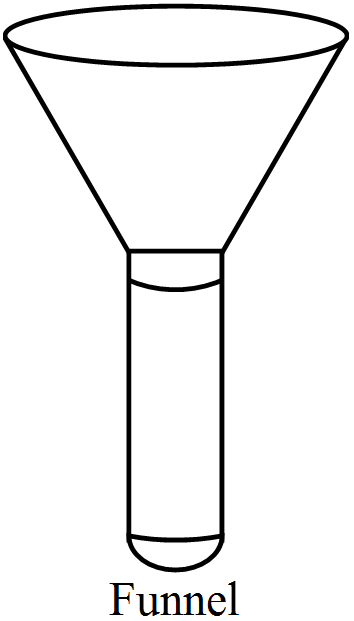
A funnel is the combination of:
- ✓
- B
A cylinder and a hemisphere.
- C
A cylinder and frustum of a cone.
- D
View full question & answer→MCQ 141 Mark
The radii of the base of a cylinder and a cone are in the ratio $3 : 4$. If their heights are in the ratio $2 : 3,$ the ratio between their volumes is:
- A
$1 : 2$
- B
$3 : 4$
- ✓
$8 : 9$
- D
$4 : 3$
AnswerCorrect option: C. $8 : 9$
$8 : 9$
View full question & answer→MCQ 151 Mark
A metallic solid sphere of radius $9\ cm$ is melted to form a solid linder of radius $9\ cm$. The height of the cylin er is:
- ✓
$12\ cm$
- B
$18\ cm$
- C
$36\ cm$
- D
$96\ cm$
AnswerCorrect option: A. $12\ cm$
$12\ cm$
View full question & answer→MCQ 161 Mark
A cubical ice$-$cream brick of edge $22\ cm$ is to be distributed among some children by filling ice$-$cream cones of radius $2\ cm$ and height $7\ cm$ up to the brim. How many children will get the ice$-$cream cones?
View full question & answer→MCQ 171 Mark
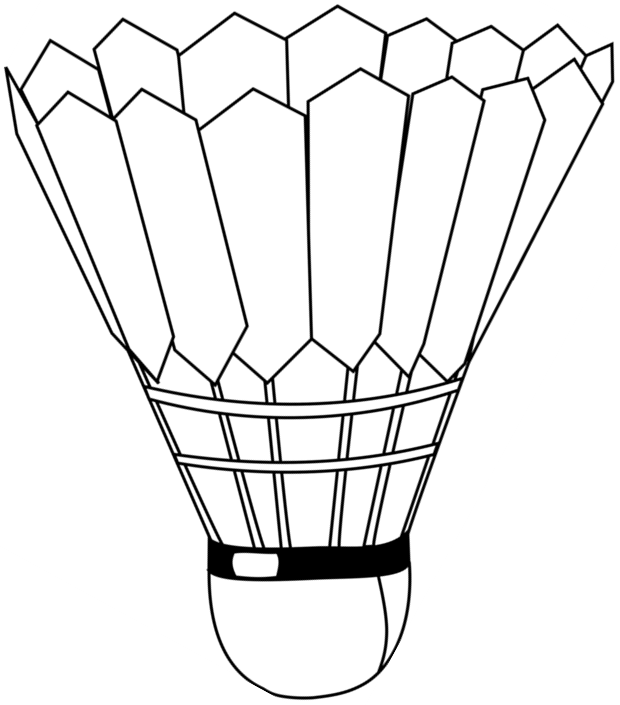
A shuttlecock used for playing badminton is the combination of:
- A
Cylinder and a hemisphere.
- B
Frustum of a cone and a hemispher.
- ✓
- D
View full question & answer→MCQ 181 Mark
On increasing the radii of the base and the height of a cone by $20\%,$ its volume will increase by:
- A
$20\%$
- B
$40\%$
- C
$60\%$
- ✓
$72.8\%$
AnswerCorrect option: D. $72.8\%$
$72.8\%$
View full question & answer→MCQ 191 Mark
The radii of the circular ends of a bucket of height $40\ cm$ are $24\ cm$ and $15\ cm.$ The slant height $($in $cm)$ of the bucket is:
View full question & answer→MCQ 201 Mark
Twelve solid spheres of the same size are made by melting a solid metallic cylinder of base diameter $2\ cm$ and height $16\ cm.$ The diameter of each sphere is:
- ✓
$2\ cm$
- B
$3\ cm$
- C
$4\ cm$
- D
$6\ cm$
AnswerCorrect option: A. $2\ cm$
$2\ cm$
View full question & answer→MCQ 211 Mark
If the radius of the base of a right circular cylinder is halved, keeping the height the same, then the ratio of the volume of the cylinder thus obtained to the volume of original cylinder is:
- A
$1 : 2$
- B
$2 : 1$
- ✓
$1 : 4$
- D
$4 : 1$
AnswerCorrect option: C. $1 : 4$
$1 : 4$
View full question & answer→MCQ 221 Mark
A cylindrical pencil sharpened at one end is a combination of:
- ✓
- B
A cylinder and frustum of a cone.
- C
A cylinder and a hemisphere.
- D
View full question & answer→MCQ 231 Mark
The diameter of the base of a cylinder is $4\ cm$ and its height is $14\ cm$. The volume of the cylinder is:
- ✓
$176\ cm^3$
- B
$196\ cm^3$
- C
$276\ cm^3$
- D
$352\ cm^3$
AnswerCorrect option: A. $176\ cm^3$
$176\ cm^3$
View full question & answer→MCQ 241 Mark
The number of solid spheres, each of diameter $6\ cm,$ that can mabe by melting a solid metal cylinder of height $45\ cm$ and diameter $4 \ cm,$ is:
View full question & answer→MCQ 251 Mark
The heights of two circular cylinders of equal volume are in the ratio $1 : 2.$ The ratio of their radii is:
- A
$1:\sqrt{2}$
- ✓
$\sqrt{2}:1$
- C
$1:2$
- D
$1:4$
AnswerCorrect option: B. $\sqrt{2}:1$
$\sqrt{2}:1$
View full question & answer→MCQ 261 Mark
If the radius of a sphere becomes $3$ times, then its volume will become:
- A
$3$ times
- B
$6$ times
- C
$9$ times
- ✓
$27$ times
AnswerCorrect option: D. $27$ times
$27$ times
View full question & answer→MCQ 271 Mark
A hollow cube of internal edge $22\ cm$ is filled with spherical marbles of diameter $0.5\ cm$ and $\frac{1}{8}$ space of the cube remains unfilled. Number of marbles required is
- ✓
$142296$
- B
$142396$
- C
$142496$
- D
$142596$
AnswerCorrect option: A. $142296$
$142296$
View full question & answer→MCQ 281 Mark
A cube of side $6\ cm$ is cut into a number of cubes, each of side $2\ cm$. The number of cubes formed is:
View full question & answer→MCQ 291 Mark
The height of a cylinder is $14\ cm$ and its curved surface area is $264\ cm^2$. The volume of the cylinder is:
- A
$308\ cm^3$
- ✓
$396\ cm^3$
- C
$1232\ cm^3$
- D
$1848\ cm^3$
AnswerCorrect option: B. $396\ cm^3$
$396\ cm^3$
View full question & answer→MCQ 301 Mark
The volume of a cube is $2744\ cm^2.$ Its surface area is:
- A
$196\ cm^2$
- ✓
$1176\ cm^2$
- C
$784\ cm^2$
- D
$588\ cm^2$
AnswerCorrect option: B. $1176\ cm^2$
$1176\ cm^2$
View full question & answer→MCQ 311 Mark
The shape of a gilli in the gilli$-$danda game is a combination of:

- ✓
- B
- C
Two cones and a cylinder.
- D
Two cylinders and a cone.
View full question & answer→MCQ 321 Mark
A metallic cone of base radius $2.1\ cm$ and height $8.4\ cm$ is melted and moulded into a sphere. The radius of the sphere is:
- ✓
$2.1\ cm$
- B
$1.05\ cm$
- C
$1.5\ cm$
- D
$2\ cm$
AnswerCorrect option: A. $2.1\ cm$
$2.1\ cm$
View full question & answer→MCQ 331 Mark
The circular ends of a bucket are of radii $35\ cm$ and $14\ cm$ and the height of the bucket is $40\ cm$. Its volume is:
- A
$60060\ cm^3$
- ✓
$80080\ cm^3$
- C
$70040\ cm^3$
- D
$80160\ cm^3$
AnswerCorrect option: B. $80080\ cm^3$
Volume of the buclet $=$ Volume of the frustum of the cone
$=\frac{1}{3}\pi\text{h}[\text{R}^2+\text{r}^2+\text{rr}]$
$=\frac{1}{3}\times\frac{22}{7}\times40[35^2+14^2+(35\times14)]$
$=\frac{880}{21}\times1911$
$=80080\text{cm}^3$
Hence, the volume of the bucket is $80080\ cm^3$.
View full question & answer→MCQ 341 Mark
The radius $($in $cm)$ of the largest right circular cone that can be cut out from a cube of edge $4.2\ cm$ is:
- ✓
$2.1$
- B
$4.2$
- C
$8.4$
- D
$1.05$
AnswerThe diameter of such a cone is equal to the edge of the cube.
So, the diameter $= 4.2\ cm.$
Hence, the radius $= 2.1\ cm.$
View full question & answer→MCQ 351 Mark
The diameter of a sphere is $14\ cm$. Its volume is:
AnswerCorrect option: C. $1437\frac{1}{3}\text{cm}^3$
Diameter $= 14\ cm$
So, the radius $= 7\ cm$
Volume of the sphere $=\frac{4}{3}\pi\text{r}^3$
$=\frac{4}{3}\times\frac{22}{7}\times(7)^3$
$=1437\frac{1}{3}\text{cm}^3$
View full question & answer→MCQ 361 Mark
If the radii of the ends of a bucket are $5\ cm$ and $15\ cm$ and it is $24\ cm$ high, then its surface area is:
- A
$1815.3\ cm^2$
- ✓
$1711.3\ cm^2$
- C
$2025.3\ cm^2$
- D
$2360\ cm^2$
AnswerCorrect option: B. $1711.3\ cm^2$
$\text{l}=\sqrt{\text{h}^2+(\text{R}-\text{r})^2}$
$\Rightarrow\text{l}=\sqrt{24^2+(15-5)}$
$\Rightarrow\text{l}=\sqrt{576+100}$
$\Rightarrow\text{l}=\sqrt{676}$
$\Rightarrow\text{l}=26\text{cm}$
Surface area of the bucket
$=\pi\big[\text{r}^2+\text{l}(\text{R}+\text{r})\big]$
$=3.14\times\big[5^2+26(15+5)\big]$
$=3.14\times[545]$
$=1711.3\text{cm}^2$
View full question & answer→Question 371 Mark
Match the following columns:
|
|
Column $I$
|
|
Column $II$
|
| $a.$ |
The radii of the circular ends of a bucket, in the form of the frustum of a cone of height $30\ cm$, are $20\ cm$ and $10\ cm$ respectively. The capacity of the bucket is $......cm^3$.
|
$p.$ |
$2418\pi$
|
| $b.$ |
The radii of the circular ends of a conical bucket of height $15\ cm$ are $20$ and $12\ cm$ respectively. The slant height of the bucket is $...... cm$.
|
$q.$ |
$22000$
|
| $c.$ |
The radii of the circular ends of a solid frustum of a cone are $33\ cm$ and $27\ cm$ and its slant height is $10\ cm$. The total surface area of the bucket is $....cm^2$.
|
$r.$ |
$12$
|
| $d.$ |
Three solid metallic spheres of radii $3\ cm, 4\ cm$ and $5\ cm$ are melted to form a single solid sphere. The diameter of the resulting sphere is $ ...... cm$.
|
$s.$ |
$17$
|
Answer
|
|
Column $I$
|
|
Column $II$
|
| $a.$ |
The radii of the circular ends of a bucket, in the form of the frustum of a cone of height $30\ cm$, are $20\ cm$ and $10\ cm$ respectively. The capacity of the bucket is $.....cm^3$.
|
$q.$ |
$22000$
|
| $b.$ |
The radii of the circular ends of a conical bucket of height $15\ cm$ are $20$ and $12\ cm$ respectively. The slant height of the bucket is $...... cm$.
|
$s.$ |
$17$
|
| $c.$ |
The radii of the circular ends of a solid frustum of a cone are $33\ cm$ and $27\ cm$ and its slant height is $10\ cm$. The total surface area of the bucket is $....cm^2$.
|
$p.$ |
$2418\pi$
|
| $d.$ |
Three solid metallic spheres of radii $3\ cm, 4\ cm$ and $5\ cm$ are melted to form a single solid sphere. The diameter of the resulting sphere is $...... cm$.
|
$r.$ |
$12$
|
Solution:
$a.$ Let $R$ and $r$ be the top and base of the bucket and $h$ be the height.
Capacity of the bucket $=$ Volume of the frustum of the cone
$=\frac{\pi\text{h}}{3}(\text{R}^2+\text{r}^2+\text{Rr})$
$=\frac{22}{7}\times\frac{1}{3}\times30\times(20^2+20^2+20+10)$
$=\frac{220}{7}\times700$
$=22000\text{cm}^3$
$b.$ Slant height, $\text{l}=\sqrt{\text{h}^2+(\text{R}-\text{r})^2}$
$=\sqrt{15^2+(20-12)^2}$
$=\sqrt{225+64}$
$=\sqrt{289}$
$=17\text{cm}$
$c.$ Total surface area of the bucket $=\pi\big[\text{R}^2+\text{r}^2+\text{l}(\text{R}+\text{r})\big]$
$=\pi\big[33^2+27^2+10(33+27)\big]$
$=\pi\big[1089=729+600\big]$
$2418\pi\text{cm}^2$
$d.$ Let the diameter be $d.$
So, the radius $=\frac{\text{d}}{2}$
Volume of the sphere $=\frac{4}{3}\pi\text{r}^3=\frac{4}{3}\pi\Big(\frac{\text{d}}{2}\Big)^3$
$\Rightarrow\frac{4}{3}\pi\Big(\frac{\text{d}}{2}\Big)^3=\frac{4}{3}\pi(3)^3+\frac{4}{3}\pi(4)^3+\frac{4}{3}\pi(5)^3$
$\Rightarrow\Big(\frac{\text{d}}{2}\Big)^3=(3)^3+(4)^3+(5)^3$
$\Rightarrow\frac{\text{d}^3}{8}=27+64+125$
$\Rightarrow\frac{\text{d}^3}{8}=216$
$\Rightarrow\text{d}^3=1728$
$\Rightarrow\text{d}=12\text{cm}$ View full question & answer→MCQ 381 Mark
The ratio of the total surface area to the lateral surface area of a cylinder with base radius $80\ cm$ and height $20\ cm$ is:
- A
$2 : 1$
- B
$3 : 1$
- C
$4 : 1$
- ✓
$5 : 1$
AnswerCorrect option: D. $5 : 1$
The ratio of the total surface area to the lateral surface area
$=\frac{\text{Total surface area}}{\text{Lateral surface area}}$
$=\frac{2\pi\text{r}(\text{h}+\text{r})}{2\pi\text{rh}}$
$=\frac{\text{h+r}}{\text{h}}$
$=\frac{20+80}{20}$
$=\frac{5}{1}$
So, the required ratio is $5 : 1$
View full question & answer→MCQ 391 Mark
Assertion and Reason Type
Each question consists of two statements, namely, Assertion $(A)$ and Reason $(R).$ For selecting the correct answer, use the following code:
|
Assertion $(A)$
|
Reason $(R)$
|
|
If the volumes of two spheres are in the ratio $27 : 8$ then their surface areas are in the ratio $3: 2.$
|
Volume of a sphere $=\frac{4}{3}\pi\text{R}^3.$
Surface area of a sphere $=4\pi\text{R}^2.$
|
- A
Both Assertion $(A)$ and Reason $(R)$ are true and Reason $(R)$ is a correct explanation of Assertion $(A).$
- B
Both Assertion $(A)$ and Reason $(R)$ are true but Reason $(R)$ is not a correct explanation of Assertion $(A).$
- C
Assertion $(A)$ is true and Reason $(R)$ is false.
- ✓
Assertion $(A)$ is false and Reason $(R)$ is true.
AnswerCorrect option: D. Assertion $(A)$ is false and Reason $(R)$ is true.
Let r and R be the radii of the two sheres.
Ratio of their volumes $=\frac{27}{8}$
$\Rightarrow\frac{\frac{4}{3}\pi\text{r}^3}{\frac{4}{3}\pi\text{R}^3}=\frac{27}{8}$
$\Rightarrow\frac{\text{r}^3}{\text{R}^3}=\frac{27}{8}$
$\Rightarrow\frac{\text{r}}{\text{R}}=\frac{3}{2}$
Ratio of their surface areas $=\frac{4\pi\text{r}^2}{4\pi\text{R}^2}$
$=\Big(\frac{\text{r}}{\text{R}}\Big)^2$
$=\Big(\frac{3}{2}\Big)^2$
$=\frac{9}{4}$
So, the Assertion $(A)$ is false.
The reason $(R)$ is true.
View full question & answer→MCQ 401 Mark
The radius of the base of a cone is $5\ cm$ and its height is $12\ cm$. Its curved surface area is:
- A
$60\pi\text{cm}^2$
- ✓
$65\pi\text{cm}^2$
- C
$30\pi\text{cm}^2$
- D
$\text{None of these}$
AnswerCorrect option: B. $65\pi\text{cm}^2$
Slant height, $\text{l}=\sqrt{\text{r}^2+\text{h}^2}$
$\Rightarrow\text{l}=\sqrt{5^2+12^2}$
$\Rightarrow\text{l}=\sqrt{25+144}$
$\Rightarrow\text{l}=\sqrt{169}$
$\Rightarrow\text{l}=13\text{cm}$
Curved surface area of the cone $=\pi\text{rl}$
$=\pi\times5\times13$
$=65\pi\text{cm}^2$
View full question & answer→MCQ 411 Mark
The surface areas of two spheres are in e ratio $16: 9.$ The ratio o their volumes is:
- ✓
$64 : 27$
- B
$16 : 9$
- C
$4 : 3$
- D
$16^3 : 9^3$
AnswerCorrect option: A. $64 : 27$
Given that the surface areas of the two spheres are in the ratio $16 : 9$.
So, $\frac{4\pi\text{r}^2}{4\pi\text{R}^2}=\frac{16}{9}$
$\Rightarrow\frac{\text{r}^2}{\text{R}^2}=\frac{16}{9}$
$\Rightarrow\frac{\text{r}}{\text{R}}=\frac{4}{3}$
Let the volume of the sphere with radius $r$ and $R$ be $V_1$ and $V_2$ respectively.
$\frac{\text{V}_1}{\text{V}_2}=\frac{\frac{4}{3}\pi\text{r}^3}{\frac{4}{3}\pi\text{R}^3}$
$\Rightarrow\frac{\text{V}_1}{\text{V}_2}=\Big(\frac{\text{r}}{\text{R}}\Big)^3$
$\Rightarrow\frac{\text{V}_1}{\text{V}_2}=\Big(\frac{4}{3}\Big)^3=\frac{64}{27}$
Hence, the ratio of their volumes is $64.27$.
View full question & answer→MCQ 421 Mark
The diameters of two circular ends of a bucket are $44\ cm$ and $24\ cm,$ and the height of the bucket is $35\ cm.$ The capacity of the bucket is:
- A
$31.7$ litres.
- ✓
$32.7$ litres.
- C
$33.7$ litres.
- D
$34.7$ litres.
AnswerCorrect option: B. $32.7$ litres.
Since the diameter of the circular ends of the bucket are $44\ cm$ and $24\ cm,$
the radii of thr circular end are $22\ cm$ and 1$2\ cm.$
Capacity of the bucket $=$ volume of the bucket
$=\frac{1}{3}\pi\text{h}\big[\text{R}^2+\text{r}^2+\text{Rr}\big]$
$=\frac{1}{3}\times\frac{22}{7}\times35\times\big[22^2+12^2+(22\times12)\big]$
$=32.7\text{ litres}$
Hence, the capacity of the bucket is $32.7$ litres.
View full question & answer→MCQ 431 Mark
A metallic spherical shell of internal and external diameters $4\ cm$ and $8\ cm$, respectively, is melted and recast in the form of a cone of base diameter $8\ cm.$ The height of the cone is:
- A
$12\ cm$
- ✓
$14\ cm$
- C
$15\ cm$
- D
$8\ cm$
AnswerCorrect option: B. $14\ cm$
The radii od the spherical shell is $2\ cm$ and $2\ cm.$
Volume of the spherical shell $=\frac{4}{3}\pi\big(\text{R}^3-\text{r}^3\big)$
$=\frac{4}{3}\pi\big(\text{R}^3-\text{2}^3\big)$
$=\frac{4}{3}\pi(56)$
Radius of the cone $= 4\ cm$
Volume of the cone $=\frac{1}{3}\pi\text{r}^2\text{h}$
$=\frac{1}{3}\pi(4)^2\text{h}$
$\Rightarrow16\text{h}=4(56)$
$\Rightarrow\text{h}=14\text{cm}$
View full question & answer→MCQ 441 Mark
A cone is cut by a plane parallel to its base and the upper part is removed. The part that is left over is called:
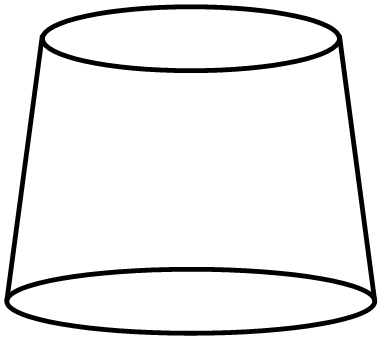
AnswerA cone is cut by a plane parallel to its base the upper part is remove. part that is left over is called the frutum of a cone.
View full question & answer→MCQ 451 Mark
The height of a conical tent is $14\ m$ and its floor area is $346.5m^2$. How much canvas, $1.1$ wide, will be required for it?
- A
$490\ m$
- ✓
$525\ m$
- C
$665\ m$
- D
$860\ m$
AnswerCorrect option: B. $525\ m$
Area of the floor of a conical tent $=\pi(\text{r})^2$
$\Rightarrow\pi\text{r}^2=346.5$
$\Rightarrow\text{r}^2=\Big(\frac{3465}{10}\times\frac{7}{22}\Big)$
$\Rightarrow\text{r}^2=\frac{441}{4}$
$\Rightarrow\frac{21}{2}\text{cm}$
Slant height of the cone, $\text{l}=\sqrt{\text{r}^2+\text{h}^2}$
$\Rightarrow\text{l}=\sqrt{\Big(\frac{21}{2}\Big)^2+14^2}$
$\Rightarrow\text{l}=\sqrt{\frac{1225}{4}}$
$\Rightarrow\text{l}=\frac{32}{2}\text{m}$
Area of the canvas $=$ curved surface area of the conical tent
$\Rightarrow$ Area of the canvas $=\pi\text{r}\text{l}$
$\Rightarrow$ Area of the canvas $=\frac{22}{7}\times\frac{21}{2}\times\frac{35}{2}=577.5\text{m}^2$
Lenght of the canvas $=\frac{\text{Area of the canvas}}{\text{Width of the canvas}}$
$=\frac{577.5}{1.1}$
$=525\text{m}$
View full question & answer→MCQ 461 Mark
A rectangular sheet of paper $40\ cm \times 22\ cm,$ is rolled to form a allow cylinder of height $40\ cm.$ The radius of e cylinder $($in $c^{th})$ is:
- ✓
$3.5$
- B
$7$
- C
$\frac{80}{7}$
- D
$5$
AnswerSince the height of the cylinder is given to be $40\ cm,$
the sheet to paper when converted to a cylinder,
Has its circum ference to be $22\ cm.$
So, circum ference $= 22\ cm$
$\Rightarrow2\pi\text{r}=22$
$\Rightarrow2\times\frac{22}{7}\times\text{r}=22$
$\Rightarrow\text{r}=3.5\text{cm}$
Hence, the radius of the cylinder is $3.5\ cm.$
View full question & answer→MCQ 471 Mark
Assertion and Reason Type
Each question consists of two statements, namely, Assertion $(A)$ and Reason $(R)$. For selecting the correct answer, use the following code:
|
Assertion $(A)$
|
Reason $(R)$
|
|
If the radii of the circular ends of a bucket $24\ cm$ high are $15\ cm$ and $5\ cm$ respectively, then the surface area of the bucket is $545\pi\text{cm}^2.$
|
if the radii of the circular ends of the frustum of a cone are $R$ and $r$ respectively and its height is $h,$ surface area is:
$\pi\big\{\text{R}^2+\text{r}^2+\text{l}(\text{R}-\text{r})\big\}$
where $\text{l}^2=\text{h}^2+(\text{R}+\text{r})^2.$
|
- A
Both Assertion $(A)$ and Reason $(R)$ are true and Reason $(R)$ is a correct explanation of Assertion (A).
- B
Both Assertion $(A)$ and Reason $(R)$ are true but Reason $(R)$ is not a correct explanation of Assertion $(A).$
- C
Assertion $(A)$ is true and Reason $(R)$ is false.
- ✓
Assertion $(A)$ is false and Reason $(R)$ is true.
AnswerCorrect option: D. Assertion $(A)$ is false and Reason $(R)$ is true.
Slant height $=\sqrt{\text{h}^2+(\text{R}-\text{r})^2}$
$=\sqrt{24^2+(15-5)^2}$
$=\sqrt{576+100}$
$=\sqrt{676}$
$=26\text{cm}$
Surface area of the bucket $=\big[\text{R}^2+\text{r}^2+\text{l}(\text{R}+\text{r})\big]$
$=\pi\big[15^2+5^2+26(15+5)\big]$
$=\pi\big[225+25+520\big]$
$=770\pi\text{cm}^2$
View full question & answer→MCQ 481 Mark
The area of the base of a right circular cone is $154cm^2$ and its height is $14\ cm$. Its curved surface area is:
- ✓
$154\sqrt{5}\text{cm}^2$
- B
$154\sqrt{7}\text{cm}^2$
- C
$77\sqrt{7}\text{cm}^2$
- D
$77\sqrt{5}\text{cm}^2$
AnswerCorrect option: A. $154\sqrt{5}\text{cm}^2$
Area of the base of the cone $= 154$
$\Rightarrow\pi\text{r}^2=154$
$\Rightarrow\frac{22}{7}\times\text{r}^2=154$
$\Rightarrow\text{r}^2=49$
$\Rightarrow\text{r}=7\text{cm}$
$\text{l}=\sqrt{\text{r}^2+\text{h}^2}$
$\Rightarrow\text{l}=\sqrt{7^2+14^2}$
$\Rightarrow\text{l}=\sqrt{49+196}$
$\Rightarrow\text{l}=\sqrt{245}$
$\Rightarrow\text{l}=7\sqrt{5}\text{cm}$
Curve surface area of the cone $=\pi\text{rl}$
$=\frac{22}{7}\times7\times7\sqrt{5}$
$=154\sqrt{5}\text{cm}^2$
View full question & answer→MCQ 491 Mark
The ratio between the volume of two spheres is $8 : 27$. What is the ratio between their surface areas?
- A
$2 : 3$
- B
$4 : 5$
- C
$5 : 6$
- ✓
$4 : 9$
AnswerCorrect option: D. $4 : 9$
Let the radii of the spheres be $R$ and $r.$
Ratio of volumes $=\frac{\frac{4}{3}\pi\text{R}^3}{\frac{4}{3}\pi\text{r}^3}$
$\Rightarrow\frac{\frac{4}{3}\pi\text{R}^3}{\frac{4}{3}\pi\text{r}^3}=\frac{8}{27}$
$\Rightarrow\Big(\frac{\text{R}}{\text{r}}\Big)^3=\Big(\frac{2}{3}\Big)^3$
$\Rightarrow\frac{\text{R}}{\text{r}}=\frac{2}{3}$
Ratio between their surface areas
$=\frac{4\pi\text{R}^2}{4\pi\text{r}^2}$
$\Rightarrow\Big(\frac{\text{R}}{\text{r}}\Big)^2$
$=\Big(\frac{2}{3}\Big)^2$
$=\frac{4}{9}$
View full question & answer→MCQ 501 Mark
The total surface area of a cube is $864cm^2$. Its volume is:
- A
$3456\ cm^3$
- B
$432\ cm^3$
- ✓
$1728\ cm^3$
- D
$3456\ cm^3$
AnswerCorrect option: C. $1728\ cm^3$
Let the edge iof the cube be $x\ cm$.
Total surface area of a cube $= 6x^2$
$\Rightarrow 6x^2 = 864$
$\Rightarrow x^2 = 144$
$\Rightarrow x = 12\ cm$
So, the volume of the cube$ = x^3$
$= (12)^3$
$= 1728\ cm^3$
View full question & answer→