Question 14 Marks
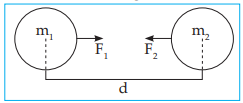
Observe the figure and answer the following questions
Question
(i) What are the masses of the objects shown?
(ii) What is the distance between their centres?
(iii) Write gravitational force between them.
(iv) Why gravitation constant is called universal constant?
(v) What will happen to gravitational force if mass of one of the objects is doubled?
(vi) What is the value of universal constant in SI?
Question
(i) What are the masses of the objects shown?
(ii) What is the distance between their centres?
(iii) Write gravitational force between them.
(iv) Why gravitation constant is called universal constant?
(v) What will happen to gravitational force if mass of one of the objects is doubled?
(vi) What is the value of universal constant in SI?
Answer
View full question & answer→(i) The masses are $m _1$ and $m _2$.
(ii) The distance between their centres is ‘d’.
(iii) The gravitational force between them would be,
$F \alpha \frac{ m _1 m_2}{d^2}$
$\therefore$$F =\frac{ Gm _1 m_2}{d^2}$ ... (G is constant of gravitation)
(iv) The value of gravitational constant does not depend upon the nature and size of the bodies. It also does not depend upon the nature of the medium between two bodies; hence it is called universal constant.
(v) If the mass of one of the objects is doubled, then the gravitational force between them also gets doubled.
(vi) In SI system, the value of ‘G’ is $6.67 \times 10^{-11} Nm ^2/ kg^2$.
(ii) The distance between their centres is ‘d’.
(iii) The gravitational force between them would be,
$F \alpha \frac{ m _1 m_2}{d^2}$
$\therefore$$F =\frac{ Gm _1 m_2}{d^2}$ ... (G is constant of gravitation)
(iv) The value of gravitational constant does not depend upon the nature and size of the bodies. It also does not depend upon the nature of the medium between two bodies; hence it is called universal constant.
(v) If the mass of one of the objects is doubled, then the gravitational force between them also gets doubled.
(vi) In SI system, the value of ‘G’ is $6.67 \times 10^{-11} Nm ^2/ kg^2$.