MCQ 11 MarkWhat will be the weight of a person on the earth, who weighs 9N on the moon? A3 NB15 NC45 N✓54 NAnswerCorrect option: D. 54 N 54 NView full question & answer→
MCQ 21 MarkHow much will a person with 72 N weight on the earth, weigh on the moon?✓12 NB36 NC21 ND63 NAnswerCorrect option: A. 12 N12 N View full question & answer→
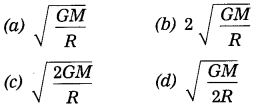
Question 31 MarkThe escape velocity of a body from the earth’s surface, $v_{sec}$ = ……. Answer$\sqrt{\frac{2 G M}{R}}$View full question & answer→
MCQ 41 MarkThe SI unit of the universal constant of gravitation is ……✓$N \cdot m ^2 / kg ^2$BN.kg ${ }^2 / m ^2$C$m / s ^2$D$kg \cdot m / s ^2$AnswerCorrect option: A. $N \cdot m ^2 / kg ^2$$N \cdot m ^2 / kg ^2$View full question & answer→
Question 51 MarkIn the usual notation, the acceleration due to gravity at a height h from the surface of the earth is …….. Answerg = $\frac{G M}{(R+h)^{2}}$ View full question & answer→
MCQ 61 MarkThe gravitational force between two particles separated by a distance r varies as ……..A$\frac{1}{r}$BrC$r^2$✓$\frac{1}{r^{2}}$AnswerCorrect option: D. $\frac{1}{r^{2}}$$\frac{1}{r^{2}}$View full question & answer→
MCQ 71 MarkThe periodic time of a planet is $T$ and the mean distance of the planet from the Sun is $r$, then according to Kepler's third law $..........$✓$T ^2 \alpha r ^3$B$T \alpha r ^3$C$T ^2 \alpha r$D$T ^3 \alpha r ^2$AnswerCorrect option: A. $T ^2 \alpha r ^3$$T^{2 }\alpha r^3$View full question & answer→
MCQ 81 MarkThe square of time period of revolution around the Sun is __________ to the cube of the mean distance of the planet from the Sun.Ainversely proportional✓directly proportionalCnot proportionalDdependAnswerCorrect option: B. directly proportionaldirectly proportional View full question & answer→
MCQ 91 MarkThe straight line joining the planet and the Sun sweeps equal __________ in equal interval of time.AvolumeBangleCdensity✓areaAnswerCorrect option: D. areaarea View full question & answer→
MCQ 101 MarkThe orbit of a planet is an ellipse with the Sun at one of the __________.✓fociBcentreCmiddleDsurfaceAnswerCorrect option: A. focifoci View full question & answer→
MCQ 111 MarkThe gravitational potential energy at the height of 'h' from the ground is __________.A$\frac{- GMm }{ R + h }$B$\frac{- GMm _1}{ R ^2+ h }$C$\frac{ GMm _1}{ R ^2+ h ^2}$D$\frac{ GMm }{ R ^2+ h }$Answer$\frac{-G M m}{R+h}$View full question & answer→
MCQ 121 MarkA body of mass $1 \ kg$ is attracted by the Earth with a force which is equal to $.......$✓$9.8 \ N$B$6.67 \times 10^{-11}$C$1 \ N$D$9.8 \ m/s$AnswerCorrect option: A. $9.8 \ N$$9.8 \ N$View full question & answer→
MCQ 131 MarkThe weight of body gradually decreases from __________.Aequator to poles✓poles to equatorCpole to poleDheight to surfaceAnswerCorrect option: B. poles to equatorpoles to equator View full question & answer→
MCQ 141 MarkThe radius of the Earth is $......m$.✓$6.4 \times 10^6$B$4.6 \times 10^6$C$4.6 \times 10^{-6}$D$6 \times 10^{24}$AnswerCorrect option: A. $6.4 \times 10^6$$6.4\times10^6$View full question & answer→
MCQ 151 MarkThe mass of the Earth is $.......kg$.A$6 \times 10^6$✓$6 \times 10^{24}$C$6.4 \times 10^6$D$6.4 \times 10^{24}$AnswerCorrect option: B. $6 \times 10^{24}$$6 \times 10^{24}$View full question & answer→
MCQ 161 MarkAccording to Newton's first law, if mass is more, then the inertia of the body is __________.AlessBvery less✓moreDcan't sayAnswerCorrect option: C. moremore View full question & answer→
MCQ 171 MarkThe mass of objects __________ at any surface on the Earth.✓remains constantBis non-uniformCchangesDincreasesAnswerCorrect option: A. remains constantremains constant View full question & answer→
MCQ 181 MarkAs the height of the object from the surface of the Earth increases, value of 'g' becomes __________.Amore✓lessCequalDcan't sayAnswerCorrect option: B. lessless View full question & answer→
MCQ 191 MarkThe value of 'g' at the depth from the ground goes on __________.AincreasingBfluctuating✓decreasingDvaryingAnswerCorrect option: C. decreasingdecreasingView full question & answer→
MCQ 201 MarkWhen an object is thrown upward, the force of gravity __________.✓Is opposite to the direction of motionBIs in the same direction as that of motionCbecomes zero at higher pointDIncrease as it rise upAnswerCorrect option: A. Is opposite to the direction of motionIs opposite to the direction of motion View full question & answer→
MCQ 211 MarkThe value of 'g' due to Earth is zero at __________.ACentre of EarthBPolesCInfinite distance✓Both a and cAnswerCorrect option: D. Both a and cBoth a and cView full question & answer→
MCQ 221 MarkThe value of '$g$' is maximum at poles and it is __________.A$9.72 \ m/s$✓$9.83 \ m/s^2$C$9.83 \ m/s$D$9.72 \ m/s^2$AnswerCorrect option: B. $9.83 \ m/s^2$$9.83 \ m/s^2$View full question & answer→
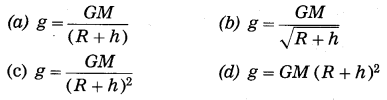
MCQ 231 MarkThe value of acceleration due to gravity at the height 'h' from the ground is __________.A$g=\frac{G M}{R+h}$B$g =\frac{ GM }{\sqrt{ R + h }}$C$g =\frac{ GM }{( R + h )^2}$D$g=G M(R+h)^2$Answer$g =\frac{G M}{(R+h)^2}$View full question & answer→
MCQ 241 MarkAcceleration is a __________ quantity.AscalarBfundamentalCunit✓vectorAnswerCorrect option: D. vectorvectorView full question & answer→
MCQ 251 MarkThe $SI$ unit of gravitational constant is $......$✓$Nm ^2 / kg ^2$B$Nkg ^2 / m ^2$C$m / s ^2$D$N \ cm ^2 / g ^2$AnswerCorrect option: A. $Nm ^2 / kg ^2$$Nm^2/kg^2$View full question & answer→
MCQ 261 MarkThe Earth attracts moon with a force of $10^{20}N$ . The moon attracts Earth with a force of $......$Aless than $10^{20} N$✓$10^{20} N$Cgreater than $10^{20} N$D$10^{-20} N$AnswerCorrect option: B. $10^{20} N$$10^{20} N$View full question & answer→
MCQ 271 MarkThe gravitational force causes __________.ATidesBCircular motion of moonCNone of these✓Both a and bAnswerCorrect option: D. Both a and bboth a and b View full question & answer→
MCQ 281 MarkThe gravitational force on the surface of the Moon is __________ times than that on the surface of the Earth.AfiveBone fifth✓one sixthDsixAnswerCorrect option: C. one sixthone sixthView full question & answer→
MCQ 291 MarkIf the distance between two objects increases 5 times, the gravitational force becomes __________ times.A5B15✓$\frac{1}{25}$D25AnswerCorrect option: C. $\frac{1}{25}$$\frac{1}{25}$View full question & answer→
MCQ 301 MarkIf the distance between two bodies becomes half, the gravitational force between them becomes __________.AhalfBone forth✓4 timesD2 timesAnswerCorrect option: C. 4 times4 times View full question & answer→
MCQ 311 MarkThe gravitational force of attraction between two objects is given by __________.A$F \alpha \frac{ m _1 m_2}{d^2}$B$F \alpha \frac{ d ^2}{m_1 m_2}$C$F \alpha \frac{ m _1 m_2}{\sqrt{ d ^2}}$D$F \alpha \frac{ m _1 m_2}{d^3}$Answer$F \alpha \frac{m_1 m_2}{d^2}$View full question & answer→