Question 11 MarkGenerally, using the same objective lens, but different eyepieces, different magnification can be obtained.AnswerTrue.View full question & answer→
Question 21 MarkThe conical cells respond to the intensity of light and communicate the degree of brightness and darkness to the brain.AnswerFalse. (The conical cells respond to colours and communicate the presence of colours in the retinal image to the brain.)View full question & answer→
Question 31 MarkThe rod like cells respond to colours and communicate the presence of colours in the retinal image of the brain.AnswerFalse. (The rod like cells respond to the intensity of light and communicate the degree of brightness and darkness, to the brain.)View full question & answer→
Question 41 MarkThe conical cells can respond differently to red, green and blue colours.AnswerTrue.View full question & answer→
Question 51 MarkIn television, we see a continuous picture due to persistence of vision.AnswerTrue.View full question & answer→
Question 61 MarkIn a compound microscope, a real image acts as an object for the eyepiece.AnswerTrue.View full question & answer→
Question 71 MarkA compound microscope forms an erect and real image of a small object.AnswerFalse. (A compound microscope forms an inverted and virtual image of a small object.)View full question & answer→
Question 81 MarkIn a simple microscope, the object is placed within the focal length of the convex lens.AnswerTrue.View full question & answer→
Question 91 MarkAs one grows old, ciliary muscles become weak.AnswerTrue.View full question & answer→
Question 101 MarkFarsightedness can be corrected using spectacles having convex lenses of suitable focal length.AnswerTrue.View full question & answer→
Question 111 MarkNearsightedness can be corrected using spectacles having convex lenses.AnswerFalse. (Nearsightedness can be corrected using spectacles having concave lenses.)View full question & answer→
Question 121 MarkAbsence of rod like cells results in colour blindness.AnswerFalse. (Absence of conical cells results in colour-blindness.)View full question & answer→
Question 131 MarkAn object of height 2 cm forms an image of height 3 cm when placed in front of a concave lens.AnswerFalse. (An object of height 2 cm forms an image of height less than 2 cm when placed in front of a concave lens.)View full question & answer→
Question 141 MarkThe principal focus of a convex lens is virtual.AnswerFalse. (The principal focus of a convex lens is real.)View full question & answer→
Question 151 MarkThe image formed by a concave lens is always virtual.AnswerTrue.View full question & answer→
Question 161 MarkWhen an object is placed in front of a concave lens, its image is obtained on the opposite side of the object.AnswerFalse. (When an object is kept in front of a concave lens, its image is obtained on the same side of the lens as the object.)View full question & answer→
Question 171 MarkWhen red light falls on the eyes, the cells responding to red light get excited more than those responding to other colours and we get the sensation of red colour.AnswerTrue.View full question & answer→
Question 181 MarkA convex lens is used to correct hypermetropia.AnswerTrue.View full question & answer→
Question 201 MarkA convex lens is used as a simple microscope.AnswerTrue.View full question & answer→
Question 211 MarkA concave lens is used as a magnifying glass.AnswerFalse. (A convex lens is used as a magnifying glass.)View full question & answer→
Question 221 MarkThe magnification produced by a convex lens is positive or negative depending on the object distance.AnswerTrue.View full question & answer→
Question 231 MarkThe magnification produced by a concave lens is positive or negative depending on the object distance.AnswerFalse. (The magnification produced by a concave lens is always positive.)View full question & answer→
Question 241 MarkThe focal length of a concave lens is negative.AnswerTrue.View full question & answer→
Question 251 MarkDue to the light sensitive cells in the eye, we get information about the brightness or dimness of the object and the colour of the object.AnswerTrue.View full question & answer→
Question 261 MarkA convex lens always forms a virtual image.AnswerFalse. (A convex lens forms a real image or a virtual image depending on the object distance.)View full question & answer→
Question 281 MarkA convex lens is a diverging lens.AnswerFalse. (A convex lens is a converging lens.)View full question & answer→
Question 291 MarkA concave lens is a converging lens. (March 2019)AnswerFalse. (A concave lens is a diverging lens.)View full question & answer→
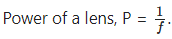
Question 301 MarkIf the power of a lens is 2 D, its focal length = 0.5 m.AnswerTrue.View full question & answer→
Question 321 MarkIn the compound microscope, two concave lenses are used.AnswerFalse. in compound microscope, two convex lenses are used.View full question & answer→
Question 331 MarkThe focal length of a convex lens is positive.AnswerTrueView full question & answer→
Question 341 MarkImpression of the image lasts on the retina for $\frac{1}{10}$ th of a second.AnswerFalse. Impression of the image lasts on the retina for $\frac{1}{16}$th of a second.View full question & answer→
Question 351 MarkAuditory nerve take the impulse from eye to brain.AnswerFalse. Optic nerve take the impulse from eye to brain. View full question & answer→
Question 361 MarkThe perception of colours is concerned with cone cells.AnswerTrue View full question & answer→
Question 371 MarkThe light is first and maximum refracted as it passes through eye lens.AnswerFalse. The light is first and maximum refracted as it passes through cornea.View full question & answer→
Question 381 MarkCornea gives colour to the eye.AnswerFalse. Pigment in iris give colour to the eye. View full question & answer→
Question 391 MarkHypermetropia can be corrected by using a spectacle of convex mirror.AnswerFalse. Hypermetropia can be corrected using a spectacle of convex lens. View full question & answer→
Question 401 MarkMyopia can be corrected by using a spectacle of concave lens.AnswerTrueView full question & answer→
Question 411 MarkA lens is an opaque object.AnswerFalse. A Lens is transparent object. View full question & answer→