Question types

P-1 Periodic Classification of Element question types

26 questions across 8 question groups — pick any mix to generate a Science paper with step-by-step answer keys.

26
Questions
8
Question groups
5
Question types
Sample Questions

P-1 Periodic Classification of Element questions

One sample from each question group in this chapter. Select any group above to see the full set with answer keys.

Q 1M.C.Q1 Mark
According to Mendeleev's periodic law.properties of elements are periodic function of their ____________.
  • A
    atomic numbers
  • atomic masses
  • C
    densities
  • D
    boiling points

Answer: B.

View full solution
Q 2M.C.Q1 Mark
In _____________ block of the modern periodic table non-metals are found.
  • A
    s-block
  • B
    d-block
  • p-block
  • D
    f-block

Answer: C.

View full solution
Q 3M.C.Q1 Mark
Lithium (Li), _____________ and potassium (K) is Dobereiner's triad.
  • A
    magnesium (Mg)
  • B
    aluminium (Al)
  • sodium (Na)
  • D
    calcium (Ca)

Answer: C.

View full solution
Q 4M.C.Q1 Mark
Alkaline earth metals have valency 2. This means that their position in the modern periodic table is in ____________
  • Group 2
  • B
    Group 16
  • C
    Period 2
  • D
    d-block

Answer: A.

View full solution
Select the appropriate option and complete the following paragraph:
(Metals, non-metals, metalloids, four, seven, s-block, p-block, d-block, f-block.)
On the basis of electronic configuration, elements in the modern periodic table are classified into ___________ blocks. Group 1 and 2 elements are included in __________ and all these elements are metais. (except hydrogen). Group 13 to 18 elements are included in _________ This block contains metals, non-metals and metalloids Group 3 to 12 elements are included. in __________ and all the elements are ___________. Elements shown at the bottom of the periodic table i.e., Janthanides and actinides constitute _________ and all these elements are metals.
View full solution
Taking into consideration the period of the elements given below, answer the following questions:
ElementAtomic radius (pm)
O66
B88
C77
N74
Be111
Li152
i. Arrange the above elements in a decreasing order of their atomic radii.
ii. State the period to which the above elements belong.
iii. Why this arrangement of elements is similar to the above period of the modern periodic table?
iv. Which of the above elements have the biggest and the smallest atom?
v. What is the periodic trend observed in the variation of atomic radius while going from left to right within a period?
View full solution
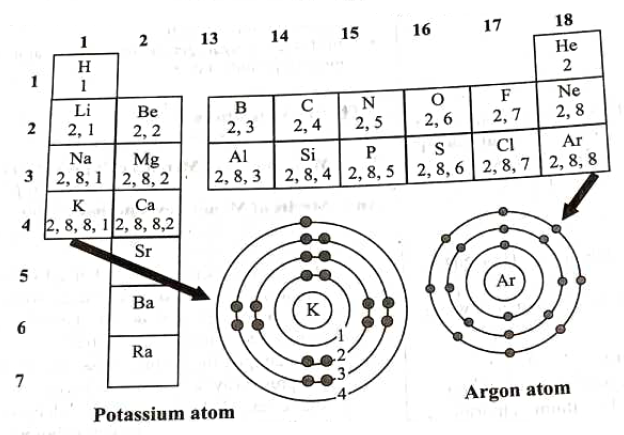
Observe the following diagram and write the answers of the following questions:
Image
i. Write the atomic numbers of first two elements in the second group.
ii. Write the number of valence electrons of the elements in the halogen group.
iii. Draw the diagram of electronic configuration of magnesium atom.
iv. After completion of a period, what change does take place in the electronic configuration of the next element?
v. Write the names of any two elements from the diagram which do not take part in chemical reaction.
View full solution

Generate a P-1 Periodic Classification of Element paper free

Pick question groups from the list above, set marks and difficulty, and export a branded PDF with step-by-step answer keys. First 3 chapters free — no signup.

Download App