All the above Explanation:
Water has a peculiarity property according to which it has maximum density at around 4 degrees Celsius. As we go above or below the mark, the density decreases. Also, the density of ice is lower than that of water. A circulation is thus set up until water in the pond reaches it is maximum density of 4 degrees Celsius.
When at atmospheric temperature reaches 0 degrees Celsius ice begins to form in ponds forming a layer on the top with water below it. If water did not have this property, then it would be impossible for aquatic life to exist in water bodies in cold seasons.
After sufficient thickness of ice is formed it prevents further loss of heat from the bottom layers of water. This is why fishes and other aquatic animals and plants can survive in ponds and other water bodies even when the atmospheric temperature reaches or is well below 0 degrees.
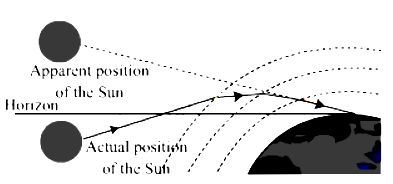 The rays of light from the Sun travel in straight line until they reach the Earth's atmosphere. The rays of light from the Sun enter obliquely in the Earth's atmosphere. The light rays coming from the Sun bend because of refraction, and this bending increases further because of the further increase in the refractive index of the successive layers. This causes the light rays to bend and we see the Sun early. Similarly, at sunset, the apparent position of the Sun is visible to us and not the actual position because of the same bending of light rays effect. Thus, due to refraction we see the Sun rise about two minutes before it is actually there and during sunset, we see it for around two minutes more, even though it has already moved from that position.