MCQ 11 Mark
Whatever be the position of the object, the image formed by a mirror is virtual, erect and smaller than the object. The mirror then must be:
- A
- B
- ✓
- D
Either concave or convex.
AnswerIt should be a convex mirror. This is because when an object is in front of a convex mirror, irrespective of its distance, a virtual, erect and diminished image of the object is obtained.
View full question & answer→MCQ 21 Mark
The figure given alongside shows the image of a clock as seen a plane mirror. The correct time is: Figure.
- A
$2.25$
- B
$2.35$
- C
$6.45$
- ✓
$9.25$
AnswerCorrect option: D. $9.25$
since the image formed by a plane mirror is laterally inverted.
View full question & answer→MCQ 31 Mark
If a magnification of, $-1 ($minus one$)$ is to be obtained by using a converging mirror, then the object has to be placed:
- A
- ✓
At the centre of curvature.
- C
Beyond the centre of curvature.
- D
AnswerCorrect option: B. At the centre of curvature.
If a magnification of $-1 ($minus one$)$ is to be obtained by using a converging mirror, the object needs to be placed at the centre of curvature so that an image of same size as the object can be formed.
View full question & answer→MCQ 41 Mark
The image formed by a concave mirror is real, inverted and of the same size as the object. The position of the object must then be:
- A
- B
Between the centre of curvature and focus.
- ✓
At the centre of curvature.
- D
Beyond the centre of curvature.
AnswerCorrect option: C. At the centre of curvature.
The reason being, the image formed by a concave mirror is real, inverted and of the same size as the object. The position of the object must then be at the centre of curvature.
View full question & answer→MCQ 51 Mark
The image formed by a concave mirror is virtual, erect and magnified. The position of object is:
- A
- ✓
Between focus and centre of curvature.
- C
- D
AnswerCorrect option: B. Between focus and centre of curvature.
The reason being, the image formed by a concave mirror is virtual, erect and magnified. The position of the object is between the pole and the focus.
View full question & answer→MCQ 61 Mark
Two big mirrors $A$ and $B$ are fitted side by side on a wall. A man is standing at such a distance from the wall that he can see the erect image of his face in both the mirrors. When the man starts walking towards the mirrors, he find that the size of his face in mirror $A$ goes on increasing but that in mirror $B$ remains the same.
- A
Mirror $A$ is concave and mirror $B$ is convex.
- B
Mirror $A$ is plane and mirror $B$ is concave.
- ✓
Mirror $A$ is concave and mirror $B$ is plane.
- D
Mirror $A$ is convex and mirror $B$ is concave.
AnswerCorrect option: C. Mirror $A$ is concave and mirror $B$ is plane.
Image formed by a plane mirror is virtual, erect and of the same size as the object.Image formed by a concave mirror is virtual, erect and larger than the object.
View full question & answer→MCQ 71 Mark
The angle of reflection is equal to the angle of incidence:
- ✓
- B
- C
Under special conditions.
- D
AnswerIn accordance with the first law of reflection, which states that the angle of reflection is equal to the angle of incidence.
View full question & answer→MCQ 81 Mark
A boy is standing in front of and close to a special mirror. He finds the image of his head bigger than normal, the middle part of his body of the same size, and his legs smaller than normal. The special mirror is made up of three types of mirrors in the following order from top downwards:
AnswerConcave: A concave mirror forms an image larger than the object.
Plane: A convex mirror forms an image smaller than the object.
Convex: A plane mirror forms an image similar to the size of the object.
View full question & answer→MCQ 91 Mark
In order to obtain a magnification of $-2 ($minus $2)$ with a concave mirror, the object should be placed:
- A
- ✓
Between focus and centre of curvature.
- C
At the centre of curvature.
- D
Beyond the centre of curvature.
AnswerCorrect option: B. Between focus and centre of curvature.
In order to obtain a magnification of $-2 ($minus $2)$ with a concave mirror, the object should be placed between the focus and the centre of curvature.
View full question & answer→MCQ 101 Mark
The focal length of a small concave mirror is $2.5\ cm.$ In order to use this concave mirror as a dentist's mirror, the distance of tooth from the mirror should be:
- A
$2.5\ cm$
- ✓
$1.5\ cm$
- C
$4.5\ cm$
- D
$3.5\ cm $
AnswerCorrect option: B. $1.5\ cm$
When an object is placed between the pole and the focus of a concave mirror, an enlarged image is formed.
View full question & answer→MCQ 111 Mark
A concave mirror produces magnification of $+4.$ The object is placed:
- A
- B
Between focus and centre of curvature.
- ✓
- D
Between the centre of curvature.
AnswerA concave mirror produces a magnification of $+4$ when the object is placed between the focus and the pole.
View full question & answer→MCQ 121 Mark
Magnification produced by a convex mirror is always:
- A
More than $1.$
- ✓
Less than $1.$
- C
Equal to $1.$
- D
More or less than $1.$
AnswerCorrect option: B. Less than $1.$
Magnification produced by a convex mirror is always less than $1.$ This is because the size of the image formed by a convex mirror is smaller than the object.
View full question & answer→MCQ 131 Mark
In order to obtain a magnification of, $-1.5$ with a concave mirror of focal length $16\ cm,$ the object will have to be placed at a distance.
- A
Between $6\ cm$ and $16\ cm$
- ✓
Between $32\ cm$ and $16\ cm$
- C
Between $48\ cm$ and $32\ cm$
- D
Beyond $64\ cm$
AnswerCorrect option: B. Between $32\ cm$ and $16\ cm$
To obtain a magnification of $-1.5,$ the object needs to be placed between the focus and the centre of curvature.
View full question & answer→MCQ 141 Mark
Linear magnification $(m)$ produced by a rear view mirror fitted in vehicles:
- A
- ✓
- C
- D
In be more less than one depending on the position of object.
AnswerLinear magnification $(m)$ produced by a rear view mirror, installed in vehicles, is less than one.
View full question & answer→MCQ 151 Mark
The image formed by a spherical mirror is virtual. The mirror will be:
- A
- ✓
- C
Either concave or convex.
- D
AnswerA convex mirror always forms a virtual image.
View full question & answer→MCQ 161 Mark
According to New Cartesian Sign Convention:
- A
Focal length of concave mirror is positive and that of convex mirror is negative.
- B
Focal length of both concave and convex mirrors is positive.
- C
Focal length of both concave and convex mirrors is negative.
- ✓
Focal length of concave mirror is negative and that of convex mirror is positive.
AnswerCorrect option: D. Focal length of concave mirror is negative and that of convex mirror is positive.
This is because the focus of a concave mirror is in front of the mirror, on the left side, and the focus of a convex mirror is behind the mirror, on the right side.
View full question & answer→MCQ 171 Mark
A ray of light is incident on a plane mirror making an angle of $90^\circ$ with the mirror surface. The angle of reflection for this ray of light will be:
- A
$45^\circ$
- B
$90^\circ$
- ✓
$0^\circ$
- D
$60^\circ $
AnswerCorrect option: C. $0^\circ$
Angle of incidence $= 0^\circ$
According to the first law of reflection, the angle of incidence is equal to the angle of reflection.
View full question & answer→MCQ 181 Mark
The focal length of a spherical mirror of radius of curvature $30\ cm$ is:
- A
$10\ cm$
- ✓
$15\ cm$
- C
$20\ cm$
- D
$30\ cm $
AnswerCorrect option: B. $15\ cm$
The focal length of a spherical mirror is half of its radius of curvature.
View full question & answer→MCQ 191 Mark
Linear magnification produced by a concave mirror may be:
- A
Less than $1$ or equal to $1.$
- B
More than $1$ or equal than $1.$
- ✓
Less than $1,$ more than $1$ or equal to $1.$
- D
Less than $1$ or more than $1.$
AnswerCorrect option: C. Less than $1,$ more than $1$ or equal to $1.$
Magnification, $\text{m}=\frac{\text{v}}{\text{u}}$
View full question & answer→MCQ 201 Mark
In a convex spherical mirror, reflection of light takes place at:
- A
- B
A bent$-$in surface.
- ✓
A bulging$-$our surface.
- D
AnswerCorrect option: C. A bulging$-$our surface.
In a convex spherical mirror, reflection of light takes place at the bulged$-$out surface.
View full question & answer→MCQ 211 Mark
A concave mirror cannot be used as:
AnswerA concave mirror cannot be used as a rear view mirror because it forms inverted images of distant objects.
View full question & answer→MCQ 221 Mark
An object is placed $20\ cm$ in front of a plane mirror. The mirror is moved $2\ cm$ towards the object. The distance between the positions of the positions of the original and final images seen in the mirror is:
- A
$2\ cm.$
- ✓
$4\ cm.$
- C
$10\ cm.$
- D
$22\ cm $
AnswerCorrect option: B. $4\ cm.$
Distance between original image and final image $=$ distance the mirror moved $+$ same distance the image moved $= 2 + 2 = 4c.$
View full question & answer→MCQ 231 Mark
Consider two statements $A$ and $B$ given below:
$(i).$ Real image is always inverted.
$(ii).$ Virtual image is always erect.
Out of these two statements:
AnswerCorrect option: C. Both $A$ and $B$ are true.
A real image is always inverted and a virtual image is always erect.
View full question & answer→MCQ 241 Mark
A real image of an object is to be obtained. The mirror required for this purpose is:
- A
- ✓
- C
- D
Either convex or concave.
AnswerA concave mirror forms a real image of an object.
View full question & answer→MCQ 251 Mark
The real image formed by a concave mirror is larger than the object when object is:
- A
At a distance equal to radius of curvature.
- B
At a distance less than the focal length.
- ✓
Between focus and centre of curvature.
- D
At a distance greater than radius of curvature.
AnswerCorrect option: C. Between focus and centre of curvature.
For an object placed between the focus and the centre of curvature, the real image formed by a concave mirror is larger than the object.
View full question & answer→MCQ 261 Mark
If the image formed is always virtual, the mirror can be:
AnswerBoth convex and plane mirrors always form virtual images.
View full question & answer→MCQ 271 Mark
The mirror which can form a magnified image of an object is:
- A
- B
- ✓
- D
Both convex and concave mirror.
AnswerA concave mirror forms a magnified image of an object.
View full question & answer→MCQ 281 Mark
The angle between an incident ray and the plane mirror is $30^\circ.$ The total angle between the incident ray and reflected ray will be:
- A
$30^\circ$
- B
$60^\circ$
- C
$90^\circ$
- ✓
$120^\circ$
AnswerCorrect option: D. $120^\circ$
Since, angle of incidence $=90^{\circ}-$ angle between plane mirror and incident ray $=90^{\circ}-30^{\circ}=60^{\circ}$ and according to first law of reflection, angle of incidence $=$ angle of reflection $=60^{\circ}$
Total angle between incident ray and reflected ray $=60^{\circ}+60^{\circ}=120^{\circ}$
View full question & answer→MCQ 291 Mark
AnswerA convex mirror diverges the rays of light incident on it; hence, it acts as a diverging mirror.
View full question & answer→MCQ 301 Mark
A ray of light strikes a plane mirror $PQ$ at an angle of incidence of $30^\circ ,$ is reflected from the plane mirror and then strikes a second plane mirror $QR$ placed at right angles to the first mirror. The angle of reflection at the second mirror is: Draw a ray$-$diagram to illustrate your answer.
- A
$30^\circ$
- B
$45^\circ$
- ✓
$60^\circ$
- D
$90^\circ$
AnswerCorrect option: C. $60^\circ$
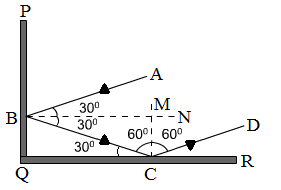
Here.
$\angle\text{A}\text{B}\text{N}= \angle\text{N}\text{B}\text{C} ($angle of incidence $=$ angle of reflection$)$
$\angle\text{B}\text{C}\text{O}=\angle\text{N}\text{B}\text{C} ($alternate angles$)$
$\angle\text{M}\text{C}\text{B}=90^\circ-\angle\text{B}\text{C}\text{O}$
$\big(\angle\text{M}\text{C}\text{B}=$angle of incident for mirror $QR\big) $
$= 60^\circ$
Now
$\big( \angle\text{M}\text{C}\text{B}=\angle\text{M}\text{C}\text{D}=60^\circ $ angle of reflection from mirror $QR$ and angle of incidence $=$ angle of reflection$\big)$ View full question & answer→MCQ 311 Mark
If $R$ is the radius of curvature of a spherical mirror and $f$ is its focal length, then:
AnswerCorrect option: B. $R = 2$
If $R$ is the radius of curvature of a spherical mirror and $f$ is its focal length, then $R = 2f.$
View full question & answer→MCQ 321 Mark
The image of an object formed by a plane mirror is:
AnswerThe reason being, the image cannot be projected on a screen.
View full question & answer→MCQ 331 Mark
In the concave reflector of a torch, the bulb is placed:
- A
Between the pole and focus of reflector.
- ✓
At the focus of reflector.
- C
Between focus and centre of curvature of reflector.
- D
At the centre of curvature of reflector.
AnswerCorrect option: B. At the focus of reflector.
When a light bulb is placed at the focus of a concave mirror reflector, the diverging light rays of the bulbare collected by the reflector and then reflected, to produce a strong, parallel$-$sided beam of light.
View full question & answer→MCQ 341 Mark
$n$ order to obtain a magnification of, $−0.6 ($minus $0.6)$ with a concave mirror, the object must be placed:
- A
- B
- C
Between focus and centre of curvature.
- ✓
Beyond the centre of curvature.
AnswerCorrect option: D. Beyond the centre of curvature.
In order to obtain a magnification of $−0.6 ($minus $0.6)$ with a concave mirror, the object needs to be placed beyond the centre of curvature, as at this point a diminished image will be formed.
View full question & answer→MCQ 351 Mark
The mirror used by a dentist to examine the teeth of a person is:
AnswerA concave mirror is used by a dentist to examine the teeth of a person.
View full question & answer→MCQ 361 Mark
An object is placed at a large distance in front of a concave mirror of radius of curvature $40\ cm.$ The image will be formed in front of the mirror at a distance:
- ✓
$20\ cm$
- B
$30\ cm$
- C
$40\ cm$
- D
$50\ cm$
AnswerCorrect option: A. $20\ cm$
An object is placed at a large distance but in front of a concave mirror with a radius of curvature of $40\ cm.$ The image of this object will be formed at the focus that is $20\ cm$ away
View full question & answer→MCQ 371 Mark
The angle of incidence for of light passing through the centre of curvature of a concave mirror is:
- A
$45^\circ$
- B
$90^\circ$
- ✓
$0^\circ$
- D
$180^\circ $
AnswerCorrect option: C. $0^\circ$
The reason being, a ray of light passing through the centre of curvature of a concave mirror strikes the mirror normally or perpendicularly.
View full question & answer→MCQ 381 Mark
The image formed by a plane mirror is:
- A
Virtual, behind the mirror and enlarged.
- ✓
Virtual, behind the mirror and of the same size as the object.
- C
Real, at the surface of the mirror and enlarged.
- D
Real, behind the mirror and of the same size as the object.
AnswerCorrect option: B. Virtual, behind the mirror and of the same size as the object.
The image formed by a plane mirror is virtual, behind the mirror and of the same size because it cannot be projected on a screen.
View full question & answer→MCQ 391 Mark
The real image formed by a concave mirror is smaller than the object if the object is:
- A
Between centre of curvature and focus.
- ✓
At a distance greater than radius of curvature.
- C
At a distance equal to radius of curvature.
- D
At a distance equal to focal length.
AnswerCorrect option: B. At a distance greater than radius of curvature.
The reason being, the image formed by a concave mirror is virtual, erect and magnified. The position of the object is between the pole and the focus.
View full question & answer→MCQ 401 Mark
The image formed by a concave mirror is real, inverted and highly diminished $($much smaller than the object$).$ The object must be:
- A
- B
- C
At the centre of curvature.
- ✓
AnswerThe reason being, the image formed by a concave mirror is real, inverted and highly diminished $($much smaller than the object$).$ Therefore, the object must be at infinity.
View full question & answer→MCQ 411 Mark
Magnification produced by a plane mirror is:
AnswerMagnification produced by a plane mirror is equal to one. This is because the size of the image formed by a plane mirror is same as the size of the object.
View full question & answer→MCQ 421 Mark
If the focal length of a spherical mirror is $12.5\ cm,$ its radius of curvature will be:
- ✓
$25\ cm$
- B
$15\ cm$
- C
$20\ cm$
- D
$35\ cm$
AnswerCorrect option: A. $25\ cm$
Radius of curvature $'R\ ' = 2f$
$R = 2 \times 12.5$
$= 25\ cm$
View full question & answer→MCQ 431 Mark
One of the following does not apply to a concave mirror. This is:
- A
Focal length is negative.
- B
Image distance can be positive or negative.
- ✓
Image distance is always positive.
- D
Height of image can be positive or negative.
AnswerCorrect option: C. Image distance is always positive.
The image distance is always positive with the exception of one case, when the object is placed between the pole and the focus. In all other cases, the image is formed in front of the mirror and on the left side.
View full question & answer→MCQ 441 Mark
An object is $100\ mm$ in front of a concave mirror which produces an upright $($erect image$)$. The radius of curvature of the mirror is:
AnswerCorrect option: D. More than $200\ mm$
The reason being, a concave mirror forms an erect image when an object is placed between the focus and the pole. Further, the radius of curvature is twice the distance between the focus and the pole. This gives a radius of curvature greater than $200\ mm.$
View full question & answer→MCQ 451 Mark
A virtual, erect and magnified image of an object is to be produced with a concave mirror of focal length $12\ cm.$ Which of the following object distance should be chosen for this purpose? Give reason for your choice
- ✓
$10\ cm$
- B
$15\ cm$
- C
$20\ cm$
- D
$30\ cm$
AnswerCorrect option: A. $10\ cm$
The object must be kept at a distance of $10\ cm$ from the concave mirror in order to produce a virtual, erect and magnified image. The reason being, a concave mirror forms a virtual, erect and magnified image when an object is placed between the focus and the pole
View full question & answer→MCQ 461 Mark
A concave mirror has a focal length of $25\ cm.$ At which of the following distance should a person hold his face from this concave mirror so that it may act as a shaving mirror? Give reason for your choice.
- A
$45\ cm$
- B
$20\ cm$
- ✓
$25\ cm$
- D
$30\ cm$
AnswerCorrect option: C. $25\ cm$
A person must hold his face at a distance of $20\ cm,$ away from the concave mirror. A concave mirror forms an erect, virtual and magnified image when an object is placed between the focus and the pole. Therefore, it acts as a shaving mirror.
View full question & answer→MCQ 471 Mark
An object is placed at the following distances from a concave mirror of focal length $15\ cm,$ turn by turn: Which position of the object will produce:
$(i).$ A magnified real image?
$(ii).$ A magnified virtual image?
$(iiii).$ A diminished real image?
$(iv).$ An image of same size as the object?
- A
$35\ cm$
- ✓
$30\ cm$
- C
$20\ cm$
- D
$10\ cm$
AnswerCorrect option: B. $30\ cm$
Here, radius of curvature $= 2 \times$ focal length $= 2 \times 15\ cm = 30\ cm$
$(i).$ At position $(c),$ i.e., $20\ cm$ from the concave mirror, the image formed will be magnified and real. The reason being, a real and magnified image is formed by the concave mirror when an object is placed between the focus and the centre of curvature.
$(ii).$ At position $(d),$ i.e., $10\ cm$ from the concave mirror, the image formed will be magnified and virtual. The reason being, a virtual and magnified image is formed by the concave mirror when an object is placed between the focus and the pole.
$(iii).$ At position $(a),$ i.e., $35\ cm$ from the concave mirror, the image formed will be diminished and real. The reason being, a diminished and real image is formed by the concave mirror when an object is placed beyond the centre of curvature.
$(iv).$ At position $(b),$ i.e., $30\ cm$ from the concave mirror, the image formed will be of the same size as the object. The reason being, an image of the same size as the object is formed by the concave mirror when the object is placed at the centre of curvature.
View full question & answer→