Questions

Answer the following questions in details.

Take a timed test

13 questions · self-marked practice — reveal the answer and mark yourself.

Question 13 Marks
Write about the importance of Tarabai Shinde in writing feminist historiography.
Answer
  • Tarabai Shinde has a prominent place among the feminist historians who wrote about women in the nineteenth century, i.e. pre-independence era.
  • She wrote a book Stripurush Tulana which was published in 1882. It is acknowledged as the first feminist book published in India.
  • Her writings attacked the male-dominated social system and the caste system.
View full question & answer
Question 23 Marks
What are the salient features of writings of historians in the courts of Mughal emperors?
Answer
The salient features of writings of historians in the courts of Mughal emperors are:
  • Historians praised the Mughal emperors in their writings.
  • Their loyalty towards the rulers is exhibited.
  • The custom of adding suitable poetic quotes was introduced. The historians started to include beautiful pictures as well.
View full question & answer
Question 33 Marks
What are the objectives of writing history according to Ziauddin Barani?
Answer
  • Ziauddin Barani explained the ’ objectives of historiography. According to him, the duty of a historian does not end with recording the ruler’s valour and welfare policies.
  • He should also write about the ruler’s failings and incorrect policies.
  • He further adds that a historian should also take into account the impact of the teachings of the wise, the learned and the saints on the cultural life of people.

Thus, Ziauddin Barani holds important place as he expanded the scope of historiography.

View full question & answer
Question 43 Marks
Write about historiography in the post-independence period.
Answer
  • In the post-independence period, along with dynastic history, cultural, social and economic histories were also written.
  • New schools of thought like Marxist, Subaltern and Feminist History were included in historiography.
  • The scholars in this era began to feel the need of writing histories of various communities, sciences, economic systems, political ideologies, cultural aspects, etc.
  • They presented the new schools of ideologies. These changes increased the scope of writing historiography.
View full question & answer
Question 53 Marks
Write information on ‘Rajtarangini’.
Answer
  • Rajtarangini was written by Kalhana in the 12th century C.E. It traces the history of Kashmir.
  • These eight books contain records of dynasties which ruled Kashmir, local traditions, coins, remains of monuments and inscriptions. Kalhana wrote the text after critically examining the various sources.
  • The book is a good example to show how scientific technique is applied in writing history.
View full question & answer
Question 63 Marks
Write about the contribution of Banabhatta in writing historiographies.
Answer
  • It was considered an important step in the Indian historiography to write biographies of kings and dynastic histories.
  • Banabhatta wrote Harshacharit, King Harsha’s biography, in the 7th century C.E.
  • It portrays a realistic picture of the social, economic, political, religious and cultural life during the period when King Harsha ruled.
View full question & answer
Question 73 Marks
What is the contribution of Swatantryaveer Savarkar to nationalistic historiography?
Answer
  1. The writings of Swatantryaveer Savarkar were infused with nationalistic ideas. He looked at the revolt of 1857 as the First War of Independence and wrote the ‘book ‘The Indian War of Independence, 1857’.
  2. His book gave inspiration to Nationalistic historiography which helped in triggering independence movement of the Indian people against the British. Even the writing of regional history got momentum.
  3. The attention of historians was drawn towards the history and geographic conditions and variations in the South Indian region.
View full question & answer
Question 83 Marks
Which things are included in the description by Emperor Babur in bis autobiography?
Answer
Babur, the founder of the Mughal empire, in his autobiography entitled Tuzuk-i-Babari describes:
  • The battles fought by him.
  • Recordings of minute observations of various regions and cities visited by him noting minute observations.
  • Observation of the local customs, economy, fauna and flora of the region travelled by him.
View full question & answer
Question 93 Marks
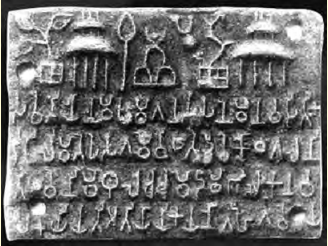
Write a short note on Copper-plate inscriptions.

Image

Answer
  • The copper-plate shown in the picture was found at Sohagaura in Gorakhpur district in Uttar Pradesh.
  • It is supposed to be from the Mauryan period and the inscription on it is in Brahmi script.
  • Many symbols are inscribed on it ‘Tree-in-railing’ and ‘Mountain’ at the beginning of inscription occur on punch marked coins.
  • A structure created on four pillars is indicative of a granary.
  • The inscriptions have a record of royal order that the grains stored in the granary should be distributed carefully.
  • This order is suggestive of precautionary measures taken during famine.
View full question & answer
Question 103 Marks
Explain the works of Dr. Babasaheb Ambedkar and Mahatma Phule in Subaltern History.
Answer
  • History of the deprived classes expressed in folklore was known as ‘Subaltern History’.
  • Similar thoughts were expressed by Mahatma Jotirao Phule and Dr. Babasaheb Ambedkar.
  • Mahatma Phule unfolded the history of the Shudratishudra communities in his book ‘Gulamgiri’.
  • He drew attention to show how women, Shudras and Atishudras were exploited under the name of religion.
  • Dr. Ambedkar focused on the idea that in spite of having a significant role in shaping the cultural and political aspects of India, the role of Dalits was not duly acknowledged in colonial and nationalistic historiography.
  • Injustice done to the Dalits was mostly written by him. ‘Who Were the Shudras’ and ‘The Untouchables’ are his books which can be cited as examples of subaltern history.
View full question & answer
Question 113 Marks
Write information about historiography in the ancient period of India.
Answer
  • In the ancient period, stories of great deeds of ancestors, mythological lore, memories of social transitions were preserved through oral traditions.
  • The art of writing was mastered by Indians as early as 3rd millennium B.C.E. But Harappan script is not deciphered yet.
  • The earliest written documents found in India were in the form of inscriptions that are as old as 3rd century B.C.E. during the period of Emperor Ashok. His edicts are inscribed on natural rocks and stone pillars.
  • Inscriptions started to occur on coins, metal images and sculptures and also on copper plates from the 1st century B.C.E.
  • Epics like Ramayana, Mahabharat, Puranas, Jain and Buddhist texts are important sources of ancient Indian literature.
  • Historical accounts by Indian authors and travelogues by foreign travellers are also important sources of history.
View full question & answer
Question 123 Marks
What is the contribution of Itihasacharya V.K. Rajwade to historiography?
Answer
  1. V.K. Rajwade is well-known for his writings in Marathi on subjects like history, linguistics, etymology and grammar. His contributions are as follows:
  2. He compiled and edited 22 volumes of Marathyanchya Itihasachi Sadhane.
  3. He stated that history is the all-inclusive image of the past societies.
  4. V. K. Rajwade was of the view that history does not include only the stories of political images, conspiracies and Wars for seizing power.
  5. He was of the firm opinion that we should write our own history and insisted that history . should be written only using the authentic sources.
  6. He was of the opinion that description of any human event in historiography should have balanced combination of three factors namely – Time, Space and Personalities.
View full question & answer
Question 133 Marks
What is Marxist History?
Answer
  1. In the post-independence era, new trends emerged in writing Indian historiography. Marxist historiography is prominent among them.
  2. Historiography which is based on ideas of Karl Marx is known as Marxist Historiography. In Marxist Historiography, more importance was given to class struggles.
  3. Marxist Historiography reflects concerns for means and modes of production as well as the industrial relations. These became centre of writings of the Marxist historians.
  4. How every social event affects the life of people was analysed and it became the theme of Marxist historians Marxist historians studied the transitions that took place in the caste system.
  5. Notable Indian historians who adopted Marxist ideologies were Damodar Kosambi, Comrade Shripad Dange, Sharad Patil and Ram Sharan Sharma.
  6. Their writings reflected Marxist ideology. Comrade Dange was the founder member of the Indian Communist Party
View full question & answer