Questions

Answer the following questions in details.

Take a timed test

14 questions · self-marked practice — reveal the answer and mark yourself.

Question 13 Marks
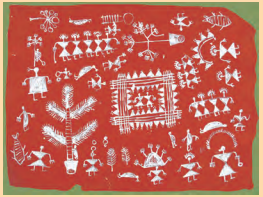
Observe the illustration of Warli painting and write about:
(a) Depiction of nature
(b) Drawings of human figures
(c) Depiction of occupations
(d) Houses
Image
Answer

Image
The traditions of Warli painting and Pingul or Chitra Katha in Maharashtra are among the finest examples of folk style of paintings. Divya Somya Mashe, the artist in Thane district has played a great role in making the Warli style of paintings very popular. He has been honored with a number of national and international awards for his paintings. In the year 2011, he was awarded ‘Padmashree’.

Name of the painting tradition:
This picture is from Warli tradition.

Nature’s description:
Artist has sketched trees, leaves and shrubs in the picture. A fish is also drawn.

Sketch of human activities:
Women dancing in a circular pattern is also sketched in the picture.

Designing features:
Pictures of men, women and children are sketched. Warli paintings do not portray the exact objects but only a sketch. Human figures are drawn with the help of a triangle, circle and square which are placed at the tip.

View full question & answer
Question 23 Marks
Differentiate between Classical and Folk: art.:
Answer
Some differences are noted between Classical and Folk art. They are as follows: Classical Art Folk Art

Classical ArtFolk Art
1. Classical art does not have such a long tradition.1. The tradition of folk art has continued from the prehistoric times.
2. Classical art is not connected to everyday life.2. Folk art is an integral part of everyday life.
3. It takes a very long time period to master classical art.3. The creation of folk art has taken place naturally because of people’s involvement.
4. Classical art developed within the established frame of rules.4. Folk art developed as an integral part of the religious festivals and social life.
5. As classical art follows set rules, different types of styles, methods and schools are developed.5. Folk art is not bound by any rules.

View full question & answer
Question 33 Marks
Give information on Indian classical sculptural art.
Answer
The development of folk styles of sculptural art led to the formation of rules for classical sculptural art and it evolved.
  1. The folk style of sculpture-making began during the Harappan period. Seals, stones and bronze statues that were made, gives a testimony that the art of sculpture was known to the Indians.
  2. It is about 5000 years old or even older tradition.
  3. The tradition of the erected stupa started in the times of Ashoka. The stupa at Borobudur in Indonesia is the largest stupa in the world.
  4. Gandhara style of sculptural art came to being in the 2nd century B.C.E. and has Greek and Persian influences.
  5. During the Kushana reign, Mathura School of art evolved which was a blend of Gandhara School of Art and indigenous art.
  6. The rules of Indian iconography was laid during the rule of the Gupta empire. Thus, Indian sculptural tradition has developed into a rich classical sculptural art.
View full question & answer
Question 43 Marks
What kind of professional opportunities are available in the field of arts?
Answer
Various opportunities are available in different fields of art:
  1. Art historian can work in field of journalism. Art students can work in museums, archives, libraries. Information Technology, archaeological research and Indology contribute to recently developed fields like Heritage Management and Cultural Tourism.
  2. An expert in art is required to assess the exact value of an art object and also in its sale and purchase. Experts are required in the field of manufacturing of objects for home decoration.
  3. Ornaments, artistic creations of metals, earthen pots with colourful designs, objects made from cane and bamboo, beautiful glass objects, attractive textiles and clothing all come are under applied arts.
  4. These fields require experts in manufacturing and sales. Hence many opportunities of employment are available in the field of arts.
View full question & answer
Question 53 Marks
Explain the characteristics of the Islamic architecture in India by giving examples.
Answer
A blend of Persian, Central Asian, Arabic and pre Islamic native Indian styles created the Islamic architecture of India.
Following are the characteristics of Islamic architecture developed in the medieval period under the patronage of Muslim sultanates:
  • Built in Islamic style, the Kutub Minor is the highest minaret in the world. It is 73 metres (240 ft) in height.
  • The Taj Mahal built by the Mughal emperor Shah Jah’an is looked’ upon as the paramount* example of Islamic’architecture.
  • The Gol Gumbaz at Bijapur in Karnataka built in 17th century is known for its echo which can be heard many times.
  • The forts at Agra and Delhi are known for their massive walls of redstone.
  • The walls are interrupted by graceful curves and lofty bastions. Red sandstone, domes, arches, minarets, magnificance all combined form characteristics of Islamic architecture.
View full question & answer
Question 63 Marks
Write in detail about folk styles of painting.
Answer
  • The art of rock painting dates back to Stone Age. These rock paintings have preserved the style of folk painting.
  • Rock paintings usually depict humans, animals and geometric figures.
  • The style of rock paintings seems to be changing according to the cultural changes from Stone age to the beginning of agriculture.
  • Man started depicting flora and fauna in a different style and also figures.
  • There was difference in colours too. Black and Red were used in rock paintings.
  • Colours extracted from natural substances were used.
  • The man started using the knowledge he got from the surroundings and nature and depicted it in the pictures.
  • In the later stage of development, man started customs such as decorating the walls and courtyards (Rangawali).
  • By drawing various figures and symbols or using panels of painting to narrate stories. It helped in the development of folk paintings.
View full question & answer
Question 73 Marks
Which fields are related to applied arts ?
Answer
  1. An artistic creation with a utilitarian purpose is called applied arts. Industry and advertisement. Interior Design and production of ornamental objects, Art Design of stage backdrops, Art Direction for films and television are the fields of applied arts.
  2. Layout of books, magazines, production of greeting cards, invitation cards, gift objects, calligraphy are also related to applied arts.
  3. Still and animated graphics, created with the help of computers are used for various purposes. This field needs experts with technical knowledge.
  4. In short, whichever art is known and is applied to create something new becomes applied art.
View full question & answer
Question 83 Marks
Write about the work of Pandit Uday Shankar.
Answer
  • Pandit Uday .Shankar created a fusion of Indian classical dance and European operti.
  • New styles of dancing were developed.
  • He also included various folk dances in his style of fusion.

Thus, the scope of Indian performing arts seems to be constantly expanding.

View full question & answer
Question 93 Marks
What efforts were taken in India to make dance and classical music easily accessible to common people?
Answer
The following efforts were taken to make dance and music easily accessible to people:
  • Dance programmes and musical festivals were organised at various places.
  • Many people attend these festivals including Indians and foreigners.
  • The Savai Gandharva festival of Pune is very famous.
View full question & answer
Question 103 Marks
Elaborate on the development of temple architecture.
Answer
  • The temple architecture began to develop in India during the Gupta period in 4th century C.E.
  • The temples built at the beginning of the Gupta period had only the sanctum sanctorum (Garbhagriha) and a veranda with four columns.
  • The magnificent structure of the Kailas temple of Verul gives testimony that temple architecture had reached its peak by the 8th century C.E.
  • Different styles of temple architecture were developed by the medieval period. Some of them are Nagara, Dravid, Vesara and Bhoomija.
View full question & answer
Question 113 Marks
Give information about the rock-cut caves in India.
Answer
  • The tradition of rock-cut caves originated in India in the 3rd century B.C.E.
  • The entire composition of a rock-cut cave represents a union of architecture and sculptural art.
  • The entrances of such rock-cut caves, interiors with its carved columns and images are excellent specimens of sculptural art.
  • The paintings on the walls and ceilings have survived till today.
  • The rock-cut caves at Ajanta and Verul in Maharashtra were declared as World Heritage Sites in 1983.
View full question & answer
Question 123 Marks
Write about development of Indian Iconography.
Answer
  • The Kushana period from the 1st – 3rd century C.E. saw the rise of Mathura School of Art.
  • The Mathura School of Art laid the foundation of Indian iconography style.
  • The Kushana Kings made use of images of various deities on their coins.
  • During the Gupta period, the ieonographic rules were formulated and standards for sculptural- art were set.
  • The art of making bronze images was developed under the patronage of Chola Kings during 9th-13tji century.
  • Bronze idols of gods and goddesses like Siva-Parvati, Natraj, Lakshmi, Vishnu, etc. were made.
View full question & answer
Question 133 Marks
Write about Gandhara School of Art.
Answer
  • The regions around Afghanistan showed great influence of Greeks and Persians from 2nd century B.C.E.
  • Gandhara style of art was a fusion of Greek- Roman and Indian style.
  • Gandhara school was heavily influenced by Greek methodologies.
  • The materials used to make sculptures were Grey sandstone. Mud, Lime and Stucco.
  • Grey sandstone is more prominently used in Gandhara School of Art.
  • The Gandhara school images are known for their anatomical accuracy, spatial depth and foreshortening.
  • The sculptures in Gandhara style are found in Taxila, Peshawar and on the North West Frontier.
View full question & answer
Question 143 Marks
Write about follk traditions of sculptural art.
Answer
  • The tradition of folk art dates back to the Stone Ages.
  • The custom of making clay images for rituals has been prevalent in India since Harappcin times.
  • It has continued even today in many regions of Bengal, Bihar, Gujarat and Rajasthan.
  • During the festivals, Ganesh idols are made along with the masks of Goddess Gauri.
  • Bull figurines are made for the festival of Bailpola.
  • Wooden memorials, Veergals (memorial stones), the decorated clay storage bins, etc.
  • Are examples of folk tradition of sculptural art.
  • The sculptures made for religious and festival reasons became masterpieces of artists’ creation.
View full question & answer