Question 13 Marks
The circumference of a circle exceeds its diameter by 45cm. find the circumference of the circle. $\Big[\text{Use }\pi=\frac{22}{7}\Big]$
AnswerLet r be the radius of the circle.
⇒ Diameter of a cirde = 2r
And, circumference of a circle $=2\pi\text{r}$
It is given that,
Circumference of a circle - Diameter of a circle = 45cm
$\Rightarrow2\pi\text{r}-2\text{r}=45$
$\Rightarrow2\text{r}(\pi-1)=45$
$\Rightarrow2\text{r}\Big(\frac{22}{7}-1\Big)=45$
$\Rightarrow\text{r}\Big(\frac{22-7}{7}\Big)=\frac{45}{2}$
$\Rightarrow\text{r}\times\frac{15}{7}=\frac{45}{2}$
$\Rightarrow\text{r}=\frac{45\times7}{15\times2}$
$\Rightarrow\text{r}=10.5\text{cm}$
$\therefore$ Circumference of a circle $=2\times\frac{22}{7}\times10.5=66\text{cm}$
View full question & answer→Question 23 Marks
Find the lengths of the arcs cut off from a circle of radius 12cm by a chord 12cm long. Also, find the area of the minor gment. $\big[\text{Take }\pi=3.14\text{ and }\sqrt{3}=1.73.\big]$
Answer$\triangle\text{OAB}$ is equilateral.
So, $\angle\text{AOB}=60$
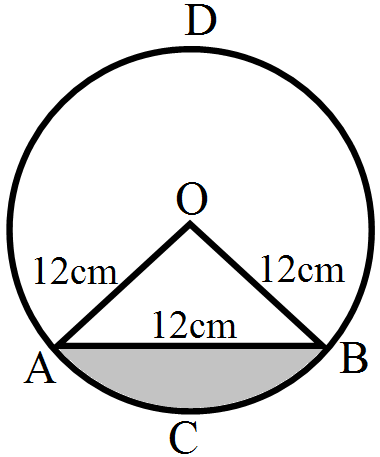
Arc $\text{ACB}=\Big(2\pi\times12\times\frac{60}{360}\Big)\text{cm}$
$=4\pi\text{cm}$
$=(4\times3.14)\text{cm}$
$=12.56\text{cm}$
Length of arc $\text{BDA}=(2\pi12-\text{Arc}\text{ACB})\text{cm}$
$=24\pi-4\pi\text{cm}=(20\pi)\text{cm}$
$=(20\ 3.14)\text{cm}=62.8\text{cm}$
Area of the minor segment ACBA
$=\Big[\pi\times(12)^2\times\frac{60}{360}-\frac{\sqrt{3}}{4}\times(12)^2\Big]\text{cm}^2$
$=\Big(3.14\times12\times12\times\frac{60}{360}-\frac{1.73}{4}\times12\times12\Big)\text{cm}^2$
$=(75.36-62.28)\text{cm}^2=13.08\text{cm}^2$ View full question & answer→Question 33 Marks
In the given figure, find the area of the shaded region, if ABCD is a square of side 14cm and APO and BPC are semicircles.
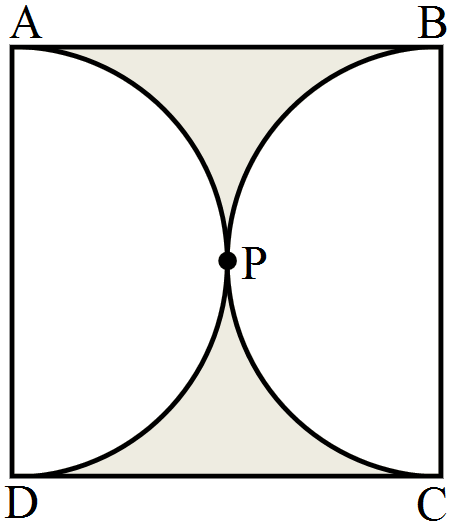
AnswerSide of a square = 14cm
⇒ Diameter of a semicircle = 14cm
⇒ Radius of a semicircle = 7cm
Now,
Area of a shaded region = Area of a square - Area of two semicircles
$=\Big[(14\times14)-\Big(\frac{22}{7}\times7\times7\Big)\Big]\text{cm}^2$
$=(196 - 154)\text{cm}^2$
$=42\text{cm}^2$
View full question & answer→Question 43 Marks
Find the area of the sector of a circle having radius $6\ cm$ and of angle $30^\circ $. $\big[\text{Take }\pi=3.14\big]$
AnswerRadius of a circle $= r = 6\ cm$
Central angle $=\theta=30^\circ$
$\therefore$ Area of the sector $=\frac{\pi\text{r}^2\theta}{360}$
$=\Big(\frac{3.14\times6\times6\times30^\circ}{360^\circ}\Big)\text{cm}^2$
$= 9.42\ cm^2$
View full question & answer→Question 53 Marks
The wheels of a car make 2500 revolutions in covering a distance of 4.95km. Find the diameter of a wheel.$\Big[\text{Use }\pi=\frac{22}{7}\Big]$
AnswerDistance covered by the wheel in 1 revolution
$=\Big(\frac{4.95\times1000\times100}{2500}\Big)\text{cm}=198\text{cm}$
$\therefore$ The circumference of the wheel = 198cm
Let the diameter of the wheel be d cm
Then, $\pi\text{d}=198\Rightarrow\frac{22}{7}\times\text{d}=198$
$\Rightarrow\text{d}=\frac{198\times7}{22}=63\text{cm}$
Hence diameter of the wheel is 63cm
View full question & answer→Question 63 Marks
A chord PQ of a circle of radius $10\ cm$ subtends an angle of $60^\circ $ at the centre of the circle. Find the area of major and minor segments of the circle. $\Big[\text{Use }\pi=\frac{22}{7}\Big]$
AnswerRadius of a circle $= r = 10.5\ cm$
Area of a sector $= 69.3\ cm^2$
Now, area of the sector $=\frac{\pi\text{r}^2\theta}{360}$
$\Rightarrow69.3=\frac{\frac{22}{7}\times10.5\times10.5\times\theta}{360^\circ}$
$\Rightarrow69.3=\frac{11\times1.5\times10.5\times\theta}{180}$
$\Rightarrow\theta=\frac{69.3\times180}{11\times1.5\times10.5}$
$\Rightarrow\theta=72^\circ$
View full question & answer→Question 73 Marks
In a circle of radius $7\ cm$, a square ABCD is inscribed. Find the area of the circle which is outside the square.
Answer
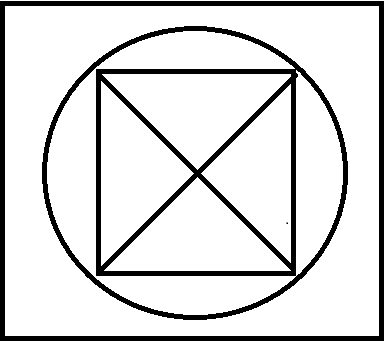
Radius of a circle $= 7\ cm$
⇒ Diagonal of the square $= 2 \times 7 = 14\ cm$
Now,
Area of the square $=\frac{1}{2}\times(\text{diagonal})^2=\Big(\frac{1}{2}\times14\times14\Big)\text{cm}^2=98\text{cm}^2$
Area of the circle $=\Big(\frac{22}{7}\times7\times7\Big)\text{cm}^2=154\text{cm}^2$
$\therefore$ Required area = Area of the circle - Area of the square
$= (154 - 98)\ cm^2$
$= 56\ cm^2$ View full question & answer→Question 83 Marks
Find the radius of a circle whose perimeterter and are are numerically equal.
Answerlet r be the radius of a circle.Then, area of a circle $=\pi\text{r}^2$
Perimeter of a circle $=2\pi\text{r}$
It is given that,
Area of a circle = Perimeter of a circle
$\Rightarrow\pi\text{r}^2=2\pi\text{r}$
$\Rightarrow \text{r}= 2 \text{ units}$
View full question & answer→Question 93 Marks
A park is in the form of a rectangle $120m$ by $90m$. At the centre of the park, there is a circular lawn as shown in the figure. The area of the park excluding the lawn is $2950m^2$ Find the radius of the circular lawn. $\big[\text{Given }\pi = 3.14.\big]$
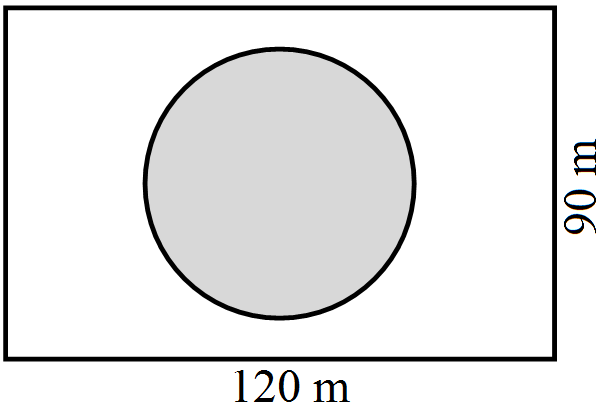
AnswerArea of rectangle $= (120 \times 90)m^2$
$= 10800m^2$
Area of circular lawn = [Area of rectangle - Area of park excluding circular lawn]
$= [10800 - 2950]m^2 = 7850m^2$
Area of circular lawn = 7850 $\Rightarrow\pi\text{r}^2=7850\text{m}^2$
$3.14 \times r^2 = 7850m^2$
$\text{r}^2=\Big(\frac{7850}{3.14}\Big)\text{m}^2$
$=2500\text{m}^2$
$\text{r}=\sqrt{2500}\text{m}$
or $\text{r}=50\text{m}$
Hence, radius of the circular lawn $= 50m$
View full question & answer→Question 103 Marks
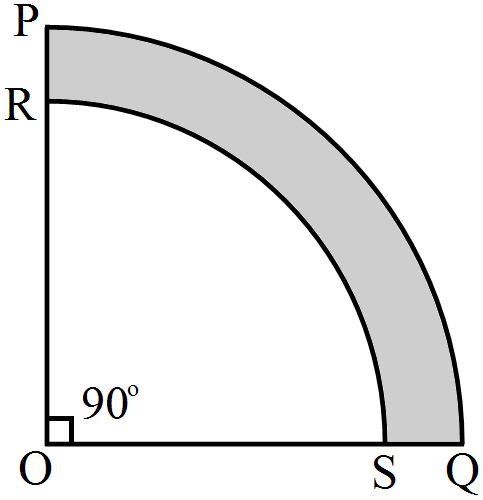
In the given figure, PQSR represents a flower bed. If OP = 21m and OR = 14m, find the area of the flower bed.
Answer
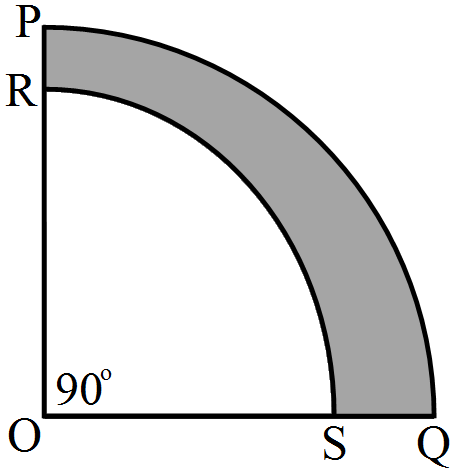 Area of flower bed = (area of quadrant OPQ) - (area of the quadrant ORS)
$=\Big[\frac{1}{4}\pi\text{r}^2_1-\frac{1}{4}\pi\text{r}^2_2\Big]$
$=\Big[\frac{1}{4}\times\frac{22}{7}\times21\times21-\frac{1}{4}\times\frac{22}{7}\times14\times14\Big]\text{m}^2$
$=[346.5-154]\text{m}^2=192.5\text{m}^2$ View full question & answer→Question 113 Marks
A circular disc of radius 6cm is divided into three sectors with central angles 90°, 120° and 150°. what part of the whole circle is the secto with central angle 150°? Also, calculate the ratio of the areas of the three sectors.
Answer$\frac{\text{Area of sector with} \ \theta \ = \ 150^\circ}{\text{Area of the circle}}=\frac{\pi\times(6)^2\times\frac{150}{360}}{\pi\times(6)^2}$
$=\frac{150}{360}=\frac{5}{12}$
Required ratio $=\Big(36\pi\times\frac{90}{360}\Big):\Big(36\pi\times\frac{120}{360}\Big):\Big(36\pi\times\frac{150}{360}\Big)$
$=\frac{1}{4}:\frac{1}{3}:\frac{5}{12}=3:4:5$
View full question & answer→Question 123 Marks
The length of a chain used as the bounary of a semicircular park is 108m. Find the area of the park $\Big[\text{Use }\pi=\frac{22}{7}\Big]$
AnswerThe length of a chain used as the bounary of a semicircular park is 108m. Find the area of the park.
Let r be the radius of the semicircular park.
Now, perimeter of a semicircular park = 108m
$\Rightarrow\pi\text{r}+2\text{r}=108$
$\Rightarrow\Big(\frac{22}{7}+2\Big)\text{r}=108$
$\Rightarrow\Big(\frac{22+14}{7}\Big)\text{r}=108$
$\Rightarrow\frac{36}{7}\text{r}=108$
$\Rightarrow\text{r}=\frac{108\times7}{36}=21\text{cm}$
$\therefore$ Area of the park $=\frac{1}{2}\times\frac{22}{7}\times21\times21=693\text{m}^2$
View full question & answer→Question 133 Marks
Two circular pieces of equal radii and maximim area, touching each other are cut out from a rectangular cardboard of dimensions $14\ cm \times 7\ cm.$ Find the area of the r maining cardboard.
AnswerSince the dimensions of a rectangular cardboard are $14\ cm \times 7\ cm,$
the diameter of each circle is $7\ cm$,
Now,
Area of the rectangular cardboard $= 14 \times 7 = 98\ cm^2$
Area of two circle $=2\times\frac{22}{7}\times\frac{7}{2}\times\frac{7}{2}=77\text{cm}^2$
$\therefore$ Area of the reamaining cardboard
= Area of the rectangular cardboard - Area of two circles
$= (98 - 77)cm^2$
$= 21cm^2$
View full question & answer→Question 143 Marks
In a circle of radius 10.5cm, the minor arc is one-fifth of the major arc. find the area of the sector corresponding to the major are. $\Big[\text{Use }\pi=\frac{22}{7}\Big]$
AnswerLet the major arc be x cm long
Then, length of the minor arc $=\frac{1}{5}\times\text{cm}$
Circumference $=\Big(\text{x}+\frac{1}{5}\text{x}\Big)\text{cm}=\frac{6\text{x}}{5}\text{cm}$
$\frac{6\text{x}}{5}=2\times\frac{22}{7}\times\frac{21}{2}\Rightarrow\text{x}=55\text{cm}$
Required area $=\Big(\frac{1}{2}\times55\times\frac{21}{2}\Big)\text{cm}^2$
$\Big[\text{Area}=\frac{1}{2}\text{rl}\Big]$
$=2988.75\text{cm}^2$
View full question & answer→Question 153 Marks
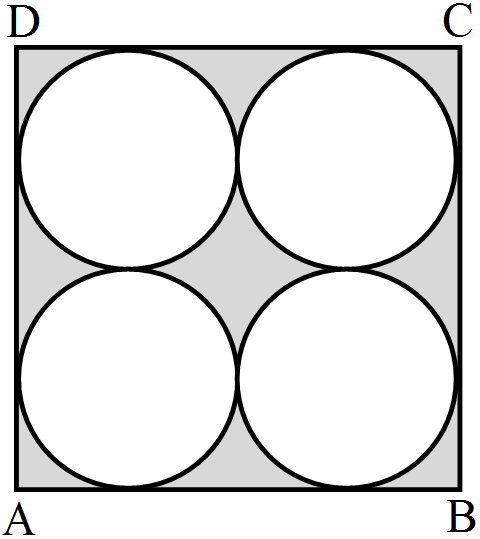
In the given figure, find the area of the shaded region, where ABCD is a square of side $14\ cm$ and all circles are of the same diameter.
Answer
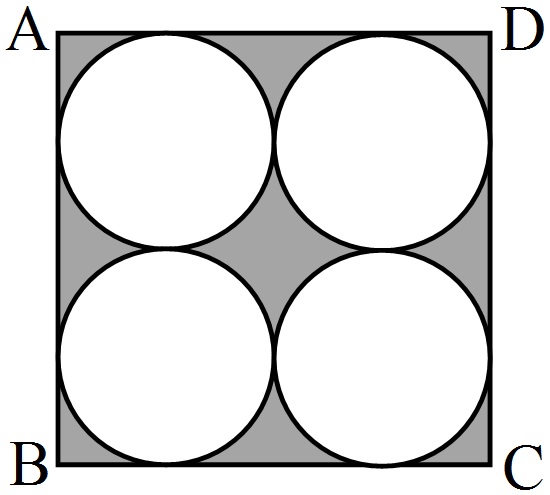
Side of the square $ABCD = 14\ cm$
Area of square $ABCD = 14 14 = 196\ cm^2$
Radius of each circle $=\frac{14}{4}=3.5\text{cm}$
Area of the circles = $4$ area of one circle
$=4\times\pi(3.5)^2$
$=4\times\frac{22}{7}\times3.5\times3.5$
$=154\text{cm}^2$
Area of shaded region = Area of square - area of $4$ circles
$= 196 - 154 = 42\ cm^2$ View full question & answer→Question 163 Marks
If the area of a circle is numerically equal to twice its circumference then what is the diameter of the circle?
AnswerLet r be the radius of the circle.
It is given that,
Area of a circle $= 2 \times $ Circumference of a circle
$\Rightarrow\pi\text{r}^2=2\times2\pi\text{r}$
$\Rightarrow r^2 = 4r$
$\Rightarrow r =4$
$\Rightarrow $ Diameter $= 2r = 2 \times 4 = 8\ cm$
View full question & answer→Question 173 Marks
The sum of the radii of two circles is 7cm, and the differece of their circumferences is 8cm. Find the circumferences of the circleas.$\Big[\text{Use }\pi=\frac{22}{7}\Big]$
AnswerLet the radii of cricles be x cm and (7 - x)cm
Then,
$2\pi\text{x}-[2\pi(7-\text{x})]=8$
$2\pi\text{x}-[14\pi-2\pi\text{x}]=8$
$2\pi\text{x}-14\pi+2\pi\text{x}=8$
$4\pi\text{x}-14\pi=8$
$2\pi\text{x}=4+7\pi$
$2\pi\text{x}=4+22$
$2\pi\text{x}=26$
Substitute the value of $2\pi\text{x}$ in $2\pi(7-\text{x})$
$=14\pi-2\pi\text{x}=14\times\frac{22}{7}-26$
$=44-26=18\text{cm}$
Circumference of the circles are 26cm and 18cm
View full question & answer→Question 183 Marks
A racetrack is in the form of a ring whose inner circumfarence is 352m and outer circumference is 396m. Find the width and the area of the track. $\Big[\text{Use }\pi=\frac{22}{7}\Big]$
AnswerLet r m and R m be the radii of inner circle and outer boundaries respectively.
Then, $2\pi\text{r}=352$ and $2\pi\text{R}=396$
$\text{r}=\frac{352}{2\pi},\ \text{R}=\frac{396}{2\pi}$
Width of the track = (R - r)m
$=\Big(\frac{396}{2\pi}-\frac{352}{2\pi}\Big)\text{m}=\Big(\frac{44}{2\pi}\Big)\text{m}$
$=\Big(\frac{44}{2}\times\frac{7}{22}\Big)\text{m}=7\text{m}$
Area the track $=\pi(\text{R}^2-\text{r}^2)=\pi(\text{R}+\text{r})(\text{R}-\text{r})$
$=\Big[\pi\Big(\frac{352}{2\pi}+\frac{396}{2\pi}\Big)\times7\Big]\text{m}^2$
$=\Big[\Big(\pi\times\frac{748}{2\pi}\Big)\times7\Big]\text{m}^2=(374\times7)\text{m}^2$
$=2618\text{m}^2$
View full question & answer→Question 193 Marks
The radius of a circle with centre O Is $7\ cm$. Two radii OA and OB are drawn at right angles to each other find the area of minor and major segments. $\Big[\text{Use }\pi=\frac{22}{7}\Big]$
AnswerRadius of the circle $= r = 7\ cm$
Central angle $=\theta=90^\circ$
$=\frac{22}{7}\times7\times7\times\frac{90}{360}-\frac{1}{2}\times7\times7\times\sin90^\circ$
$=\frac{77}{2}-\frac{49}{2}$
$=\frac{7-49}{2}$
$=\frac{28}{2}$
$=14\text{cm}^2$
Area of a cirde $=\pi^2=\frac{22}{7}\times7\times7=154\text{cm}^2$
Area of the major segment = Area of a circle - Area of the monor segment
$= (154 - 14)\ cm^2$
$= 140\ cm^2$
View full question & answer→Question 203 Marks
The perimeter of a certain sector of a circle of radius 6.5cm is 31cm. Find the area of the sector.
AnswerLet sector of circle is OAB Perimeter of a sector of circle = 31cm OA + OB + length of arc AB = 31cm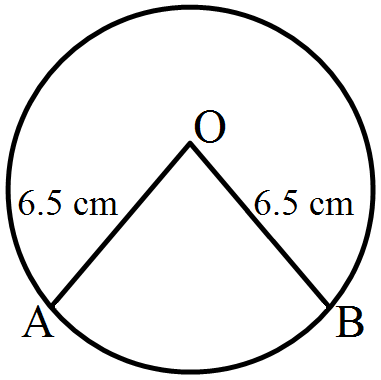
6.5 + 6.5 + arc AB = 31cm arc AB = 31 - 13 = 18cm Area of circle $=\frac{1}{2}$ lr $=\frac{1}{2}\times18\times6.5=58.5\text{ cm}^2$ View full question & answer→Question 213 Marks
Find the diameter of the circle whose area is equal to the sum of the areas of two circles having radii 4cm and 3cm.
AnswerLet the r radius of the large circle be R. Then, We have Area of large circle of radius R = Area of a circle of radius 4cm + Area of a circle of radius 3cm $\Rightarrow\pi\text{R}^2=\Big(\pi\times4^2+\pi\times3^2\Big)$ $\Rightarrow\pi\text{R}^2=(16\pi+9\pi)$ $\Rightarrow\text{R}^2=25$$\Rightarrow\text{R}=5\text{cm}$
$\Rightarrow\text{Diameter}=2\text{R}=10\text{cm}$
View full question & answer→Question 223 Marks
A sector is cut from a circle of radius 21cm. The angle of the sector is 150°. Find the length of the arc and the area of the sector. $\Big[\text{Use }\pi=\frac{22}{7}\Big]$
AnswerLength of the are $=\frac{2\pi\text{r}\theta}{360},\ \text{r}=21\text{cm},\theta=150^\circ$
$=\Big(\frac{2\pi\times21\times150}{360}\Big)\text{cm}=(17.5\pi\text{cm})$
Length of are $=\Big(17.5\times\frac{22}{7}\Big)\text{cm}=55\text{cm}$
Area of the sector $=\frac{\pi^2\theta}{360}=\Big(\frac{\pi\times21\times21\times150}{360}\Big)\text{cm}^2$
$=\Big(\frac{22}{7}\times183.75\Big)\text{cm}^2=577.5\text{cm}^2$
View full question & answer→Question 233 Marks
A horse is tethered to one comer of a field which is in the shape of an equilateral triangle of side $12m$ lf the lrngth of the rope is $7m$, find the area of the field which the horse cannot geaze. $\text{Take }\sqrt{3}=1.732$ the answer correct to $2$ places of decimal $\Big[\text{Use }\pi=\frac{22}{7}\Big]$
AnswerEach angle of equilateral triangle is 60
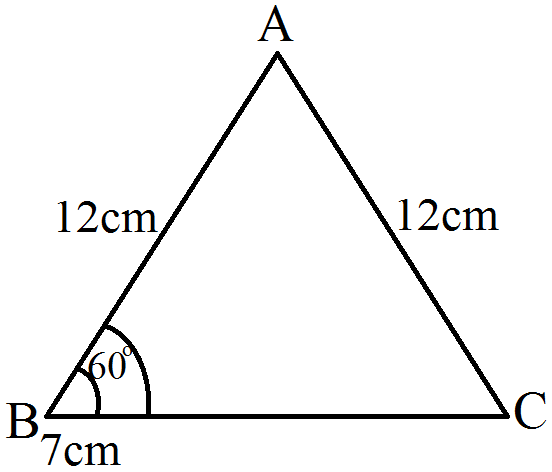
Area which cannot be grazed = $($area of equilateral $\triangle\text{ABC})$
= (area of the sector with r $= 7m$, $\theta$ $= 60^\circ $)
$=\Big[\frac{\sqrt{3}}{4}\times(12)^2-\frac{22}{7}\times(7)^2\times\frac{60}{360}\Big]\text{m}^2$
$=\Big[(\sqrt{3}\times12\times3)-\frac{(22\times7)}{6}\Big]$
$=62.35-25.66\text{m}^2$
$=36.68\text{m}^2$
Area that the horse connot graze is $36.68m^2$ View full question & answer→Question 243 Marks
From a rectangular sheet of paper ABCD with $AB = 40\ cm$ and $AD = 28\ cm$, a semicircular portion with BC as diameter is cut off. Find the area of the remaining paper.
AnswerLength of a rectangular sheet of paper $= AB = 40\ cm$
Breadth of a rectangular sheet of paper $= AD = 28\ cm$
$\Rightarrow $ Area of a rectangular sheet of paper $= AB \times AD = 40 \times 28 = 1120\ cm^2$
Diameter of a Semicircular portion $= AD = 28\ cm$
$\Rightarrow $ Radius $= 14\ cm$
⇒ Area of a Semicircular portion $=\frac{1}{2}\times\frac{22}{7}\times14\times14=308\text{cm}^2$
$\therefore$ Area of the remaining paper = Area of a rectangular sheet of paper - Area of a Semicircular portion
$= (1120 - 308)\ cm^2$
$= 812\ cm^2$
View full question & answer→Question 253 Marks
The short and long hands of a clock are 4cm and 6cm long respectively. find the sum of distances travelled by their tips in 2 days. $[\text{Take }\pi\ =3.14]$
AnswerIn 2 days, the shot hand will complete 4 rounds
$\therefore$ Distance travelled by its tip in 2 days
= 4(circumference of the circle with r = 4cm)
$=(4\times2\pi\times4)\text{cm}=32\pi\text{cm}$
In 2 days, the long hand will complete 48 rounds
$\therefore$ length moved by its tip
= 48(circumference of the circle eith r = 6cm)
$=(48\times2\pi\times6)\text{cm}=576\pi\text{cm}$
$\therefore$ Sum of the lengths moved
$=(32\pi+576\pi)=608\pi\text{cm}$
$=(608\times3.14)\text{cm}=1909.12\text{cm}$
View full question & answer→Question 263 Marks
In the given figure, the shape of the top of a table is that of a sector of a circle with centre O and $\angle\text{AOB}=90^\circ.$ If AO = OB = 42cm then find the perimeter of the top of the table.
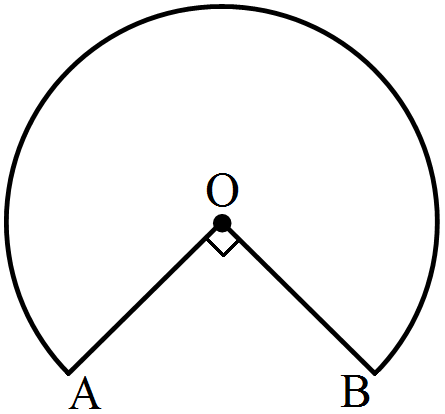
Answer$\angle\text{AOB}=90^\circ$
AO = OB = 42cm
⇒ Radius of a circle = 42cm
$\therefore$ Required perimeter = Circumference of a circle - Length of arc AB + (AO + OB)
$=\Big\{\Big(2\times\frac{22}{7}\times42\Big)-\Big(2\times\frac{22}{7}\times42\times\frac{90}{360}\Big)+(42+42)\Big\}\text{cm}$
$=\Big\{\Big(2\times\frac{22}{7}\times42\Big)-\Big(2\times\frac{22}{7}\times42\times\frac{90}{360}\Big)+(42+42)\Big\}\text{cm}$
$=(264-66+84)\text{cm}$
$=282\text{cm}$
View full question & answer→Question 273 Marks
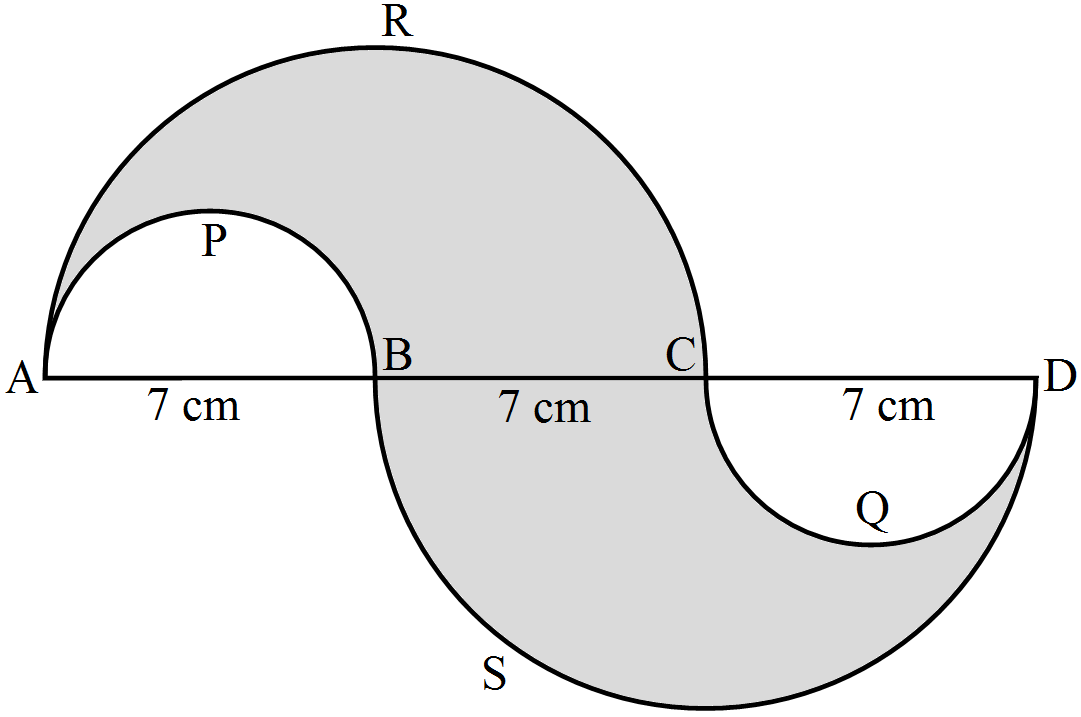
In the given figure, APB and CQD are semicircles of diameter 7cm each, while ARC an BSD are semicircles of diameter 14cm each. Find the,
- Perimeter,
- Area of the shad d region.
Answer
- Perimeter of the shaded region
= Perimeter of semicircles (ARC + BSD) + Perimeter of semicircles (APB + CQD)
$=\Big\{2\Big(\frac{22}{7}\times7\Big)+2\Big(\frac{22}{7}\times\frac{7}{2}\Big)\Big\}\text{cm}$
$=(44+22)\text{cm}$
$=66\text{cm}$
- Area of the shaded region
= Area of semicircles (ARC + BSD) - Area of semicircles (APB + CQD)
$=\Big\{2\Big(\frac{1}{2}\times\frac{22}{7}\times7\times7\Big)-2\Big(\frac{1}{2}\times\frac{22}{7}\times\frac{7}{2}\times\frac{7}{2}\Big)\Big\}\text{cm}^2$
$=\Big(2\times77-2\times\frac{77}{4}\Big)\text{cm}^2$
$=(154-38.5)\text{cm}^2$
$=115.5\text{cm}^2$ View full question & answer→Question 283 Marks
A horse is placed for grazing inside a reangular field 70m by 2m. It is tethered to one comer by a rope 21m long. On how much area an it graze? How much area is left ungrazed? $\Big[\text{Use }\pi=\frac{22}{7}\Big]$
Answer
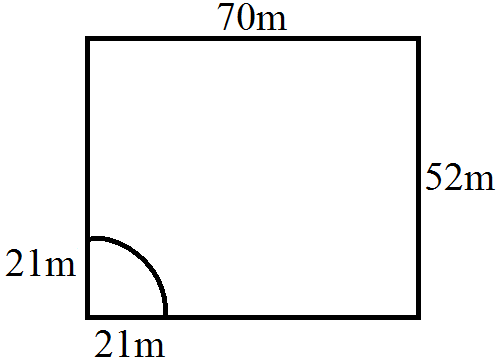 Area ehich the horse can graze = Area of the quadrant of radius 21m
$=\Big(\frac{1}{4}\times\frac{22}{7}\times21\times21\Big)\text{m}^2$
$=346.5\text{m}^2$
Area ungrazed $=[(70\times52)-346.5]\text{m}^2$
$=3293.5\text{m}^2$ View full question & answer→