Question 13 Marks
Find the coordinate of the point equidistant from three given points $A(5, 3), B(5, -5)$ and $C(1, -5).$
AnswerLet the required points be $P(x, y)$, then
$PA = PB = PC.$
The points $A, B, C$ are $(5,3), (5, -5)$ and $(1, -5)$ and $(1, -5)$ recpectively
$\Rightarrow PA^2 = PB^2= PC^2$
$\Rightarrow PA^2 = PB^2$ and $PB^2 = PC^2$
$PA^2 = PB^2$
$\Rightarrow (5 - x)^2+ (3 - y)^2 = (5 - x)^2 + (-5 - y)^2$
$25 + x^2- 10x + 9 + y^2- 6y = 25 + x^2- 10x + 25 + y^2 + 10y$
$-6y - 10y = 25 - 9$
$\Rightarrow -16y = 16$
$y = -1$
and $PB^2 = PC^2$
$\Rightarrow (5 - x)^2 + (-5 - y)^2$
$ = (1 - x) + (-5 - y)^2$
$25 + x^2 - 10x + 25 + y^2 + 10y$
$= 1 + x^2 - 2x + 25 + y^2 + 10y$
$-10x + 2x = -24$
$ \Rightarrow -8x = -24$
$\text{x}=\frac{-24}{-8}=3$
Hence, the point $P$ is $(3, -1)$
View full question & answer→Question 23 Marks
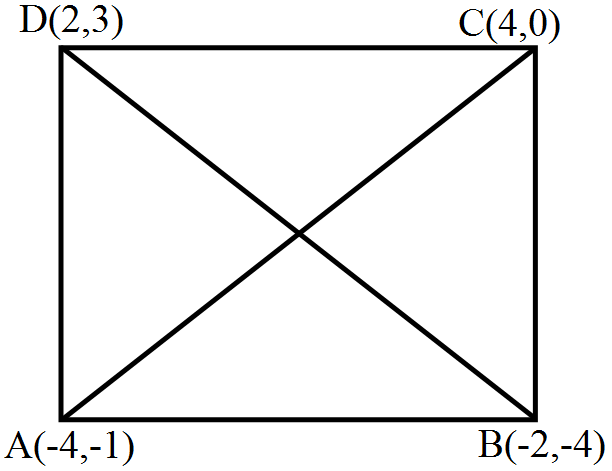
Show that the following points are the vertices of a rectangle:
A(-4, -1), B(-2, -4), C(4, 0) and D(2, 3)
AnswerLet A(-4, -1), B(-2, -4) C(4, 0) and D(2, 3) are the vertices of quadrilateral ABCD.
Then,
$\text{AB}=\sqrt{(-2+4)^2+(-4+1)^2}$
$=\sqrt{(2)^2+(-3)^2}$
$=\sqrt{4+9}=\sqrt{15}\text{ units}$
$\text{BC}=\sqrt{(4+2)^2+(0-4)^2}$
$=\sqrt{(6)^2+(-4)^2}$
$=\sqrt{36+16}=\sqrt{52}=7\sqrt{3}\text{ units}$
$\text{DC}=\sqrt{(2-4)^2+(3-0)^2}$
$=\sqrt{(-2)^2+(3)^2}$
$=\sqrt{4+9}=\sqrt{15}\text{ units}$
$\text{AD}=\sqrt{(-4-2)^2+(-1-3)^2}$
$=\sqrt{(-6)^2+(-4)^2}$
$=\sqrt{36+16}=\sqrt{52}=7\sqrt{3}\text{ units}$
Thus, $\text{AB}=\text{DC}$ and $\text{AD}=\text{BC}$
$\text{Diag}.\text{AC}=\sqrt{(4+4)^2+(0+1)^2}$
$=\sqrt{(8)^2+(1)^2}$
$=\sqrt{64+1}$
$=\sqrt{65}\text{ units}$
$\text{Diag}.\text{BD}=\sqrt{(2+2)^2+(3+4)^2}$
$=\sqrt{(4)^2+(7)^2}$
$=\sqrt{16+49}$
$=\sqrt{65}\text{ units}$
$\therefore\text{Diag}.\text{AC}\not=\text{Diag}.\text{BD}$
Thus, ABCD is a quadrilateral whose opposite are equal and the diagonals are equal.
Hence, quad. ABCD is a rectangle. View full question & answer→Question 33 Marks
Show taht the following points are collinear:$A(2, -2), B(-3, 8)$ and $C(-1, 4)$
AnswerLet $A(x_1 = 2, y_1= -2), B(x_2 = -3, y_2= 8)$ and $C(x_3 = -1, y_3= 4)$ be the given points.
Now
$x_1(y_2 - y_3) + x_2(y_3 - y_1) + x_3(y_1 - y_2)$
$= 2(8 - 4) + (-3)(4 + 2) + (-1)( -2 -8)$
$= 8 - 18 + 10$
$= 0$
Hence the given point are collinear.
View full question & answer→Question 43 Marks
If three consecutive vertices of a parallelogram ABCD are A(1, -2), B(3, 6) and C(5, 10), find its fourth vertex D.
AnswerLet A(1, -2), B(3, 6) and C(5, 10) are the given vertices of the parallelogram ABCD.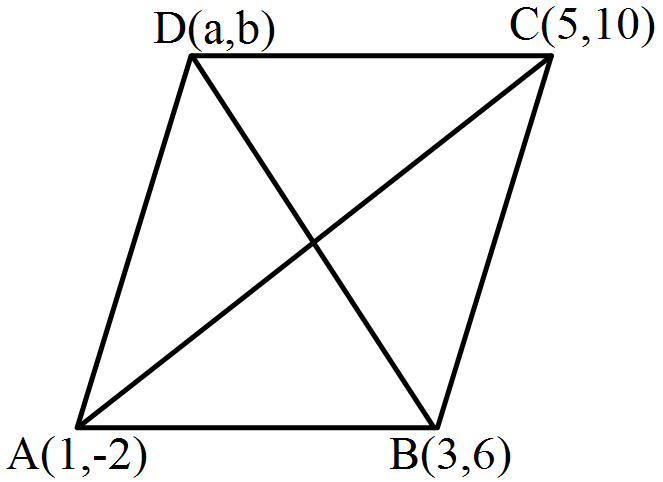
Let D(a, b) be its fourth vertex. Join AC and BD. Let AC and BD intersect at the point O. We know that the diagonal of a parallelogram bisect each other. So, O is the mid-point AC as well as that of BD. Mid-point of AC is $\Big(\frac{1+5}{2},\frac{-2+10}{2}\Big)\text{i.e},(3,4)$ Mid-point of BD is $\Big(\frac{3+\text{a}}{2},\frac{6+\text{b}}{2}\Big)$ $\frac{3+\text{a}}{2}=3$ and $\frac{6+\text{b}}{2}=4$ ⇒ a = 3 and b = 2 Hence the fourth vertices is D(3, 2). View full question & answer→Question 53 Marks
ABCD is a rectangle formed by points A(-1, -1), B(-1, 4), C(5, 4) and D(5, -1). If P, Q, R and S be the midpoints of AB, BC, CD and DA respectively, show that PQRS is a rhombus.
Answer
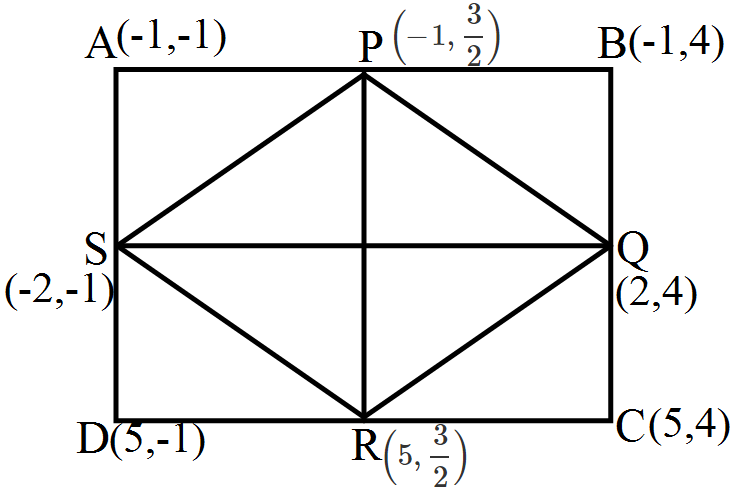 ABCD is a rectangle and P, Q, R and S are the mid-points of AB, BC, CD and DA respectively.
Thus, we have
Coordinates of P $=\Big(\frac{-1-1}{2},\frac{{-1+4}}{2}\Big)=\Big(-1,\frac{3}{2}\Big)$
Coordinates of Q $=\Big(\frac{-1+5}{2},\frac{4+4}{2}\Big)=(2,4)$
Coordinates of R $=\Big(\frac{5+5}{2},\frac{-1+4}{2}\Big)=\Big(5,\frac{3}{2}\Big)$
Coordinates of S $=\Big(\frac{-1+5}{2},\frac{-1-1}{2}\Big)=(2,-1)$
Now,
Lenght of PQ $=\sqrt{(-2-1)^2+\Big(4-\frac{3}{2}\Big)^2}$
$=\sqrt{(-3)^2+\Big(\frac{5}{2}\Big)^2}$
$=\sqrt{9+\frac{25}{4}}=\sqrt{\frac{61}{4}}$
Lenght of QR $=\sqrt{(5-2)^2+\Big(\frac{3}{2}-4\Big)^2}$
$=\sqrt{(3)^2+\Big(\frac{-5}{2}\Big)^2}$
$=\sqrt{9+\frac{25}{4}}=\sqrt{\frac{61}{4}}$
Lenght of RS $=\sqrt{(2-5)^2+\Big(-1-\frac{3}{2}\Big)^2}$
$=\sqrt{(3)^2+\Big(\frac{-5}{2}\Big)^2}$
$=\sqrt{9+\frac{25}{4}}=\sqrt{\frac{61}{4}}$
Lenght of SP $=\sqrt{(-1-2)^2+\Big(\frac{3}{2}+1\Big)^2}$
$=\sqrt{(3)^2+\Big(\frac{-5}{2}\Big)^2}$
$=\sqrt{9+\frac{25}{4}}=\sqrt{\frac{61}{4}}$
Lenght of PR $=\sqrt{(5+1)^2+\Big(\frac{3}{2}-\frac{3}{2}\Big)^2}$
$=\sqrt{(6)^2+0}=\sqrt{36}=6$
Lenght of SQ $=\sqrt{(2-2)^2+(4+1)^2}$
$=\sqrt{0+(5)^2}=\sqrt{25}=5.$
Here, all sides of PQRS are equal but diagonals are not equal.
Hence, PQRS is a rhombus. View full question & answer→Question 63 Marks
If the points P(a, -11), Q(5, b), R(2, 15) and S(1, 1) are the vertices of a parallelogram PQRS, find the value of a and b
AnswerLet P(a, -11), Q(5, b), R(2, 15) and S(1, 1) are the vertices of a parallelogram PQRS.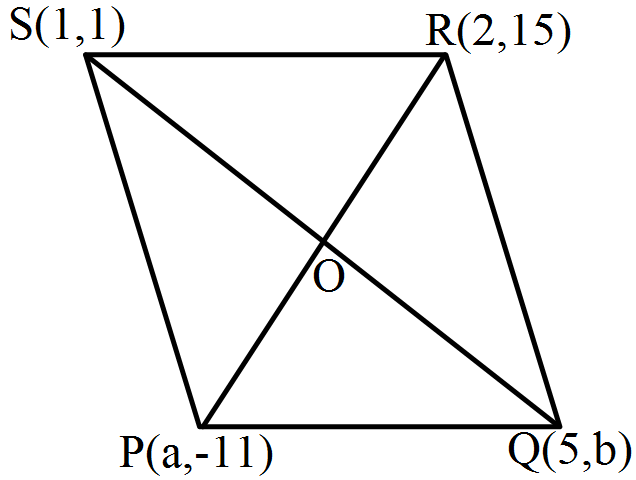
Join the diagonal PR and SQ. Then intersect each other at the point O. We know that the diagonal of a parallelpgram bisect each other. Now, mid-point of PR is $\Big(\frac{\text{a}+2}{2},\frac{-11+15}{2}\Big)\text{i.e},\Big(\frac{\text{a}+2}{2},2\Big)$ And mid-point of SQ is $\Big(\frac{5+1}{2},\frac{\text{b}+1}{2}\Big)\text{i.e},\Big(3,\frac{\text{b}+1}{2}\Big)$ $\therefore\ \frac{\text{a}+2}{2}=3$ and $\frac{\text{b}+1}{2}=2$ ⇒ a = 4 and b = 3 Hence the required values are a = 4 and b = 3. View full question & answer→Question 73 Marks
Show that the following points are the vertices of a rectangle:
A(2, -2), B(14, 10), C(11, 13) and D(-1, 1)
AnswerLet A(2, -2), B(14, 10), C(11, 13) and D(-1, 1)be the angular points of quad. ABCD. Then,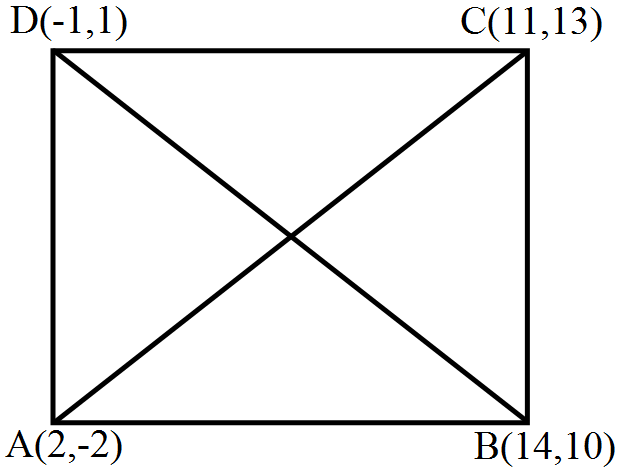
$\text{AB}=\sqrt{(14-2)^2+(10+2)^2}$ $=\sqrt{(12)^2+(12)^2}$ $=\sqrt{144+144}=\sqrt{288}=12\sqrt{2}\text{ units}$ $\text{BC}=\sqrt{(11-14)^2+(13-10)^2}$ $=\sqrt{(-3)^2+(3)^2}$ $=\sqrt{9+9}=\sqrt{18}=3\sqrt{2}\text{ units}$ $\text{DC}=\sqrt{(-1-11)^2+(1-13)^2}$ $=\sqrt{(-12)^2+(-12)^2}$ $=\sqrt{144+144}=\sqrt{288}=12\sqrt{2}\text{ units}$ $\text{AD}=\sqrt{(-1-2)^2+(1+2)^2}$ $=\sqrt{(-3)^2+(3)^2}$ $=\sqrt{9+9}=\sqrt{18}=3\sqrt{2}\text{ units}$ Thus, $\text{AB}=\text{DC}$ and $\text{AD}=\text{BC}$ $\text{Diag}.\text{AC}=\sqrt{(11-2)^2+(13+2)^2}$ $=\sqrt{(9)^2+(15)^2}$ $=\sqrt{81+150}$ $=\sqrt{306}=3\sqrt{34}\text{ units}$ $\text{Diag}.\text{BD}=\sqrt{(-1-14)^2+(1-10)^2}$ $=\sqrt{(-15)^2+(-9)^2}$ $=\sqrt{225+81}$ $=\sqrt{306}=3\sqrt{34}\text{ units}$ $=\sqrt{65}\text{ units}$ $\therefore\text{Diag}.\text{AC}=\text{Diag}.\text{BD}$ Thus, ABCD is a quadrilateral whose opposite sides are equal and diagonals are equal. Hence, quad. ABCD is a rectangle. View full question & answer→Question 83 Marks
For what value of $k(k > 0)$ is the area of the triangle with vertices $(-2, 5), (k, -4)$ and $(2k + 1, 10)$ equal to $53$ square units?
AnswerLet $A(x_1 = -2, y_1= 5), B(x_2 = k, y_2= -4)$ and $C(x_3 = 2k + 1, y_3= 10)$ be the vertices of the triangle, so
$\text{ar}\big(\triangle\text{ABC)}=\frac{1}{2}[\text{x}_1(\text{y}_2-\text{y}_3)+\text{x}_2(\text{y}_3-\text{y}_1)+\text{x}_3(\text{y}_1-\text{y}_2)]$
$\Rightarrow53=\frac{1}{2}[(-2)(-4-10)+\text{k}(10-5)+(2\text{k}+1)(5+4)]$
$\Rightarrow53=\frac{1}{2}[28+5\text{k}+9(2\text{k}+1)]$
$\Rightarrow28+5\text{k}+18\text{k}+9=106$
$\Rightarrow37+23\text{k}=106$
$\Rightarrow23\text{k}=106-37=69$
$\Rightarrow\text{k}=\frac{69}{23}=3$
Hence, $k = 3$
View full question & answer→Question 93 Marks
Find the coordinates of the midpoint the line segment joining:
- A(3, 0) and B(-5, 4)
- P(-11, -8) and Q(8, -2).
Answer
- The coordinates of mid-points of the line segment joining A(3, 0) and B(-5, 4) are $\Big(\frac{3-5}{2},\frac{0+4}{2}\Big)$ or (-1, 2)
- Let M(x, y) be the mid-point of AB, where A is (-11, -8) and B is (8, -2). Then,
$\text{x}=\frac{8-11}{2}=\frac{-3}{2}$ and $\text{y}=\frac{-8-2}{2}=\frac{-10}{2}=-5$
Hence, the required point is $\Big(\frac{-3}{2},-5\Big)$ View full question & answer→Question 103 Marks
Find the area of $\triangle\text{ABC}$ whose vertices are:
$A(-5, 2), B(-4, -5)$ and $C(4, 5)$
Answer$A(-5, 7), B(-4, -5)$ and $C(4, 5)$ are the vertices of $\triangle\text{ABC}.$
Then, $(x_1 = -5, y_1= 7), (x_2 = -4, y_2 = -5)$ and $(x_3 = 4, y_3 = 5)$
Area of triangle ABC
$=\frac{1}{2}\big\{\text{x}_1(\text{y}_2-\text{y}_3)+\text{x}_2(\text{y}_3-\text{y}_1)+\text{x}_3(\text{y}_1-\text{y}_2)\big\}$
$=\frac{1}{2}\big\{(-5)(-5-5)+(-4)+(5-7)\\+(-4-2)+(4)(7-(-5))\big\}$
$=\frac{1}{2}\big\{(-5)(-10)-4(-2)+4(12)\big\}$
$=\frac{1}{2}\big\{50+8+48\big\}$
$=\frac{1}{2}(106)$
$=53\ \text{sq}.\text{units}$
View full question & answer→Question 113 Marks
Find the distance between the points:
$P(a + b, a - b)$ and $Q(a - b, a + b)$
AnswerThe given points are $P(a + b, a - b) $and $Q(a - b, a + b)$
Then, $[x_1 = (a + b), y_1 = (a - b)]$ and $[x_2 = (a - b)$, and $y_2 = (a + b)]$
$\therefore\text{PQ}=\sqrt{(\text{x}_2-\text{x}_1)^2+(\text{y}_2-\text{y}_1)^2}$
$=\sqrt{(\text{a}-\text{b}-\text{a}-\text{b})^2+(\text{a}+\text{b}-\text{a}+\text{b})^2}$
$=\sqrt{(-\text{2b})^2+(\text{2b})^2}$
$=\sqrt{\text{4b}^2+\text{4b}^2}$
$=\sqrt{\text{8b}^2}=2\sqrt{2\text{b}}\text{ units}.$
View full question & answer→Question 123 Marks
Show that the points A(3, 0), B(6, 4) and C(-1, 3) are the vertices of an isosceles right triangle.
AnswerGiven: A(3, 0), B(6, 4) and C(-1, 3)
Now,
$\text{AB}=\sqrt{(6-3)^2+(4-0)^2}=\sqrt{(3)^2+(4)^2}$
$=\sqrt{9+16}=\sqrt{25}=5\text{ units}$
$\text{BC}=\sqrt{(-1-6)^2+(3-4)^2}=\sqrt{(-7)^2+(-1)^2}$
$=\sqrt{49+1}=\sqrt{50}=\sqrt{50}\text{ units}$
$\text{AC}=\sqrt{(-1-3)^2+(3-0)^2}=\sqrt{(-4)^2+(3)^2}$
$=\sqrt{16+9}=\sqrt{25}=5\text{ units}$
We find that AB = AC = 5 units
$\therefore\triangle\text{ABC}$ is an isosceles treangle.
And,
$=\text{AB}^2+\text{AC}^2$
$=5^2+5^2$
$=25+25=50$
$\text{BC}^2=(\sqrt{50})^2=50$
$\Rightarrow\text{AB}^2+\text{AC}^2=\text{BC}^2$
This shows that $\triangle\text{ABC}$ is righta-angled at B.
Hence, the geven points are the vertices of an isosceles right triangle.
View full question & answer→Question 133 Marks
If the point C(k, 4) divedes the join of A(2, 6) and B(5, 1) in the ratio 2 : 3 then find the value of k.
AnswerHere, the point C(k, 4) divides the join of A(2, 6) and B(5, 1) in the ratio 2 : 3. So
$\text{k}=\frac{2\times5+3\times2}{2+3}$
$=\dfrac{10+6}{5}$
$=\frac{16}{5}$
Hence, $\text{k}=\frac{16}{5}.$
View full question & answer→Question 143 Marks
Find the ratio in which the point P(m, 6) divides the join of A(-4, 3) and B(2, 8). Also find the value of m.
AnswerLet P dividing the join of line segment A(-4, 3) and B(2, 8) in the ratio k : 1.
$\therefore$ The point P is
$\Big(\frac{\text{k}\times2+1\times(-4)}{\text{k}+1},\frac{\text{k}\times8+1\times3}{\text{k}+1}\Big)=\Big(\frac{2\text{k}-4}{\text{k}+1},\frac{8\text{k}+3}{\text{k}+1}\Big)$
$\Rightarrow\ \frac{2\text{k}-4}{\text{k}+1}=\text{m}\dots(1)$
And
$\frac{8\text{k}+3}{\text{k}+1}=6$
Or $8\text{k}+3=6\text{k}+6$ or $2\text{k}=3\ \therefore\ \text{k}=\frac{3}{2}$
Putting value of k in (1)
$\frac{2\times\frac{3}{2}-4}{\frac{3}{2}+1}=\text{m}$
$\text{m}=\frac{3-4}{\frac{5}{2}}$
$\text{m}=-\frac{2}{5}$
Hence, $\text{m}=-\frac{2}{5},\text{k}=\frac{3}{2}$
View full question & answer→Question 153 Marks
The midpoint P of the line segment joining the points A(-10, 4) and B(-2, 0) lies on the line segment joining the points C(-9, -4) and D(-4, y). Find the ratio in which P divides CD. Also find the value of y.
AnswerSince P is the mid-point of line segment joining the points A(-10, 4) and B(-2, 0).
Coordinates of P $=\Big(\frac{-10-2}{2},\frac{4+0}{2}\Big)=(-6,2)$
Let P(-6, 2) divides the line segment joining the points C(-9, -4) and D(-4, y) in the ratio k : 1.
$\therefore$ By section formula, we have
Coordinates of P
$=\Big(\frac{\text{k}\times(-4)+1\times(-9)}{\text{k}+1},\frac{\text{k}\times\text{y}+1\times(-4)}{\text{k}+1}\Big)=\Big(\frac{-4\text{k}-9}{\text{k}+1},\frac{\text{ky}-4}{\text{k}+1}\Big)$
But, coordinates of P are (-4, 2).
$\therefore\ \frac{-4\text{k}-9}{\text{k}+1}=-6\Rightarrow\ -4\text{k}-9=-6\text{k}-6$
$\Rightarrow\ 2\text{k}=3\Rightarrow\ \text{k}=\frac{3}{2}$
Thus, required ratio is 2 : 3.
Also, $\frac{\text{ky}-4}{\text{k}+1}=2$
$\Rightarrow\ \text{ky}-4=2\text{k}+2$
$\Rightarrow\ \frac{3}{2}\text{y}-4=2\times\frac{3}{2}+2$
$\Rightarrow\ \frac{3}{2}\text{y}=9$
$\Rightarrow\ \text{y}=6$
View full question & answer→Question 163 Marks
The line segment joining the points A(3, -4) and B(1, 2) is trisected at the points P(p, -2) and $\text{Q}\Big(\frac{5}{3},\text{q}\Big).$ Find the values of p and q.
AnswerPoint P divides the join of A(3, -4) and B(1, 2) in the ratio 1 : 2
Coordinates of P are:
$\Big(\frac{1\times1+2\times3}{1+2},\frac{1\times2+2\times(-4)}{1+2}\Big)$ or $\Big(\frac{7}{3},\frac{-6}{3}\Big)$ or $(\frac{7}{3}, -2)$
Also the point P is (p, -2) ⇒ $\text{P}=\frac{7}{3}$
Further Q is the midpoint of PB when
$\text{P}\Big(\frac{7}{3},-2\Big)$ and B(1, 2)
$\therefore$ coordinates of Q are $\bigg(\frac{\frac{7}{3}+1}{2},\frac{-2+2}{2}\bigg)$ or $\Big(\frac{5}{3},0\Big)$
Also, Q is $\Big(\frac{5}{3},\text{q}\Big)\Rightarrow\text{q}=0$
Hence, $\text{p}=\frac{7}{3}$ and q = 0
View full question & answer→Question 173 Marks
Point A lies on the line segment PQ joinning P(6, -6) and Q(-4, -1) in such a way that $\frac{\text{PA}}{\text{PQ}}=\frac{2}{5}.$ If the point A also lies on the line 3x + k(y + 1) = 0, find the value of k.
Answer
 $\frac{\text{PA}}{\text{PQ}}=\frac{2}{5}$
$\Rightarrow\frac{\text{PQ}}{\text{PA}}=\frac{5}{2}$
$\Rightarrow\frac{\text{PA}+\text{AQ}}{\text{PA}}=\frac{5}{2}$
$\Rightarrow1+\frac{\text{AQ}}{\text{PA}}=\frac{5}{2}$
$\Rightarrow\frac{\text{AQ}}{\text{PA}}=\frac{7}{2}-1=\frac{5-2}{2}=\frac{3}{2}$
$\frac{\text{PA}}{\text{AQ}}=\frac{2}{3}$
$\Rightarrow\text{PA}:\text{AQ}=2:3$
$\therefore\text{Coordinates of A}=\Big(\frac{2\times(-4)+3\times6}{2+3},\frac{2\times(-1)+3\times(-6)}{2+3}\Big)$
$=\Big(\frac{-8+18}{5},\frac{-2-18}{5}\Big)$
$=\Big(\frac{10}{5},\frac{-20}{5}\Big)$
$=(2,-4)$
Since the point A(2, -4) lies on the line 3
× k(y + 1), we have 3 × 2 + k(-4 + 1) = 0
⇒ 6 - 3k = 0
⇒ 3k - 6
⇒ k = 2 View full question & answer→Question 183 Marks
Show that the following points are the vertices of a square:
A(3, 2), B(0, 5), C(-3, 2) and D(0, -1)
AnswerThe angular points of quadrilateral ABCD are A(3, 2), B(0, 5), C(-3, 2) and D(0, 1)
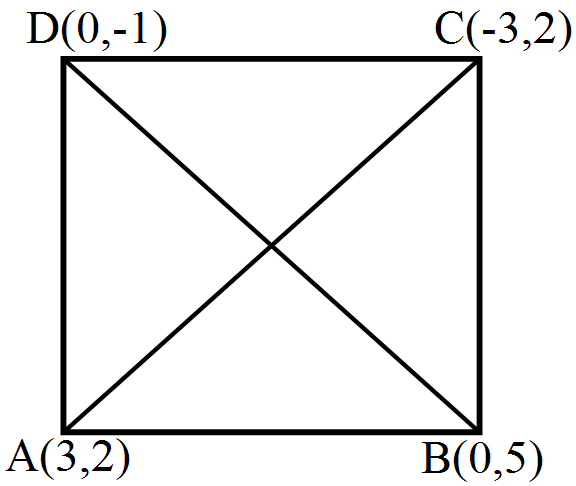
$\text{AB}=\sqrt{(0-3)^2+(5-2)^2}$
$=\sqrt{9+9}=\sqrt{18}=3\sqrt{2}$
$\text{BC}=\sqrt{(-3-0)^2+(2-5)^2}$
$=\sqrt{9+9}=\sqrt{18}=3\sqrt{2}$
$\text{CD}=\sqrt{(0+3)^2+(-1-2)^2}$
$=\sqrt{9+9}=\sqrt{18}=3\sqrt{2}$
$\text{DA}=\sqrt{(3-0)^2+(2+1)^2}$
$=\sqrt{9+9}=\sqrt{18}=3\sqrt{2}$
$\therefore\text{AB}=\text{BC}=\text{CD}+\text{DA}=3\sqrt{2}$
$\text{Diag}.\text{AC}=\sqrt{(-3-3)^2+(2-2)^2}=6$
$\text{Diag}.\text{BD}=\sqrt{(0-0)^2+(-1-5)^2}=6$
$\therefore\text{Diag}.\text{AC}=\text{Diag}.\text{BD}$
Thus, all sides of quad. ABCD are equal and diagonals are also equal
Quad. ABCD is a square. View full question & answer→Question 193 Marks
In what ratio is the line segments joining the points A(-2, -3) and B(3, 7) divided by the y-axis? Also, find the coordinates of the point of division.
AnswerLet the y-axis cut the join A(-2, -3) and B(3, 7) at the point P in the ratio k : 1. Then,
By section formula, the co-ordinates of P are
$\text{P}\Big(\frac{3\text{k}-2}{\text{k}+1},\frac{7\text{k}-3}{\text{k}+1}\Big)$
But P lies on the y-axis so, its abscissa is 0.
$\therefore\ \frac{3\text{k}-2}{\text{k}+1}=0\Rightarrow\ 3\text{k}-2=0\Rightarrow\text{k}=\frac{2}{3}$
So the required ratio is $\frac{2}{3}:1$ which is 2 : 3
Putting $\text{k}=\frac{2}{3}$ in $\Big(0,\frac{7\text{k}-3}{\text{k}-1}\Big)$ we get the point P as
$\text{P}\bigg(0,\frac{7\times\frac{2}{3}-3}{\frac{2}{3}+1}\bigg)_{\text{i.e},\text{P}(0,1)}$
Hence the points of intersection of AB and the y-axis is P(0, 1) and P divides AB in the ratio 2 : 3.
View full question & answer→Question 203 Marks
Find the value of $x$ for which the distance between the points $P(x, 4)$ and $Q(9, 10)$ is $10$ units.
AnswerWe have,
$PQ = 10$
$\Rightarrow PQ^2 = 100$
$\Rightarrow (9 - x)^2 + (10 - 4)^2 = 100$
$\Rightarrow (9 - x)^2 + 62 = 100$
$\Rightarrow (9 - x)^2 = 64$
$\Rightarrow 9-\text{x}=\pm8$
$\Rightarrow 9 - x = 8$ or $9 - x = -8$
$\Rightarrow x = 1$ or $x = 17$
Hence, the required values of $x$ are $1$ and $17$.
View full question & answer→Question 213 Marks
Show that the points A(-3, 2), B(-5, -5), C(2, -3) and D(4, 4) are the vertices of a rhombus. Find the area of this rhombus.
Hint: Area of a rhombus $=\frac{1}{2}\times(\text{product of its diagonals}).$
AnswerLet A(-3, 2), B(-5, -5) C(2, -3) and D(4, 4) be the angular points of quad. ABCD. Join AC and BD.
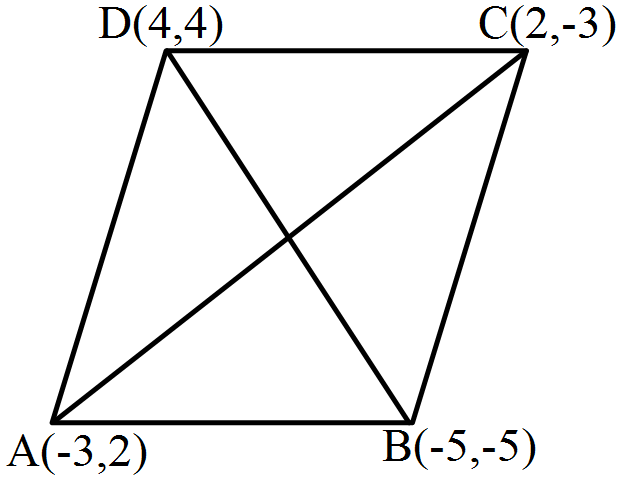
Now,
$\text{AB}=\sqrt{(-5+3)^2+(-5-2)^2}$
$=\sqrt{(-2)^2+(-7)^2}$
$=\sqrt{4+49}=\sqrt{53}\text{ units}$
$\text{BC}=\sqrt{(2+5)^2+(-3+5)^2}$
$=\sqrt{(7)^2+(2)^2}$
$=\sqrt{4+49}=\sqrt{53}\text{ units}$
$\text{CD}=\sqrt{(4-2)^2+(4+3)^2}$
$=\sqrt{(2)^2+(7)^2}$
$=\sqrt{4+49}=\sqrt{53}\text{ units}$
$\text{DA}=\sqrt{(-3-4)^2+(2-4)^2}$
$=\sqrt{(-7)^2+(2)^2}$
$=\sqrt{4+49}=\sqrt{53}\text{ units}$
Thus, $\text{AB}=\text{BC}=\text{CD}=\text{DA}=\sqrt{53}\text{ units}$
$\text{Diag}.\text{AC}=\sqrt{(2-3)^2+(-3-2)^2}$
$=\sqrt{(5)^2+(-5)^2}$
$=\sqrt{(25)+(25)}$
$=\sqrt{50}=5\sqrt{2}\text{ units}$
$\text{Diag}.\text{BD}=\sqrt{(4+5)^2+(4+5)^2}$
$=\sqrt{(81)+(81)}$
$=\sqrt{162}=9\sqrt{2}\text{ units}$
$\therefore\text{Diag}.\text{AC}\not=\text{Diag}.\text{BD}$
Thus, ABCD is a quadrilateral having all sides equal but diagonals are unequal.
Hence, ABCD is a rhombus.
$\text{Area of rhombus ABCD}$ $=\frac{1}{2}\times\text{product of its diagonals}.$
$=\Big(\frac{1}{2}\times\text{AC}\times\text{BD}\Big)=\Big(\frac{1}{2}\times5\sqrt{2}\times9\sqrt{2}\Big)$
$=45\text{ sq.units}$ View full question & answer→Question 223 Marks
Find the value of $k$ so that area of the triangle with triangle with vertices $A(k + 1, 1), B(4, -3)$ and $C(7, -k)$ is $6$ square units.
AnswerLet $A(x_1, y_1) = A(k + 1, 1), B(x_2, y_2) = B(4, -3)$ and $C(x_3, y_3) = C(7, -k).$
Now,
$\text{ar}\big(\triangle\text{ABC)}=\frac{1}{2}[\text{x}_1(\text{y}_2-\text{y}_3)+\text{x}_2(\text{y}_3-\text{y}_1)+\text{x}_3(\text{y}_1-\text{y}_2)]$
$\Rightarrow6=\frac{1}{2}[(\text{k+1})(-3+\text{k})+4(-\text{k}-1)+7(1+3)]$
$\Rightarrow6=\frac{1}{2}[\text{k}^2-2\text{k}-3-4\text{k}-4-28]$
$\Rightarrow\text{k}^2-6\text{k}+9=0$
$\Rightarrow\text{(k}-3)^2=0$
$\Rightarrow\text{k}=3$
Hence, $\text{k}=3$
View full question & answer→Question 233 Marks
Find the centroid of a $\triangle\text{ABC}$ whose vertices are $A(-1, 0), B(5, -2)$ and $C(8, 2)$
AnswerHere $(x_1 = -1, y_1 = 0)(x_2 = 5, y_2 = -2)$ and $(x_3 = 8, y_3 = 2)$
Let G(x, y) be the centroid of $\triangle\text{ABC},$ then
$\text{x}=\frac{1}{3}(\text{x}_1+\text{x}_2+\text{x}_3)$
$=\frac{1}{3}(-1+8+5)=4$
$\text{y}=\frac{1}{3}(\text{y}_1+\text{y}_2+\text{y}_3)$
$=\frac{1}{3}(0-2+2)=0$
Hence, the centroid of $\triangle\text{ABC},$ is $G(4, 0)$.
View full question & answer→Question 243 Marks
Show that the points $\text{O}(0, 0),\text{A}(3,\sqrt{3})$ and $\text{B}(3,-\sqrt{3})$ are the vertices of an equilateral triangle. Find the area of this triangle.
AnswerLet O(0, 0), $\text{A}(3,\sqrt{3})$ and $\text{B}(3,-\sqrt{3})$ are the given points
$\therefore\text{OA}=\sqrt{(3-0)^2+(\sqrt{3}-0)^2}$
$=\sqrt{9+3}=\sqrt{12}=2\sqrt{3}\text{ units}$
$\text{AB}=\sqrt{(3-3)^2+(-\sqrt{3}-\sqrt{3})^2}$
$=\sqrt{0^2+(-2\sqrt{3})}=\sqrt{12}=2\sqrt{3}\text{ units}$
$\text{OB}=\sqrt{(3-0)^2+(\sqrt{3}-0)^2}$
$=\sqrt{(3)^2+(-\sqrt{3})^2}$
$=\sqrt{9+3}=\sqrt{12}=2\sqrt{3}\text{ units}$
$\therefore\text{OA}=\text{AB}=\text{AB}=2\sqrt{3}\text{ units}$
Hence, DABC is equilateral and each of its sides being $2\sqrt{3}\text{ units}$
Area of $\triangle\text{ABC}=\Big[\frac{\sqrt{3}}{4}\times(\text{side})^2\Big]\text{sq.unit}$
$=\Big[\frac{\sqrt{3}}{4}\times(2\sqrt{3})^2\Big]\text{sq.unit}$
$=\Big[\frac{\sqrt{3}}{4}\times4\times3\Big]\text{sq.unit}$
$=3\sqrt{3}\text{ sq.unit}$
View full question & answer→Question 253 Marks
In what ratio does the point P(2, 5) divide the join of A(8, 2) and B(-6, 9)?
AnswerLet P divided the join of A(8, 2), B(-6, 9) in the ratio k : 1. By section formula, the coordinates of p are.
$\Big(\frac{-6\text{k}+8}{\text{k}+1},\frac{9\text{k}+2}{\text{k}+1}\Big)$ $\therefore\ \frac{-6\text{k}+8}{\text{k}+1}=2$ and $\frac{9\text{k}+2}{\text{k}+1}=5$ $\Rightarrow\ -6\text{k}+8=2\text{k}+2$ and $9\text{k}+2=5\text{k}+5$ $\Rightarrow\ -8\text{k}=-6$ and $4\text{k}=3$ $\Rightarrow\ \text{k}=\frac{-6}{-8}=\frac{3}{4}$ and $\text{k}=\frac{3}{4}$ $\Rightarrow\ \text{k}=\frac{3}{4}$ in each case Hence, the required ratio of $\Big(\frac{3}{4}:1\Big)$ which is (3 : 4) View full question & answer→Question 263 Marks
If G(-2, 1) is the centroid of a $\triangle\text{ABC}$ and two of its vertices are A(1, -6) and B(-5, 2), find the third vertex of the triangle.
AnswerTwo vertices of $\triangle\text{ABC}$ are A(1, -6) and B(-5, 2) let the third vertex be C(a, b). Then,
The co-ordinates of its centroid are
$\text{G}\Big(\frac{1-5+\text{a}}{3},\frac{-6+2+\text{b}}{3}\Big)\text{i.e}\ \text{G}\Big(\frac{-4+\text{a}}{3},\frac{-4+\text{b}}{3}\Big)$
But given that the centroid is G(-2, 1)
$\frac{-4+\text{a}}{3}=-2$ and $\frac{-4+\text{b}}{3}=1$
-4 + a = -6 and -4 + b = 3
a = -2 and b = 7
Hence, the third vertex C of $\triangle\text{ABC}$ is (-2, 7).
View full question & answer→Question 273 Marks
If $P(x, y)$ is equidistant from the points $A(7, 1)$ and $B(3, 5)$, find the relation between $x$ and $y$.
AnswerLet the point $P(x, y)$ be equidistant from the points $A(7, 1)$ and $B(3, 5)$.
Then,
$PA = PB$
$\Rightarrow PA^2 = PB^2$
$\Rightarrow (x- 7)^2 + (y - 1)^2= (x - 3)^2 + (y - 5)^2$
$\Rightarrow x^2 + y^2 - 14x - 2y + 50 = x^2 + y^2 - 6x - 10y + 34$
$\Rightarrow 8x - 8y = 16$
$\Rightarrow x - y = 2$
View full question & answer→Question 283 Marks
Show that A(1, 2), B(4, 3), C(6, 6) and D(3, 5) are the vertices of a Parallelogram. Show that ABCD is not a rectangle.
AnswerLet A(1, 2), B(4, 3) C(6, 6) and D(3, 5) be the angular points of a quadrilateral ABCD. Join AC and BD.
Now,
$\text{AB}=\sqrt{(4-1)^2+(3-2)^2}$
$=\sqrt{(3)^2+(1)^2}$
$=\sqrt{9+1}=\sqrt{10}\text{ units}$
$\text{BC}=\sqrt{(6-4)^2+(6-3)^2}$
$=\sqrt{(2)^2+(3)^2}$
$=\sqrt{4+9}=\sqrt{13}\text{ units}$
$\text{CD}=\sqrt{(3-6)^2+(6-3)^2}$
$=\sqrt{(-3)^2+(-1)^2}$
$=\sqrt{9+1}=\sqrt{10}\text{ units}$
$\text{DA}=\sqrt{(3-1)^2+(5-2)^2}$
$=\sqrt{(2)^2+(3)^2}$
$=\sqrt{4+9}=\sqrt{13}\text{ units}$
$\therefore\text{AB}=\text{CD}$ and $\text{BC}=\text{DA}$
Thus, ABCD is a parallelogram since its opposite sides are equal.
$\text{Diag}.\text{AC}=\sqrt{(6-1)^2+(6-2)^2}$
$=\sqrt{(5)^2+(4)^2}$
$=\sqrt{25+16}$
$=\sqrt{41}\text{ units}$
$\text{Diag}.\text{BD}=\sqrt{(3-4)^2+(5-3)^2}$
$=\sqrt{(-1)^2+(2)^2}$
$=\sqrt{1+4}$
$=\sqrt{5}\text{ units}$
$\therefore\text{Diag}.\text{AC}\not=\text{Diag}.\text{BD}$
Hence, it is not a rectangle.
View full question & answer→Question 293 Marks
Points P, Q and R in that order are dividing a line segment joining A(1, 6) and B(5, -2) in four equal parts. Find the coordinates of P, Q and R.
AnswerPoints P, Q, R divide the line segment joining the points A(1, 6) and (5, -2) in to four equal parts
⇒ Point P divide AB in the ratio 1 : 3 where A(1, 6), (5, -2)

Therefore, the point P is,
$\Big(\frac{1\times5+3\times1}{1+3},\frac{1\times(-2)+3\times6}{1+3}\Big)$ or $\Big(\frac{8}{4},\frac{16}{4}\Big)$ or $(2, 4)$
Now, Q is the midpoint of AB
The point Q is the midpoint of AB
The point Q is $\Big(\frac{1+5}{2},\frac{6-2}{2}\Big)$ or $(3,2)$
Also, R is the midpoint of the line segment joining Q(3, 2) and B(5, -2)
$\therefore$ The point R is $\Big(\frac{3+5}{2},\frac{2-2}{2}\Big)$ or $(4, 0)$ View full question & answer→Question 303 Marks
If $P(x, y)$ is a point equidistant from the points $A(6, - 1)$ and $B(2, 3)$, show that $x - y = 3$.
AnswerLet $A(6,-1)$ and $B(2,3)$ be the given point and $P(x, y)$ be the rwquired point, we get
$P A=P B \Rightarrow(P A)^2=(P B)^2$
$\Rightarrow(x-6)^2+(y+1)^2=(2-x)^2+(3-y)^2$
$\Rightarrow 36+x^2-12 x+y^2+1+2 y=4+x^2-4 x+9+y^2-6 y$
$\Rightarrow-12 x+4 x+2 y+6 y=4+9-1-36$
$\Rightarrow-8 x+8 y=-24$
$\Rightarrow-8(x-y)=-24$
$\Rightarrow x-y=3$
Hence, $x$ - $y=3$
View full question & answer→Question 313 Marks
Find the area of $\triangle\text{ABC}$ whose vertices are:
$A(10, -6), B(2, 5)$ and $C(-1, 3)$
Answer$A(10, -6), B(2, 5)$ and $C(-1, -3)$ are the vertices of $\triangle\text{ABC}.$
Then, $(x_1 = 10, y_1= -6), (x_2 = 2, y_2 = 5)$ and $(x_3 = -1, y_3 = 3)$
Area of triangle ABC
$=\frac{1}{2}\big\{\text{x}_1(\text{y}_2-\text{y}_3)+\text{x}_2(\text{y}_3-\text{y}_1)+\text{x}_3(\text{y}_1-\text{y}_2)\big\}$
$=\frac{1}{2}\big\{10(5-3)+2(3-(-6))+(-1)(-6-5)\big\}$
$=\frac{1}{2}\big\{10(2)+2(9)-1(-11)\big\}$
$=\frac{1}{2}\big\{20+18+11\big\}$
$=\frac{1}{2}(49)$
$=24.5\ \text{sq}.\text{units}$
View full question & answer→Question 323 Marks
Find the ratio in which the point $\text{P}\Big(\frac{3}{4},\frac{5}{12}\Big)$ divides the line segment joining the points $\text{A}\Big(\frac{1}{2},\frac{3}{2}\Big)$ and B(2, -5).
AnswerLet the required ratio be k : 1.
Then, by section formula,
Coordinates of P $=\bigg(\frac{\text{k}\times2+1\times\frac{1}{2}}{\text{k}+1},\frac{\text{k}\times(-5)+1\times\frac{3}{2}}{\text{k}+1}\bigg)$
$=\bigg(\frac{2\text{k}+\frac{1}{2}}{\text{k}+1},\frac{-5\text{k}+\frac{3}{2}}{\text{k}+1}\bigg)$
$=\bigg(\frac{4\text{k}+1}{2(\text{k}+1)},\frac{-10\text{k}+3}{2(\text{k}+1)}\bigg)$
Given, coordinates of P $=\Big(\frac{3}{4},\frac{5}{12}\Big)$
$\therefore\ \frac{4\text{k}+1}{2(\text{k}+1)}=\frac{3}{4}$
$\Rightarrow\ 16\text{k}+4=6\text{k}+6$
$\Rightarrow\ 10\text{k}=2$
$\Rightarrow\ \text{k}=\frac{1}{5}$
So, the required ratio is 1 : 5.
View full question & answer→Question 333 Marks
Find the coordinate of the point which divides the join of $A(-1, 7)$ and $B(4, -3)$ in the ratio $2 : 3$.
AnswerThe point of $AB$ are $A(-1, 7)$ and $B(4, -3)$
$\therefore$ $(x_1 = -1, y_1 = 7)$ and$ (x_2 = 4, y_2 = -3)$
Also $m = 2$ and $n = 3$

Let the required point be $P(x, y)$
By section formula, we have
$\Rightarrow\text{x}=\frac{(\text{mx}_2+\text{nx}_1)}{(\text{m+n})},\text{y}=\frac{(\text{my}_2+\text{ny}_1)}{(\text{m+n})}$
$\Rightarrow\text{x}=\frac{2\times4+3\times(-1)}{(2+3)},\text{y}=\frac{(2\times-3+3\times7)}{(2+3)}$
$\Rightarrow\text{x}=\frac{8-3}{5},\frac{-6+21}{5}$
$\Rightarrow\text{x}=\frac{5}{5},\frac{15}{5}$ or $x = 1, y = 3$
Hence the required point is $P(1, 3)$ View full question & answer→Question 343 Marks
If the point $P(k - 1, 2)$ is equidistant from the points $A(3, k)$ and $B(k, 5)$, find the values of $k$.
AnswerIf the point $P(k - 1, 2), A(3, k)$ and $B(k , 5)$.
$\because$ $AP = BP$
$\because$ $AP^2 = BP^2$
$\Rightarrow (k - 1 - 3)^2 + (2 - k)^2 = (k - 1 - k)^2 + (2 - 5)^2$
$\Rightarrow (k - 4)^2 + (2 - k)^2 = (-1)^2 + (-3)^2$
$\Rightarrow k^2 - 8y + 16 + 4 + k^2 - 4k = 1 + 9$
$\Rightarrow k^2 - 6y + 5 = 0$
$\Rightarrow (k - 1)(k - 5) = 0$
$\Rightarrow k = 1$ or k = 5.
Hence, $k = 1$ or $k = 5.$
View full question & answer→Question 353 Marks
Show that the points A(7, 10), B(-2, 5) and C(3, -4) are the vertices of an isosceles right triangle.
AnswerGiven: A(7, 10), B(-2, 5) and C(3, -4)
Now,
$\text{AB}=\sqrt{(-2-7)^2+(5-10)^2}=\sqrt{(-9)^2+(-5)^2}$
$=\sqrt{81+25}=\sqrt{106}=\sqrt{106}\text{ units}$
$\text{BC}=\sqrt{(3+2)^2+(-4-5)^2}=\sqrt{(5)^2+(-9)^2}$
$=\sqrt{25+18}=\sqrt{20}=\sqrt{106}\text{ units}$
$\text{AC}=\sqrt{(3+7)^2+(-4-10)^2}=\sqrt{(-4)^2+(-14)^2}$
$=\sqrt{16+196}=\sqrt{212}=\sqrt{212}\text{ units}$
We find that $\text{ AB} = \text{BC}=\sqrt{106}$
$\therefore\triangle\text{ABC}$ is an isosceles treangle.
And,
$\text{AB}^2+\text{BC}^2$
$=(\sqrt{106})^2+(\sqrt{106})^2$
$=106+106=212$
$\text{AC}^2=(\sqrt{212})^2=212$
$\Rightarrow\text{AB}^2+\text{BC}^2=\text{AC}^2$
This shows that $\triangle\text{ABC}$ is righta-angled at B.
Hence, the geven points are the vertices of an isosceles right triangle.
View full question & answer→