Question 14 Marks
A statue 1.46m tall, stands on the top of pedestal. From a point on the ground, the angle of elevation of the top of the statue is 60° and from the same point, the angle of elevation of the top of the pedestal is 45°. Find the height of the pedestal. $\big[\text{Use}\sqrt{3}=1.732\big]$
AnswerLet SP be the statue and PB be the pedestal. Angles of elevation of S and P are 60° and 45° respectively.
Further suppose AB = x m, PB = h m
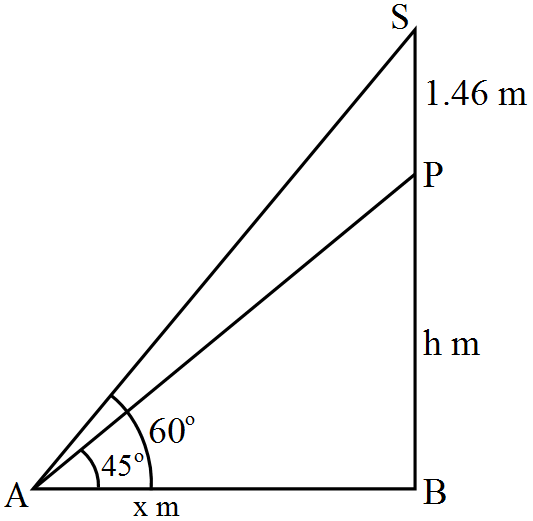
In right $\triangle\text{ABS},$
$\frac{\text{SB}}{\text{AB}}=\tan60^\circ=\sqrt{3}$
$\Rightarrow\frac{\text{h}+1.46}{\text{x}}=\sqrt{3}\dots(1)$
In right $\triangle\text{PAB},$
$\frac{\text{PB}}{\text{AB}}=\tan45^\circ=1$
$\therefore\text{h}=\text{x}\dots(2)$
Putting x = h in (1)
$\frac{\text{h}+1.46}{\text{h}}=\sqrt{3}$
$\Rightarrow\text{h}+1.46=\sqrt{3}\text{h}$
Or $\text{h}(\sqrt{3}-1)=1.46$
$\therefore\text{h}=\frac{1.46}{\sqrt{3}-1}\times\frac{\sqrt{3}+1}{\sqrt{3}+1}$
$\therefore\ \text{h}=\frac{1.46}{2}\times\big(\sqrt{3}+1)=0.73\times2.732$
$=2\text{m}$ (Nearly)
Thus, height of the pendestal = 2m. View full question & answer→Question 24 Marks
A vertical tower stands on a horizontal plane and is surmounted by a vertical flagstaff of height 6m. At a point on the plane, the angle of elevation of the bottom of the flagstaff is 30° and that of the top of the flagstaff is 60°. Find the height of the tower. $\big[\text{Use}\sqrt{3}=1.732\big]$
Answer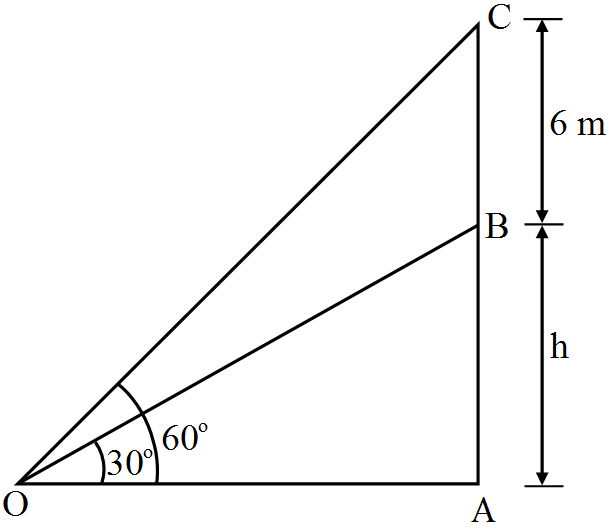
Let AB is the tower of height h meter
In right $\triangle\text{BOA},$
$\frac{\text{OA}}{\text{AB}}=\cot30^\circ$
$\Rightarrow\frac{\text{OA}}{\text{h}}=\sqrt{3}$
$\Rightarrow\text{OA}=\text{h}\sqrt{3}\text{m}\dots(\text{i})$
In right $\triangle\text{COA},$
$\frac{\text{OA}}{\text{AC}}=\cot60^\circ$
$\Rightarrow\frac{\text{OA}}{\text{h}+6}=\frac{1}{\sqrt{3}}$
$\Rightarrow\text{OA}=\frac{\big(\text{h}+6\big)}{\sqrt{3}}\text{m}\dots(\text{ii})$
From (i) and (ii),
$\frac{\big(\text{h}+6\big)}{\sqrt{3}}=\text{h}\sqrt{3}$
$\Rightarrow\text{h}+6=3\text{h}$
$\Rightarrow2\text{h}=6$
$\Rightarrow\text{h}=3$
Hence, the height of the tower is 3m. View full question & answer→Question 34 Marks
From a point on the ground 40m away from the foot of a tower, the angle ofclevation of the top of the t wer is 30°. The angle of elevation of the top of a water tank (on the top of the tower) is 45°. Find:
- The height of the tower.
- The depth of the tank.
Answer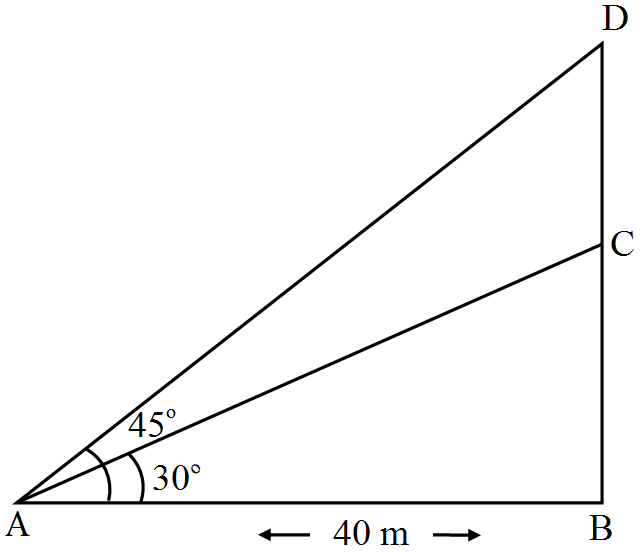
Let BC is the tower and CD be the water tank.
Let A be the point of observation.
Then, $\angle\text{BAC}=30^\circ,\angle\text{BAD}=45^\circ$ and $\text{AB}=40\text{m}$
In right $\triangle\text{ABD},$
$\frac{\text{BD}}{\text{AB}}=\tan45^\circ$
$\Rightarrow\frac{\text{BD}}{40}=1$
$\Rightarrow\text{BD}=40\text{m}$
In right $\triangle\text{ABC},$
$\frac{\text{BC}}{\text{AB}}=\tan30^\circ$
$\Rightarrow\frac{\text{BC}}{40}=\frac{1}{\sqrt{3}}$
$\Rightarrow\text{BC}=\frac{40}{\sqrt{3}}$
Rationalising we get,
$\text{BC}=\frac{40}{\sqrt{3}}\times\frac{\sqrt{3}}{\sqrt{3}}=\frac{40\sqrt{3}}{3}\text{m}$
- So, height of the tower $=\text{BC}=\frac{40\sqrt{3}}{3}\text{m}=23.1\text{m}$
- Depth of the tank = CD
= (BD - BC)
= (40 - 23.1)m
= 16.9m View full question & answer→Question 44 Marks
A tower stands vertically an the ground.From a point on the ground which is 20m away from the foot f the tower, th angle of elevation of its top is found tobe 60°. Find theh ight of the tower. $\big[\text{Take}\sqrt{3}=1.732\big]$
AnswerLet AB be the tower standing on a level ground and O be the position of the observer.
Then OA = 20m and $\angle\text{OAB}=90^\circ$ and $\angle\text{OAB}=60^\circ$
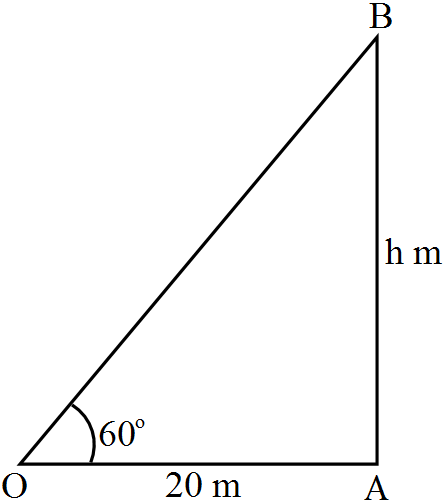
Let AB = h meters
From the right $\triangle\text{OAB},$ we have
$\frac{\text{AB}}{\text{OA}}=\tan60^\circ=\sqrt{3}$
$\Rightarrow\frac{\text{h}}{20}=\sqrt{3}$
$\Rightarrow\text{h}=(20\times\sqrt{3})$
$\Rightarrow\text{h}=20\times1.732$
$\Rightarrow\text{h}=34.64\text{m}$
Hence the height of the tower is $20\sqrt{3}\text{m}=34.64\text{m}$ View full question & answer→Question 54 Marks
An electrician has to repair an electric fault on a pole of height 4 metres. He needs to reach a point 1 metre below the top of the pole to undertake the repair work. What should be the length of the ladder that he should use, which when inclined at an angle of 60° to the horizontal would enable him to reach the required position? $\big[\text{Use}\sqrt{3}=1.73\big]$
Answer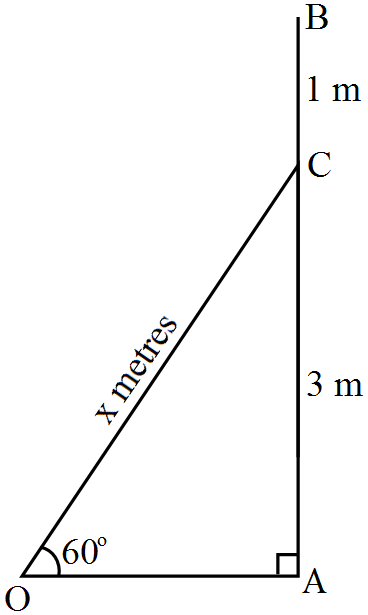
Let AB be the eletric pole such that AB = 4m.
Let C be a point 1m below B.
$\Rightarrow\text{AC}=4\text{m}-1\text{m}=3\text{m}$
Let OC be the ladder = x metres.
In right $\triangle\text{OAC},$
$\text{cosec }60^\circ=\frac{\text{OC}}{\text{AC}}$
$\Rightarrow\frac{2}{\sqrt{3}}=\frac{\text{x}}{3}$
$\Rightarrow\text{x}=\frac{6}{\sqrt{3}}$
On rationalising we get,
$\text{x}=\frac{6}{\sqrt{3}}\times\frac{\sqrt{3}}{\sqrt{3}}$
$\Rightarrow\text{x}=\frac{6\sqrt{3}}{3}$
$\Rightarrow\text{x}=2\sqrt{3}$
$\Rightarrow\text{x}=2\times1.73=3.46\text{m}$
Hence, the length of the ladder that he should use is 3.46m. View full question & answer→Question 64 Marks
From the top of a 7-metre-high building, the angle of elevation of the top of a cable tower is 60° and the angle of depression of its foot is 45°. Determine the height of the tower. $\big[\text{Use}\sqrt{3}=1.732\big]$
Answer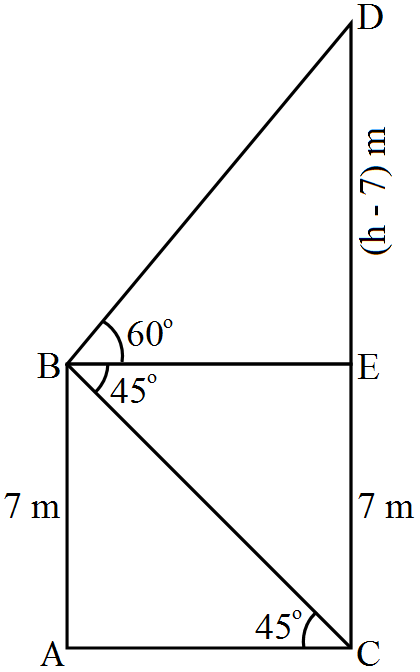
Let AB be the building and CD be the cable tawer.
Let the height of the tower be h metres.
Construction: Draw $\text{BE}\perp\text{CD}.$
Then CE = AB = 7m and DE = (h - 7)m
In right $\triangle\text{BAC},$
$\cot45^\circ=\frac{\text{AC}}{\text{AB}}$
$\Rightarrow1=\frac{\text{AC}}{7}$
$\Rightarrow\text{AC}=7\text{m}$
So, BE = AC = 7m
In right $\triangle\text{BED},$
$\cot60^\circ=\frac{\text{BE}}{\text{DE}}$
$\Rightarrow\frac{1}{\sqrt{3}}=\frac{7}{(\text{h}-7)}$
$\Rightarrow\text{h}-7=7\sqrt{3}$
$\Rightarrow\text{h}=7\sqrt{3}+7$
$\Rightarrow\text{h}=19.124\text{m}$
Hence, the height of the tower is 19.124m. View full question & answer→Question 74 Marks
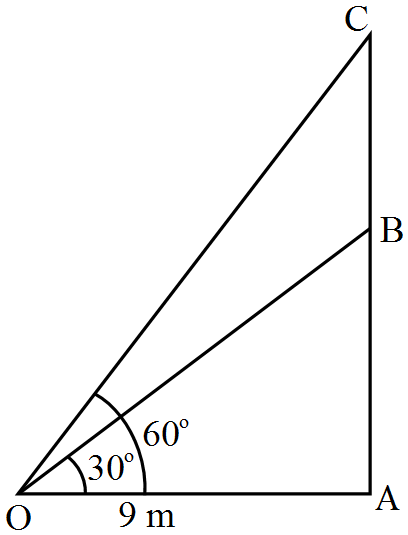
On a horizontal plane there is a vertical tower with a flagpole on the top of the tower. At a point, 9 metres away from the foot of the tower, the angle of elevation of the top and bottom the flagpole are 60° and 30° respectively. Find the height of the tower and the flagpole mounted on it. $\big[\text{Take}\sqrt{3}=1.732\big]$
AnswerLet AB be the tower and BC be flagpole, Let O be the point of observetion.Then, OA = 9m, $\angle\text{AOB}=30^\circ$ and $\angle\text{AOC}=60^\circ$
From right angled $\triangle\text{BOA}$
$\frac{\text{AB}}{\text{OA}}=\tan30^\circ$
$\Rightarrow\frac{\text{AB}}{9}=\frac{1}{\sqrt{3}}\Rightarrow\text{AB}=3\sqrt{3}$
From right angled $\triangle\text{OAC}$
$\frac{\text{AC}}{\text{OA}}=\tan60^\circ$
$\frac{\text{AC}}{9}=\sqrt{3}\Rightarrow\text{AC}=9\sqrt{3}\text{m}$
$\therefore\ \text{BC}=(\text{AC}-\text{AB})=6\sqrt{3}\text{m}$
Thus $\text{AB}=3\sqrt{3}\text{m}=5.196\text{m}$ and $\text{BC}=6\sqrt{3}\text{m}=10.392\text{m}$
Hence, hight of the tower = 5.196m and the height of the flagpole = 10392m. View full question & answer→Question 84 Marks
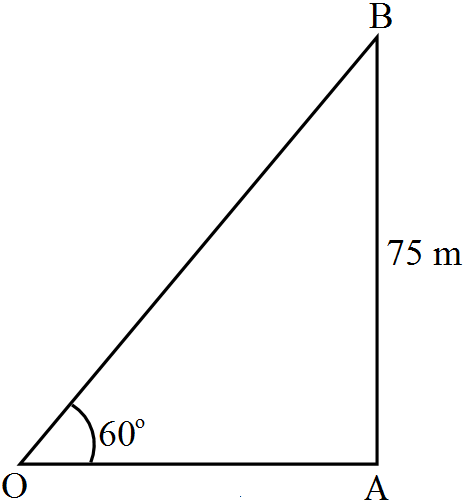
A kite is flying at a height of 75m from the level~round, a ched to a string inclined at 60° to the hori ontal. Find th length of the string, assuming that there is no slack in it.$\big[\text{Take}\sqrt{3}=1.732\big]$
AnswerLet OB be the length of the string from the level of ground and O be the point of the observer.Then, AB = 75m and $\angle\text{OAB}=90^\circ$ and $\angle\text{OAB}=60^\circ,$ let OB = 1 meters.
From the right $\triangle\text{OAB},$ we have
$\frac{\text{OB}}{\text{AB}}=\text{cosec }60^\circ=\frac{2}{\sqrt{3}}$
$\frac{\text{l}}{75}=\frac{2}{\sqrt{3}}$
$\Rightarrow\text{l}=\Big(75\times\frac{2}{\sqrt{3}}\times\frac{\sqrt{3}}{\sqrt{3}}\Big)$
$\Rightarrow\text{l}=25\times2\times\sqrt{3}$
$\Rightarrow\text{l}=50\sqrt{3}\text{m}$
$\Rightarrow\text{l}=86.6\text{m}$
Hence, the length of the string 86.6m View full question & answer→Question 94 Marks
The angle of elevation of the top of a tower from a point on the same level as the foot of the tower is 30°. On advancing 150m towards the foot of the tower, the angle of elevation becomes 60° Show that the height of the tower is 129.9 metres. $\big[\text{Given}\sqrt{3}=1.732\big]$
AnswerLet AB be the tower and let the angle of elevation of its top at C be 30°. Let D be a point at a distance 150m from C such that angle of elevation of the tower at D is 60°
Let h m be the height of the tower and AD = x m
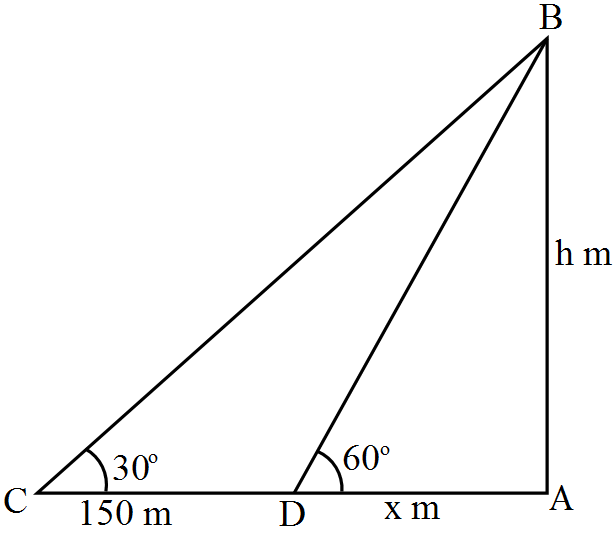
In $\triangle\text{CAB},$ we have
$\tan30^\circ=\frac{{\text{AB}}}{\text{AC}}$
$\Rightarrow\frac{1}{\sqrt{3}}=\frac{\text{h}}{\text{x}+150}\dots(1)$
In $\triangle\text{DAB},$ we have
$\tan60^\circ=\frac{\text{AB}}{\text{AD}}\Rightarrow\sqrt{3}=\frac{\text{h}}{\text{x}}$
$\Rightarrow1=\frac{\text{h}}{\sqrt{3}}\dots(2)$
Putting the $\text{x}=\frac{\text{h}}{\sqrt{3}}$ in (1), we get
$\Rightarrow\frac{1}{\sqrt{3}}=\frac{\text{h}}{\frac{\text{h}}{\sqrt{3}}+150}\Rightarrow\frac{1}{\sqrt{3}}=\frac{\sqrt{3}\text{h}}{\text{h}+150\sqrt{3}}$
$\Rightarrow\text{h}+150\sqrt{3}=3\text{h}\Rightarrow3\text{h}-\text{h}=150\sqrt{3}$
$2\text{h}=150\sqrt{3}$
$\text{h}=\frac{150}{2}\sqrt{3}=75\sqrt{3}$
$\text{h}=(75\times1.732)\text{m}$
$\text{h}=129.9$
Hence, the height of the tower is 129.9m. View full question & answer→Question 104 Marks
The angle of elevation of the top of an unifinished tower at a distance of 75m from its base is 30°. How much higher must the tower be raised so that the angle of elevation of its top at the same point may be 60°? $\big[\text{Take}\sqrt{3}=1.732\big]$
AnswerLet AB be the unfinished tower and let AC be complete tower.Let O be the point of observation.
Then OA = 75m
$\angle\text{AOB}=30^\circ$ and $\angle\text{AOC}=60^\circ$
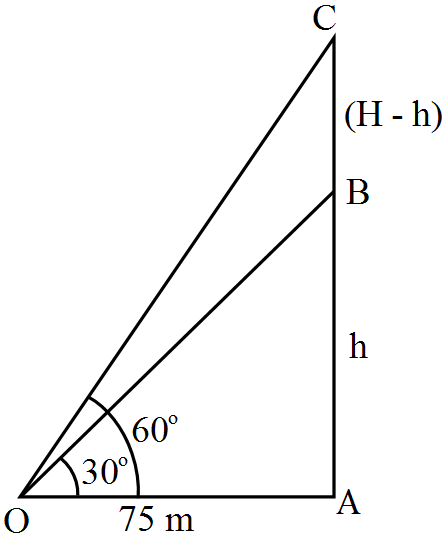
Let AB = h metres
And AC = H metres
$\frac{\text{AB}}{\text{OA}}=\tan30^\circ$
$\Rightarrow\frac{\text{h}}{75}=\frac{1}{\sqrt{3}}$
$\Rightarrow\text{h}=\frac{75}{\sqrt{3}}\times\frac{\sqrt{3}}{\sqrt{3}}=25\sqrt{3}\text{m}$
And $\frac{\text{AC}}{\text{OA}}=\tan60^\circ$
$\Rightarrow\frac{\text{H}}{75}=\sqrt{3}=\text{H}=75\sqrt{3}\text{m}$
Hence, the required height is $(\text{H}-\text{h})\text{m}=(75\sqrt{3}-25\sqrt{3})\text{m}$
$=50\sqrt{3}\text{m}=86.6$ View full question & answer→Question 114 Marks
The angle of elevation of an aeroplane from a point on the ground is 45°. After flying for 15 seconds, the elevation changes to 30°. If the aeroplane is flying at a height of 2500 metres, find the speed of the airoplane.
Answer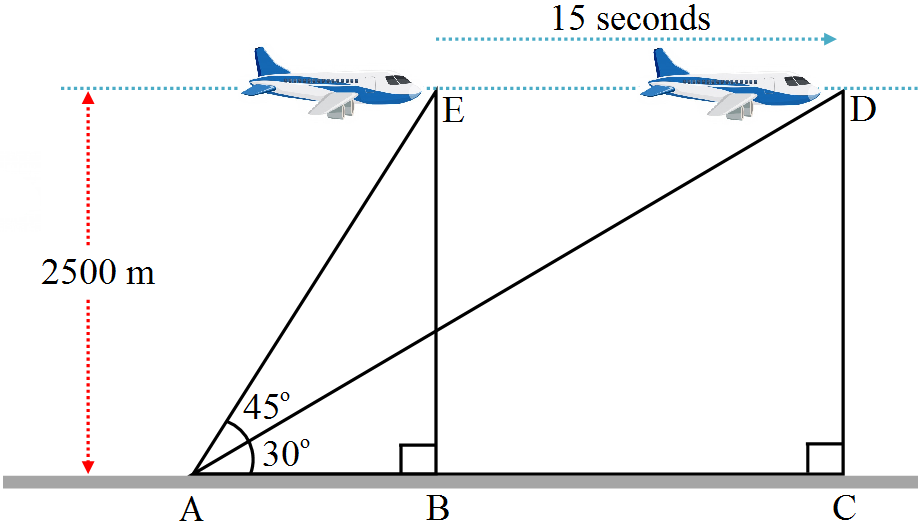
Let the first position of the plane be E and after 15 seconds, D.
In right $\triangle\text{ABE},$
$\cot45^\circ-\frac{\text{AB}}{\text{BE}}$
$\Rightarrow1=\frac{\text{AB}}{2500}$
$\Rightarrow\text{AB}=2500\text{m}$
In right $\triangle\text{ACD},$
$\cot30^\circ=\frac{\text{AC}}{\text{CD}}$
$\Rightarrow\sqrt{3}=\frac{\text{AC}}{2500}$
$\Rightarrow\text{AC}=2500\sqrt{3}\text{m}$
Distance travelled
$=\text{AC}-\text{AB}$
$=2500\sqrt{3}-2500$
$=2500(\sqrt{3}-1)\text{m}$
$=2500(1.732-1)$
$=1830\text{m}$
Time taken = 15 sec $=\frac{15}{3600}\text{hr}$ (Since 1hr = 3600 seconds)
Speed $=\frac{\text{Distance}}{\text{Time}}$
$=\frac{1830}{\frac{15}{3600}\times1000}$ (Since 1km = 1000m)
$=439.2\text{km}/\text{hr}$ View full question & answer→Question 124 Marks
From the top of a hill, the angles of depression of two consecutive kilometre stones due east are fouud to be 45° and 30° respectively.
Find the height of the hill.
Answer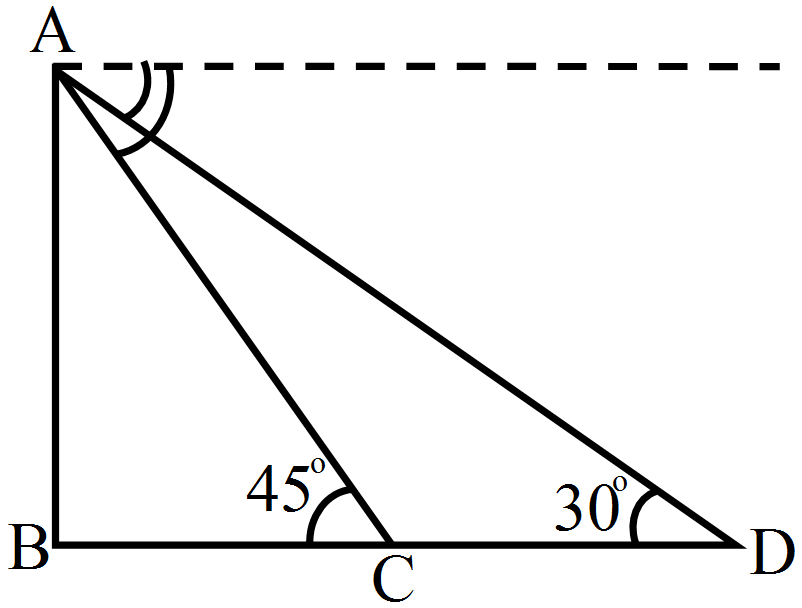
Let AB is the height of the hill and two stone are C and D resrectively.
Where depression is 45 degree and 30 degree. The distance between C and D is 1km.
Here depression and hill has formed right angle triangles with the base.
We have to find the height of the hill with this through trigonomentry.
In $\triangle\text{ABC},\tan45^\circ=\frac{\text{Height}}{\text{Base}}=\frac{\text{AB}}{\text{BC}}$
Again, $\triangle\text{ABD},\tan30=\frac{\text{AB}}{\text{BC}}$
$\frac{1}{\sqrt{3}}=\frac{\text{AB}}{\text{BC}+\text{CD}}$ $\Big[\tan30=\frac{1}{\sqrt{3}}-\frac{1}{1.732}\Big]$
Or $\frac{1}{1.732}=\frac{\text{AB}}{\text{AB}+1}$ [As AB = BC from (i) above]
1.732 AB = AB + 1
1.732 AB - AB = 1
AB (1.732 - 1) = 1
AB × 0.732 = 1
$\text{AB}=\frac{1}{0.732}=1.366$
Hence, height of the hill 1.366km View full question & answer→Question 134 Marks
Aman on the deck of a ship, 16m above water level, observes that the angles of elevation and depression respectively of the top bottom of a cliff are 60° and 30°. Calculate the distance of the cliff from the ship and height of the cliff. $\big[\text{Take}\sqrt{3}=1.732\big]$
AnswerLet AB be the height of the deck and let CD be the cliff.
Let the man be B, then, AB = 16m.
Let $\text{BE}\perp\text{CD}$ and $\text{AE}\perp\text{CD}$
Then, $\angle\text{EBD}=60$ and $\angle\text{EBC}=30$
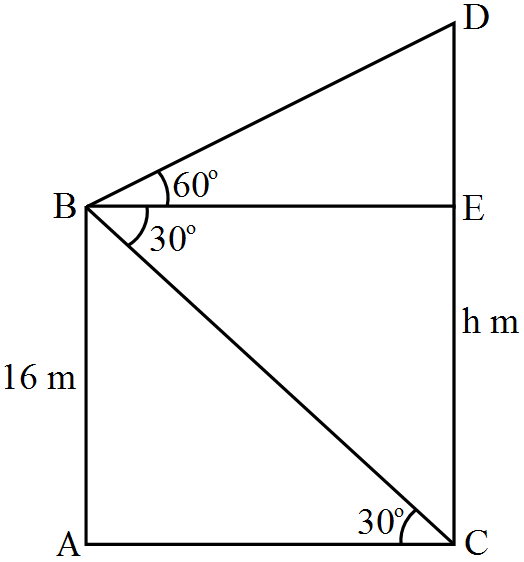
CE = AB = 16m
Let CD = h metres
Then, ED = (h = 16)m
From right $\triangle\text{BED},$ we have
$\frac{\text{BE}}{\text{ED}}=\cot60^\circ$
$\Rightarrow\frac{\text{BE}}{(\text{h}-16)}=\frac{1}{\sqrt{3}}$
$\Rightarrow\text{BE}=\frac{(\text{h}-16)}{\sqrt{3}}$
From right $\triangle\text{CAB},$ we have
$\frac{\text{AC}}{\text{AB}}=\cot30^\circ\Rightarrow\frac{\text{AC}}{16}=\sqrt{3}$
$\Rightarrow\text{AC}=16\sqrt{3}\text{m}$
But BE = AC
$\therefore\ \frac{(\text{h}-16)}{\sqrt{3}}=16\sqrt{3}\Rightarrow(\text{h}-16)=48$
$\Rightarrow\text{h}=64\text{m}$
Hence the height of cliff is 64m and the distance between the cliff and ship $=16\sqrt{3}\text{m}=27.71\text{m}$ View full question & answer→Question 144 Marks
A TV tower stands vertically on a bank of canal. From a point on the other bank directly opposite the tower, the angle of elevation of the top of the tower is 60°. From anothe point 20m away from this point on the line joining this point to the foot of the tower, the angle of elevation of the top of the tower is 30°. Find the height of the ower and the width of the canal.
Answer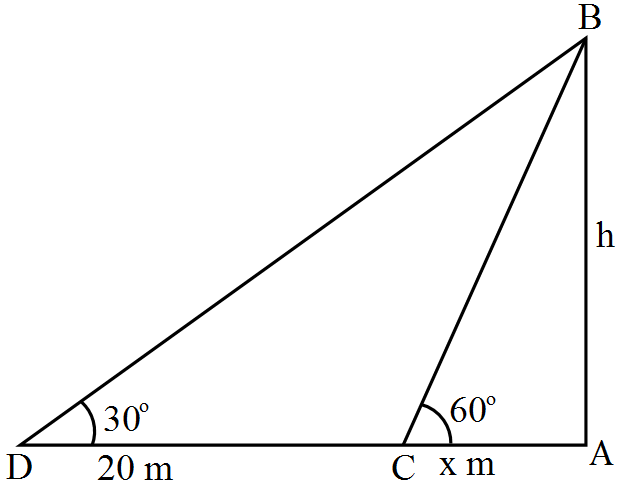
Let the tower height AB = h
In right $\triangle\text{ABC},$
$\cot60^\circ=\frac{\text{x}}{\text{h}}=\frac{1}{\sqrt{3}}\Rightarrow\text{x}=\frac{\text{h}}{\sqrt{3}}\dots(\text{i})$
In right $\triangle\text{DAB},$
$\cot30^\circ=\frac{\text{x}+20}{\text{h}}=\sqrt{3}$
$\Rightarrow\text{x}+20=\text{h}\sqrt{3}$
$\Rightarrow\text{x}=\big(\text{h}\sqrt{3}-20\big)\dots(\text{ii})$
From (i) and (ii),
$\frac{\text{h}}{\sqrt{3}}=\big(\text{h}\sqrt{3}-20\big)$
$\Rightarrow2\text{h}=20\sqrt{3}$
$\Rightarrow\text{h}=10\sqrt{3}\text{m}$
Sunstituting $\text{h}=10\sqrt{3}$ in (i) we get x = 10m.
Hence, the height of the canal is $10\sqrt{3}\text{m},$ and the width of the canal is 10m. View full question & answer→Question 154 Marks
The angles of depression of the top and bottom of a tower as seen from the top of a $60\sqrt{3}-\text{m}-\text{high}$ cliff are 45° and 60° re!pectively. Find the height of the tower.
Answer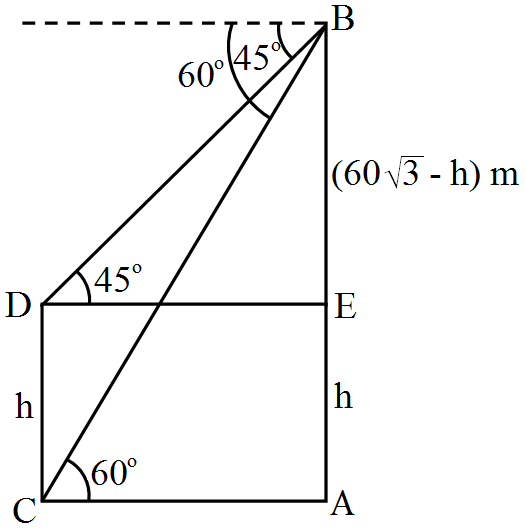
Let AB be the diff and CD be the tower, of height h metres.
So, AE = CD = h metres.
Since AB is given to be $60\sqrt{3}\text{m},\text{BE}=\big(60\sqrt{3}-\text{h}\big)\text{m}.$
In right $\triangle\text{BED},$
$\cot45^\circ=\frac{\text{DE}}{\text{BE}}$
$\Rightarrow1=\frac{\text{DE}}{60\sqrt{3}-\text{h}}$
$\Rightarrow\text{DE}=({60}{\sqrt{3}-\text{h}})\text{m}\dots(\text{i})$
In right $\triangle\text{CAB},$
$\cot60^\circ=\frac{\text{CA}}{\text{AB}}$
$\Rightarrow{\frac{1}{\sqrt{3}}}=\frac{\text{CA}}{60\sqrt{3}}$
$\Rightarrow\text{CA}=60\text{m}\dots(\text{ii})$
Since CA = DE,
From (i) and (ii),
${60}{\sqrt{3}}-\text{h}=60$
$\Rightarrow\text{h}=60\sqrt{3}-60$
$\Rightarrow\text{h}=60\times1.732-60$
$\Rightarrow\text{h}=43.92\text{m}$
$\Rightarrow\text{h}=15\text{m}$
Hence, the height of the tower is 43.92m. View full question & answer→Question 164 Marks
From a point on the ground the angles of elevation of the bottom and top of a communication tower fixed on the top of a 20-m-high building are 45° and 60° respectively. Find the eight of the tower. $\big[\text{Use}\sqrt{3}=1.732\big]$
Answer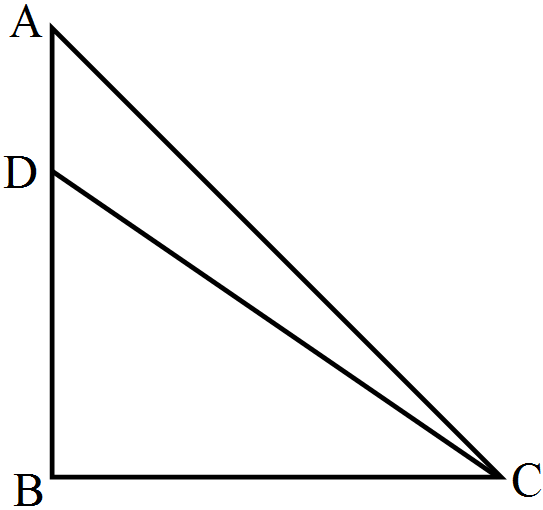
Height of Bulding = DB = 20m
$\angle\text{DCB}=45^\circ$
$\angle\text{ACB}=60^\circ$
In $\triangle\text{DBC}\tan45^\circ=1=\frac{\text{DB}}{\text{BC}}$
Or, $\text{AB}=20\sqrt{3}$
Now, $\text{AD}=\text{AB}-\text{DB}$
$=20\sqrt{3}-20=20(\sqrt{3}-1)$
$=20(1.732-1)=20\times0.732=14.64\text{m}$ View full question & answer→Question 174 Marks
A straight highway leads to the foot of a tower. A man standing on the top of the tower observes a car at an angle of depression of 30°, which is approaching the foot of the tower with a uniform speed. Six secounds later, the angle of depression of the car is fo d to be 60°. Find the time taken by the car to reach the foot of the tower form this point.
Answer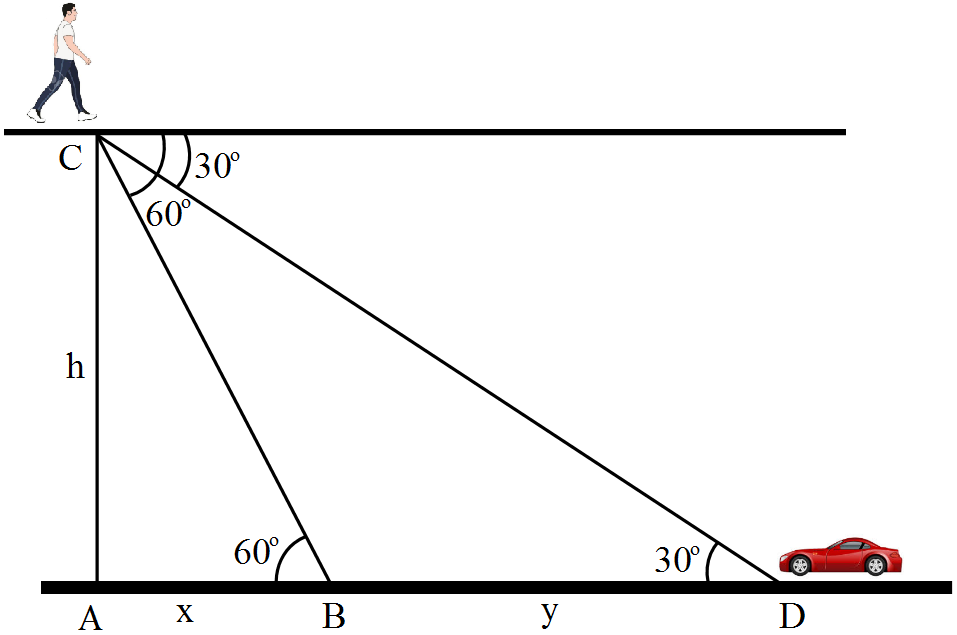
Let the tower height AC = h; BD = y; AB = x
In right angled triangle $\triangle\text{ABC}$ and $\triangle\text{ADC},$
$\cot60^\circ=\frac{\text{x}}{\text{h}}=\frac{1}{\sqrt{3}}$
$\Rightarrow\text{x}=\frac{\text{h}}{\sqrt{3}}$
$\cot30^\circ=\frac{\text{x}+\text{y}}{\text{h}}=\sqrt{3}$
$\Rightarrow\text{x}+\text{y}=\sqrt{3}\text{h}$
$\Rightarrow\text{y}=\sqrt{3}\text{h}-\text{x}$
$\Rightarrow\text{y}=\sqrt{3}\text{h}-\frac{\text{h}}{\sqrt{3}}=\frac{2\text{h}}{\sqrt{3}}$
y distance is covered in 6 seconds
Hence, x distance is covered in $\frac{6\text{x}}{\text{y}}\text{secounds}$
$=\frac{6\times\frac{\text{h}}{\sqrt{3}}}{\frac{2\text{h}}{\sqrt{3}}}=3\text{ secounds}$
Hence, the times taken by the car to reach the foot of the tower from this point is 3 secounds. View full question & answer→Question 184 Marks
The angles of elevation of the top of a tower from two points at distances of 5 metres and 20 metrers. from the base of the tower and in the same straight line with it, are complementry. Find the height of the tower.
Answer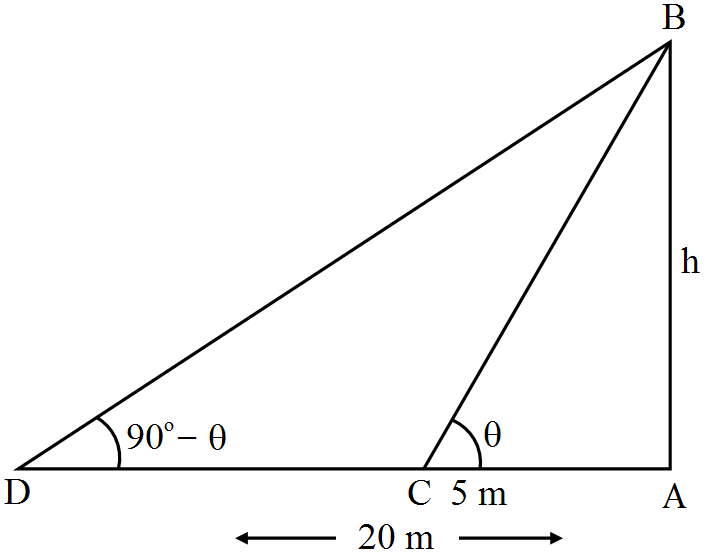
Let One angle of elevation be $\theta.$
Since the angles are complementary, the other angle is $(90^\circ-\theta).$
From right $\triangle\text{CAB},$ we have
$\frac{\text{AB}}{\text{AC}}=\tan\theta$
$\Rightarrow\frac{\text{h}}{5}=\tan\theta$
$\Rightarrow\text{h}=5\tan\theta\dots(\text{i})$
From right $\triangle\text{DAB},$ we have
$\frac{\text{AB}}{\text{AD}}=\tan(90^\circ-\theta)$
$\Rightarrow\frac{\text{h}}{20}=\tan(90^\circ-\theta)$
$\Rightarrow\text{h}=20\tan(90^\circ\theta)\dots(\text{ii})$
Multiplying (i) and (ii), we get
$\text{h}^2=100\tan\theta\times\tan(90^\circ-\theta)$
$\Rightarrow\text{h}^2=100\tan\theta\times\cot\theta$
$\Rightarrow\text{h}^2=100$
$\Rightarrow\text{h}=10\text{m}$
Hence, the height of the tower is 10m. View full question & answer→Question 194 Marks
The angle of elevation of the top of a chimney from the foot of a tower is 60° and the angle of depression of the foot of the chimney forn the top of the tower is 30°. If the height of the tower is 40 metres, find the height of the chimney.
According to pollution control norms, the minimum height of a smokeemitting chimney should be 100 metres. State if the height ,the above mentioned chimney meets the pollution norms. What value is discussed in this question?
Answer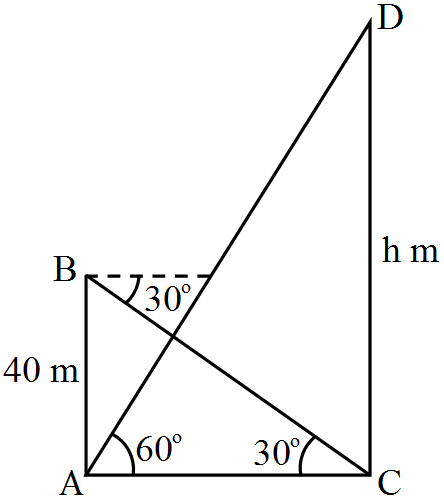
Let AB be the tower and CD be the chimney.
In right $\triangle\text{ACD},$
$\cot60^\circ=\frac{\text{AC}}{\text{CD}}$
$\Rightarrow\frac{1}{\sqrt{3}}=\frac{\text{AC}}{\text{h}}$
$\Rightarrow\text{AC}=\frac{\text{h}}{\sqrt{3}}\dots(\text{i})$
In right $\triangle\text{BAC},$
$\cot30^\circ=\frac{\text{AC}}{\text{AB}}$
$\Rightarrow\sqrt{3}=\frac{\text{AC}}{40}$
$\Rightarrow\text{AC}=40\sqrt{3}$
$\Rightarrow\frac{\text{h}}{\sqrt{3}}=40\sqrt{3}\dots(\text{From}(\text{i}))$
$\Rightarrow\text{h}=120\text{m}$
Hence, the height of the chimney is 120m.
Given that according to pollution control norms, the minimum height of a smoke - emitting chimney should be 100 metres.
Since h > 100, the height meets the pollution norms.
The value discussed is cleanliness and abiduing by rules to avoid polluting the enviroment. View full question & answer→Question 204 Marks
A man observes a car from the to of a tower, which is moving towards the tower with a uniform speed. If the angle of depression of the car changes from 30° to 45° in 12 minutes, find the time taken by the car now to reach the tower.
AnswerConsider the following figure,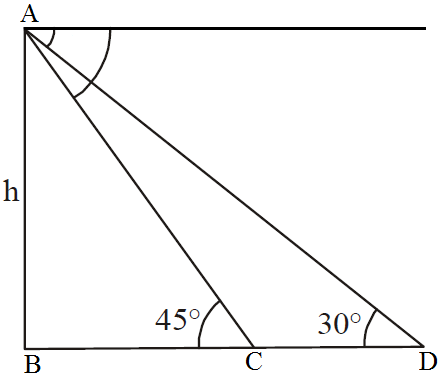
Let A be the position of the man and AB be the tower. Now, consider the triangle, ABD. $\tan30^\circ=\frac{\text{AB}}{\text{BD}}$ $\Rightarrow\frac{1}{\sqrt3}=\frac{\text{AB}}{\text{BD}}$ $\Rightarrow\frac{\text{BD}}{\sqrt3}=\text{AB}$ $\Rightarrow\frac{\text{BD + CD}}{\sqrt3}=\text{AB}\ ....(1)$ Consider the triangle ABC. $\tan45^\circ=\frac{\text{AB}}{\text{BC}}$ $\Rightarrow1=\frac{\text{AB}}{\text{BC}}$ $\Rightarrow\text{AB = BC}\ ....(2)$ Substitute the value of BC from equation (2) in equation (1), we have $\frac{\text{AB + CD}}{\sqrt3}=\text{AB}$ $\Rightarrow\text{AB + CD}=\sqrt3\text{AB}$ $\Rightarrow\sqrt3\text{AB}-\text{AB}=\text{CD}$ $\Rightarrow\text{AB}\big(\sqrt3-1\big)=\text{CD}\ ....(3)$ Let v m/min be the speed of the car. Since, the car takes 12 min to cover the distance CD, we have, CD = 12v ....(4) [Distance = speed × time] Substitute the value of CD from equation (4) in equation (3), We have, $\text{AB}\big(\sqrt3-1\big)=12\text{v}$ $\Rightarrow\frac{\text{AB}\big(\sqrt3-1\big)}{12}=\text{v}\ ....(5)$ We need to find the time taken by the car to cover the distance BC. $\text{Time}=\frac{\text{BC}}{\text{v}}$ $\Big[\text{Time}=\frac{\text{Distance}}{\text{Speed}}\Big]$ $\Rightarrow\text{Time}=\frac{12\text{BC}}{\text{AB}\big(\sqrt3-1\big)}$ [From equation (5)] $\Rightarrow\text{Time}=\frac{12\text{AB}}{\text{AB}\big(\sqrt3-1\big)}$ [From equation (2)] $\Rightarrow\text{Time}=\frac{12}{\big(\sqrt3-1\big)}\approx16.4\text{ minutes}$ View full question & answer→Question 214 Marks
The angle of elevation of the top of vertical tower from a point on the ground is 60°. From another poin 10m vertically above the first, its angle of elevation is 30°. Find the height of the tower.
Answer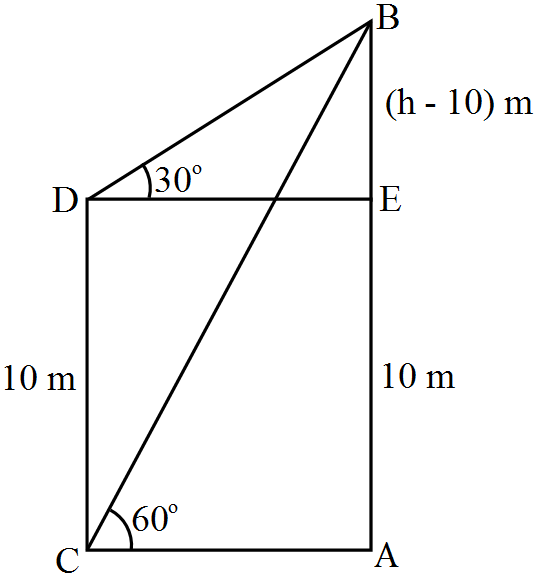
Let AB be the tower of height, h metres.
In right $\triangle\text{BPQ},$
$\cot30^\circ=\frac{\text{CA}}{\text{PB}}$
$\Rightarrow\frac{1}{\sqrt{3}}=\frac{\text{CA}}{\text{h}}$
$\Rightarrow\text{CA}=\frac{\text{h}}{\sqrt{3}}\dots(\text{i})$
In right $\triangle\text{BED},$
$\cot30^\circ=\frac{\text{DE}}{\text{BE}}$
$\Rightarrow{\sqrt{3}}=\frac{\text{DE}}{(\text{h}-10)}$
$\Rightarrow\text{DE}=\sqrt{3}(\text{h}-10)\dots(\text{ii})$
Since CA = DE,
From (i) and (ii),
$\frac{\text{h}}{\sqrt{3}}=\sqrt{3}(\text{h}-10)$
$\Rightarrow\text{h}=3(\text{h}-10)$
$\Rightarrow\text{h}=3\text{h}-30$
$\Rightarrow2\text{h}=30$
$\Rightarrow\text{h}=15\text{m}$
Hence, the height of the tower is 15m. View full question & answer→Question 224 Marks
Two poles of equal heights are standing opposite to each other on either side of the road which is 80m wide. From a point P between them on the road, the angle of elevation of the top of one pole is 60° and the angle of depression from the top of another pole at P is 30°. Find the height of each pole and distances of the point P from the poles.
Answer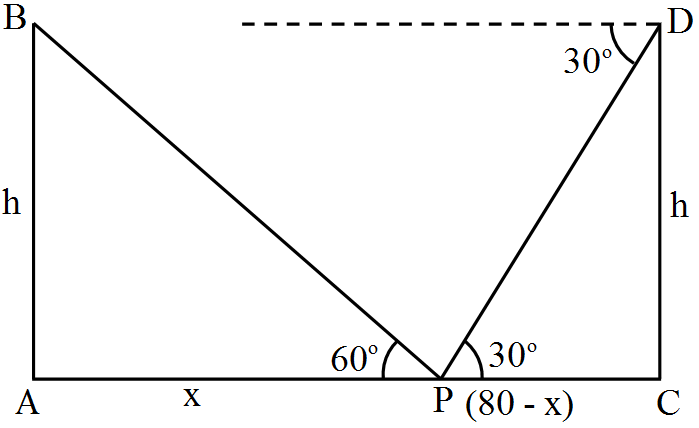
Let AB and CD be the two poles and h be their height.
In right $\triangle\text{PAB},$
$\frac{\text{AB}}{\text{AP}}=\tan60^\circ$
$\Rightarrow\frac{\text{h}}{\text{x}}=\sqrt{3}$
$\Rightarrow\text{h}=\text{x}\sqrt{3}\text{m}\dots(\text{i})$
In right $\triangle\text{PCD},$
$\frac{\text{CD}}{\text{PC}}=\tan30^\circ$
$\Rightarrow\text{h}=\frac{(80-\text{x})}{\sqrt{3}}\text{m}\dots(\text{ii})$
From (i) and (ii),
$\frac{(80-\text{x})}{\sqrt{3}}=\text{x}\sqrt{3}$
$\Rightarrow80-\text{x}=3\text{x}$
$\Rightarrow4\text{x}=80$
$\Rightarrow\text{x}=20\text{m}$
So, $\text{h}=\text{x}\sqrt{3}\text{m}=20\sqrt{3}\text{m}$
Hence, the height of each pole is $20\sqrt{3}\text{m},$ and the distances of pole AB from the point P is 20m and that of pole CD from the point P is 60m. View full question & answer→Question 234 Marks
Two men are on opposite sides of a tower. They measure the angles of elevation of the top of the tower as 30° and 45° respectively. If the height of the tower is 50 metres, find the distance between the two men. $\big[\text{Take}\sqrt{3}=1.732\big]$
Answer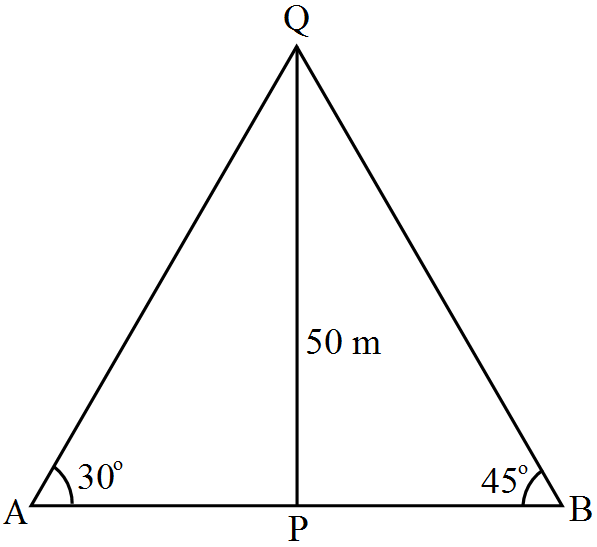
Let the men be at A and B respectively.
In right $\triangle\text{APQ},$
$\frac{\text{PQ}}{\text{AP}}=\tan30^\circ$
$\Rightarrow\frac{50}{\text{AP}}=\frac{1}{\sqrt{3}}$
$\Rightarrow\text{AP}=50\sqrt{3}$
$\Rightarrow\text{AP}=86.6\text{m}$
In right $\triangle\text{PQB},$
$\frac{\text{PQ}}{\text{PB}}=\tan45^\circ$
$\Rightarrow\frac{50}{\text{PB}}=1$
$\Rightarrow\text{PB}=50\text{m}$
Now, $\text{AB}=\text{AP}+\text{PB}$
$=86.6+50$
$=136.6\text{m}$
Hence, the distance between the two men is 136.6m. View full question & answer→Question 244 Marks
An observer 1.5m talI is 30m away from a chimney. the angle of elevation of the top of the chimney from his eye is 60°. Find the height of the chimney.
Answer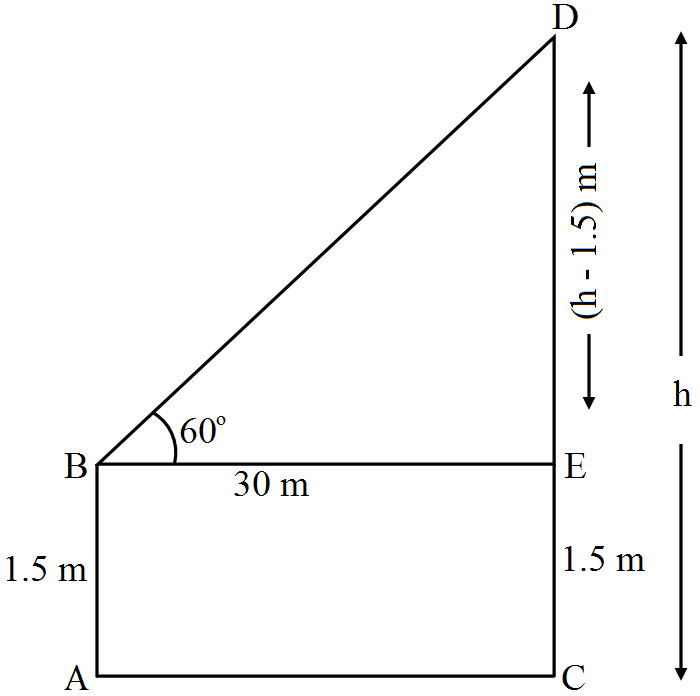
Let AB be the observe and CD = h metres be the tower.
BE = AC = 30m
From right $\triangle\text{BED},$ we have
$\frac{\text{DE}}{\text{BE}}=\tan60^\circ$
$\Rightarrow\frac{\text{DE}}{\text{BE}}=\sqrt{3}$
$\Rightarrow\text{DE}=\sqrt{3}\text{ BE}$
$\Rightarrow\text{h}-1.5=\sqrt{3}(30)$
$\Rightarrow\text{h}-1.5=30\sqrt{3}$
$\Rightarrow\text{h}=30\sqrt{3}+1.5\approx53.4\text{m}$
Hence, the height of the chimney is 53.4m. View full question & answer→Question 254 Marks
If at some time of the day the ratio of the height of a vertically standing pole to the length of its shadow on the ground is $\sqrt{3}:1$ then find the angle of elevation of the sun at that times.
Answer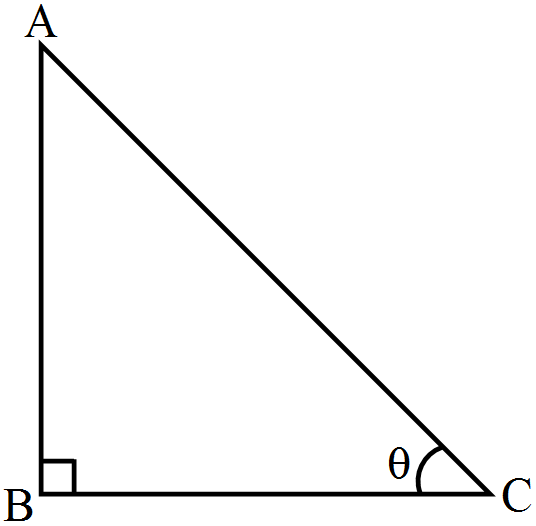
Let the height of the tower be x and y the length of the shadow on the ground be x : y.
The angle of elevation of the sun from the ground is $\theta.$
We have, $\text{x}:\text{y} =\sqrt{3}:1$
Now, in $\triangle\text{ABC},$
$\tan\theta=\frac{\text{Height}}{\text{Base}}$
$\tan\theta=\frac{\text{AB}}{\text{BC}}$
$\tan\theta=\frac{\sqrt{3}}{1}$
$\therefore\tan\theta=60^\circ$ View full question & answer→Question 264 Marks
A ladder of length 6 metres makes angle of 45° with the floor while leaning against one wall of a room. lf the foot of the ladder is kept fixed on the floor and it is made to lean against the opposite wall of the room, it makes an angle of 60° with the floor. Find the distance between two walls of the room.
Answer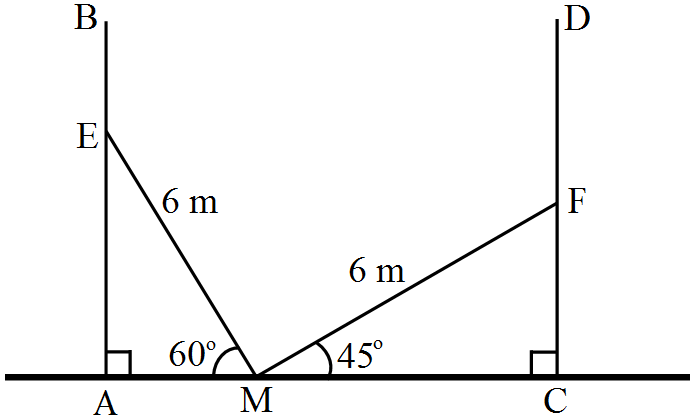
Let the floors be AB and CD and E and E and F be the positions of the ladder leaning against each wall.
From right $\triangle\text{MAE},$ we have
$\frac{\text{AM}}{\text{EM}}=\cos60^\circ$
$\Rightarrow\frac{\text{AM}}{6}=\frac12$
$\Rightarrow\text{AM}=3\text{m}$
From right $\triangle\text{MCF},$ we have
$\frac{\text{CM}}{\text{MF}}=\cos45^\circ$
$\Rightarrow\frac{\text{CM}}{6}=\frac{1}{\sqrt{2}}$
$\Rightarrow\text{CM}=\frac{6}{\sqrt{2}}$
On rationalising, we get
$\text{CM}=\frac{6}{\sqrt{2}}\times\frac{\sqrt{2}}{\sqrt{2}}=\frac{6\sqrt{2}}{2}=3\sqrt{2}\text{m}$
So, $\text{AC}=\text{AM}+\text{CM}$
$=3+3\sqrt{2}$
$=3+(3\times1.414)$
$=7.242\text{m}$
Thus, the distance between the two walls of the room is 7.242m. View full question & answer→Question 274 Marks
The angle of elevation of the top of tower at a distance of 120m from a point A on the ground is 45°. If the angle of elevation of the top of a flagstaff fixed at the top of the tower, at A is 60°, then find the height of the flagstaff. $\big[\text{Use}\sqrt{3}=1.732\big]$
Answer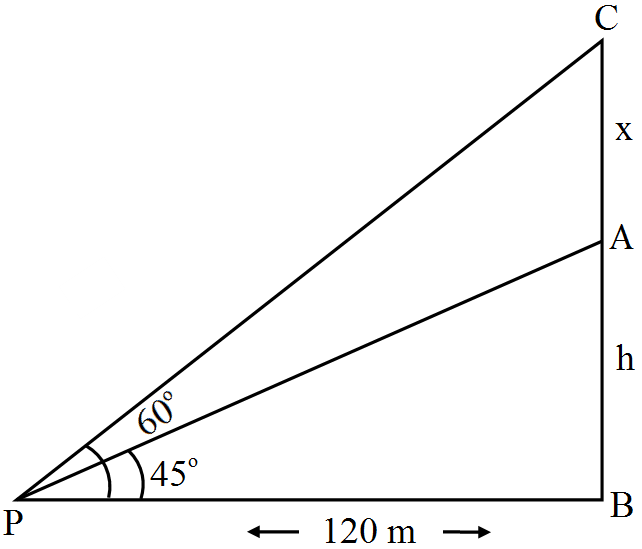
Let AB is the tower of height h meter and AC is flagstaff of height x meter.
$\angle\text{APB}=45^\circ$ and $\angle\text{BPC}=60^\circ$
$\tan60^\circ=\frac{\text{x}+\text{h}}{120}$
$\Rightarrow\sqrt{3}=\frac{\text{x}+\text{h}}{120}$
$\Rightarrow\text{x}=120\sqrt{3}-\text{h}$
$\tan45^\circ=\frac{\text{h}}{120}$
$\Rightarrow1=\frac{\text{h}}{120}$
$\Rightarrow\text{h}=120$
$\therefore$ height of the flagstaff, x
$=120\sqrt{3}-120$
$=120(\sqrt{3}-1)$
$=120\times0.732$
$=87.8\text{m}$
Hence, the height of the flastaff is 87.8m. View full question & answer→Question 284 Marks
From the top of a vertical tower, the angle of depression of two cars in the same straight line with the base of the tower, at an instant are found to be 45° and 60°. If the cars are 100m apart and are on the same side of the tower, find the height of the tower.
Answer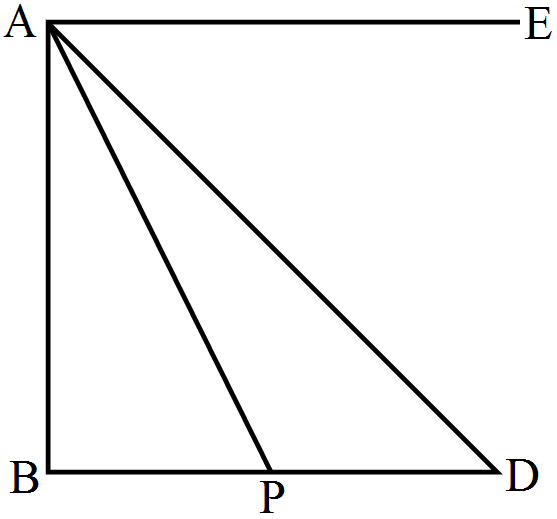
In the above figure, let AB be the tower and P and D be the positions of the two cars at an instant, observed from A.
Join A and E.
The angles of depression are $\angle\text{DAE}$ and $\angle\text{PAE}.$
Given that, PD = 100m.
Since AE is parallel to BD,
So,$\angle\text{ADB}=\angle\text{DAE}=45^\circ$ and $\angle\text{APB}=\angle\text{PAE}=60^\circ.$
Join P,D and A,B. We get two right-angled triangles $\triangle\text{ABD}$ and $\triangle\text{ABP}.$
We are to find AB. We use trigonometric ratio tan for both the triangles, using AB as height and BP as base for $\triangle\text{ABP}.$ and AB as height and BD as base for $\triangle\text{ABD}.$
From $\triangle\text{ABD},$
$\tan\angle\text{ADB}=\tan45^\circ=\frac{\text{AB}}{\text{BD}}$
Or, $\text{AB}=\text{BD}$
From $\triangle\text{APB},$
$\tan\angle\text{APB}=\tan60^\circ=\frac{\text{AB}}{\text{BP}}$
Or, $\text{BD}=\text{BP}\sqrt{3}$
$\text{BP}+100=\text{BP}\sqrt{3}$
$\text{BP}(\sqrt{3}-1)=100$
$\text{BP}=\frac{100}{(\sqrt{3}-1)}=136.61\text{m}.$ View full question & answer→Question 294 Marks
The angle of elevation of the top of building from the foot of a tower is 30°. The angle of elevation of the top of the tower from the foot of the building is 60°. If the tower is 60°. If the tower is 60m high, Find the height of the building.
Answer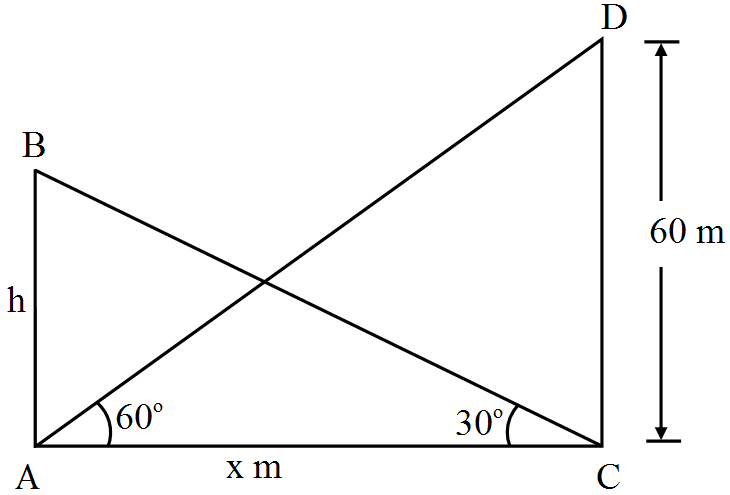
Let AB be the building and CD be the tower.
In right $\triangle\text{ACD},$
$\cot60^\circ=\frac{\text{AC}}{\text{CD}}$
$\Rightarrow\frac{1}{\sqrt{3}}=\frac{\text{x}}{60}$
$\Rightarrow\text{x}=\frac{60}{\sqrt{3}}$
On rationalising, we get
$\text{x}=\frac{60}{\sqrt{3}}\times\frac{\sqrt{3}}{\sqrt{3}}=20\sqrt{3}\text{m}$
In right $\triangle\text{BAC},$
$\tan30^\circ=\frac{\text{AB}}{\text{AC}}$
$\Rightarrow\frac{1}{\sqrt{3}}=\frac{\text{h}}{\text{x}}$
$\Rightarrow\text{h}=\frac{\text{x}}{\sqrt{3}}$
$\Rightarrow\text{h}=\frac{20\sqrt{3}}{\sqrt{3}}=20\text{m}$
Hence, the height of the building is 20m. View full question & answer→