Questions · Page 3 of 3

5 Marks Question

Question 1015 Marks
The sum of two numbers is $16$ and the sum of their reciprocals is $\frac{1}{3}.$ Find the numbers.
Answer
Let the two numbers be $x$ and $y$ respectively.
Accroding to the given question:
$\therefore x + y = 16 ...(1)$
And
$\frac{1}{\text{x}}+\frac{1}{\text{y}}=\frac{1}{3}\ \dots(2)$
From $(2),$
$\frac{\text{x}+\text{y}}{\text{xy}} =\frac{1}{3}$ or $\frac{16}{\text{xy}}=\frac{1}{3} [x + y = 16]$
$\therefore xy = 48$
We know,
$(x - y)^2 = (x + y)^2 - 4xy$
$= 16^2 - 4 \times 48 = 256 - 192 = 64$
$\therefore x - y = 8 ...(3)$
Adding $(1)$ and $(3),$ we get
$2x = 24$
$\therefore x = 12$
Putting $x = 12$ in $(1),$
$y = 16 - x$
$= 16 - 12$
$= 4$
$\therefore$ The required numbers are $12$ and $4$
View full question & answer
Question 1025 Marks
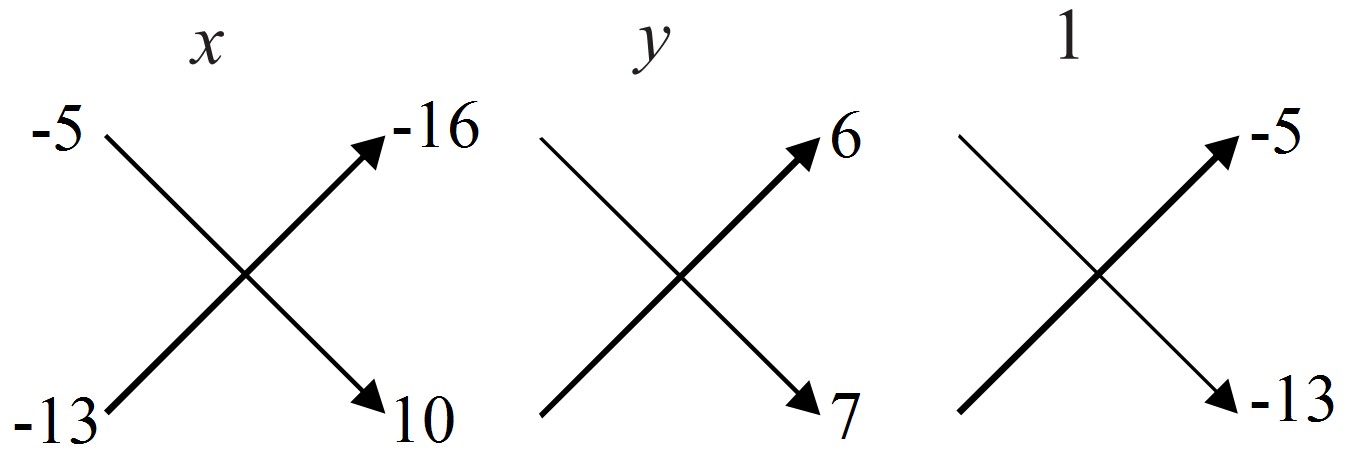
Solve the following systems of equations by using the method of cross multiplication:
$6x - 5y - 16 = 0,$
$7x - 13y + 10 = 0$
Answer
The given equations are: $6x - 5y - 16 = 0 ...(i) 7x - 13y + 10 = 0 ...(ii)$
Here, $a_1 = 6, b_1 = -5, c_1 = -16, a_2 = 7, b_2 = -13$ and $c_2 = 10$ By cross multiplication, we have:

$\therefore\frac{\text{x}}{[(-5)\times10-(-16)\times(-13)]}=\frac{{\text{y}}}{[(-16)\times7-10\times6]}=\frac{1}{[6\times(-13)-(-5)\times7]}$ $\Rightarrow\frac{\text{x}}{(-50-208)}=\frac{\text{y}}{(-112-60)}=\frac{1}{(-78+35)}$
$\Rightarrow\frac{\text{x}}{(-258)}=\frac{\text{y}}{(-172)}=\frac{1}{(-43)}$
$\Rightarrow\text{x}=\frac{-258}{-43}=6,\ \text{y}=\frac{-172}{-43}=4$
Hence, $x = 6$ and $y = 4$ is the required solution.
View full question & answer
Question 1035 Marks
Solve for x and y:
$2\text{x}-\frac{3}{\text{y}}=\text{9},$
$\text{3x}+\frac{7}{\text{y}}=\text{2}$ $(\text{y}\neq0).$
Answer
Putting $\frac{1}{\text{y}}=\text{v}$ the given equations become 2x - 3v = 9 ...(1) 3x + 7v = 2 ...(2)Multiplying (1) by 7 and (2) by 3, we get
14x - 21v = 63 ...(3)
9x + 21v = 6 ...(4)
Adding (3) and (4), we get
23x = 69
$\Rightarrow\text{x}=\frac{39}{13}=3$Putting x = 3 in (1), we get
2 × 3 - 3v = 9
-3v = 9 - 6
⇒ -3v = 3
⇒ v = -1
$\Rightarrow\frac{1}{\text{y}}=-1$⇒ y = -1
$\therefore$ The solution is x = 3 and y = 1
View full question & answer
Question 1045 Marks
If 1 is added to both of the numerator and denominator of a fraction, it becomes $\frac{4}{5}.$ If however, 5 is subtracted from both numerator and denominator, the fraction $\frac{1}{2}.$ Find the fraction.
Answer
Let the required fraction be $\frac{\text{x}}{\text{y}}.$
Then, we have:
$\frac{\text{x}+1}{\text{y}+1}=\frac{4}{5}$
⇒ 5(x + 1) = 4(y + 1)
⇒ 5x + 5 = 4y + 4
⇒ 5x - 4y = -1 ...(i)
Again, we have:
$\frac{\text{x}-5}{\text{y}-5}=\frac{1}{2}$
⇒ 2(x - 5) = 1(y - 5)
⇒ 2x - 10 = y - 5
⇒ 2x - y = 5 ...(ii)
On multiplying (ii) by 4, we get:
⇒ 8x - 4y = 20 ....(iii)
On subtracting (i) from (iii), we get:
3x = (20 - (-1)) = 20 + 1 = 21
⇒ 3x = 21
⇒ x = 7
On substituting x = 7 in (i), we get:
5 × 7 - 4y = -1
⇒ 35 - 4y = -1
⇒ 4y = 36
⇒ y = 9
$\therefore$ x = 7 and y = 9
Hence, the required fraction is $\frac{7}{9}.$
View full question & answer
5 Marks Question - Page 3 - Maths STD 10 Questions - Vidyadip