Questions · Page 5 of 5

4 Marks Questions

Question 2014 Marks
Solve the following systems of equations:
$\frac{15}{\text{u}}+\frac{2}{\text{v}}=17$
$\frac{1}{\text{u}}+\frac{1}{\text{v}}=\frac{36}{5}$
Answer
$\frac{15}{\text{u}}+\frac{2}{\text{v}}=17$
$\frac{1}{\text{u}}+\frac{1}{\text{v}}=\frac{36}{5}$Let us consider $\frac{1}{\text{u}}=\text{x}$ and $\frac{1}{\text{v}}=\text{y}$
$15\text{x}+2\text{y}=17\ ...(\text{i})$
$\text{x}+\text{y}=\frac{36}{5}\ ...(\text{ii})$Now multiplying equation $2^{nd}$​​​​​​​ by $2$ and substract from (i)
$15\text{x}+2\text{x}=17-\frac{72}{5}$
$17\text{x}=\frac{85-72}{5}$
$\text{x}=\frac{13}{85}$And $\text{y}=\frac{36}{5}-\frac{13}{85}$
$\Rightarrow\text{y}=\frac{612-13}{85}$
$\text{y}=\frac{599}{85}$Thus $\text{u}=\frac{85}{13}$ and $\text{v}=\frac{85}{599}$
View full question & answer
Question 2024 Marks
Abdul travelled 300km by train and 200km by taxi, it took him 5 hours 30 minutes. But if he travels 260km by train and 240km by taxi he takes 6 minutes longer. Find the speed of the train and that of the taxi.
Answer
Let the speed of the train be x km/ hr. and that of that of the taxi be y km/ hr. we have the following cases:
Case I: When abdul travels 300km by train and 200km by taxi:
In this case we have
Time taken by abdul to travel 300km by train $=\frac{300}{\text{x}}\text{hrs.}$
Time taken by abdul to travel 200km by taxi $=\frac{200}{\text{y}}\text{hrs.}$
$\therefore$ Total time taken by abdul $=\frac{300}{\text{x}}+\frac{200}{\text{y}}$
It is given that the total time taken is 5 hours 30 minutes.
$\therefore\frac{300}{\text{x}}+\frac{200}{\text{y}}=5\text{ hours 30 minutes}$
$\Rightarrow\frac{300}{\text{x}}+\frac{200}{\text{y}}=5\frac{1}{2}$
$\Rightarrow\frac{300}{\text{x}}+\frac{200}{\text{y}}=\frac{11}{2}$
$\Rightarrow\frac{600}{\text{x}}+\frac{400}{\text{y}}=11\ ....(\text{i})$
Case II: When abdul travels 260km by train and 240km by taxi:
In this case we have
Time taken by abdul to travel 200km by train $=\frac{260}{\text{x}}\text{hrs.}$
Time taken by abdul to travel 240km by taxi $=\frac{240}{\text{y}}\text{hrs.}$
In this case total time of time of the journey is (5 hours 30 minutes + 6 minutes)
$=5\frac{1}{2}+\frac{1}{10}$
$=\frac{11}{2}+\frac{1}{10}$
$=\frac{55+1}{10}$
$=\frac{56}{10}$
$=\frac{28}{5}\text{hrs.}$
$\therefore\frac{260}{\text{x}}+\frac{240}{\text{y}}=\frac{28}{5}$
$\Rightarrow4\Big(\frac{65}{\text{x}}+\frac{60}{\text{y}}\Big)=\frac{28}{5}$
$\Rightarrow\frac{65}{\text{x}}+\frac{60}{\text{y}}=\frac{7}{5}$
$\Rightarrow\frac{65\times5}{\text{x}}+\frac{60\times5}{\text{y}}=7$
$\Rightarrow\frac{325}{\text{x}}+\frac{300}{\text{y}}=7\ .....(\text{ii})$
Putting $\frac{1}{\text{x}}=\text{u}$ and $\frac{1}{\text{y}}=\text{v}$ in equation (i) and (ii) we get
$600\text{u}+400\text{v}=11$
$\Rightarrow600\text{u}+400\text{v}-11=0\ .....(\text{iii})$
And, $325\text{u}+300\text{v}-7=0\ ....(\text{iv})$
By cross-multiplying we have
$\Rightarrow\frac{\text{u}}{400\times(-7)-(-11)\times300}=\frac{-\text{v}}{600\times(-7)-(-11)\times325}\\=\frac{1}{600\times300-400\times325}$
$\Rightarrow\frac{\text{u}}{-2800+3300}=\frac{-\text{v}}{-4200+3575}=\frac{1}{180000-130000}$
$\Rightarrow\frac{\text{u}}{500}=\frac{-\text{v}}{-625}=\frac{1}{50000}$
$\Rightarrow\frac{\text{u}}{500}=\frac{\text{v}}{625}=\frac{1}{50000}$
$\Rightarrow\frac{\text{u}}{500}=\frac{1}{50000}$ and $\frac{\text{v}}{625}=\frac{1}{50000}$
$\Rightarrow\text{u}=\frac{1}{100}$ and $\text{v}=\frac{1}{80}$
Now, $\text{u}=\frac{1}{100}$
$\Rightarrow\frac{1}{\text{x}}=\frac{1}{100}$
$\Rightarrow\text{x}=100$
And, $\text{v}=\frac{1}{80}$
$\Rightarrow\frac{1}{\text{y}}=\frac{1}{80}$
$\Rightarrow\text{y}=80$
Hence, speed of the train = 100km/ hr. Speed of the taxi = 80km/ hr.
View full question & answer
Question 2034 Marks
Roohi travels 300km to her home partly by train and partly by bus. She takes 4 hours if she travels 60km by train and the remaining by bus. If she travels 100km by train and the remaining by bus, she takes 10 minutes longer. Find the speed of the train and the bus separately.
Answer
Let the speed of the train be x km/ hr. and that of the bus be y km/ hr. we have the following cases:
Case I: When Roohi travels 60km by train and the rest by bus in this case, we have
Time taken by Roohi to travel 60km by train $=\frac{60}{\text{x}}\text{ hrs.}$
Time taken by Roohi to travel (300 - 60) = 240km by bus $=\frac{240}{\text{y}}\text{ hrs.}$
$\therefore$ Total times taken by Roohi to cover 300km $=\frac{60}{\text{x}}+\frac{240}{\text{y}}$
It is given that the total times taken is 4 hours.
$\therefore\frac{60}{\text{x}}+\frac{240}{\text{y}}=4$
$\Rightarrow4\Big[\frac{15}{\text{x}}+\frac{60}{\text{y}}\Big]=4$
$\Rightarrow\frac{15}{\text{x}}+\frac{60}{\text{y}}=1\ ....(\text{i})$
Case II: When Roohi travels 100km by train and the rest by bus in this case we have
Time taken by Roohi to travel 100km by train $=\frac{100}{\text{x}}\text{hrs.}$
Time taken by Roohi to travel (300 - 100) = 200km by bus $=\frac{200}{\text{y}}\text{hrs.}$
In this case total time of the journey is 4 hrs 10 minutes
$\therefore\frac{100}{\text{x}}+\frac{200}{\text{y}}=4\text{ hrs.}10\text{ minutes}$
$\Rightarrow\frac{100}{\text{x}}+\frac{200}{\text{y}}=4\frac{1}{6}$
$\Rightarrow\frac{100}{\text{x}}+\frac{200}{\text{y}}=\frac{25}{6}$
$\Rightarrow25\Big(\frac{4}{\text{x}}+\frac{8}{\text{y}}\Big)=\frac{25}{6}$
$\Rightarrow\frac{4}{\text{x}}+\frac{8}{\text{y}}=\frac{1}{6}$
$\Rightarrow6\Big(\frac{4}{\text{x}}+\frac{8}{\text{y}}\Big)=1$
$\Rightarrow\frac{24}{\text{x}}+\frac{48}{\text{y}}=1\ ....(\text{ii})$
Putting $\frac{1}{\text{x}}=\text{u}$ and $\frac{1}{\text{y}}=\text{v},$ in equation (i) and (ii) we get
$15\text{u}+60\text{v}=1\ ....(\text{iii})$
$24\text{u}+48\text{v}=1\ ....(\text{iv})$
By cross-multiplication we have
$\Rightarrow\frac{\text{u}}{60\times(-1)-48\times(-1)}=\frac{-\text{v}}{15\times(-1)-24\times(-1)}\\=\frac{1}{15\times48-60\times24}$
$\Rightarrow\frac{\text{u}}{-60+48}=\frac{-\text{v}}{-15+24}=\frac{1}{720-1440}$
$\Rightarrow\frac{\text{u}}{-12}=\frac{-\text{v}}{9}=\frac{1}{-720}$
$\Rightarrow\frac{\text{u}}{-12}=\frac{1}{-720}$ and $\frac{-\text{v}}{9}=\frac{1}{-720}$
$\Rightarrow\text{u}=\frac{-12}{-720}$ and $\text{v}=\frac{-9}{-720}$
$\Rightarrow\text{u}=\frac{1}{60}$ and $\text{v}=\frac{1}{80}$
Now, $\text{u}=\frac{1}{60}$
$\Rightarrow\frac{1}{\text{x}}=\frac{1}{60}$
$\Rightarrow\text{x}=60\text{km/ hr.}$
And $\text{v}=\frac{1}{80}$
$\Rightarrow\frac{1}{\text{y}}=\frac{1}{80}$
$\Rightarrow\text{y}=80\text{km/ hr.}$
Hence, speed of the train = 60km/ hr. speed of the car = 80km/ hr.
View full question & answer
Question 2044 Marks
Solve the following system of equations by the method of cross-multiplication:
$\frac{\text{x}+\text{y}}{\text{xy}}=2,$
$\frac{\text{x}-\text{y}}{\text{xy}}=6.$
Answer
The given system of equations is
$\frac{\text{x}+\text{y}}{\text{xy}}=2$
$\Rightarrow\frac{\text{x}}{\text{xy}}+\frac{\text{y}}{\text{xy}}=2$
$\Rightarrow\frac{1}{\text{y}}+\frac{1}{\text{x}}=2$
$\Rightarrow\frac{1}{\text{x}}+\frac{1}{\text{y}}=2\ .....(\text{i})$
and $\frac{\text{x}-\text{y}}{\text{xy}}=6$
$\Rightarrow\frac{\text{x}}{\text{xy}}-\frac{\text{y}}{\text{xy}}=6$
$\Rightarrow\ \frac{1}{\text{y}}-\frac{1}{\text{x}}=6$
$\Rightarrow\ \frac{1}{\text{x}}-\frac{1}{\text{y}}=6\ .....(\text{ii})$
Taking $\text{u}=\frac{1}{\text{x}}$ and $\text{v}=\frac{1}{\text{y}},$ we get
$\text{u}+\text{v}=2$
$\Rightarrow\text{u}+\text{v}-2=0\ ...(\text{iii})$
and $\text{u}-\text{v}=-6$
$\Rightarrow\text{u}-\text{v}+6=0\ ....(\text{iv})$
Here, $\text{a}_1=1,\text{b}_1=1,\text{c}_1=-2$
$\text{a}_2=1,\text{b}_2=-1$ and $\text{c}_2=6$
By cross multiplication
$ \Rightarrow\ \frac{\text{u}}{1\times6-(-2)\times(-1)}=\frac{-\text{v}}{1\times6-(-2)\times1}\\=\frac{1}{1\times(-1)-1\times1}$
$\Rightarrow\ \frac{\text{u}}{6-2}=\frac{-\text{v}}{6+2}=\frac{1}{-1-1}$
$\Rightarrow\ \frac{\text{u}}{4}=\frac{-\text{v}}{8}=\frac{1}{-2}$
Now,
$\frac{\text{u}}{4}=\frac{1}{-2}$
$\Rightarrow\ \text{u}=\frac{4}{-2}=-2$
And, $\frac{-\text{v}}{8}=\frac{1}{-2}$
$\Rightarrow-\text{v}=\frac{8}{-2}=-4$
$\Rightarrow-\text{v}=-4$
$\Rightarrow\ \text{v}=4$
Now, $\text{x}=\frac{1}{\text{u}}=\frac{-1}{2}$ and $\text{y}=\frac{1}{\text{v}}=\frac{1}{4}$
Hence, $\text{x}=\frac{-1}{2},\ \text{y}=\frac{1}{4}$ is the solution of the given system of equations.
View full question & answer
Question 2054 Marks
Solve the following system of linear equations graphically:
3x + y - 11 = 0,
x - y - 1 = 0.
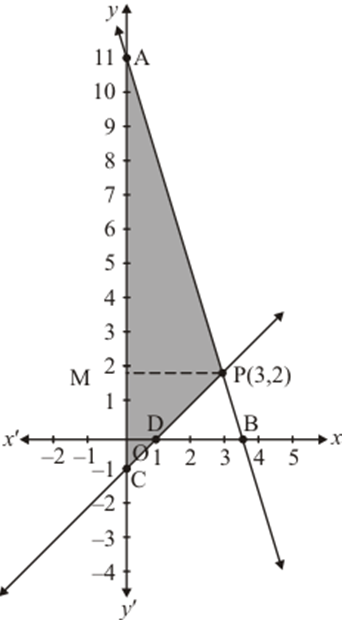
Shade the region bounded by these lines and y-axis. Also, find the area of the region bounded by these lines and y-axis.
Answer
The given equations are, 3x + y - 11 = 0 ......(i) x - y - 1 = 0 ........(ii) Putting x = 0 in equations (i), we get, ⇒ 3 × 0 + y = 11 ⇒ y = 11 ⇒ x = 0, y = 11 Putting y = 0 in equations (i), we get, ⇒ 3x + 0 = 11 $\Rightarrow\text{x}=\frac{11}{3}$ $\Rightarrow\text{x}=\frac{11}{3},\ \text{y}=0$ Use the following table to draw the graph.
x
0
$\frac{11}{3}$
y
11
0
Draw the graph by plotting the two points from table. x - y = 1 ......(ii) Putting x = 0 in equation (ii), we get, ⇒ 0 - y = 1 ⇒ y = -1 ⇒ x = 0, y = -1 Putting y = 0 in equation (ii), we get, ⇒ x - 0 = 1 ⇒ x = 1 ⇒ x = 1, y = 0 Use the following table to draw the graph.
x
0
1
y
-1
0
Draw the graph by plotting the two points from table. The two lines intersect at P(3, 2). Hence x = 3, y = 2 is the solution of the given equations. The area enclosed by the lines represented by the given equations and the y−axis is shaded region in the, Now, Required area = Area of shaded region ⇒ Required area = Area of PAC ⇒ Required area $=\frac{1}{2}$ (base × height) ⇒ Required area $=\frac{1}{2}$ (AC × PM) ⇒ Required area $=\frac{1}{2}$ (12 × 3) sq. units ⇒ Required area $=\frac{1}{2}$ (36) ⇒ Required area = 18 Hence the required area is 18 sq. unit.
View full question & answer
Question 2064 Marks
Solve the following systems of equations:
$\frac{1}{5\text{x}}+\frac{1}{6\text{y}}=12,$
$\frac{1}{3\text{x}}-\frac{3}{7\text{y}}=8,\text{x}\neq0,\text{y}\neq0.$
Answer
Taking $\frac{1}{\text{x}}=\text{u}$ and $\frac{1}{\text{y}}=\text{v},$ the given equations become
$\frac{\text{u}}{5}+\frac{\text{v}}{6}=12$
$\Rightarrow\frac{6\text{u}+5\text{v}}{30}=12$
$\Rightarrow6\text{u}+5\text{v}=360\ ....(\text{i})$
And, $\frac{\text{u}}{3}-\frac{3\text{v}}{7}=8$
$\Rightarrow\frac{7\text{u}-9\text{v}}{21}=8$
$\Rightarrow7\text{u}-9\text{v}=168\ .......(\text{ii})$
Let us eliminate 'v' from equation (i) and (ii), multiolying equation (i) by 9 and equation (ii) by 5, we get
$54\text{u}+45\text{v}=3240\ .....(\text{iii})$
$35\text{u}-45\text{u}=840\ ......(\text{iv})$
Adding equation (i) adding equation (ii), we get
$54\text{u}+35\text{u}=3240+840$
$\Rightarrow89\text{u}=4080$
$\Rightarrow\text{u}=\frac{4080}{89}$
Putting $\text{u}=\frac{4080}{89}$ in equation (i), we get
$6\times\frac{4080}{89}+5\text{v}=360$
$\Rightarrow\frac{24480}{89}+5\text{v}=360$
$\Rightarrow5\text{v}=360-\frac{24480}{89}$
$\Rightarrow5\text{v}=\frac{32040-24480}{89}$
$\Rightarrow5\text{v}=\frac{7560}{89}$
$\Rightarrow\text{v}=\frac{7560}{5\times89}$
$\Rightarrow\text{v}=\frac{1512}{89}$
Hence, $\text{x}=\frac{1}{\text{u}}=\frac{89}{4080}$ and $\text{y}=\frac{1}{\text{v}}=\frac{89}{1512}$
So, the solution of the given system of equation is $\text{x}=\frac{89}{4080},\ \text{y}=\frac{89}{1512}.$
View full question & answer
Question 2074 Marks
Solve the following systems of equations:
$7\text{x}-\frac{2\text{y}}{\text{xy}}=5,$
$8\text{x}+\frac{7\text{y}}{\text{xy}}=15.$
Answer
$\frac{7\text{x}-2\text{y}}{\text{xy}}=5$$\Rightarrow\ \frac{7\text{x}}{\text{xy}}-\frac{2\text{y}}{\text{xy}}=5$
$\Rightarrow\ \frac{7}{\text{y}}-\frac{2}{\text{x}}=5\dots(\text{i})$
$\frac{ 8\text{x}+7\text{y}}{\text{xy}}=15$
$\frac{8\text{x}+7\text{y}}{\text{xy}}=15$
$\Rightarrow\frac{8\text{x}}{\text{xy}}+\frac{7\text{y}}{\text{xy}}=15$
$\Rightarrow\ \frac{8}{\text{y}}+\frac{7}{\text{x}}=15\dots(\text{ii})$
Putting $\frac{1}{\text{x}} =\text{p}$ and $\frac{1}{\text{y}} =\text{q}$ in (i) and (ii) we get,
7q - 2p = 5...(iii)
8q + 7p = 15 ...(iv)
Multiplying equation (iii) by 7 and multiplying equation (iv) by 2 we get,
49q - 14p = 35 ...(v)
16q + 14p = 30..(vi)
Now. adding equation (v) and (vi) we get,
49q - 14p + 16q + 14p = 35 + 30
$\Rightarrow\ 65\text{q}=65$
$\Rightarrow\ \text{q}=1$
Putting the value of q in equation (iv)
8 + 7p = 15
7p = 15 - 8
$\Rightarrow7\text{p}=7$
$\Rightarrow\ \text{p}=1$
Now,
$\text{p}=\frac{1}{\text{x}}=1$
$\Rightarrow\frac{1}{\text{x}}=1$
$\Rightarrow\text{x}=1$
also, $\text{q}=1 =\frac{1}{\text{y}}$
$\Rightarrow\ \frac{1}{\text{y}}=1$
$\Rightarrow\ \text{y}=1$
Hence, x = 1 and y = 1 is the solution.
View full question & answer
Question 2084 Marks
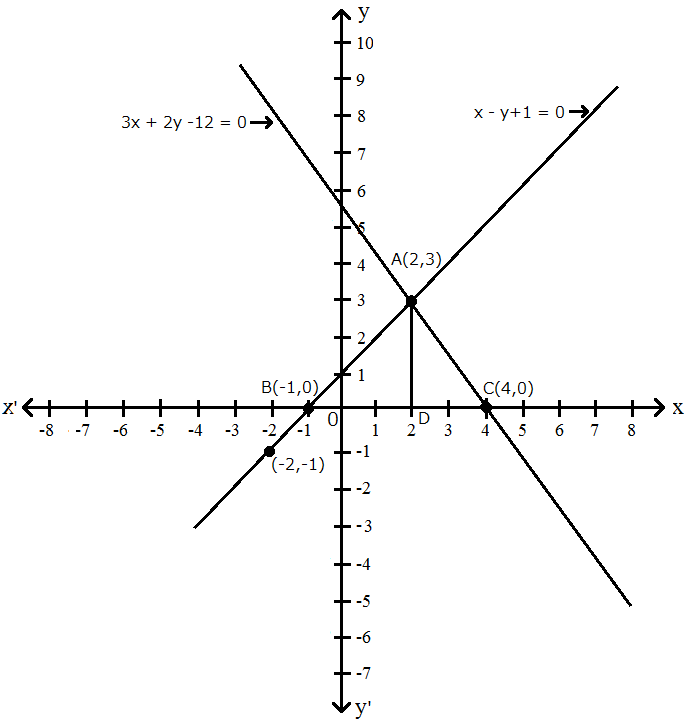
Draw the graphs of x - y + 1 = 0 and 3x + 2y - 12 = 0. Determine the coordinates of the vertices of the triangle formed by these lines and x-axis and shade the triangular area. Calculate the area bounded by these lines and x-axis.
Answer
The given system of equations is
x - y + 1 = 0
3x + 2y - 12 = 0
Now, x - y + 1 = 0
⇒ x = y - 1
When y = 3, we have
x = 3 - 1 = 2
When y = -1, we have
x = -1 - 1 = -2
Thus, we have the following table,
x
2
-2
y
3
-1
We have
⇒ 3x + 2y - 12 = 0
⇒ 3x = 12 - 2y
$\Rightarrow\text{x}=\frac{12-2\text{y}}{3}$
When y = 6, we have
$\text{x}=\frac{12-2\times6}{3}=0$
When y = 3, we have
$\text{x}=\frac{12-2\times3}{3}=2$
Thus, we have the following table,
x
0
2
y
6
3
Graph of the given system of equations.

Clearly, the two lines intersect at A(2, 3). We also observe that lines represented by the equations. x - y + 1 = 0 and 3x + 2y - 12 = 0 meet x-axis at B(-1, 0) and C(4, 0) respectively. Thus, x = 2, y = 3 is the solution of the given system of equations. Draw AD per perpendicular from A on x- axis. Clearly, we have AD = y-coordinate of point A(2, 3),
AD = 3 and BC = 4 - (-1) = 4 + 1 = 5.
View full question & answer
Question 2094 Marks
The ages of two friends Ani and Biju differ by 3 years. Ani's father Dharma is twice as old as Ani and Biju as twice as old as his sister Cathy. The ages of Cathy and Dharam differ by 30 years. Find the ages of Ani and Biju.
Answer
Let the present ages of Ani, Biju, Dharam and Cathy be x, y, z and t years respectively.
The ages of Ani and Biju differ by 3 years. Thus, we have
$\text{x}-\text{y}=\pm3$
$\Rightarrow\text{x}=\text{y}\pm3$
Dharam is twice as old as Ani. Thus, we have z = 2x
Biju is twice as old as Cathy. Thus, we have y = 2t
The ages of Cathy and Dharam differ by 30 years. Clearly, Dharam is older than Cathy.
Thus, we have z - t = 30
So, we have two systems of simultaneous equations
x = y + 3 .....(i)
z = 2x
y = 2t
z - t = 30
x = y - 3 ......(ii)
z = 2x
y = 2t
z - t = 30
Here x, y, z and t are unknowns. We have to find the value of x and y.
eq. (i) by using the third equation, the first equation becomes x = 2t + 3
From the fourth equation, we have
t = z - 30
Hence, we have
x = 2(z - 30) + 3
= 2z - 60 + 3
= 2z - 57
Using the second equation, we have
x = 2 × 2x - 57
⇒ x = 4x - 57
⇒ 4x - x = 57
⇒ 3x = 57
$\Rightarrow\text{x}=\frac{57}{3}$
⇒ x = 19
From the first equation we have
x = y + 3
⇒ y = x - 3
⇒ y = 19 - 3
⇒ y = 16
Hence, the age of Ani is 19 years and the age of Biju is 16 years.
By using the third equation the first equation becomes x = 2t - 3
From the fourth equation we have
t = z - 30
Hence, we have
x = 2(z - 30) - 3
= 2z - 60 - 3
= 2z - 60 - 3
= 2z - 63
Using the second equation, we have
x = 2 × 2x - 63
⇒ x = 4x - 63
⇒ 4x - x = 63
$\Rightarrow\text{x}=\frac{63}{3}$
⇒ x = 21
From the first equation we have
x = y - 3
⇒ y = x + 3
⇒ y = 21 + 3
⇒ y = 24
Hence, the age of Ani is 21 years and the age of Biju is 24 years.
Note: that there are two possibilites.
View full question & answer