Question 14 Marks
Let’s draw graphs of x + y = 4, 2x - y = 2 and observe them
Question 24 Marks
Draw graph of 2x - y = 4.
Question 34 Marks
A three digit number is equal to 17 times the sum of its digits; If the digits are reversed, the new number is 198 more than the old number ; also the sum of extreme digits is less than the middle digit by unity. Find the original number.
Question 44 Marks
View full question & answer→Question 54 Marks
View full question & answer→Question 64 Marks
The perimeter of a rectangle is 40 cm. The length of the rectangle is
more than double its breadth by 2. Find length and breadth.
Question 74 Marks
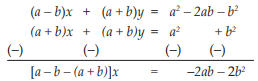
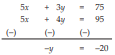
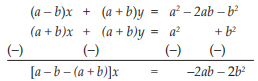
Solve : $(a-b) x+(a+b) y=a^2-2 a b-b^2$ and $(a+b)(x+y)=a^2+b^2$
View full question & answer→Question 84 Marks
A train covered a certain distance at a uniform speed. If the train would have been $6 \ km/hr$ faster, it would have taken $4$ hours less than the schedule time. And, if train were slower by $6 \ km/hr,$ it would have taken $6$ hours more than the schedule time. Find the length of the journey.
AnswerLet the original speed of train be $x \ km/hr$ and the actual time taken be $y$ hours.
Then, distance $=$ speed $\times$ time
$=(x y) \ km$
According to the first condition,
$(x+6)(y-4)=x y$
$\therefore x y-4 x+6 y-24=x y$
$\therefore-4 x+6 y=24$
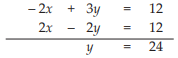
$\therefore-2 x+3 y=12 ...(i)$
According to the second condition,
$(x-6)(y+6)=x y$
$\therefore x y+6 x-6 y-36=x y$
$\therefore 6 x-6 y=36$
$\therefore x-y=6 ...(ii)$
Multiplying $(ii)$ by $2,$ we get,
$2 x-2 y=12 ...(iii)$
Adding equations $(i)$ and $(iii)$ we get,
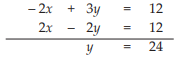
Substituting the value of $y$ in equation $(i)$ we get,
$x-24=6$
$\therefore x=6+24$
$\therefore x=30$
$\therefore$ The original speed $= 30 \ km/hr$ and time $= 24$ hours.
Hence, length of the journey $=$ speed $\times$ time
$=30 \times 24$
$=720 \ km$
$\therefore$ Length of the journey is $720 \ km.$ View full question & answer→Question 94 Marks
The sum of the digits of a number consisting of three digits is 12. The middle digit is equal to half of the sum of the other two. If the order of the digit be reversed, the number diminished by 198. Find the number.
Answer| Digits | H | T | U |
Original
number | x | $\frac{1}{2}(x+y)$ | y |
Reversed
number | y | $\frac{1}{2}(y+x)$ | x |
Let the digit in the hundredth place be x and the digit in the units place be y.
$\therefore$ The middle digit $=\frac{1}{2}(x+y)$
The sum of the digits is 12. (Given)
$\therefore x+\frac{1}{2}(x+y)+y=12$
$\therefore \quad 2 x+x+y+2 y=24$
$\therefore \quad 3 x+3 y=24$
$\therefore \quad x+y=8$... (i)
The original number $=100 x+10 \times \frac{1}{2}(x+y)+y$
$=100 x+5(x+y)+y$
$=100 x+5 x+5 y+y$
$=105 x+6 y$
The reversed number $=100 y+10 \times \frac{1}{2}(y+x)+x$
$=100 y+5(y+x)+x$
$=100 y+5 y+5 x+x$
$=6 x+105 y$
Now,
Reversed number = Original number – 198 (Given)
$\therefore \quad 6 x+105 y=105 x+6 y-198$
$\therefore 6 x-105 x+105 y-6 y=-198$
$\therefore \quad-99 x+99 y=-198$
$\therefore \quad x-y=2$ ....(ii)
Adding (i) and (ii), we get,
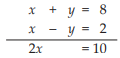
$\therefore$ $x=5$
Substituting $x=5$ in (i),
$5+y=8$
$\therefore \quad y=8-5$
$\therefore \quad y=3$
$\therefore$ The required number $=105 x+6 y$
$=105 \times 5+6 \times 3$
= 525 + 18
= 543
$\therefore$ The required number is 543 View full question & answer→Question 104 Marks
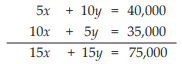
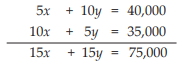
A person deposits ₹ $x$ in savings bank account at the rate of $5 \%$ per annum and ₹ y in fixed deposit at $10 \%$ per annum. At the end of one year, he gets ₹ 400 as total interest. If he deposits ₹ y in savings bank account and ₹ $x$ in fixed deposit, he would get ₹ 350 as total interest. Find the total amount he deposited.
View full question & answer→Question 114 Marks
Solve: $2^x+3^y=17,2^{x+2}-3^{y+1}=5$
Answer$2^x+3^y=17...(i)$
$2^{x+2}-3^{y+1}=5$
$\therefore \quad 2^x \cdot 2^2-3^y \cdot 3^1=5$
$\therefore \quad 4.2^x-3.3^y=5 ...(ii)$
Substituting $2^x=m$ and $3^y=n$, we get,
$m+n=17...(iii)$
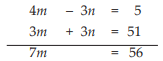
$4 m-3 n=5...(iv)$
Multiplying eq. $(iii)$ by $3,$
$ 3m + 3n = 51...(v)$
Adding $(iv)$ and $(v)$ we get,
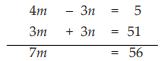
$\therefore \quad m=\frac{56}{7}$
$\therefore \quad m=8$
Substituting $m=8$ in $(iii),$
$8+n=17$
$\therefore \quad n=17-8$
$\therefore \quad n=9$
Resubstituting the value of $m$ and $n$, we get,
$ m=2^x$
$\therefore 8=2^x$
$\therefore 2^3=2^x$
$\therefore x=3$
$n=3^y$
$9=3^y$
$3^2=3^y$
$y=2$
$\therefore x=3$ and $y=2$ is the solution. View full question & answer→Question 124 Marks
Find the area of the triangle formed by the following lines and X axis.
$4 x-3 y+4=0$ and $4 x+3 y-20=0$
Answer$4 x-3 y+4=0 \quad \therefore y=\frac{4 x+4}{3}$| x | 2 | 5 | -4 |
| y | 4 | 8 | -4 |
| (x, y) | (2, 4) | (5, 8) | (-4, -4) |
$4 x+3 y-20=0 \quad \therefore y=\frac{20-4 x}{3}$| x | 2 | -1 | 5 |
| y | 4 | 8 | 0 |
| (x, y) | (2, 4) | (-1, 8) | (5, 0) |
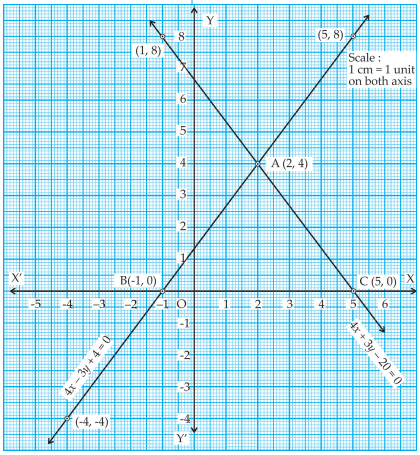
For $\triangle ABC , A (2,4), B (-1,0)$ and $C(5,0)$
$\therefore A (\triangle ABC )=\frac{1}{2} \times b \times h$
$=\frac{1}{2} \times 6 \times 4$
$\therefore$ $A(\triangle A B C)=12$ sq. units View full question & answer→Question 134 Marks
The forewheel of a carriage makes $6$ revolutions more than the rearwheel in going $120 m$ . If the diameter of the forewheel be increased by $\frac{1}{4}$ its present diameter and the diameter of the rearwheel be increased by $\frac{1}{5}$ of its present diameter, then the forewheel makes $4$ revolutions more than the rearwheel in going the same distance. Find the circumference of each wheel of the carriage.
AnswerLet the circumference of the forewheel be $x m$ and circumference of rearwheel be $y m$.
Number of revolutions $=\frac{\text { Distance covered }}{\text { circumference }}$
$\therefore $ Distance covered by each wheel $=120 m$
$\therefore $ Number of revolutions made by forewheel $=\frac{120}{x}$
$\therefore $ Number of revolutions made by rearwheel $=\frac{120}{y}$
According to the first condition,
$\frac{120}{x}=\frac{120}{y}+6$
$\therefore \frac{120}{x}-\frac{120}{y}=6$
$\therefore \frac{20}{x}-\frac{20}{y}=1 ...(i)$
Now, $c=\pi d$
$\therefore $ As diameter increases, circumference also increases.
Increase in circumference of forewheel $=\frac{x}{4}$
New circumference of forewheel $=x+\frac{x}{4}$
$=\frac{4 x+x}{4}$
$=\left(\frac{5 x}{4}\right) m $
New circumference of rearwheel $=y+\frac{y}{5}$
$=\frac{5 y+y}{5}$
$=\left(\frac{6 y}{5}\right) m $
According to the second condition,
$\frac{120}{5 x / 4}=\frac{120}{6 y / 5}+4$
$\therefore \frac{120 \times 4}{5 x}=\frac{120 \times 5}{6 y}+4$
$\therefore \frac{96}{x}=\frac{100}{y}+4$
$\therefore \frac{96}{x}-\frac{100}{y}=4 ...(ii)$
Substituting $\frac{1}{x}=a$ and $\frac{1}{y}=b$, we get,
$20a – 20b = 1 ...(iii)$
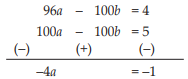
$96a – 100b = 4...(iv)$
Multiplying equation $(iii)$ by $5,$ we get
$100a – 100b = 5 ...(v)$
Subtracting $(v)$ from $(iv),$
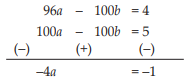
$\therefore a=\frac{1}{4}$
Substituting value of $a=\frac{1}{4}$ in $(iii),$ we get
$20 \times \frac{1}{4}-20 b=1$
$\therefore 5-20 b=1$
$\therefore 5-1=20 b$
$\therefore 4=20 b$
$\therefore b=\frac{4}{20}$
$\therefore b=\frac{1}{5}$
Resubstituting the values of $a$ and $b,$
$a=\frac{1}{x}=\frac{1}{4}$ and $b=\frac{1}{y}=\frac{1}{5}$
$\therefore x=4$ and $y=5$
$\therefore$Circumference of forewheel is $4 m$ and circumference of rearwheel is $5 m$. View full question & answer→Question 144 Marks
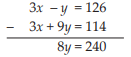
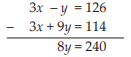
When the son will be as old as his father today, the sum of their ages then will be 126; when the
father was as old as his son is today, the sum of
their ages then was 38. Find their present ages.
Question 154 Marks
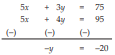
Abdul travelled 300 km by train and 200 km by taxi, it took him 5 hours 30 minutes. But if he travels 260 km by train and 240 km by taxi, he takes 6 minutes longer. Find the speed of the
train and that of the taxi.
AnswerLet the speed of the train be x km/hr and speed of the taxi be y km/hr.
Time $=\frac{\text { Distance }}{\text { Speed }}$
Time taken to cover 300 km by train $=\frac{300}{x}$ hrs.
Time taken to cover 200 km by taxi $=\frac{200}{y}$ hrs.
According to the first condition,
$\frac{300}{x}+\frac{200}{y}=5 \frac{30}{60}$ [ 1 hour $=60 min$.]
$\therefore \quad \frac{300}{x}+\frac{200}{y}=\frac{11}{2}$ ...(i)
Similarly,
Time taken to cover 260 km by train $=\frac{260}{x} hrs$.
Time taken to cover 240 km by taxi $=\frac{240}{y}$ hrs.
According to the second condition,
$\frac{260}{x}+\frac{240}{y}=5 \frac{36}{60}$
$\therefore \quad \frac{260}{x}+\frac{240}{y}=\frac{28}{5}$ ...(ii)
Substituting $\frac{1}{x}=m$ and $\frac{1}{y}=n$ in equations (i) and (ii),
$300 m+200 n=\frac{11}{2}$
i.e. $600 m+400 n=11$ ...(iii)
Similarly, $260 m+240 n=\frac{28}{5}$
i.e. $1300 m+1200 n=28$...(iv)
Multiplying eq. (iii) by 3 ,
$1800 m+1200 n=33$ ...(v)
Subtracting (iv) from (v),
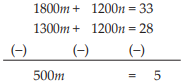
$\therefore \quad m=\frac{5}{500}$
$\therefore \quad m=\frac{1}{100}$
Substituting value of m in equation (iii) we get,
$600 \times \frac{1}{100}+400 n=11$
$\therefore \quad 6+400 n=11$
$\therefore \quad 400 n=11-6$
$\therefore \quad 400 n=5$
$\therefore \quad n=\frac{5}{400}$
$\therefore \quad n=\frac{1}{80}$
Resubstituting the values of $m$ and $n$,
$\frac{1}{x}=\frac{1}{100}$ and $\frac{1}{y}=\frac{1}{80}$
$\therefore x=100$ and $y=80$
The speed of the train is $100 km / hr$ and the speed of the taxi is $80 km / hr$. View full question & answer→Question 164 Marks
The weight of a bucket is 15 kg , when it is filled with water upto $\frac{3}{5}$ of its capacity. And the weight is 19 kg , if it is filled with water upto $\frac{4}{5}$ of its capacity. Find the weight of bucket, if it is completely filled with water.
View full question & answer→Question 174 Marks
$4 x-y=-5 ; 2 x-y=-1$
View full question & answer→Question 184 Marks
$x+2 y=5 ; 2 x+y=-2$
View full question & answer→Question 194 Marks
$x+3 y=7 ; 2 x+y=-1$
View full question & answer→Question 204 Marks
$3 x+4 y=-5 ; x-y=-4$
View full question & answer→Question 214 Marks
$x+y=8 ; x-y=2$
View full question & answer→Question 224 Marks
A man travels 370 km partly by train and partly by car. If he covers 250 km by train and the rest by car, it takes him 4 hours. But, If he travels 130 km by train and the rest by car, he takes 18 minutes longer. Find the speed of the train and that of the car.
Answer$100 km / hr$ and $80 km / hr$
View full question & answer→Question 234 Marks
$\frac{5}{x-1}+\frac{1}{y-2}=2 ; \frac{6}{x-1}-\frac{3}{y-2}=1$
View full question & answer→Question 244 Marks
$\frac{14}{x+y}+\frac{3}{x-y}=5 ; \frac{21}{x+y}-\frac{2}{x-y}=1$
View full question & answer→Question 254 Marks
$\frac{7}{2 x+1}+\frac{13}{y+2}=27 ; \frac{13}{2 x+1}+\frac{7}{y+2}=33$
Answer$x=\frac{-1}{4}, y=-1$
View full question & answer→Question 264 Marks
$\frac{4}{x}+\frac{3}{y}=1 ; \frac{8}{x}-\frac{9}{y}=7$
View full question & answer→Question 274 Marks
$4 x+3 y=4 ; 6 x+5 y=8$
View full question & answer→Question 284 Marks
$3 x+y=1 ; 2 x=11 y+3$
Answer$x=\frac{2}{5}, y=\frac{-1}{5}$,
View full question & answer→Question 294 Marks
$3 x-y=7 ; x+4 y=11$
View full question & answer→Question 304 Marks
$x+2 y+4=0 ; 3 x=-4 y-16$
View full question & answer→Question 314 Marks
$3 x-2 y=3 ; 2 x+y=16$
View full question & answer→Question 324 Marks
Let’s draw graphs of x + y = 4, 2x - y = 2 and observe them
Question 334 Marks
Draw graph of 2x - y = 4.
Question 344 Marks
A three digit number is equal to 17 times the sum of its digits; If the digits are reversed, the new number is 198 more than the old number ; also the sum of extreme digits is less than the middle digit by unity. Find the original number.
AnswerLet the digit in hundreds place be x and that in unit place be y.$\therefore$ the three digit number is $100 x+10(x+y+1)+y$
$=100 x+10 x+10 y+10+y=110 x+11 y+10$
the sum of the digits in the given number $=x+(x+y+1)+y=2 x+2 y+1$
$\therefore$ From first condition
$\begin{aligned}
& \text { Given number }=17 \times(\text { sum of the digits }) \\
& \therefore 110 x+11 y+10=17 \times(2 x+2 y+1) \\
& \therefore 110 x+11 y+10=34 x+34 y+17 \\
& \therefore 76 x-23 y=7 \ldots \text { (I) }
\end{aligned}$
The number obtained by reversing the digits
$\begin{aligned}
& =100 y+10(x+y+1)+x=110 y+11 x+10 \\
& \text { Given number }=110 x+11 y+10
\end{aligned}$
From $2^{\text {nd }}$ condition, Given number $+198=$ new number.
$\begin{aligned}
& 110 x+11 y+10+198=110 y+11 x+10 \\
& 99 x-99 y=-198 \\
& \quad x-y=-2 \\
& \therefore x=y-2 \ldots \text { (II) }
\end{aligned}$
Substitute this value of $x$ in equation (I).
$\begin{gathered}
\therefore 76(y-2)-23 y=7 \\
\therefore 76 y-152-23 y=7 \\
53 y=159
\end{gathered}$
$\therefore \quad y=3 \quad \therefore$ the digit in units place is $=3$
Substitute this value in equation (II)
$\begin{aligned}
& \quad x=y-2 \\
& \therefore \quad x=3-2=1 \\
& \therefore \quad x=1
\end{aligned}$
$\therefore \quad x=1 \quad \therefore \text { The digit in hundred's place is } 1$
the digit in ten's place is $3+1+1=5$
$\therefore$ the number is 153 .
View full question & answer→Question 354 Marks
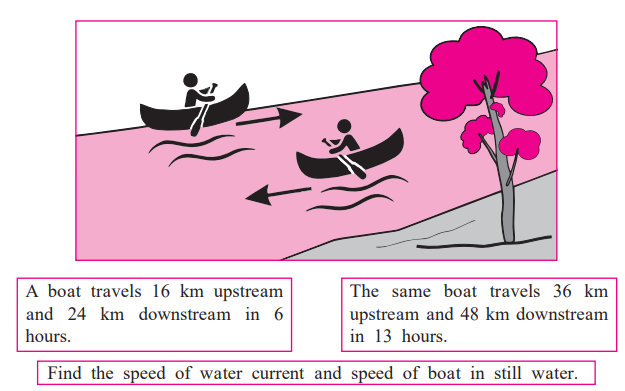
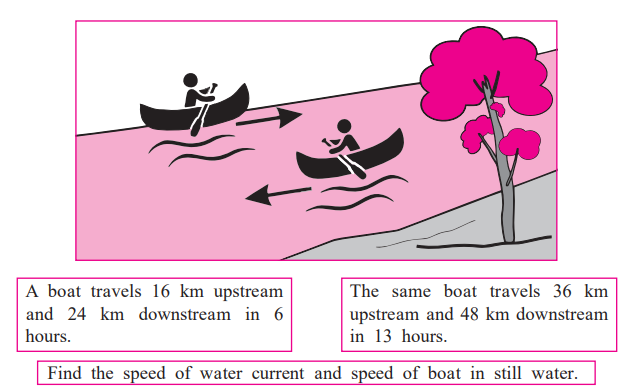
AnswerLet the speed of the boat in still water be $x km / hr$ and the speed of water current be $y km / hr$
$\therefore$ speed of boat in downstream $=(x+y) km / hr$. and that in upstream $=(x-y) km / hr$.
Now distance $=$ speed $\times$ time
$\therefore \text { time }=\frac{\text { distance }}{\text { speed }}$
Time taken by the boat to travel $16 km$ upstream $=\frac{16}{x-y}$ hours and it takes $\frac{24}{x+y}$ hours to travel $24 km$ downstream.
from first condition -
$\frac{16}{x-y}+\frac{24}{x+y}=6 \ldots (I)$
from $2^{\text {nd }}$ condition
$\frac{36}{x-y}+\frac{48}{x+y}=13 \ldots (II)$
By replacing $\frac{1}{x-y}$ by $m$ and $\frac{1}{x+y}$ by $n$ we get
$\begin{aligned}
& 16 m+24 n=6 \ldots \text { (III) } \\
& 36 m+48 n=13 \ldots \text { (IV) }
\end{aligned}$
Solving equations (III) and (IV) $m=\frac{1}{4}, n=\frac{1}{12}$
Repalcing $m, n$ by their original values we get
$x-y=4 \ldots \text { (V) } x+y=12 \ldots \text { (VI) }$
Solving equations (V), (VI) we get $x=8, y=4$
$\therefore$ speed of the boat in still water is $8 km / hr$. and speed of water current is $4 km / hr$.
View full question & answer→Question 364 Marks
View full question & answer→Question 374 Marks
The perimeter of a rectangle is 40 cm. The length of the rectangle is
more than double its breadth by 2. Find length and breadth.
AnswerLet length of rectangle be $x cm$ and breadth be $y cm$.
From first condition -
$\begin{aligned}
2(x+y) & =40 \\
x+y & =20 \ldots(1)
\end{aligned}$
From $2^{\text {nd }}$ condition -
$\begin{gathered}
x=2 y+2 \\
\therefore x-2 y=2 \ldots(2)
\end{gathered}$
Let's solve eq. (I), (II) by determinant method
$\begin{aligned}
& \quad \begin{aligned}
x+y=20 \\
x-2 y=2
\end{aligned} \\
& D =\left|\begin{array}{rr}
1 & 1 \\
1 & -2
\end{array}\right|=[1 \times(-2)]-(1 \times 1)=-2-1=-3 \\
& D _x=\left|\begin{array}{rr}
20 & 1 \\
2 & -2
\end{array}\right|=[20 \times(-2)]-(1 \times 2)=-40-2=-42 \\
& D _y=\left|\begin{array}{rr}
1 & 20 \\
1 & 2
\end{array}\right|=(1 \times 2)-(20 \times 1)=2-20=-18 \\
& x=\frac{ D _x}{ D } \text { and } y=\frac{ D _y}{ D } \\
& \therefore x=\frac{-42}{-3} \text { and } y=\frac{-18}{-3} \\
& \therefore x=14, \quad y=6
\end{aligned}$
$\therefore$ Length of the rectangle is $14 cm$ and breadth is $6 cm$.
View full question & answer→Question 384 Marks
Solve: $x+y=8 ; x-y=2$
View full question & answer→Question 394 Marks
Solve: $x+3 y=7 ; 2 x+y=-1$
View full question & answer→Question 404 Marks
Solve: $x+2 y=5 ; 2 x+y=-2$
View full question & answer→Question 414 Marks
Solve: $x+2 y+4=0 ; 3 x=-4 y-16$
View full question & answer→Question 424 Marks
When the son will be as old as his father today, the sum of their ages then will be 126; when the
father was as old as his son is today, the sum of
their ages then was 38. Find their present ages.
Question 434 Marks
The weight of a bucket is 15 kg , when it is filled with water upto $\frac{3}{5}$ of its capacity. And the weight is 19 kg , if it is filled with water upto $\frac{4}{5}$ of its capacity. Find the weight of bucket, if it is completely filled with water.
View full question & answer→Question 444 Marks
The sum of the digits of a number consisting of three digits is 12. The middle digit is equal to half of the sum of the other two. If the order of the digit be reversed, the number diminished by 198. Find the number.
Answer| Digits | H | T | U |
Original
number | x | $\frac{1}{2}(x+y)$ | y |
Reversed
number | y | $\frac{1}{2}(y+x)$ | x |
Let the digit in the hundredth place be x and the digit in the units place be y.
$\therefore$ The middle digit $=\frac{1}{2}(x+y)$
The sum of the digits is 12. (Given)
$\therefore x+\frac{1}{2}(x+y)+y=12$
$\therefore \quad 2 x+x+y+2 y=24$
$\therefore \quad 3 x+3 y=24$
$\therefore \quad x+y=8$... (i)
The original number $=100 x+10 \times \frac{1}{2}(x+y)+y$
$=100 x+5(x+y)+y$
$=100 x+5 x+5 y+y$
$=105 x+6 y$
The reversed number $=100 y+10 \times \frac{1}{2}(y+x)+x$
$=100 y+5(y+x)+x$
$=100 y+5 y+5 x+x$
$=6 x+105 y$
Now,
Reversed number = Original number – 198 (Given)
$\therefore \quad 6 x+105 y=105 x+6 y-198$
$\therefore 6 x-105 x+105 y-6 y=-198$
$\therefore \quad-99 x+99 y=-198$
$\therefore \quad x-y=2$ ....(ii)
Adding (i) and (ii), we get,
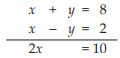
$\therefore$ $x=5$
Substituting $x=5$ in (i),
$5+y=8$
$\therefore \quad y=8-5$
$\therefore \quad y=3$
$\therefore$ The required number $=105 x+6 y$
$=105 \times 5+6 \times 3$
= 525 + 18
= 543
$\therefore$ The required number is 543 View full question & answer→Question 454 Marks
The forewheel of a carriage makes 6 revolutions more than the rearwheel in going 120 m . If the diameter of the forewheel be increased by $\frac{1}{4}$ its present diameter and the diameter of the rearwheel be increased by $\frac{1}{5}$ of its present diameter, then the forewheel makes 4 revolutions more than the rearwheel in going the same distance. Find the circumference of each wheel of the carriage.
AnswerLet the circumference of the forewheel be x m and circumference of rearwheel be y m.
Number of revolutions $=\frac{\text { Distance covered }}{\text { circumference }}$
$\therefore \quad$ Distance covered by each wheel $=120 m$
$\therefore \quad$ Number of revolutions made by forewheel $=\frac{120}{x}$
$\therefore \quad$ Number of revolutions made by rearwheel $=\frac{120}{y}$
According to the first condition,
$\frac{120}{x}=\frac{120}{y}+6$
$\therefore \quad \frac{120}{x}-\frac{120}{y}=6$
$\therefore \quad \frac{20}{x}-\frac{20}{y}=1$ ...(i)
Now, $c=\pi d$
$\therefore \quad$ As diameter increases, circumference also increases.
Increase in circumference of forewheel $=\frac{x}{4}$
New circumference of forewheel $=x+\frac{x}{4}$
$\begin{array}{l}=\frac{4 x+x}{4} \\ =\left(\frac{5 x}{4}\right) m \end{array}$
New circumference of rearwheel $=y+\frac{y}{5}$
$\begin{array}{l}=\frac{5 y+y}{5} \\ =\left(\frac{6 y}{5}\right) m \end{array}$
According to the second condition,
$\frac{120}{5 x / 4}=\frac{120}{6 y / 5}+4$
$\therefore \quad \frac{120 \times 4}{5 x}=\frac{120 \times 5}{6 y}+4$
$\therefore \quad \frac{96}{x}=\frac{100}{y}+4$
$\therefore \quad \frac{96}{x}-\frac{100}{y}=4$ ...(ii)
Substituting $\frac{1}{x}=a$ and $\frac{1}{y}=b$, we get,
20a – 20b = 1 ...(iii)
96a – 100b = 4...(iv)
Multiplying equation (iii) by 5, we get
100a – 100b = 5 ...(v)
Subtracting (v) from (iv),
$\therefore \quad a=\frac{1}{4}$
Substituting value of $a=\frac{1}{4}$ in (iii), we get
$20 \times \frac{1}{4}-20 b=1$
$\therefore 5-20 b=1$
$\therefore \quad 5-1=20 b$
$\therefore \quad 4=20 b$
$\therefore \quad b=\frac{4}{20}$
$\therefore \quad b=\frac{1}{5}$
Resubstituting the values of a and b,
$a=\frac{1}{x}=\frac{1}{4}$ and $b=\frac{1}{y}=\frac{1}{5}$
$\therefore \quad x=4$ and $y=5$
$\therefore$Circumference of forewheel is 4 m and circumference of rearwheel is 5 m. View full question & answer→Question 464 Marks
Solve : $(a-b) x+(a+b) y=a^2-2 a b-b^2$ and $(a+b)(x+y)=a^2+b^2$
View full question & answer→Question 474 Marks
Solve: $2^x+3^y=17,2^{x+2}-3^{y+1}=5$
View full question & answer→Question 484 Marks
Solve : $\frac{7}{2 x+1}+\frac{13}{y+2}=27 ; \frac{13}{2 x+1}+\frac{7}{y+2}=33$
Answer$x=\frac{-1}{4}, y=-1$
View full question & answer→Question 494 Marks
Solve : $\frac{5}{x-1}+\frac{1}{y-2}=2 ; \frac{6}{x-1}-\frac{3}{y-2}=1$
View full question & answer→Question 504 Marks
Solve : $\frac{4}{x}+\frac{3}{y}=1 ; \frac{8}{x}-\frac{9}{y}=7$
View full question & answer→Question 514 Marks
Solve : $\frac{14}{x+y}+\frac{3}{x-y}=5 ; \frac{21}{x+y}-\frac{2}{x-y}=1$
View full question & answer→Question 524 Marks
Find the area of the triangle formed by the following lines and X axis.
$4 x-3 y+4=0$ and $4 x+3 y-20=0$
Answer$4 x-3 y+4=0 \quad \therefore y=\frac{4 x+4}{3}$| x | 2 | 5 | -4 |
| y | 4 | 8 | -4 |
| (x, y) | (2, 4) | (5, 8) | (-4, -4) |
$4 x+3 y-20=0 \quad \therefore y=\frac{20-4 x}{3}$| x | 2 | -1 | 5 |
| y | 4 | 8 | 0 |
| (x, y) | (2, 4) | (-1, 8) | (5, 0) |
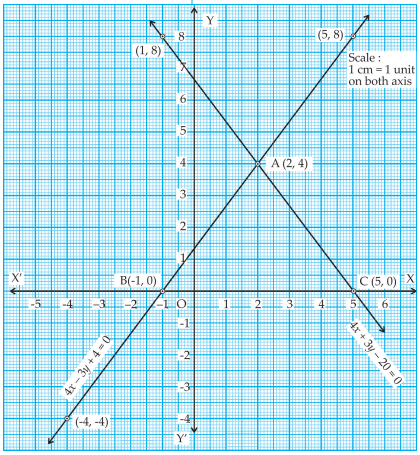
For $\triangle ABC , A (2,4), B (-1,0)$ and $C(5,0)$
$\therefore A (\triangle ABC )=\frac{1}{2} \times b \times h$
$=\frac{1}{2} \times 6 \times 4$
$\therefore$ $A(\triangle A B C)=12$ sq. units View full question & answer→Question 534 Marks
A train covered a certain distance at a uniform speed. If the train would have been 6 km/hr faster, it would have taken 4 hours less than the schedule time. And, if train were slower by 6 km/hr, it would have taken 6 hours more than the schedule time. Find the length of the journey.
Question 544 Marks
A person deposits ₹ $x$ in savings bank account at the rate of $5 \%$ per annum and ₹ y in fixed deposit at $10 \%$ per annum. At the end of one year, he gets ₹ 400 as total interest. If he deposits ₹ y in savings bank account and ₹ $x$ in fixed deposit, he would get ₹ 350 as total interest. Find the total amount he deposited.
View full question & answer→Question 554 Marks
A man travels 370 km partly by train and partly by car. If he covers 250 km by train and the rest by car, it takes him 4 hours. But, If he travels 130 km by train and the rest by car, he takes 18 minutes longer. Find the speed of the train and that of the car.
Answer$100 km / hr$ and $80 km / hr$
View full question & answer→Question 564 Marks
Abdul travelled 300 km by train and 200 km by taxi, it took him 5 hours 30 minutes. But if he travels 260 km by train and 240 km by taxi, he takes 6 minutes longer. Find the speed of the
train and that of the taxi.
AnswerLet the speed of the train be x km/hr and speed of the taxi be y km/hr.
Time $=\frac{\text { Distance }}{\text { Speed }}$
Time taken to cover 300 km by train $=\frac{300}{x}$ hrs.
Time taken to cover 200 km by taxi $=\frac{200}{y}$ hrs.
According to the first condition,
$\frac{300}{x}+\frac{200}{y}=5 \frac{30}{60}$ [ 1 hour $=60 min$.]
$\therefore \quad \frac{300}{x}+\frac{200}{y}=\frac{11}{2}$ ...(i)
Similarly,
Time taken to cover 260 km by train $=\frac{260}{x} hrs$.
Time taken to cover 240 km by taxi $=\frac{240}{y}$ hrs.
According to the second condition,
$\frac{260}{x}+\frac{240}{y}=5 \frac{36}{60}$
$\therefore \quad \frac{260}{x}+\frac{240}{y}=\frac{28}{5}$ ...(ii)
Substituting $\frac{1}{x}=m$ and $\frac{1}{y}=n$ in equations (i) and (ii),
$300 m+200 n=\frac{11}{2}$
i.e. $600 m+400 n=11$ ...(iii)
Similarly, $260 m+240 n=\frac{28}{5}$
i.e. $1300 m+1200 n=28$...(iv)
Multiplying eq. (iii) by 3 ,
$1800 m+1200 n=33$ ...(v)
Subtracting (iv) from (v),
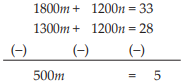
$\therefore \quad m=\frac{5}{500}$
$\therefore \quad m=\frac{1}{100}$
Substituting value of m in equation (iii) we get,
$600 \times \frac{1}{100}+400 n=11$
$\therefore \quad 6+400 n=11$
$\therefore \quad 400 n=11-6$
$\therefore \quad 400 n=5$
$\therefore \quad n=\frac{5}{400}$
$\therefore \quad n=\frac{1}{80}$
Resubstituting the values of $m$ and $n$,
$\frac{1}{x}=\frac{1}{100}$ and $\frac{1}{y}=\frac{1}{80}$
$\therefore x=100$ and $y=80$
The speed of the train is $100 km / hr$ and the speed of the taxi is $80 km / hr$. View full question & answer→Question 574 Marks
Solve : $4 x-y=-5 ; 2 x-y=-1$
View full question & answer→Question 584 Marks
Solve : $4 x+3 y=4 ; 6 x+5 y=8$
View full question & answer→Question 594 Marks
Solve : $3 x-y=7 ; x+4 y=11$
View full question & answer→Question 604 Marks
Solve : $3 x+y=1 ; 2 x=11 y+3$
Answer$x=\frac{2}{5}, y=\frac{-1}{5}$,
View full question & answer→Question 614 Marks
Solve : $3 x+4 y=-5 ; x-y=-4$
View full question & answer→Question 624 Marks
Solve : $3 x-2 y=3 ; 2 x+y=16$
View full question & answer→