Questions

M.C.Q (1 Marks)

Take a timed test

20 questions · 6 auto-graded MCQ + 14 self-marked written.

Question 11 Mark
Four alternative answers for each of the following questions are given. Choose the correct alternative.
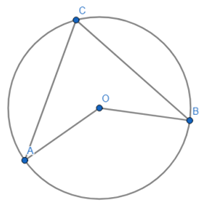
Points A, B, C are on a circle, such that m(arc AB) = m(arc BC) = 120°. Nopoint, except point B, is common to the arcs. Which is the type of ∆ ABC?
A. Equilateral triangle
B. Scalene triangle
C. Right angled triangle
D. Isosceles triangle

Answer
Angle subtended by the arcs at centre = 120°


⇒ Angle subtended by the arc at the remaining part of the circle = 60° {The measure of an inscribed angle is half the measure of the arc intercepted by it.}


∵ Interior angles of the triangle ABC = 60°


∴It is an equilateral triangle.

View full question & answer
MCQ 21 Mark
Four alternative answers for each of the following questions are given. Choose the correct alternative.
In a cyclic $\square \ce{ABCD},$ twice the measure of $\angle A$ is thrice the measure of $\angle C.$ Find the measure of $\angle C$ ?
  • A
    $36$
  • $72$
  • C
    $90$
  • D
    $108$
Answer
Correct option: B.
$72$
Given that $2\angle A = 3\angle C$
We know that in a cyclic quadrilateral opposite angles are supplementary to each other.
$\Rightarrow \angle A + \angle C = 180^\circ$
$\Rightarrow \frac{3}{2} \angle C +\angle C =180^{\circ} $
$ \Rightarrow \frac{5}{2} \angle C =180^{\circ}$
$\Rightarrow \angle C = 72^\circ$
View full question & answer
Question 31 Mark
Four alternative answers for each of the following questions are given. Choose the correct alternative.
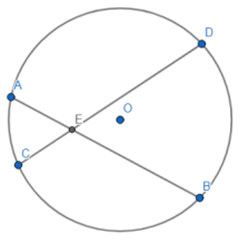
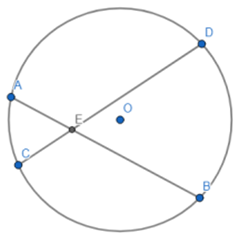
Chords AB and CD of a circle intersect inside the circle at point E. If AE = 5.6,EB = 10, CE = 8, find ED.
A. 7
B. 8
C. 11.2
D. 9
Answer

Given: AE = 5.6,EB = 10, CE = 8
We know that AE × EB = CE × ED
This property is known as theorem of chords intersecting inside the circle.
⇒ 5.6 × 10 = 8 × ED
⇒ ED = 7
View full question & answer
Question 41 Mark
Four alternative answers for each of the following questions are given. Choose the correct alternative.
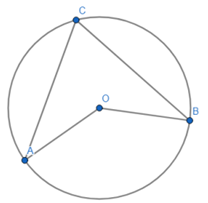
∠ ACB is inscribed in arc ACB of a circle with centre O. If ∠ ACB = 65°,find m(arc ACB).
A. 65°
B. 130°
C. 295°
D. 230°
Answer

Given ∠ACB = 65°
⇒∠ AOB = 2 × 65° = 130° {∵ The measure of an inscribed angle is half the measure of the arc intercepted by it.}
m(AB) = 130°
So, m(arc ACB ) = 360° - m(AB) {∵ Measure of a major arc = 360°- measure of its corresponding minor arc}
⇒m(arc ACB ) = 360° - 130° = 230°
View full question & answer
Question 51 Mark
Four alternative answers for each of the following questions are given. Choose the correct alternative.
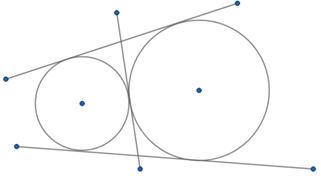
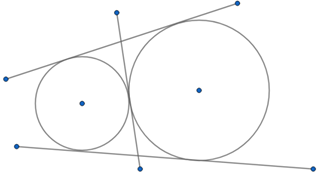
If two circles are touching externally, how many common tangents of them can be drawn?
A. One
B. Two
C. Three
D. Four
Answer

If two circles are touching each other externally, they have 3 tangents in common. The above figure proves this statement.
There are three common tangets for the given two circles.
View full question & answer
Question 61 Mark
Four alternative answers for each of the following questions are given. Choose the correct alternative.
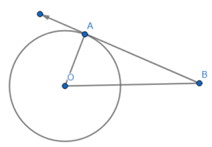
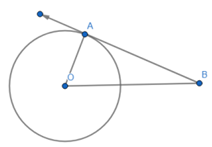
Length of a tangent segment drawn from a point which is at a distance 12.5 cm from the centre of a circle is 12 cm, find the diameter of the circle.
A. 25 cm
B. 24 cm
C. 7 cm
D. 14 cm
Answer

Given: $B O=12.5 \mathrm{~cm}$ and $A B=12 \mathrm{~cm}$
In $\triangle A O B$,
$\angle \mathrm{OAB}=90^{\circ}$ Using tangent-radius theorem which states that a tangent at any point of a circle is perpendicular to the radius at the point of contact.}
$B O^2=A B^2+O A^2\{$ Using Pythagoras theorem $\}$
$\Rightarrow(12.5)^2=12^2+O A^2$
$\Rightarrow O A^2=156.25-144$
$\Rightarrow O A=\sqrt{ } 12.25$
$\Rightarrow O A=3.5 \mathrm{~cm}$
Radius $=3.5 \mathrm{~cm}$
$\Rightarrow$ Diameter $=7 \mathrm{~cm}$
View full question & answer
Question 71 Mark
Four alternative answers for each of the following questions are given. Choose the correct alternative.
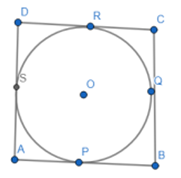
A circle touches all sides of a parallelogram. So the parallelogram must be a,................... .
A. rectangle
B. rhombus
C. square
D. trapezium
Answer

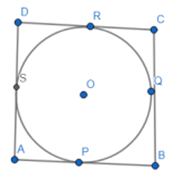
Let ABCD be a parallelogram which circumscribes the circle.
AP = AS [Tangents drawn from an external point to a circle are equal in length]
BP = BQ [Tangents drawn from an external point to a circle are equal in length]
CR = CQ [Tangents drawn from an external point to a circle are equal in length]
DR = DS [Tangents drawn from an external point to a circle are equal in length]
Consider, (AP + BP) + (CR + DR) = (AS + DS) + (BQ + CQ)
AB + CD = AD + BC
But AB = CD and BC = AD [Opposite sides of parallelogram ABCD]
AB + CD = AD + BC
Hence 2AB = 2BC
Therefore, AB = BC
Similarly, we get AB = DA and DA = CD
Thus, ABCD is a rhombus.
View full question & answer
Question 81 Mark
Four alternative answers for each of the following questions are given. Choose the correct alternative.
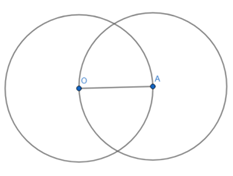
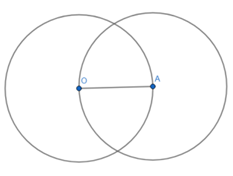
Two circles intersect each other such that each circle passes through the centre of the other. If the distance between their centres is 12, what is the radius of each circle?
A. 6 cm
B. 12 cm
C. 24 cm
D. can’t say
Answer
Given OA = 12

From the figure, OA is the radius of both the circles.
Given that distance between their centres is OA = 12
∴ Radius of the circles = 12
View full question & answer
Question 91 Mark
Four alternative answers for each of the following questions are given. Choose the correct alternative.
Seg XZ is a diameter of a circle. Point Y lies in its interior. How many of the following statements are true?
(i) It is not possible that ∠XYZ is an acute angle.
(ii) ∠ XYZ can’t be a right angle.
(iii) ∠ XYZ is an obtuse angle.
(iv) Can’t make a definite statement for measure of ∠ XYZ.
A. Only one
B. Only two
C. Only three
D. All

Answer
coming soon
View full question & answer
Question 101 Mark
Four alternative answers for each of the following questions are given. Choose the correct alternative.
Two circles of radii 5.5 cm and 3.3 cm respectively touch each other. What is the distance between their centers?
A. 4.4 cm
B. 8.8 cm
C. 2.2 cm
D. 8.8 or 2.2 cm

Answer
Given that both the circles touch each other but not specified externally or internally.


The distance between the centres of the circles touching internally is equal to the difference of their radii.


⇒distance between their centres = 5.5 cm – 3.3 cm = 2.2 cm


If the circles touch each other externally, distance between their centres is equal to the sum of their radii.


⇒distance between their centres = 5.5 cm + 3.3 cm = 8.8 cm

View full question & answer
MCQ 111 Mark
  • Equilateral triangle
  • B
    Scalene triangle
  • C
    Right angled triangle
  • D
    Isosceles triangle
Answer
Correct option: A.
Equilateral triangle
(A) Equilateral triangle
Angle subtended by the arcs at centre = 120°
⇒ Angle subtended by the arc at the remaining part of the circle = 60° {The measure of an inscribed angle is half the measure of the arc intercepted by it.}
∵ Interior angles of the triangle ABC = 60°
∴It is an equilateral triangle.
View full question & answer
MCQ 121 Mark
In a cyclic $\square ABCD$, twice the measure of $\angle A$ is thrice the measure of $\angle C$. Find the measure of $\angle C$ ?
View full question & answer
MCQ 131 Mark
Chords AB and CD of a circle intersect inside the circle at point E. If AE = 5.6,EB = 10, CE = 8, find ED.
Answer
Correct option: A.
(A)7
Image
Given: AE = 5.6,EB = 10, CE = 8
We know that AE × EB = CE × ED
This property is known as theorem of chords intersecting inside the circle.
⇒ 5.6 × 10 = 8 × ED
⇒ ED = 7
View full question & answer
MCQ 161 Mark
Length of a tangent segment drawn from a point which is at a distance 12.5 cm from the centre of a circle is 12 cm, find the diameter of the circle.
  • A
    25 cm
  • B
    24 cm
  • C
    7 cm
  • D
    14 cm
View full question & answer
MCQ 171 Mark
A circle touches all sides of a parallelogram. So the parallelogram must be a,................... .
  • A
    rectangle
  • B
    rhombus
  • C
    square
  • D
    trapezium
View full question & answer
MCQ 201 Mark
Two circles of radii 5.5 cm and 3.3 cm respectively touch each other. What is the distance between their centers?
  • A
  • B
    8.8 cm
  • C
    2.2 cm
  • 8.8 or 2.2 cm
Answer
Correct option: D.
8.8 or 2.2 cm
(D) 8.8. or 2.2 cm
Given that both the circles touch each other but not specified externally or internally.
The distance between the centres of the circles touching internally is equal to the difference of their radii.
⇒distance between their centres = 5.5 cm – 3.3 cm = 2.2 cm
If the circles touch each other externally, distance between their centres is equal to the sum of their radii.
⇒distance between their centres = 5.5 cm + 3.3 cm = 8.8 cm
View full question & answer