Questions

2 Marks Questions

Take a timed test

32 questions · self-marked practice — reveal the answer and mark yourself.

Question 12 Marks
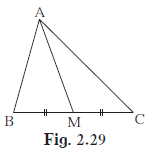
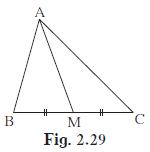
In ΔABC, point M is the midpointof side BC.
If, $AB ^2+ AC ^2=290 cm^2, AM =8 cm, BM = MC$
Answer
Given $AB ^2+ AC ^2=290 cm^2, AM =8 cm, BM = MC$
According to formula,
$ AM ^2=\frac{A B^2+A C^2}{2}-\frac{B C^2}{4} $
$ \Rightarrow 64=\frac{290}{2}-\frac{B C^2}{4} $
$ \Rightarrow 64-\frac{290}{2}=-\frac{B C^2}{4}$
$\Rightarrow B C^2=324$
BC = 18.
Thus BC = 18 cm.
View full question & answer
Question 22 Marks
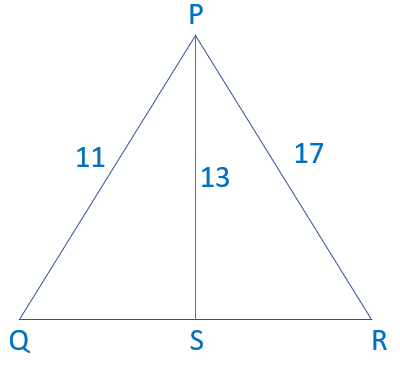
In ΔPQR, point S is the midpoint of side QR. If PQ = 11,PR = 17, PS = 13,find QR.
Answer

Given $P S=13, P Q=11, P R=17$
By Apollonius's Theorem,
$PS ^2=\frac{ PQ ^2+ PR ^2}{2}-\frac{ QR ^2}{4} $
$\Rightarrow 169=\frac{121+289}{2}-\frac{ QR ^2}{4} $
$\Rightarrow \frac{ QR ^2}{4}=36 $
$\Rightarrow QR ^2=144 $
$QR =12$
View full question & answer
Question 32 Marks
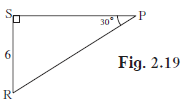
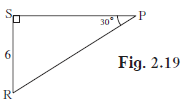
See figure 2.19. Find RP and PSusing the information given in ΔPSR.
Answer
$\text { In } \triangle P S R, \angle P S R=90^0$
$\text { So } P S^2+S R^2=R P^2$
$\Rightarrow 6^2+\left(R P \cos \left(30^{\circ}\right)\right)^2=R P^2$
$\Rightarrow 6^2+R P^2 \times \frac{3}{4}=R P^2$
$\Rightarrow 6^2=\frac{R P^2}{4}$
$\Rightarrow R P^2=4 \times 36$
Thus RP $=12$.
$P S=R P \cos \left(30^{\circ}\right)$
$\Rightarrow P S=12 \times \frac{\sqrt{3}}{2}$
$P S=6 \sqrt{ } 3$.
 
View full question & answer
Question 42 Marks
Solve the following examples.
In ∆ PQR; PQ = $\sqrt 8$ , QR = $\sqrt 5$, PR = $\sqrt 3.$ Is ∆ PQR a right angled triangle? If yes, which angle is of 90°?
Answer
As,
$(\sqrt{ } 5)^2+(\sqrt{ } 3)^2=(\sqrt{ } 8)^2$
$\Rightarrow \mathrm{QR}^2+\mathrm{PR}^2=\mathrm{PQ}^2$
i.e. sides of the triangle $A B C$ satisfy the Pythagoras theorem
$(\text { Hypotenuse })^2=(\text { base })^2+(\text { Perpendicular })^2$
$\therefore P Q R$ is a right-angled triangle at $R[$ As hypotenuse is $P Q]$.
View full question & answer
Question 52 Marks
Solve the following examples.
Find the length of the hypotenuse of a right angled triangle if remaining sides are $9\ cm$ and $12\ cm.$
 
Answer
In a right-angled triangle
By Pythagoras theorem
$(\text { Hypotenuse })^2=(\text { base })^2+(\text { Perpendicular })^2$
Given,
Other sides are $9\ cm$ and $12\ cm$
$\Rightarrow$ Hypotenuse $^2=9^2+12^2$
$\Rightarrow$ Hypotenuse $^2=81+144$
$\Rightarrow$ Hypotenuse $^2=225$
$\Rightarrow$ Hypotenuse $=15\ cm$
View full question & answer
Question 62 Marks
Solve the following examples.
Do sides $7\ cm , 24\ cm, 25\ cm$ form a right angled triangle ? Give reason.
 
Answer
Yes,
Because
$7^2 + 24^2 = 25^2 [i.e. 49 + 576 = 625]$
As, sides satisfy the Pythagoras theorem, i.e.
$\text ({Hypotenuse})^2 = \text ({base})^2 + \text ({Perpendicular})^2$
They do form a right-angled triangle.
View full question & answer
Question 82 Marks
In the right angled triangle, sides making right angle are 9 cm and 12 cm. Find the length of the hypotenuse
View full question & answer
Question 92 Marks
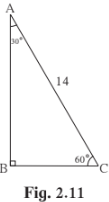
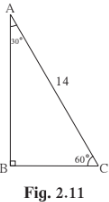
See fig 2.11. In $\triangle \mathrm{ABC}, \angle \mathrm{B}=90^{\circ}, \angle \mathrm{A}=30^{\circ}, \mathrm{AC}=14$, then find $\mathrm{AB}$ and $\mathrm{BC}$

Image

Answer
In $\triangle \mathrm{ABC}$,
$\angle \mathrm{B}=90^{\circ}, \angle \mathrm{A}=30^{\circ}, \therefore \angle \mathrm{C}=60^{\circ}$
By $30^{\circ}-60^{\circ}-90^{\circ}$ theorem,
$\mathrm{BC}=\frac{1}{2} \times \mathrm{AC}$
$\mathrm{BC}=\frac{1}{2} \times 14$
$\mathrm{BC}=7$
$\mathrm{AB}=\frac{\sqrt{3}}{2} \times \mathrm{AC}$
$\mathrm{AB}=\frac{\sqrt{3}}{2} \times 14$
$\mathrm{AB}=7 \sqrt{3}$
View full question & answer
Question 102 Marks
Adjacent sides of a parallelogram are 11 cm and 17 cm. If the length of one of its diagonals is 26 cm, find the length of the other.
Answer
12 cm
View full question & answer
Question 112 Marks
In $\triangle A B C, A B^2+A C^2=122$ and $B C=10$. Find the length of the median on side $B C$.
Answer
6
View full question & answer
Question 132 Marks
In $\triangle P Q R, M$ is the midpoint of side $Q R$. If $P Q=11, P R=17$ and $Q R=12$, then find $P M$.
Answer
13
View full question & answer
Question 142 Marks
A ladder 10 m long reaches a window 8 m above the ground. Find the distance of the foot of the ladder from the base of the wall.
Answer
6m
View full question & answer
Question 152 Marks
Sides of triangles are given below. Determine which of them are right angled triangle.
(i) 8, 15, 17
(ii) 20, 30, 40
(iii) 11, 12, 15
(iv) 20, 16, 12
Answer
(i) and (iv) are right angled triangle
View full question & answer
Question 202 Marks
Solve the following examples.
Find the length of the hypotenuse of a right angled triangle if remaining sides are 9 cm and 12 cm.

View full question & answer
Question 252 Marks
In the right angled triangle, sides making right angle are 9 cm and 12 cm. Find the length of the hypotenuse
View full question & answer
Question 262 Marks
See fig 2.11. In $\triangle \mathrm{ABC}, \angle \mathrm{B}=90^{\circ}, \angle \mathrm{A}=30^{\circ}, \mathrm{AC}=14$, then find $\mathrm{AB}$ and $\mathrm{BC}$

Image

View full question & answer
Question 272 Marks
Sides of triangles are given below. Determine which of them are right angled triangle.
(i) 8, 15, 17
(ii) 20, 30, 40
(iii) 11, 12, 15
(iv) 20, 16, 12
View full question & answer
Question 282 Marks
In $\triangle P Q R, M$ is the midpoint of side $Q R$. If $P Q=11, P R=17$ and $Q R=12$, then find $P M$.
View full question & answer
Question 312 Marks
A ladder 10 m long reaches a window 8 m above the ground. Find the distance of the foot of the ladder from the base of the wall.
View full question & answer
Question 322 Marks
Adjacent sides of a parallelogram are 11 cm and 17 cm. If the length of one of its diagonals is 26 cm, find the length of the other.
View full question & answer