Question 14 Marks
For what value of $k, -4$ is a zero of the polynomial $x^2 - x - (2k + 2)$?
AnswerWe know that if $x = a$ is zero polynomial then $x - 2$ is a factor of $f(x)$ Since $-4$ is zeros of $f(x)$ Therefore $x + 4$ is a factor of $f(x)$
Now, we divide $f(x) = x^2 - x - (2k + 2) by g(x) = x + 4$ to find the value of $k$
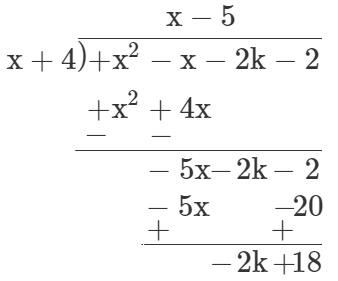
Now, Remainder $= 0 -2k + 18 = 0 -2k = -18$ $\text{k}=\frac{-18}{-2}$k = 9
Hence, the value of $k$ is $9$ View full question & answer→Question 24 Marks
If the zeros of the polynomial $f(x) = ax^3 + 3bx^2 + 3cx + d$ are in A.P., prove that $2b^3 - 3abc + a^2d = 0.$
Answer$f(x) = ax^3 + 3bx^2 + 3cx + d .....(1)$
Let $A - d, A $and $A + d$ be the zroes of $f(x)$
We know that
Sum of zeroes $ =-\frac{\text{Coefficient of x}^2}{\text{coefficient of x}^3}$
$\Rightarrow\text{a}-\text{d}+\text{a}+\text{a}+\text{d}=\frac{-3\text{b}}{\text{a}}$
$\Rightarrow3\text{a}=\frac{-3\text{b}}{\text{a}}$
$\Rightarrow\text{A}=\frac{-\text{b}}{\text{a}}$
$7(\text{A})=0$
$\Rightarrow\text{aA}^3+3\text{bA}^2+3\text{Ac}+\text{d}=0$
$\text{a}\Big(\frac{-\text{b}}{\text{a}}\Big)^3+3\text{b}\Big(\frac{-\text{b}}{\text{a}}\Big)^2+3\Big(\frac{-\text{b}}{\text{a}}\Big)\text{c}+\text{d}=0$
$\Rightarrow\frac{-\text{b}^3}{\text{a}^2}+\frac{3\text{b}^3}{\text{a}^2}-\frac{3\text{bc}}{\text{a}}+\text{d}=0$
$\Rightarrow\frac{-\text{b}^3+3\text{b}^3-3\text{abc }+\text{ a}^2\text{d}}{\text{a}^2}=0$
$\Rightarrow2\text{b}^3-3\text{abc}+\text{a}^2\text{d} =0$
Proved.
View full question & answer→Question 34 Marks
If $\alpha$ and $\beta$ are the zeros of the quadratic polynomial $f(x) = x^2 - px + q$, prove that $\frac{\alpha^2}{\beta^2}+\frac{\beta^2}{\alpha^2}=\frac{\text{p}^2}{\text{q}}-\frac{4\text{p}^2}{\text{q}}+2.$
AnswerSince $\alpha$ and $\beta$ are the roots of the polynomials
$\text{f(x)}=\text{x}^2-\text{px}-+2$
sum of zeroes $=\text{p}=\alpha+\beta$
Product of zeroes $=\text{q}=\alpha\beta$
$ \text{LHS}=\frac{\alpha^2}{\beta^2}+\frac{\beta^2}{\alpha^2}$
$ =\frac{\alpha^2+\beta^2}{\alpha\beta^2}=\frac{(\alpha^2+\beta^2)^2-2(\alpha\beta)^2}{(\alpha\beta)^2}$
$ =\frac{\big[(\alpha+\beta)^2-2\alpha\beta\big]^2-2(\alpha\beta)^2}{(\alpha\beta)^2}$
$ =\frac{\big[(\text{p})^2-2\text{q}\big]^2-2\text{q}^2}{\text{q}^2}$
$ =\frac{\text{p}^4+4\text{q}^2-4\text{p}^2\text{q}-2\text{q}^2}{\text{q}^2}$
$\frac{\text{p}^4}{\text{q}^2}+\frac{4\text{q}^2}{\text{q}^2}-\frac{4\text{p}^2\text{q}}{\text{q}^2}-\frac{2\text{q}^2}{\text{q}^2}$
$\frac{\text{p}^4}{\text{q}^2}+\frac{2\text{q}^2}{\text{q}^2}-\frac{4\text{p}^2\text{q}}{\text{q}^2}$
$\frac{\text{p}^4}{\text{q}^2}+2-\frac{4\text{p}^2}{\text{q}}$
View full question & answer→Question 44 Marks
Find all zeros of the polynomial $f(x) = 2x^4 - 2x^3 - 7x^2 + 3x + 6$,
if its two zeros are $-\sqrt{\frac{3}{2}}$ and $\sqrt{\frac{3}{2}}$
Answer$f(x) = 2x^4 - 2x^3 - 7x^2 + 3x + 6$
It is given that two zeros of f(x) are $-\sqrt{\frac{3}{2}}$ and $\sqrt{\frac{3}{2}}$
so, $\Big(\text{x}+\sqrt{\frac{3}{2}}\Big)\Big(\text{x}-\sqrt{\frac{3}{2}}\Big)=\text{x}^2-\Big(\sqrt{\frac{3}{2}}\Big)^2$
$=\text{x}^2-\frac{3}{2}$ $=\frac{1}{2}(2\text{x}^2-3)$
So, $(2x^2 - 3)$ is a factor of $f(x)$ Now, $f(x)$ is divided by $(2x^2 - 3)$
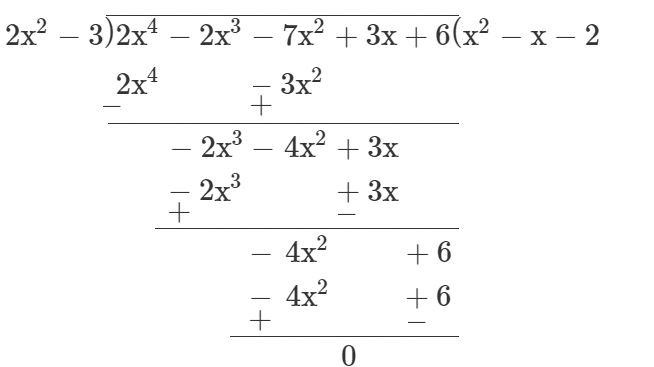
So, $f(x) = (2x^2 - 3)(x^2 - x - 2)$
Thus, other zeros of f(x) are zeros of poltnomial
$(x^2 - x - 2) x^2 - x - 2 $
$= x^2 + x - 2x - 2 $
$= x(x + 1) - 2(x + 1) $
$= (x - 2)(x + 1) $
$= x = 2$ or $x = -1$
Hence, all the zeros of $f(x)$ are $-\sqrt{\frac{3}{2}},\sqrt{\frac{3}{2}},2$ and $1$. View full question & answer→Question 54 Marks
If the zeros of the polynomial $f(x) = 2x^3 - 15x^2 + 37x - 30$ are in A.P., find them.
AnswerLet be the zeros of the given polynomial
$f(x) = 2x^3 - 15x^2 + 37x - 30$
Here $a = 2, b = -15, c = 37$ and $d = -30$
$\therefore\ \alpha+\beta+\gamma=\frac{-\text{b}}{\text{a}}=-\Big(\frac{-15}{2}\Big)=\frac{15}{2}\ \dots(\text{i})$
$\alpha\beta+\beta\gamma+\gamma\alpha=\frac{\text{c}}{\text{a}}=\frac{37}{2}\ \dots(\text{ii})$
and $\alpha\beta\gamma=\frac{-\text{d}}{\text{a}}=-\Big(\frac{-30}{2}\Big)=15\ \dots(\text{iii})$
$\because\ \alpha,\beta$ and $\gamma $ are in AP
$\therefore\ \beta-\alpha=\gamma-\beta$
$2\beta=\alpha+\gamma$
From (i)
$\alpha+\beta+\gamma =\frac{15}{2}$ $\Rightarrow2\beta+\beta=\frac{15}{2}$
$\Rightarrow3\beta=\frac{15}{2}$ $\Rightarrow\beta=\frac{15}{2\times3}=\frac{5}{2}$
From (ii)
$ \alpha\beta\gamma=15$
$\Rightarrow\frac{5}{2}\alpha\gamma=15$ $\Rightarrow\alpha\gamma=\frac{15\times2}{5}=6$
and $\alpha+\gamma=2\beta=2\times\frac{5}{2}=5$
Now $(\alpha-\gamma)^2=(\alpha+\gamma)^2-4\alpha\gamma$
$=(5)^2-4\times6=25-24=1$
$\therefore\ \alpha-\gamma=1$
But $\alpha+\gamma=5$
Adding we get $2\alpha=6\Rightarrow\alpha=\frac{6}{2}$
and subtracting $-2\gamma=-4$
$\gamma=\frac{-4}{-2}=2$
$\therefore\ \text{Zeros are }3,\frac{5}{2},2$
View full question & answer→Question 64 Marks
Find all the zeros of the polynomial $2x^3 + x^2 - 6x - 3,$ if two of its zeros are $-\sqrt{3}$ and $\sqrt{3}.$
Answer$f(x) = 2x^3 + x^2 -6x - 3$ $\text{x}=-\sqrt{3}$ is a solution $\text{x}+\sqrt{3}$ is a factor $\text{x}=\sqrt{3}$ is a solution $\text{x}-\sqrt{3}$ is a factor Here,
$(\text{x}+\sqrt{3})(\text{x}-\sqrt{3})$ is a factor of $f(x) x^2 - 3$ is a factor of $f(x)$
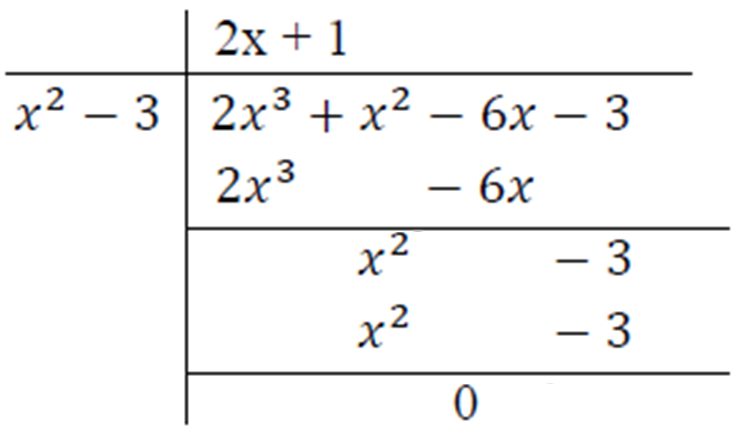
Hence, $2x^3 + x^2 - 6x - 3 = (x^2 - 3)(2x + 1)$ Other zeros of $f(x) is 2x + 1 = 0$ $\text{x}=-\frac{1}{2}$ Set of zeroes $\bigg\{\sqrt{3},-\sqrt{3},\frac{-1}{2}\bigg\}$ View full question & answer→Question 74 Marks
Obtain all zeros of the polynomial $f(x) = x^4 - 3x^3 - x^2 + 9x - 6$, if two of its zeros are $-\sqrt{3}$ and $\sqrt{3}$
Answer$f(x) = x^4 - 3x^3- x^2 + 9x - 6$
It is given that two zeros of f(x) are $-\sqrt{3}$ and $\sqrt{3}$ so,
$(\text{x}+\sqrt{3})(\text{x}-\sqrt{3})=\text{x}^2-(\sqrt{3})^2$
$=\text{x}^2-3$
Thus , $(x^2 - 3)$ is a factor of $f(x)$. So $f(x)$ is divided by $(x^2 - 3)$
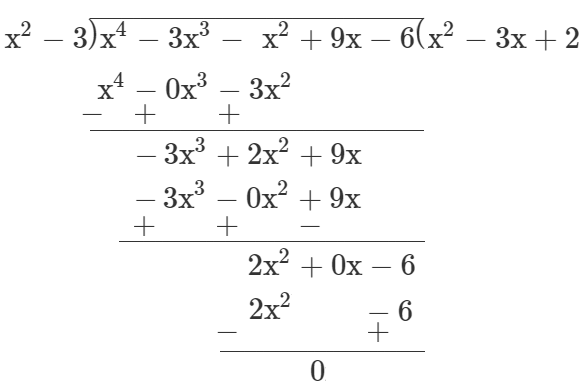
So, $f(x) =(x^2 - 3) (x^2 - 3x + 2)$
Now, other zeros of f(x) are zeros of $(x^2 - 3x + 2).$
$x^2 - 3x + 2 = x^2 - x - 2x + 2$
$= x(x - 1) - 2(x - 1)$
$= (x - 1)(x - 2)$
$= x = 1$ or $x = 2$
Hence, all the zeros of $f(x)$ are $\sqrt{3},\sqrt{3},$ $1$ and $2.$ View full question & answer→Question 84 Marks
Find all zeros of the polynomial $2x^4 + 7x^3 - 19x^2 - 14x + 30$, if two of its zeros are $\sqrt{2}$ and $\sqrt{2}.$
AnswerLet $f(x) = 2x^4 + 7x^3 - 79x^2 - 14x + 30$
Two zeros are $\sqrt{2}$ and $-\sqrt{2}$
$\because\ \sqrt{2}$ and $-\sqrt{2}$ are its two zeros
$\therefore\ (\text{x}-\sqrt{2})$ and $(\text{x}+\sqrt{2})$ will be its factors or $(x^2 - 2)$ will be its factor
Now dividing $f(x)$ by $(x^2 - 2)$, we get
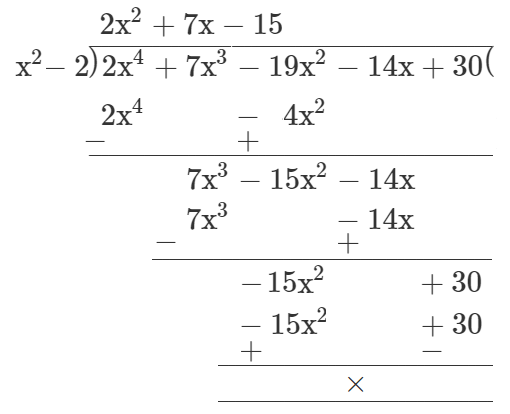
$\therefore$ Quotient = $2x^2 + 7x - 15$
Now $2x^2 + 7x - 15$
$= 2\text{x}^2 + 10\text{x} - 3\text{x} - 15 \begin{Bmatrix}\therefore2\times(-18)=-30 \\-30-10\times(-3)\\7=10-3 \end{Bmatrix}$
$= 2x(x + 5) - 3(x + 5)$
$= (x + 5)(2x - 3)$
Either $x + 5 = 0$, then $x = -5$
or $2x - 3 = 0$, then $2x = 3$ $\Rightarrow\text{x}=\frac{3}{2}$
$\therefore$ All zeros are $\sqrt{2},-\sqrt{2},-5$ and $\frac{3}{2}$ View full question & answer→Question 94 Marks
Find the zeros of the following quadratic polynomial and verify the relationship between the zeros and their coefficients:
$\text{g(x)}=\text{a(x}^2+1)-\text{x(a}^2+1)$
Answer$\text{g}(\text{x})=\text{a}(\text{x}^2+1)-\text{x}(\text{a}^2+1)$ $=\text{a}\text{x}^2+\text{a}-\text{a}^2\text{x}-\text{x}$
$=\text{a}\text{x}^2-(\text{a}^2+1)\text{x}+\text{a}$ $=\text{a}\text{x}^2-\text{a}^2\text{x}-\text{x}+\text{a}$
$=\text{a}\text{x}(\text{x}-\text{a})-1(\text{x}-\text{a})=(\text{x}-\text{a})(\text{ax}-1)$
Zeroes of the polynomials $=\frac{1}{\text{a}}$ and a
Sum of the zeroes $=\frac{-[-\text{a}^2-1]}{\text{a}}$
$\Rightarrow\frac{1}{\text{a}}+\text{a}=\frac{\text{a}^2+1}{\text{a}}$ $\Rightarrow\frac{\text{a}^2+1}{\text{a}}=\frac{\text{a}^2+1}{\text{a}}$
Product of zeroes $=\frac{\text{a}}{\text{a}}$
$\Rightarrow\frac{1}{\text{a}}\times\text{a}=\frac{\text{a}}{\text{a}}$ $\Rightarrow\frac{\text{a}^2+1}{\text{a}}=\frac{\text{a}^2+1}{\text{a}}$
Product of zeroes $=\frac{\text{a}}{\text{a}}\Rightarrow1=1$
Hence relationship verified.
View full question & answer→Question 104 Marks
Find the zeros of the following quadratic polynomial and verify the relationship between the zeros and their coefficients:
$\text{q(y)}=7\text{y}^2+\frac{11}{3}\text{y}-\frac{2}{3}$
Answer$\text{q}(\text{y})=7\text{y}^2-\frac{11}{3}\text{y}-\frac{2}{3}$
$\text{q}(\text{y})=\frac{1}{3}\big(21\text{y}^2-11\text{y}-2\big)$
$=\frac{1}{3}\big(21\text{y}^2-14\text{y}+3\text{y}-2\big)$
$=\frac{1}{3}\big[7\text{y}(3\text{y}-2)+1(3\text{y}-2)\big]$
$=\frac{1}{3}\big[(7\text{y}+1)(3\text{y}-2)\big]$
The zeros are given by q(y) = 0.
Thus, the zeros of $\text{q}(\text{y})=\frac{1}{3}(7\text{y}+1)(3\text{y}-2)$ are $\alpha=\frac{-1}{7}$ and $\beta=\frac{2}{3}.$
Now,
Sum of the zeros $=\alpha+\beta$
$=\frac{-1}{7}+\frac{2}{3}$
$=\frac{11}{21}$
and
$\frac{-\text{Coefficient of y}}{\text{Coefficient of y}^2}$
$=\frac{-\big(-\frac{11}{3}\big)}{7}=\frac{11}{21}$
Therefore, sum of the zeros $=\frac{-\text{Coefficient of x}}{\text{Coefficient of x}^2}$
Product of the zeros $=\alpha\beta$
$=\frac{-1}{7}\times\frac{2}{3}$
$=\frac{-2}{21}$
and
$\frac{\text{Constant term}}{\text{Coefficient of y}^2}$
$=\frac{\frac{-2}{3}}{7}$
$=\frac{-2}{21}$
Therefore,
Product of the zeros $=\frac{\text{Constant term}}{\text{Coefficient of x}^2}$
Hence, the relation-ship between the zeros and coefficient are verified.
View full question & answer→Question 114 Marks
Find the condition that the zeros of the polynomial $f(x) = x^3 + 3px^2 + 3qx + r$ may be in A.P.
AnswerLet $a - d, a$ and $a + d$ be the zeros of the polynomials$ f(x)$. Then,
Sum of the zeros $=\frac{\text{Coefficient of x }^2}{\text{Coefficient of x}^3}$
$\text{a}-\text{d}+\text{a}+\text{a}+\text{d}=\frac{-3\text{p}}{1}$
$\text{a}-\text{d}+\text{a}+\text{a}+\text{d}=-3\text{p}$
$3\text{a}=-3\text{p}$
$\text{a}=\frac{-3\times\text{p}}{3}$
$ \text{a}=-\text{p}$
Since a is a zero of the polynomial f(x). Therefore,
$\text{f(x)}=\text{x}^3+3\text{px}^2+3\text{qx}+\text{r}$
$\text{f(a)}=0$
$\text{f(a)}=\text{a}^3+3\text{pa}^2+3\text{qa}+\text{r}$
$\text{a}^3+3\text{pa}^2+3\text{qa}+\text{r}=0$
Substituting a = -p we get,
$(-\text{p})^3+3\text{p}(-\text{p})^2+3\text{q}(-\text{p})+\text{r}=0$
$-\text{p}^3+3\text{p}^3-3\text{pq}+\text{r}=0$
$2\text{p}^3-3\text{pq}+\text{r}=0$
Hence, the condition for the given polynmial is $2p^3 - 3pq + r = 0.$
View full question & answer→Question 124 Marks
Find the zeros of the following quadratic polynomial and verify the relationship between the zeros and their coefficients:$f(x) = x^2 - 2x - 8$
Answer$f(x) = x^2 - 2x - 8$
$ \Rightarrow f(x) = x^2 - 4x + 2x - 8 $
$\Rightarrow f(x) = x(x - 4) + 2(x - 4) $
$\Rightarrow f(x) = (x - 4)(x + 2)$
The zeros of $7(n) = 0$
$ \Rightarrow (x - 4)(x + 2) = 0 $
$\Rightarrow x - 4 = 0$ or $x + 2 = 0$
$ \Rightarrow x = 4$ or $x = -2$
The zeros of quadratic polynomials $7(n)$ are $\alpha = 4 \ \beta = -2$
Verfication:
Sum of zeros $=\alpha+ \beta = 4 - 2 = 2$ $= \frac{\text{Coefficient of x}}{\text{coefficient of x}^{2}} = -\frac{(-2)}{1} = 2$
Product of zeros $= \alpha \times \beta = 4 \times (-2) = -8$
$= \frac{\text{Coefficient of term}}{\text{coefficient of x}^{2}} = -\frac{(-8)}{1} = -8$
$\therefore \text{Product of zeros} = \frac{\text{Constant term}}{\text{Coefficient of x}^{2}}$
View full question & answer→Question 134 Marks
Verify that the numbers given along side of the cubic polynomials below are their zeros. Also, verify the relationship between the zeros and coefficients in each case:
$\text{f}(\text{x})=2\text{x}^2+\text{x}^2-5\text{x}+2;\frac{1}{2},1,-2$
Answer$\text{f}(\text{x})=2\text{x}^2+\text{x}^2-5\text{x}+2$
$\text{f}\Big(\frac{1}{2}\Big)=2\Big(\frac{1}{2}\Big)^3+\Big(\frac{1}{2}\Big)^2-5\Big(\frac{1}{2}\Big)+2$
$=\frac{2}{8}+\frac{1}{4}-\frac{5}{2}+2=\frac{-4}{2}+2=0$
$\text{f}(1)=2(1)^3+(1)^2-5(1)+2=2+1-5+2=0$
$\text{f}(-2)=\text{2}(-2)^3+(-2)^2-5(-2)+2$
$=-16+4+10+2$
$=-16+16=0$
$=\alpha+\beta+\gamma=\frac{-\text{b}}{\text{a}}$
$ \frac{1}{2}+1-2=\frac{-1}{2}$
$\frac{1}{2}-1=\frac{-1}{2}$
$\frac{1}{2}=\frac{-1}{2}$
$\alpha\beta+\beta\text{r}+\text{r}\alpha=\frac{\text{c}}{\text{a}}$
$\frac{1}{2}\times1+1\times-2+-2\times\frac{1}{2}=\frac{-5}{2}$
$\frac{1}{2}-2-1=\frac{-5}{2}$
$ \frac{-5}{2}=\frac{-5}{2}$
View full question & answer→Question 144 Marks
If $\alpha$ and $\beta$ are the zeroes of the quadratic polynomial $f(x) = ax^2 + bx + c$, find evaluate:$\frac{\beta}{\text{a}\alpha+\text{b}}+\frac{\alpha}{\text{a}\beta+\text{b}} $
Answer$\frac{\beta}{\text{a}\alpha+\text{b}}+\frac{\alpha}{\text{a}\beta+\text{b}}$
$ =\frac{\beta(\text{a}\beta+\text{b})+\alpha(\text{a}\alpha+\text{b})}{(\text{a}\alpha+\text{b})(\text{a}\beta+\text{b})}$
$ =\frac{\text{a}\beta^2+\text{b}\beta+\text{a}\alpha^2+\alpha\text{b}}{\text{a}^2\alpha\beta+\text{ab}\alpha+\text{ab}\beta+\text{b}^2}$
$=\frac{\text{b}(\alpha+\beta)+\text{a}(\alpha^2+\beta^2)}{\text{a}^2\alpha\beta+\text{ab}(\alpha+\beta)+\text{b}^2}$
$ =\frac{\text{b}\Big(\frac{-\text{b}}{\text{a}}\Big)+\text{a}\big\{(\alpha+\beta)^2-2\alpha\beta\big\}}{\text{a}^2\Big(\frac{\text{c}}{\text{a}}\Big)+\text{ab}\Big(\frac{-\text{b}}{\text{a}}\Big)+\text{b}^2}$
$ =\frac{\frac{-\text{b}^2}{\text{a}}+\text{a}\bigg\{\Big(\frac{-\text{b}}{\text{a}}\Big)^2-2\frac{\text{c}}{\text{a}}\bigg\}}{\text{ac}-\text{b}^2+\text{b}^2}$
$ =\frac{\frac{-\text{b}^2}{\text{a}}+\text{a}\Big\{\frac{\text{b}^2}{\text{a}^2}-\frac{2\text{c}}{\text{a}}\Big\}}{\text{ac}}=\frac{\frac{-\text{b}^2}{\text{a}}+\text{a}\Big\{\frac{\text{b}^2-2\text{ac}}{\text{a}^2}\Big\}}{\text{ac}}$
$=\frac{\frac{-\text{b}^{-2}}{\text{a}}+\frac{\big(\text{b}^{-2}-2\text{ac}\big)}{\text{a}}}{\text{ac}}=\frac{-\text{b}^2+\text{b}^2-2\text{ac}}{\text{a}\times\text{ac}}=\frac{-2\text{ac}}{\text{a}^2\text{c}}$
$ =\frac{-2}{\text{a}}$
View full question & answer→Question 154 Marks
Find the zeros of the following quadratic polynomial and verify the relationship between the zeros and their coefficients:
$\text{p(y)}=\text{y}^2+\frac{3\sqrt{5}}{2}\text{y}-5$
Answer$\text{p}(\text{y})=\text{y}^2+\frac{3\sqrt{5}}{2}\text{y}-5$
$\text{p}(\text{y})=\frac{1}{2}\big(2\text{y}^2+4\sqrt{5}\text{y}-\sqrt{5}\text{y}-10\big)$
$=\frac{1}{2}\Big[2\text{y}\big(\text{y}+2\sqrt{5}\big)-\sqrt{5}\big(\text{y}+2\sqrt{5}\big)\Big]$
$=\frac{1}{2}\Big[\big(2\text{y}-\sqrt{5}\big)\big(\text{y}+2\sqrt{5}\big)\Big]$
The zeros are given by p(y) = 0.
$\text{p}(\text{y})=\frac{1}{2}\big(2\text{y}-\sqrt{5}\big)\big(\text{y}+2\sqrt{5}\big)$ are $\alpha=\frac{\sqrt{5}}{2}$ and $\beta=-2\sqrt{5}$
Now,
Sum of the zeros $=\alpha+\beta$
$=\frac{\sqrt{5}}{2}-2\sqrt{5}=\frac{\sqrt{5}-4\sqrt{5}}{2}=\frac{-3\sqrt{5}}{2}$
and
$\frac{-\text{Coefficient of y}}{\text{Coefficient of y}^2}$
$=\frac{\frac{-3\sqrt{5}}{2}}{1}=\frac{-3\sqrt{5}}{2}$
Therefore, sum of the zeros $=\frac{-\text{Coefficient of x}}{\text{Coefficient of x}^2}$
Product of the zeros $=\alpha\beta$
$=\frac{\sqrt{5}}{2}\times-2\sqrt{5}$
$=-5$
and
$\frac{\text{Constant term}}{\text{Coefficient of y}^2}$
$=\frac{-5}{1}=-5$
Therefore,
Product of the zeros $=\frac{\text{Constant term}}{\text{Coefficient of x}^2}$
Hence, the relation-ship between the zeros and coefficient are verified.
View full question & answer→Question 164 Marks
Obtain all zeros of the polynomial $f(x) = 2x^4 + x^3 - 14x^2 - 19x - 6$, if two of its zeros are -$2$ and $-1$.
Answer$f(x) = 2x^4 + x^3 - 14x^2 - 19x - 6$ It is given that $-2$ and $-1$ are two zeros of $f(x)$ so,
$(x + 2)(x + 1) $
$= x^2 + 2x + x + 2 $
$= x^2 + 3x + 2$
Also, $(x^2 + 3x + 2)$ is a factor of $f(x)$ So, $f(x)$ is divided by $x^2 + 3x + 2.$
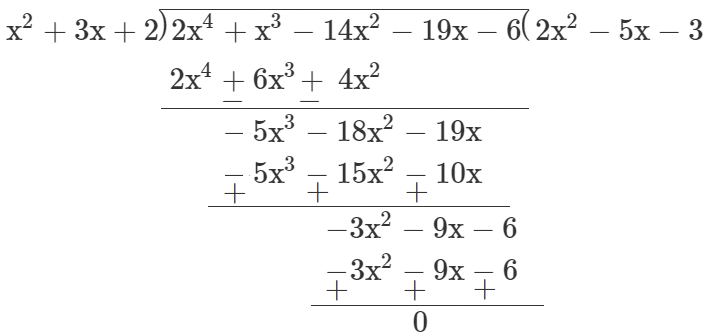
So, $f(x) = (x^2 + 3x + 2)(2x^2 - 5x - 3)$
Thus, other two zero of f(x) are zeros of polynomial $(2x^2- 5x - 3). 2x^2 - 5x - 3$
$= 2x^2 + x - 6x - 3 $
$= x(2x + 1) - 3(2x + 1) $
$= (2x + 1)(x - 3)$
$=\text{x}=\frac{-1}{2}$ or x = 3
Thus, all the zeros of $f(x)$ are $-2, -1$, $\frac{-1}{2}$ and $3$. View full question & answer→Question 174 Marks
Find the zeros of the following quadratic polynomial and verify the relationship between the zeros and their coefficients:
$\text{f(x)}=\text{x}^2-\big(\sqrt{3}+1\big)\text{x}+\sqrt{3}$
Answer$\text{f(x)}=\text{x}^2-\big(\sqrt{3}+1\big)\text{x}+\sqrt{3}$ $\Rightarrow\ \text{f(x)}=\text{x}^2-\text{x}-\sqrt{3}\text{x}+\sqrt{3}$ $\Rightarrow\ \text{f(x)}=\text{x(x}-1)-\sqrt{3}(\text{x}-1)$ $\Rightarrow\ \text{f(x)}=(\text{x}-\sqrt{3})(\text{x}-1)$ The zeros of f(x) = 0 $\Rightarrow\ \big(\text{x}-\sqrt{3}\big)(\text{x}-1)=0$ $\Rightarrow\ \big(\text{x}-\sqrt{3}\big)=0$ or $(\text{x}-1)=0$ $\Rightarrow\ \text{x}=\sqrt{3}$ or $\text{x}=1$ Thus, the zeroes of quadratic polynomials f(x) are $\alpha = \sqrt{3}$ and $\beta = 1$Verification:
Sum of zeroes $=\alpha+\beta$ $=\big(\sqrt{3}+1\big)$ and $=\frac{-\text{Coefficient of x}}{\text{Coefficient of x}^2}=\frac{-(\sqrt{3}+1)}{1}=(\sqrt{3}+1)$ $\therefore\ \text{Sum of zeroes}=-\frac{-\text{Coefficient of x}}{\text{Coefficient of x}^2}$ Product of zeroes $=\alpha\times\beta$ $=\big(\sqrt{3}\times1\big)=\sqrt{3}$ and, $=\frac{-\text{Constant term}}{\text{Coefficient of x}^2}=\frac{\sqrt{3}}{1}=\sqrt{3}$ $\therefore\ \text{Product of zeroes}=\frac{-\text{Constant term}}{\text{Coefficient of x}^2}$
View full question & answer→Question 184 Marks
Find all the zeros of the polynomial $x^4 + x^3 - 34x^2 - 4x + 120$, if two of its zeros are $2$ and $-2$.
AnswerWe know that if $x = a$ is a zero of a polynomial, then $x-a$ is a factor of $f(x).$
Since, $2$ and -$2$ are zeros of $f(x).$
Therefore
$(x + 2) (x - 2) = x^2 - 2^2$
$= x^2- 4$
$x^2 - 4$ is a factor of f(x). Now, we divide $x^4 + x^3 - 34x^2 - 4x + 120$ by $g(x) = x^2 - 4$ to fin d the other zeros od $f(x)$.
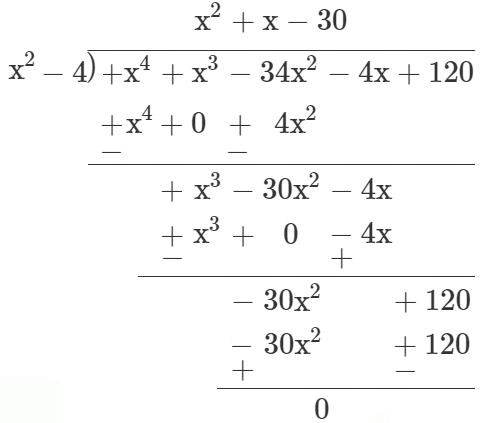
By using divison algorithm we have$ f(x) = g(x) × q(x) - r(x)$
$x^4 + x^3 - 34x^2 - 4x + 120 = (x^2 - 4)(x^2 + x - 30 ) -0$
$x^4 + x^3 - 34x^2 - 4x + 120 = (x + 2)(x - 2)(x^2 + 6x - 5x - 30)$
$x^4 + x^3 - 34x^2 - 4x + 120 = (x + 2)(x - 2)(x (x + 6) - 5(x + 6))$
$x^4 + x^3 - 34x^2 - 4x + 120 = (x + 2)(x - 2)(x + 6)(x - 5)$
Hence, the zeros of the given polynomial are -$2, +2, -6 $and $5$. View full question & answer→Question 194 Marks
Find the zeros of the following quadratic polynomial and verify the relationship between the zeros and their coefficients:
$\text{h(s)}=2\text{s}^2-\big(1+2\sqrt{2}\big)\text{s}+\sqrt{2}$
AnswerLet $\text{f}(\text{s})=2\text{s}^2-\big(1+2\sqrt{2}\big)\text{s}+\sqrt{2}$
$=2\text{s}^2-\text{s}-2\sqrt{2}\text{s}+\sqrt{2}$
$=\text{s}(2\text{s}-1)-\sqrt{2}(2\text{s}-1)$
$=(2\text{s}-1)(\text{s}-\sqrt{2})$
So, the value of $ 2\text{s}^2-(1+2\sqrt{2})\text{s}+\sqrt{2}$ is
zero when $2\text{s}-1=0$ or $\text{s}-\sqrt{2}=0$
i.e., when $\text{s}=\frac{1}{2}$ or $\text{s}=\sqrt{2}$
So, the zeroes of $2\text{s}^2-(1+2\sqrt{2})\text{s}+\sqrt{2}$
are $\frac{1}{2}$ and $\sqrt{2}$
$\therefore\ \text{Sum of zeroes}=\frac{1}{2}+\sqrt{2}=\frac{1+2\sqrt{2}}{2}$
$=\frac{-\big[-(1+2\sqrt{2})\big]}{2}=\frac{(\text{Coefficient of s})}{(\text{Coefficient of s}^2)}$
and product of zeroes $=\frac{1}{2}.\sqrt{2}=\frac{1}{\sqrt{2}}$
$=\frac{\text{Constant term}}{\text{Coefficient of s}^2}$
Hence, verified the relations between the zeroes and the coefficients of the polynomial.
View full question & answer→Question 204 Marks
If $\alpha$ and $\beta$ are the zeroes of the quadratic polynomial $f(x) = x^2 - 3x - 2$, find a quadratic polynomial whose zeroes are $\frac{1}{2\alpha+\beta}$ and $\frac{1}{2\beta+\alpha}.$
Answer$\text{f(x)}=\text{x}^2-3\text{x}-2$
Sum of zeroes $[\alpha+\beta]=3$
Product of zeroes $[\alpha\beta]=-2$
Sum of zeroes $=\frac{1}{2\alpha+\beta}+\frac{1}{2\beta+\alpha}$
$ =\frac{2\beta+\alpha+2\alpha+\beta}{(2\alpha+\beta)(2\beta+\alpha)}$
$=\frac{3\alpha+3\beta}{2(\alpha^2+\beta^2)+5\alpha\beta}$
$ =\frac{3\times3}{2\big[2(\alpha+\beta)^2+2\alpha\beta+5\times(-2)\big]}$
$ =\frac{9}{2[9]-10}=\frac{9}{16}$
Product of zeroes $ =\frac{1}{\alpha+\beta}\times\frac{1}{2\alpha+\beta}=\frac{1}{4\alpha\beta+\alpha\beta+2\alpha^2+2\beta^2}$
$ =\frac{1}{5\times-2+2\big[(\alpha+\beta)^2-2\alpha\beta\big]}$
$=\frac{1}{-10+2[9+4]}$
$=\frac{1}{10+26}$
$=\frac{1}{16}$
Quadration equation = $x^2$ - [sum of zeroes]x + product of zeroes
$=\text{x}^2-\frac{9\text{x}}{16}+\frac{1}{16}$
$ =\text{k}\Big[\text{x}^2-\frac{9\text{x}}{16}+\frac{1}{16}\Big]$
View full question & answer→Question 214 Marks
Obtain all zeros of $f(x) = x^3 + 13x^2 + 32x + 20$, if one of its zeros is $-2.$
Answer$f(x) = x^3 + 13x ^2 + 32x + 20$
One zero $= -2 $or $x = -2$
$x + 2$ is a factor of $f(x)$
Now dividing $f(x)$ by$ x + 2$, we get
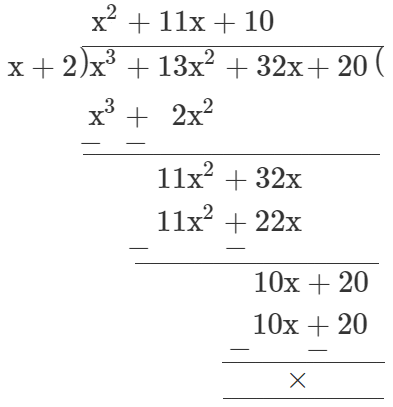
$f(x) = (x + 2)(x^2 + 11x + 10)$
$= (x + 2)(x^2 + x + 10x 10)$
$= (x + 2){ x (x + 1) + 10 (x + 1)}$
$= (x + 2)(x + 1)(x + 10)$
$\therefore$ Other zeros will be
$x + 1 = 0 \Rightarrow x = -1$
and$ x + 10 = 0$
$⇒ x = -10$
$-1$ and $-10$
Hence zeros are $-10, -1, -2$ View full question & answer→Question 224 Marks
If $\alpha$ and $\beta$ are the zeroes of the quadratic polynomial $f(x) = x^2+ px + q$, find a quadratic polynomial whose zeroes are $(\alpha+\beta)^2$ and $(\alpha-\beta)^2.$
AnswerIf $\alpha$ and $\beta$ are the zeroes of the quadratic polynomial $\text{f(x)}=\text{x}^2+\text{px}+\text{q}$
$\alpha+\beta=\frac{-\text{Coefficient of x}}{\text{Coefficient of x}^2}$
$=\frac{-\text{p}}{1}$
$ \alpha\beta=\frac{\text{Constant term}}{\text{Coefficient of x}^2}$
$ =\frac{\text{q}}{1}$
$=\text{q}$
Let $S$ and $P$ denote respectively the sums and product of the zeroes the polynomial whose zeroes are $(\alpha+\beta)^2$ and $(\alpha-\beta)^2.$ Then,
$ \text{S}=(\alpha+\beta)^2+(\alpha-\beta)^2$
$ \text{S}=\alpha^2+\beta^2+2\alpha\beta+\alpha^2+\beta^2-2\alpha\beta$
$ \text{S}=2\big[\alpha^2+\beta^2\big]$
$ \text{S}=2\big[(\alpha+\beta)^2-2\alpha\beta\big]$
$ \text{S}=2(\text{p}^2-2\times\text{q})$
$\text{S}=2(\text{p}^2-2\text{q})$
$ \text{p}=(\alpha+\beta)^2(\alpha-\beta)^2$
$ \text{P}=(\alpha^2+\beta^2+2\alpha\beta)(\alpha^2+\beta^2-2 \alpha\beta)$
$ \text{P}=\big((\alpha+\beta)^2-2\alpha\beta+2\alpha\beta\big)\big((\alpha+\beta)^2-2\alpha\beta-2\alpha\beta\big)$
$ \text{P}=(\text{p})^2\big((\text{p})^2-4\times\text{q}\big)$
$\text{P}=\text{p}^2(\text{p}^2-4\text{q})$
The required polynomial of $\text{f(x)}=\text{k}(\text{kx}^2-\text{sx}+\text{p})$ is going by
$ \text{f}(\text{x})=\text{k}\big\{\text{x}^2-2(\text{p}^2-2\text{q})\text{x}+\text{p}^2(\text{p}^2-4\text{q})\big\}$
$ \text{f}(\text{x})=\text{k}\big\{\text{x}^2-2(\text{p}^2-2\text{q})\text{x}+\text{p}^2(\text{p}^2-4\text{q})\big\},$ where k is any non-zero real number.
View full question & answer→Question 234 Marks
Given that $\text{x}-\sqrt{5}$ is a factor of the cubic polynomial $\text{x}^3-3\sqrt{5}\text{x}^2+13\text{x}-3\sqrt{5},$ find all the zeroes of the polynomial.
AnswerLet $\text{f(x)}=\text{x}^3-3\sqrt{5}\text{x}^2+13\text{x}-3\sqrt{5}$ and given that, $\big(\text{x}-\sqrt{5}\big)$ is a one of the factor of f(x). Now, using divison algorithm,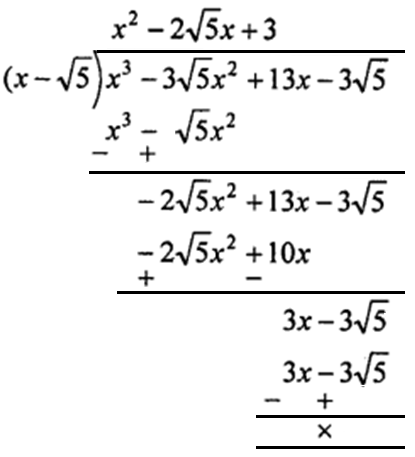
View full question & answer→Question 244 Marks
Find the zeros of the following quadratic polynomial and verify the relationship between the zeros and their coefficients:
$\text{f}(v)=v^2+4\sqrt{3}v-15$
Answer$\text{f}(v)=v^2+4\sqrt{3}v-15$
$\text{f}(v)=v^2+5\sqrt{3}v-\sqrt{3}v-15$
$=v^2-\sqrt{3}v+5\sqrt{3}v-15$
$=v\big(v-\sqrt{3}\big)+5\sqrt{3}\big(v-\sqrt{3}\big)$
$=\big(v-\sqrt{3}\big)\big(v+5\sqrt{3}\big)$
The zeros of f(v) are given by
$\text{f}(v)=0$
$v^2+4\sqrt{3}v-15=0$
$\big(v+5\sqrt{3}\big)\big(v-\sqrt{3}\big)=0$
$\big(v-\sqrt{3}\big)=0\text{ or }\big(v+5\sqrt{3}\big)=0$
$v=\sqrt{3}\text{ or }v=-5\sqrt{3}$
Thus, the zeros of $\text{f}(v)=\big(v-\sqrt{3}\big)\big(v+5\sqrt{3}\big)$ are $\alpha=\sqrt{3}$ and $\beta=-5\sqrt{3}.$
Now,
Sum of the zeros $=\alpha+\beta$
$=\sqrt{3}-5\sqrt{3}=-4\sqrt{3}$
and
$\frac{-\text{Coefficient of }v}{\text{Coefficient of }v^2}$
$=\frac{-4\sqrt{3}}{1}=-4\sqrt{3}$
Therefore, sum of the zeros $\frac{-\text{Coefficient of x}}{\text{Coefficient of x}^2}$
Product of the zeros $=\alpha\beta$
$=\sqrt{3}\times\big(-5\sqrt{3}\big)=-15$
and
$=\frac{\text{Constant term}}{\text{Coefficient of }v^2}$
$=\frac{-15}{1}=-15$
Therefore,
Product of the zeros $=\frac{\text{Constant term}}{\text{ Coefficient of x}^2}$
Hence, the relation-ship between the zeros and coefficient are verified.
View full question & answer→Question 254 Marks
Find the zeros of the following quadratic polynomial and verify the relationship between the zeros and their coefficients:
$\text{p(x)}=\sqrt{3}\text{x}^2+10\text{x}+7\sqrt{3}$
AnswerGiven $\text{q}(\text{x})=\sqrt{3}\text{x}^2+10\text{x}+7\sqrt{3}$
We have $\text{q}(\text{x})=\sqrt{3}\text{x}^2+10\text{x}+7\sqrt{3}$
$\text{q}(\text{x})=\sqrt{3}\text{x}^2+3\text{x}+7\text{x}+7\sqrt{3}$
$\text{q}(\text{x})=\sqrt{3}\text{x}^2+\sqrt{3}\times\sqrt{3}\times\text{x}+7\text{x}+7\sqrt{3}$
$\text{q}(\text{x})=\sqrt{3}\text{x}(\text{x}+\sqrt{3})+7(\text{x}+\sqrt{3})$
$\text{q}(\text{x})=\sqrt{3}\text{x}(\text{x}+\sqrt{3})+7(\text{x}+\sqrt{3})$
The zeroes of g(x) are given by
$\text{g}(\text{x})=0$
$\sqrt{3}\text{x}^2+10\text{x}+7\sqrt{3}=0$
$(\text{x}+\sqrt{3})(\sqrt{3}\text{x}+7)=0$
$\text{x}+\sqrt{3}=0$
$\text{x}=-\sqrt{3}$
Or
$\sqrt{3}\text{x}=-7$
$\text{x}=\frac{-7}{\sqrt{3}}$
Thus, the zeros of $\text{q}(\text{x})=\sqrt{3}\text{x}^2+7\sqrt{3}$ are $ \alpha=-\sqrt{3}$ and $ \beta=\frac{-7}{\sqrt{3}}$
Now,
Sum of the zeros
$=-\sqrt{3}+\frac{-7}{\sqrt{3}}$
$=\frac{-\sqrt{3}\times\sqrt{3}+(-7)}{\sqrt{3}}$
$=\frac{-3-7}{\sqrt{3}}$
$=\frac{-10}{\sqrt{3}}$
and $=\frac{-\text{Coefficient of x}}{\text{Coefficient of x}^2}$
$=\frac{-(+10)}{\sqrt{3}}$
$=\frac{-10}{\sqrt{3}}$
Therefore, sum of the zeros $=\frac{-\text{Coefficient of x}}{\text{Coefficient of x}^2}$
Product of zeros $=-\sqrt{3}\times\frac{-7}{\sqrt{3}}$
$=+7$
and $=\frac{-\text{Coefficient of x}}{\text{Coefficient of x}^2}$
$=\frac{7\sqrt{3}}{\sqrt{3}}$
$=7$
Therefore, the product of the zeros $=\frac{-\text{Constant term}}{\text{Coefficient of x}^2}$
Hence, the relation-ship between the zeros and coefficient are verified.
View full question & answer→