Questions

2 Marks Questions

Take a timed test

33 questions · self-marked practice — reveal the answer and mark yourself.

Question 12 Marks
In a lottery there are 10 prizes and 25 blanks. What is the probability of getting a prize?
Answer
The number of prizes = 10

The number of blanks = 25

So, the total number of tickets = 10 + 25 = 35

P(getting a prize)

$=\frac{10}{35}$

$=\frac{2}{7}$

View full question & answer
Question 22 Marks
There are 40 students in a class of whom 25 are girls and 15 are boys. The class teacher has to select one student as a class representative. He writes the name of each student on a separate card, the cards being identical. Then she puts cards in a bag and stirs them thoroughly. She then draws one card from the bag. What is the probability that the name written on the card is the name of:
  1. A girl?
  2. A boy?
Answer
Tatoal number of students = 40
  1. The number of girl = 25
P(that the name written is a girl)

$=\frac{25}{40}$

$=\frac{5}{8}$
  1. The number of boys = 15
P(that the name written is a boy)

$=\frac{15}{40}$

$=\frac{3}{8}$
View full question & answer
Question 32 Marks
A child has a die whose 6 faces show the letters given below:
Answer
Since there are 6 letters on the die,
the total number of outomes = 26
  1. The number of times A appears = 3
P(getting an A)
$=\frac{3}{6}$
$=\frac{1}{2}$
  1. The number of times D appears = 1
P(getting a D)
$=\frac{1}{6}$
View full question & answer
Question 42 Marks
Suppose the bulbs contain 4 defective ones. One bulb is drawn at random from the lot. What is the probability that this bulb is defective?
Answer
Given that the bulb drawn in (i) is not defective and not replaced.So, there are 15 non-defective bulbs
P(getting a non-defective bulb)
$=\frac{15}{19}$
View full question & answer
Question 52 Marks
A lot of 20 bulbs contain 4 defective ones. One bulb is drawn at random from the lot. What is the probability that this bulb is defective?
Answer
Total number of discs = 20There are 4 difective bulbs.
P(getting a defective bulb)
$=\frac{4}{20}$
$=\frac{1}{5}$
View full question & answer
Question 62 Marks
A jar contains 54 marbles, each of which some are blue, some are green and some are white. The probabiliy of selecting a blue marble at random is $\frac{1}{3}$ and the probability of selecting a green marble at random is $\frac{4}{9}.$ How many white marbles does the jar contain?
Answer
The total number of marbles in the jar is 54.Let the number of white marbles in the jar be x.
P(getting a white marble)
$=\frac{\text{x}}{54}$
Since there are only three type s of marbles in the jar,
P(getting a blue marble) + P(getting a green marble) P(getting a white marble) = 1
$\Rightarrow\frac{1}{3}+\frac{4}{9}+\frac{\text{x}}{54}=1$
$\Rightarrow\frac{1}{3}+\frac{4}{9}=1-\frac{\text{x}}{54}$
$\Rightarrow\frac{7}{9}=\frac{54-\text{x}}{54}$
$\Rightarrow42=54-\text{x}$
$\Rightarrow\text{x}=12$
Hence, the number of white marbles in the jar is 12.
View full question & answer
Question 72 Marks
The probability of selecting a ratten apple randomly from a heap of 900 apples is 0.18. What is the number of rotten apples in the heap?
Answer
Probability $=\frac{(\text{Number of rotten apples)}}{(\text{Total number of apples})}$
$0.18=\frac{\text{x}}{900}$
$\text{x}=900\times0.18$
$=162$
View full question & answer
Question 82 Marks
250 lottery tickets were sold and there are 5 prizes on these tickets. If kunal has purchased one lottery ticket, what is the probability that he wins a prize?
Answer
Total number of tickets sold = 250

Number of prizes = 5

Let E be the event getting a prize

Number of favorable outcomes = 5

$\therefore$ P(getting a prize) = P(E)

$=\frac{5}{250}$

$=\frac{1}{50}$
View full question & answer
Question 92 Marks
A bag contains 4 white balls, 5 red balls, 2 black balls and 4 green balls. A ball is drawn at random from the bag. Find the probability that it is:
  1. Black.
  2. Not green.
  3. red or white.
  4. neither red nor green.
Answer
The bag has 4 white balls, 5 red balls, 2 blacks balls and 4 green balls.
So, total number of balls in the bag = 4 + 5 + 2 + 4 = 15
  1. The number of black balls = 2
P(getting a black ball)
$=\frac{2}{15}$
  1. The number of green balls = 4
So, there are 15 - 4 = 11 non-green balls
P(getting a non-green ball)
$=\frac{11}{15}$
  1. The number of red and white balls = 5 + 4 = 9
P(getting a red or white ball)
$=\frac{9}{15}$
$=\frac{3}{5}$
  1. The number of red and green balls = 5 + 4 = 9
So, there are 15 - 9 = 6 balls which are neither red nor green.
P(getting a ball which is neither red nor green)
$=\frac{6}{15}$
$=\frac{2}{5}$
View full question & answer
Question 102 Marks
All kings, queens and aces are removed from a pack of 52 cards. The remaining cards are wel-shuffled and then a card is drawn from it. Find the probability that the drawr card is:
  1. A black face card.
  2. A red card.
Answer
There are 4 kings, 4 queens and 4 aces in every pack
So, the remaining number of cards = 52 - 12 = 40
Total number of outcomes = 40
  1. The remaining number of black face cards = 2
P(getting a black face card)

$=\frac{2}{40}$

$=\frac{1}{20}$
  1. There are 26 red cards in the pack.
Out of these the 2 red kings, 2 red queens and the 2 red aces are removed.

So, there are 26 - 6 = 20 possible outcomes left.

P(getting a red card)

$=\frac{20}{40}$

$=\frac{1}{2}$
View full question & answer
Question 112 Marks
What is the probability that an ordinary year has 53 Mondays?
Answer
There are 365 days in an ordinary year,
Total number of outcomes = 365
Since in an ordinary year there are 52 weeks,
There will surely be 52 Mondays.
Now, 52 × 7 = 364 days
So, the last day could be any of the 7 days of the week.
Thus, P(the last day is a Monday)
$=\frac{1}{7}$
View full question & answer
Question 122 Marks
All red face cards are removed from a pack of playing cards. The remaining cards are well shuffled and then a card is drawn at random from them. Find the probability that the drawn card is:
  1. A red card.
  2. A face card.
  3. A card of clubs.
Answer
There are 6 red face cards in every pack.
So, the remaining number of cards = 52 - 6 = 46
Toatal number of outcomes = 46
  1. The remaining number of red cards = 26 - 6 = 20
P(getting a red card)

$=\frac{20}{46}$

$=\frac{10}{23}$
  1. Since the red face cards are removed, the remaining number of black face cards = 6
P(getting a face card)

$=\frac{6}{46}$

$=\frac{3}{23}$
  1. There are 13 dubs.
P(getting a card of dubs)

$=\frac{13}{46}$

Note: The answer given in the text for the sub-part (iii) is incorrect.
View full question & answer
Question 132 Marks
Very-Short-Answer Questions.
A die is thrown once. Find the probability of getting:
An even number.
Answer
In a throw of a dice, all possible outcomes are 1, 2, 3, 4, 5, 6

Total number of possible outcomes = 6

Let E be event of getting even number

Then, the favorable outcomes are 2, 4, 6

Number of favorable outcomes = 3

$\therefore$ P(getting a even number) = P(E)

$=\frac{3}{6}$

$=\frac{1}{2}$
View full question & answer
Question 142 Marks
A box contains 90 discs which are numbered 1 to 90. If one disc is drawn at random from the box, find the probability that it bears:
  1. A two-digit number.
  2. A number divisible by 5.
Answer
Perfect square numbers = 1, 4, 9, 16, 25, 36, 49, 64 and 81Favourable numbers of events = 9
Probability of getting a perfect square number
$=\frac{9}{90}$
$=\frac{1}{10}$
Numbers which are divisible by 5 = 5, 10, 15, 20, 25, 30, 35, 40, 45, 50, 55, 60, 65, 70, 75, 80, 85 and 90
Favourable numbers of events = 18
Probability of getting a number divisible by 5
$=\frac{18}{90}$
$=\frac{1}{5}$
View full question & answer
Question 152 Marks
The probability of selecting a red ball at random from a jar that contains only red, blue and orange balls balls is $\frac{1}{4}.$ The probability of selecting a blue ball at randome from the same jar is $\frac{1}{3}.$ If the jar contains 10 orange balls, find the total number of balls in the jar.
Answer
Let the total number of balls in the jar be x.Since there are 10 orange balls in the jar,
P(getting an orange ball)
$=\frac{10}{\text{x}}$
Since there are only three types of balls in the jar,
P(getting a red ball) + P(getting a blue ball) + P(getting an orange ball) = 1
$\Rightarrow\frac{1}{4}+\frac{1}{3}+\frac{10}{\text{x}}=1$
$\Rightarrow\frac{3\text{x}+4\text{x}+120}{12\text{x}}=1$
$\Rightarrow3\text{x}+4\text{x}+120=12\text{x}$
$\Rightarrow120=5\text{x}$
$\Rightarrow\text{x}=24$
Hence, the total number of balls in the jar is 24.
View full question & answer
Question 162 Marks
A bag contains 18 balls out of which x balls are red.
  1. If one ball is drawn at random from the bag, what is the probability that it is not red?
  2. If two more red balls are put in the bag, the probability of drawing a red ball will be $\frac{9}{8}$ times the probability of drawing a red ball in the first case. Find the value of x.
Answer
Given that there are 18 balls in the bag.
  1. Since the number of red balls is given to be x,
there are (18 - x) non-red balls.

P(getting a non-red ball)

$=\frac{18-\text{x}}{18}$
  1. If two more red balls are put in the bag,
then there are (18 + 2) = 20 total number of balls.

So, the number of red balls in this case is (x + 2).

According to the given condition,

P(getting a red ball)

$=\frac{9}{8}\times$ P(getting a red ball in the first case)

$\Rightarrow\frac{\text{x}+2}{20}=\frac{9}{8}\Big(\frac{\text{x}}{18}\Big)$

$\Rightarrow\frac{\text{x}+2}{20}=\frac{\text{x}}{16}$

$\Rightarrow16\text{x}+32=20\text{x}$

$\Rightarrow4\text{x}=30$

$\Rightarrow\text{x}=8$

So the value of x is 8.
View full question & answer
Question 172 Marks
In a family of 3 children, find the probability of having at least one boy.
Answer
The number of outcomes is:

{GGG, BGG, GBG, GGB, BBG, BGB, GBB, BBB)

Total number of outcomes = 8

The possible outcomes of having at least one boy are:

{BGG, GBG, GGB, BBG, BGB, GBB, BBB)

So, there are 7 possible outoomes.

P(getting at least one boy)

$=\frac{7}{8}$
View full question & answer
Question 182 Marks
A letter of English alphabet is chosen at random. Determine the probability that the chosen letter is a consonant.
Answer
There are 26 letters in the English alphabet.

Total number of outomes = 26

The vowels are A, E, I, O and U

So, there are 26 - 5 = 21 consonants

P(getting a consonant)

$=\frac{21}{26}$
View full question & answer
Question 192 Marks
A lot consists of 144 ballpoint pens of which 20 are defective and others good. Tanvy will buy a pen if it is good, but will buy it if it is defective. The shopkeeper draws one pen at random and gives it to her. What is the probability that:
  1. She will buy it.
  2. She will not buy it.
Answer
Total number of ballpoint pens = 144
There are 20 defective pens, so there are 144 - 20 = 124 good pens.
  1. P(that she will buy it)
$=\frac{124}{144}$

$=\frac{31}{36}$
  1. P(that she will not buy it)
$=\frac{20}{144}$

$=\frac{5}{36}$
View full question & answer
Question 202 Marks
A carton consists of 100 shirts of which 88 are good and 8 have minor defects. Rohit, a trader, will only accept the shirts which are good. But kamal, an another trader, will only reject the shirts which have major defects. One shirt is drawn at random from the corton. What is the probability that it is acceptable to.
  1. Rohit.
  2. Kamal.
Answer
The total number of shirts is 100.
  1. Since Rohit accepts only shirts which are good,
So, there are 88 possible outcomes.
P(shirt is acceptable to Rohit)
$=\frac{88}{100}$
$=\frac{22}{25}$
  1. Given that there are 88 shirt that are godd, 8 that have minor difects.
This means there are 100 - 88 - 8 = 4 shirts with major defects.
Since Kamal only rejects shirts with major defects,
So, there are 96 possible outcomes.
P(shirt is acceptable to kamal)
$=\frac{96}{100}$
$=\frac{24}{25}$
View full question & answer
Question 212 Marks
A box contains 80 discs, which are numbered from 1 to 80. If one disc is drawn at random from the box, find the probability that it bears a perfect square number.
Answer
Total number of discs = 50
Total number of favourable events = 81
Probability that it bears a two-digit number
$=\frac{81}{90}$
$=\frac{9}{10}$
View full question & answer
Question 222 Marks
Find the probability that a leap year selected at random will contain 53 Sundays.
Answer
There are 366 days in a leap year.
Total number of outcomes = 366
Since in a leap year there are 52 weeks,
There will surely be 52 Sundays.
Now, 52 × 7 = 364 days
So, the last two days could be any of the following outcomes:
{(Saturday, Sunday), (Sunday, Monday)}
Thus, P(that there are 53 Sundays)
$=\frac{2}{7}$
View full question & answer
Question 232 Marks
A card is drawn at random from a well shuffled pack of 52 cards. Find the probability that the card drawn is neither a red card nor a queen.
Answer
We know that there are 52 cards in a pack of cards.
Total number of outcomes = 50
The number of red cards = 26
Out of these are 2 red queens, and there are 2 more black queens.
So, the cards which are neither a red card nor a queen are 52 - (26 + 2) = 24
P(getting neither a red card nor a eqeen)
$=\frac{24}{52}$
$=\frac{6}{13}$
View full question & answer
Question 242 Marks
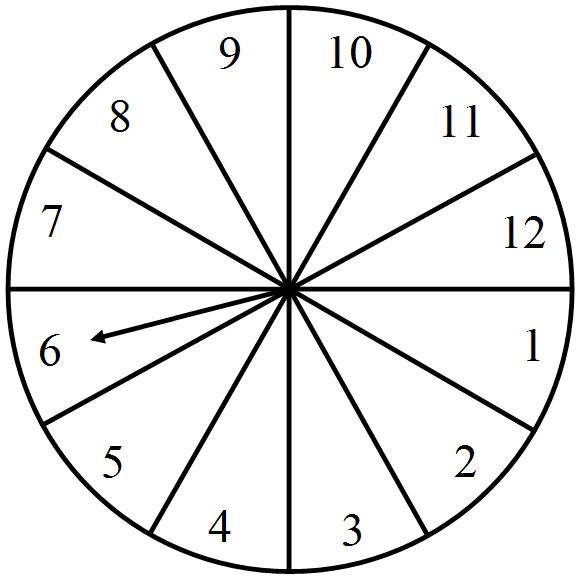
A game of chance consists of spinning an arrow which is equally likely to come to rest pointing to one of the numbers 1, 2, 3, ..., 12 as shown in the figure. What is the probability that it will point to:
  1. 6?
  2. An even number?
  3. A prime number?
  4. A number which is a multiple of 5?
Answer
Spinning arrow may come to rest at one of the 12 numbers
$\therefore\ $total number of outcomes = 12
  1. Probability that it will point at 6
$=\frac{1}{12}$
  1. Even number are 2, 4, 6, 8, 10 and 12.
There are 6 numbers

$\therefore\ $Probability that it points at even numbers

$=\frac{6}{12}$

$=\frac{1}{2}$
  1. The prime numbers are 2, 3, 5, 7 and 11.
There are 5 prime numbers.

$\therefore\ $Probability that it points at prime numbers

$=\frac{5}{12}$
  1. There are 2 number divisible by 5.
These are 5 and 10.

$\therefore\ $Probability that a number is a multiple of 5

$=\frac{2}{12}$

$=\frac{1}{6}$
View full question & answer
Question 252 Marks
Very-Short-Answer Questions.
A die is thrown once. Find the probability of getting:
A number less than 5.
Answer
In a throw of a dice, all possible outcomes are 1, 2, 3, 4, 5, 6

Total number of possible outcomes = 6

Let R be the number less than 5

Then, the favorable outcomes are 1, 2, 3, 4

Number of favorable outcomes = 4

$\therefore$ P(getting a number less than 5) = P(R)

$=\frac{4}{6}$

$=\frac{2}{3}$
View full question & answer
Question 262 Marks
Very-Short-Answer Questions. A die is thrown once. Find the probability of getting:The number 5.
Answer
In a throw of a dice, all possible outcomes are 1, 2, 3, 4, 5, 6

Total number of possible outcomes = 6

Let T be event of getting a number 5

Then the favorable outcome is 5

Number of favorable outcomes = 1

$\therefore$ P(getting a number 5) = P(T)

$=\frac{1}{6}$
View full question & answer
Question 272 Marks
It is known that a box of $200$ electric bulbs contains $16$ defective bulbs. One bulb is taken out at random from the box. What is the probability that the bulb drawn is:
  1. Defective.
  2. Nondefective.
Answer
Total number of bulbs $= 200$
Number of defective bulbs $= 16$
  1. Let $E_1$​​​​​​​ be the event of getting a defective bulb Total number of defective bulbs = 16
$\therefore$ P(getting defective bulbs) $= P(E_1)$
$=\frac{16}{200}$
$=\frac{2}{25}$
  1. Let $E_2$​​​​​​​ be the event of "getting non-defective bulb"
$\therefore$ P(getting non defective bulb) $= P(E_1)$
$=1-\frac{1}{ 200}$
$=\frac{184}{ 200}$
$=\frac{23}{ 25}$
View full question & answer
Question 282 Marks
Very-Short-Answer Questions.
A die is thrown once. Find the probability of getting:
A number between 3 and 6.
Answer
In a throw of a dice, all possible outcomes are 1, 2, 3, 4, 5, 6

Total number of possible outcomes = 6

Let N be the number lying between 3 and 6

Then the favorable outcomes are 4, 5

Number of favorable outcomes = 2

P(getting a number 3 and 6) = P(N)

$=\frac{2}{6}$

$=\frac{1}{3}$
View full question & answer
Question 292 Marks
12 defective pens are accidently mixed with 132 good ones. It is not possible to just look at pen and tell whether or not it is defective. One pen is taken out at random from this lot. Find the probability that the pen taken out is good one.
Answer
There are 12 defective pens, which are accidentally mixed with 132 good ones.
So, there are total 12 + 132 = 144 pens
P(that the pen taken out is good)
$=\frac{132}{144}$
$=\frac{11}{12}$
View full question & answer
Question 302 Marks
17 cards numbered 1, 2, 3, 4, ..., 17 are put in a box and mixed thoroughly. A card is drawn at random from the box. Find the probability that the card drawn bears:
  1. An odd number.
  2. A number divisible by 5.
Answer
Total number of outcomes = 17
  1. The odd number numbers on the cards are 1, 3, 5, 7, 9, 11, 13, 15 and 17
So, there are 9 possible outoomes.
P(getting an odd number)
$=\frac{9}{17}$
  1. The numbers divisible by 5 are:
5, 10 and 15
So, there are 3 possible outcomes.
P(getting a number divisible by 5)
$=\frac{3}{17}$
View full question & answer
Question 312 Marks
There are 35 students in a class of whom 20 are boys and 15 are girls. From these students one is chosen at random. What is the probability that the chosen student is:
  1. Boy.
  2. Girl.
View full question & answer
Question 322 Marks
A game consists of tossing a one-rupes coin three times, and noting its outcome each time. Find the probability of getting.
  1. Three heads.
  2. At least 2 tails.
Answer
Since the one-repee coin is tossed thrice, its outcomes are
{HHH, HTT, TTH, HHT, HTH, THH, TTT}.
So, there are 8 outcomes.
  1. P(getting three heads)
$=\frac{1}{8}$
  1. P(getting at least 2 tails)
$=\frac{4}{8}$

$=\frac{1}{2}$
View full question & answer
Question 332 Marks
Two dice are rolled together. Find the probability of getting such numbers on the two dice whose product is 12.
Answer
If two dice are rolled together, the possible outcomes are:
(1, 1), (1, 2), (1, 3), (1, 4), (1, 5), (1, 6)
(2, 1), (2, 2), (2, 3), (2, 4), (2, 5), (2, 6)
(3, 1), (3, 2), (3, 3), (3, 4), (3, 5), (3, 6)
(4, 1), (4, 2), (4, 3), (4, 4), (4, 5), (4, 6)
(5, 1), (5, 2), (5, 3), (5, 4), (5, 5), (5, 6)
(6, 1), (6, 2), (6, 3), (6, 4), (6, 5), (6, 6)
So, there are 36 outcomes.
The following outcomes will give the product 12.
(2, 6), (6, 2), (3, 4), (4, 3)
So, there are 4 possible outcomes.
P(getting number whose product is 12)
$=\frac{4}{36}$
$=\frac{1}{9}$
View full question & answer