Questions · Page 2 of 2

2 Marks Questions

Question 512 Marks
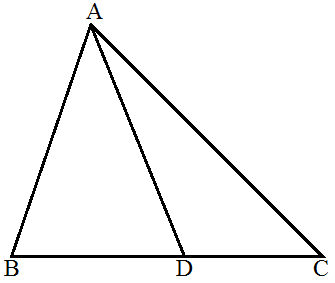
If a $\triangle\text{ABC},$ AD is the bisector of $\angle\text{A},$ Meeting side BC at D.
If AB = 10cm, AC = 14cm and BC = 6cm, find BD and DC
Answer
We have,
AB = 10cm, AC = 14cm and BC = 6cm
Now, $\frac{\text{BD}}{\text{AB}}=\frac{\text{CD}}{\text{AC}}$
⇒ BD × AC = CD × AB
⇒ (BC - CD) AC = CD × AB ($\because$ BD = BC - CD)
⇒ (6 - CD) 14 = CD × 10
⇒ 84 - 14CD = 10CD
⇒ 24CD = 84
$\Rightarrow \text{CD} =\frac{84}{24}$
⇒ CD = 3.5
$\because$ BD = BC - CD
⇒ BD = 6 - 3.5
⇒ BD = 2.5cm
View full question & answer
Question 522 Marks
The area of two similar triangles are $36\ cm^2$ and $100\ cm^2$. If the length of a side of the smaller triangle in $3\ cm$, find the length of the corresponding side of the larger triangle.
Answer
Area of smaller triangle $= 36\ cm^2$
and area of larger triangle $= 100\ cm^2​​​​​​​$​​​​​​​
One side of smaller triangle $= 3\ cm$
Let the corresponding side of larger triangle $= x$
$\triangle\text{s}$ are similar
$\therefore\frac{\text{area of smaller triangle}}{\text{area of larger triangle}}=\frac{(3)^2}{\text{x}^2}$
$\Rightarrow\frac{36}{100}=\frac{9}{\text{x}^2}\Rightarrow\text{x}^2=\frac{9\times100}{36}=25=(5)^2$
$\therefore\text{x}=5$
$\therefore$ Corresponding side of larger triangle $= 5\ cm.$
View full question & answer
Question 532 Marks
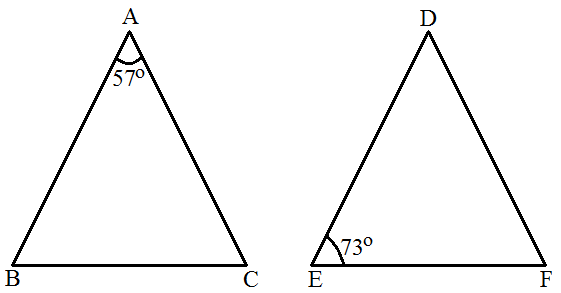
If ABC and DEF are similar triangles such that $\angle\text{A}=57^\circ$ and $\angle\text{E}=73^\circ,$ what is the measure of $\angle\text{C}?$
Answer
We have,

$\triangle\text{ABC}\sim\triangle\text{DEF}$
we know that corresponding angle of similar triangle are equal.
$\angle\text{A}=\angle\text{D}=57^\circ$ and $\angle\text{B}=\angle\text{E}=73^\circ$
$\angle\text{C}=\angle\text{F}=?$
$\angle\text{A}+\angle\text{B}+\angle\text{C}=180^\circ$ (Angle sum property)
$\Rightarrow57^\circ+73^\circ+\angle\text{C}=180^\circ$
$\Rightarrow130^\circ+\angle\text{C}=180^\circ$
$\Rightarrow\angle\text{C}=180^\circ-130^\circ$
$\Rightarrow\angle\text{C}=50^\circ$
Thus, $\angle\text{C}=50^\circ$
View full question & answer
Question 542 Marks
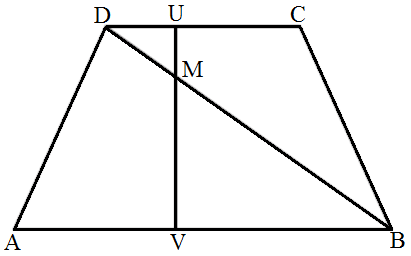
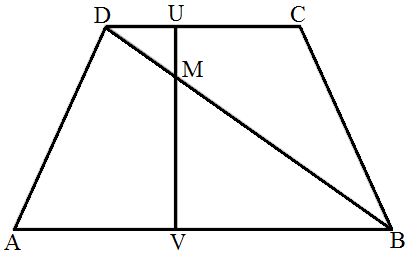
In the given figure,

AB || DC prove that
DM × BV = BM × DU
Answer

Since $\triangle\text{DMU}\sim\triangle\text{BMV}$
$\frac{\text{DM}}{\text{BM}}=\frac{\text{MU}}{\text{MV}}=\frac{\text{DU}}{\text{BV}}$
$\frac{\text{DM}}{\text{BM}}=\frac{\text{DU}}{\text{BV}}$
By cross multiplication, we get,
DM × BV = DU × BM
Hence proved that DM × BV = DU × BM.
View full question & answer
Question 552 Marks
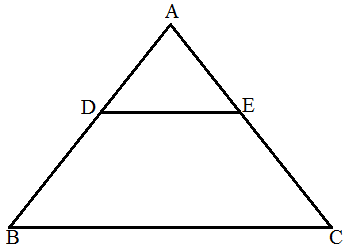
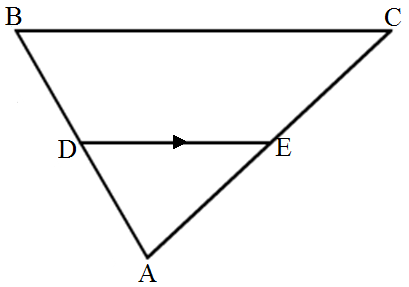
In the given figure, DE || BC and $\text{AD}=\frac{1}{2}\text{BD}.$ If BC = 4.5cm, find DE.
Answer
Given: In $\triangle\text{ABC},\ \text{DE}||\text{BC}.\ \text{AD}=\frac{1}{2}\text{BD}$ and BC = 4.5cm.
To find: DE
In $\triangle\text{ABC}$ and $\triangle\text{ADE}$
$\angle\text{B}=\angle\text{ADE}$ (Corresponding angles)
$\angle\text{A}=\angle\text{A}$ (Common)
$\therefore\triangle\text{ABC}\sim\triangle\text{ADE}$ (AA Similarity)
$\frac{\text{AD}}{\text{AB}}=\frac{\text{DE}}{\text{BC}}$
$\frac{\text{AD}}{\text{AD}+\text{BD}}=\frac{\text{DE}}{\text{BC}}$
$\frac{\frac{1}{2}\text{BD}}{\frac{1}{2}\text{BD}+\text{BD}}=\frac{\text{DE}}{\text{BC}}$
$\frac{1}{3}=\frac{\text{DE}}{\text{BC}}$
$\frac{1}{3}=\frac{\text{DE}}{4.5}$
$\text{DE} = 1.5\text{cm.}$
View full question & answer
Question 562 Marks
In FIg. check whether AD is the bisector of $\angle\text{A}$ of $\triangle\text{ABC}$ in the following.

AB = 6cm, AC = 8cm, BD = 1.5cm and CD = 2cm.
Answer
It is given that, AB = 6cm, AC = 8cm, BD = 1.5cm and CD = 2cm.
We have to check whether AD is bisector of $\angle\text{A}$.
First we will check proportional retio between sides.
So $\frac{\text{AB}}{\text{AC}}=\frac{\text{BD}}{\text{DC}}$
$\Rightarrow\frac{6}{8}=\frac{1.5}{2}$
$\Rightarrow\frac{3}{4}=\frac{3}{4}$
(It is proportional)
Hence, AD is bisector of $\angle\text{A}$.
View full question & answer
Question 572 Marks
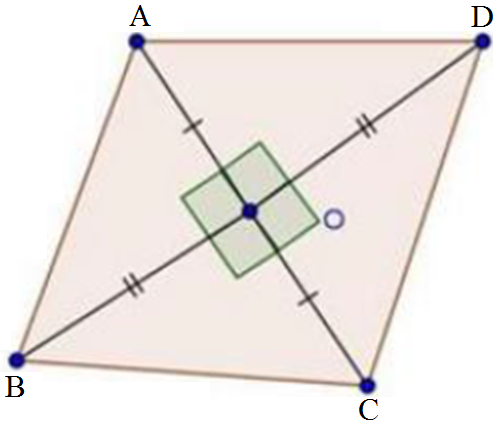
The lengths of the diagonals of a rhombus are $24\ cm$ and $10\ cm$. Find each side of the rhombus.
Answer


We have,
ABCD is a rhombus with diagonals $AC = 10\ cm$ and $BD = 24\ cm$
We know that diagonal of a rhombus bisect each other at $90^\circ $
$\therefore$ $AO = OC = 5\ cm$ and $BO = OD = 12\ cm$
In $\triangle\text{AOB},$ by Pythagoras theorem
$AB^2 = AO^2 + BO^2$
$\Rightarrow AB^2 = 5^2 + 12^2$
$\Rightarrow AB^2 = 25 + 144 = 169$
$\Rightarrow\text{AB}=\sqrt{169}=13\text{cm}$
View full question & answer
Question 582 Marks
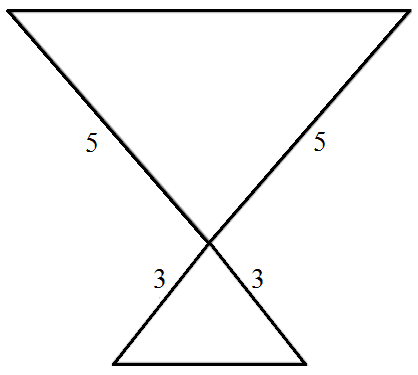
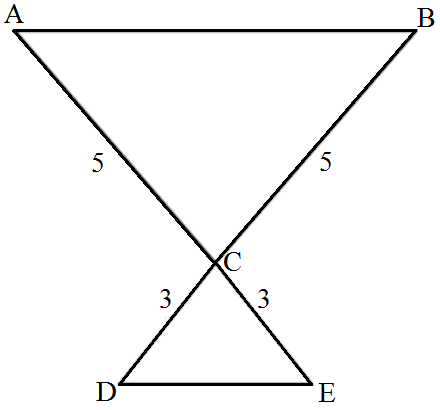
In the following figures, you find who triangles. Indicate whether the triangles are similar. Give reasons in support of your answer.​
Answer
In two triangle, we observe that

In $\triangle\text{ABC}$ and $\triangle\text{CDE}$
$\frac{\text{CD}}{\text{CE}}=\frac{\text{CB}}{\text{CA}}$
$\angle\text{ACB}=\angle\text{DCE}$ (Vertically opposite angles)
$\triangle\text{ABC}\sim\triangle\text{CDE}$ (SAS Similarity)
yes two triangles are similar.
View full question & answer
Question 592 Marks
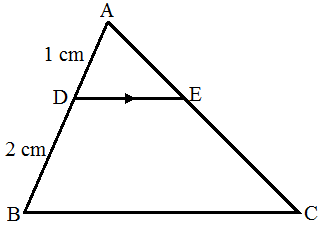
In the adjoining figure, DE is parallel to BC and AD = 1cm, BD = 2cm. What is the ratio of the area of $\triangle\text{ABC}$ to the area of $\triangle\text{ADE}?$
Answer
In $\triangle\text{ABC},\ \text{DE}||\text{BC}$
$\therefore\triangle\text{ADE}\sim\triangle\text{ABC}$

$\therefore\frac{\text{area}\triangle\text{ABC}}{\text{area}\triangle\text{ADE}}=\frac{\text{AB}^2}{\text{AD}^2}=\frac{(\text{AD}+\text{DB})^2}{\text{AD}^2}$
$=\frac{(1+2)^2}{(1)^2}=\frac{3^2}{1}=\frac{9}{1}$
$\therefore$ Ratio = 9 : 1
View full question & answer
Question 602 Marks
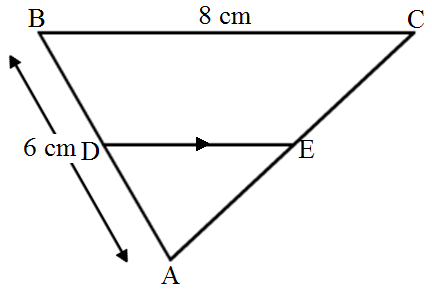
In the figure, DE || BC in $\triangle\text{ABC}$ such that BC = 8cm, AB = 6cm and DA = 1.5cm. Find DE.
Answer
In the given figure,
DE || BC
BC = 8cm, AB = 6cm and DA = 1.5cm.

In $\triangle\text{ABC}$ and $\triangle\text{ADE},$
$\angle\text{A}=\angle\text{A}$ (Common)
$\angle\text{B}=\angle\text{ADE}$ (Corresponding angles)
$\therefore\triangle\text{ABC}\sim\triangle\text{ADE}$ (AA axiom)
$\therefore\frac{\text{AB}}{\text{AD}}=\frac{\text{BC}}{\text{DE}}\Rightarrow\frac{6}{1.5}=\frac{8}{\text{DE}}$
$\Rightarrow\text{DE}=\frac{8\times1.5}{6}=\frac{12}{6}=2\text{cm}.$
View full question & answer
Question 612 Marks
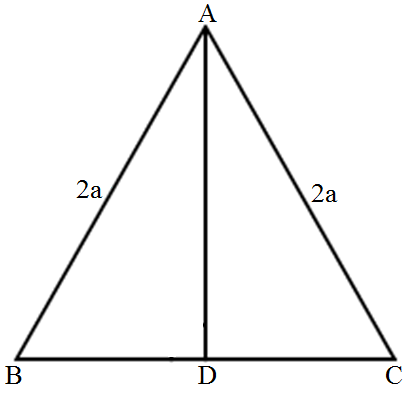
In a $\triangle\text{ABC},$ $AB = BC = CA = 2a$ and $\text{AD}\perp\text{BC}.$ Prove that
$\text{AD}=\text{a}\sqrt{3}$
Answer
$\triangle\text{ABC},$ $AB = BC = AC = 2a$
$\triangle\text{AD}\perp\text{BC}$
AD bisects BC at D
$\text{BD}=\text{DC}=\frac{1}{2}\text{BC}=\text{a}$

Now in $\triangle\text{ABD}$
$AB^2 = AD^2 + BD^2$
$\Rightarrow (2a)^2 = AD^2 + a^2 $
$\Rightarrow 4a^2 = AD^2 + a^2$
$\Rightarrow AD^2 = 4a^2 - a^2 = 3a^2​​​​​​​$​​​​​​​ $=(\sqrt3\text{a})^2$
$\therefore\text{AD}=\sqrt{3}\text{a}$
View full question & answer
Question 622 Marks
state SAS similarity criterion.
Answer
If in two triangles, one pair of coresponding sides are proportional and the included angle are equal then the two triangles are similar.
View full question & answer