Question 14 Marks
In $\triangle\text{ABC},$ D and E are the mid-points of AB and AC respectively. Find the ratio of the areas of $\triangle\text{ADE}$ and $\triangle\text{ABC.}$
Answer
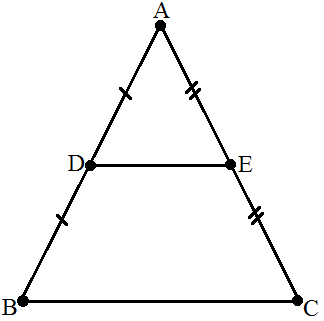 We have, D and E as the mid-points of AB and AC
So, according to the mid-point theorem
DE || BC and DE $=\frac{1}{2}\text{BC}\ \ ....(\text{i})$
In $\triangle\text{ADE and }\triangle\text{ABC}$
$\angle\text{A}=\angle\text{A}$ [Common]
$\angle\text{ADE}=\angle\text{B}$ [Corresponding angles]
Then, $\triangle\text{ADE}\sim\triangle\text{ABC}$ [By AA similarity]
By area of similar triangle theorem
$\frac{\text{ar}\ (\triangle\text{ADE})}{\text{ar }(\triangle\text{ABC})}=\frac{\text{DE}^2}{\text{BC}^2}$
$=\frac{\Big(\frac{1}{2}\text{BC}\Big)^2}{\text{BC}^2}\ \ \ [\text{From (i)}]$
$=\frac{\frac{1}{4}\text{BC}^2}{\text{BC}^2}$
$=\frac{1}{4}$ View full question & answer→Question 24 Marks
ABCD is a rectangle. Points M and N are on BD such that $\text{AM}\perp\text{BD}$ and $\text{CN}\perp\text{BD}.$ Prove that $BM^2 + BN^2= DM^2+ DN^2$.
AnswerGiven: A rectangle ABCD where $\text{AM}\perp\text{BD}$ and $\text{CN}\perp\text{BD}.$
To prove: $BM^2 + BN^2 = DM^2 + DN^2$
Proof:
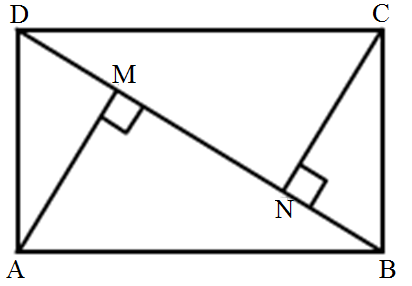
Apply Pythagoras Theorem in $\triangle AMB$ and $\triangle CND$,
$A B^2=A M^2+M B^2$
$C D^2=C N^2+N D^2$
Since $A B=C D, A M^2+M B^2=C N^2+N D^2$
$\Rightarrow AM^2-CN^2=ND^2-MB^2 \ldots \text { (i) }$
Again apply Pythagoras Theorem in $\triangle AMD$ and $\triangle CNB$,
$A D^2=A M^2+M D^2$
$C B^2=C N^2+N B^2$
Since $A D=B C, A M^2+M D^2=C N^2+N B^2$
$\Rightarrow AM^2-CN^2=NB^2-MD^2 \ldots$
Equating (i) and (ii),
$N D^2-M B^2=N B^2-M D^2$
l.e., $BM ^2+ BN ^2= DM ^2+ DN ^2$
This proves the given relation. View full question & answer→Question 34 Marks
In the given figure, $AB || CD,$ if $OA = 3x - 19, OB = x - 4, OC = x - 3$ and $OD = 4,$ find $x.$
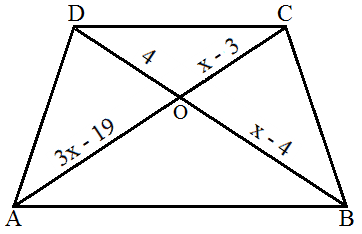
AnswerIn figure, $AB || CD,$ if $OA = 3x - 19, OB = x - 4, OC = x - 3 $ and $OD = 4$, find $x.$
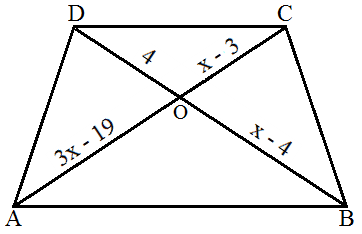
we have,
$AB || CD$ and $OA = 3x - 19, OB = x - 4, OC = x - 3$ and $OD = 4$
Now, $\frac{\text{AO}}{\text{OC}}=\frac{\text{BO}}{\text{OD}}$
$\Rightarrow\frac{(3\text{x}-19)}{(\text{x}-3)}=\frac{(\text{x}-4)}{4}$
$\Rightarrow 4(3x - 19) = (x - 4)(x - 3)$
$\Rightarrow 12x - 76 = x^2- 4x - 3x + 12$
$\Rightarrow 12x - 76 = x^2 - 7x + 12$
$\Rightarrow x^2 - 7x - 12x = -76 - 12$
$\Rightarrow x^2 - 19x = -88$
$\Rightarrow x^2 - 19x + 88 = 0$
$\Rightarrow x^2 - 11x - 8x + 88 = 0$
$\Rightarrow x(x - 11) - 8(x - 11) = 0$
$\Rightarrow (x - 11)(x - 8) = 0$
$\Rightarrow x - 11 = 0$ or $x - 8 = 0$
$\Rightarrow x = 11$ or $x = 8$
Thus, $x = 11, 8$ View full question & answer→Question 44 Marks
$A$ point $D$ is on the side $BC$ of an equilateral triangle $ABC$ such that $\text{DC}=\frac{1}{4}\text{BC}.$ Prove that $AD^2= 13\ CD^2$
AnswerGiven: In the equilateral $\triangle\text{ABC,}$ D is a point on BC such that $\text{DC}=\frac{1}{4}\text{BC}$
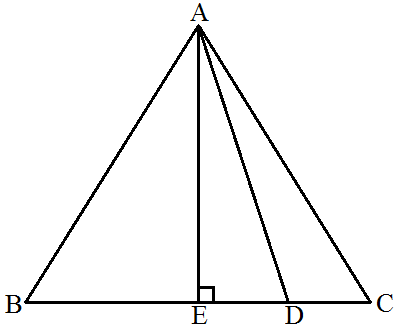
To prove: $AD^2 = 13CD^2$
Construction: Draw $\text{AE}\perp\text{BC}$
Proof: $\because\text{AE}\perp\text{BC}$
$\therefore E$ is the mid-point of $BC$ and $D$ is a point such that
$\text{DC}=\frac{1}{4}\text{BC}$ Now in right
$\triangle\text{ADE,} AD^2 = AE^2 + ED^2 ($Pythagoras Theorem$)$ and in right
$\triangle\text{AEC,} AC^2 = AE^2 + EC^2 \Rightarrow AE^2 = AC^2 - EC^2$
$\therefore AD^2 = AC^2 - EC^2 + ED^2 =\text{BC}^2-\Big(\frac{1}{2}\text{BC}\Big)^2+\text{ED}^2$ $\{\because E$ is mid point of BC$\} $
$=\text{BC}^2-\frac{1}{4}\text{BC}^2+\text{ED}^2$
$=\frac{3}{4}\text{BC}^2+\text{ED}^2$
$=\frac{3}{4}(4\text{DC})^2+\text{DC}^2\ \ \ \ \ (\because\text{ED}=\text{DC})$
$=\frac{3}{4}\times16\text{DC}^2+\text{DC}^2$
$= 12DC^2 + DC^2 = 13DC^2$
Hence $AD^2 = 13DC^2$ or $13CD^2 $ Hence proved. View full question & answer→Question 54 Marks
A guy wire attached to a vertical pole of height $18\ m$ is $24\ m$ long has a stake attached to the other end. How far from the base of pole should the stake be driven so that the wire will be taut?
AnswerWe will draw the figure from the given information as below,
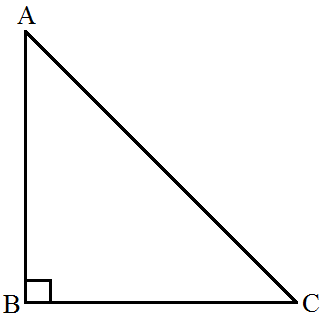
Let AB be the vertical pole of length $18\ m$ and let the stake be at the point $C$ so the wire will be taut.
Therefore, we have $AB = 18\ m, AC = 24\ m$ and we have to find BC.
Now we will use Pythagoras theorem,
$AC^2 = AB^2 + BC^2$
Let us substitute the values we get,
$24^2 = 18^2 + BC^2$
Subtracting $324$ from both sides of the equation we get,
$BC^2 = 576 - 324$
$BC^2 = 252$
We can rewrite the $252$ as $36 \times 7$, therefore, our equation becomes,
$BC^2 = 36 \times 7$
Now we will take the square root,
$\text{BC}=6\times\sqrt{7}$
Therefore, the stake should be $6\sqrt{7}\text{ m}$ far from the base of the pole so that the wire will be taut. View full question & answer→Question 64 Marks
The corresponding altitudes of two similar triangles are 6cm and 9cm respectively. Find the ratio of their areas.
Answer
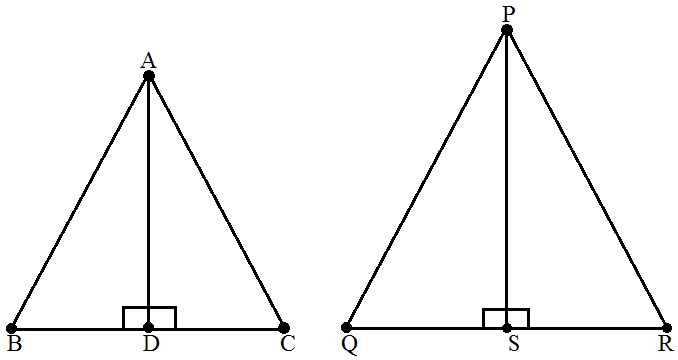 We have,
$\triangle\text{ABC}\sim\triangle\text{PQR}$
AD = 6cm
And, PS = 9cm
By area of similar triangle theorem
$\frac{\text{Area}(\triangle\text{ABC})}{\text{Area}(\triangle\text{PQR})}=\frac{\text{AB}^2}{\text{PQ}^2}\ ...(\text{i})$
In $\triangle\text{ABD}$ and $\triangle\text{PQS}$
$\angle\text{B}=\angle\text{Q}\ \ \ \ \ [\triangle\text{ABC}\sim\triangle\text{PQR}]$
$\angle\text{ADB}=\angle\text{PSQ}$ [Each 90°]
Then, $\triangle\text{ABD}\sim\triangle\text{PQS}$ [by AA similarity]
$\therefore\frac{\text{AB}}{\text{PQ}}=\frac{\text{AD}}{\text{PS}}$ [Corresponding parts of similar $\triangle$ are proportional]
$\Rightarrow\frac{\text{AB}}{\text{PQ}}=\frac{6}{9}$
$\Rightarrow\frac{\text{AB}}{\text{PQ}}=\frac{2}{3}\ \ \ ....(\text{ii})$
Compare equations (i) and (ii)
$\frac{\text{Area}(\triangle\text{ABC})}{\text{Area}(\triangle\text{PQR})}=\Big(\frac{2}{3}\Big)^2=\frac{4}{9}$ View full question & answer→Question 74 Marks
$AD$ is an altitude of an equilateral triangle $ABC.$ On $AD$ as base, another equilateral triangle $ADE$ is constructed.
Prove that Area $(\triangle\text{ADE)}$ : Area $(\triangle\text{ABC)} = 3 : 4.$
Answer
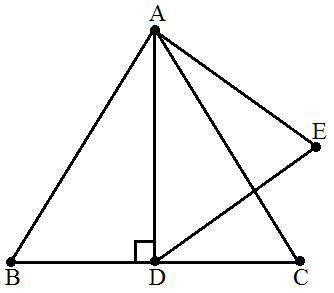
We have,
$\triangle\text{ABC}$ is an equilateral triangle
Then, $AB = BC = AC$
Let, $AB = BC = AC = 2x$
Since, $\text{AD}\perp\text{BC}$ then $BD = DC = x$
In $\triangle\text{ADB}$, by pythagoras theorem
$AB^2 = (2x)^2- (x)^2$
$\Rightarrow AD^2 = 4x^2 - x^2 = 3x^2$
$\Rightarrow\text{AD}=\sqrt{3}\text{x cm}$
Since, $\triangle\text{ABC}$ and $\triangle\text{ADE}$ both are equilateral triangles then they are equiangular
$\therefore\triangle\text{ABC}\sim\triangle\text{ADE}$ [By AA similarity]
By area of similar triangle theorem
$\frac{\text{ar}(\triangle\text{ADE)}}{\text{ar}(\triangle\text{ABC})}=\frac{\text{AD}^2}{\text{AB}^2}$
$=\frac{(\sqrt{3}\text{x})^2}{(2\text{x})^2}$
$=\frac{3\text{x}^2}{4\text{x}^2}$
$=\frac{3}{4}$ View full question & answer→Question 84 Marks
Nazima is fly Ashing in a stream. The tip of her Ashing rod is $1.8m$ above the surface of the water and the fly at the end of the string rests on the water $3.6m$ away and $2.4m$ from a point directly under the tip of the rod. Assuming that her string (from the tip of her rod to the fly) is taut, how much string does she have out? If she pulls the string at the rate of $5cm$ per second, what will the horizontal distance of the fly from her after $12$ seconds.
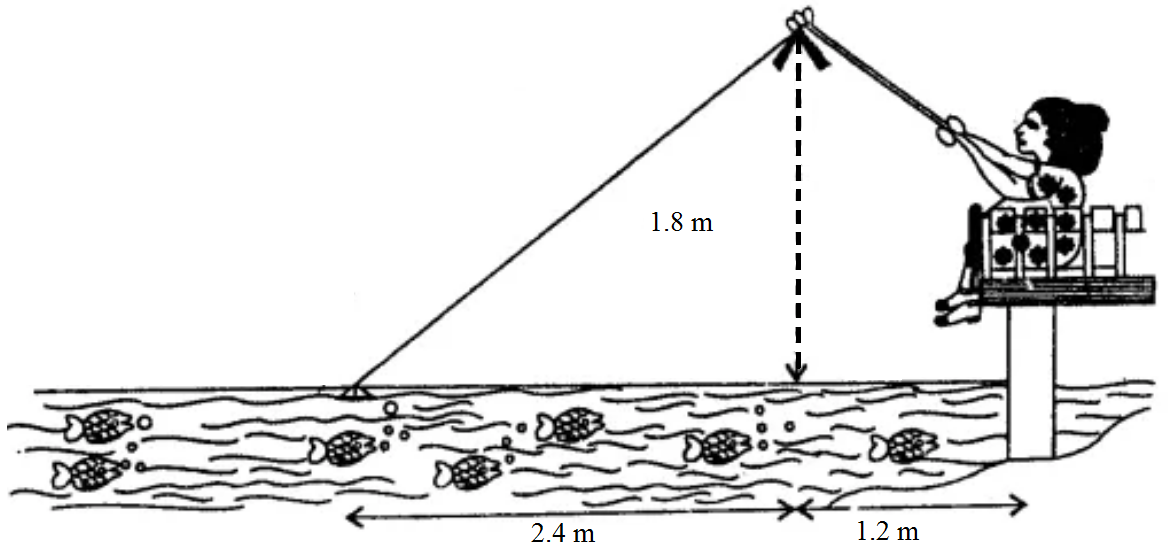
AnswerHeight of the rod from stream level $= 1.8m$
and of string from the point under the tip of rod $= 2.4m$
Let the length of string $= x$
$x^2 = (1.8)^2 + (2.4)^2 = 3.24 + 5.76 = 9.00 = (3.0)^2$
$x = 3.0$
Length of string $= 3m$
Rate of pulling the string $= 5cm$ per second
Distance covered in $12$ seconds $= 5 \times 12 = 60cm.$
At this stage, length of string $= 3.0 - 0.6 = 2.4m$
Height $= 1.8m$
Let base $= y$ then
$(2.4)^2 = y^2+ (1.8)^2$
$\Rightarrow 5.76 = y^2 + 3.24$
$\Rightarrow y^2 = 5.76 - 3.24 = 2.52$
$y = 1.59$
and distance from her $= 1.59 + 1.2 = 2.79m.$
View full question & answer→Question 94 Marks
The diagonals of quadrilateral ABCD intersect at O. Prove that $\frac{\text{ar}(\triangle\text{ACB})}{\text{ar}(\triangle\text{ACD})}=\frac{\text{BO}}{\text{DO}}.$
AnswerWe are given the following quadrilateral with O as the intersection point of diagonals
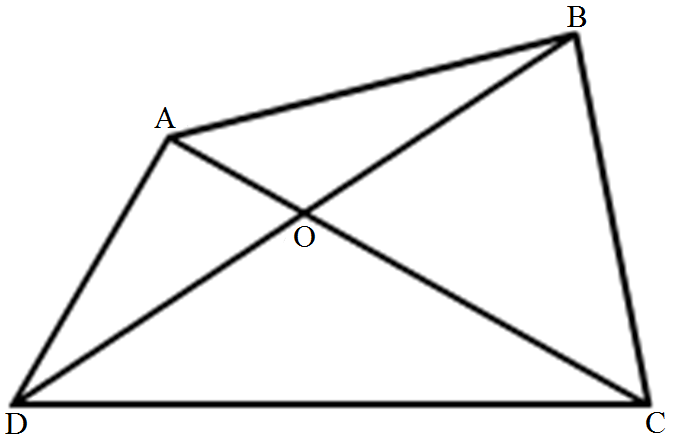
To Prove: $\frac{\text{ar}(\triangle\text{ACB})}{\text{ar}(\triangle\text{ACD})}=\frac{\text{BO}}{\text{DO}}$
Given: ACB and ACD are two triangles on the same base AC
Consider h as the distance between two parallel sides
Now we see that the height of these two triangles ACB and ACD are same and are equal to h
So $\frac{\text{ar}(\triangle\text{ACB})}{\text{ar}(\triangle\text{ACD})}=\frac{\frac{1}{2}\times\text{AB}\times\text{h}}{\frac{1}{2}\times\text{CD}\times\text{h}}$
$=\frac{\text{AB}}{\text{CD}}\ \ \ ....(1)$
Now consider the triangles AOB and COD in which
$\angle\text{AOB}=\angle\text{COD}$
$\angle\text{ABO}=\angle\text{ODC}$ (alternative angle)
$\angle\text{BAO}=\angle\text{DCA}$ (alternative angle)
Therefore, $\triangle\text{ODC}\sim\triangle\text{OBA}$
$\Rightarrow\frac{\text{AO}}{\text{OC}}=\frac{\text{BO}}{\text{DO}}=\frac{\text{AB}}{\text{CD}}$
$\Rightarrow\frac{\text{BO}}{\text{DO}}=\frac{\text{AB}}{\text{CD}}\ \ \ ....(2)$
From equation (1) and (2) we get
$\frac{\text{ar}(\triangle\text{ACB})}{\text{ar}(\triangle\text{ACD})}=\frac{\text{BO}}{\text{DO}}$
Hence prove that $\frac{\text{ar}(\triangle\text{ACB})}{\text{ar}(\triangle\text{ACD})}=\frac{\text{BO}}{\text{DO}}$ View full question & answer→Question 104 Marks
In an isosceles $\triangle\text{ABC,}$ the base $AB$ is produced both the ways to $P$ and $Q$ such that $AP \times BQ = AC^2.$ Prove that $\triangle\text{APC}\sim \triangle\text{BCQ}.$
Answer
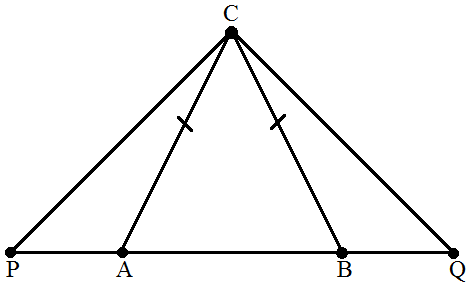
Given: In $\triangle\text{ABC}, CA = CB$ and $AP \times BQ = AC^2$
To prove: $\triangle\text{APC}\sim\triangle\text{BCQ}$
Proof:
$\text{AP}\times\text{BQ}=\text{AC}^2\ \ \ \ \ [\text{Given}]$
$\Rightarrow\text{AP}\times\text{BQ}=\text{AC}\times\text{AC}$
$\Rightarrow\text{AP}\times\text{BQ}=\text{AC}\times\text{BC}\ \ \ \ [\text{AC = BC given}]$
$\Rightarrow\frac{\text{AP}}{\text{BC}}=\frac{\text{AC}}{\text{BQ}}\ \ ....(\text{i})$
Since, $CA = CB [$Given$]$
Then, $\angle\text{CAB}=\angle\text{CBA}\ .....(\text{ii})$ [Opposite angles to equal sides]
Now, $\angle\text{CAB}+\angle\text{CAP}=180^\circ\ .....(\text{iii})$ [Linear pair of angles]
And, $\angle\text{CBA}+\angle\text{CBQ}=180^\circ\ .....(\text{iv})$ [Linear pair of angles]
Compare equation $(ii), (iii)$ & $(iv)$
$\angle\text{CAP}=\angle\text{CBQ}\ \ \ ....(\text{v})$
In $\triangle\text{APC}$ and $\triangle\text{BCQ}$
$\angle\text{CAP}=\angle\text{CBQ}$ [From (V)]
$\frac{\text{AP}}{\text{BC}}=\frac{\text{AC}}{\text{BQ}}$ [From (i)]
Then, $\triangle\text{APC}\sim\triangle\text{BCQ}$ [By SAS similarity] View full question & answer→Question 114 Marks
In $\triangle\text{ABC},\ \angle\text{ABC}=135^\circ.$ Prove that $AC^2 = AB^2 + BC^2 + 4 \text{ar}(\triangle\text{ABC}).$
AnswerWe have the following figure.
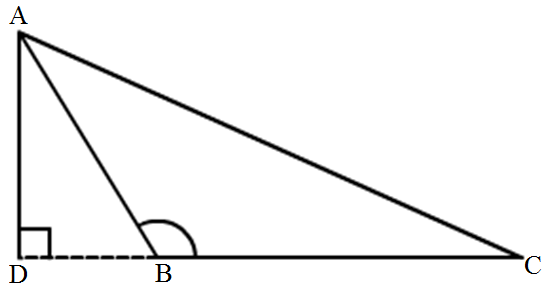
Here $\triangle\text{ADB}$ is a right triangle right angled at $D.$ therefore by Pythagoras theorem we have
$AB^2 = AD^2 + DB^2$
Again $\triangle\text{ADC}$ is a right triangle right angled at $D.$
Therefore, by Pythagoras theorem, we have
$AC^2 = AD^2 + DC^2$
$AC^2 = AD^2 + (DB + BC)^2$
$AC^2 = AD^2 + DB^2 + BC^2 + 2 \times BC \times BD$
Since angle ABD is $45^\circ$ and therefore angle $BAD$ is also $45^\circ .$
Hence $AB = DB$
So,
$AC^2 = AD^2 + DB^2 + BC^2 + 2BC \times AD$
$= \text{AD}^2 + \text{DB}^2 + \text{BC}^2 + 2\times2\times\frac{1}{2}\text{BC}\times\text{AD}$
$= \text{AD}^2 + \text{DB}^2 + \text{BC}^2 + 4\text{ar}(\triangle\text{ABC})$
Since $AB^2 = AD^2 + DB^2$
So, $\text{AC}^2 = \text{AB}^2 + \text{BC}^2 + 4\text{ar}(\triangle\text{ABC})$
Hence we have proved that $\text{AC}^2 = \text{AB}^2 + \text{BC}^2 + 4\text{ar}(\triangle\text{ABC})$ View full question & answer→Question 124 Marks
ABCD is a parallelogram and APQ is a straight line meeting BC at P and DC produced at Q. Prove that the rectangle obtained by BP and DQ is equal to the rectangle contained by AB and BC.
Answer
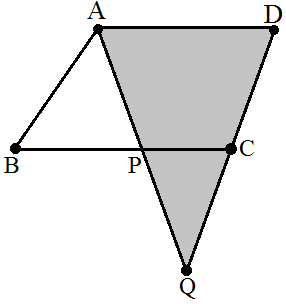 Given: ABCD is a parallelogram
To prove: BP × DQ = AB × BC
Proof: In $\triangle\text{ABP}$ and $\triangle\text{QDA}$
$\angle\text{B}=\angle\text{D}$ [Opposite angles of parallelogram]
$\angle\text{BAP}=\angle\text{AQD}$ [Alternate interior angles]
Then, $\triangle\text{ABP}\sim\triangle\text{QDA}$ [By AA similarity]
$\therefore\frac{\text{AB}}{\text{QD}}=\frac{\text{BP}}{\text{DA}}$ [Corresponding parts of similar $\triangle$ are proportional]
But, DA = BC [Opposite sides of parallelogram]
Then, $\frac{\text{AB}}{\text{QD}}=\frac{\text{BP}}{\text{BC}}$
$\Rightarrow\text{AB}\times\text{BC}=\text{QD}\times\text{BP}$ View full question & answer→Question 134 Marks
D, E and F are the points on sides BC, CA and AB respectively of $\triangle\text{ABC}$ such that AD bisects $\angle\text{A},$ BE bisects $\angle\text{B}$ and CF bisects $\angle\text{C}.$ If AB = 5cm, BC = 8cm and CA = 4cm, determine AF, CE and BD.
AnswerIn $\triangle\text{ABC},$
AD, BE and CE bisects $\angle\text{A},\angle\text{B}\ \text{and}\ \angle\text{C}$ respectively.
AB = 5cm, BC = 8cm and CA = 4cm
$\because$ AD bisects $\angle\text{A}$ so,
$\frac{\text{AB}}{\text{BD}}=\frac{\text{AC}}{\text{CD}}$
$\Rightarrow\frac{\text{AB}}{\text{BD}}=\frac{\text{AC}}{\text{BC}-\text{BD}}$
$\Rightarrow\frac{5}{\text{BD}}=\frac{4}{8-\text{BD}}$
$\Rightarrow40-5\text{BD}=4\text{BD}$
$\Rightarrow9\text{BD}=40$
$\Rightarrow\text{BD}=\frac{40}{9}=4.44\text{cm}$
and, BE bisects $\angle\text{B}$ so,
$\Rightarrow\frac{\text{BC}}{\text{CE}}=\frac{\text{AB}}{\text{AE}}$
$\Rightarrow\frac{\text{BC}}{\text{CE}}=\frac{\text{AB}}{\text{AC}-\text{CE}}$
$\Rightarrow\frac{8}{\text{CE}}=\frac{5}{4-\text{CE}}$
$\Rightarrow32-8\text{CE}=5\text{CE}$
$\Rightarrow13\text{CE}=32$
$\Rightarrow\text{CE}=\frac{32}{13}$
$\Rightarrow\text{CE}=2.46\text{cm}$
and, CF bisects $\angle\text{C}$ so,
$\Rightarrow\frac{\text{BC}}{\text{BF}}=\frac{\text{AC}}{\text{AF}}$
$\Rightarrow\frac{\text{BC}}{\text{AB}-\text{AF}}=\frac{\text{AC}}{\text{AF}}$
$\Rightarrow\frac{8}{5-\text{AF}}=\frac{4}{\text{AF}}$
$\Rightarrow8\text{AF}=20-4\text{AF}$
$\Rightarrow12\text{AF}=20$
$\Rightarrow\text{AF}=\frac{20}{12}$
$\Rightarrow\text{AF}=\frac{5}{3}$
$\Rightarrow\text{AF}=1.66$
$\Rightarrow\text{AF}=1.7\text{cm}$
View full question & answer→Question 144 Marks
In $\triangle\text{ABC}, AD$ is median. Prove that $AB^2 + AC^2 = 2AD^2 + 2DC^2.$
AnswerGiven: In $\triangle\text{ABC},$ AD is the median of $BC$
To prove: $AB^2 + AC^2 = 2AD^2 + 2DC^2$
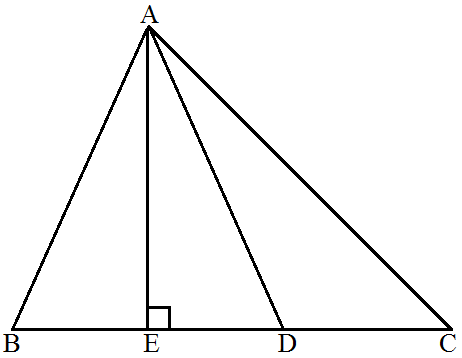
Construction: Draw $\text{AE}\perp\text{BC}$
Proof: In $\triangle\text{ABE},$
$AB^2 = AE^2 + BE^2 ....(i) ($Pythagoras Theorem$)$
Similarly in right $\triangle\text{ACE},$
$AC^2 = AE^2 + EC^2 .....(ii)$
and in right $\triangle\text{AED},$
$AD^2 = AE^2 + ED^2 ....(iii)$
Adding $(i)$ and $(ii)$
$AB^2 + AC^2 = AE^2 + BE^2 + AE^2 + EC^2$
$= 2AE^2 + (BD - ED)^2 + (DC + ED)^2$
$= 2AE^2 + BD^2 + ED^2 - 2BD \times ED + DC^2 + ED^2 + 2BC \times ED$
$= 2AE^2 + BD^2 + 2ED^2 + BD^2 + 2BD \times ED - 2BD \times ED ( \because D$ is mid points$)$
$= 2AE^2 + 2BD^2 + 2ED^2$
$= 2(AE^2 + ED^2) + 2DC^2 ( \because DC = BD)$
$= 2AD^2 + 2DC^2 \{$From $(iii)\}$
Hence proved. View full question & answer→Question 154 Marks
In the given figure, if $AB || CD,$ find the value of $x.$
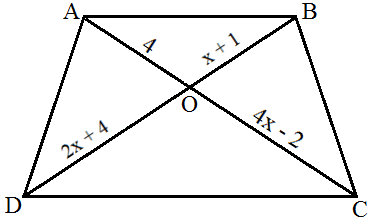
AnswerIn the figure, $AB || CD$
The diagonals of a trapezium divides each other proportionally
$\therefore\frac{\text{AO}}{\text{OC}}=\frac{\text{BO}}{\text{OD}}\Rightarrow\frac{4}{4\text{x}-2}=\frac{\text{x}+1}{2\text{x}+4}$
$\Rightarrow 4x(2x + 4) = (4x - 2)(x + 1) ($by cross multiplication$)$
$\Rightarrow 8x + 16 = 4x^2 +4x - 2x - 2$
$\Rightarrow 8x + 16 = 4x^2 + 2x - 2$
$\Rightarrow 4x^2 + 2x - 2 - 8x - 16 = 0$
$\Rightarrow 4x^2 - 6x - 18 = 0$
$\Rightarrow 2x^2 - 3x - 9 = 0$
$\Rightarrow 2x^2 - 6x + 3x - 9 = 0$ $\begin{cases}\because-9\times2=-18\\\therefore-18=-6\times3\\-3=-6+3\end{cases}$
$\Rightarrow 2x(x - 3) + 3(x - 3) = 0$
$\Rightarrow (x - 3)(2x + 3) = 0$
Either $x - 3 = 0,$ then $x = 3$
or $2x + 3 = 0$, then $2x = -3$
$\Rightarrow\text{x}=\frac{-3}{2}$
But it is negative
$\therefore\text{x}=3$
View full question & answer→Question 164 Marks
In the given figure, l || m
- Name three pairs of similar triangle with proper correspondence; write similarities.
- prove that $\frac{\text{AB}}{\text{PQ}}=\frac{\text{AC}}{\text{PR}}=\frac{\text{BC}}{\text{RQ}}$
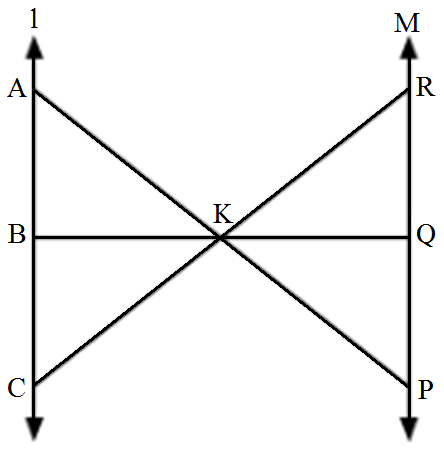
AnswerIn the figure, l || m
$\therefore\angle\text{A}=\angle\text{P}$ and $\angle\text{C}=\angle\text{R}$ (Alternate angles)
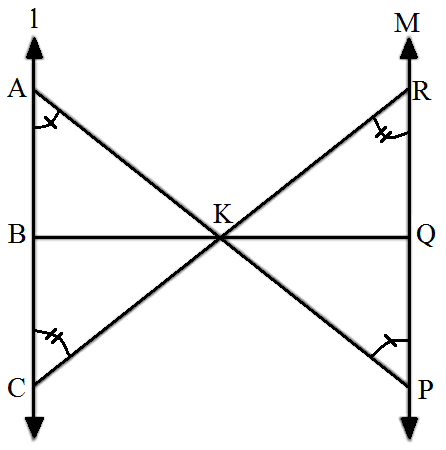
$\angle\text{AKB}=\angle\text{PKQ}$
$\angle\text{CKB}=\angle\text{RKQ}$ (Vertically opposite angles)
$\therefore\triangle\text{ABK}\sim\triangle\text{PQR}\ \ \ ... (\text{i})$ (AA criterion)
and $\triangle\text{CBK}\sim\triangle\text{RQK}\ \ \ ... (\text{ii})$ (AA criterion)
and $\triangle\text{AKC}\sim\triangle\text{PKR}\ \ \ ... (\text{iii})$ (AAA criterion)
(i) From (ii)
$\because\triangle\text{AKB}\sim\triangle\text{PKQ}$
$\therefore\frac{\text{AB}}{\text{PQ}}=\frac{\text{BK}}{\text{QK}}=\frac{\text{AK}}{\text{PK}}\ \ ....(\text{iv})$
and from (ii)
$\because\frac{\text{BC}}{\text{RQ}}=\frac{\text{BK}}{\text{QK}}=\frac{\text{CK}}{\text{RK}}\ \ ....(\text{v})$
and from (iii)
$\triangle\text{AKC}=\angle\text{PKR}$
$\therefore\frac{\text{AK}}{\text{PK}}=\frac{\text{CK}}{\text{RK}}=\frac{\text{AC}}{\text{PR}}\ \ ....(\text{vi})$
From (iv), (v) and (vi)
$\frac{\text{AB}}{\text{PQ}}=\frac{\text{AC}}{\text{PR}}=\frac{\text{BC}}{\text{RQ}}$
Hence proved. View full question & answer→Question 174 Marks
In $\triangle\text{ABC},$ AD and BE are altitudes. Prove that: $\frac{\text{ar}(\triangle\text{DEC})}{\text{ar}(\triangle\text{ABC})}=\frac{\text{DC}^2}{\text{AC}^2}$
Answer
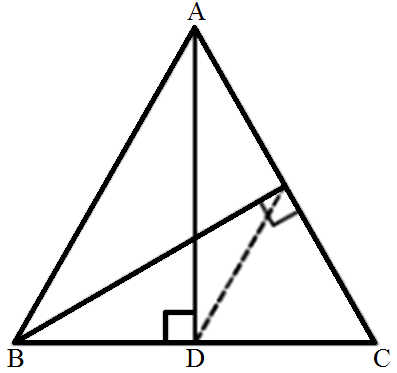 Given: $\triangle\text{ABC}$ in which AD and BE are altitudes on sides BC and AC respectively.
Since $\angle\text{ADB}=\angle\text{AEB}=90^\circ,$ there must be a circle passing through point D and E having AB as diameter.
We also know that, angle in a semi-circle is a right angle.
Now, join DE.
So ABDE is a cyclic quadrilateral with AB being the diameter of the circle.
$\angle\text{A}+\angle\text{BDE}=180^\circ$ [Opposite angles in a cyclic quadrilateral are supplementary]
$\Rightarrow\angle\text{A}+(\angle\text{BDA}+\angle\text{ADE})=180^\circ$
$\Rightarrow\angle\text{BDA}+\angle\text{ADE}=180^\circ-\angle\text{A}\ ....(1)$
Again
$\angle\text{BDA}+\angle\text{ADC}=180^\circ$ [Linear pair]
$\Rightarrow\angle\text{BDA}+\angle\text{ADE}+\angle\text{EDC}=180^\circ$
$\Rightarrow\angle\text{BDA}+\angle\text{ADE}=180^\circ-\angle\text{EDC}\ \ ...(2)$
Equating (1) and (2), we get
$180^\circ-\angle\text{A}=180^\circ-\angle\text{EDC}$
$\Rightarrow\angle\text{A}=\angle\text{EDC}$
Similarly, $\angle\text{B}=\angle\text{CED}$
Now, in $\triangle\text{ABC}$ and $\triangle\text{DEC}$, we have
$\angle\text{A}=\angle\text{EDC}$
$\angle\text{B}=\angle\text{CED}$
$\angle\text{C}=\angle\text{C}$
$\therefore\triangle\text{ABC}\sim\triangle\text{DEC}$
$\Rightarrow\frac{\text{Area of }\triangle\text{DEC}}{\text{Area of }\triangle\text{ABC}}=\Big(\frac{\text{DC}}{\text{AC}}\Big)^2$ View full question & answer→Question 184 Marks
$ABCD$ is a square. $F$ is the mid-point of $AB. BE$ is one third of $BC.$ If the area of $\triangle\text{FBE}=108\text{cm}^2,$ find the length of $AC.$
Answer
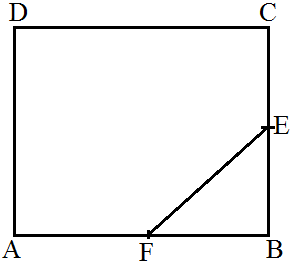
We have,
$\text{BE}=\frac{1}{3}\text{BC},\ \ \text{AF}=\text{FB}=\frac{1}{2}\text{AB}$
$\text{AB} = \text{BC} = \text{AC} = \text{AD}$ (sides of square)
In $\triangle\text{FBE},$
Area $(\triangle\text{FBE})=\frac{1}{2}\times\text{EB}\times\text{FB}$
$=\frac{1}{2}\times\frac{1}{3}\text{AC}\times\frac{1}{2}\text{AB}=\frac{1}{12}\text{AC}\times\text{AB}$
$108=\frac{1}{12}\text{AC}\times\text{AB}$
$\text{AC}\times\text{AB}=108\times12\text{cm}^2\ \ ...(1)$
Area $($square $ABCD) = ($side$)^2$
$=\text{AB}^2$
$=\text{AB}\times\text{AC}\ \ ...(2)$
From $(1)$ and $(2)$
$108\times12 = \text{AB}^2$
$\text{AB}=36\text{cm}$
Now. in $\triangle\text{ABC},$
$\text{AC}^2=\text{AB}^2+\text{BC}^2$
$\text{AC}^2=(36)^2+(36)^2$
$\text{AC}^2=2\times(36)^2$
$\text{AC}=\sqrt{2(36)^2}$
$\text{AC}=36\sqrt{2}\text{cm}$
$\text{AC}=36\times1.414$
$\text{AC}=50.904$
Thus, $\text{AC} = 50.90\text{cm.}$ View full question & answer→Question 194 Marks
ABCD is a quadrilateral in which AD = BC. If P, Q, R, S be the mid-points of AB, AC, CD and BD respectively, show that PQRS is a rhombus.
AnswerGiven: In quadrilateral ABCD, AD = BC
P, Q, R and S are the mid points of AB, AC, CD and AD respectively
PQ, QR, RS, SP are joined
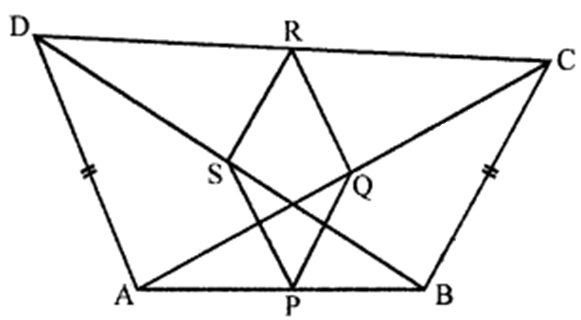
To prove: PQRS is a rhombus
Proof: In $\triangle\text{ABC},$
P and Q are mid points of AB and AC
$\therefore\text{PQ}||\text{BC and }\frac{1}{2}\text{BC}\ ....(\text{i})$
Similarly in $\triangle\text{ABD},$
P and S are mid points of AB and BD
$\therefore\text{PS}||\text{AD and }\frac{1}{2}\text{AD}\ ....(\text{ii})$
From (i) and (ii)
$\text{PQ} = \text{PS}\ \ \ \ \ \ \ \ (\text{AD} = \text{BC})$
Similarly $\text{QR}=\text{SR}=\Big(\frac{1}{2}\text{BC or AD}\Big)$
$\therefore$ PQ = QR = RS = PS
$\therefore$ PQRS is a rhombus. View full question & answer→Question 204 Marks
A vertical stick 10cm long casts a shadow 8cm long. At the same time a tower casts a shadow 30m long. Determine the height of the tower.
Answer
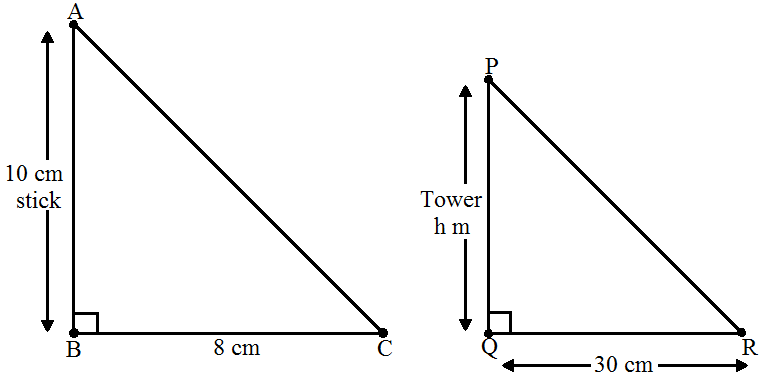 Length of stick = 10cm
Length of shadow of stick = 8cm
Length of shadow of tower = h cm
In $\triangle\text{ABC}$ and $\triangle\text{PQR}$
$\angle\text{B}=\angle\text{Q}=90^\circ$
And, $\angle\text{C}=\angle\text{R}$ [Angular elevation of sum]
Then, $\triangle\text{ABC}\sim\triangle\text{PQR}$ [By AA similarity]
$\therefore\frac{\text{AB}}{\text{PQ}}=\frac{\text{BC}}{\text{QR}}$
$\Rightarrow\frac{10\text{cm}}{8\text{cm}}=\frac{\text{h cm}}{3000}$
$\Rightarrow\text{h}=\frac{10}{8}\times3000=3750\text{cm}=37.5\text{m}$ View full question & answer→Question 214 Marks
In the figures given below, an altitude is drawn to the hypotenuse by a right-angled triangle. The length of different line-segment are marked in figure. Determine $x, y, z$ in case.
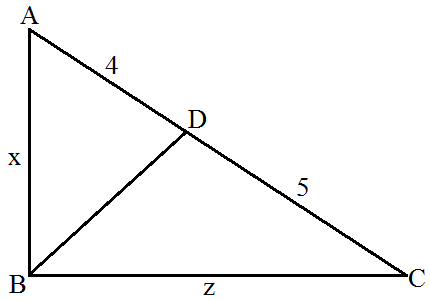
Answer$\triangle\text{ABC}$ is right angled triangle right angled at $B$
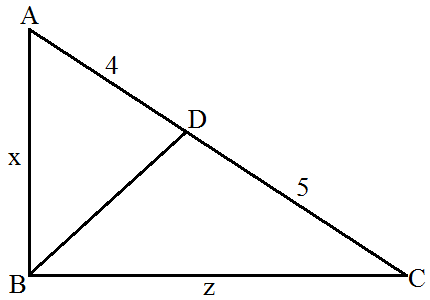
$AB^2 + BC^2 = AC^2$
$x^2 + z^2 = (4 + 5)^2$
$x^2 + z^2 = 9^2$
$x^2 + z^2 = 81 .......(i)$
$\triangle\text{BDA}$ is right triangle right angled at $D$
$BD2 + AD2 = AB2$
$y^2 + 4^2 = x^2$
$y^2 + 16 = x^2$
$16 = x^2 - y^2 .......(ii)$
$\triangle\text{BDC}$ is right triangle right angled at $D$
$BD^2 + DC^2 = BC^2$
$y^2 + 25 = z^2$
$25 = z^2 - y^2 ......(iii)$
By canceling equation $(i)$ and $(ii)$ by elimination method, we get
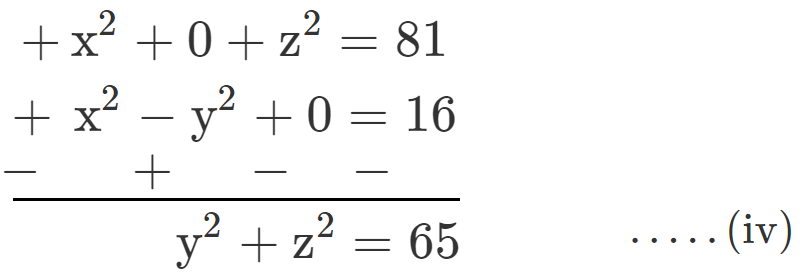
y canceling and by elimination method we get,
$\ \text{z}^2-\text{y}^2=25$
$\underline{\ \text{z}^2+\text{y}^2=65}$
$2\text{z}^2\ \ \ \ \ \ \ \ =90$
$\text{z}^2=\frac{90}{2}$
$\text{z}^2=45$
$\text{z}=\sqrt{45}$
$\text{z}=\sqrt{3\times3\times5}$
$\text{z}=3\sqrt{5}$
Now, substituting $z^2 = 45$ in equation $(iv)$ we get
$y^2 + z^2 = 65$
$y^2 + 45 = 65$
$y^2 = 65 - 45$
$y^2 = 20$
$\text{y}=\sqrt{20}$
$\text{y}=\sqrt{2\times2\times5}$
$\text{y}=2\sqrt{5}$
Now, substituting $y^2 = 20$ in equation $(ii)$ we get,
$x^2 - y^2 = 16$
$x^2 - 20 = 16$
$x^2 = 16 + 20$
$x^2 = 36$
$\text{x}=\sqrt{36}$
$\text{x}=\sqrt{6\times6}$
$\text{x}=6$
Hence the values of $\text{x, y, z}$ is $6,2\sqrt{5},3\sqrt{5}.$ View full question & answer→Question 224 Marks
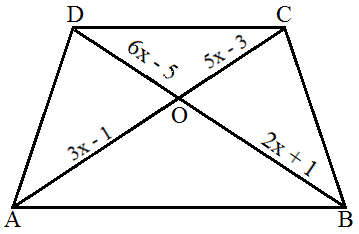
In the given figure, if $AB || CD$. find the value of $x$
.
AnswerIn the below fig., If $AB || CD$, find the value of $x$.
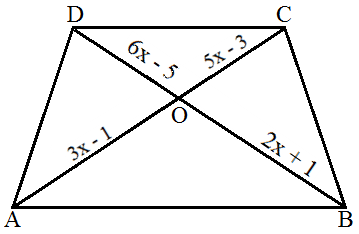
$\Rightarrow\frac{3\text{x}-1}{5\text{x}-3}=\frac{2\text{x}+1}{6\text{x}-5}$
$\Rightarrow (3x - 1)(6x - 5) = (2x + 1)(5x - 3)$
$\Rightarrow 3x(6x - 5) -1(6x - 5) = 2x(5x - 3) +1(5x - 3)$
$\Rightarrow 18x^2 - 15x - 6x + 5 = 10x^2 - 6x + 5x - 3$
$\Rightarrow 8x^2 - 20x + 8 = 0 \Rightarrow 4(2x^2 - 5x + 2) = 0$
$\Rightarrow 2x^2 - 4x - 1x + 2 = 0 \Rightarrow 2x(x - 2) - 1(x - 2) = 0$
$\Rightarrow (2x - 1)(x - 2) = 0 \Rightarrow 2x - 1 = 0$ or $x - 2 = 0$
$\Rightarrow\text{x}=\frac{1}{2}\ \text{or x}=2$ $\text{x}=\frac{1}{2}$ is not possible,
because, $OC = 5x - 3$ $=5\Big(\frac{1}{2}\Big)-3$ $=\frac{5-6}{2}=-\frac{1}{2}$ View full question & answer→Question 234 Marks
In $\triangle\text{ABC},\ \angle\text{A}$ is obtuse, $\text{PB}\perp\text{AC}$ and $\text{QC}\perp\text{AB}$ Prove that:
$BC^2 = (AC \times CP + AB \times BQ)$
Answer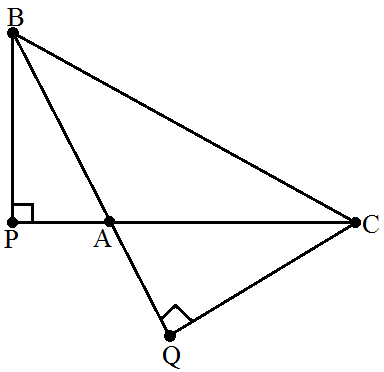
In $\triangle\text{BPC},$ by pythagoras theorem
$BC^2 = BP^2 + PC^2$
$\Rightarrow BC^2 = AB^2 - AP^2 + (AP + AC)^2 [$By pythagoras theorem$]$
$\Rightarrow BC^2 = AB^2 + AC^2 + 2AP \times AC .....(ii)$
In $\triangle\text{BQC},$ by pythagoras theorem,
$BC^2 = CQ^2 + BQ^2$
$\Rightarrow BC^2 = AC^2 - AQ^2 + (AB + AQ)^2 [$By pythagoras theorem$]$
$\Rightarrow BC^2 = AC^2 - AQ^2 + AB^2 + AQ^2 + 2AB \times AQ$
$\Rightarrow BC^2 = AC^2 + AB^2 + 2AB \times AQ ....(iii)$
Add equations $ (ii)\ \&\ (iii)$
$2BC^2 = 2AC^2 + 2AB^2 + 2AP \times AC + 2AB \times AQ$
$\Rightarrow 2BC^2 = 2AC^2 + 2AB^2 + 2AP \times AC + 2AB \times AQ$
$\Rightarrow 2BC^2 = 2AC[AC + AP] + AB[AB + AQ]$
$\Rightarrow 2BC^2 = 2AC \times PC + 2AB \times BQ$
$\Rightarrow BC^2 = AC \times PC + AB \times BQ [$Divide by $2]$ View full question & answer→Question 244 Marks
In the figures given below, an altitude is drawn to the hypotenuse by a right-angled triangle. The length of different line-segment are marked in figure. Determine $x, y, z$ in case.
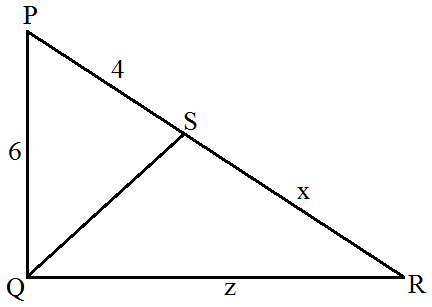
Answer$\triangle\text{PQR}$ is a right triangle, right angled at $Q$
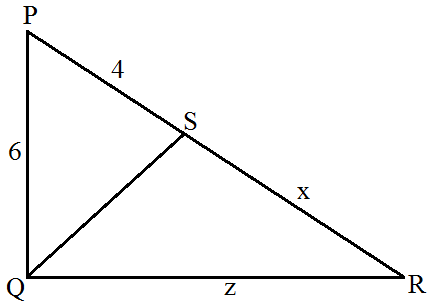
$6 + z2 = (4 + x)2$
$36 + z2 = 16 + x2 + 8x$
$z2 - x2 - 8x = 16 - 36$
$z2 - x2 - 8x = -20 ........(i)$
$\triangle\text{QSP}$ is a right triangle right angled at $S$
$QS^2 + PS^2 = PQ^2$
$y^2 + 4^2 = 6^2$
$y^2 + 16 = 36$
$y^2 = 36 - 16$
$y^2 = 20$
$\text{y}=\sqrt{20}$
$\text{y}=\sqrt{2\times2\times5}$
$\text{y}=2\sqrt{5}$
$\triangle\text{QSR}$ is a right triangle right angled at $S$
$QS^2 + RS^2 = QR^2$
$y^2 + x^2 = z^2 ......(ii)$
Now substituting $y^2 + x^2 = z^2 $ in equation $(i)$ we get
$y^2 + x^2 - x^2 - 8x = -20$
$y^2 + x^2 - x^2 - 8x = -20$
$y^2 - 8x = -20 .......(iii)$
Now substituting $y^2 = 20$ in equation $(iii)$ we get
$y^2 - 8x = -20$
$20 - 8x = -20$
$-8x = -20 - 20$
$-8x = -40$
$\text{x}=\frac{40}{8}$
$\text{x}=5$
Now substituting $x = 5$ and $y^2 = 20$ in equation $(ii)$ we get
$y^2 + x^2 = z^2$
$20 + 5^2 = z^2$
$20 + 25 = z^2$
$45 = z^2$^
$\sqrt{3\times3\times5}=\text{z}^2$
$3\sqrt{5}=\text{z}$
Hence the value of $x, y$ and $z$ are $5,2\sqrt{5},3\sqrt{5}.$ View full question & answer→Question 254 Marks
In $\triangle\text{ABC},$ P and Q are points on sides AB and AC respectively such that PQ || BC. If AP = 4cm, PB = 6cm and PQ = 3cm, determine BC.
AnswerIn $\triangle\text{ABC},$ P and Q are points on AB and AC respectively such that PQ || BC AP = 4cm, PB = 6cm, PQ = 3cm
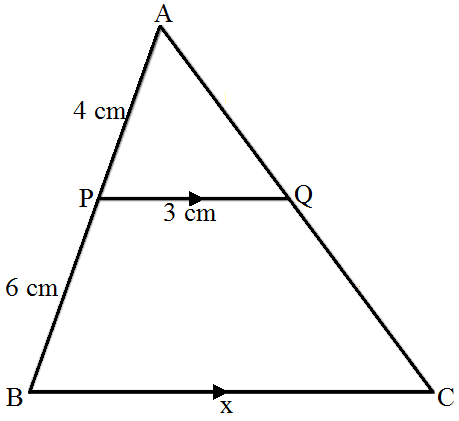
Let BC = x cm
$\because$ PQ || BC
$\therefore\triangle\text{APQ}\sim\triangle\text{ABC}$
$\therefore\frac{\text{AP}}{\text{AB}}=\frac{\text{AQ}}{\text{AC}}=\frac{\text{PQ}}{\text{BC}}$
$\Rightarrow\frac{\text{AP}}{\text{AP}+\text{PB}}=\frac{\text{PQ}}{\text{BC}}$
$\Rightarrow\frac{4}{4+6}=\frac{3}{\text{x}}\Rightarrow\frac{4}{10}=\frac{3}{\text{x}}$
$\Rightarrow\text{x}=\frac{10\times3}{4}=\frac{15}{2}$
$\therefore\text{BC}=\frac{15}{2}\text{cm}=7.5\text{cm}$ View full question & answer→Question 264 Marks
The areas of two similar triangles are $121\ cm^2$ and $64\ cm^2$ respectively. If the median of the first triangle is 12.1cm, find the corresponding median of the other.
Answer
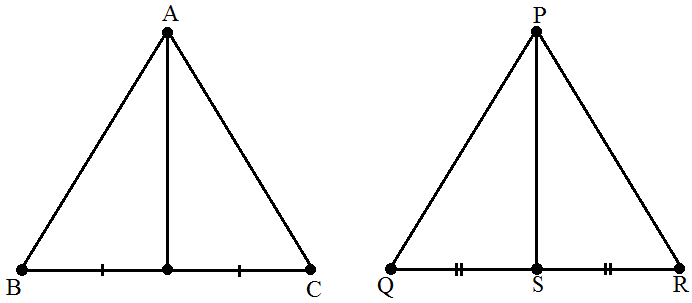
We have,
$\triangle\text{ABC}\sim\triangle\text{PQR}$
Area $(\triangle\text{ABC})= 121\ cm^2,$
Area $(\triangle\text{PQR}) = 64\ cm^2$
$AD = 12.1\ cm$
And AD and PS are the medians
By area of similar triangle theorem
$\frac{\text{Area}(\triangle\text{ABC})}{\text{Area}(\triangle\text{PQR})}=\frac{\text{AB}^2}{\text{PQ}^2}$
$\Rightarrow\frac{121}{64}=\frac{\text{AB}^2}{\text{PQ}^2}$
$\Rightarrow\frac{11}{8}=\frac{\text{AB}}{\text{PQ}}\ \ ...(\text{i})$
Since, $\triangle\text{ABC}\sim\triangle\text{PQR}$
Then, $\frac{\text{AB}}{\text{PQ}}=\frac{\text{BC}}{\text{QR}}$ [Corresponding parts of similar $\triangle$ are proportional]
$\Rightarrow\frac{\text{AB}}{\text{PQ}}=\frac{\text{2BD}}{\text{2QS}}$ [AD and PS are medians]
$\Rightarrow\frac{\text{AB}}{\text{PQ}}=\frac{\text{BD}}{\text{QS}}\ \ ...(\text{ii})$
In $\triangle\text{ABD}$ and $\triangle\text{PQS}$
$\angle\text{B}=\angle\text{Q}\ \ \ \ [\triangle\text{ABC}\sim\triangle\text{PQS}]$
$\frac{\text{AB}}{\text{PQ}}=\frac{\text{BD}}{\text{QS}}$ [From (ii)]
Then, $\triangle\text{ABD}\sim\triangle\text{PQS}$ [By SAS similarity]
$\therefore\frac{\text{AB}}{\text{PQ}}=\frac{\text{AD}}{\text{PS}}\ \ \ ...\text{(iii)}$ [Corresponding parts of similar $\triangle$ are proportional]
Compare (i) and (iii)
$\frac{11}{8}=\frac{\text{AD}}{\text{PS}}$
$\Rightarrow\frac{11}{8}=\frac{12.1}{\text{PS}}$
$\Rightarrow\text{PS}=\frac{8\times12.1}{\text{PS}}=8.8\text{cm}$ View full question & answer→Question 274 Marks
In the given figure, $\angle\text{B}<90^\circ$ and segment $\text{AD}\perp\text{BC}$ show that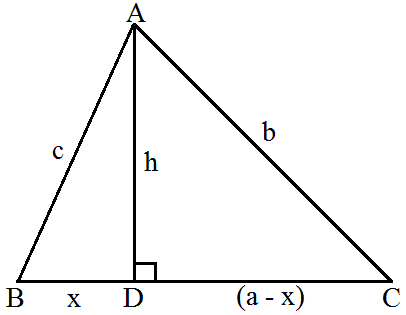
- $b^2 = h^2 + a^2 + x^2 - 2ax$
- $b^2 = a^2 + c^2 - 2ax$
Answer
- Since $AD$ perpendicular to $BC$ we obtained two right angled triangles, triangle $ADB$ and triangle $ADC.$
We will use Pythagoras theorem in the right angled triangle $ADC$
$AC^2 = AD^2 + DC^2 ....(1)$
Let us substitute $AD = h, AC = b$ and $DC = (a - x)$ in equation $(1)$ we get,
$b^2 = h^2 + (a - x)^2$
$b^2 = h^2 + a^2 - 2ax + x^2$
$b^2 = h^2 + a^2 + x^2 - 2ax .....(2)$
- Let us use Pythagoras theorem in the right angled triangle ADB as shown below,
$AB^2 = AD^2 + BD^2 .....(3)$
Let us substitute $AB = c, AD = h$ and $BD = x$ in equation $(3)$ we get,
$c^2 = h^2 + x^2$^
Let us rewrite the equation $(2)$ as below,
$b^2 = h^2 + x^2 + a^2 - 2ax .....(4)$
Now we will substitute $h^2 + x^2 = c^2 $ in equation $(4)$ we get,
$b^2 = c^2 + a^2 - 2ax$
Therefore, $b^2 = c^2 + a^2 - 2ax.$ View full question & answer→Question 284 Marks
D is the mid-point of side BC of a $\triangle\text{ABC}.$ AD is bisected at the point E and BE produced cuts AC at the point X. Prove that BE = EX = 3 : 1.
AnswerGiven: ABC is a triangle in which D is the mid point of BC, E is the mid point of AD, BE produced meets AC at X. To Prove: BE : EX = 3 : 1. Construction: We draw a line DY parallel to BX. 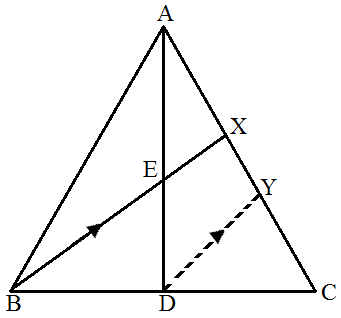 Prrof:
In $\triangle\text{BCX}$ and $\triangle\text{DCY,}$ $\angle\text{CBX}=\angle\text{CDY}$ (Corresponding angles) $\angle\text{CXB}=\angle\text{CYD}$ (Corresponding angles) $\triangle\text{BCX}\sim\triangle\text{DCY}$ (AA similarity) We know that corresponding sides of similar triangles are proportional. Thus, $\frac{\text{BC}}{\text{DC}}=\frac{\text{BX}}{\text{DY}}=\frac{\text{CX}}{\text{CY}}$ $\Rightarrow\frac{\text{BX}}{\text{DY}}=\frac{\text{BC}}{\text{DC}}$ $\Rightarrow\frac{\text{BX}}{\text{DY}}=\frac{2\text{DC}}{\text{DC}}$ (As D is the mid point of BC) $\Rightarrow\frac{\text{BX}}{\text{DY}}=\frac{2}{1}\ ....(1)$ In $\triangle\text{AEX}$ and $\triangle\text{ADY,}$ $\angle\text{AEX}=\angle\text{ADY}$ (Corresponding angles) $\angle\text{AXE}=\angle\text{AYD}$ (Corresponding angles) $\triangle\text{AEX}\sim\triangle\text{ADY}$ (AA similarity) We know that corresponding sides of similar triangles are proportional. Thus, $\frac{\text{AE}}{\text{AD}}=\frac{\text{EX}}{\text{DY}}=\frac{\text{AX}}{\text{AY}}$ $\Rightarrow\frac{\text{EX}}{\text{DY}}=\frac{\text{AE}}{\text{AD}}$ $\Rightarrow\frac{\text{EX}}{\text{DY}}=\frac{\text{AE}}{2\text{AE}}$ (As D is the mid point of BC) $\Rightarrow\frac{\text{EX}}{\text{DY}}=\frac{1}{2}\ ...(2)$ Dividing (1) by (2), we get $\frac{\text{BX}}{\text{EX}}=4$ $\Rightarrow\text{BX}=4\text{EX}$ $\Rightarrow\text{BE}+\text{EX}=4\text{EX}$ $\Rightarrow\text{BE}=3\text{EX}$ $\Rightarrow\text{BE}:\text{EX}=3:1$ View full question & answer→Question 294 Marks
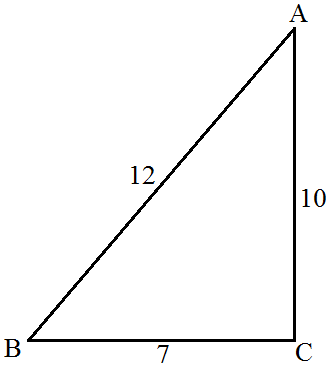
In the given figure, given that $\triangle\text{ABC}\sim\triangle\text{PQR}$ and quad ABCD ∼ quad PQRS. Determine the value of x, y, z in each case.
-
-
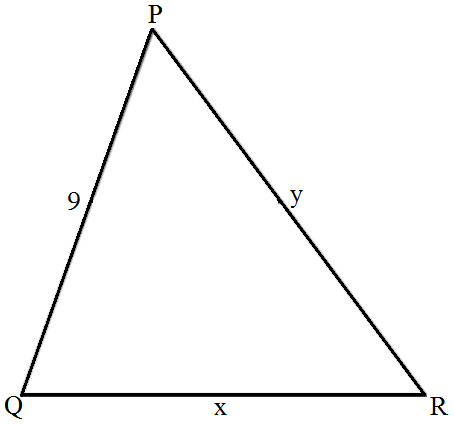
-
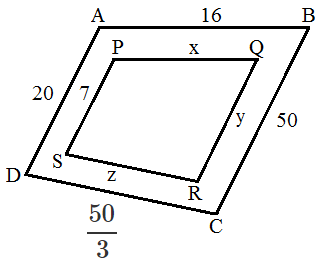
Answer
- We have, $\triangle\text{ABC}\sim\triangle\text{PQR}$
So the ratio of the sides of the triangles will be proportional to each other.
$\frac{\text{AB}}{\text{PQ}}=\frac{\text{BC}}{\text{QR}}=\frac{\text{AC}}{\text{PR}}$
Therefore put the values of the known terms in the above equation to get,
$\frac{12}{9}=\frac{7}{\text{x}}=\frac{10}{\text{y}}$
On solving these simultaneous equations, we get
$\text{x}=\frac{21}{4}$
$\text{y}=\frac{30}{4}$
- We have, $\Box\text{ABCD}\sim\Box\text{PQRS}$
So the ratio of the sides of the quadrilaterals will be proportional to each other.
$\frac{\text{AB}}{\text{PQ}}=\frac{\text{BC}}{\text{QR}}=\frac{\text{CD}}{\text{RS}}=\frac{\text{DA}}{\text{SP}}$
Therefore put the values of the known terms in the above equation to get,
$\frac{20}{7}=\frac{16}{\text{x}}=\frac{50}{\text{y}}=\frac{50}{3\text{z}}$
On solving these simultaneous equations, we get
$\text{x}=\frac{28}{5}$
$\text{y}=\frac{35}{2}$
$\text{z}=\frac{35}{6}$ View full question & answer→Question 304 Marks
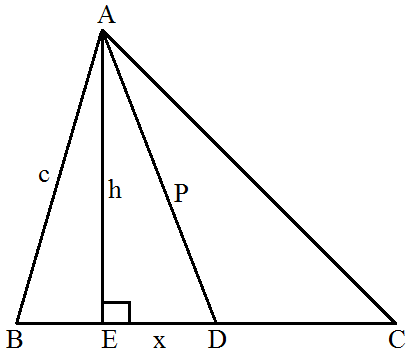
In the given figure, $D$ is the mid-point of side $BC$ and $\text{AE}\perp\text{BC}.$ If $BC = a, AC = b, AB = c, ED = x, AD = p$ and $AE = h$, prove that:
- $\text{b}^2=\text{p}^2+\text{ax}+\frac{\text{a}^2}{4}$
- $\text{c}^2=\text{p}^2-\text{ax}+\frac{\text{a}^2}{4}$
- $\text{b}^2+\text{c}^2=2\text{p}^2+\frac{\text{a}^2}{4}$
AnswerGiven: In $\triangle\text{ABC},$ AD is median of BC and $\text{AE}\perp\text{BC}$
$AB = c, BC = a, CA = b ED = x, AD = p, AE = h.$
To prove:
- $\text{b}^2=\text{p}^2+\text{ax}+\frac{\text{a}^2}{4}$
- $\text{c}^2=\text{p}^2-\text{ax}+\frac{\text{a}^2}{4}$
- $\text{b}^2+\text{c}^2=2\text{p}^2+\frac{\text{a}^2}{4}$
Proof: In right $\triangle\text{AEC},$
- $AC^2 = AE^2 + EC^2 ($pythagoras theorem$)$
$AC^2 = AE^2 + (ED + DC)^2$
$\text{b}^2=\text{h}^2+\Big(\text{x}+\frac{1}{2}\text{a}\Big)^2$
$(D$ is mid-points of $BC)$
$=\text{h}^2+\text{x}^2+\text{ax}+\frac{\text{a}^2}{4}\ \ ....(\text{i})$
But in right $\triangle\text{AED},$
$AD^2 = AE^2 + ED^2$
$p^2 = h^2 + x^2 ......(ii)$
$\therefore\text{b}^2=\text{p}^2+\text{ax}+\frac{\text{a}^2}{4}$
- Similarly in right $\triangle\text{AEB},$
$AB^2 = AE^2 + BE^2$
$\Rightarrow AB^2 = AE^2 + (BD - ED)^2$
$\Rightarrow\text{c}^2=\text{h}^2+\Big(\frac{\text{1}}{2}\text{BC}-\text{x}\Big)^2$
$\Rightarrow\text{c}^2=\text{h}^2+\Big(\frac{\text{a}}{2}-\text{x}\Big)^2$
$\Rightarrow\text{c}^2=\text{h}^2+\text{x}^2+\frac{\text{a}^2}{4}-\text{ax}$
$\Rightarrow\text{c}^2=\text{p}^2-\text{ax}+\frac{\text{a}^2}{4}\ \ \ [\because\text{From (ii)}]$
- Adding results of $(i)$ and $(ii)$
$\text{b}^2+\text{c}^2=\text{p}^2+\text{ax}+\frac{\text{a}^2}{4}+\text{p}^2-\text{ax}+\frac{\text{a}^2}{4}$
$=2\text{p}^2+2\times\frac{\text{a}^2}{4}=2\text{p}^2+\frac{\text{a}^2}{2}$
Hence proved. View full question & answer→