Questions

Answer the following questions: [2 M]

Take a timed test

38 questions · self-marked practice — reveal the answer and mark yourself.

Question 12 Marks
Why is the use of iodised salt advisable?
Answer
Iodine is necessary for the thyroid gland to make thyroxine hormone which regulates the metabolism of carbohydrates, fats and proteins so as to produce the best balance for the growth. Iodised salt is advisable as it contains appropriate amounts of iodine compounds needed by the thyroid gland to make sufficient thyroxine hormone for the body and hence goitre disease can be prevented.
View full question & answer
Question 22 Marks
Why is the folding up of the leaves of a sensitive plant on touching with a finger not a tropism?
Answer
The folding of leaves of a sensitive plant is not a case of tropism (like thigmotropism) because in this case the direction of movement of leaves does not depend on the direction of stimulus (touch).
View full question & answer
Question 32 Marks
What is meant by nastic movements in plants? Give one example of nastic movements in plants.
Answer
The movement of a plant part in response to an external stimulus in which the direction of response is not determined by the direction of stimulus is called nastic movement. Example: The folding up of the leaves of a sensitive plant on touching is an example of thigmonasty.
View full question & answer
Question 42 Marks
What is meant by receptors and effectors? Give two examples of each.
Answer
A receptor is a cell (or a group of cells) in a sense organ which is sensitive to a particular type of stimulus (or a particular type of change in the environment). Example: Photoreceptors and Phonoreceptors.An effecter is the part of the body which can respond to the stimulus according to the instructions sent from the nervous system (spinal cord and brain). Example: Muscles and glands.
View full question & answer
Question 52 Marks
What is a tendril? Name the two types of tendrils. What does a tendril do in response to the touch of a support ? What is this phenomenon known as?
Answer
Tendrils are the thin, thread-like growths on the stems or leaves of climbing plants. The two types of tendrils are stem tendrils and leaf tendrils. The tendrils grow towards the things they happen to touch. This phenomenon is known as thigmotropism.
View full question & answer
Question 62 Marks
What is the difference between photonasty and thigmonasty?
Answer
Photonasty
Thigmonasty
The non-directional movement of a plant part (usually petals of flowers) in response to light is called photonasty.
Example: The opening and closing of petals of dandelion flowers in response to the intensity of light.
The non-directional movement of a plant part in response to the touch of an object is called thigmonasty.
Example: In Mimosa pudica plant, the leaves fold up in response to touch.
View full question & answer
Question 72 Marks
Plant parts show two types of movements, one dependent on growth and the other independent of growth. Give one example of the movement in plant parts:
  1. Which depends on growth.
  2. Which does not depend on growth.
Answer
  1. Bending of stem towards light.
  2. Folding up of leaves of a sensitive plant on touching.
View full question & answer
Question 82 Marks
What is the function of insulin hormone? What type of patients are given insulin injections?
Answer
The function of insulin hormone is to lower the blood sugar level (or blood glucose level). People having severe diabetes are treated by giving injections of insulin.
View full question & answer
Question 92 Marks
How do hormones reach the organs they control?
Answer
The endocrine glands do not have ducts to secrete their hormones. They release hormones directly into the blood of a person and reach the concerned body part through the blood and act on it.
View full question & answer
Question 102 Marks
What happens to the dendelion flower
  1. During daytime, and
  2. At night ? What is this phenomenon known as?
Answer
  1. A dandelion flower opens up in the morning in bright light. This phenomenon is known is positive photonasty.
  2. At night, the dandelion flower closes and this phenomenon is known as negative photonasty.
View full question & answer
Question 112 Marks
How are involuntary actions and reflex actions different from each other?
Answer
Reflex Action
Involuntary Action
It is a rapid, automatic response to a stimulus which is not under the voluntary control of the brain.
Example: Sneezing, coughing.
Those actions which do not need thinking and are not performed by us knowingiy are called involuntary action.
Example: Digestion, respiration.
View full question & answer
Question 122 Marks
What is autonomic nervous system? What is its function?
Answer
Autonomic nervous system means self governing nervous system. Its function is to control and regulate the functions of the internal organs of our body involuntarily.
View full question & answer
Question 132 Marks
When the leaves of a sensitive plant are touched with a finger, they fold up and when light fades at dusk, the petals of a dandelion flower close.
  1. State one way in which the above two processes are similar.
  2. State two ways in which the above two processes differ.
Answer
  1. Both the processes are similar as the response is not determined by the direction of the stimulus. They are nastic movement.
  2. The first process of folding up of leaf is thigmonastic and the stimulus is touch. The second process of closing of petals is photonastic and the stimulus is light.
View full question & answer
Question 142 Marks
A piece of thread was tied tightly around an animal's pancreatic duct. The animal subsequently had difficulty in digesting food but did not get diabetes. Explain.
Answer
When a piece of thread is tightly tied around an animal’s pancreatic duct, the pancreatic juice containing digestive enzymes will not be able to reach the small intestine. The pancreatic juice contains enzymes which help in the digestion of food. In its absence (due to the blockage of the pancreatic duct), the animal would have difficulty in digesting certain food substances.
However, the pancreas being an endocrine gland releases insulin directly into the blood. Since, the main function of insulin is to maintain the blood sugar level in the body; the animal will not suffer from diabetes.
View full question & answer
Question 152 Marks
Explain why the tongue may be considered as both a receptor and an effector organ.
Answer
Receptors are sensory structures (organs/ tissues/ cells) that detect changes in the environment, which are called stimuli, and turn them into electrical impulses to be transferred to the brain. The tongue has taste buds which can detect chemicals in food and identify taste. Hence, it is considered as receptor. Effector is an organ that responds to stimulus. The tongue is a muscular organ that can respond to a stimulus. Hence, it is also considered as an effector organ.
View full question & answer
Question 162 Marks
Define thigmotropism. Give one example of thigmotropism.
Answer
The directional growth movement of a plant part in response to the touch of an object is called thigmotropism. Example: Tendrils grow towards any support which they happen to touch and wind around it.
View full question & answer
Question 172 Marks
Distinguish between tropic movements and nastic movements in plants. Give examples to illustrate your answer.
Answer
Tropic movements:
  1. These movements are always in the direction of the stimulus.
  2. These movements are slow.
  3. These movements are exhibited by all parts of a plant. For example, movement of shoot towards the light and not towards gravity.
Nastic movements:
  1. These movements are neither away nor towards the stimulus.
  2. These movements are fast.
  3. These movements are exhibited by the flat organs (like leaves and petals of flowers) of a plant. For example, the bending and drooping of leaves in ‘Touch-me-not’ plant.
View full question & answer
Question 182 Marks
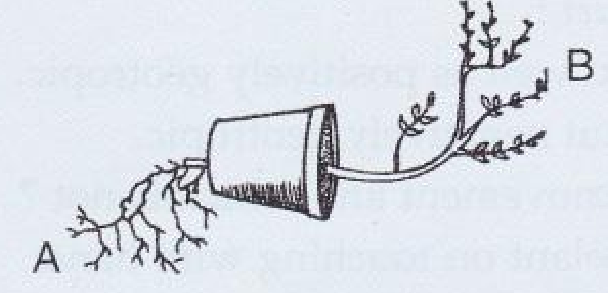
A potted plant having straight parts A and B was placed horizontally on its side as shown in figure (i). After a few days it was observed that the parts A and B of the plant acquire new positions as shown in Figure (ii).
  1. Name the phenomenon exhibited by the position of plant parts A and B in Figure (ii).
  2. Name the stimulus (other than sunlight) which causes plant part A to grow and bend upwards, and plant part B to bend downwards.
Answer
  1. The phenomenon exhibited by the positions of plant parts A and B is geotropism.
  2. The stimulus which causes plant part A to grow and bend upwards and part B to bend downwards is gravity.
View full question & answer
Question 192 Marks
What happens to the moonflower
  1. During daytime, and
  2. At night ? What is this phenomenon known as?
Answer
  1. During the daytime the petals of moon flower close when there is bright light.
  2. At night, when it is dark the petals of moon flower opens up. This phenomenon is known as photonasty.
View full question & answer
Question 202 Marks
What are the various sense organs in our body?
Answer
There are 5 sense organs: Eyes, ears, nose, tongue and skin.
View full question & answer
Question 212 Marks
Define phototropism. Give one example of phototropism.
Answer
Phototropism – The movement of a plant part in response to light is called phototropism.
Example - Stem bends towards the light is positive phototropism.
View full question & answer
Question 222 Marks
What is meant by ‘tropisms’ (or tropic movements)? Explain with an example.
Answer
A growth movement ofa plant part in response to an external stimulus in which the direction of stimulus determines the direction of response is called tropism. Example – The bending of plant stem towards light is an example of positive phototropism.
View full question & answer
Question 232 Marks
What does CNS stand for? Which part of CNS:
  1. Consists of two cerebral hemispheres, and
  2. Has spinal nerves attached to it?
Answer
CNS – Central nervous system.
  1. Cerebrum.
  2. Spinal cord.
View full question & answer
Question 242 Marks
Name the five types of tropisms. How are tropic movements helpful to plants? Explain with an example.
Answer
The five types of tropisms are: Phototropism, Geotropism, Chemotropism, Hydrotropism and Thigmotropism. The various types of tropic movements help the plants to survive. Example even if a seed is planted upside down, its root will grow downwards into earth because it is positively geotropic.
View full question & answer
Question 252 Marks
Define geotropism. Give one example of geotropism.
Answer
The movement of plant part in response to gravity is called geotropism. Example – Roots grow towards gravity.
View full question & answer
Question 262 Marks
What is the function of our nervous system?
Answer
  1. The function of the nervous system is to coordinate the activities of our body.
  2. It helps all other systems of our body to work together.
  3. It receives information from the surroundings, processes it, interprets it and then responds accordingly.
View full question & answer
Question 272 Marks
Define chemotropism. Give one example of chemotropism. State whether this example is of positive chemotropism or negative chemotropism.
Answer
The growth of a plant part due to chemical stimulus is known as chemotropism. For example the growth of pollen tube towards the ovule induced by a sugary substance as stimulus. This is an example of positive chemotropism.
View full question & answer
Question 292 Marks
Write the functions of testosterone and oestrogen hormones.
Answer
The function of testosterone hormone is to control the development of male sex organs and male features such as deeper voice, moustache, body hairs etc. The function of oestrogen is to control the development of female sex organs and female features such as feminine voice, soft skin and mammary glands.
View full question & answer
Question 302 Marks
Write the names of the regions in hindbrain. Give one function of each region.
Answer
Hindbrain has 3 regions:
  1. Pons:
It takes part in regulating respiration.
  1. Cerebellum:
​​​​​​​It helps in maintaining posture and balance of the body. It enables us to make precise and accurate movements.
  1. Medulla:
​​​​​​​The medulla controls various involuntary actions such as heart beat, breathing, blood pressure and peristaltic movements of the elementary canal. It is also the controlling centre for reflexes such a swallowing, coughing, sneezing, secretion of saliva and vomiting.
View full question & answer
Question 312 Marks
Name the functions of cerebrum.
Answer
Function of cerebrum: It is the main thinking part of the brain. It is the site of our faculties such as learning, reasoning, intelligence, personality and memory. All our thoughts, sensation, actions and movements are controlled by cerebrum.
View full question & answer
Question 322 Marks
Give the functions of medulla.
Answer
The medulla controls various involuntary actions such as heart beat, breathing, blood pressure and peristaltic movements of the elementary canal. It is also the controlling centre for reflexes such a swallowing, coughing, sneezing, secretion of saliva and vomiting.
View full question & answer
Question 332 Marks
What is spinal cord? What is its main function?
Answer
Spinal cord is a cylindrical structure which begins in continuation with medulla and extends downwards. Its function is the conduction of nerve impulses to and from the brain and it is concerned with spinal reflex actions.
View full question & answer
Question 342 Marks
What is the function of receptors and effectors in our body?
Answer
Receptors are the special cells present in our sense organs which detect all the information from our environment and feed it to the nervous system. An effector responds to electrical impulses sent from the nervous system through motor nerves.
View full question & answer
Question 352 Marks
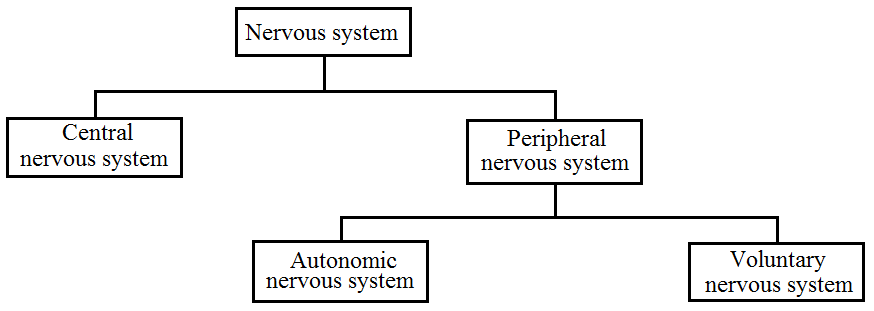
Draw a flow chart to show the classification of nervous system into various parts.
Answer
The classification of nervous into various parts is given in the following chart:
View full question & answer
Question 362 Marks
How does the human nervous system work? Explain.
Answer
When the sense organ in our body is affected, it sends the message to the brain in the form of electrical impulses through the sensory neurons. The brain analyses this message and decides the action to be taken. The brain then sends out instructions to the muscles of the concerned body parts through motor nerves and the concerned body part acts accordingly.
View full question & answer
Question 372 Marks
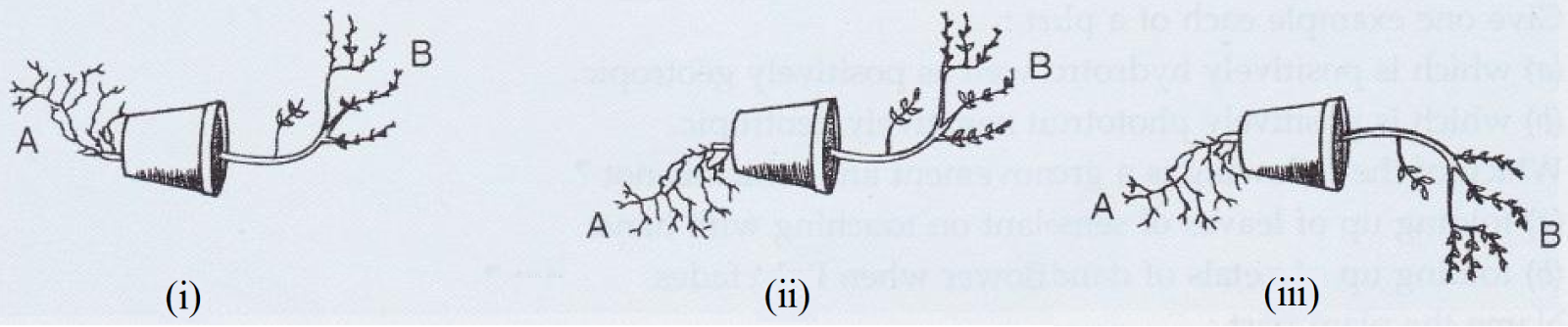
A potted plant is kept horizontally for a considerable time the position of the part A and B of the potted plant are shown in the following figures:
  1. Which figure shows the correct position taken by the parts A and B of the plant?
  2. What type of phenomenon is exhibited by the figure chosen in (a) above?
Answer
  1. Figure(ii)
  1. Geotropism.
View full question & answer
Question 382 Marks
Why is the closing of a dandelion flower at dusk (when it gets dark) not a tropism?
Answer
The closing of a dandelion flower at dusk (when it gets dark) is not a tropism because the direction of movement of petals of dandelion flower does not depend on the direction of stimulus (light).
View full question & answer