Questions

Answer the following questions: [3 M]

Take a timed test

19 questions · self-marked practice — reveal the answer and mark yourself.

Question 13 Marks
What is the difference between a reflex action and walking?
Answer
Reflex action
Walking
It is a rapid, automatic response to a stimulus which is not under the voluntary control of the brain. It is a kind of involuntary action which involves the spinal cord. It is not based on our thinking.
It is a voluntary action which we undertake knowingly. The action of walking involves thinking by the brain. The central nervous system (brain, spinal cord) take part in the action of walking.
View full question & answer
Question 23 Marks
How does control and coordination take place in plants? How does it differ from that in animals?
Answer
The plants do not have a nervous system but they can sense things in the presence of stimuli such as light, touch, water etc. and respond to them by the action of hormones. Thus, the plants coordinate their behavior against environmental behavior by using organic chemicals called hormones. This is called chemical coordination. The hormones in plants coordinate their behavior by affecting the growth of a part of the plant resulting in the movement of that plant part in response to a stimulus. The control and coordination in animals takes place by both nervous system and hormones.
View full question & answer
Question 33 Marks
The human brain can be broadly divided into three regions. Name these three regions.
Answer
The 3 regions of human brain are:
  1. Forebrain.
  2. Midbrain and
  3. Hindbrain.
View full question & answer
Question 43 Marks
P, Q, R and S are four major types of phytohormones. P is a phytohormone which functions mainly as a growth inhibitor. It promotes the wilting and falling of leaves. Q, R and S are phytohormones which all promote growth of plants in various ways. Q is responsible for the phenomenon of phototropism in plants. R is involved mainly in shoot extensions. The phytohormone S helps in breaking the dormancy of seeds and buds. What are P, Q, R and S? Give one reason each for your choice.
Answer
P is abscisic acid because it is antagonistic to growth and inhibits it.
Q is auxin because it causes bending of shoots towards the light.
R is gibberellins because it increases the cell division in a plant shoot and increases its length. S is cytokinin because it breaks the dormancy of buds and seeds.
View full question & answer
Question 53 Marks
What is the difference between a voluntary and an involuntary action? Which kind of action is digestion? Explain your choice.
Answer
Voluntary Action
Involuntary Action
Those action which need think and are performed by us knowingly are called voluntary action. Explanation: Writing, dancing.
Those actios which do not need thinking and are not performed by us knowingly are called involuntary action. Example: Digestion, respiration.
Digestion is an involuntary action as it does not involve the thinking process and is performed unknowingly by our digestive system.
View full question & answer
Question 63 Marks
In what ways are puberty and adolescence result of the activity of some glands in the human body?
Answer
Puberty and adolescence are the results of sex glands in human beings. In males, testes make male sex hormones called testosterone which is associated with male puberty, which the boys attain an age of 13 - 14 years. In females the oestrogen hormone is responsible for all the changes associated with female puberty which the girl attains at an age of 10 - 12 years.
View full question & answer
Question 73 Marks
How do we detect the smell of an incense stick (agarbatti)?
Answer
When the agarbatti burns, it produces vapours having a characteristic pleasant smell which is detected by the olfactory receptors present inside our nose. The action of smell of agarbatti or receptors sets off chemical reactions which generate electrical impulses. The sensory neurons carry these electric al impulses to the sensory area of fore brain called cerebrum. This makes us detect the smell of burning agarbatti.
View full question & answer
Question 83 Marks
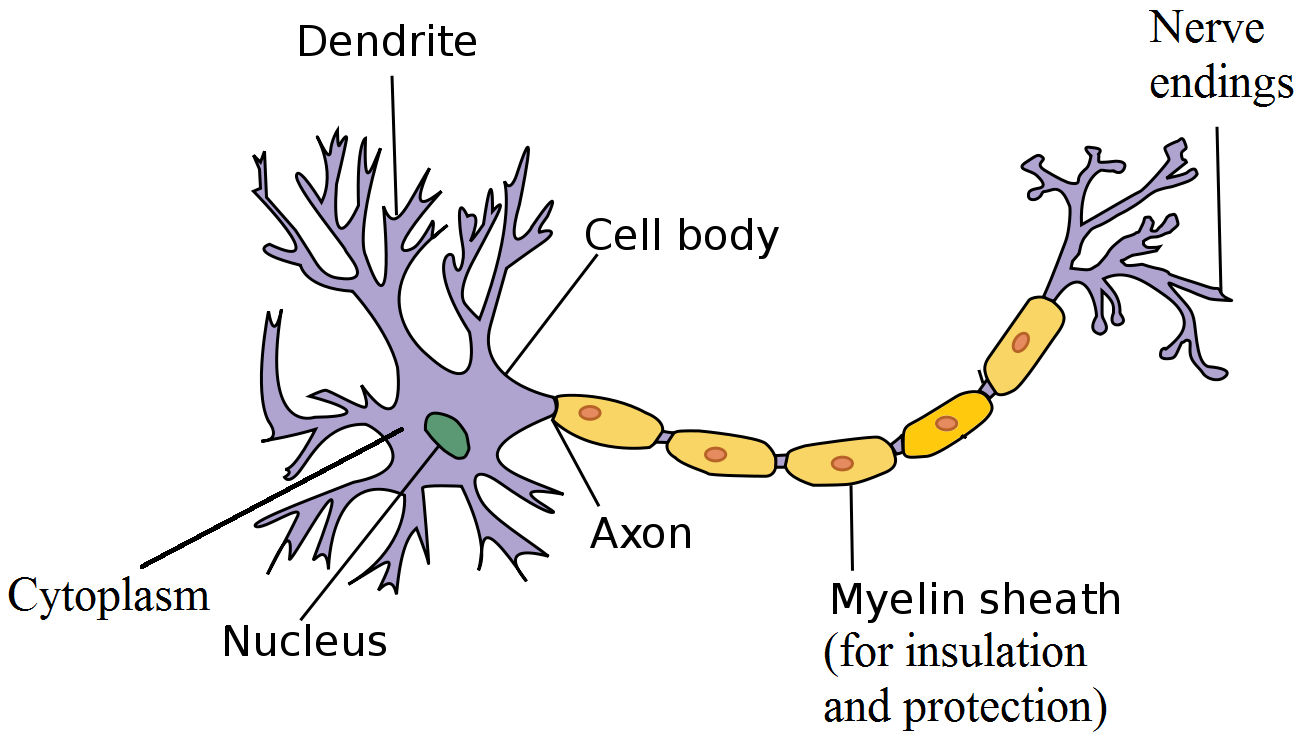
What is a neuron? Draw a labelled diagram of a neuron.
Answer
The unit which makes up the nervous system is called a neuron.

A neuron (or nerve cell).
View full question & answer
Question 93 Marks
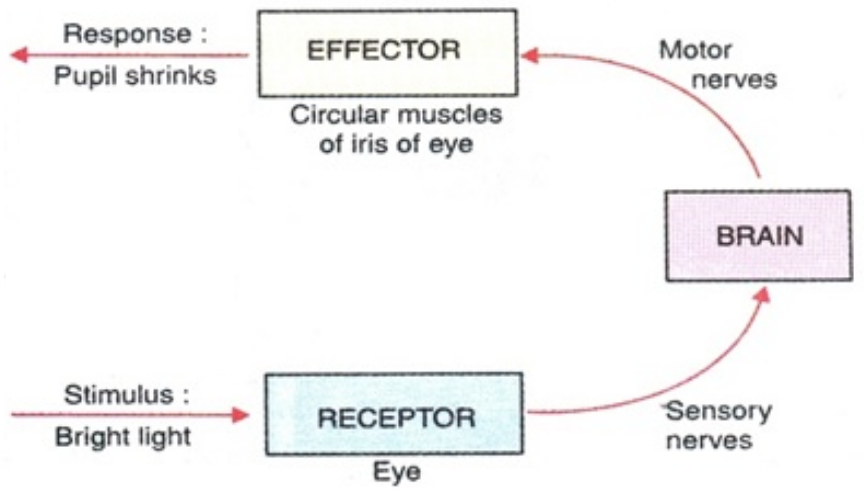
What is voluntary nervous system? Explain the working of voluntary nervous system with an example.
Answer
The voluntary nervous system is a system which helps us to take voluntary actions which are under the conscious control of the brain.
Example: If a student is getting late for school and sees his watch. He starts walking fast. In this process, the eyes see the time and send the information to the brain through the sensory nerves. The brain analyses the information and sends the instructions to walk faster to the muscle of our legs through the motor nerves. The muscles of the legs act accordingly and make the student walk faster.
View full question & answer
Question 103 Marks
What is meant by positive tropism and negative tropism? Explain with examples.
Answer
The growth of a plant part in response to a stimulus is called positive tropism and if the growth of a plant part is away from the stimulus, then it is called negative tropism. Example: The roots of a plant go towards earth in response to gravity is an example of positive geotropism whereas stem grows away from earth against gravity is an example of negative geotropism.
View full question & answer
Question 113 Marks
How do tropisms differ from nasties (or nastic movements)?
Answer
Tropisms:
  1. These movements are always in the direction of the stimulus.
  2. These movements are slow.
  3. These movements are exhibited by all parts of a plant. For example, movement of shoot towards the light and not towards.
Nasties:
  1. These movements are neither away nor towards the stimulus.
  2. These movements are fast.
  3. These movements are exhibited by the flat organs (like leaves and petals of flowers) of a plant. For example, the bending and dropping of leaves in ‘Touch-me-not’ plant.
View full question & answer
Question 123 Marks
How does chemical coordination take place in human beings?
Answer
The chemical coordination in animals takes place through the actions of chemicals called hormones which are release directly into the blood and are carried by the blood circulatory system to other parts of the body. Hormones travel all over the body but affect only particular organs at particular places which are called target organs. The organs control and coordinate several functions of animal body such as growth, development, metabolism, behavior and secondary sexual characteristics, etc.
View full question & answer
Question 133 Marks
A person walks across a room in barefeet and puts his foot on a drawing pin lying on the floor. He lets out a cry. Explain what happens in his nervous system in bringing about this response.
Answer
It is an example of reflex action. The stimulus here is drawing pin lying on the floor. The pain is sensed by the receptors in the skin which triggers and impulse in a sensory neuron and transmits the message to the spinal cord. The impulse is passed onto a relay neuron, which in turn, passes it to the motor neuron. The motor neuron passes the impulse to a muscle in the feet. The muscle then contracts and pulls our feet away from the drawing pin.
View full question & answer
Question 143 Marks
How does our body respond when adrenaline is secreted in large amounts into the blood?
Answer
The adrenaline hormone prepares our body to function at maximum efficiency during emergency situations like danger, anger etc. This adrenaline hormone increases our heartbeat, breathing rate, blood flow into muscles and causes liver to put more stored glucose into our blood. All these actions produce a lot of energy in our body and help us to cope up the emergency situations. Thus, when adrenaline is secreted in large amounts it prepares our body for action.
View full question & answer
Question 153 Marks
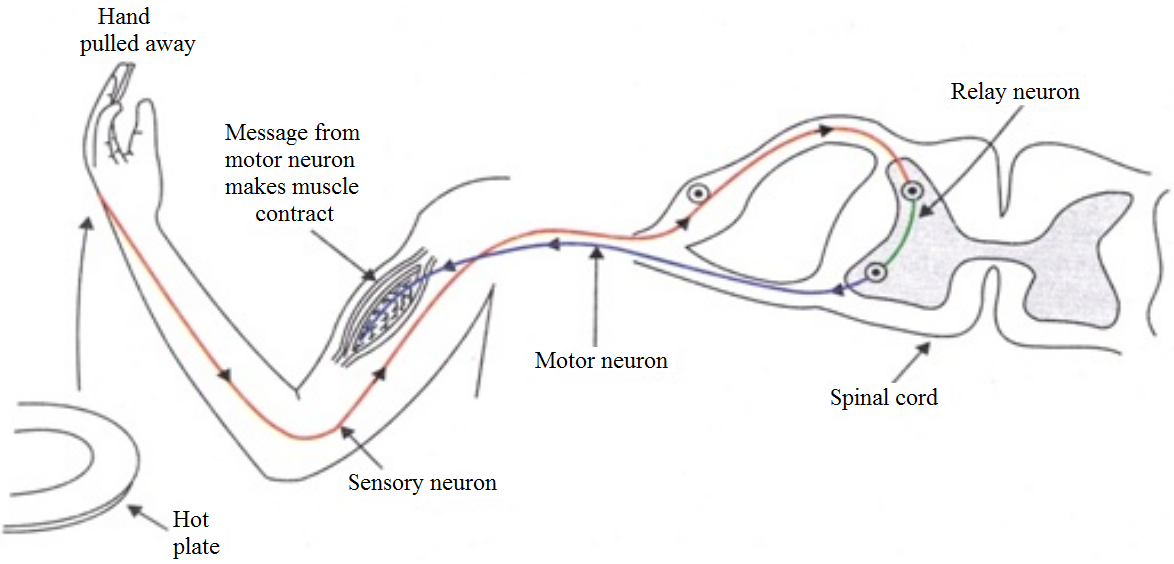
Define reflex arc. Give the flow chart of a spinal reflex arc.
Answer
The pathway taken by the never impulses in our reflex action is called the reflex arc.

A reflex are (This is actually a spinal reflex are).
View full question & answer
Question 163 Marks
What is the difference between thigmotropism and thigmonasty? Name one plant which exhibits thigmotropism and one plant which exhibits thigmonasty. What behaviour (or responses) of these plants make you think that they exhibit thigmotropism and thigmonasty respectively?
Answer
Thigmotropism
Thimonasty
The directional growth movement of a plant touch of an object is called thigmotropism. Example: Tendrils.
The non-directional movement of a plant part in responce to the touch of an object is called thigmonasty. Example: Mimosapudica.
Tendrils grow towards a stimulus hence it is a directional movement which shows that it is a case of thigmotropism whereas, the folding of leaves in mimosa plant does not depend on the direction of stimulus (touch) which shows that it is an example of thigmonasty.
View full question & answer
Question 173 Marks
What is meant by positive phototropism and negative phototropism? Give one example of each type.
Answer
The movement of a plant part towards light is called positive phototropism. Example? the stem of the growing bends towards light. The movement of a plant part away from light is called negative phototropism. Example? The roots of a plant move away from light.
View full question & answer
Question 183 Marks
What is a reflex action? Explain with the help of an example.
Answer
The rapid, automatic response to a stimulus which is not under the voluntary action of the brain is called reflex action. Example: Moving our hand away on touching a hot plate.
View full question & answer
Question 193 Marks
Compare the nervous system and endocrine system (hormonal system) for control and coordination in humans.
Answer
Nervous System It is a system to coordinate the activities of bodies. It helps all other system of our body to work together. It receives information from the surroundings, processes it, interprets it and then responds accordingly. Endocrine System It is a group of endocrine glands which produces various hormones that helps in coordinating the activities of our body. The hormones produced by the endocrine glands act as messengers between the nervous system and the organs of our body.
View full question & answer